ACTA
UNIVERSITATIS
UPSALIENSIS
UPPSALA
2015
Digital Comprehensive Summaries of Uppsala Dissertations
from the Faculty of Medicine 1123
Towards Good Palliation for
Children with Cancer
Recognizing the Family and the Value of
Communication
LI JALMSELL
ISSN 1651-6206
ISBN 978-91-554-9291-5
urn:nbn:se:uu:diva-259409
Dissertation presented at Uppsala University to be publicly examined in A1:111a, BMC,
Husargatan 3, Uppsala, Friday, 25 September 2015 at 09:00 for the degree of Doctor of
Philosophy (Faculty of Medicine). The examination will be conducted in English. Faculty
examiner: Associate Professor Steven Joffe (University of Pennsylvania School of Medicine,
Department of Medical Ethics and Health Policy).
Abstract
Jalmsell, L. 2015. Towards Good Palliation for Children with Cancer. Recognizing the
Family and the Value of Communication. Digital Comprehensive Summaries of Uppsala
Dissertations from the Faculty of Medicine 1123. 73 pp. Uppsala: Acta Universitatis
Upsaliensis. ISBN 978-91-554-9291-5.
Pediatric cancer imposes a threat on the child’s life and approximately every fifth child
diagnosed with cancer will die due to his or her disease. The overall aim of this thesis was to
explore palliative care of children with cancer and bereaved family members. The thesis includes
data collected retrospectively from medical records, a nationwide questionnaire directed to
bereaved parents, a nationwide questionnaire for bereaved siblings and individual interviews
with children in cancer care.
Most children dying from cancer were recognized as being beyond cure at time of death;
for some this recognition occurred close to death, leaving little time for potential personal
preferences (Paper I). Bereaved parents and siblings noticed extensive suffering in the child
close to death (Paper II, VI), with physical fatigue being the most commonly reported symptom
irrespectively of age and diagnosis of the child (Paper II). Bereaved parents’ psychological well-
being appears to be closely related to experiencing suffering in the dying child (Paper III) but
also to high-intensity treatment (with bone marrow transplant as the example) of a child that
still dies from his or her disease (Paper IV). Bereaved siblings experience a lack in information
at the end of their brother’s or sister’s life and report feeling poorly prepared for the loss. An
increased risk of anxiety was seen in siblings whom nobody talked to about what to expect at
the time of death of their brother or sister (Paper VI). When caring for children with cancer
it is vital to take the individual child’s awareness and preferences regarding information into
consideration. Bereaved parents who have communicated with their child about death expressed
that this often occurred at the child’s own initiative (Paper V) and simple means such as fairy
tales could be used to facilitate communication. Ill children themselves expressed in interviews
wanting honest, but still hopeful information regarding bad news (Paper VII).
The results of this thesis stress the importance of striving to achieve good communication
and keeping a family perspective throughout care of children with cancer.
Keywords: palliative care, child, cancer, family, communication, end-of-life care, bereavement
Li Jalmsell, Centre for Research Ethics and Bioethics, Box 564, Uppsala University, SE-751
22 Uppsala, Sweden.
© Li Jalmsell 2015
ISSN 1651-6206
ISBN 978-91-554-9291-5
urn:nbn:se:uu:diva-259409 (http://urn.kb.se/resolve?urn=urn:nbn:se:uu:diva-259409)
 
To	
  my	
  fabulous	
  family	
  
Fredrik,	
  Hannah,	
  Hugo	
  &	
  Henry	
  
On ne voit bien qu’avec le cœur.
L’essentiel est invisible pour les yeux.
Antoine de Saint-Exupéry
List of Papers
This thesis is based on the following papers:
I Jalmsell L., Forslund M., Hansson M.G., Henter J.I., Kreicbergs U.,
Frost B.M. (2013) Transition to non-curative end of life care in
pediatric oncology – a nationwide follow-up. Acta Paediatrica
102(7):744-748
II Jalmsell L., Kreicbergs U., Onelöv E., Steineck G., Henter J.I.
(2006) Symptoms affecting children with malignancies during the
last month of life: a nationwide follow-up. Pediatrics, 117(4):1314-
1320
III Jalmsell L., Kreicbergs U., Onelöv E., Steineck G., Henter J.I.
(2010) Anxiety is contagious: symptoms of anxiety in the terminally
ill child affect long-term psychological well-being in bereaved par-
ents. Pediatric Blood and Cancer 54(5):751-757
IV Jalmsell L., Onelöv E., Steineck G., Henter J.I., Kreicbergs U.
(2011) Hematopoietic stem cell transplantation in children with
cancer and the risk of long-term psychological morbidity in bereaved
parents. Bone Marrow Transplantation 46(8):1063-1070
V Jalmsell L., Kontio T., Stein M., Henter J.I., Kreicbergs U. (2015)
On the child’s own initiative: Parents communicate with their dying
child about death. Death Studies 39(2):111-117
VI Lövgren M., Jalmsell L., Eilegård A., Steineck G., Kreicbergs U.
(2015) Siblings’ experience of the brother’s or sister’s cancer death:
a nationwide follow-up 2-9 years later. Psycho-Oncology, E-
published ahead of print August 12th
, 2015
VII Jalmsell L., Frost B.M., Hansson M.G., Henter J.I., Kreicbergs U.,
Lövgren M. Tell the truth but leave room for hope - children with
cancer share their views on receiving bad news. Manuscript
Reprints were made with permission from the respective publishers.
Contents
Personal reflections .......................................................................................11	
  
Acknowledging that children die ..................................................................13	
  
Childhood cancer......................................................................................13	
  
Childhood cancer – a global perspective .............................................14	
  
Palliative care ...........................................................................................14	
  
Cornerstones in palliative care .................................................................16	
  
Easing of symptoms and suffering.......................................................16	
  
Cooperation in the multiprofessional team..........................................17	
  
Communication and relationships........................................................17	
  
Support to close relatives.....................................................................18	
  
The child in the midst of the family .........................................................19	
  
Rationale...................................................................................................20	
  
Aims ..............................................................................................................22	
  
Ethical considerations ...................................................................................23	
  
Methods.........................................................................................................26	
  
Is there an age-limit to being a child?.......................................................26	
  
Paper I: Review of medical records..........................................................27	
  
Paper II-V: Questionnaire for bereaved parents.......................................28	
  
Paper VI: Questionnaire for bereaved siblings.........................................31	
  
Paper VII: Interviews with ill children.....................................................33	
  
Summary of papers........................................................................................35	
  
Paper I: Characteristics of end-of-life care...............................................35	
  
Paper II: Suffering at the end of life.........................................................35	
  
Paper III: Parental well-being and experienced suffering in the child .....37	
  
Paper IV: Well-being of parents whose child went through HSCT .........38	
  
Paper V: Parent–child communication about death .................................40	
  
Paper VI: Siblings’ experiences ...............................................................42	
  
Paper VII: The child’s thoughts on receiving bad news...........................42	
  
Key findings..................................................................................................44	
  
Discussion of key findings............................................................................45	
  
Family relations matter ........................................................................46	
  
The importance of communication ......................................................47	
  
Pediatric palliative care ............................................................................50	
  
Methodological considerations .....................................................................53	
  
Concluding remarks and future research.......................................................56	
  
Svensk sammanfattning (Swedish summary) ...............................................58	
  
Acknowledgements.......................................................................................61	
  
References.....................................................................................................63	
  
Appendix 1: Pediatric oncology units in Sweden .........................................71	
  
Appendix 2: WHO definition of palliative care............................................72	
  
Appendix 3: Narratives .................................................................................73	
  
Abbreviations
CES-D Center for Epidemiological Studies Depression Scale
CI Confidence interval
HADS Hospital Anxiety and Depression Scale
HCP Health care practitioners
HSCT Hematopoietic stem cell transplantation
NOPHO Nordic Society of Paediatric Haematology and Oncology
RR Relative risk
SIOP International Society of Paediatric Oncology
STAI-T State-Trait Anxiety Inventory
VDS Visual digital scale
WHO World Health Organization


11
Personal reflections
When I was accepted into medical school, I had a clear idea about what I
wanted to be when I graduated. I wanted to work with families. In my mind
I pictured working with autistic children (or children with some other kind
of mental disability) and their families. However, early on I realized that I
was even more fascinated by somatic illnesses and especially the trauma that
affects the family when one of its members fell ill, trauma that was further
accentuated if the illness posed an immediate threat to that individual’s life.
During my rotation in hematology blood cells and chemotherapy caught my
attention and new treatments like “antibodies” and “targeted drugs” sounded
almost magical. So, I adjusted my plan for the future: about halfway into
med school I knew that I wanted to be a pediatric oncologist when I “grew-
up”. They got to work with severely ill children together with the families
and were faced with the challenge of possible death and subsequently be-
reaved family members.
For me, the journey that in the end led to this thesis started after a seminar in
pediatric oncology. I had been looking forward to that seminar since I first
laid eyes on it in the lecture plan. Imagine my disappointment when it turned
out that there were cases to prepare, and that I hadn’t done so. I was abso-
lutely sure that I hadn’t received any papers in advance, and although our
supervisor was initially skeptical, my fellow students backed me up (I had
been an ambitious student so far), and defended me. The seminar was orga-
nized by Jan-Inge Henter, and we began talking after the seminar. Jan-Inge
probably realized what was at the root of my disappointment and I expressed
my interest in meeting the whole family and possibly finding ways in which
individual family members could be supported during their difficult journey
and even after the possible death of the child. As it turned out, he had an
ongoing project regarding bereaved parents and I was invited to see if any of
the research appealed to me. I got to meet Ulrika Kreicbergs (at the time a
PhD student close to defending her thesis) and was given the opportunity to
work with her material. The following summer my journey into the scientific
world began. One could have imagined that I should have stayed and fin-
ished a thesis then and there, but somehow life got in the way. My mother,
who some years earlier had been diagnosed with breast cancer, found out
that her disease had now metastasized and somehow this made me think
differently about research. I wanted to meet real patients and learn to be a
12
good clinician. I moved to Visby to do my internship at a smaller hospital to
get as much clinical experience as possible and also to be forced to take
challenging decisions as a young physician on call. During my internship my
mother died and my clinical work became even more important to me; thus I
put all my ambitions on continuing with my research on hold.
I finished my internship and continued with my clinical work at the com-
bined oncology and palliative unit (for adult patients). However, as part of
my residency I had to revisit the university hospital in Stockholm. Back
again, research started growing on me, and luckily my supervisors had not
given up hope on me and welcomed me back. (Thank you!) However, I had
abandoned the idea of continuing exclusively with material about bereaved
parents. I wanted to pair data from parents with reports from clinicians, other
family members and most definitely from the children themselves.
At a conference in Sandhamn on ethics and end-of-life decisions I came in
contact with Britt-Marie Frost, pediatric oncologist from Uppsala, and Mats
Hansson, medical ethicist who shared my interest in pediatric palliative care.
In addition, they had decided to take on a PhD student to explore the area
and were kind enough to invite me to the Centre for Research Ethics & Bio-
ethics (CRB) at Uppsala University where I finally embarked on the PhD
journey in earnest. (Thank you!) Although CRB embraces a diverse group of
researchers and PhD students, the interest in ethical issues arising in differ-
ent parts of medicine unites all the co-workers, and I felt that my project had
found its rightful home. I’m grateful you let me come aboard, even with the
bumpy ride of my research career so far. It would have been easier for you if
you had found a PhD student who could have just “worked” for four years
without all my detours…
Still, life and clinical work tend to get in the way, and additional studies in
this thesis have had to compete with my wish to pursue a clinical career as
well as with my personal life. Marrying the man of my dreams (with dreams
of his own), and having three children together, has further delayed this
work, which at times has been hard to accept. However, life gives you per-
spective and I do believe that all that has happened has not only given me
perspectives on my own life but also on how I interpret data. I think that the
extended time, and all the obstacles and joys that lengthened the time it took
me to compose this thesis have made it better. It would not have been what it
is today, had I finished it earlier.


13
Acknowledging that children die
We’ll meet in Nangiyala1
In Western countries, the death of a child is rare, but even so, one must
acknowledge that not all children live into adulthood. In Sweden a total of
439 children below the age of 15 years died in 2012, approximately two
thirds of them during their first year of life.2
The most common causes of
infant mortality (death during the first year of life) are perinatal complica-
tions and severe congenital malformations. For children older than one year,
accidents and cancer are the most common causes of death.2,3
Children are expected to outlive their parents, and losing a child has been
described as one of the most stressful life-events possible.4,5
While accidents
are by definition unexpected, death due to cancer can often be foreseen and
if the possibility of death is acknowledged, the child as well as his or her
family can be encouraged to plan according to personal preferences. This,
together with the possibility of saying a proper farewell has been seen to
benefit bereaved family members years after their loss.6,7
Childhood cancer
In Sweden, approximately 300 children are diagnosed with cancer every
year. Leukemia and tumors in the central nervous system are the most com-
mon forms of childhood cancer and also represent the leading causes of
death from pediatric malignancies.8
Over the last fifty years, mortality due to
pediatric malignancies has decreased significantly but still approximately
one out of five children will die due to his or her disease, and mortality rates
are similar in most Western countries.9-13
Treatment in pediatric oncology, in Sweden, is provided according to treat-
ment protocols sanctioned by the Nordic Society of Paediatric Haematology
and Oncology (NOPHO).8
However, when it becomes evident that the child
is beyond cure, no protocol or national guidelines stipulate how to provide
optimal pediatric palliative care. Some clinics/departments have developed
regional guidelines but in many cases the clinicians must draw on their own
14
experiences to guide them through the care of the dying child and his or her
family.
Many families express a wish for end-of-life care to be given at home, in-
cluding the home as the desired place of death.14,15
Caring for the child at
home is the least disruptive to family life, and has been seen to give parents
a feeling of choice and control.16
Nonetheless, many children die in hospi-
tals, and there are studies reporting that the hospital is the place of death for
at least half of the children who die of cancer.17-20
In order for end-of-life
care to take place at home one has to accept the likelihood of death, which
permits the family to plan accordingly. The great number of children who
die in hospitals, contradictory to the expressed wishes, could partly be due to
a lack of recognizing the possibility of death, but also to cancer-directed
treatment being administered close to death. Another contributing factor
could be the poor availability of advanced home care for children.21
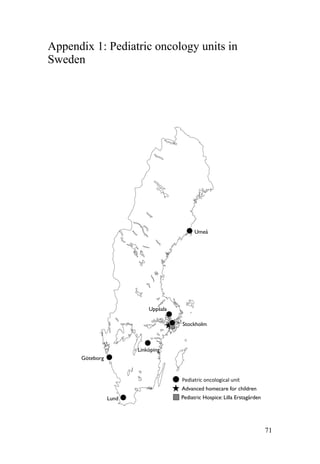
In Sweden, treatment for childhood cancers takes place at one of the coun-
try’s six pediatric oncological units, situated in Stockholm, Uppsala, Göte-
borg, Lund, Linköping and Umeå (Appendix 1). If a curative approach no
longer remains possible, care can often be transferred to a hospital closer to
home. However, there is only one formal service that provides advanced
home care for children and only one pediatric hospice; both of these are
located in the Stockholm area. In other parts of the country, the regular staff
giving advanced home care might or might not accept children as their pa-
tients, depending on the function they have been assigned.
Childhood cancer – a global perspective
Although this thesis focuses on Swedish conditions (similar to those in many
other Western countries) it should be noted that improving the conditions of
children diagnosed with cancer remains a global concern. Globally, approx-
imately 100 000 children are diagnosed with cancer each year and roughly
250 of them die per day.3
Most of these children die in low-income coun-
tries, and could have been cured, had adequate therapies been available.
Palliative care
“To cure sometimes, to comfort always, to hurt the least, to harm never.”
	
  
The ethical code of Hippocrates remains valid even though medical and
technical advances have improved the outcome of many diseases. Diagnoses
15
that used to mean certain death are now curable. Likewise, diseases that
were considered life-threatening merely decades ago are now considered
chronic conditions without necessarily shortening an expected lifespan.
Palliative care according to the World Health Organization (WHO) is “an
approach that improves the quality of life of patients and their families fac-
ing the problems associated with life-threatening illness, through the preven-
tion and relief of suffering by means of early identification and impeccable
assessment and treatment of pain and other problems, physical, psychologi-
cal and spiritual”.22
While palliative care traditionally has mainly been seen to include care of
the dying individual, the WHO definition of palliative care for children
(Appendix 2), states that it starts when a child receives a life-threatening
diagnosis.22
According to this definition, palliative care should be provided
to all children diagnosed with a cancer, irrespective of the expected out-
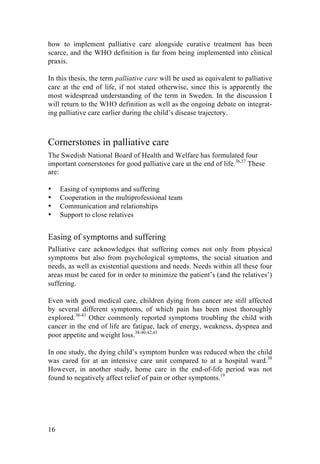
come. In line with these recommendations an integrated approach often is
advocated in favor of a traditional model where palliative care follows after
curative treatment when all hope of cure is gone (Figure 1).6,20,23-26
Figure 1. Traditional care model vs. model of integrated palliative care
However, this model is not yet routine in clinical praxis.24,27,28
Several barri-
ers have been suggested to contribute to this,24,25,29
including a lack of train-
ees in palliative medicine.27,30-32
In Sweden the medical specialty of pallia-
tive medicine was formalized only in May 2015, and it remains to be seen
how many pediatricians pursue this subspecialty. In addition, there is a lack
in consensus regarding the term palliative care,32,33
which for many is asso-
ciated exclusively with care of the dying individual, and hence an integrated
approach might seem strange.28,34,35
In Sweden, discussion of whether and
Diagnosis
Diagnosis
Your%
Title%
Here%Curative directed treatment
Traditional model
Diagnosis
Palliative care
Curative directed treatment
Palliative care
Focus on palliative values
Bereavement support
Bereavement support
Model of integrated
palliative care
Proposed model
Death
Death
Death
16
how to implement palliative care alongside curative treatment has been
scarce, and the WHO definition is far from being implemented into clinical
praxis.
In this thesis, the term palliative care will be used as equivalent to palliative
care at the end of life, if not stated otherwise, since this is apparently the
most widespread understanding of the term in Sweden. In the discussion I
will return to the WHO definition as well as the ongoing debate on integrat-
ing palliative care earlier during the child’s disease trajectory.
Cornerstones in palliative care
The Swedish National Board of Health and Welfare has formulated four
important cornerstones for good palliative care at the end of life.36,37
These
are:
• Easing of symptoms and suffering
• Cooperation in the multiprofessional team
• Communication and relationships
• Support to close relatives
Easing of symptoms and suffering
Palliative care acknowledges that suffering comes not only from physical
symptoms but also from psychological symptoms, the social situation and
needs, as well as existential questions and needs. Needs within all these four
areas must be cared for in order to minimize the patient’s (and the relatives’)
suffering.
Even with good medical care, children dying from cancer are still affected
by several different symptoms, of which pain has been most thoroughly
explored.38-43
Other commonly reported symptoms troubling the child with
cancer in the end of life are fatigue, lack of energy, weakness, dyspnea and
poor appetite and weight loss.38-40,42,43
In one study, the dying child’s symptom burden was reduced when the child
was cared for at an intensive care unit compared to at a hospital ward.38
However, in another study, home care in the end-of-life period was not
found to negatively affect relief of pain or other symptoms.19
17
Cooperation in the multiprofessional team
In order to provide best possible palliative care, it is important that the health
care system and the social services work together. Securing this collabora-
tion as well as a multiprofessional team that work together to resolve any
difficult situations the patient or his or her relatives encounter is central.37
The composition of the team might vary depending on the needs of the indi-
vidual patient; team members may include physicians, nurses, nurse’s aides,
physiotherapists, occupational therapists, psychologists, counselors, nutri-
tionists and priests, among others.
The clinical work can be organized in various ways. This will however not
be elaborated upon in this thesis.
Communication and relationships
Communication is the core of medicine. The ability to communicate openly
leads to better-informed patients, and improved psychological as well as
behavioral outcomes. It can also help a family adapt to a stressful and chal-
lenging situation. Communication is a key element in providing high quality
palliative care44,45
and improvements in communication are recognized as
one of the most important factors in enhancing end-of-life care in a pediatric
setting.46-48
Communication is vital not only between the health care practitioners (HCP)
and the child and his or her family, but also within the family and between
clinicians. Communication includes more that just delivering information.
Several persons can participate and the aim can be both to exchange infor-
mation, to develop mutual understanding, and to provide support. Good
communication is needed to secure adequate information from the patient
about his or her situation so that optimal treatment (e.g. pain relief) can be
provided, but may also in itself offer relief by giving guidance on how to
handle emotional distress or a difficult situation.37
Communication and the severely ill child
Historically, there was a general belief among physicians and parents that
children should not be informed about their cancer diagnosis. This attitude
began to shift during the 1970s, with new therapies, improved survival rates
and growing availability of psychosocial support services.49
Studies also
revealed that children were well aware of their illness, whether they had
been directly told or not, and that they were able to cope more effectively
when properly informed.47,50-55
Even though most physicians, in Western
countries, believe in telling children about their illness and prognosis,49
fam-
ily preferences and cultural values may disagree with this view.56
Most stud-
18
ies regarding communication around bad news in pediatric oncology focus
on interaction between physicians and parents and there is a lack on research
where the children themselves have been asked to share their preferences
and wishes.57
The need for new studies focusing on the ill child’s own per-
spective is highlighted in a recent review regarding communication barriers
in pediatric palliative care.58
Communication and close relatives
Having a child with a severe, potentially life-threatening illness forces the
family to recognize that life is not endless, and that even children might die.
Being told that one’s child is likely to die is undoubtedly one of the worst
fears of any parent, who may in addition be faced with the difficult task of
balancing the wish to keep the child alive as long as possible with the wish
to protect the child from unnecessary suffering.
In a study by Mack et al, the quality of communication with the physicians
was closely related to how bereaved parents rated their child’s end-of-life
care.59
Key elements parents considered important in physician communica-
tion were receiving clear information about what to expect during the end-
of-life period, attention to emotions, and an appropriate level of communica-
tion with both child and parent. They also expressed that it was important
that physicians communicated directly with the sick child, and not only with
the parents.60
Still, it is crucial to acknowledge that even though there is a
wish for difficult news to be delivered directly and honestly, the family
members of severely ill children usually want to be able to maintain hope,59
and leaving room for hope agrees with guidelines from the International
Society of Paediatric Oncology (SIOP).61
If and when the child gets worse, the parents have to choose if, when and
how to communicate about death with the child, and more specifically if and
how to communicate about the child’s own approaching death. In a study by
Kreicbergs et al, no parent who had talked to his or her child about death
was seen to regret this, whereas a quarter of the parents who had not talked
about death with their child regretted this later on.62
The study concludes
that HCPs might support families in talking about death at minimal risk of
causing long-term regrets, in particular if the child is aware of the approach-
ing death, but specific recommendations as to how this could be facilitated
are not presented.
Support to close relatives
Pediatric palliative care includes support to members of the ill child’s fami-
ly. According to WHO, this support starts at the time when the child is diag-
nosed with a life-threatening disease and continues following the child’s
19
death. The support needed varies between individuals as well as with time
and with the progression of the disease.37
Studies based on data from be-
reaved family members often conclude that there is a need for more infor-
mation and that parents as well as siblings often want an opportunity to be
included in decision-making and care-giving.63,64
Parents
Even though the overall prognosis for childhood malignancies is good the
individual outcome is always uncertain. When the child is diagnosed with
cancer, the parents are at risk of anticipatory grief65
with the recognition of
the possible separation to come.
Caring for severely ill patients is emotionally challenging and there are stud-
ies reporting that inadequate control of the patient’s symptoms affects the
psychological well-being of family members (as well as other caregivers).66-
69
Bereaved parents report longer-lasting and more intense grief reactions
than adults who have lost a spouse or a parent and they are at increased risk
of psychological morbidity (e.g. anxiety and depression) than peers.70-72
Several care-related factors have been seen to affect bereavement outcome
for parents66,69
and even though most parents express satisfaction with the
palliative care given to their child at the end of life, the need for improve-
ments is stressed repeatedly.42,59,60,73-75
Siblings
Siblings of children diagnosed with cancer are often described as being in-
visible. With both the parents and HCPs focusing on the ill child, the vulner-
ability of the healthy sibling is often overlooked.63,76
If and when the child’s
condition deteriorates and hope of cure is lost, parents have to balance their
own grief with continued care for the ill child and it is therefore not uncom-
mon that siblings experience a feeling of loneliness.64
Siblings are exposed to their brother’s or sister’s physical and emotional
suffering during treatment as well as the parent’s grief both before and after
the loss. Moreover, parents have been seen to withhold information about
the ill brother or sister in an attempt to spare the siblings from worry or pain,
which results in anxiety and depression in the siblings who are left alone
with their thoughts and worries.77,78
The siblings are at risk of losing their
childhood as well as losing their sense of security.
The child in the midst of the family
There are several challenges in pediatric palliative care. Given the small
number of children who die every year there is limited professional
20
knowledge and experience regarding the care of these children. Different
conditions involve different disciplines and specialists. Although this thesis
addresses palliative care of children dying from cancer, it should be recog-
nized that there are children with other diagnoses who could also benefit
from improved palliative care, e.g. children with neuromuscular diseases,
cystic fibrosis and heart diseases.24,28
In addition, HCPs working within pediatrics meet children of various ages,
and it almost goes without saying that you cannot treat a 3-year-old the same
way as a 10-year-old or a 17-year-old. Of special concern is the growing
child, and a 10-year-old who has lived with a life-threatening illness for 4
years will have a deeper understanding of the situation, as well as of life and
death, than a newly diagnosed child the same age, or healthy peers. Discern-
ing the individual understanding and maturity in the child is one of the chal-
lenges that must be met in order to provide the best possible care.
Last but not least, children are tightly bound to their close family. Although
autonomous beings, they must legally abide by choices made by their guard-
ians (usually their parents), which may or may not correspond with their
own preferences. It is presumable that not all parents and children share the
same view on if and how information, communication and care should be
provided. A recent example from the literature reports a mother and a child
who did not agree on the amount of information that should be given to the
child.46
The relevance of this issue is supported by the clinical experience of
many colleagues working within pediatric oncology.
Parents may have their own hopes, goals and dreams for their child that
might cloud their decision-making in doing only what is “objectively” best
for their child. In addition, parents have a duty to care not only for the ill
child but also for other siblings. This may in some cases cause a conflict of
interest. Nonetheless, most parents do what is best for their child and also
listen to and let their child participate in the decision-making concerning his
or her care. Still, the formal and legal roles within the family should not be
forgotten as factors that can and sometimes will complicate the medical care.
Rationale
Research in pediatric palliative care in Sweden is limited, with most studies
exploring well-being in parents. A recent review stresses the need for includ-
ing the views of the ill child in future research.79
In addition, most studies
use only one source of informants, whereas guidelines state that palliative
care should include both the ill child and his or her family members. With
this in mind, it is important to add results from different informants (and
21
different perspectives) to search for aspects where improvements could in-
crease quality of care not only for the ill child but also for surrounding fami-
ly members.
This thesis seeks to provide a clearer picture as to when children dying from
cancer are presumed to be incurable and if and how factors in the care of the
ill child affect bereaved family members. By connecting data from medical
records with the narratives and opinions of ill children and bereaved family
members, I will discuss pediatric palliative care within the perspective of the
family as a whole and not as individual family members.


22
Aims
The overall aim of this thesis is to provide a better understanding of pallia-
tive care of children with cancer and to explore aspects of care and commu-
nication of interest for both the child and bereaved family members.
The specific aims for the included papers were
I. to study if and when there is a shift from curative to non-curative
care in children dying from cancer
II. to study symptoms affecting the well-being of children dying from
cancer, as described by bereaved parents
III. to study if reduced psychological well-being in bereaved parents is
associated with unrelieved symptoms in the dying child
IV. to study long-term psychological consequences in bereaved parents
whose child underwent treatment with bone marrow transplantation
prior to his or her death
V. to study ways in which parents and their children dying from a ma-
lignancy communicated about death
VI. to study siblings’ experiences of their brother’s or sister’s cancer
death and if these experiences influenced long-term anxiety, and
VII. to study aspects that children suffering from malignancies regarded
as important when receiving bad news


23
Ethical considerations
To comply with Swedish law, all research involving human subjects with a
risk of physical or psychological harm must first be approved by an Ethics
Committee.80
This thesis focuses on palliative care of children with cancer
and includes research with ill children as well as with bereaved parents and
siblings. Children with cancer and their relatives are in a vulnerable position
and all research needs to be conducted with respect for the individual and
without compromising the trust between these families and the health care
staff. The research within this thesis was conducted in agreement with Swe-
dish law and the Declaration of Helsinki.81
The Regional Ethics Board at
Karolinska Institutet, Stockholm, Sweden granted ethical approval for the
studies included in Papers II-V (Dnr 01-024) and Paper VI (Dnr 2007:862-
31), and the Regional Ethics Board in Uppsala, Sweden granted ethical ap-
proval for the studies in Paper I and Paper VII (Dnr 2009/361).
Many children suffering from cancer are included in studies regarding new
treatment protocols, evaluation of certain procedures, etc. Participating in
many studies can be burdensome for both the child and his or her family and
might also impact the research, depending on the form it takes. For example,
an interviewed child’s perception of the care he or she has received might
not provide an accurate view of how care in general would be perceived, if
the child has participated in extensive studies that included more check-ups
than would be provided in regular care.
Several ethical principles have been considered during the research process.
The Swedish Research Council has set forth four main requirements that
must be fulfilled by all research within humanities and social science: in-
formation, consent, confidentiality and utilization of research data.82
These
requirements overlap the principles described by Beauchamp and Childress
(probably the most commonly used ethical framework in medical ethics):
respect of autonomy, beneficence, non-maleficence and justice.83
For Paper I, where medical records of deceased children were reviewed,
there was no legal requirement for informed consent from the bereaved par-
ents as long as the study had received ethical permission from the Regional
Ethics Board and data were handled according to Swedish Law and present-
ed in an anonymous way. However, bereaved parents have already lived
24
through one of the greatest losses there is, and going through their child’s
medical records without them knowing seemed like a violation. Therefore
all parents or legal guardians of the child at the time of death received a let-
ter explaining the aim of the study along with a consent form. If one of the
parents declined consent, the medical records were not examined.
Papers II-V are all based on the same questionnaire directed to bereaved
parents. At the time of data collection, questions were raised of whether or
not it was unethical to “remind” these parents of their loss 4 to 9 years later.
Fears that this might bring up bad memories and cause the parents more
harm were discussed. After ethical approval, the questionnaire was sent out
with an additional form including five questions regarding the parents per-
ceptions of the study.70
Interestingly, most participants reported being posi-
tively affected by participation (285 parents, corresponding to 68% of eligi-
ble parents), and although 123 (28%) parents reported being negatively af-
fected, almost all participating parents (423; 99%) found their participation
in the study valuable.
The questionnaire was returned in such a way that did not permit the re-
searchers to identify who had sent in which questionnaire, thus safeguarding
the participants’ anonymity.
The questionnaire used in Paper VI resembles the parental questionnaire
used in Papers II-V and was sent out to siblings that had reached majority
(18 years). Inviting only siblings aged 18 years or older allowed them to
give consent themselves, without involving the parents. The questionnaire
was returned anonymously, in the same way as that from the bereaved par-
ent. Most siblings found it to be a positive experience answering the ques-
tionnaire (142 siblings, corresponding to 84%), while 21 siblings considered
it a negative experience (13%). No sibling thought their participation would
affected them negatively in the long term.84
Finally, special considerations must be taken when interviewing ill children
about their disease and preferences regarding receiving bad news (Paper
VII). It must be clear to the children that the interview is not part of the reg-
ular care, that participation is voluntary and that their care will not be affect-
ed by whether or not they participate. Receiving information from a re-
searcher somewhere outside the ward might reinforce the child’s feeling that
the study is not part of regular care. However, being approached by an un-
familiar face while under treatment might result in mistrust towards research
and/or HCPs. Therefore, physicians and nurses who the child already knew
well informed the family about the opportunity to take part in the study.
They stressed that participation was voluntary and would include an audio-
recorded interview where the child would be asked what it had been like
25
being ill and about communication on the ward. In addition to oral infor-
mation, written information and a consent form, was provided where both
the parent and the child could sign. After obtaining consent, the researcher
approached the family and ensured that they had understood the information
given previously. The child and the parents were informed that the interview
would only include the child and although the parents were welcome to stay,
they were asked to remain silent if present.
While the aim of the interviews was to gather viewpoints on how the chil-
dren thought bad news could be delivered in the best possible way, it re-
mained important that the interview did not cause the child harm or unneces-
sary worries. The word death was left out of the conversation unless the
child him- or herself brought it up.
While there are many factors that need to be considered when conducting
research within pediatric palliative care, one should not feel limited by these
factors but embrace and explore them. Backing away from research in an
attempt to spare these families from potential harm is counterproductive
since it condemns us all to a future where such families are denied access to
evidence based medicine. However, the path forward should be treaded gen-
tly, with respect for and in collaboration with the individuals involved, to
ensure that the families are neither “under-researched” nor “over-
researched”.


26
Methods
In order to gain a deeper understanding of palliative care of children with
cancer in Sweden, both quantitative (Paper I-IV, VI) and qualitative meth-
ods (Paper V-VII) were used. Data were collected through medical records,
questionnaires and interviews with patients.
In Paper I, a review of medical records was chosen to describe characteris-
tics of end-of-life care for children dying of cancer. In addition, information
was gathered on if and when the children were considered to be beyond
cure.
To examine bereaved parents’ experiences of their child’s care and suffering
at the end of life, as well as the parents’ own well-being 4 to 9 years after
their loss, a nationwide anonymous questionnaire was used (Paper II-IV).
In addition, free-hand comments from the parents were analyzed to examine
how the parents had communicated with their child about death (Paper V).
In Paper VI a nationwide questionnaire was chosen to study bereaved sib-
lings’ experiences of their brother’s or sister’s cancer death as well as the
siblings’ own psychological well-being 2 to 9 years after their loss.
In Paper VII individual interviews were chosen to explore ill children’s
own views regarding receiving bad news.
Is there an age-limit to being a child?
Internationally, the term childhood cancer is usually used to describe can-
cers that arise before the age of 15 years. This particular age group is there-
fore often represented in epidemiological research and statistics. However,
Swedish pediatricians care for patients until they turn 18, and this thesis
therefore includes children and/or adolescents diagnosed with cancer before
the age of 18 years.
Paper I and Paper VII focuses on care and communication in the field of
pediatrics, and therefore only includes children who were dying before being
transferred to adult medicine, hence with an upper age-limit of 18 years.
27
However, Papers II-VI focus on the relationship between the child and his
or her parents and/or siblings. The two questionnaires include bereaved par-
ents and siblings of a child diagnosed with cancer below the age of 17, and
who later died before the age of 25. Technically some of these were in fact
adolescents or young adults when they died. Readers should bear in mind
that in this thesis, all deceased children, adolescents and young adults are
grouped together with regard to their relational role within the family, as a
child to their parents and a brother or sister to their siblings.
Paper I: Review of medical records
Children who had died due to cancer in 2007-2009 were identified through
the NOPHO registry for children. In total 159 children having a Swedish
social security number, and parents/legal guardians living in Sweden, were
identified. Parents were identified through the Swedish Population Register.
In 2010, all parents were sent a letter explaining the purpose of the study
together with a consent form for permission to go through the child’s medi-
cal records. A reminder was sent after 3 weeks to parents that had not re-
turned the consent form. The child’s medical records were only examined if
all legal guardians consented to the study. Consent was given for 110 chil-
dren. For 11 children at least one of the parents declined permission to ac-
cess to their child’s medical records, and parents of 38 children failed to
return the consent form.
Data were gathered on site at the six departments of pediatric oncology in
Sweden with the help of a data extraction sheet developed based on a review
of the literature, supplemented with clinical experience. When end-of-life
care was provided at a hospital closer to the child’s home, medical records
were requested from the home clinic. In total, medical records of 95 children
(60% of the eligible children) were reviewed.
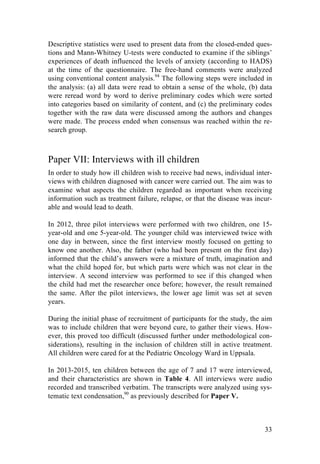
Descriptive statistics were used to present the characteristics of the children
(Table 1). Data were analyzed with regard to diagnosis, age and sex of the
child, and results are presented in proportions and relative risks (RR) with an
associated 95% confidence interval (CI).


28
Table 1. Characteristics of children whose medical records were reviewed in Paper
I (no. (%)).
All children (n=95)
Sex
Boy 52 (55)
Girl 43 (45)
Diagnosis
Hematological malignancy 31 (33)
Brain tumor 30 (31)
Solid tumor 34 (36)
Age at time of death
<5 y 32 (34)
5-9 y 17 (18)
10-14 y 20 (21)
>15 y 26 (27)
Place of death
Home 37 (39)
Hospital (incl. 2 children dying at hospice) 52 (55)
Other/Not stated 6 (6)
Paper II-V: Questionnaire for bereaved parents
Papers II-V are part of a larger nationwide study of bereaved parents.70,85
Data were collected with a study-specific questionnaire sent out in 2001 to
parents who had lost a child to cancer 4 to 9 years earlier. The questionnaire
included questions on various aspects of the care of the child as well as the
psychological health of the parents, both prior to the child’s disease and at
time of the questionnaire.
Children diagnosed with cancer before the age of 17 and who died before
age of 25 (1992-1997) were identified through the Swedish National Regis-
ter of Causes of Death linked with the Swedish National Cancer Register.
The children’s parents were identified through the Swedish Population Reg-
ister.
Parents were eligible if they: 1) were born in one of the Nordic countries; 2)
had a non-confidential telephone number; and 3) understood Swedish. The
561 parents who met the study’s inclusion criteria were sent a letter intro-
ducing and explaining the objectives of the study together with an invitation
to participate. All parents were telephoned with a request for their informed
consent before the questionnaire was sent out to mothers and fathers, sepa-
rately. To safeguard anonymity, the parents were asked to return the non-
coded questionnaire separately from a coded card, notifying the investigators
that the questionnaire had been returned.
29
In total, 449 (80%) parents participated in the study and their characteristics
are presented in Table 2. Of the 112 parents who did not participate, 30
declined participation, 23 could not be reached, and 59 failed to return the
questionnaire.
Table 2. Characteristics of bereaved parents (Paper II-V) (no. (%))
All parents
(Paper II-V)
(n=449)
Parents whose child
underwent HSCT
(Paper IV) (n=97)
Parents included in
the content analysis
(Paper V) (n=67)
Relation
Father 191 (43) 41 (42) 16 (24)
Mother 251 (56) 55 (57) 51 (76)
Not stated 7 (2) 1 (1) 0
Diagnosis of the child
Hematological malignancy 149 (33) 63 (65) 29 (43)
Brain tumor 157 (35) 1 (1) 18 (27)
Solid tumor 93 (21) 25 (26) 14 (21)
Other/Not stated 50 (11) 8 (8) 6 (9)
Child’s age at time of death
0-4 y 132 (29) 28 (29) 11 (16)
5-8 y 95 (21) 15 (15) 17 (25)
9-15 y 103 (23) 31 (32) 20 (30)
16-24 y 106 (24) 21 (22) 17 (25)
Not stated 13 (3) 2 (2) 2 (3)
Place of death
Home 158 (35) 32 (33) 25 (37)
Hospital 272 (60) 61 (63) 40 (60)
Other/Not stated 19 (5) 4 (4) 2 (3)
The parents were asked to rate 19 different symptoms according to the effect
they perceived the symptoms to have on their child’s well-being his or her
last month of life. The 19 symptoms studied were: pain, poor appetite,
weight loss, nausea, vomiting, difficulties swallowing, physical fatigue,
shortness of breath, paralysis, anxiety, depression, reduced mobility, im-
paired speech, sleepiness (daytime), disturbed sleep due to anxiety, disturbed
sleep due to pain, troublesome swelling/edema, urinary problems, and con-
stipation. A 5-point scale was provided: not applicable, none, low, moderate
or severe effect. In Paper II the answers were dichotomized with “not ap-
plicable”, “none” and “low” effect in one group and “moderate” and “se-
vere” effect in the other group. Data were analyzed with regard to the diag-
nosis and age at time of death of the child (Paper II), and presented as RR
with an associated 95% CI.
To detect potential relationships between parental experiences of the child’s
suffering at the end of life and the parents’ own psychological well-being,
parents’ reports on suffering were linked to parental self-estimated psycho-
logical morbidity (Paper III). Parental assessments of symptoms (the same
30
19 symptoms as in Paper II) were dichotomized into those reporting suffer-
ing in the child (“low”, “moderate” or “severe”), and those that did not (“not
applicable”, “none”).
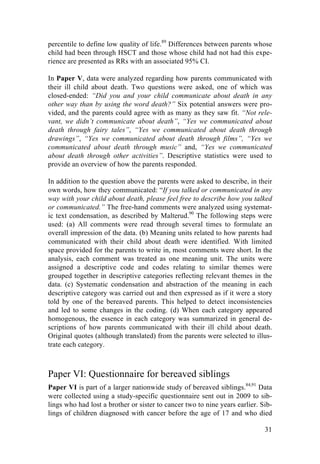
The parents were asked to rate their psychological well-being over the last
month at the time of the questionnaire on a 7-point visual digital scale
(VDS)86
(Figure 2). Scores of the five most negative values were interpreted
to indicate moderate or much anxiety/depression and decreased psychologi-
cal well-being or low quality of life.
Figure 2. Visual digital scale provided to measure psychological well-being in be-
reaved family members
In Paper IV, hematopoietic stem cell transplantation (HSCT) was used as an
example of intensive treatment, and the psychological well-being of be-
reaved parents who had experienced their child going through HSCT was
compared with the well-being of bereaved parents who had not had this ex-
perience. Ninety-seven parents reported having a child that went through
HSCT, and the characteristics are shown in Table 2.
In addition to the VDSs used in Paper III, the Spielberger’s trait measure
from the State-Trait Anxiety Inventory (STAI-T)87
and the Center for Epi-
demiological Studies Depression Scale (CES-D)88
were used to measure
anxiety and depression. To assess quality of life, in addition to the VDS, the
Göteborg Quality of Life Instrument was used, with a cut-off below the 10th
Ques%ons(concerning(your(well0being(during(the(past(month:(
!
Try!to!rate!how!you!have!felt!during!the!past!month.!
!
Have!you!been!anxious!the!past!month?!
1—————2—————3—————4—————5—————6—————7!
Never ! ! ! ! ! ! ! ! ! ! ! !All!the!Ame !!
!
Have!you!felt!depressed!the!past!month?!
1—————2—————3—————4—————5—————6—————7!
Never ! ! ! ! ! ! ! ! ! ! ! !All!the!Ame!
!!
How!would!you!rate!your!psychological!well:being!during!the!past!month?!
1—————2—————3—————4—————5—————6—————7!
Worst!possible ! ! ! ! ! ! ! ! ! ! !Best!possible!!
psychological!wellFbeing ! ! ! ! ! ! ! ! !psychological!wellFbeing!
!
How!would!you!rate!your!quality!of!life!during!the!past!month?!
1—————2—————3—————4—————5—————6—————7!
Worst!possible ! ! ! ! ! ! ! ! ! ! !Best!possible!!
quality!of!life ! ! ! ! ! ! ! ! ! ! !quality!of!life!
!
31
percentile to define low quality of life.89
Differences between parents whose
child had been through HSCT and those whose child had not had this expe-
rience are presented as RRs with an associated 95% CI.
In Paper V, data were analyzed regarding how parents communicated with
their ill child about death. Two questions were asked, one of which was
closed-ended: “Did you and your child communicate about death in any
other way than by using the word death?” Six potential answers were pro-
vided, and the parents could agree with as many as they saw fit. “Not rele-
vant, we didn’t communicate about death”, “Yes we communicated about
death through fairy tales”, “Yes we communicated about death through
drawings”, “Yes we communicated about death through films”, “Yes we
communicated about death through music” and, “Yes we communicated
about death through other activities”. Descriptive statistics were used to
provide an overview of how the parents responded.
In addition to the question above the parents were asked to describe, in their
own words, how they communicated: “If you talked or communicated in any
way with your child about death, please feel free to describe how you talked
or communicated.” The free-hand comments were analyzed using systemat-
ic text condensation, as described by Malterud.90
The following steps were
used: (a) All comments were read through several times to formulate an
overall impression of the data. (b) Meaning units related to how parents had
communicated with their child about death were identified. With limited
space provided for the parents to write in, most comments were short. In the
analysis, each comment was treated as one meaning unit. The units were
assigned a descriptive code and codes relating to similar themes were
grouped together in descriptive categories reflecting relevant themes in the
data. (c) Systematic condensation and abstraction of the meaning in each
descriptive category was carried out and then expressed as if it were a story
told by one of the bereaved parents. This helped to detect inconsistencies
and led to some changes in the coding. (d) When each category appeared
homogenous, the essence in each category was summarized in general de-
scriptions of how parents communicated with their ill child about death.
Original quotes (although translated) from the parents were selected to illus-
trate each category.
Paper VI: Questionnaire for bereaved siblings
Paper VI is part of a larger nationwide study of bereaved siblings.84,91
Data
were collected using a study-specific questionnaire sent out in 2009 to sib-
lings who had lost a brother or sister to cancer two to nine years earlier. Sib-
lings of children diagnosed with cancer before the age of 17 and who died
32
before the age of 25 (2000-2007) were invited to participate. The deceased
children were traced through the Swedish Childhood Cancer Registry and
siblings were identified through the Swedish Population Registry.
Eligible siblings had to be 18 years or older at time of data collection. Sib-
lings younger than 12 and older than 25 at the time of the brother’s/sister’s
death were excluded. In addition, the siblings had to have a valid ad-
dress/phone number and not suffer from mental disabilities. The 240 siblings
meeting the study criteria were sent a letter introducing and explaining the
objectives of the study together with an invitation to participate. All siblings
were telephoned with a request for informed consent before the question-
naire was sent out. To safeguard anonymity, the siblings were asked to re-
turn the non-coded questionnaire separately from a coded card, notifying the
investigators that the questionnaire had been returned.
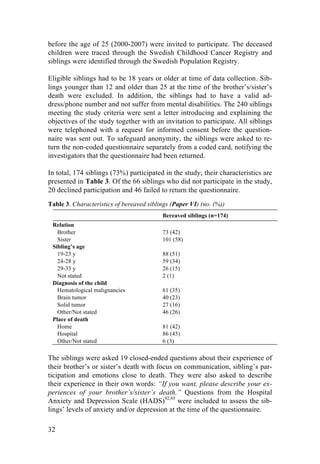
In total, 174 siblings (73%) participated in the study; their characteristics are
presented in Table 3. Of the 66 siblings who did not participate in the study,
20 declined participation and 46 failed to return the questionnaire.
Table 3. Characteristics of bereaved siblings (Paper VI) (no. (%))
Bereaved siblings (n=174)
Relation
Brother 73 (42)
Sister 101 (58)
Sibling’s age
19-23 y 88 (51)
24-28 y 59 (34)
29-33 y 26 (15)
Not stated 2 (1)
Diagnosis of the child
Hematological malignancies 61 (35)
Brain tumor 40 (23)
Solid tumor 27 (16)
Other/Not stated 46 (26)
Place of death
Home 81 (42)
Hospital 86 (45)
Other/Not stated 6 (3)
The siblings were asked 19 closed-ended questions about their experience of
their brother’s or sister’s death with focus on communication, sibling’s par-
ticipation and emotions close to death. They were also asked to describe
their experience in their own words: “If you want, please describe your ex-
periences of your brother’s/sister’s death.” Questions from the Hospital
Anxiety and Depression Scale (HADS)92,93
were included to assess the sib-
lings’ levels of anxiety and/or depression at the time of the questionnaire.
33
Descriptive statistics were used to present data from the closed-ended ques-
tions and Mann-Whitney U-tests were conducted to examine if the siblings’
experiences of death influenced the levels of anxiety (according to HADS)
at the time of the questionnaire. The free-hand comments were analyzed
using conventional content analysis.94
The following steps were included in
the analysis: (a) all data were read to obtain a sense of the whole, (b) data
were reread word by word to derive preliminary codes which were sorted
into categories based on similarity of content, and (c) the preliminary codes
together with the raw data were discussed among the authors and changes
were made. The process ended when consensus was reached within the re-
search group.
Paper VII: Interviews with ill children
In order to study how ill children wish to receive bad news, individual inter-
views with children diagnosed with cancer were carried out. The aim was to
examine what aspects the children regarded as important when receiving
information such as treatment failure, relapse, or that the disease was incur-
able and would lead to death.
In 2012, three pilot interviews were performed with two children, one 15-
year-old and one 5-year-old. The younger child was interviewed twice with
one day in between, since the first interview mostly focused on getting to
know one another. Also, the father (who had been present on the first day)
informed that the child’s answers were a mixture of truth, imagination and
what the child hoped for, but which parts were which was not clear in the
interview. A second interview was performed to see if this changed when
the child had met the researcher once before; however, the result remained
the same. After the pilot interviews, the lower age limit was set at seven
years.
During the initial phase of recruitment of participants for the study, the aim
was to include children that were beyond cure, to gather their views. How-
ever, this proved too difficult (discussed further under methodological con-
siderations), resulting in the inclusion of children still in active treatment.
All children were cared for at the Pediatric Oncology Ward in Uppsala.
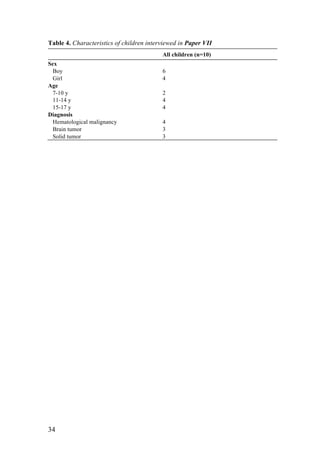
In 2013-2015, ten children between the age of 7 and 17 were interviewed,
and their characteristics are shown in Table 4. All interviews were audio
recorded and transcribed verbatim. The transcripts were analyzed using sys-
tematic text condensation,90
as previously described for Paper V.
34
Table 4. Characteristics of children interviewed in Paper VII
All children (n=10)
Sex
Boy 6
Girl 4
Age
7-10 y 2
11-14 y 4
15-17 y 4
Diagnosis
Hematological malignancy 4
Brain tumor 3
Solid tumor 3


35
Summary of papers
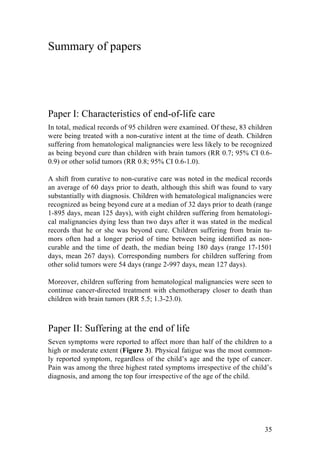
Paper I: Characteristics of end-of-life care
In total, medical records of 95 children were examined. Of these, 83 children
were being treated with a non-curative intent at the time of death. Children
suffering from hematological malignancies were less likely to be recognized
as being beyond cure than children with brain tumors (RR 0.7; 95% CI 0.6-
0.9) or other solid tumors (RR 0.8; 95% CI 0.6-1.0).
A shift from curative to non-curative care was noted in the medical records
an average of 60 days prior to death, although this shift was found to vary
substantially with diagnosis. Children with hematological malignancies were
recognized as being beyond cure at a median of 32 days prior to death (range
1-895 days, mean 125 days), with eight children suffering from hematologi-
cal malignancies dying less than two days after it was stated in the medical
records that he or she was beyond cure. Children suffering from brain tu-
mors often had a longer period of time between being identified as non-
curable and the time of death, the median being 180 days (range 17-1501
days, mean 267 days). Corresponding numbers for children suffering from
other solid tumors were 54 days (range 2-997 days, mean 127 days).
Moreover, children suffering from hematological malignancies were seen to
continue cancer-directed treatment with chemotherapy closer to death than
children with brain tumors (RR 5.5; 1.3-23.0).
Paper II: Suffering at the end of life
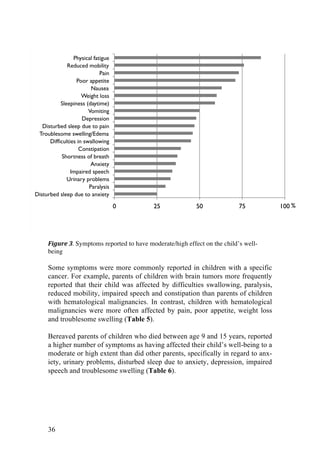
Seven symptoms were reported to affect more than half of the children to a
high or moderate extent (Figure 3). Physical fatigue was the most common-
ly reported symptom, regardless of the child’s age and the type of cancer.
Pain was among the three highest rated symptoms irrespective of the child’s
diagnosis, and among the top four irrespective of the age of the child.
36
	
  
Figure	
  3.	
  Symptoms reported to have moderate/high effect on the child’s well-
being
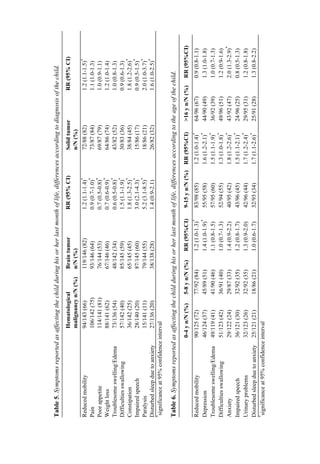
Some symptoms were more commonly reported in children with a specific
cancer. For example, parents of children with brain tumors more frequently
reported that their child was affected by difficulties swallowing, paralysis,
reduced mobility, impaired speech and constipation than parents of children
with hematological malignancies. In contrast, children with hematological
malignancies were more often affected by pain, poor appetite, weight loss
and troublesome swelling (Table 5).
Bereaved parents of children who died between age 9 and 15 years, reported
a higher number of symptoms as having affected their child’s well-being to a
moderate or high extent than did other parents, specifically in regard to anx-
iety, urinary problems, disturbed sleep due to anxiety, depression, impaired
speech and troublesome swelling (Table 6).


0	

 25	

 50	

 75	

 100	

Disturbed sleep due to anxiety	

Paralysis	

Urinary problems	

Impaired speech	

Anxiety	

Shortness of breath	

Constipation	

Difficulties in swallowing	

Troublesome swelling/Edema	

Disturbed sleep due to pain	

Depression	

Vomiting	

Sleepiness (daytime)	

Weight loss	

Nausea	

Poor appetite	

Pain	

Reduced mobility	

Physical fatigue	

%
Table5.Symptomsreportedasaffectingthechildduringhisorherlastmonthoflife,differencesaccordingtodiagnosisofthechild.
Hematological
malignancyn/N(%)
Braintumor
n/N(%)
RR(95%CI)Solidtumor
n/N(%)
RR(95%CI)
Reducedmobility94/143(66)119/146(82)1.2(1.1-1.4)*
72/88(82)1.2(1.1-1.5)*
Pain106/142(75)93/146(64)0.9(0.7-1.0)*
73/87(84)1.1(1.0-1.3)
Poorappetite114/141(81)76/144(53)0.7(0.5-0.8)*
69/87(79)1.0(0.9-1.1)
Weightloss88/141(62)67/146(46)0.7(0.6-0.9)*
64/86(74)1.2(1.0-1.4)
Troublesomeswelling/Edema73/136(54)48/142(34)0.6(0.5-0.8)*
43/82(52)1.0(0.8-1.3)
Difficultiesswallowing57/142(40)85/145(59)1.5(1.1-1.9)*
30/83(36)0.9(0.6-1.3)
Constipation36/142(25)65/145(45)1.8(1.3-2.5)*
38/84(45)1.8(1.2-2.6)*
Impairedspeech28/140(20)87/145(60)3.0(2.1-4.3)*
15/86(17)0.9(0.5-1.5)*
Paralysis15/141(11)79/144(55)5.2(3.1-8.5)*
18/86(21)2.0(1.0-3.7)*
Disturbedsleepduetoanxiety27/136(20)38/138(28)1.4(0.9-2.1)26/82(32)1.6(1.0-2.5)*
*
significanceat95%confidenceinterval
Table6.Symptomsreportedasaffectingthechildduringhisorherlastmonthoflife,differencesaccordingtotheageofthechild.
0-4yn/N(%)5-8yn/N(%)RR(95%CI)9-15yn/N(%)RR(95%CI)>16yn/N(%)RR(95%CI)
Reducedmobility90/125(72)77/92(84)1.2(1.0-1.3)*
83/98(85)1.2(1.0-1.4)*
64/96(67)0.9(0.8-1.1)
Depression46/124(37)45/89(51)1.4(1.0-1.9)*
55/95(58)1.6(1.2-2.1)*
44/90(49)1.3(1.0-1.8)
Troublesomeswelling/Edema49/119(41)41/90(46)1.1(0.8-1.5)57/95(60)1.5(1.1-1.9)*
36/92(39)1.0(0.7-1.3)
Difficultiesswallowing51/123(42)36/91(40)1.0(0.7-1.3)52/94(55)1.3(1.0-1.8)*
49/96(51)1.2(0.9-1.6)
Anxiety29/122(24)29/87(33)1.4(0.9-2.2)40/95(42)1.8(1.2-2.6)*
43/92(47)2.0(1.3-2.9)*
Impairedspeech36/121(30)32/92(35)1.2(0.8-1.7)43/96(45)1.5(1.1-2.1)*
24/96(25)0.8(0.5-1.3)
Urinaryproblems32/123(26)32/92(35)1.3(0.9-2.0)42/96(44)1.7(1.2-2.4)*
29/95(31)1.2(0.8-1.8)
Disturbedsleepduetoanxiety25/121(21)18/86(21)1.0(0.6-1.7)32/93(34)1.7(1.1-2.6)*
25/91(28)1.3(0.8-2.2)
*
significanceat95%confidenceinterval
38
Paper III: Parental well-being and experienced suffering
in the child
Approximately one quarter of all bereaved parents participating in the study
reported experiencing symptoms of anxiety (106 parents; 24%) or depres-
sion (122 parents; 28%) at the time of the questionnaire. A potential rela-
tionship between parental psychological morbidity and the symptoms that
the parents felt had affected their child’s well-being his or her last month of
life (as described in Paper II) was studied, and an increased risk of psycho-
logical morbidity was found for parents who reported that their child’s well-
being was affected by anxiety or by disturbed sleep due to either anxiety or
pain.
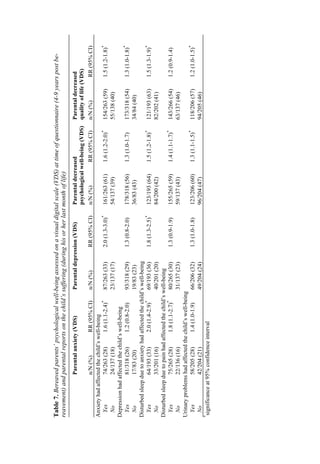
Parents who reported that their child’s well-being was affected by anxiety or
by disturbed sleep due to anxiety had a higher risk of self-assessed anxiety,
depression, decreased psychological well-being, and decreased quality of
life at follow-up (Table 7). In addition, parents who reported that their
child’s well-being was affected by disturbed sleep due to pain had an in-
creased risk of self-assessed anxiety and decreased psychological well-
being.
Bereaved parents who reported that their child had been affected by urinary
problems were at greater risk of both decreased self-assessed psychological
well-being and decreased quality of life. Apart from that, no relationship
was found between the somatic symptoms the parents were asked to rate and
alterations in the risk of parental anxiety, depression, psychological well-
being or quality of life.
Paper IV: Well-being of parents whose child went
through HSCT
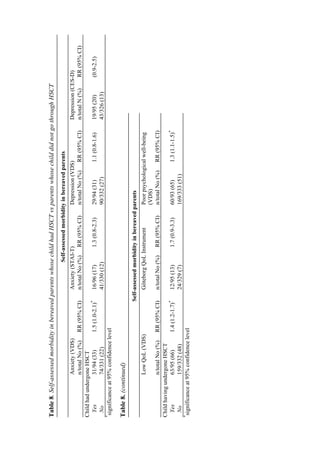
To summarize, there was a trend that bereaved parents whose child had un-
dergone HSCT had an increased risk of decreased psychological well-being
at time of the questionnaire. Statistically significant differences were found,
with increased risk for anxiety, and decreased psychological well-being and
low quality of life when the parents were asked to fill in the 7-point VDS
and although there was a trend towards increased risks of the same when
measured with the STAI-T and the Göteborg Quality of Life Instrument,
these results were non-significant (Table 8).
Table7.Bereavedparents’psychologicalwell-beingassessedonavisualdigitalscale(VDS)attimeofquestionnaire(4-9yearspostbe-
reavement)andparentalreportsonthechild’ssuffering(duringhisorherlastmonthoflife)
Parentalanxiety(VDS)Parentaldepression(VDS)Parentaldecreased
psychologicalwell-being(VDS)
Parentaldecreased
qualityoflife(VDS)
n/N(%)RR(95%CI)n/N(%)RR(95%CI)n/N(%)RR(95%CI)n/N(%)RR(95%CI)
Anxietyhadaffectedthechild’swell-being
Yes74/263(28)1.6(1.1-2.4)*
87/263(33)2.0(1.3-3.0)*
161/263(61)1.6(1.2-2.0)*
154/263(59)1.5(1.2-1.8)*
No24/137(18)23/137(17)54/137(39)55/138(40)
Depressionhadaffectedthechild’swell-being
Yes81/318(26)1.2(0.8-2.0)93/318(29)1.3(0.8-2.0)178/318(56)1.3(1.0-1.7)173/318(54)1.3(1.0-1.8)*
No17/83(20)19/83(23)36/83(43)34/84(40)
Disturbedsleepduetoanxietyhadaffectedthechild’swell-being
Yes64/193(33)2.0(1.4-2.9)*
69/193(36)1.8(1.3-2.5)*
123/193(64)1.5(1.2-1.8)*
121/193(63)1.5(1.3-1.9)*
No33/201(16)40/201(20)84/200(42)82/202(41)
Disturbedsleepduetopainhadaffectedthechild’swell-being
Yes75/265(28)1.8(1.1-2.7)*
80/265(30)1.3(0.9-1.9)155/265(59)1.4(1.1-1.7)*
143/266(54)1.2(0.9-1.4)
No22/136(16)31/137(23)59/137(43)63/137(46)
Urinaryproblemshadaffectedthechild’swell-being
Yes58/205(28)1.4(1.0-1.9)66/206(32)1.3(1.0-1.8)123/206(60)1.3(1.1-1.5)*
118/206(57)1.2(1.0-1.5)*
No42/204(21)49/204(24)96/204(47)94/205(46)
*
significanceat95%confidenceinterval
	
  
Table8.Self-assessedmorbidityinbereavedparentswhosechildhadHSCTvsparentswhosechilddidnotgothroughHSCT
Self-assessedmorbidityinbereavedparents
Anxiety(VDS)Anxiety(STAI-T)Depression(VDS)Depression(CES-D)
n/totalNo(%)RR(95%CI)n/totalNo(%)RR(95%CI)n/totalNo(%)RR(95%CI)n/totalN(%)RR(95%CI)
ChildhadundergoneHSCT
Yes31/94(33)1.5(1.0-2.1)*
16/96(17)1.3(0.8-2.3)29/94(31)1.1(0.8-1.6)19/95(20)(0.9-2.5)
No74/331(22)41/330(12)90/332(27)43/326(13)
*
significanceat95%confidencelevel
Table8.(continued)
Self-assessedmorbidityinbereavedparents
LowQoL(VDS)GöteborgQoLInstrumentPoorpsychologicalwell-being
(VDS)
n/totalNo(%)RR(95%CI)n/totalNo(%)RR(95%CI)n/totalNo(%)RR(95%CI)
ChildhavingundergoneHSCT
Yes63/95(66)1.4(1.2-1.7)*
12/95(13)1.7(0.9-3.3)60/93(65)1.3(1.1-1.5)*
No159/332(48)24/329(7)169/333(51)
*
significanceat95%confidencelevel
41
Paper V: Parent–child communication about death
Overall the parents expressed that their child was well aware of his or her
impending death and that the child often was the one who initiated commu-
nication about death.
The parents described four ways in which communication about death oc-
curred (Figure 4). Some parents expressed that they talked about death to-
gether with their child, either about the child’s own impending death or
about friends and family that had died. Others described talking about a life
after death, an approach that was often described as providing comfort to the
child in that he or she was not going to be alone after death but that someone
was already waiting for him or her. The parents also described that some
children communicated about and around death by making practical prepara-
tions for their own death. Such preparations included planning one’s own
grave, deciding about flowers and/or rituals for the funeral. The children also
prepared by giving away toys and thus ensuring that a favorite teddy bear
would be taken care of by someone else.
Communication at the child’s own initiative
Talking about
friends and family
that had died, or
about death itself
Talking about life
after death
Preparing for
death through
practical prepara-
tions
Communication
about death by
using narratives
Figure 4. Theme and categories as to how parents and child communicated about
death
The most commonly described approach was communication about death
through narratives, such as children’s books and/or movies. The parents ex-
pressed that this approach was used with both younger and older children.
For younger children the parents often referred to well-known children’s
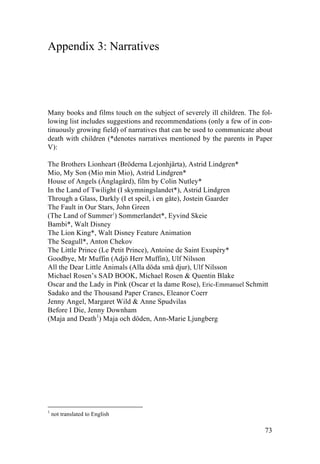
books (Appendix 3) that had helped them in communicating about the diffi-
cult subject of death in a way that made it more bearable for them and also
facilitated communication with and understanding of a small child. With
older children (or young adults) the parents revealed that some children
chose others to talk to, such as a girlfriend or boyfriend, and narratives were
understandably others than the ones used for smaller children.
42
Paper VI: Siblings’ experiences
The bereaved siblings reported receiving poor information regarding the
impending death of their brother or sister, and most siblings only understood
that their brother or sister was going to die less than 24 hours before death
occurred.
The siblings were seldom informed about their brother’s or sister’s deteriora-
tion and upcoming death by HCPs, and felt unsure about what to expect
from a dying person, especially regarding bodily changes. This was related
to increased levels of anxiety at follow-up; siblings who reported that no-
body had talked to them about what to expect had significantly higher levels
of anxiety compared to those who had talked to someone (p=0.048).
Some siblings described the time shortly before their brother’s or sister’s
death as emotional, with feelings of helplessness or powerlessness as well as
fear of death. They described the uncertainty of waiting for death and how
distressing it was to see their brother or sister suffer. Some sibling expressed
regret that they did not spend more time with their brother or sister during
the illness period. While some reported that this was due to them being busy
with their own lives, others stated that they did not understand that their
brother or sister was dying or that death could come so suddenly.
Approximately half of the siblings were present at the time of death with
only one regretting this, whereas around three quarters of those who were
not present regretted this. Among those who were present at the time of
death, most reported a calm and beautiful atmosphere in the room but also
sadness and, notably, more than two thirds of the siblings (70%) reported
that their brother or sister suffered. Some siblings expressed feeling relief at
the time of death and shortly thereafter since death released their brother or
sister from more suffering.
The siblings expressed that it was important to be together as a family after
the death, to say goodbye and to take care of the body. They described emp-
tiness, as well as feeling angry but also guilty for being the one still alive.
Over one quarter of the siblings reported not talking to anyone about the
brother’s or sister’s death after it had occurred, and one third wished that
they had talked more with their families about it.
Paper VII: The child’s thoughts on receiving bad news
The children interviewed agreed on wanting truthful information regarding
their disease and their prognosis, even if it was a poor one. They expressed a
43
wish not to be shielded from bad news and did not believe that one should
hide bad news from other children their age or younger. However, they ex-
pressed that this might not be universal to all children and stressed that bad
news as well as other medical information had to be delivered in a sensitive
way, in language appropriate for the individual child, e.g. with wordings
understandable according to age and maturity.
Most children expressed a wish to receive bad news together with, and at the
same time as their parents and not, as is seen sometimes in the clinic, that the
parents receive bad news beforehand. One boy stated that he wanted to be
told separately in advance although he could not express why this was im-
portant, only that “it feels the best”.
Several children expressed that there always had to be hope in some way.
One girl expressed that the child and his or her family as well as the physi-
cians need that to hold on to. Others stressed that it was the hope of one day
getting well that made them endure all the treatment and gave them the
strength to keep fighting their disease. Others regarded the possibility of
further treatment as self-evident and apparently considered the thought of no
more treatment being possible very far-fetched. One 17-year-old boy, who
was treated for several years for his brain tumor, expressed that when the
treatment no longer worked, the physician could always offer a new treat-
ment. When asked to imagine that there was no other treatment possible he
thought for a moment, and then restated that there was always more treat-
ment available, and if there wasn’t then you would go back to the old treat-
ment.


44
Key findings
The overall aim of this thesis was to provide a better understanding of pallia-
tive care of children with cancer and to explore aspects of care and/or com-
munication of interest for both the child and bereaved family members.
Paper I, with data collected from medical records, reflects notes from HCPs;
Papers II-V gathered data from bereaved parents; Paper VI gathered data
from bereaved siblings, and in Paper VII the informants were children un-
der active treatment for cancer. During the research leading to this thesis,
and in the process of exploring pediatric palliative care, two overarching
themes emerged from the included papers:
a The need to recognize that family relations matter, and the suf-
fering of the dying child affects bereaved family members (par-
ents and siblings) years after their loss.
b The importance of communication between all the parties in-
volved: HCPs, the child and his or her relatives. Highlighted ar-
eas are communication regarding disease, prognosis and expec-
tations, but also communication within the family, sharing in-
formation but also thoughts and worries.
While different aspects of palliative care have been studied, these two inter-
twining themes can be seen as overarching and can be traced back to the ill
child as well as bereaved parents and siblings. Achieving good communica-
tion and keeping a family focus are cornerstones in pediatric palliative care
and in the following chapter these themes will be discussed more thoroughly
in relation to the literature and the current goals of palliative care.
45
Discussion of key findings
Most children diagnosed with cancer initially receive treatment with a cura-
tive intent. If and when the initial treatment fails, there is often a second and
third line of treatment to try. With the continuous emergence of new drugs
and new indications for older ones it is easy to reach for yet another treat-
ment when an earlier one fails. The results in this thesis strengthen earlier
findings that close family members are affected by the end-of-life care. It
also appears that intensified treatment or lack of communication, e.g. not
discussing a potential fatal outcome, makes it harder for parents and siblings
to accept a potential death. So how to know when to stop trying for a cure?
Even though statistics tell us that approximately every fifth child diagnosed
with cancer will die from his or her disease, we rarely know which child and
when.
Throughout the course of the disease, the ill child will be exposed to new
and sometimes scary events, procedures, anesthesia and surgery. He or she
will be given medicines that without proper administration and control can in
themselves be fatal. Side effects are usually impossible to avoid and come in
both physical form from the treatment itself (e.g. nausea, vomiting, rashes
and hair loss) and psychological form, with the child having to be away from
home and his or her friends and being subjected to unfamiliar surroundings
and procedures.
The individual disease trajectory is uncertain and a fatal outcome is not al-
ways easy to foresee. The cancer of a few children will be incurable from
start, whereas most children will initially be treated with hope of a cure.
Progressive disease, treatment failure or relapse might lead to a shift in care
when only a fatal outcome remains. Some children will have a period of time
after this shift in care until death, whereas others are recognized as being
beyond cure late in the course of their illness, and die only days thereafter
(Paper I). In addition, some children die while still in potentially curative
treatment, unexpectedly and from treatment complications. The latter is par-
ticularly true of children suffering from hematological malignancies.95,96
When standard therapy no longer works and all that is left is treatment with
low likelihood of cure, the parents – knowingly or unknowingly – face the
dilemma of wishing their child to live as long as possible while simultane-
46
ously wanting to protect their child from unnecessary suffering. Treatment
that does not result in prolonged life might in retrospect be seen as having
caused the child unnecessary suffering (due to additional hospital visits and
potential side-effects).97
This can be compared with the findings in Paper IV
where bereaved parents whose child went through HSCT as part of his or her
treatment and still died, were at higher risk of decreased psychological well-
being. Continued treatment at the end of life can be estimated to provide the
child as well as the parents and siblings with unrealistic expectations and a
false sense of hope, that hinders them in planning for the last time together
and using that time in a way they would have chosen had they known death
was close.
Family relations matter
Relations within families differ and it is not always easy to describe the
bonds shared. There is a balance between loving intimacy and individual
growth that family members must maintain. Further, there are responsibili-
ties to consider. Parents have formal responsibilities for their children as
long as they are minors. Moreover, most would agree that parents have addi-
tional responsibilities (although not necessarily legally binding ones) to-
wards their children. Exactly where these responsibilities end is however not
clear and is subject to discussion.98
Most would probably agree that the pa-
rental role includes providing your child with love and a feeling of being
cared for. In addition most parents want to shield their children from suffer-
ing and pain, especially unnecessary pain. When the child is diagnosed with
a life-threatening disease, all these ambitions are in jeopardy. A cancer diag-
nosis carries with it procedures, treatments and hospital stays that menace
the safe environment that one wishes for the child, and imposes a threat on
life itself.
While reducing distressing symptoms and suffering in the ill child should be
prioritized regardless of whether the child is regarded as curable or not, it
may be considered as increasingly important at the end of life. However,
despite efforts to reduce suffering and to obtain symptom control, children
dying from cancer are affected by a number of different symptoms as death
draws near.38-40,42
In Paper VI, 70% of bereaved siblings reported that their
brother or sister suffered during the last hours of life. In Paper II, bereaved
parents expressed that physical fatigue, reduced mobility, pain and decreased
appetite were the symptoms that affected their child’s well-being the most.
Similar results have been found in other studies.38-40,42,43,99
All these symp-
toms affect the child’s possibility to interact with family and friends, and
hinder them in normal activities. Even if these symptoms, and the hindrance
they impose on life, are the ones that have the greatest effect on the child,
they are not the ones that seem to stay with the parents in a long-term per-
47
spective. Instead, psychological suffering in the child, such as anxiety and
disturbed sleep, were found to affect bereaved parents’ psychological well-
being years after their loss (Paper III).
Physical fatigue and reduced mobility can often be a direct cause of the ill-
ness as well as the treatment provided. Pain is often caused by the illness and
providing adequate pain relief is one of the key responsibilities of health
care. However, relieving anxiety and helping your child have a good night’s
sleep are embedded in the role of a parent. It is therefore not surprising that
these symptoms are the ones that stay with the parents long-term, as a possi-
ble expression of feelings of guilt (in having failed your child). Similarly,
previous studies have reported about unrelieved psychological symptoms in
patients having affected the surrounding persons (HCPs and relatives) more
than unrelieved somatic symptoms.67,68
Bereaved parents’ psychological well-being appeared to be well connected
to the perceived psychological well-being of the dying child. In addition, it
appeared that the experience of seeing a child undergoing intensive treat-
ment (in the form of HSCT) and nonetheless ultimately dying of his or her
cancer, affected the bereaved parents’ psychological well-being negatively
(Paper IV).
All treatment aiming at a cure carries with it hopes for the child but also for
the family. Earlier findings report on parents’ intellectual awareness of their
child’s impending death being delayed when treatment is continued close to
death,100
and in adults with incurable cancer, continued treatment has been
seen to provide both patients and physicians with false optimism.101
When
the treatment does not succeed, these hopes will be crushed. Since all forms
of treatment carry with them side-effects, one should always weigh these
against potential benefits. If there is chance of a cure, more severe side-
effects can be accepted than in cases where the best outcome is “only” pro-
longed life.
Family relations remain important, and pain or suffering in one member
affects the others. The results in this thesis stress the need to always have a
family focus in pediatric palliative care.
The importance of communication
Open and honest communication in the health care setting has been proposed
as an important factor in providing good palliative care, and poor communi-
cation has been seen to increase distress in both the sick child and his or her
parents.48,59,73
Children have historically been regarded as unaware of their
situation, and parents as well as HCPs have tried to shield them from the
48
truth – that their disease would lead to death. This view has changed over the
years and one of the most influential studies is the anthropological study by
Bluebond-Langner, which provides insight into the lives of children suffer-
ing from cancer.54
She describes how children treated at the cancer ward
reach awareness of death as a possible outcome of their own as well as other
children’s disease. Similar reports have been presented by others47,51,52,102,103
and are further supported by statements from bereaved parents, who ex-
pressed that communication around death often occurred at the ill child’s
initiative (Paper V), pointing once again to the child’s own awareness about
his or her impending death. Communication occurred in different ways and
included practical preparations for the child’s own funeral as well as making
sure that their favorite teddy bear would be taken care of after their death.
These results are in line with earlier results by Beale et al, who found that
children often raised the subject of death themselves, sometimes at unex-
pected times.47
While Paper I revealed that although medical records show when a curative
aim was abandoned, they do not show whether the parents and the child
were informed (and were able to grasp the finality of this decision) at that
same time. Awareness of the upcoming death has been seen to benefit be-
reaved family members.100
Parents and physicians have previously been
shown to estimate the likelihood of cure fairly equal at the time of diagnosis.
However, as the child’s condition deteriorated, the parents’ understanding
and acceptance of the likelihood of death was substantially delayed.104
Parents of children with cancer have reported wanting to be informed imme-
diately when physicians realize that the child’s illness must be considered
incurable.105
Being informed about the child’s terminal condition provides
the parents with the possibility of making end-of-life decisions according to
their preferences, as well as allowing for preparations according to family
traditions and values, all of which have been seen to be beneficial to be-
reaved parents long term.100,106
Further, bereaved parents with short aware-
ness time prior to the loss of their child report increased levels of long-term
anxiety, compared to bereaved parents with longer awareness time.100
It is
also more common for the child to be cared for at home when parents have
reached intellectual awareness of the child’s impending death,19
this being in
accordance with preferences often expressed by family members of ill chil-
dren.16,17,107
Even with both HCPs and family members bearing witness to the child’s
insight and awareness, there may be uncertainties regarding how to approach
the child with bad news. One fear has been that giving the child such news
would reduce the child’s hope and quality of life. HCPs are in a unique posi-
tion to help the families through this difficult time by facilitating communi-
49
cation. Importantly, siblings should also be invited into communication
about the prognosis and what happens at the time of death, as siblings who
had not been informed about what to expect when their brother or sister was
dying were at greater risk of psychological morbidity at the time of the ques-
tionnaire (Paper VI).
Interviews with children in Paper VII reveal that they want information, and
to be informed in no uncertain terms about their disease as well as the prog-
nosis, even if that may be a poor one and no more treatment is at hand. The-
se finding are supported by the study by Hinds et al, who report that ill chil-
dren and their families are able to hold on to parallel goals of treatment and a
possibility of cure as well as a palliative focus.108
It is worth stressing that
information is to be given in a respectful way, in words appropriate to the
child’s level of understanding and in as positive wordings as possible. The
children wish to keep hope even when being informed of a poor or even fatal
prognosis (Paper VII). The concept of hope is ambiguous and is subject to
change over time. Even so, earlier studies conclude the importance of hope
both for adolescents in cancer care and for parents whose children have can-
cer.109-111
Finding the balance in how to provide open and honest communi-
cation while supporting the child’s and his or her family’s hope remains one
of the challenges but also one of the beauties of working with severely ill
children and their families.
In Paper VI bereaved siblings reported that they experienced a lack of
communication and were ill prepared for the death of their brother or sister.
Similar results have been reported earlier.64
While it is important to stress
that siblings have a right to their own life, assuring that they are informed of
an expected outcome will allow them to make choices based on a correct set
of information and balancing a wish of spending time with their brother or
sister with their own plans and dreams. Inviting and including them early in
communication about disease and prognosis, preferably from time of diag-
nosis, will likely diminish the number of siblings who feel uninformed and
who miss out on spending time with their ill brother or sister.
Parents who were able to grasp during end-of-life care that their child’s dis-
ease was incurable were more likely to say goodbye to their child before
death.105
In addition, bereaved parents who talked to their child about death
have not been seen to regret this, whereas some parents who did not talk to
their child about death have reported regretting it.62
This was seen to be es-
pecially true of parents who sensed that their child was aware of his or her
impending death while still choosing not to communicate about it. In Paper
V, four different ways in which communication occurred was found, the
most common being through narratives. By using narratives the difficult
subject of death can be approached without specifically referring to the
50
child’s imminent death. Fairy-tales might also be an easier way to describe
death to younger children and provide them with a vocabulary they other-
wise might lack, hindering them from expressing their thoughts. Awareness
of different ways in which communication around death can occur, as pre-
sented in Paper V, can guide HCPs in helping these families. By supporting
communication when the child shows interest, and by reassuring parents that
this will usually be beneficial for both the child and the parents, communica-
tion around death can be facilitated. Since narratives are a common way to
approach the topic one could also easily provide appropriate children’s and
teen books and/or movies at the hospital ward in any bookshelf and in this
way facilitate for a conversation without forcing the topic on someone who
is not yet ready.
Good communication is vital in providing good medical care, perhaps even
more so in palliative care. Communication includes not only giving infor-
mation but also interaction. Good communication can lead to shared goals
and a better understanding of each other’s perspectives, resulting in better
outcomes for the child as well as his or her family.
Pediatric palliative care
The results from this thesis highlight communication and inclusion of the
whole family (as opposed to focusing exclusively on the ill child) as im-
portant aspects when caring for a child with cancer. Integrated palliative
care, as discussed briefly in the background, alongside potentially curative
treatment aims to provide a continuous focus on these as well as other values
and goals of palliative care throughout a disease trajectory. Though WHO22
and the American Academy of Pediatrics112
have advocated integration of
palliative care alongside potentially curative treatment for years, this integra-
tion is not regularly taking place.24,25,28
Reported barriers include inadequate
palliative care training of HCPs and a lack of evidence based palliative care
assessments and interventions in pediatrics but also professional attitudes
regarding the appropriateness of discussing palliative care when prognosis is
uncertain.25,28,29,63
The belief that palliative care exclusively involves care of
the dying individual results in many reacting strongly to the concept of inte-
grated palliative care.
While achieving good communication and keeping a family perspective are
important aspects of palliative care, they are undoubtedly important in all
pediatric care and even all medical care. One might therefore question the
need for an integrated model of palliative care. Even so, based on the results
in this thesis there appears to be room for improvements regarding both
symptom control and communication. In addition, an increased family focus,
51
attending to the needs of both siblings and parents during the disease period
as well as after bereavement seems to be warranted.
The results from this thesis support a model where palliative care values
such as symptom relief, enhanced communication and support to close rela-
tives are introduced early during the disease trajectory (Figure 5). These
aspects should not interfere with potentially curative treatment. Honest
communication from the time of diagnosis, that even though treatment aims
at achieving a cure, a fatal outcome remains a possibility, helps the child and
his or her family members have realistic expectations on the treatment given.
Notably, one should certainly not discourage the child and his or her family:
if a cure is likely this should of course be emphasized. If and when the dis-
ease progresses and hope of cure diminishes (or is lost) palliative care values
gain in importance. By this time, a foundation has hopefully been laid to
continue an open dialogue about realistic expectations that allow the families
to spend the final time together according to personal preferences, to plan
place of death and make it possible for the child and his or her parents and
siblings to say farewell.
Figure 5. Different models of palliative care
In the proposed model the term palliative care is left out. Due to the lack of
consensus regarding the definition of palliative care,32,33
use of the term may
Diagnosis
Diagnosis
Your%
Title%
Here%Curative directed treatment
Traditional model
Diagnosis
Palliative care
Curative directed treatment
Palliative care
Focus on palliative values
Bereavement support
Bereavement support
Model of integrated
palliative care
Proposed model
Death
Death
Death
52
lead to debate regarding semantics rather than a discussion of how to im-
prove the care offered to these children and their families.
This thesis particularly stresses the need for considering the whole family –
as opposed to only the ill child – when caring for children with life-
threatening diseases. Acknowledging each family member as an individual,
and paying attention to family preferences regarding care and communica-
tion will help individualize care and hopefully result in improved palliative
care. Key aspects to consider:
• Identify the whole family. Who are the people close to the child? Identi-
fy parents, siblings and/or other close relatives likely to be affected by
the child’s disease.
• Identify family values and preferences, both regarding communication
but also regarding treatment. Who should be informed and by whom if
or when a treatment is no longer working? Is the family prone always to
try out a new treatment or do they (in case of a really poor prognosis and
when only experimental treatment remains) prefer to care for the child at
home, having a period of time together as a family before the child’s
death?
• Identify treatment expectations. Before offering and starting any treat-
ment, the realistic expectations of said treatment should be evaluated and
distinguished from mere hopeful expectations. Throughout the child’s
care, these expectations need to be reevaluated and openly communicat-
ed between HCPs, the child and family members. An open dialogue
permits the family to make preparations according to their preferences
and personal values, but also for HCPs to support the families in their
preferences and to provide the best possible care.
These are only a few of the important aspects to consider when caring for
children with life-threatening diseases and their families. Future research as
well as clinical expertise can add to the list. It is imperative to strive for open
communication from the time of diagnosis, and to remember that no child is
isolated: children always exist in the context of a family.


53
Methodological considerations
The overall aim of this thesis was to provide a better understanding of pallia-
tive care of children with cancer and to explore aspects of care and/or com-
munication of interest for both the child and bereaved family members. To
answer the various research questions, information was gathered in four
separate studies and analyzed using both quantitative (Paper I-IV, VI) and
qualitative method (Paper V-VII). Gathering data from different sources
and using different methodologies strengthen the findings of this thesis.
However, there are methodological considerations and limitations with the
approaches used in this study that need to be discussed:
Retrospective review of medical records
The aim of Paper I was to provide baseline data on patterns of care for chil-
dren dying from cancer in Sweden. The nationwide approach ensures that
the data do not represent treatment traditions at a single center. However, the
retrospective design of collecting data through medical records limits the
results to what is written in the medical records.
Consent was sought from bereaved parents before examining the child’s
medical records and the selection bias introduced by the 49 children for
whom consent was denied or where the parents failed to return the consent
form represents a limitation of the study. Due to study design it is not possi-
ble to determine if patterns of care differed for children whose parents de-
nied consent. Conclusions from the study must be interpreted with this in
mind.
The Swedish Register of Palliative Care started in 2005 and strives to in-
clude all persons dying in Sweden.113
One aim of the register is to use the
data to evaluate the quality of end-of-life care. HCPs report directly to the
register after the death of a patient, including data on place of death, symp-
toms and suffering, pain relief, etc. In 2014, 68% of the deaths in Sweden
were reported; however, the coverage is significantly lower in the pediatric
population, with only 23% of deaths being registered.113,114
With increased
awareness of the register and encouragement to report data on deceased chil-
dren, this register could be used in future evaluations of end-of-life care not
only of children in pediatric oncology wards, but of all children who die.
54
Questionnaire for bereaved parents (used in Paper II-V)
The nationwide, population-based approach together with a participation rate
of 80% represents one of the strengths of the study. The questionnaire was
anonymous and could be answered at home, and forms were sent to mothers
and fathers separately.
However, the study approach also has several limitations. Recall bias, due to
the years that have passed between bereavement and the time of the ques-
tionnaire, cannot be disregarded. Further, the design of the questionnaire did
not permit follow-up questions or clarifications, which is of special im-
portance when analyzing free-hand comments as in Paper V.
Questionnaire for bereaved siblings
The questionnaire directed to bereaved siblings (used in Paper VI) has
strengths and limitations similar to those of the questionnaire for bereaved
parents. In addition, special considerations needed to be addressed. Only
siblings older than 18 at time of the questionnaire were included, since in-
cluding younger siblings would cause difficulties regarding informed con-
sent, where parents and siblings would have to provide consent and assent,
respectively. Thus, the results are limited by inclusion only of older siblings.
Interviews with ill children
Individual interviews empower individuals to share their stories and the
qualitative approach can be used to explore and understand complex issues
that cannot easily be measured.115
As mentioned earlier, the initial aim in Paper VII was to interview children
for whom there no longer remained hope of a cure and who were informed
of this. However, this approach proved too difficult due to the small number
of eligible subjects, and the sometimes short time span during which they
had to be asked to participate (in agreement with findings in Paper I). In
addition, patients were recruited at the ward at the University Hospital in
Uppsala, and many children who no longer are regarded as curable are trans-
ferred to a hospital closer to home or chose to stay at home with support of a
home health care team. Some children themselves also prioritized (wisely) to
live their life rather than participate in yet another study, being interviewed
by someone they didn’t know. A boy for whom there no longer remained
any hope of cure, simply stated when asked if he wanted to participate in the
study: “I don’t have time, I’m dying, you know. I have stuff I need to do.”
To ask children still in potentially curative care if they would like to be in-
formed if the worst happens – that their disease becomes incurable and that
they will die – is to pose a hypothetical question and the results must be in-
55
terpreted with this in mind. An anthropological design or a prospective study
following children (together with their families) from the time of diagnosis
and throughout their disease period would enable collection of better data on
how children receiving bad news perceive this, together with their views on
improvements.
Generalizability of the findings of the thesis
This thesis is strengthened by the diverse approaches used, collecting data
from medical records, children and their family members. Combining quan-
titative data with qualitative data allows for a deeper understanding of differ-
ent aspects in and of the care. The results include care of children with can-
cer spanning more than two decades and one must acknowledge that care has
evolved during this period of time. The individual findings in each paper
should not be generalized to all children with cancer, or automatically re-
garded as “true” of the care given today. However, the key themes, repre-
sented over time and supported by both children, parents and siblings should
be seen as important aspects to consider in the care of all children diagnosed
with cancer.
Increased awareness of aspects of communication that child and family re-
gard as important as well as awareness that the care of the ill child affects
family members is important in improving future care. The results and dis-
cussion of this thesis should not be regarded as a universal truth but rather as
a stepping-stone toward continued discussion regarding how palliative care
in pediatric oncology can be improved.
56
Concluding remarks and future research
Two overarching themes were found: acknowledging that family matters and
the importance of communication. The findings in this thesis show that even
though most children dying from a cancer in Sweden are recognized as being
beyond cure at the time of death, for many children this is not acknowledged
until shortly before death, especially for children dying from hematological
malignancies. Bereaved parents and siblings recognize suffering in the child
at the end of life, and bereaved parents are at increased risk of decreased
psychological well-being if they perceive psychological distress in their
child close to death. In addition, bereaved parents whose child went through
HSCT as part of his or her treatment appear to be at increased risk as com-
pared to bereaved parents without this experience.
Communication was found to be of great importance both to the ill child and
to bereaved parents and siblings. Children with cancer expressed a wish for
open communication, even in the case of a poor prognosis although they still
wanted to be able to keep their hope. Bereaved parents reported that com-
munication about death often occurred at the child’s own initiative and
communication was often facilitated through narratives. Several children
also communicated through practical preparation for their own death or by
talking about friends and family that had died or about life after death. Be-
reaved siblings expressed a lack of information and felt unprepared for their
loss. In addition, siblings who reported that no one talked to them about what
to expect when the brother or sister was going to die had increased levels of
anxiety 2 to 9 years later.
Since the start of the research leading to this thesis, over a decade has
passed. The field of pediatric palliative care has blossomed and there are an
increasing number of papers and even textbooks on the subject. In Sweden,
the first Nordic Hospice for children opened in 2010, and palliative medicine
was recently recognized as an official specialty for physicians. Though ad-
vances have been made, pediatric palliative care still face several challenges.
In Sweden, few children die, which means that physicians and nurses have
limited clinical experience. In addition, our sparsely populated country has
just six centers caring for children suffering from cancers. The only hospice
and the only advanced home care team specialized on children are situated in
57
the Stockholm area (Appendix 1). There are large differences and inequali-
ties in the possibility for children to receive palliative care in Sweden, and
although this thesis focuses on children with cancer, children with other life-
threatening diagnoses will have the same challenges.
This thesis provides some pieces to the puzzle of caring for children with
life-threatening diseases, although many are still missing. While continued
research might help find more of the missing pieces, it would also be of great
importance to continue not only describing the care provided but also trying
to implement research findings into routine care, and evaluating such inter-
ventions.
Digging deeper into preferences of ill children and their families would be
interesting in further developing palliative care services. Prospective studies,
following children and their families over time, would be preferable. Of
special interest would be to capture arguments and thoughts on choosing
between continued treatment and best supportive care when hope of cure is
diminishing (or even lost).
Adding “practice” to the descriptive results by visiting hospitals and care
facilities that have succeeded in integrating palliative care (or values thereof)
alongside regular therapy and developing a model that applies to Swedish
conditions would be of great interest. Thereafter, the next step would be
implementing and evaluating such a model.
More intervention studies are needed. A few interesting areas involve sup-
port to ill children and interventions to empower them, as well as support
programs to siblings of ill children together with bereavement support.
Ethical areas that need further focus involve exploring assent versus consent
in pediatric research as well as finding ways in which to conduct research
with the ill child (as opposed to of the child).
Somewhere in the midst of this it would be interesting and of great im-
portance to sort out the different meanings of palliative care and to develop
nomenclature that helps us discuss these topics with each other without get-
ting stuck in semantics. This, I am certain, will help us improve care for both
ill children and their families.


58
Svensk sammanfattning (Swedish summary)
Barn borde överleva sina föräldrar. Trots detta måste vi acceptera att för
vissa är situationen omvänd. Knappt 450 barn avled i Sverige under 2012, de
flesta innan de nått ett års ålder. För barn över ett år är olyckor och cancer de
två vanligaste dödsorsakerna. Medan dödsolyckan oftast är oväntad och
plötslig medför cancerdiagnosen en möjlighet att förbereda sig inför avske-
det, att planera den sista tiden samt möjliggöra ett avsked på det sätt man
själv önskar.
Omkring 300 barn får varje år en cancerdiagnos i Sverige och behandling
inleds oftast i syfte att uppnå bot. Behandlingen följer Nordiska protokoll
som förankras, diskuteras och revideras regelbundet. För de barn som inte
svarar på behandling och vars sjukdom avancerar bortom bot, saknas nation-
ellt förankrade handlingsplaner och barnet med familj blir utlämnade till den
enskilda läkarens eller vårdteamets erfarenheter och kompetens. I dagsläget
kommer drygt vart femte barn som diagnosticerats med cancer att dö på
grund av sin sjukdom.
Syftet med denna avhandling är att kartlägga vård av barn med cancer i li-
vets slut samt att undersöka hur vård och kommunikation påverkar både det
svårt sjuka, och döende barnet samt föräldrar och syskon efter barnets död.
Resultaten bygger på fyra olika datainsamlingar, en journalgranskning
(delstudie I), en nationell enkät med efterlevande föräldrar (delstudie II-V),
en nationell enkät med efterlevande syskon (delstudie VI) samt intervjuer
med barn under pågående cancerbehandling (delstudie VII).
Majoriteten av barnen avled efter att botande behandling hade avslutats, för
ett antal skedde detta dock nära döden vilket lämnar lite tid till familj och
barn att planera enligt egna övertygelser och preferenser (delstudie I). Anhö-
riga syskon och föräldrar vittnar om uttalat lidande hos det döende barnet
(delstudie II, IV). Kroppslig orkeslöshet och smärta var vanligt hos alla barn
som avled oavsett barnets ålder eller diagnos (delstudie II). Efterlevande
föräldrars psykiska välbefinnande tycks sammanflätat med hur de upplevde
sitt barns lidande i slutet av sitt liv (delstudie III). Likaledes återfanns en
ökad risk för psykisk lidande hos de föräldrar vars barn genomgick en ben-
märgstransplantation innan sin död. En tolkning av detta är att ökad behand-
59
lingsintensitet inger familjen med ett ökat hopp om bot som gör en förlusten
än svårare (delstudie IV).
Vidare studerades hur syskon upplevde tiden kring sin bror eller systers död
(delstudie VI). Sammantaget upplevde syskonen sig dåligt informerade och
dåligt förberedda på dödsfallet. Syskon som inte fått prata med någon om
vad de skulle vänta sig vid dödsfallet befanns ha en ökad risk för ångest flera
år efter brodern eller systerns död.
När man vårdar barn med cancer är det viktigt att beakta det enskilda barnets
egen förståelse för sin situation. Det är också viktigt att barn tillåts fortsätta
vara just barn trots sin sjukdom. Historiskt har man försökt skydda barnen
från medicinsk information om deras egen sjukdom, speciellt om prognosen
varit dyster. Under senare delen av 1900-talet blev det dock alltmer accepte-
rat att informera barn om sin sjukdom och flera framstående forskare kunde
visa på att barnen själva mycket väl förstod sin situation även om ingen be-
rättade för dem hur det låg till.
Tidigare studier har visat att en del föräldrar som förlorat ett barn i cancer
ångrar att de inte pratade om döden med sitt barn. Jämförelsevis kan noteras
att föräldrar som pratat om döden med sitt barn inte tycks ångra detta.
Kommunikation om döden kan ske på många olika sätt (delstudie V). För-
äldrarna vittnade om att initiativet ofta kom från barnet själv, vilket är i sam-
klang med tidigare studier som pekar på barnets egen medvetenhet om sin
situation. Flera pratade om andra som dött, om släktingar och vänner men
även andra barn man träffat under sjukdomstiden. En del pratade om himlen
och ett liv efter döden. Andra barn planerade praktiskt för sin egen död, de
berättade vart de ville begravas, vilka blommor och sånger de föredrog och
planerade vem som skulle ta hand om deras gosedjur. Det vanligaste sättet
att kommunicera om döden, oavsett ålder, var via berättelser. Sagor och fil-
mer kunde användas för att göra ett tungt ämne mer lättillgängligt men också
för att förenkla förståelsen för yngre barn.
I den sista delstudien (delstudie VII) intervjuades tio barn i aktiv cancerbe-
handling om deras syn på att erhålla svåra besked, såsom att deras cancer
inte svarade på given behandling, återfall eller att deras sjukdom inte be-
dömdes botbar och skulle leda till döden. Alla barnen önskade ärliga besked
och ville inte att ”sanningen” skulle undanhållas, även om prognosen var
dyster. Samtidigt önskade de att samtalet balanserades med hopp, en plan för
hur man skulle gå framåt eller hopp om ett mirakel. Dessutom önskade bar-
nen bli informerade samtidigt med sina föräldrar, och inte som ibland sker
att föräldrarna blir informerade först.
60
Resultaten i denna avhandling visar på vikten av öppen kommunikation samt
ett bibehållet familjefokus i vård av svårt sjuka barn med cancer. Tidigt, om
möjligt redan då barnet får sin cancerdiagnos, bör man identifiera de olika
familjemedlemmar som står barnet nära och kommer påverkas av sjukdom
och behandlingsinsatser (föräldrar, syskon och andra närstående). Eftersom
familjer är olika är det viktigt att efterfråga hur varje enskild familj ser på
kommunikation; om och när ett bakslag kommer, vem ska informeras, av
vem och hur? Vidare är det viktigt att diskutera behandlingsstrategier, vissa
familjer är mer benägna att pröva nya experimentella behandlingar när hopp
om bot med konventionella terapier är borta. Andra kan föredra att få en tid
tillsammans utan behandling och täta sjukhusbesök innan barnet dör. Genom
att ha en öppen dialog där realistiska förväntningar på tänkbar behandling
identifieras (att jämföra med ett större hopp som ställs på behandlingen) kan
familjen, med stöd av vårdpersonal, fatta beslut som överensstämmer med
egna värderingar samt möjliggöra ett bra avslut om och när barnet dör.
Viktigt är att inte behandla barn med livshotande sjukdom som isolerade
individer utan som del i en familj.
61
Acknowledgements
This work has been a wild, joyful and tearful journey during which I have
learned a lot. I am deeply grateful for all the wonderful persons I have met
and who have given me both times of fun and learning.
First and foremost, I wish to express my gratitude to the children who partic-
ipated in my last study. Our conversations really were the most “fun” during
this project. Thank you all for bravely and generously sharing your experi-
ences and thoughts with me! A special thank you to Anki for helping me
contact potential candidates.
Thanks to all my supervisors who have accompanied me during this thesis:
Britt-Marie Frost, Mats Hansson, Jan-Inge Henter & Ulrika Kreicbergs. It
has been an interesting journey with a lot of fruitful discussions regarding
research, ethics and clinics. Jan-Inge & Ulrika: you have followed me the
whole way, through ups and downs. Thank you for never giving up on me. I
finally reached the end of “the book”… Britt-Marie & Mats: you provided
my research with a perfect home at the Centre for Research Ethics and Bio-
ethics, and although sometimes philosophically challenging, there have been
a lot of great discussions along the way. Without you I doubt that I would
have finished this thesis.
I’ve had the pleasure of working with different co-authors during this thesis.
It has been a joy working with you all. Thanks to Gunnar, Martin, Taru,
Maria & Alexandra
I’ve further had the benefit of working with two great statisticians, Erik and
Tommy. How you make statistics approachable and “understandable” is a
riddle. Thank you for your patience with me!
Special thanks to Malin, co-author, colleague and friend. Your support and
insightful comments this past year have been invaluable.
Thanks to all my colleagues at the Centre for Research Ethics and Bioethics,
with a special thanks to Josepine – without you we would all be stuck in
traditional ways to present our research. Your creativity and eye for “reach-
ing out” have been invaluable! Black posters from now on!
62
Special thanks to the junior researchers at CRB, past and present. Malin,
Joanna, Linus, Frida, Ashkan & Maria: thank you for clearing the path for
PhD students at CRB. Mona: thank you for always having an open door and
time to listen. Tove: It’s been a privilege having you as a companion in writ-
ing up the thesis. We made it in the end! Jennifer, Mirko & Amal you are a
great support team in times of need and dreams. I will miss our discussions!
Marit: now let’s focus more on exchanging knitting and sewing experiences!
Also, great thanks to friends and colleagues at the Childhood Cancer Re-
search Unit at Karolinska Institutet, Childhood Cancer Unit at Karolinska
University Hospital and the Oncological Unit at Visby Lasarett. You have all
taught me so much both in research and clinics!
Thanks to friends and family who kept me from disappearing completely in
my work.
My dearest friends: Céline: my ”oldest” friend, thank you for pauses in daily
life, coffee-breaks while working from home and just letting me think about
something other than work. Nathalie: now more time to wine and dine…!
Marie: we have some catching up to do! All the book-club girls: after this
it’s time to re-launching the book club! Although having busy lives we all
need time for literature, gossip, soup and cake…!
Lena & Göran: Thank you for support both mentally and by being the best
of grandparents! Special thanks to Göran for great talks and dinner company
while finishing this thesis as well as to all “Bäne-bor” for joyful conversa-
tions!
My father Rune, and big brother Jonas, for encouraging me throughout.
My late mother, Monica for support and encouragement and for teaching me
the value of following your dreams.
Emma and Karin: you are both sort of “big sisters” to me and it’s always a
privilege to chat, share, cook, travel, create, work-out…(the list could be
long) with you. Time to catch up!
Fredrik: I could write a whole book about just how fabulous you are. Your
love and support has carried me these last years. This book would not have
been what it is without you. I love you now and forever!
Hannah, Hugo & Henry – my wonderful children. You put life in perspec-
tive and I enjoy every day with you. Tack för era underbara skratt och
bekymmerslösa tillvaro. Ni är de coolaste jag vet!
63
References
1. Lindgren A. The brothers Lionheart (Trans. J. Tate). Oxford: Oxford
University Press 2009. (Original work published 1975)
2. Folkhälsan i Sverige : årsrapport 2014. Folkhälsomyndigheten; 2014.
3. Pritchard-Jones K, Pieters R, Reaman GH, Hjorth L, Downie P, Calaminus
G, Naafs-Wilstra MC, Steliarova-Foucher E. Sustaining innovation and
improvement in the treatment of childhood cancer: lessons from high-
income countries. Lancet Oncol 2013; 14(3): e95-e103.
4. James L, Johnson B. The needs of parents of pediatric oncology patients
during the palliative care phase. J Pediatr Oncol Nurs 1997; 14(2): 83-95.
5. Wheeler I. Parental bereavement: the crisis of meaning. Death Stud
2001; 25(1): 51-66.
6. Mack JW, Wolfe J. Early integration of pediatric palliative care: for
some children, palliative care starts at diagnosis. Curr Opin Pediatr
2006; 18(1): 10-14.
7. Rosenberg AR, Postier A, Osenga K, Kreicbergs U, Neville B, Dussel
V, Wolfe J. Long-term psychosocial outcomes among bereaved siblings
of children with cancer. J Pain Symptom Manage 2015; 49(1): 55-65.
8. Gustafsson G, Kogner P, Heyman M. Childhood Cancer Incidence and
Survival in Sweden 1984-2010. Report from the Swedish Childhood
Cancer Registry 2013.
9. Gatta G, Botta L, Rossi S, Aareleid T, Bielska-Lasota M, Clavel J,
Dimitrova N, Jakab Z, Kaatsch P, Lacour B, Mallone S, Marcos-
Gragera R, Minicozzi P, Sanchez-Perez MJ, Sant M, Santaquilani M,
Stiller C, Tavilla A, Trama A, Visser O, Peris-Bonet R. Childhood
cancer survival in Europe 1999-2007: results of EUROCARE-5--a
population-based study. Lancet Oncol 2014; 15(1): 35-47.
10. Lacour B, Goujon S, Guissou S, Guyot-Goubin A, Desmee S, Desandes
E, Clavel J. Childhood cancer survival in France, 2000-2008. Eur J
Cancer Prev 2014; 23(5): 449-457.
11. Madanat-Harjuoja LM, Pokhrel A, Kivivuori SM, Saarinen-Pihkala
UM. Childhood cancer survival in Finland (1953-2010): a nation-wide
population-based study. Int J Cancer 2014; 135(9): 2129-2134.
12. Smith MA, Seibel NL, Altekruse SF, Ries LA, Melbert DL, O'Leary M,
Smith FO, Reaman GH. Outcomes for children and adolescents with
cancer: challenges for the twenty-first century. J Clin Oncol 2010;
28(15): 2625-2634.
64
13. Ward E, DeSantis C, Robbins A, Kohler B, Jemal A. Childhood and
adolescent cancer statistics, 2014. CA Cancer J Clin 2014; 64(2): 83-
103.
14. Kassam A, Skiadaresis J, Alexander S, Wolfe J. Parent and clinician
preferences for location of end-of-life care: home, hospital or
freestanding hospice? Pediatr Blood Cancer 2014; 61(5): 859-864.
15. Beardsmore S, Fitzmaurice N. Palliative care in paediatric oncology.
Eur J Cancer 2002; 38(14): 1900-1907; discussion 1908-1910.
16. Vickers JL, Carlisle C. Choices and control: parental experiences in
pediatric terminal home care. J Pediatr Oncol Nurs 2000; 17(1): 12-21.
17. Klopfenstein KJ, Hutchison C, Clark C, Young D, Ruymann FB.
Variables influencing end-of-life care in children and adolescents with
cancer. J Pediatr Hematol Oncol 2001; 23(8): 481-486.
18. Kreicbergs U, Valdimarsdottir U, Onelov E, Henter JI, Steineck G.
Anxiety and depression in parents 4-9 years after the loss of a child
owing to a malignancy: a population-based follow-up. Psychol Med
2004; 34(8): 1431-1441.
19. Surkan PJ, Dickman PW, Steineck G, Onelov E, Kreicbergs U. Home
care of a child dying of a malignancy and parental awareness of a
child's impending death. Palliat Med 2006; 20(3): 161-169.
20. Feudtner C, DiGiuseppe DL, Neff JM. Hospital care for children and
young adults in the last year of life: a population-based study. BMC
Med 2003; 1: 3.
21. Pousset G, Bilsen J, Cohen J, Addington-Hall J, Miccinesi G,
Onwuteaka-Philipsen B, Kaasa S, Mortier F, Deliens L. Deaths of
children occurring at home in six European countries. Child Care
Health Dev 2010; 36(3): 375-384.
22. WHO Definition of Palliative Care.
http://www.who.int/cancer/palliative/definition/en/ (Accessed June 8
2015)
23. Zhukovsky DS, Herzog CE, Kaur G, Palmer JL, Bruera E. The impact
of palliative care consultation on symptom assessment, communication
needs, and palliative interventions in pediatric patients with cancer. J
Palliat Med 2009; 12(4): 343-349.
24. Kang TI, Munson D, Hwang J, Feudtner C. Integration of palliative care
into the care of children with serious illness. Pediatr Rev 2014; 35(8):
318-325; quiz 326.
25. Liben S, Papadatou D, Wolfe J. Paediatric palliative care: challenges
and emerging ideas. Lancet 2008; 371(9615): 852-864.
26. Golan H, Bielorai B, Grebler D, Izraeli S, Rechavi G, Toren A.
Integration of a palliative and terminal care center into a comprehensive
pediatric oncology department. Pediatr Blood Cancer 2008; 50(5): 949-
955.
65
27. Friedrichsdorf SJ, Menke A, Brun S, Wamsler C, Zernikow B. Status
quo of palliative care in pediatric oncology-a nationwide survey in
Germany. J Pain Symptom Manage 2005; 29(2): 156-164.
28. Thompson LA, Knapp C, Madden V, Shenkman E. Pediatricians'
perceptions of and preferred timing for pediatric palliative care.
Pediatrics 2009; 123(5): e777-782.
29. Durall A, Zurakowski D, Wolfe J. Barriers to conducting advance care
discussions for children with life-threatening conditions. Pediatrics
2012; 129(4): e975-982.
30. Dangel T. The status of pediatric palliative care in Europe. J Pain
Symptom Manage 2002; 24(2): 160-165.
31. Hilden JM, Emanuel EJ, Fairclough DL, Link MP, Foley KM, Clarridge
BC, Schnipper LE, Mayer RJ. Attitudes and practices among pediatric
oncologists regarding end-of-life care: results of the 1998 American
Society of Clinical Oncology survey. J Clin Oncol 2001; 19(1): 205-
212.
32. Lofmark R, Nilstun T, Bolmsjo IA. From cure to palliation: concept,
decision and acceptance. J Med Ethics 2007; 33(12): 685-688.
33. Hui D, Mori M, Parsons HA, Kim SH, Li Z, Damani S, Bruera E. The
lack of standard definitions in the supportive and palliative oncology
literature. J Pain Symptom Manage 2012; 43(3): 582-592.
34. Bergstraesser E. Pediatric palliative care: a reflection on terminology.
Palliat Care 2013; 7: 31-36.
35. Pastrana T, Junger S, Ostgathe C, Elsner F, Radbruch L. A matter of
definition--key elements identified in a discourse analysis of definitions
of palliative care. Palliat Med 2008; 22(3): 222-232.
36. Döden angår oss alla: värdig vård vid livets slut : slutbetänkande.
Stockholm: Fritzes offentliga publikationer; 2001.
37. Nationellt kunskapsstöd för god palliativ vård i livets slutskede:
vägledning, rekommendationer och indikatorer : stöd för styrning och
ledning. Stockholm: Socialstyrelsen; 2013.
38. Drake R, Frost J, Collins JJ. The symptoms of dying children. J Pain
Symptom Manage 2003; 26(1): 594-603.
39. Goldman A. Symptoms and suffering at the end of life in children with
cancer. N Engl J Med 2000; 342(26): 1998; author reply 1998-1999.
40. Hongo T, Watanabe C, Okada S, Inoue N, Yajima S, Fujii Y, Ohzeki T.
Analysis of the circumstances at the end of life in children with cancer:
symptoms, suffering and acceptance. Pediatr Int 2003; 45(1): 60-64.
41. Hunt A, Goldman A, Seers K, Crichton N, Mastroyannopoulou K,
Moffat V, Oulton K, Brady M. Clinical validation of the paediatric pain
profile. Dev Med Child Neurol 2004; 46(1): 9-18.
42. Wolfe J, Grier HE, Klar N, Levin SB, Ellenbogen JM, Salem-Schatz S,
Emanuel EJ, Weeks JC. Symptoms and suffering at the end of life in
children with cancer. N Engl J Med 2000; 342(5): 326-333.
66
43. Theunissen JM, Hoogerbrugge PM, van Achterberg T, Prins JB, Vernooij-
Dassen MJ, van den Ende CH. Symptoms in the palliative phase of
children with cancer. Pediatr Blood Cancer 2007; 49(2): 160-165.
44. Christenson K, Lybrand SA, Hubbard CR, Hubble RA, Ahsens L, Black
P. Including the perspective of the adolescent in palliative care
preferences. J Pediatr Health Care 2010; 24(5): 286-291.
45. Levetown M, American Academy of Pediatrics Committee on B.
Communicating with children and families: from everyday interactions
to skill in conveying distressing information. Pediatrics 2008; 121(5):
e1441-1460.
46. Hsiao JL, Evan EE, Zeltzer LK. Parent and child perspectives on
physician communication in pediatric palliative care. Palliat Support
Care 2007; 5(4): 355-365.
47. Beale EA, Baile WF, Aaron J. Silence is not golden: communicating
with children dying from cancer. J Clin Oncol 2005; 23(15): 3629-
3631.
48. Mack JW, Grier HE. The Day One Talk. J Clin Oncol 2004; 22(3): 563-
566.
49. De Trill M, Kovalcik R. The child with cancer. Influence of culture on
truth-telling and patient care. Ann N Y Acad Sci 1997; 809: 197-210.
50. Waechter EH. Children's awareness of fatal illness. Am J Nurs 1971;
7(6): 1168-1172.
51. Spinetta JJ. The dying child's awareness of death: a review. Psychol
Bull 1974; 81(4): 256-260.
52. Spinetta JJ, Rigler D, Karon M. Anxiety in the dying child. Pediatrics
1973; 52(6): 841-845.
53. Raimbault G. Children talk about death. Acta Paediatr Scand 1981;
70(2): 179-182.
54. Bluebond-Langner M. The Private Worlds of Dying Children;
Chichester, Princeton University Press 1980.
55. Parsons SK, Saiki-Craighill S, Mayer DK, Sullivan AM, Jeruss S,
Terrin N, Tighiouart H, Nakagawa K, Iwata Y, Hara J, Grier HE, Block
S. Telling children and adolescents about their cancer diagnosis: Cross-
cultural comparisons between pediatric oncologists in the US and
Japan. Psychooncology 2007; 16(1): 60-68.
56. Hurwitz CA, Duncan J, Wolfe J. Caring for the child with cancer at the
close of life: "there are people who make it, and I'm hoping I'm one of
them". JAMA 2004; 292(17): 2141-2149.
57. Hinds PS, Brandon J, Allen C, Hijiya N, Newsome R, Kane JR. Patient-
reported outcomes in end-of-life research in pediatric oncology. J
Pediatr Psychol 2007; 32(9): 1079-1088.
58. Coad J, Patel R, Murray S. Disclosing terminal diagnosis to children
and their families: palliative professionals' communication barriers.
Death Stud 2014; 38(1-5): 302-307.
67
59. Contro N, Larson J, Scofield S, Sourkes B, Cohen H. Family
perspectives on the quality of pediatric palliative care. Arch Pediatr
Adolesc Med 2002; 156(1): 14-19.
60. Mack JW, Hilden JM, Watterson J, Moore C, Turner B, Grier HE,
Weeks JC, Wolfe J. Parent and physician perspectives on quality of care
at the end of life in children with cancer. J Clin Oncol 2005; 23(36):
9155-9161.
61. Masera G, Spinetta JJ, Jankovic M, Ablin AR, D'Angio GJ, Van
Dongen-Melman J, Eden T, Martins AG, Mulhern RK, Oppenheim D,
Topf R, Chesler MA. Guidelines for assistance to terminally ill children
with cancer: a report of the SIOP Working Committee on psychosocial
issues in pediatric oncology. Med Pediatr Oncol 1999; 32(1): 44-48.
62. Kreicbergs U, Valdimarsdottir U, Onelov E, Henter JI, Steineck G.
Talking about death with children who have severe malignant disease.
N Engl J Med 2004; 351(12): 1175-1186.
63. Bergstraesser E. Pediatric palliative care-when quality of life becomes
the main focus of treatment. Eur J Pediatr 2013; 172(2): 139-150.
64. Nolbris M, Hellstrom AL. Siblings' needs and issues when a brother or
sister dies of cancer. J Pediatr Oncol Nurs 2005; 22(4): 227-233.
65. Al-Gamal E, Long T. Anticipatory grieving among parents living with a
child with cancer. J Adv Nurs 2010; 66(9): 1980-1990.
66. Kreicbergs U, Valdimarsdottir U, Onelov E, Bjork O, Steineck G,
Henter JI. Care-related distress: a nationwide study of parents who lost
their child to cancer. J Clin Oncol 2005; 23(36): 9162-9171.
67. McCluggage HL. Symptoms suffered by life-limited children that cause
anxiety to UK children's hospice staff. Int J Palliat Nurs 2006; 12(6):
254-258.
68. Valdimarsdottir U, Helgason AR, Furst CJ, Adolfsson J, Steineck G.
The unrecognised cost of cancer patients' unrelieved symptoms: a
nationwide follow-up of their surviving partners. Br J Cancer 2002;
86(10): 1540-1545.
69. van der Geest IM, Darlington AS, Streng IC, Michiels EM, Pieters R,
van den Heuvel-Eibrink MM. Parents' experiences of pediatric
palliative care and the impact on long-term parental grief. J Pain
Symptom Manage 2014; 47(6): 1043-1053.
70. Kreicbergs U, Valdimarsdottir U, Steineck G, Henter JI. A population-
based nationwide study of parents' perceptions of a questionnaire on
their child's death due to cancer. Lancet 2004; 364(9436): 787-789.
71. Murphy SA, Johnson LC, Wu L, Fan JJ, Lohan J. Bereaved parents'
outcomes 4 to 60 months after their children's deaths by accident,
suicide, or homicide: a comparative study demonstrating differences.
Death Stud 2003; 27(1): 39-61.
68
72. Rosenberg AR, Baker KS, Syrjala K, Wolfe J. Systematic review of
psychosocial morbidities among bereaved parents of children with
cancer. Pediatr Blood Cancer 2012; 58(4): 503-512.
73. Contro NA, Larson J, Scofield S, Sourkes B, Cohen HJ. Hospital staff
and family perspectives regarding quality of pediatric palliative care.
Pediatrics 2004; 114(5): 1248-1252.
74. Sirkia K, Saarinen UM, Ahlgren B, Hovi L. Terminal care of the child
with cancer at home. Acta Paediatr 1997; 86(10): 1125-1130.
75. Steele AC, Kaal J, Thompson AL, Barrera M, Compas BE, Davies B,
Fairclough DL, Foster TL, Jo Gilmer M, Hogan N, Vannatta K,
Gerhardt CA. Bereaved parents and siblings offer advice to health care
providers and researchers. Journal of Pediatric Hematology/Oncology
2013; 35(4): 253-259.
76. Alderfer MA, Long KA, Lown EA, Marsland AL, Ostrowski NL, Hock
JM, Ewing LJ. Psychosocial adjustment of siblings of children with
cancer: a systematic review. Psychooncology 2010; 19(8): 789-805.
77. Murray JS. Siblings of children with cancer: a review of the literature. J
Pediatr Oncol Nurs 1999; 16(1): 25-34.
78. Sidhu R, Passmore A, Baker D. An investigation into parent perceptions
of the needs of siblings of children with cancer. J Pediatr Oncol Nurs
2005; 22(5): 276-287.
79. Enskar K, Bjork M, Knutsson S, Granlund M, Darcy L, Huus K. A
Swedish perspective on nursing and psychosocial research in paediatric
oncology: A literature review. Eur J Oncol Nurs 2014.
80. Svensk författningssamling 2003:460 Lag om etikprövning av forskning
som avser människor, .
81. WMA Declaration of Helsinki - Ethical Principles for Medical Research
Involving Human Subjects 2013.
82. Forskningsetiska principer inom humanistisk-samhällsvetenskaplig
forskning. Stockholm: Vetenskapsrådet; 2002.
83. Beauchamp TL, Childress JF. Principles of biomedical ethics. New
York: Oxford University Press; 2008.
84. Eilegard A, Steineck G, Nyberg T, Kreicbergs U. Bereaved siblings'
perception of participating in research--a nationwide study.
Psychooncology 2013; 22(2): 411-416.
85. Kreicbergs U. To lose a child to cancer : a nationwide study of parental
experiences. Stockholm; 2004.
86. Onelov E, Steineck G, Nyberg U, Hauksdottir A, Kreicbergs U,
Henningsohn L, Bergmark K, Valdimarsdottir U. Measuring anxiety
and depression in the oncology setting using visual-digital scales. Acta
Oncol 2007; 46(6): 810-816.
87. Spielberger C, Gorusch R, Lushene P, Vagg P, Jacobs G. Manual for
the State-Trait anxiety inventory (form Y): Consulting Psychologists
Press: Palo Alto; 1983.
69
88. Sawyer Radloff L. The CES-D Scale: A self-report depression scale for
research in the general population. Applied Psychological Measurement
1977; 1(3): 385-401.
89. Tibblin G, Tibblin B, Peciva S, Kullman S, Svardsudd K. "The
Goteborg quality of life instrument"--an assessment of well-being and
symptoms among men born 1913 and 1923. Methods and validity.
Scand J Prim Health Care Suppl 1990; 1: 33-38.
90. Malterud K. Systematic text condensation: a strategy for qualitative
analysis. Scand J Public Health 2012; 40(8): 795-805.
91. Eilegård A. The loss of a child to cancer - focusing on siblings.
Stockholm: Karolinska institutet 2012.
92. Zigmond AS, Snaith RP. The hospital anxiety and depression scale.
Acta Psychiatr Scand 1983; 67(6): 361-370.
93. Herrmann C. International experiences with the Hospital Anxiety and
Depression Scale--a review of validation data and clinical results. J
Psychosom Res 1997; 42(1): 17-41.
94. Hsieh HF, Shannon SE. Three approaches to qualitative content
analysis. Qualitative Health Research 2005; 15(9): 1277-1288.
95. Bradshaw G, Hinds PS, Lensing S, Gattuso JS, Razzouk BI. Cancer-
related deaths in children and adolescents. J Palliat Med 2005; 8(1): 86-
95.
96. Ullrich CK, Dussel V, Hilden JM, Sheaffer JW, Lehmann L, Wolfe J.
End-of-life experience of children undergoing stem cell transplantation
for malignancy: parent and provider perspectives and patterns of care.
Blood 2010; 115(19): 3879-3885.
97. Mack JW, Joffe S, Hilden JM, Watterson J, Moore C, Weeks JC, Wolfe
J. Parents' views of cancer-directed therapy for children with no realistic
chance for cure. J Clin Oncol 2008; 26(29): 4759-4764.
98. Nelson HL, Nelson JL. The patient in the family : an ethics of medicine
and families. New York: Routledge; 1995.
99. Carter BS, Howenstein M, Gilmer MJ, Throop P, France D, Whitlock
JA. Circumstances surrounding the deaths of hospitalized children:
opportunities for pediatric palliative care. Pediatrics 2004; 114(3):
e361-366.
100. Valdimarsdottir U, Kreicbergs U, Hauksdottir A, Hunt H, Onelov E,
Henter JI, Steineck G. Parents' intellectual and emotional awareness of
their child's impending death to cancer: a population-based long-term
follow-up study. Lancet Oncol 2007; 8(8): 706-714.
101. The AM, Hak T, Koeter G, van der Wal G. Collusion in doctor-patient
communication about imminent death: an ethnographic study. West J
Med 2001; 174(4): 247-253.
102. Chapman JA, Goodall J. Helping a child to live whilst dying. Lancet
1980; 1(8171): 753-756.
70
103. Hinds PS, Drew D, Oakes LL, Fouladi M, Spunt SL, Church C, Furman
WL. End-of-life care preferences of pediatric patients with cancer. J
Clin Oncol 2005; 23(36): 9146-9154.
104. Wolfe J, Klar N, Grier HE, Duncan J, Salem-Schatz S, Emanuel EJ,
Weeks JC. Understanding of prognosis among parents of children who
died of cancer: impact on treatment goals and integration of palliative
care. JAMA 2000; 284(19): 2469-2475.
105. Lannen P, Wolfe J, Mack J, Onelov E, Nyberg U, Kreicbergs U.
Absorbing information about a child's incurable cancer. Oncology 2010;
78(3-4): 259-266.
106. Kreicbergs UC, Lannen P, Onelov E, Wolfe J. Parental grief after losing
a child to cancer: impact of professional and social support on long-
term outcomes. J Clin Oncol 2007; 25(22): 3307-3312.
107. Vickers J, Thompson A, Collins GS, Childs M, Hain R. Place and
provision of palliative care for children with progressive cancer: a study
by the Paediatric Oncology Nurses' Forum/United Kingdom Children's
Cancer Study Group Palliative Care Working Group. J Clin Oncol
2007; 25(28): 4472-4476.
108. Hinds PS, Schum L, Baker JN, Wolfe J. Key factors affecting dying
children and their families. J Palliat Med 2005; 8 Suppl 1: S70-78.
109. van der Geest IM, van den Heuvel-Eibrink MM, Falkenburg N,
Michiels EM, van Vliet L, Pieters R, Darlington AS. Parents' Faith and
Hope during the Pediatric Palliative Phase and the Association with
Long-Term Parental Adjustment. J Palliat Med 2015; 18(5): 402-407.
110. Hendricks-Ferguson V. Hope and spiritual well-being in adolescents
with cancer. West J Nurs Res 2008; 30(3): 385-401; discussion 402-
387.
111. Hinds PS, Quargnenti A, Fairclough D, Bush AJ, Betcher D, Rissmiller
G, Pratt CB, Gilchrist GS. Hopefulness and its characteristics in
adolescents with cancer. West J Nurs Res 1999; 21(5): 600-616;
discussion 617-620.
112. American Academy of Pediatrics. Committee on Bioethics and
Committee on Hospital Care. Palliative care for children. Pediatrics
2000; 106(2 Pt 1): 351-357.
113. Årsrapport för Svenska Palliativregistret verksamhetsåret 2014. 2015.
114. Personal correspondence with Staffan Lundström, head of research at
the Swedish register of Palliative Care, Svenska Palliativregistret (June
2015).
115. Creswell JW. Qualitative inquiry and research design : choosing among
five approaches. Thousand Oaks: SAGE Publications; 2013.
	
  
71
Appendix 1: Pediatric oncology units in
Sweden
Umeå
Uppsala
Stockholm
Göteborg
Lund
Pediatric)oncological)unit)
Advanced homecare for children
Pediatric Hospice: Lilla Erstagården
Linköping
72
Appendix 2: WHO definition of palliative care
WHO definition of palliative care for children
Palliative care for children represents a special, albeit closely related field to
adult palliative care. WHO’s definition of palliative care appropriate for
children and their families is as follows;
• Palliative care for children is the active total care of the child's body,
mind and spirit, and also involves giving support to the family.
• It begins when illness is diagnosed, and continues regardless of whether
or not a child receives treatment directed at the disease.
• Health providers must evaluate and alleviate a child's physical, psycho-
logical, and social distress.
• Effective palliative care requires a broad multidisciplinary approach that
includes the family and makes use of available community resources; it
can be successfully implemented even if resources are limited.
• It can be provided in tertiary care facilities, in community health centers
and even in children's homes.


73
Appendix 3: Narratives
Many books and films touch on the subject of severely ill children. The fol-
lowing list includes suggestions and recommendations (only a few of in con-
tinuously growing field) of narratives that can be used to communicate about
death with children (*denotes narratives mentioned by the parents in Paper
V):
The Brothers Lionheart (Bröderna Lejonhjärta), Astrid Lindgren*
Mio, My Son (Mio min Mio), Astrid Lindgren*
House of Angels (Änglagård), film by Colin Nutley*
In the Land of Twilight (I skymningslandet*), Astrid Lindgren
Through a Glass, Darkly (I et speil, i en gåte), Jostein Gaarder
The Fault in Our Stars, John Green
(The Land of Summer1
) Sommerlandet*, Eyvind Skeie
Bambi*, Walt Disney
The Lion King*, Walt Disney Feature Animation
The Seagull*, Anton Chekov
The Little Prince (Le Petit Prince), Antoine de Saint Exupéry*
Goodbye, Mr Muffin (Adjö Herr Muffin), Ulf Nilsson
All the Dear Little Animals (Alla döda små djur), Ulf Nilsson
Michael Rosen’s SAD BOOK, Michael Rosen & Quentin Blake
Oscar and the Lady in Pink (Oscar et la dame Rose), Eric-Emmanuel Schmitt
Sadako and the Thousand Paper Cranes, Eleanor Coerr
Jenny Angel, Margaret Wild & Anne Spudvilas
Before I Die, Jenny Downham
(Maja and Death1
) Maja och döden, Ann-Marie Ljungberg


1
not translated to English
Acta Universitatis Upsaliensis
Digital Comprehensive Summaries of Uppsala Dissertations
from the Faculty of Medicine 1123
Editor: The Dean of the Faculty of Medicine
A doctoral dissertation from the Faculty of Medicine, Uppsala
University, is usually a summary of a number of papers. A few
copies of the complete dissertation are kept at major Swedish
research libraries, while the summary alone is distributed
internationally through the series Digital Comprehensive
Summaries of Uppsala Dissertations from the Faculty of
Medicine. (Prior to January, 2005, the series was published
under the title “Comprehensive Summaries of Uppsala
Dissertations from the Faculty of Medicine”.)
Distribution: publications.uu.se
urn:nbn:se:uu:diva-259409
ACTA
UNIVERSITATIS
UPSALIENSIS
UPPSALA
2015

FULLTEXT01LiJamsellBarnCancerVillVeta

  • 1.
    ACTA UNIVERSITATIS UPSALIENSIS UPPSALA 2015 Digital Comprehensive Summariesof Uppsala Dissertations from the Faculty of Medicine 1123 Towards Good Palliation for Children with Cancer Recognizing the Family and the Value of Communication LI JALMSELL ISSN 1651-6206 ISBN 978-91-554-9291-5 urn:nbn:se:uu:diva-259409
  • 2.
    Dissertation presented atUppsala University to be publicly examined in A1:111a, BMC, Husargatan 3, Uppsala, Friday, 25 September 2015 at 09:00 for the degree of Doctor of Philosophy (Faculty of Medicine). The examination will be conducted in English. Faculty examiner: Associate Professor Steven Joffe (University of Pennsylvania School of Medicine, Department of Medical Ethics and Health Policy). Abstract Jalmsell, L. 2015. Towards Good Palliation for Children with Cancer. Recognizing the Family and the Value of Communication. Digital Comprehensive Summaries of Uppsala Dissertations from the Faculty of Medicine 1123. 73 pp. Uppsala: Acta Universitatis Upsaliensis. ISBN 978-91-554-9291-5. Pediatric cancer imposes a threat on the child’s life and approximately every fifth child diagnosed with cancer will die due to his or her disease. The overall aim of this thesis was to explore palliative care of children with cancer and bereaved family members. The thesis includes data collected retrospectively from medical records, a nationwide questionnaire directed to bereaved parents, a nationwide questionnaire for bereaved siblings and individual interviews with children in cancer care. Most children dying from cancer were recognized as being beyond cure at time of death; for some this recognition occurred close to death, leaving little time for potential personal preferences (Paper I). Bereaved parents and siblings noticed extensive suffering in the child close to death (Paper II, VI), with physical fatigue being the most commonly reported symptom irrespectively of age and diagnosis of the child (Paper II). Bereaved parents’ psychological well- being appears to be closely related to experiencing suffering in the dying child (Paper III) but also to high-intensity treatment (with bone marrow transplant as the example) of a child that still dies from his or her disease (Paper IV). Bereaved siblings experience a lack in information at the end of their brother’s or sister’s life and report feeling poorly prepared for the loss. An increased risk of anxiety was seen in siblings whom nobody talked to about what to expect at the time of death of their brother or sister (Paper VI). When caring for children with cancer it is vital to take the individual child’s awareness and preferences regarding information into consideration. Bereaved parents who have communicated with their child about death expressed that this often occurred at the child’s own initiative (Paper V) and simple means such as fairy tales could be used to facilitate communication. Ill children themselves expressed in interviews wanting honest, but still hopeful information regarding bad news (Paper VII). The results of this thesis stress the importance of striving to achieve good communication and keeping a family perspective throughout care of children with cancer. Keywords: palliative care, child, cancer, family, communication, end-of-life care, bereavement Li Jalmsell, Centre for Research Ethics and Bioethics, Box 564, Uppsala University, SE-751 22 Uppsala, Sweden. © Li Jalmsell 2015 ISSN 1651-6206 ISBN 978-91-554-9291-5 urn:nbn:se:uu:diva-259409 (http://urn.kb.se/resolve?urn=urn:nbn:se:uu:diva-259409)
  • 3.
      To  my  fabulous  family   Fredrik,  Hannah,  Hugo  &  Henry  
  • 4.
    On ne voitbien qu’avec le cœur. L’essentiel est invisible pour les yeux. Antoine de Saint-Exupéry
  • 5.
    List of Papers Thisthesis is based on the following papers: I Jalmsell L., Forslund M., Hansson M.G., Henter J.I., Kreicbergs U., Frost B.M. (2013) Transition to non-curative end of life care in pediatric oncology – a nationwide follow-up. Acta Paediatrica 102(7):744-748 II Jalmsell L., Kreicbergs U., Onelöv E., Steineck G., Henter J.I. (2006) Symptoms affecting children with malignancies during the last month of life: a nationwide follow-up. Pediatrics, 117(4):1314- 1320 III Jalmsell L., Kreicbergs U., Onelöv E., Steineck G., Henter J.I. (2010) Anxiety is contagious: symptoms of anxiety in the terminally ill child affect long-term psychological well-being in bereaved par- ents. Pediatric Blood and Cancer 54(5):751-757 IV Jalmsell L., Onelöv E., Steineck G., Henter J.I., Kreicbergs U. (2011) Hematopoietic stem cell transplantation in children with cancer and the risk of long-term psychological morbidity in bereaved parents. Bone Marrow Transplantation 46(8):1063-1070 V Jalmsell L., Kontio T., Stein M., Henter J.I., Kreicbergs U. (2015) On the child’s own initiative: Parents communicate with their dying child about death. Death Studies 39(2):111-117 VI Lövgren M., Jalmsell L., Eilegård A., Steineck G., Kreicbergs U. (2015) Siblings’ experience of the brother’s or sister’s cancer death: a nationwide follow-up 2-9 years later. Psycho-Oncology, E- published ahead of print August 12th , 2015 VII Jalmsell L., Frost B.M., Hansson M.G., Henter J.I., Kreicbergs U., Lövgren M. Tell the truth but leave room for hope - children with cancer share their views on receiving bad news. Manuscript Reprints were made with permission from the respective publishers.
  • 7.
    Contents Personal reflections .......................................................................................11   Acknowledging that children die ..................................................................13   Childhood cancer......................................................................................13   Childhood cancer – a global perspective .............................................14   Palliative care ...........................................................................................14   Cornerstones in palliative care .................................................................16   Easing of symptoms and suffering.......................................................16   Cooperation in the multiprofessional team..........................................17   Communication and relationships........................................................17   Support to close relatives.....................................................................18   The child in the midst of the family .........................................................19   Rationale...................................................................................................20   Aims ..............................................................................................................22   Ethical considerations ...................................................................................23   Methods.........................................................................................................26   Is there an age-limit to being a child?.......................................................26   Paper I: Review of medical records..........................................................27   Paper II-V: Questionnaire for bereaved parents.......................................28   Paper VI: Questionnaire for bereaved siblings.........................................31   Paper VII: Interviews with ill children.....................................................33   Summary of papers........................................................................................35   Paper I: Characteristics of end-of-life care...............................................35   Paper II: Suffering at the end of life.........................................................35   Paper III: Parental well-being and experienced suffering in the child .....37   Paper IV: Well-being of parents whose child went through HSCT .........38   Paper V: Parent–child communication about death .................................40   Paper VI: Siblings’ experiences ...............................................................42   Paper VII: The child’s thoughts on receiving bad news...........................42   Key findings..................................................................................................44   Discussion of key findings............................................................................45   Family relations matter ........................................................................46   The importance of communication ......................................................47   Pediatric palliative care ............................................................................50  
  • 8.
    Methodological considerations .....................................................................53   Concluding remarks and future research.......................................................56   Svensk sammanfattning (Swedish summary) ...............................................58   Acknowledgements.......................................................................................61   References.....................................................................................................63   Appendix 1: Pediatric oncology units in Sweden .........................................71   Appendix 2: WHO definition of palliative care............................................72   Appendix 3: Narratives .................................................................................73  
  • 9.
    Abbreviations CES-D Center forEpidemiological Studies Depression Scale CI Confidence interval HADS Hospital Anxiety and Depression Scale HCP Health care practitioners HSCT Hematopoietic stem cell transplantation NOPHO Nordic Society of Paediatric Haematology and Oncology RR Relative risk SIOP International Society of Paediatric Oncology STAI-T State-Trait Anxiety Inventory VDS Visual digital scale WHO World Health Organization        
  • 10.
  • 11.
    11 Personal reflections When Iwas accepted into medical school, I had a clear idea about what I wanted to be when I graduated. I wanted to work with families. In my mind I pictured working with autistic children (or children with some other kind of mental disability) and their families. However, early on I realized that I was even more fascinated by somatic illnesses and especially the trauma that affects the family when one of its members fell ill, trauma that was further accentuated if the illness posed an immediate threat to that individual’s life. During my rotation in hematology blood cells and chemotherapy caught my attention and new treatments like “antibodies” and “targeted drugs” sounded almost magical. So, I adjusted my plan for the future: about halfway into med school I knew that I wanted to be a pediatric oncologist when I “grew- up”. They got to work with severely ill children together with the families and were faced with the challenge of possible death and subsequently be- reaved family members. For me, the journey that in the end led to this thesis started after a seminar in pediatric oncology. I had been looking forward to that seminar since I first laid eyes on it in the lecture plan. Imagine my disappointment when it turned out that there were cases to prepare, and that I hadn’t done so. I was abso- lutely sure that I hadn’t received any papers in advance, and although our supervisor was initially skeptical, my fellow students backed me up (I had been an ambitious student so far), and defended me. The seminar was orga- nized by Jan-Inge Henter, and we began talking after the seminar. Jan-Inge probably realized what was at the root of my disappointment and I expressed my interest in meeting the whole family and possibly finding ways in which individual family members could be supported during their difficult journey and even after the possible death of the child. As it turned out, he had an ongoing project regarding bereaved parents and I was invited to see if any of the research appealed to me. I got to meet Ulrika Kreicbergs (at the time a PhD student close to defending her thesis) and was given the opportunity to work with her material. The following summer my journey into the scientific world began. One could have imagined that I should have stayed and fin- ished a thesis then and there, but somehow life got in the way. My mother, who some years earlier had been diagnosed with breast cancer, found out that her disease had now metastasized and somehow this made me think differently about research. I wanted to meet real patients and learn to be a
  • 12.
    12 good clinician. Imoved to Visby to do my internship at a smaller hospital to get as much clinical experience as possible and also to be forced to take challenging decisions as a young physician on call. During my internship my mother died and my clinical work became even more important to me; thus I put all my ambitions on continuing with my research on hold. I finished my internship and continued with my clinical work at the com- bined oncology and palliative unit (for adult patients). However, as part of my residency I had to revisit the university hospital in Stockholm. Back again, research started growing on me, and luckily my supervisors had not given up hope on me and welcomed me back. (Thank you!) However, I had abandoned the idea of continuing exclusively with material about bereaved parents. I wanted to pair data from parents with reports from clinicians, other family members and most definitely from the children themselves. At a conference in Sandhamn on ethics and end-of-life decisions I came in contact with Britt-Marie Frost, pediatric oncologist from Uppsala, and Mats Hansson, medical ethicist who shared my interest in pediatric palliative care. In addition, they had decided to take on a PhD student to explore the area and were kind enough to invite me to the Centre for Research Ethics & Bio- ethics (CRB) at Uppsala University where I finally embarked on the PhD journey in earnest. (Thank you!) Although CRB embraces a diverse group of researchers and PhD students, the interest in ethical issues arising in differ- ent parts of medicine unites all the co-workers, and I felt that my project had found its rightful home. I’m grateful you let me come aboard, even with the bumpy ride of my research career so far. It would have been easier for you if you had found a PhD student who could have just “worked” for four years without all my detours… Still, life and clinical work tend to get in the way, and additional studies in this thesis have had to compete with my wish to pursue a clinical career as well as with my personal life. Marrying the man of my dreams (with dreams of his own), and having three children together, has further delayed this work, which at times has been hard to accept. However, life gives you per- spective and I do believe that all that has happened has not only given me perspectives on my own life but also on how I interpret data. I think that the extended time, and all the obstacles and joys that lengthened the time it took me to compose this thesis have made it better. It would not have been what it is today, had I finished it earlier.    
  • 13.
    13 Acknowledging that childrendie We’ll meet in Nangiyala1 In Western countries, the death of a child is rare, but even so, one must acknowledge that not all children live into adulthood. In Sweden a total of 439 children below the age of 15 years died in 2012, approximately two thirds of them during their first year of life.2 The most common causes of infant mortality (death during the first year of life) are perinatal complica- tions and severe congenital malformations. For children older than one year, accidents and cancer are the most common causes of death.2,3 Children are expected to outlive their parents, and losing a child has been described as one of the most stressful life-events possible.4,5 While accidents are by definition unexpected, death due to cancer can often be foreseen and if the possibility of death is acknowledged, the child as well as his or her family can be encouraged to plan according to personal preferences. This, together with the possibility of saying a proper farewell has been seen to benefit bereaved family members years after their loss.6,7 Childhood cancer In Sweden, approximately 300 children are diagnosed with cancer every year. Leukemia and tumors in the central nervous system are the most com- mon forms of childhood cancer and also represent the leading causes of death from pediatric malignancies.8 Over the last fifty years, mortality due to pediatric malignancies has decreased significantly but still approximately one out of five children will die due to his or her disease, and mortality rates are similar in most Western countries.9-13 Treatment in pediatric oncology, in Sweden, is provided according to treat- ment protocols sanctioned by the Nordic Society of Paediatric Haematology and Oncology (NOPHO).8 However, when it becomes evident that the child is beyond cure, no protocol or national guidelines stipulate how to provide optimal pediatric palliative care. Some clinics/departments have developed regional guidelines but in many cases the clinicians must draw on their own
  • 14.
    14 experiences to guidethem through the care of the dying child and his or her family. Many families express a wish for end-of-life care to be given at home, in- cluding the home as the desired place of death.14,15 Caring for the child at home is the least disruptive to family life, and has been seen to give parents a feeling of choice and control.16 Nonetheless, many children die in hospi- tals, and there are studies reporting that the hospital is the place of death for at least half of the children who die of cancer.17-20 In order for end-of-life care to take place at home one has to accept the likelihood of death, which permits the family to plan accordingly. The great number of children who die in hospitals, contradictory to the expressed wishes, could partly be due to a lack of recognizing the possibility of death, but also to cancer-directed treatment being administered close to death. Another contributing factor could be the poor availability of advanced home care for children.21 In Sweden, treatment for childhood cancers takes place at one of the coun- try’s six pediatric oncological units, situated in Stockholm, Uppsala, Göte- borg, Lund, Linköping and Umeå (Appendix 1). If a curative approach no longer remains possible, care can often be transferred to a hospital closer to home. However, there is only one formal service that provides advanced home care for children and only one pediatric hospice; both of these are located in the Stockholm area. In other parts of the country, the regular staff giving advanced home care might or might not accept children as their pa- tients, depending on the function they have been assigned. Childhood cancer – a global perspective Although this thesis focuses on Swedish conditions (similar to those in many other Western countries) it should be noted that improving the conditions of children diagnosed with cancer remains a global concern. Globally, approx- imately 100 000 children are diagnosed with cancer each year and roughly 250 of them die per day.3 Most of these children die in low-income coun- tries, and could have been cured, had adequate therapies been available. Palliative care “To cure sometimes, to comfort always, to hurt the least, to harm never.”   The ethical code of Hippocrates remains valid even though medical and technical advances have improved the outcome of many diseases. Diagnoses
  • 15.
    15 that used tomean certain death are now curable. Likewise, diseases that were considered life-threatening merely decades ago are now considered chronic conditions without necessarily shortening an expected lifespan. Palliative care according to the World Health Organization (WHO) is “an approach that improves the quality of life of patients and their families fac- ing the problems associated with life-threatening illness, through the preven- tion and relief of suffering by means of early identification and impeccable assessment and treatment of pain and other problems, physical, psychologi- cal and spiritual”.22 While palliative care traditionally has mainly been seen to include care of the dying individual, the WHO definition of palliative care for children (Appendix 2), states that it starts when a child receives a life-threatening diagnosis.22 According to this definition, palliative care should be provided to all children diagnosed with a cancer, irrespective of the expected out- come. In line with these recommendations an integrated approach often is advocated in favor of a traditional model where palliative care follows after curative treatment when all hope of cure is gone (Figure 1).6,20,23-26 Figure 1. Traditional care model vs. model of integrated palliative care However, this model is not yet routine in clinical praxis.24,27,28 Several barri- ers have been suggested to contribute to this,24,25,29 including a lack of train- ees in palliative medicine.27,30-32 In Sweden the medical specialty of pallia- tive medicine was formalized only in May 2015, and it remains to be seen how many pediatricians pursue this subspecialty. In addition, there is a lack in consensus regarding the term palliative care,32,33 which for many is asso- ciated exclusively with care of the dying individual, and hence an integrated approach might seem strange.28,34,35 In Sweden, discussion of whether and Diagnosis Diagnosis Your% Title% Here%Curative directed treatment Traditional model Diagnosis Palliative care Curative directed treatment Curative directed treatment Palliative care Focus on palliative values Bereavement support Bereavement support Model of integrated palliative care Proposed model Death Death Death
  • 16.
    16 how to implementpalliative care alongside curative treatment has been scarce, and the WHO definition is far from being implemented into clinical praxis. In this thesis, the term palliative care will be used as equivalent to palliative care at the end of life, if not stated otherwise, since this is apparently the most widespread understanding of the term in Sweden. In the discussion I will return to the WHO definition as well as the ongoing debate on integrat- ing palliative care earlier during the child’s disease trajectory. Cornerstones in palliative care The Swedish National Board of Health and Welfare has formulated four important cornerstones for good palliative care at the end of life.36,37 These are: • Easing of symptoms and suffering • Cooperation in the multiprofessional team • Communication and relationships • Support to close relatives Easing of symptoms and suffering Palliative care acknowledges that suffering comes not only from physical symptoms but also from psychological symptoms, the social situation and needs, as well as existential questions and needs. Needs within all these four areas must be cared for in order to minimize the patient’s (and the relatives’) suffering. Even with good medical care, children dying from cancer are still affected by several different symptoms, of which pain has been most thoroughly explored.38-43 Other commonly reported symptoms troubling the child with cancer in the end of life are fatigue, lack of energy, weakness, dyspnea and poor appetite and weight loss.38-40,42,43 In one study, the dying child’s symptom burden was reduced when the child was cared for at an intensive care unit compared to at a hospital ward.38 However, in another study, home care in the end-of-life period was not found to negatively affect relief of pain or other symptoms.19
  • 17.
    17 Cooperation in themultiprofessional team In order to provide best possible palliative care, it is important that the health care system and the social services work together. Securing this collabora- tion as well as a multiprofessional team that work together to resolve any difficult situations the patient or his or her relatives encounter is central.37 The composition of the team might vary depending on the needs of the indi- vidual patient; team members may include physicians, nurses, nurse’s aides, physiotherapists, occupational therapists, psychologists, counselors, nutri- tionists and priests, among others. The clinical work can be organized in various ways. This will however not be elaborated upon in this thesis. Communication and relationships Communication is the core of medicine. The ability to communicate openly leads to better-informed patients, and improved psychological as well as behavioral outcomes. It can also help a family adapt to a stressful and chal- lenging situation. Communication is a key element in providing high quality palliative care44,45 and improvements in communication are recognized as one of the most important factors in enhancing end-of-life care in a pediatric setting.46-48 Communication is vital not only between the health care practitioners (HCP) and the child and his or her family, but also within the family and between clinicians. Communication includes more that just delivering information. Several persons can participate and the aim can be both to exchange infor- mation, to develop mutual understanding, and to provide support. Good communication is needed to secure adequate information from the patient about his or her situation so that optimal treatment (e.g. pain relief) can be provided, but may also in itself offer relief by giving guidance on how to handle emotional distress or a difficult situation.37 Communication and the severely ill child Historically, there was a general belief among physicians and parents that children should not be informed about their cancer diagnosis. This attitude began to shift during the 1970s, with new therapies, improved survival rates and growing availability of psychosocial support services.49 Studies also revealed that children were well aware of their illness, whether they had been directly told or not, and that they were able to cope more effectively when properly informed.47,50-55 Even though most physicians, in Western countries, believe in telling children about their illness and prognosis,49 fam- ily preferences and cultural values may disagree with this view.56 Most stud-
  • 18.
    18 ies regarding communicationaround bad news in pediatric oncology focus on interaction between physicians and parents and there is a lack on research where the children themselves have been asked to share their preferences and wishes.57 The need for new studies focusing on the ill child’s own per- spective is highlighted in a recent review regarding communication barriers in pediatric palliative care.58 Communication and close relatives Having a child with a severe, potentially life-threatening illness forces the family to recognize that life is not endless, and that even children might die. Being told that one’s child is likely to die is undoubtedly one of the worst fears of any parent, who may in addition be faced with the difficult task of balancing the wish to keep the child alive as long as possible with the wish to protect the child from unnecessary suffering. In a study by Mack et al, the quality of communication with the physicians was closely related to how bereaved parents rated their child’s end-of-life care.59 Key elements parents considered important in physician communica- tion were receiving clear information about what to expect during the end- of-life period, attention to emotions, and an appropriate level of communica- tion with both child and parent. They also expressed that it was important that physicians communicated directly with the sick child, and not only with the parents.60 Still, it is crucial to acknowledge that even though there is a wish for difficult news to be delivered directly and honestly, the family members of severely ill children usually want to be able to maintain hope,59 and leaving room for hope agrees with guidelines from the International Society of Paediatric Oncology (SIOP).61 If and when the child gets worse, the parents have to choose if, when and how to communicate about death with the child, and more specifically if and how to communicate about the child’s own approaching death. In a study by Kreicbergs et al, no parent who had talked to his or her child about death was seen to regret this, whereas a quarter of the parents who had not talked about death with their child regretted this later on.62 The study concludes that HCPs might support families in talking about death at minimal risk of causing long-term regrets, in particular if the child is aware of the approach- ing death, but specific recommendations as to how this could be facilitated are not presented. Support to close relatives Pediatric palliative care includes support to members of the ill child’s fami- ly. According to WHO, this support starts at the time when the child is diag- nosed with a life-threatening disease and continues following the child’s
  • 19.
    19 death. The supportneeded varies between individuals as well as with time and with the progression of the disease.37 Studies based on data from be- reaved family members often conclude that there is a need for more infor- mation and that parents as well as siblings often want an opportunity to be included in decision-making and care-giving.63,64 Parents Even though the overall prognosis for childhood malignancies is good the individual outcome is always uncertain. When the child is diagnosed with cancer, the parents are at risk of anticipatory grief65 with the recognition of the possible separation to come. Caring for severely ill patients is emotionally challenging and there are stud- ies reporting that inadequate control of the patient’s symptoms affects the psychological well-being of family members (as well as other caregivers).66- 69 Bereaved parents report longer-lasting and more intense grief reactions than adults who have lost a spouse or a parent and they are at increased risk of psychological morbidity (e.g. anxiety and depression) than peers.70-72 Several care-related factors have been seen to affect bereavement outcome for parents66,69 and even though most parents express satisfaction with the palliative care given to their child at the end of life, the need for improve- ments is stressed repeatedly.42,59,60,73-75 Siblings Siblings of children diagnosed with cancer are often described as being in- visible. With both the parents and HCPs focusing on the ill child, the vulner- ability of the healthy sibling is often overlooked.63,76 If and when the child’s condition deteriorates and hope of cure is lost, parents have to balance their own grief with continued care for the ill child and it is therefore not uncom- mon that siblings experience a feeling of loneliness.64 Siblings are exposed to their brother’s or sister’s physical and emotional suffering during treatment as well as the parent’s grief both before and after the loss. Moreover, parents have been seen to withhold information about the ill brother or sister in an attempt to spare the siblings from worry or pain, which results in anxiety and depression in the siblings who are left alone with their thoughts and worries.77,78 The siblings are at risk of losing their childhood as well as losing their sense of security. The child in the midst of the family There are several challenges in pediatric palliative care. Given the small number of children who die every year there is limited professional
  • 20.
    20 knowledge and experienceregarding the care of these children. Different conditions involve different disciplines and specialists. Although this thesis addresses palliative care of children dying from cancer, it should be recog- nized that there are children with other diagnoses who could also benefit from improved palliative care, e.g. children with neuromuscular diseases, cystic fibrosis and heart diseases.24,28 In addition, HCPs working within pediatrics meet children of various ages, and it almost goes without saying that you cannot treat a 3-year-old the same way as a 10-year-old or a 17-year-old. Of special concern is the growing child, and a 10-year-old who has lived with a life-threatening illness for 4 years will have a deeper understanding of the situation, as well as of life and death, than a newly diagnosed child the same age, or healthy peers. Discern- ing the individual understanding and maturity in the child is one of the chal- lenges that must be met in order to provide the best possible care. Last but not least, children are tightly bound to their close family. Although autonomous beings, they must legally abide by choices made by their guard- ians (usually their parents), which may or may not correspond with their own preferences. It is presumable that not all parents and children share the same view on if and how information, communication and care should be provided. A recent example from the literature reports a mother and a child who did not agree on the amount of information that should be given to the child.46 The relevance of this issue is supported by the clinical experience of many colleagues working within pediatric oncology. Parents may have their own hopes, goals and dreams for their child that might cloud their decision-making in doing only what is “objectively” best for their child. In addition, parents have a duty to care not only for the ill child but also for other siblings. This may in some cases cause a conflict of interest. Nonetheless, most parents do what is best for their child and also listen to and let their child participate in the decision-making concerning his or her care. Still, the formal and legal roles within the family should not be forgotten as factors that can and sometimes will complicate the medical care. Rationale Research in pediatric palliative care in Sweden is limited, with most studies exploring well-being in parents. A recent review stresses the need for includ- ing the views of the ill child in future research.79 In addition, most studies use only one source of informants, whereas guidelines state that palliative care should include both the ill child and his or her family members. With this in mind, it is important to add results from different informants (and
  • 21.
    21 different perspectives) tosearch for aspects where improvements could in- crease quality of care not only for the ill child but also for surrounding fami- ly members. This thesis seeks to provide a clearer picture as to when children dying from cancer are presumed to be incurable and if and how factors in the care of the ill child affect bereaved family members. By connecting data from medical records with the narratives and opinions of ill children and bereaved family members, I will discuss pediatric palliative care within the perspective of the family as a whole and not as individual family members.    
  • 22.
    22 Aims The overall aimof this thesis is to provide a better understanding of pallia- tive care of children with cancer and to explore aspects of care and commu- nication of interest for both the child and bereaved family members. The specific aims for the included papers were I. to study if and when there is a shift from curative to non-curative care in children dying from cancer II. to study symptoms affecting the well-being of children dying from cancer, as described by bereaved parents III. to study if reduced psychological well-being in bereaved parents is associated with unrelieved symptoms in the dying child IV. to study long-term psychological consequences in bereaved parents whose child underwent treatment with bone marrow transplantation prior to his or her death V. to study ways in which parents and their children dying from a ma- lignancy communicated about death VI. to study siblings’ experiences of their brother’s or sister’s cancer death and if these experiences influenced long-term anxiety, and VII. to study aspects that children suffering from malignancies regarded as important when receiving bad news    
  • 23.
    23 Ethical considerations To complywith Swedish law, all research involving human subjects with a risk of physical or psychological harm must first be approved by an Ethics Committee.80 This thesis focuses on palliative care of children with cancer and includes research with ill children as well as with bereaved parents and siblings. Children with cancer and their relatives are in a vulnerable position and all research needs to be conducted with respect for the individual and without compromising the trust between these families and the health care staff. The research within this thesis was conducted in agreement with Swe- dish law and the Declaration of Helsinki.81 The Regional Ethics Board at Karolinska Institutet, Stockholm, Sweden granted ethical approval for the studies included in Papers II-V (Dnr 01-024) and Paper VI (Dnr 2007:862- 31), and the Regional Ethics Board in Uppsala, Sweden granted ethical ap- proval for the studies in Paper I and Paper VII (Dnr 2009/361). Many children suffering from cancer are included in studies regarding new treatment protocols, evaluation of certain procedures, etc. Participating in many studies can be burdensome for both the child and his or her family and might also impact the research, depending on the form it takes. For example, an interviewed child’s perception of the care he or she has received might not provide an accurate view of how care in general would be perceived, if the child has participated in extensive studies that included more check-ups than would be provided in regular care. Several ethical principles have been considered during the research process. The Swedish Research Council has set forth four main requirements that must be fulfilled by all research within humanities and social science: in- formation, consent, confidentiality and utilization of research data.82 These requirements overlap the principles described by Beauchamp and Childress (probably the most commonly used ethical framework in medical ethics): respect of autonomy, beneficence, non-maleficence and justice.83 For Paper I, where medical records of deceased children were reviewed, there was no legal requirement for informed consent from the bereaved par- ents as long as the study had received ethical permission from the Regional Ethics Board and data were handled according to Swedish Law and present- ed in an anonymous way. However, bereaved parents have already lived
  • 24.
    24 through one ofthe greatest losses there is, and going through their child’s medical records without them knowing seemed like a violation. Therefore all parents or legal guardians of the child at the time of death received a let- ter explaining the aim of the study along with a consent form. If one of the parents declined consent, the medical records were not examined. Papers II-V are all based on the same questionnaire directed to bereaved parents. At the time of data collection, questions were raised of whether or not it was unethical to “remind” these parents of their loss 4 to 9 years later. Fears that this might bring up bad memories and cause the parents more harm were discussed. After ethical approval, the questionnaire was sent out with an additional form including five questions regarding the parents per- ceptions of the study.70 Interestingly, most participants reported being posi- tively affected by participation (285 parents, corresponding to 68% of eligi- ble parents), and although 123 (28%) parents reported being negatively af- fected, almost all participating parents (423; 99%) found their participation in the study valuable. The questionnaire was returned in such a way that did not permit the re- searchers to identify who had sent in which questionnaire, thus safeguarding the participants’ anonymity. The questionnaire used in Paper VI resembles the parental questionnaire used in Papers II-V and was sent out to siblings that had reached majority (18 years). Inviting only siblings aged 18 years or older allowed them to give consent themselves, without involving the parents. The questionnaire was returned anonymously, in the same way as that from the bereaved par- ent. Most siblings found it to be a positive experience answering the ques- tionnaire (142 siblings, corresponding to 84%), while 21 siblings considered it a negative experience (13%). No sibling thought their participation would affected them negatively in the long term.84 Finally, special considerations must be taken when interviewing ill children about their disease and preferences regarding receiving bad news (Paper VII). It must be clear to the children that the interview is not part of the reg- ular care, that participation is voluntary and that their care will not be affect- ed by whether or not they participate. Receiving information from a re- searcher somewhere outside the ward might reinforce the child’s feeling that the study is not part of regular care. However, being approached by an un- familiar face while under treatment might result in mistrust towards research and/or HCPs. Therefore, physicians and nurses who the child already knew well informed the family about the opportunity to take part in the study. They stressed that participation was voluntary and would include an audio- recorded interview where the child would be asked what it had been like
  • 25.
    25 being ill andabout communication on the ward. In addition to oral infor- mation, written information and a consent form, was provided where both the parent and the child could sign. After obtaining consent, the researcher approached the family and ensured that they had understood the information given previously. The child and the parents were informed that the interview would only include the child and although the parents were welcome to stay, they were asked to remain silent if present. While the aim of the interviews was to gather viewpoints on how the chil- dren thought bad news could be delivered in the best possible way, it re- mained important that the interview did not cause the child harm or unneces- sary worries. The word death was left out of the conversation unless the child him- or herself brought it up. While there are many factors that need to be considered when conducting research within pediatric palliative care, one should not feel limited by these factors but embrace and explore them. Backing away from research in an attempt to spare these families from potential harm is counterproductive since it condemns us all to a future where such families are denied access to evidence based medicine. However, the path forward should be treaded gen- tly, with respect for and in collaboration with the individuals involved, to ensure that the families are neither “under-researched” nor “over- researched”.    
  • 26.
    26 Methods In order togain a deeper understanding of palliative care of children with cancer in Sweden, both quantitative (Paper I-IV, VI) and qualitative meth- ods (Paper V-VII) were used. Data were collected through medical records, questionnaires and interviews with patients. In Paper I, a review of medical records was chosen to describe characteris- tics of end-of-life care for children dying of cancer. In addition, information was gathered on if and when the children were considered to be beyond cure. To examine bereaved parents’ experiences of their child’s care and suffering at the end of life, as well as the parents’ own well-being 4 to 9 years after their loss, a nationwide anonymous questionnaire was used (Paper II-IV). In addition, free-hand comments from the parents were analyzed to examine how the parents had communicated with their child about death (Paper V). In Paper VI a nationwide questionnaire was chosen to study bereaved sib- lings’ experiences of their brother’s or sister’s cancer death as well as the siblings’ own psychological well-being 2 to 9 years after their loss. In Paper VII individual interviews were chosen to explore ill children’s own views regarding receiving bad news. Is there an age-limit to being a child? Internationally, the term childhood cancer is usually used to describe can- cers that arise before the age of 15 years. This particular age group is there- fore often represented in epidemiological research and statistics. However, Swedish pediatricians care for patients until they turn 18, and this thesis therefore includes children and/or adolescents diagnosed with cancer before the age of 18 years. Paper I and Paper VII focuses on care and communication in the field of pediatrics, and therefore only includes children who were dying before being transferred to adult medicine, hence with an upper age-limit of 18 years.
  • 27.
    27 However, Papers II-VIfocus on the relationship between the child and his or her parents and/or siblings. The two questionnaires include bereaved par- ents and siblings of a child diagnosed with cancer below the age of 17, and who later died before the age of 25. Technically some of these were in fact adolescents or young adults when they died. Readers should bear in mind that in this thesis, all deceased children, adolescents and young adults are grouped together with regard to their relational role within the family, as a child to their parents and a brother or sister to their siblings. Paper I: Review of medical records Children who had died due to cancer in 2007-2009 were identified through the NOPHO registry for children. In total 159 children having a Swedish social security number, and parents/legal guardians living in Sweden, were identified. Parents were identified through the Swedish Population Register. In 2010, all parents were sent a letter explaining the purpose of the study together with a consent form for permission to go through the child’s medi- cal records. A reminder was sent after 3 weeks to parents that had not re- turned the consent form. The child’s medical records were only examined if all legal guardians consented to the study. Consent was given for 110 chil- dren. For 11 children at least one of the parents declined permission to ac- cess to their child’s medical records, and parents of 38 children failed to return the consent form. Data were gathered on site at the six departments of pediatric oncology in Sweden with the help of a data extraction sheet developed based on a review of the literature, supplemented with clinical experience. When end-of-life care was provided at a hospital closer to the child’s home, medical records were requested from the home clinic. In total, medical records of 95 children (60% of the eligible children) were reviewed. Descriptive statistics were used to present the characteristics of the children (Table 1). Data were analyzed with regard to diagnosis, age and sex of the child, and results are presented in proportions and relative risks (RR) with an associated 95% confidence interval (CI).    
  • 28.
    28 Table 1. Characteristicsof children whose medical records were reviewed in Paper I (no. (%)). All children (n=95) Sex Boy 52 (55) Girl 43 (45) Diagnosis Hematological malignancy 31 (33) Brain tumor 30 (31) Solid tumor 34 (36) Age at time of death <5 y 32 (34) 5-9 y 17 (18) 10-14 y 20 (21) >15 y 26 (27) Place of death Home 37 (39) Hospital (incl. 2 children dying at hospice) 52 (55) Other/Not stated 6 (6) Paper II-V: Questionnaire for bereaved parents Papers II-V are part of a larger nationwide study of bereaved parents.70,85 Data were collected with a study-specific questionnaire sent out in 2001 to parents who had lost a child to cancer 4 to 9 years earlier. The questionnaire included questions on various aspects of the care of the child as well as the psychological health of the parents, both prior to the child’s disease and at time of the questionnaire. Children diagnosed with cancer before the age of 17 and who died before age of 25 (1992-1997) were identified through the Swedish National Regis- ter of Causes of Death linked with the Swedish National Cancer Register. The children’s parents were identified through the Swedish Population Reg- ister. Parents were eligible if they: 1) were born in one of the Nordic countries; 2) had a non-confidential telephone number; and 3) understood Swedish. The 561 parents who met the study’s inclusion criteria were sent a letter intro- ducing and explaining the objectives of the study together with an invitation to participate. All parents were telephoned with a request for their informed consent before the questionnaire was sent out to mothers and fathers, sepa- rately. To safeguard anonymity, the parents were asked to return the non- coded questionnaire separately from a coded card, notifying the investigators that the questionnaire had been returned.
  • 29.
    29 In total, 449(80%) parents participated in the study and their characteristics are presented in Table 2. Of the 112 parents who did not participate, 30 declined participation, 23 could not be reached, and 59 failed to return the questionnaire. Table 2. Characteristics of bereaved parents (Paper II-V) (no. (%)) All parents (Paper II-V) (n=449) Parents whose child underwent HSCT (Paper IV) (n=97) Parents included in the content analysis (Paper V) (n=67) Relation Father 191 (43) 41 (42) 16 (24) Mother 251 (56) 55 (57) 51 (76) Not stated 7 (2) 1 (1) 0 Diagnosis of the child Hematological malignancy 149 (33) 63 (65) 29 (43) Brain tumor 157 (35) 1 (1) 18 (27) Solid tumor 93 (21) 25 (26) 14 (21) Other/Not stated 50 (11) 8 (8) 6 (9) Child’s age at time of death 0-4 y 132 (29) 28 (29) 11 (16) 5-8 y 95 (21) 15 (15) 17 (25) 9-15 y 103 (23) 31 (32) 20 (30) 16-24 y 106 (24) 21 (22) 17 (25) Not stated 13 (3) 2 (2) 2 (3) Place of death Home 158 (35) 32 (33) 25 (37) Hospital 272 (60) 61 (63) 40 (60) Other/Not stated 19 (5) 4 (4) 2 (3) The parents were asked to rate 19 different symptoms according to the effect they perceived the symptoms to have on their child’s well-being his or her last month of life. The 19 symptoms studied were: pain, poor appetite, weight loss, nausea, vomiting, difficulties swallowing, physical fatigue, shortness of breath, paralysis, anxiety, depression, reduced mobility, im- paired speech, sleepiness (daytime), disturbed sleep due to anxiety, disturbed sleep due to pain, troublesome swelling/edema, urinary problems, and con- stipation. A 5-point scale was provided: not applicable, none, low, moderate or severe effect. In Paper II the answers were dichotomized with “not ap- plicable”, “none” and “low” effect in one group and “moderate” and “se- vere” effect in the other group. Data were analyzed with regard to the diag- nosis and age at time of death of the child (Paper II), and presented as RR with an associated 95% CI. To detect potential relationships between parental experiences of the child’s suffering at the end of life and the parents’ own psychological well-being, parents’ reports on suffering were linked to parental self-estimated psycho- logical morbidity (Paper III). Parental assessments of symptoms (the same
  • 30.
    30 19 symptoms asin Paper II) were dichotomized into those reporting suffer- ing in the child (“low”, “moderate” or “severe”), and those that did not (“not applicable”, “none”). The parents were asked to rate their psychological well-being over the last month at the time of the questionnaire on a 7-point visual digital scale (VDS)86 (Figure 2). Scores of the five most negative values were interpreted to indicate moderate or much anxiety/depression and decreased psychologi- cal well-being or low quality of life. Figure 2. Visual digital scale provided to measure psychological well-being in be- reaved family members In Paper IV, hematopoietic stem cell transplantation (HSCT) was used as an example of intensive treatment, and the psychological well-being of be- reaved parents who had experienced their child going through HSCT was compared with the well-being of bereaved parents who had not had this ex- perience. Ninety-seven parents reported having a child that went through HSCT, and the characteristics are shown in Table 2. In addition to the VDSs used in Paper III, the Spielberger’s trait measure from the State-Trait Anxiety Inventory (STAI-T)87 and the Center for Epi- demiological Studies Depression Scale (CES-D)88 were used to measure anxiety and depression. To assess quality of life, in addition to the VDS, the Göteborg Quality of Life Instrument was used, with a cut-off below the 10th Ques%ons(concerning(your(well0being(during(the(past(month:( ! Try!to!rate!how!you!have!felt!during!the!past!month.! ! Have!you!been!anxious!the!past!month?! 1—————2—————3—————4—————5—————6—————7! Never ! ! ! ! ! ! ! ! ! ! ! !All!the!Ame !! ! Have!you!felt!depressed!the!past!month?! 1—————2—————3—————4—————5—————6—————7! Never ! ! ! ! ! ! ! ! ! ! ! !All!the!Ame! !! How!would!you!rate!your!psychological!well:being!during!the!past!month?! 1—————2—————3—————4—————5—————6—————7! Worst!possible ! ! ! ! ! ! ! ! ! ! !Best!possible!! psychological!wellFbeing ! ! ! ! ! ! ! ! !psychological!wellFbeing! ! How!would!you!rate!your!quality!of!life!during!the!past!month?! 1—————2—————3—————4—————5—————6—————7! Worst!possible ! ! ! ! ! ! ! ! ! ! !Best!possible!! quality!of!life ! ! ! ! ! ! ! ! ! ! !quality!of!life! !
  • 31.
    31 percentile to definelow quality of life.89 Differences between parents whose child had been through HSCT and those whose child had not had this expe- rience are presented as RRs with an associated 95% CI. In Paper V, data were analyzed regarding how parents communicated with their ill child about death. Two questions were asked, one of which was closed-ended: “Did you and your child communicate about death in any other way than by using the word death?” Six potential answers were pro- vided, and the parents could agree with as many as they saw fit. “Not rele- vant, we didn’t communicate about death”, “Yes we communicated about death through fairy tales”, “Yes we communicated about death through drawings”, “Yes we communicated about death through films”, “Yes we communicated about death through music” and, “Yes we communicated about death through other activities”. Descriptive statistics were used to provide an overview of how the parents responded. In addition to the question above the parents were asked to describe, in their own words, how they communicated: “If you talked or communicated in any way with your child about death, please feel free to describe how you talked or communicated.” The free-hand comments were analyzed using systemat- ic text condensation, as described by Malterud.90 The following steps were used: (a) All comments were read through several times to formulate an overall impression of the data. (b) Meaning units related to how parents had communicated with their child about death were identified. With limited space provided for the parents to write in, most comments were short. In the analysis, each comment was treated as one meaning unit. The units were assigned a descriptive code and codes relating to similar themes were grouped together in descriptive categories reflecting relevant themes in the data. (c) Systematic condensation and abstraction of the meaning in each descriptive category was carried out and then expressed as if it were a story told by one of the bereaved parents. This helped to detect inconsistencies and led to some changes in the coding. (d) When each category appeared homogenous, the essence in each category was summarized in general de- scriptions of how parents communicated with their ill child about death. Original quotes (although translated) from the parents were selected to illus- trate each category. Paper VI: Questionnaire for bereaved siblings Paper VI is part of a larger nationwide study of bereaved siblings.84,91 Data were collected using a study-specific questionnaire sent out in 2009 to sib- lings who had lost a brother or sister to cancer two to nine years earlier. Sib- lings of children diagnosed with cancer before the age of 17 and who died
  • 32.
    32 before the ageof 25 (2000-2007) were invited to participate. The deceased children were traced through the Swedish Childhood Cancer Registry and siblings were identified through the Swedish Population Registry. Eligible siblings had to be 18 years or older at time of data collection. Sib- lings younger than 12 and older than 25 at the time of the brother’s/sister’s death were excluded. In addition, the siblings had to have a valid ad- dress/phone number and not suffer from mental disabilities. The 240 siblings meeting the study criteria were sent a letter introducing and explaining the objectives of the study together with an invitation to participate. All siblings were telephoned with a request for informed consent before the question- naire was sent out. To safeguard anonymity, the siblings were asked to re- turn the non-coded questionnaire separately from a coded card, notifying the investigators that the questionnaire had been returned. In total, 174 siblings (73%) participated in the study; their characteristics are presented in Table 3. Of the 66 siblings who did not participate in the study, 20 declined participation and 46 failed to return the questionnaire. Table 3. Characteristics of bereaved siblings (Paper VI) (no. (%)) Bereaved siblings (n=174) Relation Brother 73 (42) Sister 101 (58) Sibling’s age 19-23 y 88 (51) 24-28 y 59 (34) 29-33 y 26 (15) Not stated 2 (1) Diagnosis of the child Hematological malignancies 61 (35) Brain tumor 40 (23) Solid tumor 27 (16) Other/Not stated 46 (26) Place of death Home 81 (42) Hospital 86 (45) Other/Not stated 6 (3) The siblings were asked 19 closed-ended questions about their experience of their brother’s or sister’s death with focus on communication, sibling’s par- ticipation and emotions close to death. They were also asked to describe their experience in their own words: “If you want, please describe your ex- periences of your brother’s/sister’s death.” Questions from the Hospital Anxiety and Depression Scale (HADS)92,93 were included to assess the sib- lings’ levels of anxiety and/or depression at the time of the questionnaire.
  • 33.
    33 Descriptive statistics wereused to present data from the closed-ended ques- tions and Mann-Whitney U-tests were conducted to examine if the siblings’ experiences of death influenced the levels of anxiety (according to HADS) at the time of the questionnaire. The free-hand comments were analyzed using conventional content analysis.94 The following steps were included in the analysis: (a) all data were read to obtain a sense of the whole, (b) data were reread word by word to derive preliminary codes which were sorted into categories based on similarity of content, and (c) the preliminary codes together with the raw data were discussed among the authors and changes were made. The process ended when consensus was reached within the re- search group. Paper VII: Interviews with ill children In order to study how ill children wish to receive bad news, individual inter- views with children diagnosed with cancer were carried out. The aim was to examine what aspects the children regarded as important when receiving information such as treatment failure, relapse, or that the disease was incur- able and would lead to death. In 2012, three pilot interviews were performed with two children, one 15- year-old and one 5-year-old. The younger child was interviewed twice with one day in between, since the first interview mostly focused on getting to know one another. Also, the father (who had been present on the first day) informed that the child’s answers were a mixture of truth, imagination and what the child hoped for, but which parts were which was not clear in the interview. A second interview was performed to see if this changed when the child had met the researcher once before; however, the result remained the same. After the pilot interviews, the lower age limit was set at seven years. During the initial phase of recruitment of participants for the study, the aim was to include children that were beyond cure, to gather their views. How- ever, this proved too difficult (discussed further under methodological con- siderations), resulting in the inclusion of children still in active treatment. All children were cared for at the Pediatric Oncology Ward in Uppsala. In 2013-2015, ten children between the age of 7 and 17 were interviewed, and their characteristics are shown in Table 4. All interviews were audio recorded and transcribed verbatim. The transcripts were analyzed using sys- tematic text condensation,90 as previously described for Paper V.
  • 34.
    34 Table 4. Characteristicsof children interviewed in Paper VII All children (n=10) Sex Boy 6 Girl 4 Age 7-10 y 2 11-14 y 4 15-17 y 4 Diagnosis Hematological malignancy 4 Brain tumor 3 Solid tumor 3    
  • 35.
    35 Summary of papers PaperI: Characteristics of end-of-life care In total, medical records of 95 children were examined. Of these, 83 children were being treated with a non-curative intent at the time of death. Children suffering from hematological malignancies were less likely to be recognized as being beyond cure than children with brain tumors (RR 0.7; 95% CI 0.6- 0.9) or other solid tumors (RR 0.8; 95% CI 0.6-1.0). A shift from curative to non-curative care was noted in the medical records an average of 60 days prior to death, although this shift was found to vary substantially with diagnosis. Children with hematological malignancies were recognized as being beyond cure at a median of 32 days prior to death (range 1-895 days, mean 125 days), with eight children suffering from hematologi- cal malignancies dying less than two days after it was stated in the medical records that he or she was beyond cure. Children suffering from brain tu- mors often had a longer period of time between being identified as non- curable and the time of death, the median being 180 days (range 17-1501 days, mean 267 days). Corresponding numbers for children suffering from other solid tumors were 54 days (range 2-997 days, mean 127 days). Moreover, children suffering from hematological malignancies were seen to continue cancer-directed treatment with chemotherapy closer to death than children with brain tumors (RR 5.5; 1.3-23.0). Paper II: Suffering at the end of life Seven symptoms were reported to affect more than half of the children to a high or moderate extent (Figure 3). Physical fatigue was the most common- ly reported symptom, regardless of the child’s age and the type of cancer. Pain was among the three highest rated symptoms irrespective of the child’s diagnosis, and among the top four irrespective of the age of the child.
  • 36.
    36   Figure  3.  Symptoms reported to have moderate/high effect on the child’s well- being Some symptoms were more commonly reported in children with a specific cancer. For example, parents of children with brain tumors more frequently reported that their child was affected by difficulties swallowing, paralysis, reduced mobility, impaired speech and constipation than parents of children with hematological malignancies. In contrast, children with hematological malignancies were more often affected by pain, poor appetite, weight loss and troublesome swelling (Table 5). Bereaved parents of children who died between age 9 and 15 years, reported a higher number of symptoms as having affected their child’s well-being to a moderate or high extent than did other parents, specifically in regard to anx- iety, urinary problems, disturbed sleep due to anxiety, depression, impaired speech and troublesome swelling (Table 6).     0 25 50 75 100 Disturbed sleep due to anxiety Paralysis Urinary problems Impaired speech Anxiety Shortness of breath Constipation Difficulties in swallowing Troublesome swelling/Edema Disturbed sleep due to pain Depression Vomiting Sleepiness (daytime) Weight loss Nausea Poor appetite Pain Reduced mobility Physical fatigue %
  • 37.
    Table5.Symptomsreportedasaffectingthechildduringhisorherlastmonthoflife,differencesaccordingtodiagnosisofthechild. Hematological malignancyn/N(%) Braintumor n/N(%) RR(95%CI)Solidtumor n/N(%) RR(95%CI) Reducedmobility94/143(66)119/146(82)1.2(1.1-1.4)* 72/88(82)1.2(1.1-1.5)* Pain106/142(75)93/146(64)0.9(0.7-1.0)* 73/87(84)1.1(1.0-1.3) Poorappetite114/141(81)76/144(53)0.7(0.5-0.8)* 69/87(79)1.0(0.9-1.1) Weightloss88/141(62)67/146(46)0.7(0.6-0.9)* 64/86(74)1.2(1.0-1.4) Troublesomeswelling/Edema73/136(54)48/142(34)0.6(0.5-0.8)* 43/82(52)1.0(0.8-1.3) Difficultiesswallowing57/142(40)85/145(59)1.5(1.1-1.9)* 30/83(36)0.9(0.6-1.3) Constipation36/142(25)65/145(45)1.8(1.3-2.5)* 38/84(45)1.8(1.2-2.6)* Impairedspeech28/140(20)87/145(60)3.0(2.1-4.3)* 15/86(17)0.9(0.5-1.5)* Paralysis15/141(11)79/144(55)5.2(3.1-8.5)* 18/86(21)2.0(1.0-3.7)* Disturbedsleepduetoanxiety27/136(20)38/138(28)1.4(0.9-2.1)26/82(32)1.6(1.0-2.5)* * significanceat95%confidenceinterval Table6.Symptomsreportedasaffectingthechildduringhisorherlastmonthoflife,differencesaccordingtotheageofthechild. 0-4yn/N(%)5-8yn/N(%)RR(95%CI)9-15yn/N(%)RR(95%CI)>16yn/N(%)RR(95%CI) Reducedmobility90/125(72)77/92(84)1.2(1.0-1.3)* 83/98(85)1.2(1.0-1.4)* 64/96(67)0.9(0.8-1.1) Depression46/124(37)45/89(51)1.4(1.0-1.9)* 55/95(58)1.6(1.2-2.1)* 44/90(49)1.3(1.0-1.8) Troublesomeswelling/Edema49/119(41)41/90(46)1.1(0.8-1.5)57/95(60)1.5(1.1-1.9)* 36/92(39)1.0(0.7-1.3) Difficultiesswallowing51/123(42)36/91(40)1.0(0.7-1.3)52/94(55)1.3(1.0-1.8)* 49/96(51)1.2(0.9-1.6) Anxiety29/122(24)29/87(33)1.4(0.9-2.2)40/95(42)1.8(1.2-2.6)* 43/92(47)2.0(1.3-2.9)* Impairedspeech36/121(30)32/92(35)1.2(0.8-1.7)43/96(45)1.5(1.1-2.1)* 24/96(25)0.8(0.5-1.3) Urinaryproblems32/123(26)32/92(35)1.3(0.9-2.0)42/96(44)1.7(1.2-2.4)* 29/95(31)1.2(0.8-1.8) Disturbedsleepduetoanxiety25/121(21)18/86(21)1.0(0.6-1.7)32/93(34)1.7(1.1-2.6)* 25/91(28)1.3(0.8-2.2) * significanceat95%confidenceinterval
  • 38.
    38 Paper III: Parentalwell-being and experienced suffering in the child Approximately one quarter of all bereaved parents participating in the study reported experiencing symptoms of anxiety (106 parents; 24%) or depres- sion (122 parents; 28%) at the time of the questionnaire. A potential rela- tionship between parental psychological morbidity and the symptoms that the parents felt had affected their child’s well-being his or her last month of life (as described in Paper II) was studied, and an increased risk of psycho- logical morbidity was found for parents who reported that their child’s well- being was affected by anxiety or by disturbed sleep due to either anxiety or pain. Parents who reported that their child’s well-being was affected by anxiety or by disturbed sleep due to anxiety had a higher risk of self-assessed anxiety, depression, decreased psychological well-being, and decreased quality of life at follow-up (Table 7). In addition, parents who reported that their child’s well-being was affected by disturbed sleep due to pain had an in- creased risk of self-assessed anxiety and decreased psychological well- being. Bereaved parents who reported that their child had been affected by urinary problems were at greater risk of both decreased self-assessed psychological well-being and decreased quality of life. Apart from that, no relationship was found between the somatic symptoms the parents were asked to rate and alterations in the risk of parental anxiety, depression, psychological well- being or quality of life. Paper IV: Well-being of parents whose child went through HSCT To summarize, there was a trend that bereaved parents whose child had un- dergone HSCT had an increased risk of decreased psychological well-being at time of the questionnaire. Statistically significant differences were found, with increased risk for anxiety, and decreased psychological well-being and low quality of life when the parents were asked to fill in the 7-point VDS and although there was a trend towards increased risks of the same when measured with the STAI-T and the Göteborg Quality of Life Instrument, these results were non-significant (Table 8).
  • 39.
    Table7.Bereavedparents’psychologicalwell-beingassessedonavisualdigitalscale(VDS)attimeofquestionnaire(4-9yearspostbe- reavement)andparentalreportsonthechild’ssuffering(duringhisorherlastmonthoflife) Parentalanxiety(VDS)Parentaldepression(VDS)Parentaldecreased psychologicalwell-being(VDS) Parentaldecreased qualityoflife(VDS) n/N(%)RR(95%CI)n/N(%)RR(95%CI)n/N(%)RR(95%CI)n/N(%)RR(95%CI) Anxietyhadaffectedthechild’swell-being Yes74/263(28)1.6(1.1-2.4)* 87/263(33)2.0(1.3-3.0)* 161/263(61)1.6(1.2-2.0)* 154/263(59)1.5(1.2-1.8)* No24/137(18)23/137(17)54/137(39)55/138(40) Depressionhadaffectedthechild’swell-being Yes81/318(26)1.2(0.8-2.0)93/318(29)1.3(0.8-2.0)178/318(56)1.3(1.0-1.7)173/318(54)1.3(1.0-1.8)* No17/83(20)19/83(23)36/83(43)34/84(40) Disturbedsleepduetoanxietyhadaffectedthechild’swell-being Yes64/193(33)2.0(1.4-2.9)* 69/193(36)1.8(1.3-2.5)* 123/193(64)1.5(1.2-1.8)* 121/193(63)1.5(1.3-1.9)* No33/201(16)40/201(20)84/200(42)82/202(41) Disturbedsleepduetopainhadaffectedthechild’swell-being Yes75/265(28)1.8(1.1-2.7)* 80/265(30)1.3(0.9-1.9)155/265(59)1.4(1.1-1.7)* 143/266(54)1.2(0.9-1.4) No22/136(16)31/137(23)59/137(43)63/137(46) Urinaryproblemshadaffectedthechild’swell-being Yes58/205(28)1.4(1.0-1.9)66/206(32)1.3(1.0-1.8)123/206(60)1.3(1.1-1.5)* 118/206(57)1.2(1.0-1.5)* No42/204(21)49/204(24)96/204(47)94/205(46) * significanceat95%confidenceinterval  
  • 40.
    Table8.Self-assessedmorbidityinbereavedparentswhosechildhadHSCTvsparentswhosechilddidnotgothroughHSCT Self-assessedmorbidityinbereavedparents Anxiety(VDS)Anxiety(STAI-T)Depression(VDS)Depression(CES-D) n/totalNo(%)RR(95%CI)n/totalNo(%)RR(95%CI)n/totalNo(%)RR(95%CI)n/totalN(%)RR(95%CI) ChildhadundergoneHSCT Yes31/94(33)1.5(1.0-2.1)* 16/96(17)1.3(0.8-2.3)29/94(31)1.1(0.8-1.6)19/95(20)(0.9-2.5) No74/331(22)41/330(12)90/332(27)43/326(13) * significanceat95%confidencelevel Table8.(continued) Self-assessedmorbidityinbereavedparents LowQoL(VDS)GöteborgQoLInstrumentPoorpsychologicalwell-being (VDS) n/totalNo(%)RR(95%CI)n/totalNo(%)RR(95%CI)n/totalNo(%)RR(95%CI) ChildhavingundergoneHSCT Yes63/95(66)1.4(1.2-1.7)* 12/95(13)1.7(0.9-3.3)60/93(65)1.3(1.1-1.5)* No159/332(48)24/329(7)169/333(51) * significanceat95%confidencelevel
  • 41.
    41 Paper V: Parent–childcommunication about death Overall the parents expressed that their child was well aware of his or her impending death and that the child often was the one who initiated commu- nication about death. The parents described four ways in which communication about death oc- curred (Figure 4). Some parents expressed that they talked about death to- gether with their child, either about the child’s own impending death or about friends and family that had died. Others described talking about a life after death, an approach that was often described as providing comfort to the child in that he or she was not going to be alone after death but that someone was already waiting for him or her. The parents also described that some children communicated about and around death by making practical prepara- tions for their own death. Such preparations included planning one’s own grave, deciding about flowers and/or rituals for the funeral. The children also prepared by giving away toys and thus ensuring that a favorite teddy bear would be taken care of by someone else. Communication at the child’s own initiative Talking about friends and family that had died, or about death itself Talking about life after death Preparing for death through practical prepara- tions Communication about death by using narratives Figure 4. Theme and categories as to how parents and child communicated about death The most commonly described approach was communication about death through narratives, such as children’s books and/or movies. The parents ex- pressed that this approach was used with both younger and older children. For younger children the parents often referred to well-known children’s books (Appendix 3) that had helped them in communicating about the diffi- cult subject of death in a way that made it more bearable for them and also facilitated communication with and understanding of a small child. With older children (or young adults) the parents revealed that some children chose others to talk to, such as a girlfriend or boyfriend, and narratives were understandably others than the ones used for smaller children.
  • 42.
    42 Paper VI: Siblings’experiences The bereaved siblings reported receiving poor information regarding the impending death of their brother or sister, and most siblings only understood that their brother or sister was going to die less than 24 hours before death occurred. The siblings were seldom informed about their brother’s or sister’s deteriora- tion and upcoming death by HCPs, and felt unsure about what to expect from a dying person, especially regarding bodily changes. This was related to increased levels of anxiety at follow-up; siblings who reported that no- body had talked to them about what to expect had significantly higher levels of anxiety compared to those who had talked to someone (p=0.048). Some siblings described the time shortly before their brother’s or sister’s death as emotional, with feelings of helplessness or powerlessness as well as fear of death. They described the uncertainty of waiting for death and how distressing it was to see their brother or sister suffer. Some sibling expressed regret that they did not spend more time with their brother or sister during the illness period. While some reported that this was due to them being busy with their own lives, others stated that they did not understand that their brother or sister was dying or that death could come so suddenly. Approximately half of the siblings were present at the time of death with only one regretting this, whereas around three quarters of those who were not present regretted this. Among those who were present at the time of death, most reported a calm and beautiful atmosphere in the room but also sadness and, notably, more than two thirds of the siblings (70%) reported that their brother or sister suffered. Some siblings expressed feeling relief at the time of death and shortly thereafter since death released their brother or sister from more suffering. The siblings expressed that it was important to be together as a family after the death, to say goodbye and to take care of the body. They described emp- tiness, as well as feeling angry but also guilty for being the one still alive. Over one quarter of the siblings reported not talking to anyone about the brother’s or sister’s death after it had occurred, and one third wished that they had talked more with their families about it. Paper VII: The child’s thoughts on receiving bad news The children interviewed agreed on wanting truthful information regarding their disease and their prognosis, even if it was a poor one. They expressed a
  • 43.
    43 wish not tobe shielded from bad news and did not believe that one should hide bad news from other children their age or younger. However, they ex- pressed that this might not be universal to all children and stressed that bad news as well as other medical information had to be delivered in a sensitive way, in language appropriate for the individual child, e.g. with wordings understandable according to age and maturity. Most children expressed a wish to receive bad news together with, and at the same time as their parents and not, as is seen sometimes in the clinic, that the parents receive bad news beforehand. One boy stated that he wanted to be told separately in advance although he could not express why this was im- portant, only that “it feels the best”. Several children expressed that there always had to be hope in some way. One girl expressed that the child and his or her family as well as the physi- cians need that to hold on to. Others stressed that it was the hope of one day getting well that made them endure all the treatment and gave them the strength to keep fighting their disease. Others regarded the possibility of further treatment as self-evident and apparently considered the thought of no more treatment being possible very far-fetched. One 17-year-old boy, who was treated for several years for his brain tumor, expressed that when the treatment no longer worked, the physician could always offer a new treat- ment. When asked to imagine that there was no other treatment possible he thought for a moment, and then restated that there was always more treat- ment available, and if there wasn’t then you would go back to the old treat- ment.    
  • 44.
    44 Key findings The overallaim of this thesis was to provide a better understanding of pallia- tive care of children with cancer and to explore aspects of care and/or com- munication of interest for both the child and bereaved family members. Paper I, with data collected from medical records, reflects notes from HCPs; Papers II-V gathered data from bereaved parents; Paper VI gathered data from bereaved siblings, and in Paper VII the informants were children un- der active treatment for cancer. During the research leading to this thesis, and in the process of exploring pediatric palliative care, two overarching themes emerged from the included papers: a The need to recognize that family relations matter, and the suf- fering of the dying child affects bereaved family members (par- ents and siblings) years after their loss. b The importance of communication between all the parties in- volved: HCPs, the child and his or her relatives. Highlighted ar- eas are communication regarding disease, prognosis and expec- tations, but also communication within the family, sharing in- formation but also thoughts and worries. While different aspects of palliative care have been studied, these two inter- twining themes can be seen as overarching and can be traced back to the ill child as well as bereaved parents and siblings. Achieving good communica- tion and keeping a family focus are cornerstones in pediatric palliative care and in the following chapter these themes will be discussed more thoroughly in relation to the literature and the current goals of palliative care.
  • 45.
    45 Discussion of keyfindings Most children diagnosed with cancer initially receive treatment with a cura- tive intent. If and when the initial treatment fails, there is often a second and third line of treatment to try. With the continuous emergence of new drugs and new indications for older ones it is easy to reach for yet another treat- ment when an earlier one fails. The results in this thesis strengthen earlier findings that close family members are affected by the end-of-life care. It also appears that intensified treatment or lack of communication, e.g. not discussing a potential fatal outcome, makes it harder for parents and siblings to accept a potential death. So how to know when to stop trying for a cure? Even though statistics tell us that approximately every fifth child diagnosed with cancer will die from his or her disease, we rarely know which child and when. Throughout the course of the disease, the ill child will be exposed to new and sometimes scary events, procedures, anesthesia and surgery. He or she will be given medicines that without proper administration and control can in themselves be fatal. Side effects are usually impossible to avoid and come in both physical form from the treatment itself (e.g. nausea, vomiting, rashes and hair loss) and psychological form, with the child having to be away from home and his or her friends and being subjected to unfamiliar surroundings and procedures. The individual disease trajectory is uncertain and a fatal outcome is not al- ways easy to foresee. The cancer of a few children will be incurable from start, whereas most children will initially be treated with hope of a cure. Progressive disease, treatment failure or relapse might lead to a shift in care when only a fatal outcome remains. Some children will have a period of time after this shift in care until death, whereas others are recognized as being beyond cure late in the course of their illness, and die only days thereafter (Paper I). In addition, some children die while still in potentially curative treatment, unexpectedly and from treatment complications. The latter is par- ticularly true of children suffering from hematological malignancies.95,96 When standard therapy no longer works and all that is left is treatment with low likelihood of cure, the parents – knowingly or unknowingly – face the dilemma of wishing their child to live as long as possible while simultane-
  • 46.
    46 ously wanting toprotect their child from unnecessary suffering. Treatment that does not result in prolonged life might in retrospect be seen as having caused the child unnecessary suffering (due to additional hospital visits and potential side-effects).97 This can be compared with the findings in Paper IV where bereaved parents whose child went through HSCT as part of his or her treatment and still died, were at higher risk of decreased psychological well- being. Continued treatment at the end of life can be estimated to provide the child as well as the parents and siblings with unrealistic expectations and a false sense of hope, that hinders them in planning for the last time together and using that time in a way they would have chosen had they known death was close. Family relations matter Relations within families differ and it is not always easy to describe the bonds shared. There is a balance between loving intimacy and individual growth that family members must maintain. Further, there are responsibili- ties to consider. Parents have formal responsibilities for their children as long as they are minors. Moreover, most would agree that parents have addi- tional responsibilities (although not necessarily legally binding ones) to- wards their children. Exactly where these responsibilities end is however not clear and is subject to discussion.98 Most would probably agree that the pa- rental role includes providing your child with love and a feeling of being cared for. In addition most parents want to shield their children from suffer- ing and pain, especially unnecessary pain. When the child is diagnosed with a life-threatening disease, all these ambitions are in jeopardy. A cancer diag- nosis carries with it procedures, treatments and hospital stays that menace the safe environment that one wishes for the child, and imposes a threat on life itself. While reducing distressing symptoms and suffering in the ill child should be prioritized regardless of whether the child is regarded as curable or not, it may be considered as increasingly important at the end of life. However, despite efforts to reduce suffering and to obtain symptom control, children dying from cancer are affected by a number of different symptoms as death draws near.38-40,42 In Paper VI, 70% of bereaved siblings reported that their brother or sister suffered during the last hours of life. In Paper II, bereaved parents expressed that physical fatigue, reduced mobility, pain and decreased appetite were the symptoms that affected their child’s well-being the most. Similar results have been found in other studies.38-40,42,43,99 All these symp- toms affect the child’s possibility to interact with family and friends, and hinder them in normal activities. Even if these symptoms, and the hindrance they impose on life, are the ones that have the greatest effect on the child, they are not the ones that seem to stay with the parents in a long-term per-
  • 47.
    47 spective. Instead, psychologicalsuffering in the child, such as anxiety and disturbed sleep, were found to affect bereaved parents’ psychological well- being years after their loss (Paper III). Physical fatigue and reduced mobility can often be a direct cause of the ill- ness as well as the treatment provided. Pain is often caused by the illness and providing adequate pain relief is one of the key responsibilities of health care. However, relieving anxiety and helping your child have a good night’s sleep are embedded in the role of a parent. It is therefore not surprising that these symptoms are the ones that stay with the parents long-term, as a possi- ble expression of feelings of guilt (in having failed your child). Similarly, previous studies have reported about unrelieved psychological symptoms in patients having affected the surrounding persons (HCPs and relatives) more than unrelieved somatic symptoms.67,68 Bereaved parents’ psychological well-being appeared to be well connected to the perceived psychological well-being of the dying child. In addition, it appeared that the experience of seeing a child undergoing intensive treat- ment (in the form of HSCT) and nonetheless ultimately dying of his or her cancer, affected the bereaved parents’ psychological well-being negatively (Paper IV). All treatment aiming at a cure carries with it hopes for the child but also for the family. Earlier findings report on parents’ intellectual awareness of their child’s impending death being delayed when treatment is continued close to death,100 and in adults with incurable cancer, continued treatment has been seen to provide both patients and physicians with false optimism.101 When the treatment does not succeed, these hopes will be crushed. Since all forms of treatment carry with them side-effects, one should always weigh these against potential benefits. If there is chance of a cure, more severe side- effects can be accepted than in cases where the best outcome is “only” pro- longed life. Family relations remain important, and pain or suffering in one member affects the others. The results in this thesis stress the need to always have a family focus in pediatric palliative care. The importance of communication Open and honest communication in the health care setting has been proposed as an important factor in providing good palliative care, and poor communi- cation has been seen to increase distress in both the sick child and his or her parents.48,59,73 Children have historically been regarded as unaware of their situation, and parents as well as HCPs have tried to shield them from the
  • 48.
    48 truth – thattheir disease would lead to death. This view has changed over the years and one of the most influential studies is the anthropological study by Bluebond-Langner, which provides insight into the lives of children suffer- ing from cancer.54 She describes how children treated at the cancer ward reach awareness of death as a possible outcome of their own as well as other children’s disease. Similar reports have been presented by others47,51,52,102,103 and are further supported by statements from bereaved parents, who ex- pressed that communication around death often occurred at the ill child’s initiative (Paper V), pointing once again to the child’s own awareness about his or her impending death. Communication occurred in different ways and included practical preparations for the child’s own funeral as well as making sure that their favorite teddy bear would be taken care of after their death. These results are in line with earlier results by Beale et al, who found that children often raised the subject of death themselves, sometimes at unex- pected times.47 While Paper I revealed that although medical records show when a curative aim was abandoned, they do not show whether the parents and the child were informed (and were able to grasp the finality of this decision) at that same time. Awareness of the upcoming death has been seen to benefit be- reaved family members.100 Parents and physicians have previously been shown to estimate the likelihood of cure fairly equal at the time of diagnosis. However, as the child’s condition deteriorated, the parents’ understanding and acceptance of the likelihood of death was substantially delayed.104 Parents of children with cancer have reported wanting to be informed imme- diately when physicians realize that the child’s illness must be considered incurable.105 Being informed about the child’s terminal condition provides the parents with the possibility of making end-of-life decisions according to their preferences, as well as allowing for preparations according to family traditions and values, all of which have been seen to be beneficial to be- reaved parents long term.100,106 Further, bereaved parents with short aware- ness time prior to the loss of their child report increased levels of long-term anxiety, compared to bereaved parents with longer awareness time.100 It is also more common for the child to be cared for at home when parents have reached intellectual awareness of the child’s impending death,19 this being in accordance with preferences often expressed by family members of ill chil- dren.16,17,107 Even with both HCPs and family members bearing witness to the child’s insight and awareness, there may be uncertainties regarding how to approach the child with bad news. One fear has been that giving the child such news would reduce the child’s hope and quality of life. HCPs are in a unique posi- tion to help the families through this difficult time by facilitating communi-
  • 49.
    49 cation. Importantly, siblingsshould also be invited into communication about the prognosis and what happens at the time of death, as siblings who had not been informed about what to expect when their brother or sister was dying were at greater risk of psychological morbidity at the time of the ques- tionnaire (Paper VI). Interviews with children in Paper VII reveal that they want information, and to be informed in no uncertain terms about their disease as well as the prog- nosis, even if that may be a poor one and no more treatment is at hand. The- se finding are supported by the study by Hinds et al, who report that ill chil- dren and their families are able to hold on to parallel goals of treatment and a possibility of cure as well as a palliative focus.108 It is worth stressing that information is to be given in a respectful way, in words appropriate to the child’s level of understanding and in as positive wordings as possible. The children wish to keep hope even when being informed of a poor or even fatal prognosis (Paper VII). The concept of hope is ambiguous and is subject to change over time. Even so, earlier studies conclude the importance of hope both for adolescents in cancer care and for parents whose children have can- cer.109-111 Finding the balance in how to provide open and honest communi- cation while supporting the child’s and his or her family’s hope remains one of the challenges but also one of the beauties of working with severely ill children and their families. In Paper VI bereaved siblings reported that they experienced a lack of communication and were ill prepared for the death of their brother or sister. Similar results have been reported earlier.64 While it is important to stress that siblings have a right to their own life, assuring that they are informed of an expected outcome will allow them to make choices based on a correct set of information and balancing a wish of spending time with their brother or sister with their own plans and dreams. Inviting and including them early in communication about disease and prognosis, preferably from time of diag- nosis, will likely diminish the number of siblings who feel uninformed and who miss out on spending time with their ill brother or sister. Parents who were able to grasp during end-of-life care that their child’s dis- ease was incurable were more likely to say goodbye to their child before death.105 In addition, bereaved parents who talked to their child about death have not been seen to regret this, whereas some parents who did not talk to their child about death have reported regretting it.62 This was seen to be es- pecially true of parents who sensed that their child was aware of his or her impending death while still choosing not to communicate about it. In Paper V, four different ways in which communication occurred was found, the most common being through narratives. By using narratives the difficult subject of death can be approached without specifically referring to the
  • 50.
    50 child’s imminent death.Fairy-tales might also be an easier way to describe death to younger children and provide them with a vocabulary they other- wise might lack, hindering them from expressing their thoughts. Awareness of different ways in which communication around death can occur, as pre- sented in Paper V, can guide HCPs in helping these families. By supporting communication when the child shows interest, and by reassuring parents that this will usually be beneficial for both the child and the parents, communica- tion around death can be facilitated. Since narratives are a common way to approach the topic one could also easily provide appropriate children’s and teen books and/or movies at the hospital ward in any bookshelf and in this way facilitate for a conversation without forcing the topic on someone who is not yet ready. Good communication is vital in providing good medical care, perhaps even more so in palliative care. Communication includes not only giving infor- mation but also interaction. Good communication can lead to shared goals and a better understanding of each other’s perspectives, resulting in better outcomes for the child as well as his or her family. Pediatric palliative care The results from this thesis highlight communication and inclusion of the whole family (as opposed to focusing exclusively on the ill child) as im- portant aspects when caring for a child with cancer. Integrated palliative care, as discussed briefly in the background, alongside potentially curative treatment aims to provide a continuous focus on these as well as other values and goals of palliative care throughout a disease trajectory. Though WHO22 and the American Academy of Pediatrics112 have advocated integration of palliative care alongside potentially curative treatment for years, this integra- tion is not regularly taking place.24,25,28 Reported barriers include inadequate palliative care training of HCPs and a lack of evidence based palliative care assessments and interventions in pediatrics but also professional attitudes regarding the appropriateness of discussing palliative care when prognosis is uncertain.25,28,29,63 The belief that palliative care exclusively involves care of the dying individual results in many reacting strongly to the concept of inte- grated palliative care. While achieving good communication and keeping a family perspective are important aspects of palliative care, they are undoubtedly important in all pediatric care and even all medical care. One might therefore question the need for an integrated model of palliative care. Even so, based on the results in this thesis there appears to be room for improvements regarding both symptom control and communication. In addition, an increased family focus,
  • 51.
    51 attending to theneeds of both siblings and parents during the disease period as well as after bereavement seems to be warranted. The results from this thesis support a model where palliative care values such as symptom relief, enhanced communication and support to close rela- tives are introduced early during the disease trajectory (Figure 5). These aspects should not interfere with potentially curative treatment. Honest communication from the time of diagnosis, that even though treatment aims at achieving a cure, a fatal outcome remains a possibility, helps the child and his or her family members have realistic expectations on the treatment given. Notably, one should certainly not discourage the child and his or her family: if a cure is likely this should of course be emphasized. If and when the dis- ease progresses and hope of cure diminishes (or is lost) palliative care values gain in importance. By this time, a foundation has hopefully been laid to continue an open dialogue about realistic expectations that allow the families to spend the final time together according to personal preferences, to plan place of death and make it possible for the child and his or her parents and siblings to say farewell. Figure 5. Different models of palliative care In the proposed model the term palliative care is left out. Due to the lack of consensus regarding the definition of palliative care,32,33 use of the term may Diagnosis Diagnosis Your% Title% Here%Curative directed treatment Traditional model Diagnosis Palliative care Curative directed treatment Curative directed treatment Palliative care Focus on palliative values Bereavement support Bereavement support Model of integrated palliative care Proposed model Death Death Death
  • 52.
    52 lead to debateregarding semantics rather than a discussion of how to im- prove the care offered to these children and their families. This thesis particularly stresses the need for considering the whole family – as opposed to only the ill child – when caring for children with life- threatening diseases. Acknowledging each family member as an individual, and paying attention to family preferences regarding care and communica- tion will help individualize care and hopefully result in improved palliative care. Key aspects to consider: • Identify the whole family. Who are the people close to the child? Identi- fy parents, siblings and/or other close relatives likely to be affected by the child’s disease. • Identify family values and preferences, both regarding communication but also regarding treatment. Who should be informed and by whom if or when a treatment is no longer working? Is the family prone always to try out a new treatment or do they (in case of a really poor prognosis and when only experimental treatment remains) prefer to care for the child at home, having a period of time together as a family before the child’s death? • Identify treatment expectations. Before offering and starting any treat- ment, the realistic expectations of said treatment should be evaluated and distinguished from mere hopeful expectations. Throughout the child’s care, these expectations need to be reevaluated and openly communicat- ed between HCPs, the child and family members. An open dialogue permits the family to make preparations according to their preferences and personal values, but also for HCPs to support the families in their preferences and to provide the best possible care. These are only a few of the important aspects to consider when caring for children with life-threatening diseases and their families. Future research as well as clinical expertise can add to the list. It is imperative to strive for open communication from the time of diagnosis, and to remember that no child is isolated: children always exist in the context of a family.    
  • 53.
    53 Methodological considerations The overallaim of this thesis was to provide a better understanding of pallia- tive care of children with cancer and to explore aspects of care and/or com- munication of interest for both the child and bereaved family members. To answer the various research questions, information was gathered in four separate studies and analyzed using both quantitative (Paper I-IV, VI) and qualitative method (Paper V-VII). Gathering data from different sources and using different methodologies strengthen the findings of this thesis. However, there are methodological considerations and limitations with the approaches used in this study that need to be discussed: Retrospective review of medical records The aim of Paper I was to provide baseline data on patterns of care for chil- dren dying from cancer in Sweden. The nationwide approach ensures that the data do not represent treatment traditions at a single center. However, the retrospective design of collecting data through medical records limits the results to what is written in the medical records. Consent was sought from bereaved parents before examining the child’s medical records and the selection bias introduced by the 49 children for whom consent was denied or where the parents failed to return the consent form represents a limitation of the study. Due to study design it is not possi- ble to determine if patterns of care differed for children whose parents de- nied consent. Conclusions from the study must be interpreted with this in mind. The Swedish Register of Palliative Care started in 2005 and strives to in- clude all persons dying in Sweden.113 One aim of the register is to use the data to evaluate the quality of end-of-life care. HCPs report directly to the register after the death of a patient, including data on place of death, symp- toms and suffering, pain relief, etc. In 2014, 68% of the deaths in Sweden were reported; however, the coverage is significantly lower in the pediatric population, with only 23% of deaths being registered.113,114 With increased awareness of the register and encouragement to report data on deceased chil- dren, this register could be used in future evaluations of end-of-life care not only of children in pediatric oncology wards, but of all children who die.
  • 54.
    54 Questionnaire for bereavedparents (used in Paper II-V) The nationwide, population-based approach together with a participation rate of 80% represents one of the strengths of the study. The questionnaire was anonymous and could be answered at home, and forms were sent to mothers and fathers separately. However, the study approach also has several limitations. Recall bias, due to the years that have passed between bereavement and the time of the ques- tionnaire, cannot be disregarded. Further, the design of the questionnaire did not permit follow-up questions or clarifications, which is of special im- portance when analyzing free-hand comments as in Paper V. Questionnaire for bereaved siblings The questionnaire directed to bereaved siblings (used in Paper VI) has strengths and limitations similar to those of the questionnaire for bereaved parents. In addition, special considerations needed to be addressed. Only siblings older than 18 at time of the questionnaire were included, since in- cluding younger siblings would cause difficulties regarding informed con- sent, where parents and siblings would have to provide consent and assent, respectively. Thus, the results are limited by inclusion only of older siblings. Interviews with ill children Individual interviews empower individuals to share their stories and the qualitative approach can be used to explore and understand complex issues that cannot easily be measured.115 As mentioned earlier, the initial aim in Paper VII was to interview children for whom there no longer remained hope of a cure and who were informed of this. However, this approach proved too difficult due to the small number of eligible subjects, and the sometimes short time span during which they had to be asked to participate (in agreement with findings in Paper I). In addition, patients were recruited at the ward at the University Hospital in Uppsala, and many children who no longer are regarded as curable are trans- ferred to a hospital closer to home or chose to stay at home with support of a home health care team. Some children themselves also prioritized (wisely) to live their life rather than participate in yet another study, being interviewed by someone they didn’t know. A boy for whom there no longer remained any hope of cure, simply stated when asked if he wanted to participate in the study: “I don’t have time, I’m dying, you know. I have stuff I need to do.” To ask children still in potentially curative care if they would like to be in- formed if the worst happens – that their disease becomes incurable and that they will die – is to pose a hypothetical question and the results must be in-
  • 55.
    55 terpreted with thisin mind. An anthropological design or a prospective study following children (together with their families) from the time of diagnosis and throughout their disease period would enable collection of better data on how children receiving bad news perceive this, together with their views on improvements. Generalizability of the findings of the thesis This thesis is strengthened by the diverse approaches used, collecting data from medical records, children and their family members. Combining quan- titative data with qualitative data allows for a deeper understanding of differ- ent aspects in and of the care. The results include care of children with can- cer spanning more than two decades and one must acknowledge that care has evolved during this period of time. The individual findings in each paper should not be generalized to all children with cancer, or automatically re- garded as “true” of the care given today. However, the key themes, repre- sented over time and supported by both children, parents and siblings should be seen as important aspects to consider in the care of all children diagnosed with cancer. Increased awareness of aspects of communication that child and family re- gard as important as well as awareness that the care of the ill child affects family members is important in improving future care. The results and dis- cussion of this thesis should not be regarded as a universal truth but rather as a stepping-stone toward continued discussion regarding how palliative care in pediatric oncology can be improved.
  • 56.
    56 Concluding remarks andfuture research Two overarching themes were found: acknowledging that family matters and the importance of communication. The findings in this thesis show that even though most children dying from a cancer in Sweden are recognized as being beyond cure at the time of death, for many children this is not acknowledged until shortly before death, especially for children dying from hematological malignancies. Bereaved parents and siblings recognize suffering in the child at the end of life, and bereaved parents are at increased risk of decreased psychological well-being if they perceive psychological distress in their child close to death. In addition, bereaved parents whose child went through HSCT as part of his or her treatment appear to be at increased risk as com- pared to bereaved parents without this experience. Communication was found to be of great importance both to the ill child and to bereaved parents and siblings. Children with cancer expressed a wish for open communication, even in the case of a poor prognosis although they still wanted to be able to keep their hope. Bereaved parents reported that com- munication about death often occurred at the child’s own initiative and communication was often facilitated through narratives. Several children also communicated through practical preparation for their own death or by talking about friends and family that had died or about life after death. Be- reaved siblings expressed a lack of information and felt unprepared for their loss. In addition, siblings who reported that no one talked to them about what to expect when the brother or sister was going to die had increased levels of anxiety 2 to 9 years later. Since the start of the research leading to this thesis, over a decade has passed. The field of pediatric palliative care has blossomed and there are an increasing number of papers and even textbooks on the subject. In Sweden, the first Nordic Hospice for children opened in 2010, and palliative medicine was recently recognized as an official specialty for physicians. Though ad- vances have been made, pediatric palliative care still face several challenges. In Sweden, few children die, which means that physicians and nurses have limited clinical experience. In addition, our sparsely populated country has just six centers caring for children suffering from cancers. The only hospice and the only advanced home care team specialized on children are situated in
  • 57.
    57 the Stockholm area(Appendix 1). There are large differences and inequali- ties in the possibility for children to receive palliative care in Sweden, and although this thesis focuses on children with cancer, children with other life- threatening diagnoses will have the same challenges. This thesis provides some pieces to the puzzle of caring for children with life-threatening diseases, although many are still missing. While continued research might help find more of the missing pieces, it would also be of great importance to continue not only describing the care provided but also trying to implement research findings into routine care, and evaluating such inter- ventions. Digging deeper into preferences of ill children and their families would be interesting in further developing palliative care services. Prospective studies, following children and their families over time, would be preferable. Of special interest would be to capture arguments and thoughts on choosing between continued treatment and best supportive care when hope of cure is diminishing (or even lost). Adding “practice” to the descriptive results by visiting hospitals and care facilities that have succeeded in integrating palliative care (or values thereof) alongside regular therapy and developing a model that applies to Swedish conditions would be of great interest. Thereafter, the next step would be implementing and evaluating such a model. More intervention studies are needed. A few interesting areas involve sup- port to ill children and interventions to empower them, as well as support programs to siblings of ill children together with bereavement support. Ethical areas that need further focus involve exploring assent versus consent in pediatric research as well as finding ways in which to conduct research with the ill child (as opposed to of the child). Somewhere in the midst of this it would be interesting and of great im- portance to sort out the different meanings of palliative care and to develop nomenclature that helps us discuss these topics with each other without get- ting stuck in semantics. This, I am certain, will help us improve care for both ill children and their families.    
  • 58.
    58 Svensk sammanfattning (Swedishsummary) Barn borde överleva sina föräldrar. Trots detta måste vi acceptera att för vissa är situationen omvänd. Knappt 450 barn avled i Sverige under 2012, de flesta innan de nått ett års ålder. För barn över ett år är olyckor och cancer de två vanligaste dödsorsakerna. Medan dödsolyckan oftast är oväntad och plötslig medför cancerdiagnosen en möjlighet att förbereda sig inför avske- det, att planera den sista tiden samt möjliggöra ett avsked på det sätt man själv önskar. Omkring 300 barn får varje år en cancerdiagnos i Sverige och behandling inleds oftast i syfte att uppnå bot. Behandlingen följer Nordiska protokoll som förankras, diskuteras och revideras regelbundet. För de barn som inte svarar på behandling och vars sjukdom avancerar bortom bot, saknas nation- ellt förankrade handlingsplaner och barnet med familj blir utlämnade till den enskilda läkarens eller vårdteamets erfarenheter och kompetens. I dagsläget kommer drygt vart femte barn som diagnosticerats med cancer att dö på grund av sin sjukdom. Syftet med denna avhandling är att kartlägga vård av barn med cancer i li- vets slut samt att undersöka hur vård och kommunikation påverkar både det svårt sjuka, och döende barnet samt föräldrar och syskon efter barnets död. Resultaten bygger på fyra olika datainsamlingar, en journalgranskning (delstudie I), en nationell enkät med efterlevande föräldrar (delstudie II-V), en nationell enkät med efterlevande syskon (delstudie VI) samt intervjuer med barn under pågående cancerbehandling (delstudie VII). Majoriteten av barnen avled efter att botande behandling hade avslutats, för ett antal skedde detta dock nära döden vilket lämnar lite tid till familj och barn att planera enligt egna övertygelser och preferenser (delstudie I). Anhö- riga syskon och föräldrar vittnar om uttalat lidande hos det döende barnet (delstudie II, IV). Kroppslig orkeslöshet och smärta var vanligt hos alla barn som avled oavsett barnets ålder eller diagnos (delstudie II). Efterlevande föräldrars psykiska välbefinnande tycks sammanflätat med hur de upplevde sitt barns lidande i slutet av sitt liv (delstudie III). Likaledes återfanns en ökad risk för psykisk lidande hos de föräldrar vars barn genomgick en ben- märgstransplantation innan sin död. En tolkning av detta är att ökad behand-
  • 59.
    59 lingsintensitet inger familjenmed ett ökat hopp om bot som gör en förlusten än svårare (delstudie IV). Vidare studerades hur syskon upplevde tiden kring sin bror eller systers död (delstudie VI). Sammantaget upplevde syskonen sig dåligt informerade och dåligt förberedda på dödsfallet. Syskon som inte fått prata med någon om vad de skulle vänta sig vid dödsfallet befanns ha en ökad risk för ångest flera år efter brodern eller systerns död. När man vårdar barn med cancer är det viktigt att beakta det enskilda barnets egen förståelse för sin situation. Det är också viktigt att barn tillåts fortsätta vara just barn trots sin sjukdom. Historiskt har man försökt skydda barnen från medicinsk information om deras egen sjukdom, speciellt om prognosen varit dyster. Under senare delen av 1900-talet blev det dock alltmer accepte- rat att informera barn om sin sjukdom och flera framstående forskare kunde visa på att barnen själva mycket väl förstod sin situation även om ingen be- rättade för dem hur det låg till. Tidigare studier har visat att en del föräldrar som förlorat ett barn i cancer ångrar att de inte pratade om döden med sitt barn. Jämförelsevis kan noteras att föräldrar som pratat om döden med sitt barn inte tycks ångra detta. Kommunikation om döden kan ske på många olika sätt (delstudie V). För- äldrarna vittnade om att initiativet ofta kom från barnet själv, vilket är i sam- klang med tidigare studier som pekar på barnets egen medvetenhet om sin situation. Flera pratade om andra som dött, om släktingar och vänner men även andra barn man träffat under sjukdomstiden. En del pratade om himlen och ett liv efter döden. Andra barn planerade praktiskt för sin egen död, de berättade vart de ville begravas, vilka blommor och sånger de föredrog och planerade vem som skulle ta hand om deras gosedjur. Det vanligaste sättet att kommunicera om döden, oavsett ålder, var via berättelser. Sagor och fil- mer kunde användas för att göra ett tungt ämne mer lättillgängligt men också för att förenkla förståelsen för yngre barn. I den sista delstudien (delstudie VII) intervjuades tio barn i aktiv cancerbe- handling om deras syn på att erhålla svåra besked, såsom att deras cancer inte svarade på given behandling, återfall eller att deras sjukdom inte be- dömdes botbar och skulle leda till döden. Alla barnen önskade ärliga besked och ville inte att ”sanningen” skulle undanhållas, även om prognosen var dyster. Samtidigt önskade de att samtalet balanserades med hopp, en plan för hur man skulle gå framåt eller hopp om ett mirakel. Dessutom önskade bar- nen bli informerade samtidigt med sina föräldrar, och inte som ibland sker att föräldrarna blir informerade först.
  • 60.
    60 Resultaten i dennaavhandling visar på vikten av öppen kommunikation samt ett bibehållet familjefokus i vård av svårt sjuka barn med cancer. Tidigt, om möjligt redan då barnet får sin cancerdiagnos, bör man identifiera de olika familjemedlemmar som står barnet nära och kommer påverkas av sjukdom och behandlingsinsatser (föräldrar, syskon och andra närstående). Eftersom familjer är olika är det viktigt att efterfråga hur varje enskild familj ser på kommunikation; om och när ett bakslag kommer, vem ska informeras, av vem och hur? Vidare är det viktigt att diskutera behandlingsstrategier, vissa familjer är mer benägna att pröva nya experimentella behandlingar när hopp om bot med konventionella terapier är borta. Andra kan föredra att få en tid tillsammans utan behandling och täta sjukhusbesök innan barnet dör. Genom att ha en öppen dialog där realistiska förväntningar på tänkbar behandling identifieras (att jämföra med ett större hopp som ställs på behandlingen) kan familjen, med stöd av vårdpersonal, fatta beslut som överensstämmer med egna värderingar samt möjliggöra ett bra avslut om och när barnet dör. Viktigt är att inte behandla barn med livshotande sjukdom som isolerade individer utan som del i en familj.
  • 61.
    61 Acknowledgements This work hasbeen a wild, joyful and tearful journey during which I have learned a lot. I am deeply grateful for all the wonderful persons I have met and who have given me both times of fun and learning. First and foremost, I wish to express my gratitude to the children who partic- ipated in my last study. Our conversations really were the most “fun” during this project. Thank you all for bravely and generously sharing your experi- ences and thoughts with me! A special thank you to Anki for helping me contact potential candidates. Thanks to all my supervisors who have accompanied me during this thesis: Britt-Marie Frost, Mats Hansson, Jan-Inge Henter & Ulrika Kreicbergs. It has been an interesting journey with a lot of fruitful discussions regarding research, ethics and clinics. Jan-Inge & Ulrika: you have followed me the whole way, through ups and downs. Thank you for never giving up on me. I finally reached the end of “the book”… Britt-Marie & Mats: you provided my research with a perfect home at the Centre for Research Ethics and Bio- ethics, and although sometimes philosophically challenging, there have been a lot of great discussions along the way. Without you I doubt that I would have finished this thesis. I’ve had the pleasure of working with different co-authors during this thesis. It has been a joy working with you all. Thanks to Gunnar, Martin, Taru, Maria & Alexandra I’ve further had the benefit of working with two great statisticians, Erik and Tommy. How you make statistics approachable and “understandable” is a riddle. Thank you for your patience with me! Special thanks to Malin, co-author, colleague and friend. Your support and insightful comments this past year have been invaluable. Thanks to all my colleagues at the Centre for Research Ethics and Bioethics, with a special thanks to Josepine – without you we would all be stuck in traditional ways to present our research. Your creativity and eye for “reach- ing out” have been invaluable! Black posters from now on!
  • 62.
    62 Special thanks tothe junior researchers at CRB, past and present. Malin, Joanna, Linus, Frida, Ashkan & Maria: thank you for clearing the path for PhD students at CRB. Mona: thank you for always having an open door and time to listen. Tove: It’s been a privilege having you as a companion in writ- ing up the thesis. We made it in the end! Jennifer, Mirko & Amal you are a great support team in times of need and dreams. I will miss our discussions! Marit: now let’s focus more on exchanging knitting and sewing experiences! Also, great thanks to friends and colleagues at the Childhood Cancer Re- search Unit at Karolinska Institutet, Childhood Cancer Unit at Karolinska University Hospital and the Oncological Unit at Visby Lasarett. You have all taught me so much both in research and clinics! Thanks to friends and family who kept me from disappearing completely in my work. My dearest friends: Céline: my ”oldest” friend, thank you for pauses in daily life, coffee-breaks while working from home and just letting me think about something other than work. Nathalie: now more time to wine and dine…! Marie: we have some catching up to do! All the book-club girls: after this it’s time to re-launching the book club! Although having busy lives we all need time for literature, gossip, soup and cake…! Lena & Göran: Thank you for support both mentally and by being the best of grandparents! Special thanks to Göran for great talks and dinner company while finishing this thesis as well as to all “Bäne-bor” for joyful conversa- tions! My father Rune, and big brother Jonas, for encouraging me throughout. My late mother, Monica for support and encouragement and for teaching me the value of following your dreams. Emma and Karin: you are both sort of “big sisters” to me and it’s always a privilege to chat, share, cook, travel, create, work-out…(the list could be long) with you. Time to catch up! Fredrik: I could write a whole book about just how fabulous you are. Your love and support has carried me these last years. This book would not have been what it is without you. I love you now and forever! Hannah, Hugo & Henry – my wonderful children. You put life in perspec- tive and I enjoy every day with you. Tack för era underbara skratt och bekymmerslösa tillvaro. Ni är de coolaste jag vet!
  • 63.
    63 References 1. Lindgren A.The brothers Lionheart (Trans. J. Tate). Oxford: Oxford University Press 2009. (Original work published 1975) 2. Folkhälsan i Sverige : årsrapport 2014. Folkhälsomyndigheten; 2014. 3. Pritchard-Jones K, Pieters R, Reaman GH, Hjorth L, Downie P, Calaminus G, Naafs-Wilstra MC, Steliarova-Foucher E. Sustaining innovation and improvement in the treatment of childhood cancer: lessons from high- income countries. Lancet Oncol 2013; 14(3): e95-e103. 4. James L, Johnson B. The needs of parents of pediatric oncology patients during the palliative care phase. J Pediatr Oncol Nurs 1997; 14(2): 83-95. 5. Wheeler I. Parental bereavement: the crisis of meaning. Death Stud 2001; 25(1): 51-66. 6. Mack JW, Wolfe J. Early integration of pediatric palliative care: for some children, palliative care starts at diagnosis. Curr Opin Pediatr 2006; 18(1): 10-14. 7. Rosenberg AR, Postier A, Osenga K, Kreicbergs U, Neville B, Dussel V, Wolfe J. Long-term psychosocial outcomes among bereaved siblings of children with cancer. J Pain Symptom Manage 2015; 49(1): 55-65. 8. Gustafsson G, Kogner P, Heyman M. Childhood Cancer Incidence and Survival in Sweden 1984-2010. Report from the Swedish Childhood Cancer Registry 2013. 9. Gatta G, Botta L, Rossi S, Aareleid T, Bielska-Lasota M, Clavel J, Dimitrova N, Jakab Z, Kaatsch P, Lacour B, Mallone S, Marcos- Gragera R, Minicozzi P, Sanchez-Perez MJ, Sant M, Santaquilani M, Stiller C, Tavilla A, Trama A, Visser O, Peris-Bonet R. Childhood cancer survival in Europe 1999-2007: results of EUROCARE-5--a population-based study. Lancet Oncol 2014; 15(1): 35-47. 10. Lacour B, Goujon S, Guissou S, Guyot-Goubin A, Desmee S, Desandes E, Clavel J. Childhood cancer survival in France, 2000-2008. Eur J Cancer Prev 2014; 23(5): 449-457. 11. Madanat-Harjuoja LM, Pokhrel A, Kivivuori SM, Saarinen-Pihkala UM. Childhood cancer survival in Finland (1953-2010): a nation-wide population-based study. Int J Cancer 2014; 135(9): 2129-2134. 12. Smith MA, Seibel NL, Altekruse SF, Ries LA, Melbert DL, O'Leary M, Smith FO, Reaman GH. Outcomes for children and adolescents with cancer: challenges for the twenty-first century. J Clin Oncol 2010; 28(15): 2625-2634.
  • 64.
    64 13. Ward E,DeSantis C, Robbins A, Kohler B, Jemal A. Childhood and adolescent cancer statistics, 2014. CA Cancer J Clin 2014; 64(2): 83- 103. 14. Kassam A, Skiadaresis J, Alexander S, Wolfe J. Parent and clinician preferences for location of end-of-life care: home, hospital or freestanding hospice? Pediatr Blood Cancer 2014; 61(5): 859-864. 15. Beardsmore S, Fitzmaurice N. Palliative care in paediatric oncology. Eur J Cancer 2002; 38(14): 1900-1907; discussion 1908-1910. 16. Vickers JL, Carlisle C. Choices and control: parental experiences in pediatric terminal home care. J Pediatr Oncol Nurs 2000; 17(1): 12-21. 17. Klopfenstein KJ, Hutchison C, Clark C, Young D, Ruymann FB. Variables influencing end-of-life care in children and adolescents with cancer. J Pediatr Hematol Oncol 2001; 23(8): 481-486. 18. Kreicbergs U, Valdimarsdottir U, Onelov E, Henter JI, Steineck G. Anxiety and depression in parents 4-9 years after the loss of a child owing to a malignancy: a population-based follow-up. Psychol Med 2004; 34(8): 1431-1441. 19. Surkan PJ, Dickman PW, Steineck G, Onelov E, Kreicbergs U. Home care of a child dying of a malignancy and parental awareness of a child's impending death. Palliat Med 2006; 20(3): 161-169. 20. Feudtner C, DiGiuseppe DL, Neff JM. Hospital care for children and young adults in the last year of life: a population-based study. BMC Med 2003; 1: 3. 21. Pousset G, Bilsen J, Cohen J, Addington-Hall J, Miccinesi G, Onwuteaka-Philipsen B, Kaasa S, Mortier F, Deliens L. Deaths of children occurring at home in six European countries. Child Care Health Dev 2010; 36(3): 375-384. 22. WHO Definition of Palliative Care. http://www.who.int/cancer/palliative/definition/en/ (Accessed June 8 2015) 23. Zhukovsky DS, Herzog CE, Kaur G, Palmer JL, Bruera E. The impact of palliative care consultation on symptom assessment, communication needs, and palliative interventions in pediatric patients with cancer. J Palliat Med 2009; 12(4): 343-349. 24. Kang TI, Munson D, Hwang J, Feudtner C. Integration of palliative care into the care of children with serious illness. Pediatr Rev 2014; 35(8): 318-325; quiz 326. 25. Liben S, Papadatou D, Wolfe J. Paediatric palliative care: challenges and emerging ideas. Lancet 2008; 371(9615): 852-864. 26. Golan H, Bielorai B, Grebler D, Izraeli S, Rechavi G, Toren A. Integration of a palliative and terminal care center into a comprehensive pediatric oncology department. Pediatr Blood Cancer 2008; 50(5): 949- 955.
  • 65.
    65 27. Friedrichsdorf SJ,Menke A, Brun S, Wamsler C, Zernikow B. Status quo of palliative care in pediatric oncology-a nationwide survey in Germany. J Pain Symptom Manage 2005; 29(2): 156-164. 28. Thompson LA, Knapp C, Madden V, Shenkman E. Pediatricians' perceptions of and preferred timing for pediatric palliative care. Pediatrics 2009; 123(5): e777-782. 29. Durall A, Zurakowski D, Wolfe J. Barriers to conducting advance care discussions for children with life-threatening conditions. Pediatrics 2012; 129(4): e975-982. 30. Dangel T. The status of pediatric palliative care in Europe. J Pain Symptom Manage 2002; 24(2): 160-165. 31. Hilden JM, Emanuel EJ, Fairclough DL, Link MP, Foley KM, Clarridge BC, Schnipper LE, Mayer RJ. Attitudes and practices among pediatric oncologists regarding end-of-life care: results of the 1998 American Society of Clinical Oncology survey. J Clin Oncol 2001; 19(1): 205- 212. 32. Lofmark R, Nilstun T, Bolmsjo IA. From cure to palliation: concept, decision and acceptance. J Med Ethics 2007; 33(12): 685-688. 33. Hui D, Mori M, Parsons HA, Kim SH, Li Z, Damani S, Bruera E. The lack of standard definitions in the supportive and palliative oncology literature. J Pain Symptom Manage 2012; 43(3): 582-592. 34. Bergstraesser E. Pediatric palliative care: a reflection on terminology. Palliat Care 2013; 7: 31-36. 35. Pastrana T, Junger S, Ostgathe C, Elsner F, Radbruch L. A matter of definition--key elements identified in a discourse analysis of definitions of palliative care. Palliat Med 2008; 22(3): 222-232. 36. Döden angår oss alla: värdig vård vid livets slut : slutbetänkande. Stockholm: Fritzes offentliga publikationer; 2001. 37. Nationellt kunskapsstöd för god palliativ vård i livets slutskede: vägledning, rekommendationer och indikatorer : stöd för styrning och ledning. Stockholm: Socialstyrelsen; 2013. 38. Drake R, Frost J, Collins JJ. The symptoms of dying children. J Pain Symptom Manage 2003; 26(1): 594-603. 39. Goldman A. Symptoms and suffering at the end of life in children with cancer. N Engl J Med 2000; 342(26): 1998; author reply 1998-1999. 40. Hongo T, Watanabe C, Okada S, Inoue N, Yajima S, Fujii Y, Ohzeki T. Analysis of the circumstances at the end of life in children with cancer: symptoms, suffering and acceptance. Pediatr Int 2003; 45(1): 60-64. 41. Hunt A, Goldman A, Seers K, Crichton N, Mastroyannopoulou K, Moffat V, Oulton K, Brady M. Clinical validation of the paediatric pain profile. Dev Med Child Neurol 2004; 46(1): 9-18. 42. Wolfe J, Grier HE, Klar N, Levin SB, Ellenbogen JM, Salem-Schatz S, Emanuel EJ, Weeks JC. Symptoms and suffering at the end of life in children with cancer. N Engl J Med 2000; 342(5): 326-333.
  • 66.
    66 43. Theunissen JM,Hoogerbrugge PM, van Achterberg T, Prins JB, Vernooij- Dassen MJ, van den Ende CH. Symptoms in the palliative phase of children with cancer. Pediatr Blood Cancer 2007; 49(2): 160-165. 44. Christenson K, Lybrand SA, Hubbard CR, Hubble RA, Ahsens L, Black P. Including the perspective of the adolescent in palliative care preferences. J Pediatr Health Care 2010; 24(5): 286-291. 45. Levetown M, American Academy of Pediatrics Committee on B. Communicating with children and families: from everyday interactions to skill in conveying distressing information. Pediatrics 2008; 121(5): e1441-1460. 46. Hsiao JL, Evan EE, Zeltzer LK. Parent and child perspectives on physician communication in pediatric palliative care. Palliat Support Care 2007; 5(4): 355-365. 47. Beale EA, Baile WF, Aaron J. Silence is not golden: communicating with children dying from cancer. J Clin Oncol 2005; 23(15): 3629- 3631. 48. Mack JW, Grier HE. The Day One Talk. J Clin Oncol 2004; 22(3): 563- 566. 49. De Trill M, Kovalcik R. The child with cancer. Influence of culture on truth-telling and patient care. Ann N Y Acad Sci 1997; 809: 197-210. 50. Waechter EH. Children's awareness of fatal illness. Am J Nurs 1971; 7(6): 1168-1172. 51. Spinetta JJ. The dying child's awareness of death: a review. Psychol Bull 1974; 81(4): 256-260. 52. Spinetta JJ, Rigler D, Karon M. Anxiety in the dying child. Pediatrics 1973; 52(6): 841-845. 53. Raimbault G. Children talk about death. Acta Paediatr Scand 1981; 70(2): 179-182. 54. Bluebond-Langner M. The Private Worlds of Dying Children; Chichester, Princeton University Press 1980. 55. Parsons SK, Saiki-Craighill S, Mayer DK, Sullivan AM, Jeruss S, Terrin N, Tighiouart H, Nakagawa K, Iwata Y, Hara J, Grier HE, Block S. Telling children and adolescents about their cancer diagnosis: Cross- cultural comparisons between pediatric oncologists in the US and Japan. Psychooncology 2007; 16(1): 60-68. 56. Hurwitz CA, Duncan J, Wolfe J. Caring for the child with cancer at the close of life: "there are people who make it, and I'm hoping I'm one of them". JAMA 2004; 292(17): 2141-2149. 57. Hinds PS, Brandon J, Allen C, Hijiya N, Newsome R, Kane JR. Patient- reported outcomes in end-of-life research in pediatric oncology. J Pediatr Psychol 2007; 32(9): 1079-1088. 58. Coad J, Patel R, Murray S. Disclosing terminal diagnosis to children and their families: palliative professionals' communication barriers. Death Stud 2014; 38(1-5): 302-307.
  • 67.
    67 59. Contro N,Larson J, Scofield S, Sourkes B, Cohen H. Family perspectives on the quality of pediatric palliative care. Arch Pediatr Adolesc Med 2002; 156(1): 14-19. 60. Mack JW, Hilden JM, Watterson J, Moore C, Turner B, Grier HE, Weeks JC, Wolfe J. Parent and physician perspectives on quality of care at the end of life in children with cancer. J Clin Oncol 2005; 23(36): 9155-9161. 61. Masera G, Spinetta JJ, Jankovic M, Ablin AR, D'Angio GJ, Van Dongen-Melman J, Eden T, Martins AG, Mulhern RK, Oppenheim D, Topf R, Chesler MA. Guidelines for assistance to terminally ill children with cancer: a report of the SIOP Working Committee on psychosocial issues in pediatric oncology. Med Pediatr Oncol 1999; 32(1): 44-48. 62. Kreicbergs U, Valdimarsdottir U, Onelov E, Henter JI, Steineck G. Talking about death with children who have severe malignant disease. N Engl J Med 2004; 351(12): 1175-1186. 63. Bergstraesser E. Pediatric palliative care-when quality of life becomes the main focus of treatment. Eur J Pediatr 2013; 172(2): 139-150. 64. Nolbris M, Hellstrom AL. Siblings' needs and issues when a brother or sister dies of cancer. J Pediatr Oncol Nurs 2005; 22(4): 227-233. 65. Al-Gamal E, Long T. Anticipatory grieving among parents living with a child with cancer. J Adv Nurs 2010; 66(9): 1980-1990. 66. Kreicbergs U, Valdimarsdottir U, Onelov E, Bjork O, Steineck G, Henter JI. Care-related distress: a nationwide study of parents who lost their child to cancer. J Clin Oncol 2005; 23(36): 9162-9171. 67. McCluggage HL. Symptoms suffered by life-limited children that cause anxiety to UK children's hospice staff. Int J Palliat Nurs 2006; 12(6): 254-258. 68. Valdimarsdottir U, Helgason AR, Furst CJ, Adolfsson J, Steineck G. The unrecognised cost of cancer patients' unrelieved symptoms: a nationwide follow-up of their surviving partners. Br J Cancer 2002; 86(10): 1540-1545. 69. van der Geest IM, Darlington AS, Streng IC, Michiels EM, Pieters R, van den Heuvel-Eibrink MM. Parents' experiences of pediatric palliative care and the impact on long-term parental grief. J Pain Symptom Manage 2014; 47(6): 1043-1053. 70. Kreicbergs U, Valdimarsdottir U, Steineck G, Henter JI. A population- based nationwide study of parents' perceptions of a questionnaire on their child's death due to cancer. Lancet 2004; 364(9436): 787-789. 71. Murphy SA, Johnson LC, Wu L, Fan JJ, Lohan J. Bereaved parents' outcomes 4 to 60 months after their children's deaths by accident, suicide, or homicide: a comparative study demonstrating differences. Death Stud 2003; 27(1): 39-61.
  • 68.
    68 72. Rosenberg AR,Baker KS, Syrjala K, Wolfe J. Systematic review of psychosocial morbidities among bereaved parents of children with cancer. Pediatr Blood Cancer 2012; 58(4): 503-512. 73. Contro NA, Larson J, Scofield S, Sourkes B, Cohen HJ. Hospital staff and family perspectives regarding quality of pediatric palliative care. Pediatrics 2004; 114(5): 1248-1252. 74. Sirkia K, Saarinen UM, Ahlgren B, Hovi L. Terminal care of the child with cancer at home. Acta Paediatr 1997; 86(10): 1125-1130. 75. Steele AC, Kaal J, Thompson AL, Barrera M, Compas BE, Davies B, Fairclough DL, Foster TL, Jo Gilmer M, Hogan N, Vannatta K, Gerhardt CA. Bereaved parents and siblings offer advice to health care providers and researchers. Journal of Pediatric Hematology/Oncology 2013; 35(4): 253-259. 76. Alderfer MA, Long KA, Lown EA, Marsland AL, Ostrowski NL, Hock JM, Ewing LJ. Psychosocial adjustment of siblings of children with cancer: a systematic review. Psychooncology 2010; 19(8): 789-805. 77. Murray JS. Siblings of children with cancer: a review of the literature. J Pediatr Oncol Nurs 1999; 16(1): 25-34. 78. Sidhu R, Passmore A, Baker D. An investigation into parent perceptions of the needs of siblings of children with cancer. J Pediatr Oncol Nurs 2005; 22(5): 276-287. 79. Enskar K, Bjork M, Knutsson S, Granlund M, Darcy L, Huus K. A Swedish perspective on nursing and psychosocial research in paediatric oncology: A literature review. Eur J Oncol Nurs 2014. 80. Svensk författningssamling 2003:460 Lag om etikprövning av forskning som avser människor, . 81. WMA Declaration of Helsinki - Ethical Principles for Medical Research Involving Human Subjects 2013. 82. Forskningsetiska principer inom humanistisk-samhällsvetenskaplig forskning. Stockholm: Vetenskapsrådet; 2002. 83. Beauchamp TL, Childress JF. Principles of biomedical ethics. New York: Oxford University Press; 2008. 84. Eilegard A, Steineck G, Nyberg T, Kreicbergs U. Bereaved siblings' perception of participating in research--a nationwide study. Psychooncology 2013; 22(2): 411-416. 85. Kreicbergs U. To lose a child to cancer : a nationwide study of parental experiences. Stockholm; 2004. 86. Onelov E, Steineck G, Nyberg U, Hauksdottir A, Kreicbergs U, Henningsohn L, Bergmark K, Valdimarsdottir U. Measuring anxiety and depression in the oncology setting using visual-digital scales. Acta Oncol 2007; 46(6): 810-816. 87. Spielberger C, Gorusch R, Lushene P, Vagg P, Jacobs G. Manual for the State-Trait anxiety inventory (form Y): Consulting Psychologists Press: Palo Alto; 1983.
  • 69.
    69 88. Sawyer RadloffL. The CES-D Scale: A self-report depression scale for research in the general population. Applied Psychological Measurement 1977; 1(3): 385-401. 89. Tibblin G, Tibblin B, Peciva S, Kullman S, Svardsudd K. "The Goteborg quality of life instrument"--an assessment of well-being and symptoms among men born 1913 and 1923. Methods and validity. Scand J Prim Health Care Suppl 1990; 1: 33-38. 90. Malterud K. Systematic text condensation: a strategy for qualitative analysis. Scand J Public Health 2012; 40(8): 795-805. 91. Eilegård A. The loss of a child to cancer - focusing on siblings. Stockholm: Karolinska institutet 2012. 92. Zigmond AS, Snaith RP. The hospital anxiety and depression scale. Acta Psychiatr Scand 1983; 67(6): 361-370. 93. Herrmann C. International experiences with the Hospital Anxiety and Depression Scale--a review of validation data and clinical results. J Psychosom Res 1997; 42(1): 17-41. 94. Hsieh HF, Shannon SE. Three approaches to qualitative content analysis. Qualitative Health Research 2005; 15(9): 1277-1288. 95. Bradshaw G, Hinds PS, Lensing S, Gattuso JS, Razzouk BI. Cancer- related deaths in children and adolescents. J Palliat Med 2005; 8(1): 86- 95. 96. Ullrich CK, Dussel V, Hilden JM, Sheaffer JW, Lehmann L, Wolfe J. End-of-life experience of children undergoing stem cell transplantation for malignancy: parent and provider perspectives and patterns of care. Blood 2010; 115(19): 3879-3885. 97. Mack JW, Joffe S, Hilden JM, Watterson J, Moore C, Weeks JC, Wolfe J. Parents' views of cancer-directed therapy for children with no realistic chance for cure. J Clin Oncol 2008; 26(29): 4759-4764. 98. Nelson HL, Nelson JL. The patient in the family : an ethics of medicine and families. New York: Routledge; 1995. 99. Carter BS, Howenstein M, Gilmer MJ, Throop P, France D, Whitlock JA. Circumstances surrounding the deaths of hospitalized children: opportunities for pediatric palliative care. Pediatrics 2004; 114(3): e361-366. 100. Valdimarsdottir U, Kreicbergs U, Hauksdottir A, Hunt H, Onelov E, Henter JI, Steineck G. Parents' intellectual and emotional awareness of their child's impending death to cancer: a population-based long-term follow-up study. Lancet Oncol 2007; 8(8): 706-714. 101. The AM, Hak T, Koeter G, van der Wal G. Collusion in doctor-patient communication about imminent death: an ethnographic study. West J Med 2001; 174(4): 247-253. 102. Chapman JA, Goodall J. Helping a child to live whilst dying. Lancet 1980; 1(8171): 753-756.
  • 70.
    70 103. Hinds PS,Drew D, Oakes LL, Fouladi M, Spunt SL, Church C, Furman WL. End-of-life care preferences of pediatric patients with cancer. J Clin Oncol 2005; 23(36): 9146-9154. 104. Wolfe J, Klar N, Grier HE, Duncan J, Salem-Schatz S, Emanuel EJ, Weeks JC. Understanding of prognosis among parents of children who died of cancer: impact on treatment goals and integration of palliative care. JAMA 2000; 284(19): 2469-2475. 105. Lannen P, Wolfe J, Mack J, Onelov E, Nyberg U, Kreicbergs U. Absorbing information about a child's incurable cancer. Oncology 2010; 78(3-4): 259-266. 106. Kreicbergs UC, Lannen P, Onelov E, Wolfe J. Parental grief after losing a child to cancer: impact of professional and social support on long- term outcomes. J Clin Oncol 2007; 25(22): 3307-3312. 107. Vickers J, Thompson A, Collins GS, Childs M, Hain R. Place and provision of palliative care for children with progressive cancer: a study by the Paediatric Oncology Nurses' Forum/United Kingdom Children's Cancer Study Group Palliative Care Working Group. J Clin Oncol 2007; 25(28): 4472-4476. 108. Hinds PS, Schum L, Baker JN, Wolfe J. Key factors affecting dying children and their families. J Palliat Med 2005; 8 Suppl 1: S70-78. 109. van der Geest IM, van den Heuvel-Eibrink MM, Falkenburg N, Michiels EM, van Vliet L, Pieters R, Darlington AS. Parents' Faith and Hope during the Pediatric Palliative Phase and the Association with Long-Term Parental Adjustment. J Palliat Med 2015; 18(5): 402-407. 110. Hendricks-Ferguson V. Hope and spiritual well-being in adolescents with cancer. West J Nurs Res 2008; 30(3): 385-401; discussion 402- 387. 111. Hinds PS, Quargnenti A, Fairclough D, Bush AJ, Betcher D, Rissmiller G, Pratt CB, Gilchrist GS. Hopefulness and its characteristics in adolescents with cancer. West J Nurs Res 1999; 21(5): 600-616; discussion 617-620. 112. American Academy of Pediatrics. Committee on Bioethics and Committee on Hospital Care. Palliative care for children. Pediatrics 2000; 106(2 Pt 1): 351-357. 113. Årsrapport för Svenska Palliativregistret verksamhetsåret 2014. 2015. 114. Personal correspondence with Staffan Lundström, head of research at the Swedish register of Palliative Care, Svenska Palliativregistret (June 2015). 115. Creswell JW. Qualitative inquiry and research design : choosing among five approaches. Thousand Oaks: SAGE Publications; 2013.  
  • 71.
    71 Appendix 1: Pediatriconcology units in Sweden Umeå Uppsala Stockholm Göteborg Lund Pediatric)oncological)unit) Advanced homecare for children Pediatric Hospice: Lilla Erstagården Linköping
  • 72.
    72 Appendix 2: WHOdefinition of palliative care WHO definition of palliative care for children Palliative care for children represents a special, albeit closely related field to adult palliative care. WHO’s definition of palliative care appropriate for children and their families is as follows; • Palliative care for children is the active total care of the child's body, mind and spirit, and also involves giving support to the family. • It begins when illness is diagnosed, and continues regardless of whether or not a child receives treatment directed at the disease. • Health providers must evaluate and alleviate a child's physical, psycho- logical, and social distress. • Effective palliative care requires a broad multidisciplinary approach that includes the family and makes use of available community resources; it can be successfully implemented even if resources are limited. • It can be provided in tertiary care facilities, in community health centers and even in children's homes.      
  • 73.
    73 Appendix 3: Narratives Manybooks and films touch on the subject of severely ill children. The fol- lowing list includes suggestions and recommendations (only a few of in con- tinuously growing field) of narratives that can be used to communicate about death with children (*denotes narratives mentioned by the parents in Paper V): The Brothers Lionheart (Bröderna Lejonhjärta), Astrid Lindgren* Mio, My Son (Mio min Mio), Astrid Lindgren* House of Angels (Änglagård), film by Colin Nutley* In the Land of Twilight (I skymningslandet*), Astrid Lindgren Through a Glass, Darkly (I et speil, i en gåte), Jostein Gaarder The Fault in Our Stars, John Green (The Land of Summer1 ) Sommerlandet*, Eyvind Skeie Bambi*, Walt Disney The Lion King*, Walt Disney Feature Animation The Seagull*, Anton Chekov The Little Prince (Le Petit Prince), Antoine de Saint Exupéry* Goodbye, Mr Muffin (Adjö Herr Muffin), Ulf Nilsson All the Dear Little Animals (Alla döda små djur), Ulf Nilsson Michael Rosen’s SAD BOOK, Michael Rosen & Quentin Blake Oscar and the Lady in Pink (Oscar et la dame Rose), Eric-Emmanuel Schmitt Sadako and the Thousand Paper Cranes, Eleanor Coerr Jenny Angel, Margaret Wild & Anne Spudvilas Before I Die, Jenny Downham (Maja and Death1 ) Maja och döden, Ann-Marie Ljungberg                                                                                                                 1 not translated to English
  • 74.
    Acta Universitatis Upsaliensis DigitalComprehensive Summaries of Uppsala Dissertations from the Faculty of Medicine 1123 Editor: The Dean of the Faculty of Medicine A doctoral dissertation from the Faculty of Medicine, Uppsala University, is usually a summary of a number of papers. A few copies of the complete dissertation are kept at major Swedish research libraries, while the summary alone is distributed internationally through the series Digital Comprehensive Summaries of Uppsala Dissertations from the Faculty of Medicine. (Prior to January, 2005, the series was published under the title “Comprehensive Summaries of Uppsala Dissertations from the Faculty of Medicine”.) Distribution: publications.uu.se urn:nbn:se:uu:diva-259409 ACTA UNIVERSITATIS UPSALIENSIS UPPSALA 2015