By Sheeryl Desilva
INTRODUCTION
The word Tense is derived from
Latin word “tempus” which means
time. A verb indicates the time of an
action, event or condition by
changing its form.
Based on Time frame
The verb tenses may be categorized
according to the time frame to show the
time of an action or the state of an event:
There are three tenses:
o Present Tense
o Past Tense
o Future Tense
Each of the three tenses has four
forms or subdivisions to show
continuity or completeness of the
action and time. These are :
• Indefinite
• Continuous or Imperfect
• Perfect
• Perfect Continuous
Present Tense :---
Present tense expresses an unchanging, repeated,
or reoccurring action or situation that exists only now. It
can also represent a widespread truth.
Past Tense :---
Past tense expresses an action or situation
that was started and finished in the past.
Future Tense :---
Future tense expresses an action or situation
that will occur in the future.
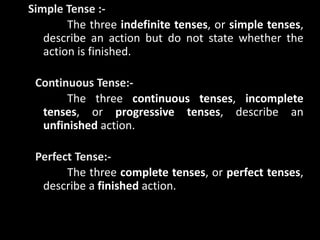
Simple Tense :-
The three indefinite tenses, or simple tenses,
describe an action but do not state whether the
action is finished.
Continuous Tense:-
The three continuous tenses, incomplete
tenses, or progressive tenses, describe an
unfinished action.
Perfect Tense:-
The three complete tenses, or perfect tenses,
describe a finished action.
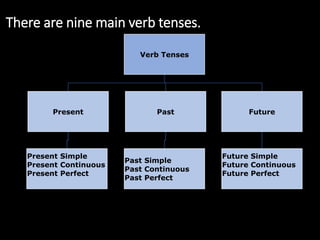
There are nine main verb tenses.
Verb Tenses
Present
Present Simple
Present Continuous
Present Perfect
Past
Past Simple
Past Continuous
Past Perfect
Future
Future Simple
Future Continuous
Future Perfect
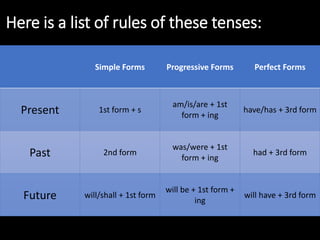
Here is a list of rules of these tenses:
Simple Forms Progressive Forms Perfect Forms
Present 1st form + s
am/is/are + 1st
form + ing
have/has + 3rd form
Past 2nd form
was/were + 1st
form + ing
had + 3rd form
Future will/shall + 1st form
will be + 1st form +
ing
will have + 3rd form
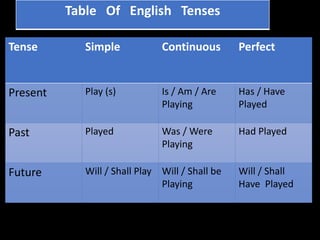
Tense Simple Continuous Perfect
Present Play (s) Is / Am / Are
Playing
Has / Have
Played
Past Played Was / Were
Playing
Had Played
Future Will / Shall Play Will / Shall be
Playing
Will / Shall
Have Played
Table Of English Tenses
oThe Simple Tense does not indicate whether the action
is complete or not.
oThe Continuous Tense that the action is still going on.
oThe Perfect Tense indicates that the action is complete
, finished or perfect.
PRESENT
SIMPLE PRESENT TENSE
Subject + Verb1 + Object
Expresses a general truth or an action that is
occurring now
Eg : The sun rises from the east.
Expresses an action that occurs regularly or
habitually
Eg : She goes to the school regularly.
• Affirmative Sentences : They play.
• Negative Sentences : They do not play.
• Interrogative Sentences : Do they play ?
PRESENT CONTINOUS TENSE
Subject + Is/Am/Are + V1 + ing + Object.
The present continuous tense is used to express
an action which is happening at a particular time
in the present or extending over a period of
present time.
• Affirmative Sentences : You are playing.
• Negative Sentences : You are not playing.
• Interrogative Sentences : Are you playing ?
PRESENT PERFECT TENSE
• Subject + has/have + V3 + Object.
• Has -> Singular , Have -> Plural.
• The present perfect tense denotes an action that was
started in the past and has just been completed.
• Affirmative Sentences : I have played.
• Negative Sentences : I have not played.
• Interrogative Sentences : Have I played ?
PAST
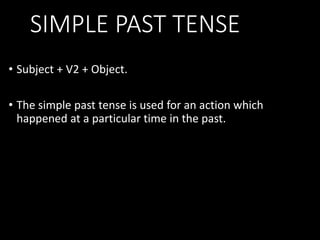
SIMPLE PAST TENSE
• Subject + V2 + Object.
• The simple past tense is used for an action which
happened at a particular time in the past.
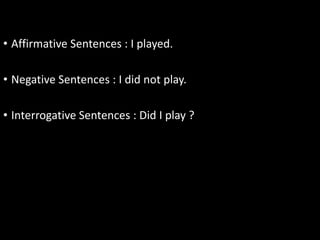
• Affirmative Sentences : I played.
• Negative Sentences : I did not play.
• Interrogative Sentences : Did I play ?
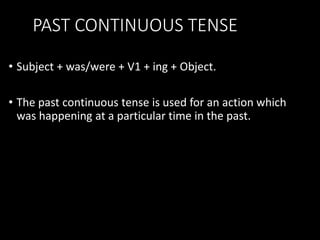
PAST CONTINUOUS TENSE
• Subject + was/were + V1 + ing + Object.
• The past continuous tense is used for an action which
was happening at a particular time in the past.
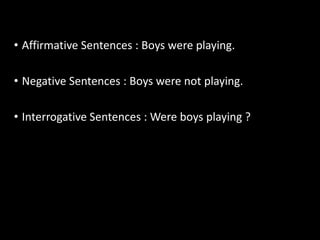
• Affirmative Sentences : Boys were playing.
• Negative Sentences : Boys were not playing.
• Interrogative Sentences : Were boys playing ?
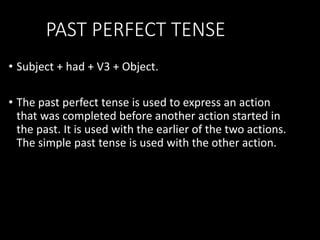
PAST PERFECT TENSE
• Subject + had + V3 + Object.
• The past perfect tense is used to express an action
that was completed before another action started in
the past. It is used with the earlier of the two actions.
The simple past tense is used with the other action.
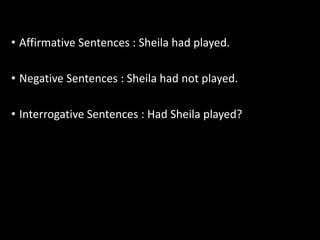
• Affirmative Sentences : Sheila had played.
• Negative Sentences : Sheila had not played.
• Interrogative Sentences : Had Sheila played?
FUTURE
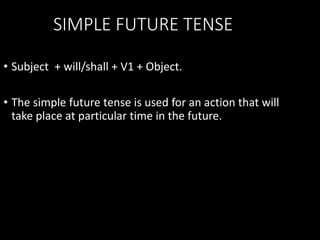
SIMPLE FUTURE TENSE
• Subject + will/shall + V1 + Object.
• The simple future tense is used for an action that will
take place at particular time in the future.
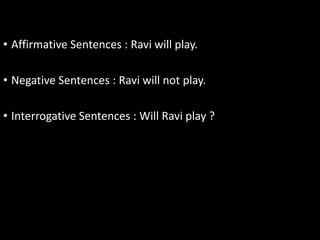
• Affirmative Sentences : Ravi will play.
• Negative Sentences : Ravi will not play.
• Interrogative Sentences : Will Ravi play ?
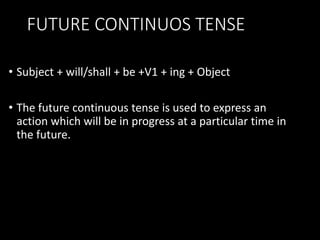
FUTURE CONTINUOS TENSE
• Subject + will/shall + be +V1 + ing + Object
• The future continuous tense is used to express an
action which will be in progress at a particular time in
the future.
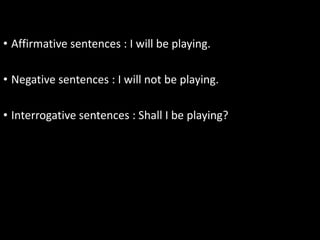
• Affirmative sentences : I will be playing.
• Negative sentences : I will not be playing.
• Interrogative sentences : Shall I be playing?
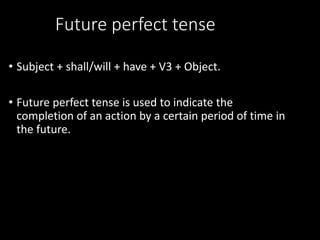
Future perfect tense
• Subject + shall/will + have + V3 + Object.
• Future perfect tense is used to indicate the
completion of an action by a certain period of time in
the future.
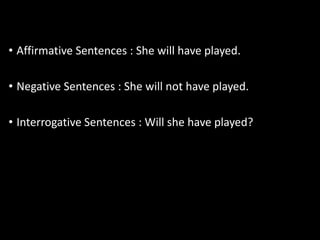
• Affirmative Sentences : She will have played.
• Negative Sentences : She will not have played.
• Interrogative Sentences : Will she have played?
The End
By Sheeryl Desilva

Tenses

  • 1.
  • 2.
    INTRODUCTION The word Tenseis derived from Latin word “tempus” which means time. A verb indicates the time of an action, event or condition by changing its form.
  • 3.
    Based on Timeframe The verb tenses may be categorized according to the time frame to show the time of an action or the state of an event: There are three tenses: o Present Tense o Past Tense o Future Tense
  • 4.
    Each of thethree tenses has four forms or subdivisions to show continuity or completeness of the action and time. These are : • Indefinite • Continuous or Imperfect • Perfect • Perfect Continuous
  • 5.
    Present Tense :--- Presenttense expresses an unchanging, repeated, or reoccurring action or situation that exists only now. It can also represent a widespread truth. Past Tense :--- Past tense expresses an action or situation that was started and finished in the past. Future Tense :--- Future tense expresses an action or situation that will occur in the future.
  • 6.
    Simple Tense :- Thethree indefinite tenses, or simple tenses, describe an action but do not state whether the action is finished. Continuous Tense:- The three continuous tenses, incomplete tenses, or progressive tenses, describe an unfinished action. Perfect Tense:- The three complete tenses, or perfect tenses, describe a finished action.
  • 7.
    There are ninemain verb tenses. Verb Tenses Present Present Simple Present Continuous Present Perfect Past Past Simple Past Continuous Past Perfect Future Future Simple Future Continuous Future Perfect
  • 8.
    Here is alist of rules of these tenses: Simple Forms Progressive Forms Perfect Forms Present 1st form + s am/is/are + 1st form + ing have/has + 3rd form Past 2nd form was/were + 1st form + ing had + 3rd form Future will/shall + 1st form will be + 1st form + ing will have + 3rd form
  • 9.
    Tense Simple ContinuousPerfect Present Play (s) Is / Am / Are Playing Has / Have Played Past Played Was / Were Playing Had Played Future Will / Shall Play Will / Shall be Playing Will / Shall Have Played Table Of English Tenses
  • 10.
    oThe Simple Tensedoes not indicate whether the action is complete or not. oThe Continuous Tense that the action is still going on. oThe Perfect Tense indicates that the action is complete , finished or perfect.
  • 11.
  • 12.
    SIMPLE PRESENT TENSE Subject+ Verb1 + Object Expresses a general truth or an action that is occurring now Eg : The sun rises from the east. Expresses an action that occurs regularly or habitually Eg : She goes to the school regularly.
  • 13.
    • Affirmative Sentences: They play. • Negative Sentences : They do not play. • Interrogative Sentences : Do they play ?
  • 14.
    PRESENT CONTINOUS TENSE Subject+ Is/Am/Are + V1 + ing + Object. The present continuous tense is used to express an action which is happening at a particular time in the present or extending over a period of present time.
  • 15.
    • Affirmative Sentences: You are playing. • Negative Sentences : You are not playing. • Interrogative Sentences : Are you playing ?
  • 16.
    PRESENT PERFECT TENSE •Subject + has/have + V3 + Object. • Has -> Singular , Have -> Plural. • The present perfect tense denotes an action that was started in the past and has just been completed.
  • 17.
    • Affirmative Sentences: I have played. • Negative Sentences : I have not played. • Interrogative Sentences : Have I played ?
  • 18.
  • 19.
    SIMPLE PAST TENSE •Subject + V2 + Object. • The simple past tense is used for an action which happened at a particular time in the past.
  • 20.
    • Affirmative Sentences: I played. • Negative Sentences : I did not play. • Interrogative Sentences : Did I play ?
  • 21.
    PAST CONTINUOUS TENSE •Subject + was/were + V1 + ing + Object. • The past continuous tense is used for an action which was happening at a particular time in the past.
  • 22.
    • Affirmative Sentences: Boys were playing. • Negative Sentences : Boys were not playing. • Interrogative Sentences : Were boys playing ?
  • 23.
    PAST PERFECT TENSE •Subject + had + V3 + Object. • The past perfect tense is used to express an action that was completed before another action started in the past. It is used with the earlier of the two actions. The simple past tense is used with the other action.
  • 24.
    • Affirmative Sentences: Sheila had played. • Negative Sentences : Sheila had not played. • Interrogative Sentences : Had Sheila played?
  • 25.
  • 26.
    SIMPLE FUTURE TENSE •Subject + will/shall + V1 + Object. • The simple future tense is used for an action that will take place at particular time in the future.
  • 27.
    • Affirmative Sentences: Ravi will play. • Negative Sentences : Ravi will not play. • Interrogative Sentences : Will Ravi play ?
  • 28.
    FUTURE CONTINUOS TENSE •Subject + will/shall + be +V1 + ing + Object • The future continuous tense is used to express an action which will be in progress at a particular time in the future.
  • 29.
    • Affirmative sentences: I will be playing. • Negative sentences : I will not be playing. • Interrogative sentences : Shall I be playing?
  • 30.
    Future perfect tense •Subject + shall/will + have + V3 + Object. • Future perfect tense is used to indicate the completion of an action by a certain period of time in the future.
  • 31.
    • Affirmative Sentences: She will have played. • Negative Sentences : She will not have played. • Interrogative Sentences : Will she have played?
  • 32.