TENSES - Learn without tense
Compiled by
Chandra shekar Pendoti
M.A. English , B.Ed , TS-SET
Poet & Author
Youtube: chandrashekar’sspokenenglishclasses
FB page: Chandu English
chanduenglish.blogspot.com
Page 1 of 17
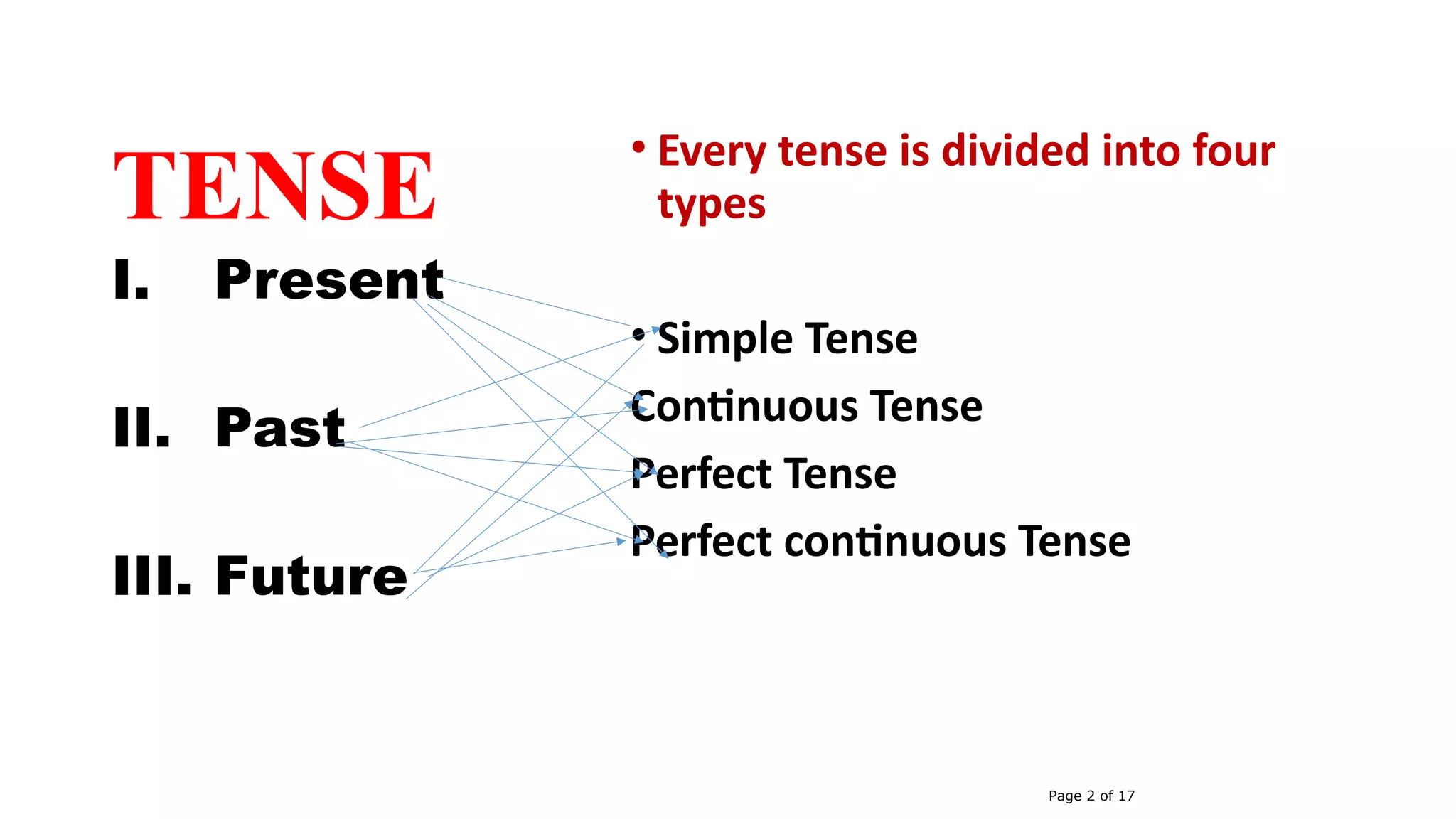
TENSE
• Every tense is divided into four
types
• Simple Tense
Continuous Tense
Perfect Tense
Perfect continuous Tense
I. Present
II. Past
III. Future
Page 2 of 17
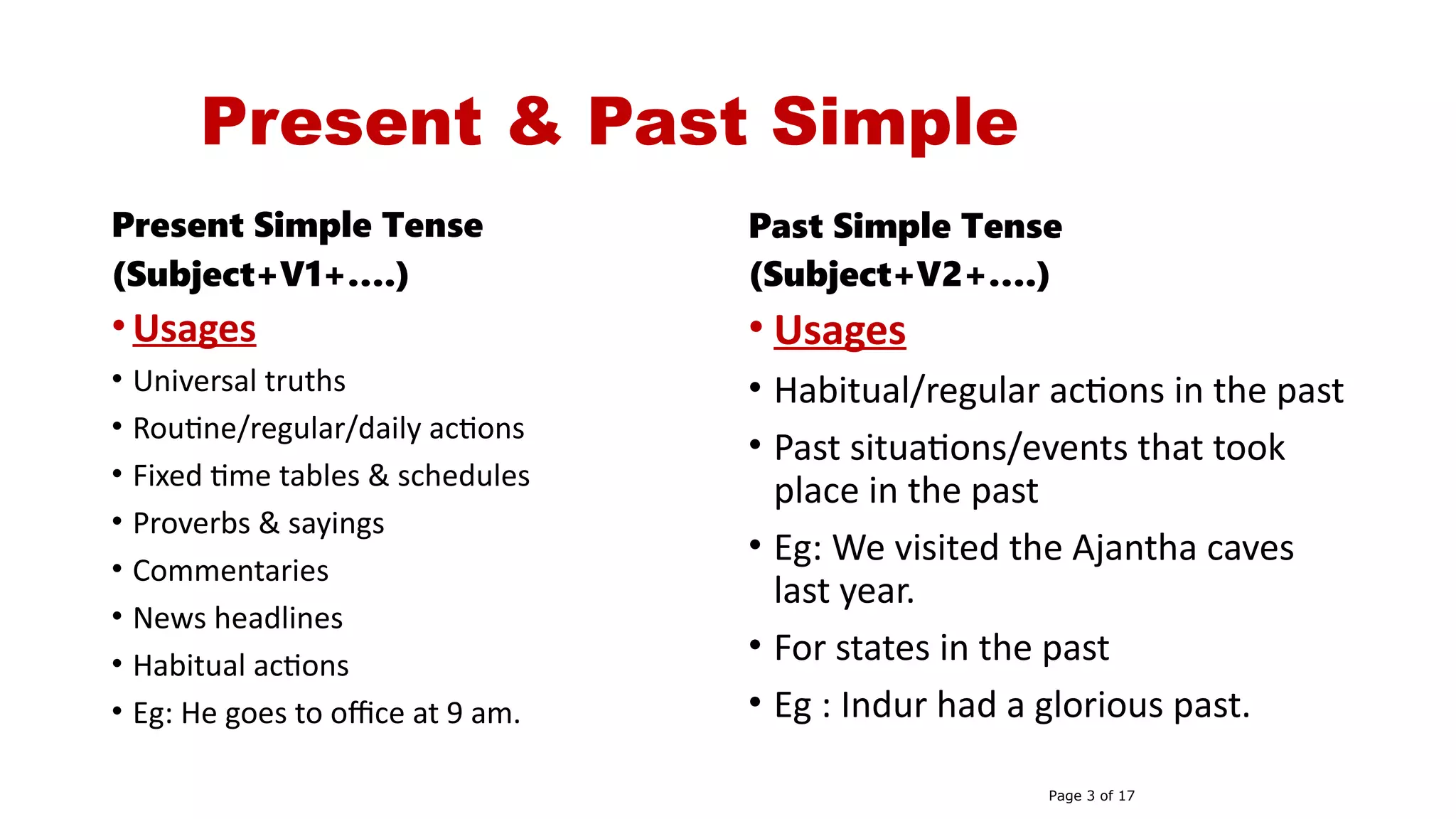
Present & Past Simple
Present Simple Tense
(Subject+V1+….)
• Usages
• Universal truths
• Routine/regular/daily actions
• Fixed time tables & schedules
• Proverbs & sayings
• Commentaries
• News headlines
• Habitual actions
• Eg: He goes to office at 9 am.
Past Simple Tense
(Subject+V2+….)
• Usages
• Habitual/regular actions in the past
• Past situations/events that took
place in the past
• Eg: We visited the Ajantha caves
last year.
• For states in the past
• Eg : Indur had a glorious past.
Page 3 of 17
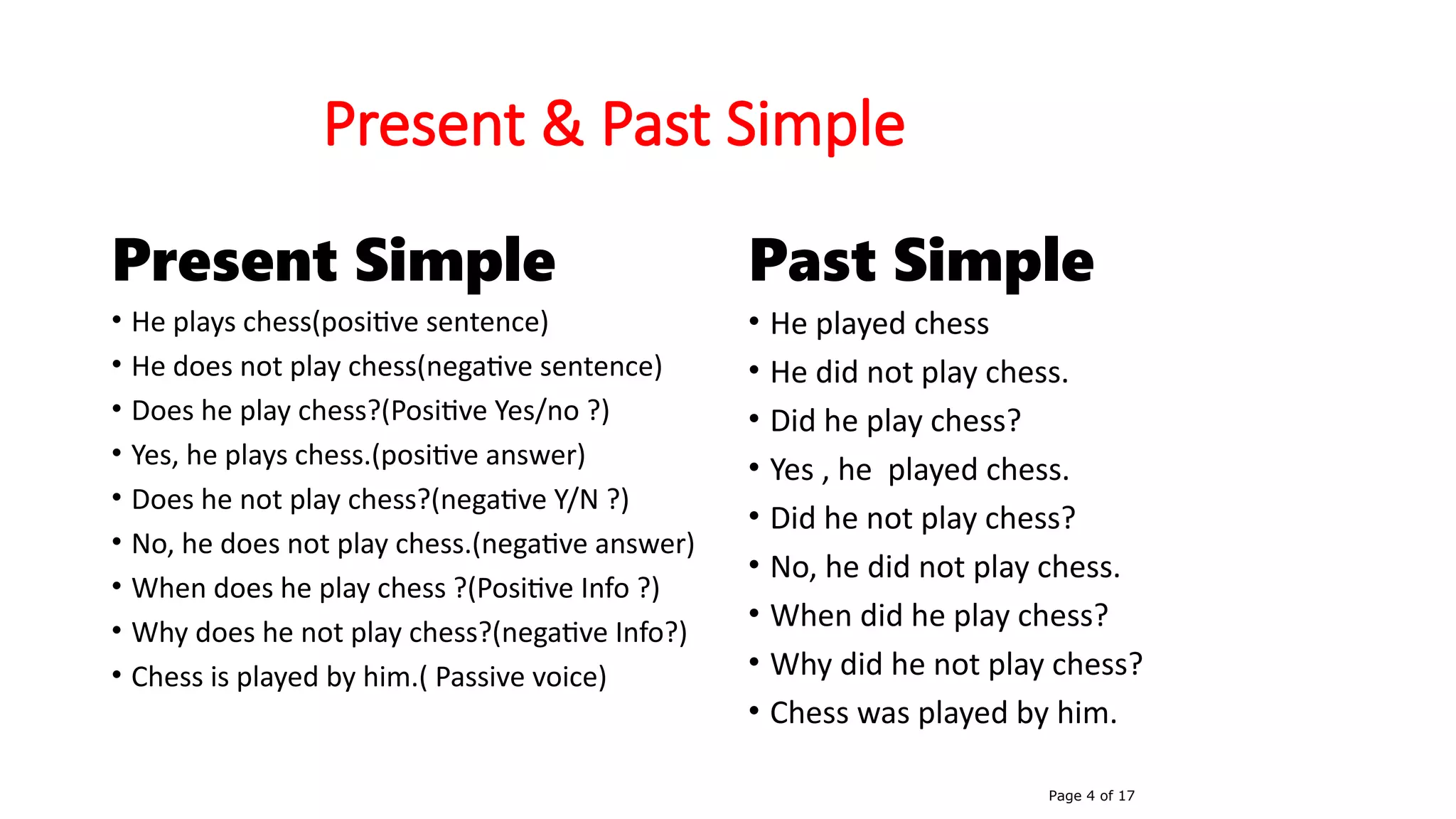
Present & Past Simple
Present Simple
• He plays chess(positive sentence)
• He does not play chess(negative sentence)
• Does he play chess?(Positive Yes/no ?)
• Yes, he plays chess.(positive answer)
• Does he not play chess?(negative Y/N ?)
• No, he does not play chess.(negative answer)
• When does he play chess ?(Positive Info ?)
• Why does he not play chess?(negative Info?)
• Chess is played by him.( Passive voice)
Past Simple
• He played chess
• He did not play chess.
• Did he play chess?
• Yes , he played chess.
• Did he not play chess?
• No, he did not play chess.
• When did he play chess?
• Why did he not play chess?
• Chess was played by him.
Page 4 of 17
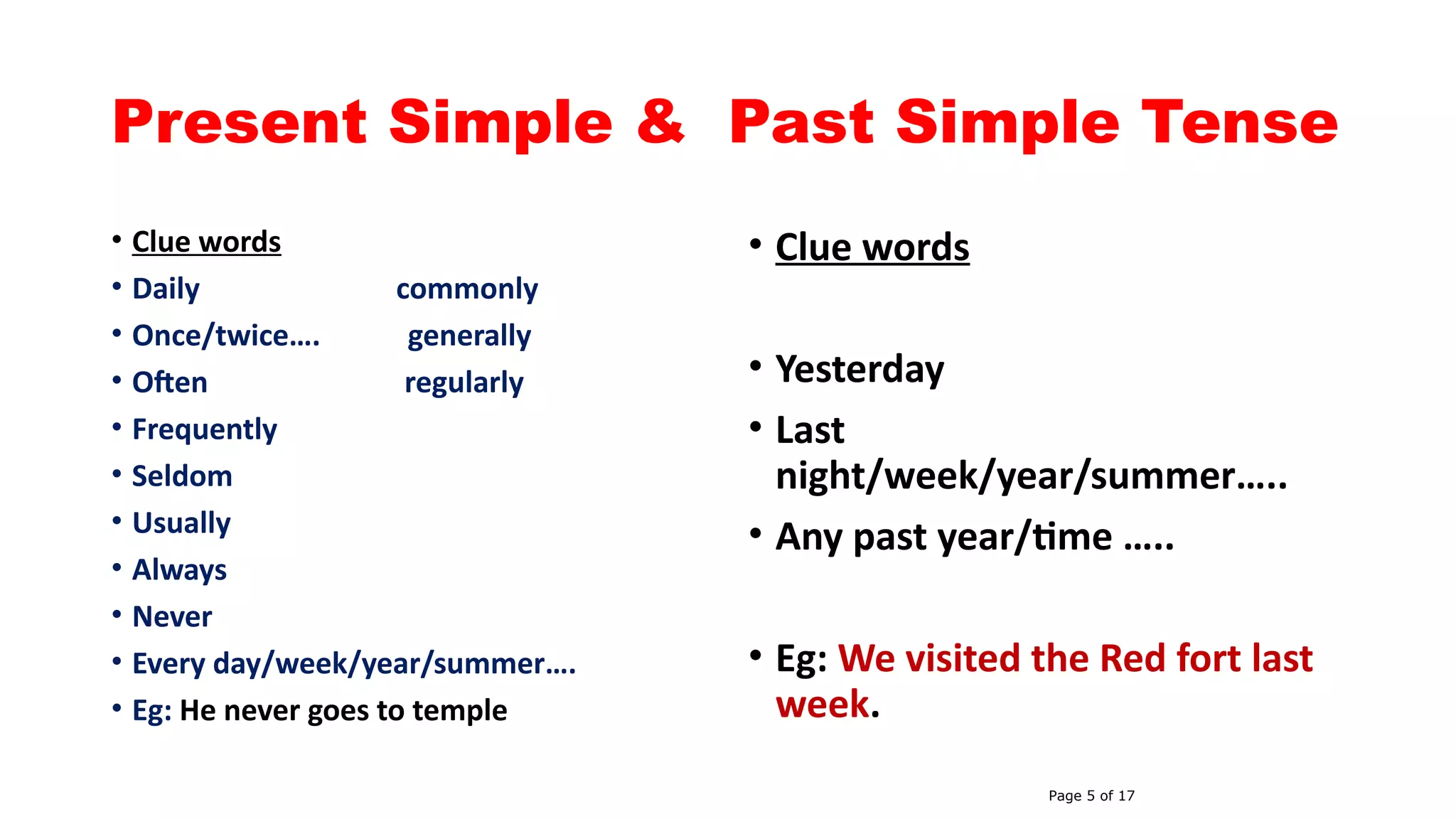
Present Simple & Past Simple Tense
• Clue words
• Daily commonly
• Once/twice…. generally
• Often regularly
• Frequently
• Seldom
• Usually
• Always
• Never
• Every day/week/year/summer….
• Eg: He never goes to temple
• Clue words
• Yesterday
• Last
night/week/year/summer…..
• Any past year/time …..
• Eg: We visited the Red fort last
week.
Page 5 of 17
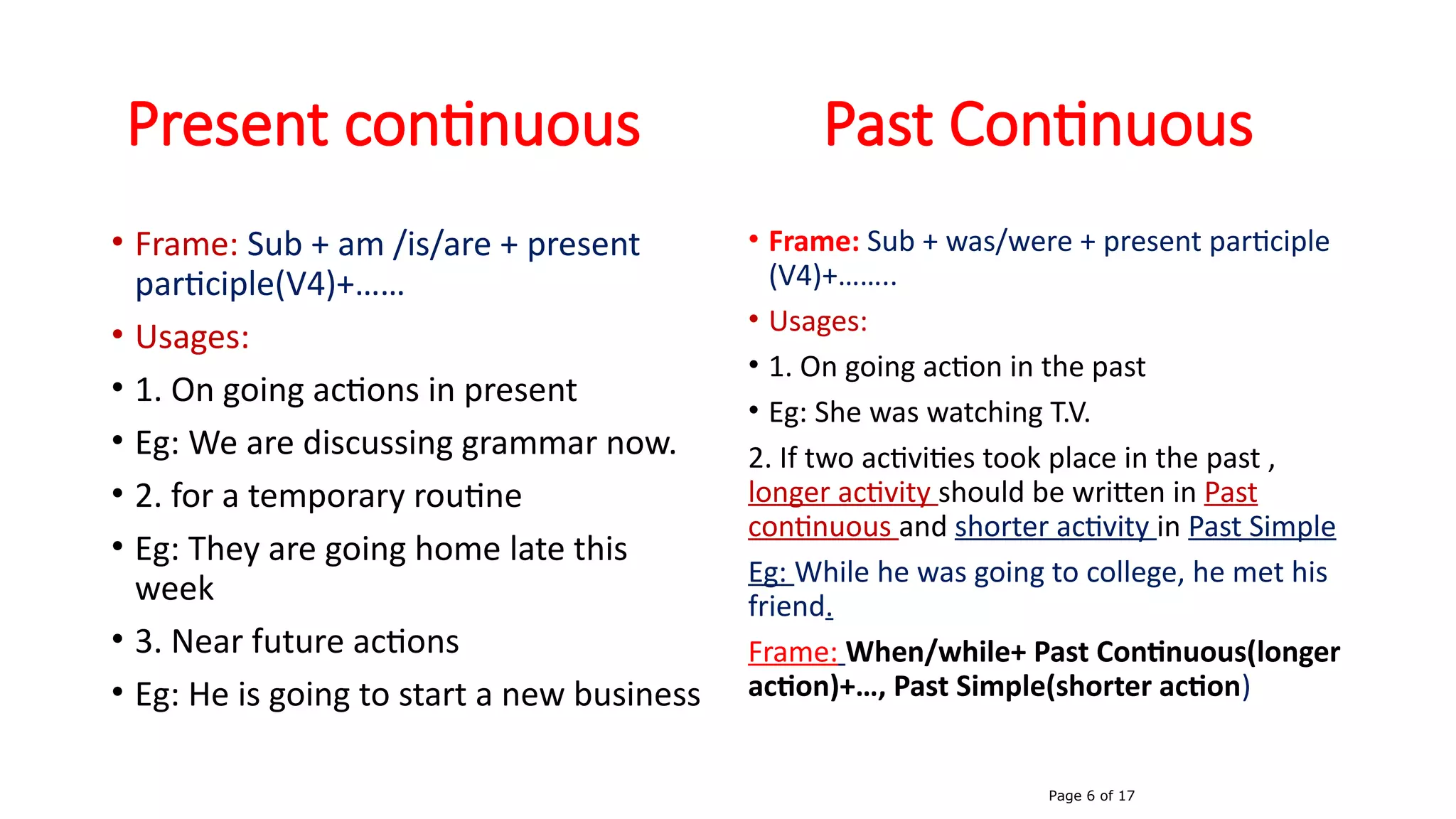
Present continuous Past Continuous
• Frame: Sub + am /is/are + present
participle(V4)+……
• Usages:
• 1. On going actions in present
• Eg: We are discussing grammar now.
• 2. for a temporary routine
• Eg: They are going home late this
week
• 3. Near future actions
• Eg: He is going to start a new business
• Frame: Sub + was/were + present participle
(V4)+……..
• Usages:
• 1. On going action in the past
• Eg: She was watching T.V.
2. If two activities took place in the past ,
longer activity should be written in Past
continuous and shorter activity in Past Simple
Eg: While he was going to college, he met his
friend.
Frame: When/while+ Past Continuous(longer
action)+…, Past Simple(shorter action)
Page 6 of 17
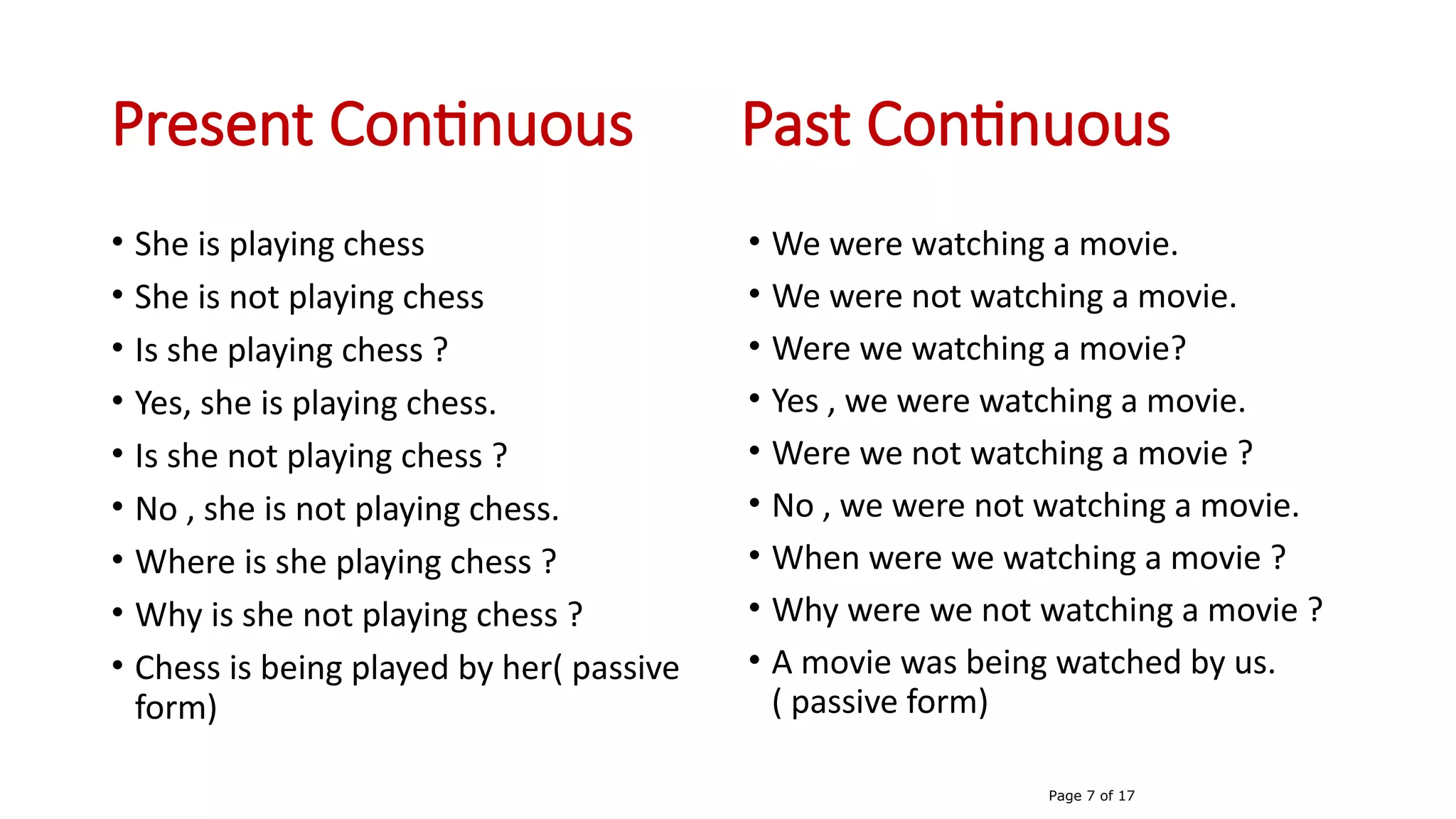
Present Continuous Past Continuous
• She is playing chess
• She is not playing chess
• Is she playing chess ?
• Yes, she is playing chess.
• Is she not playing chess ?
• No , she is not playing chess.
• Where is she playing chess ?
• Why is she not playing chess ?
• Chess is being played by her( passive
form)
• We were watching a movie.
• We were not watching a movie.
• Were we watching a movie?
• Yes , we were watching a movie.
• Were we not watching a movie ?
• No , we were not watching a movie.
• When were we watching a movie ?
• Why were we not watching a movie ?
• A movie was being watched by us.
( passive form)
Page 7 of 17
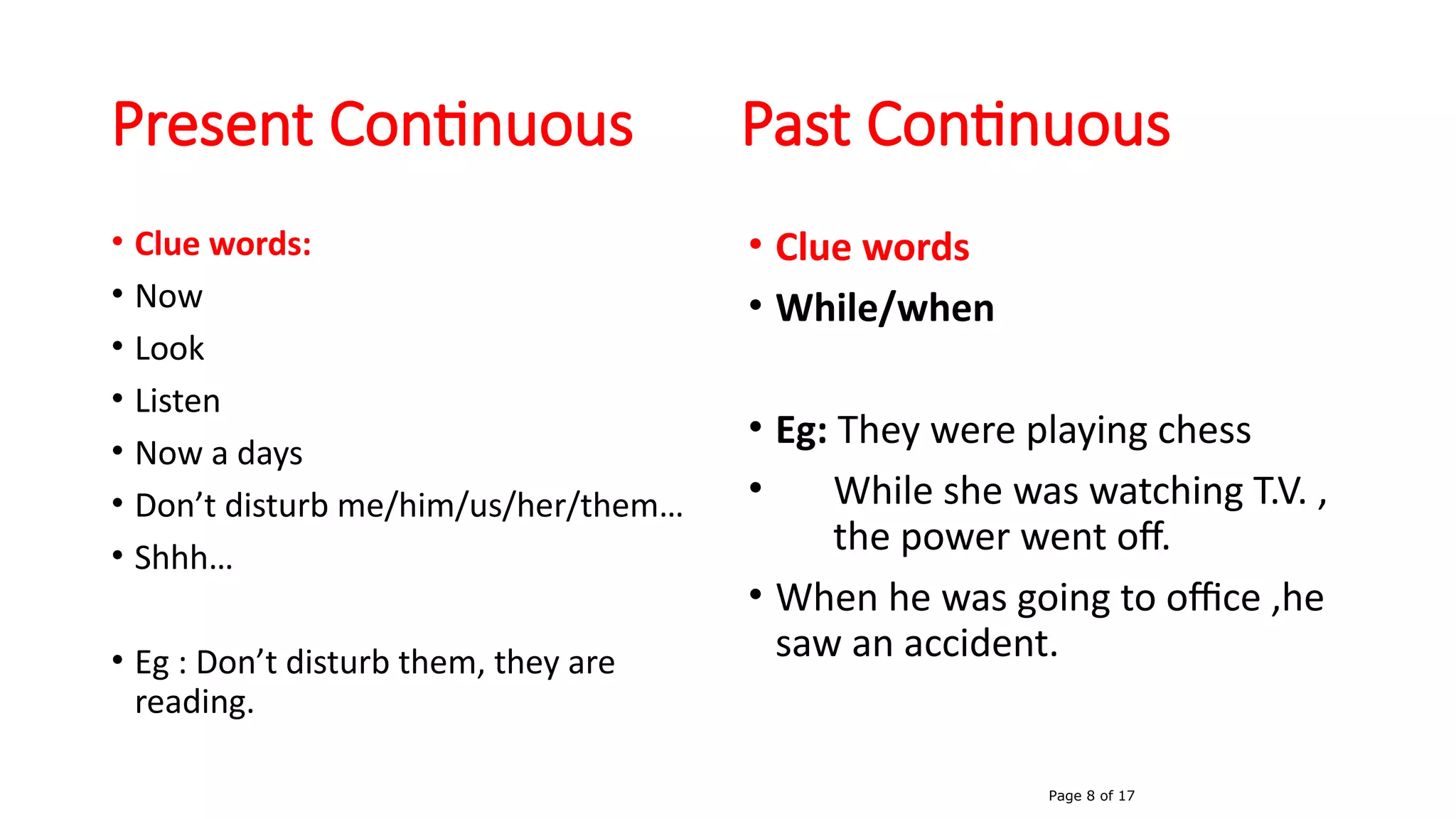
Present Continuous Past Continuous
• Clue words:
• Now
• Look
• Listen
• Now a days
• Don’t disturb me/him/us/her/them…
• Shhh…
• Eg : Don’t disturb them, they are
reading.
• Clue words
• While/when
• Eg: They were playing chess
• While she was watching T.V. ,
the power went off.
• When he was going to office ,he
saw an accident.
Page 8 of 17
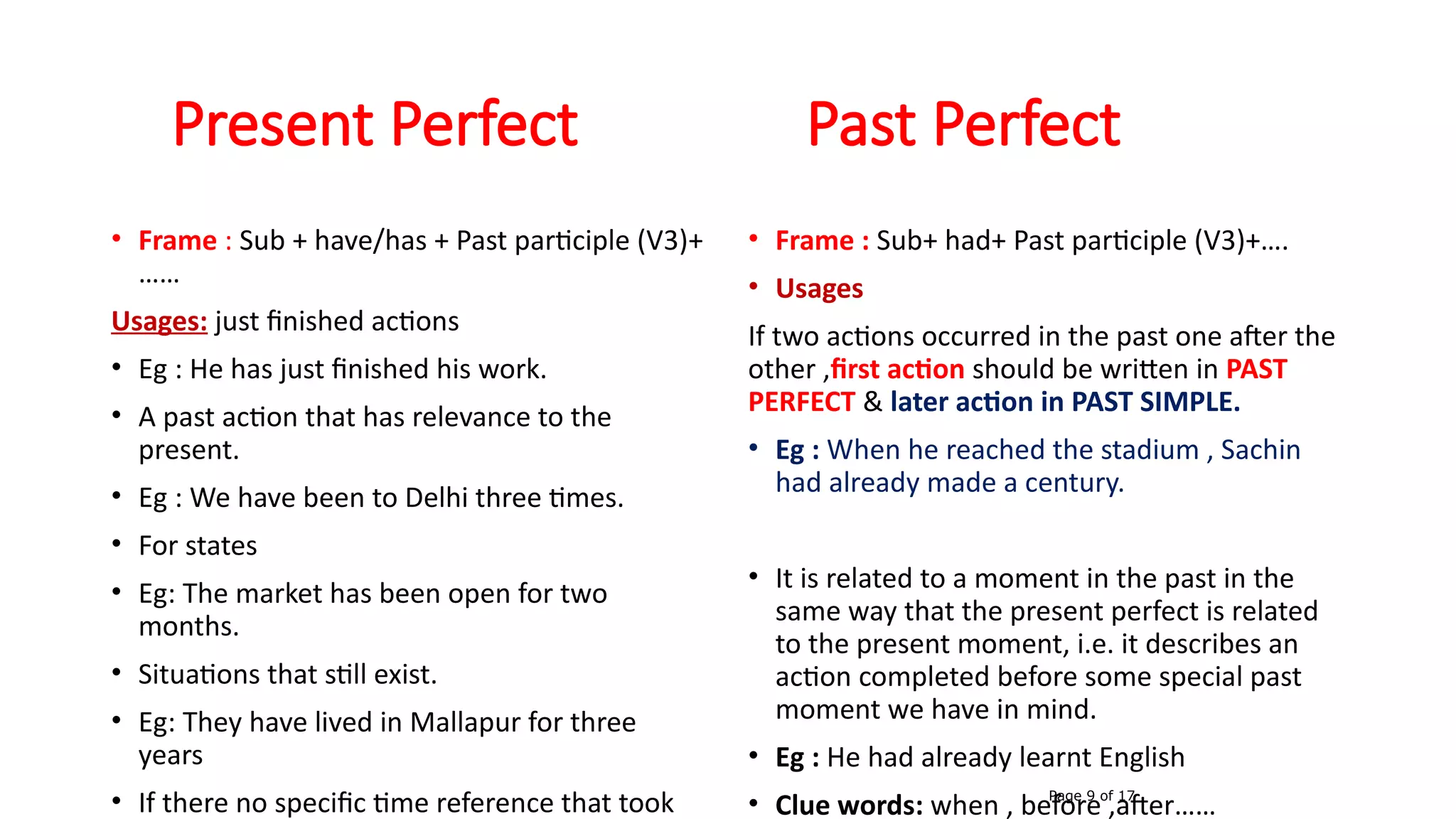
Present Perfect Past Perfect
• Frame : Sub + have/has + Past participle (V3)+
……
Usages: just finished actions
• Eg : He has just finished his work.
• A past action that has relevance to the
present.
• Eg : We have been to Delhi three times.
• For states
• Eg: The market has been open for two
months.
• Situations that still exist.
• Eg: They have lived in Mallapur for three
years
• If there no specific time reference that took
• Frame : Sub+ had+ Past participle (V3)+….
• Usages
If two actions occurred in the past one after the
other ,first action should be written in PAST
PERFECT & later action in PAST SIMPLE.
• Eg : When he reached the stadium , Sachin
had already made a century.
• It is related to a moment in the past in the
same way that the present perfect is related
to the present moment, i.e. it describes an
action completed before some special past
moment we have in mind.
• Eg : He had already learnt English
• Clue words: when , before ,after……Page 9 of 17
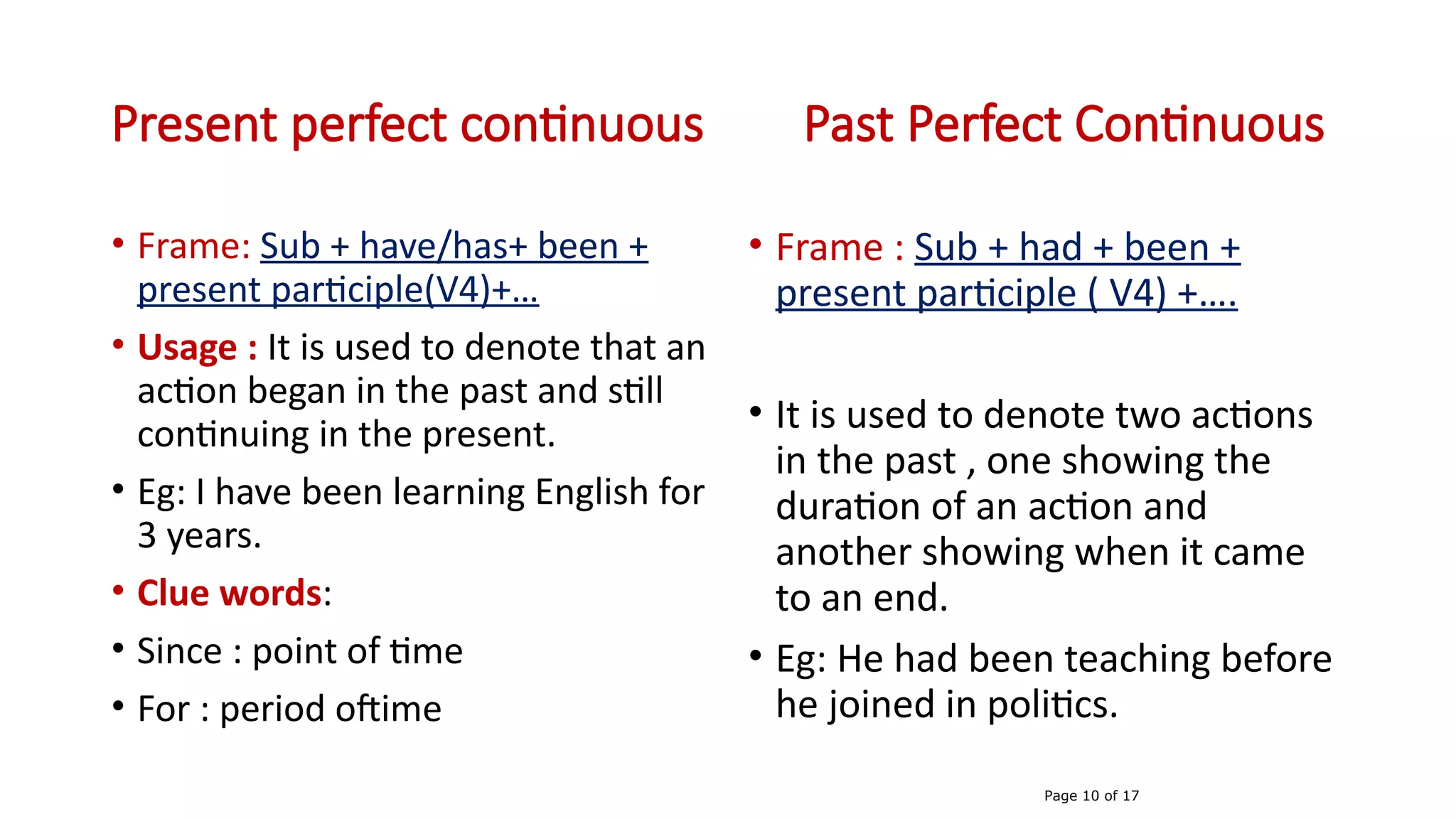
Present perfect continuous Past Perfect Continuous
• Frame: Sub + have/has+ been +
present participle(V4)+…
• Usage : It is used to denote that an
action began in the past and still
continuing in the present.
• Eg: I have been learning English for
3 years.
• Clue words:
• Since : point of time
• For : period oftime
• Frame : Sub + had + been +
present participle ( V4) +….
• It is used to denote two actions
in the past , one showing the
duration of an action and
another showing when it came
to an end.
• Eg: He had been teaching before
he joined in politics.
Page 10 of 17
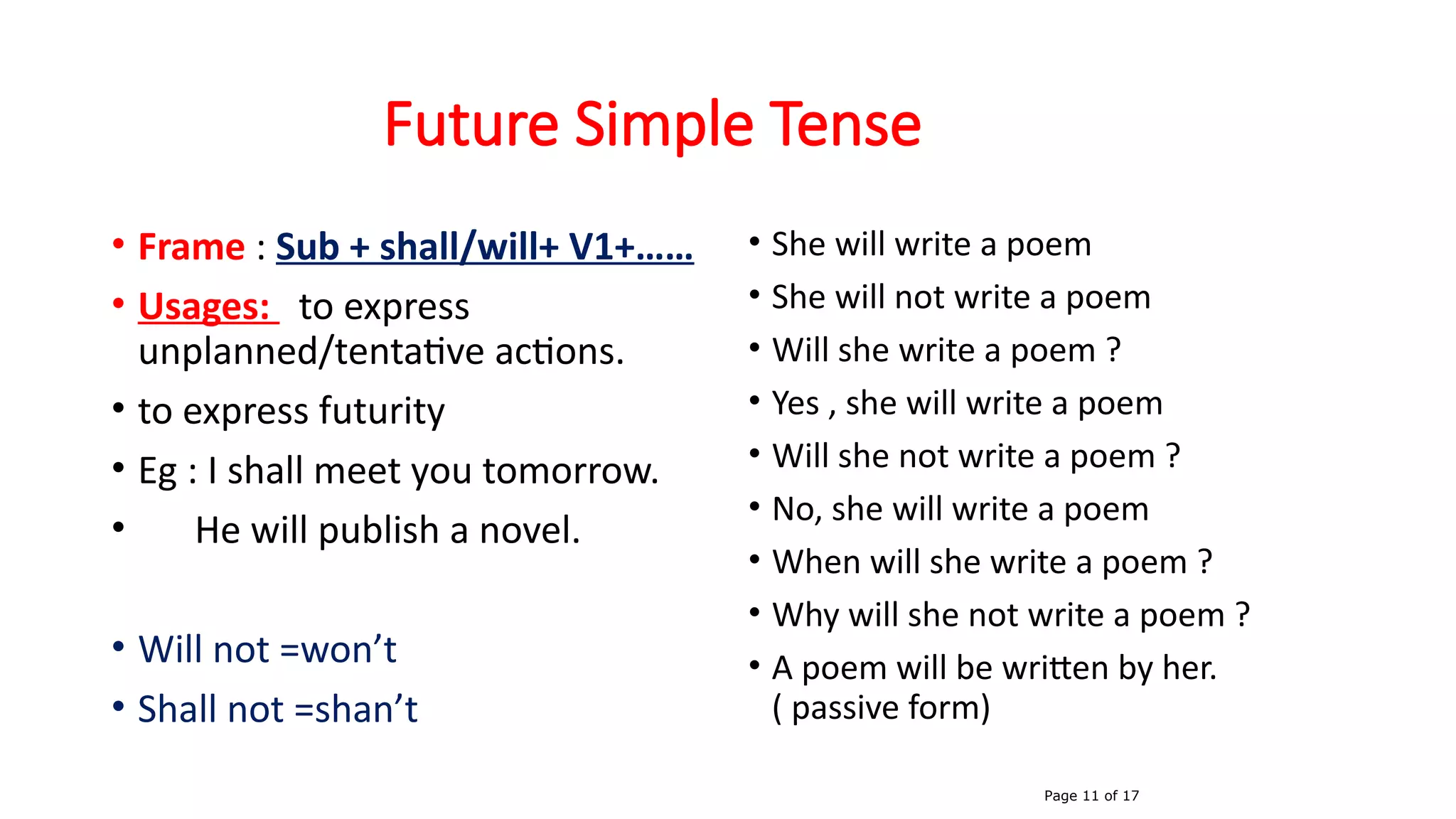
Future Simple Tense
• Frame : Sub + shall/will+ V1+……
• Usages: to express
unplanned/tentative actions.
• to express futurity
• Eg : I shall meet you tomorrow.
• He will publish a novel.
• Will not =won’t
• Shall not =shan’t
• She will write a poem
• She will not write a poem
• Will she write a poem ?
• Yes , she will write a poem
• Will she not write a poem ?
• No, she will write a poem
• When will she write a poem ?
• Why will she not write a poem ?
• A poem will be written by her.
( passive form)
Page 11 of 17
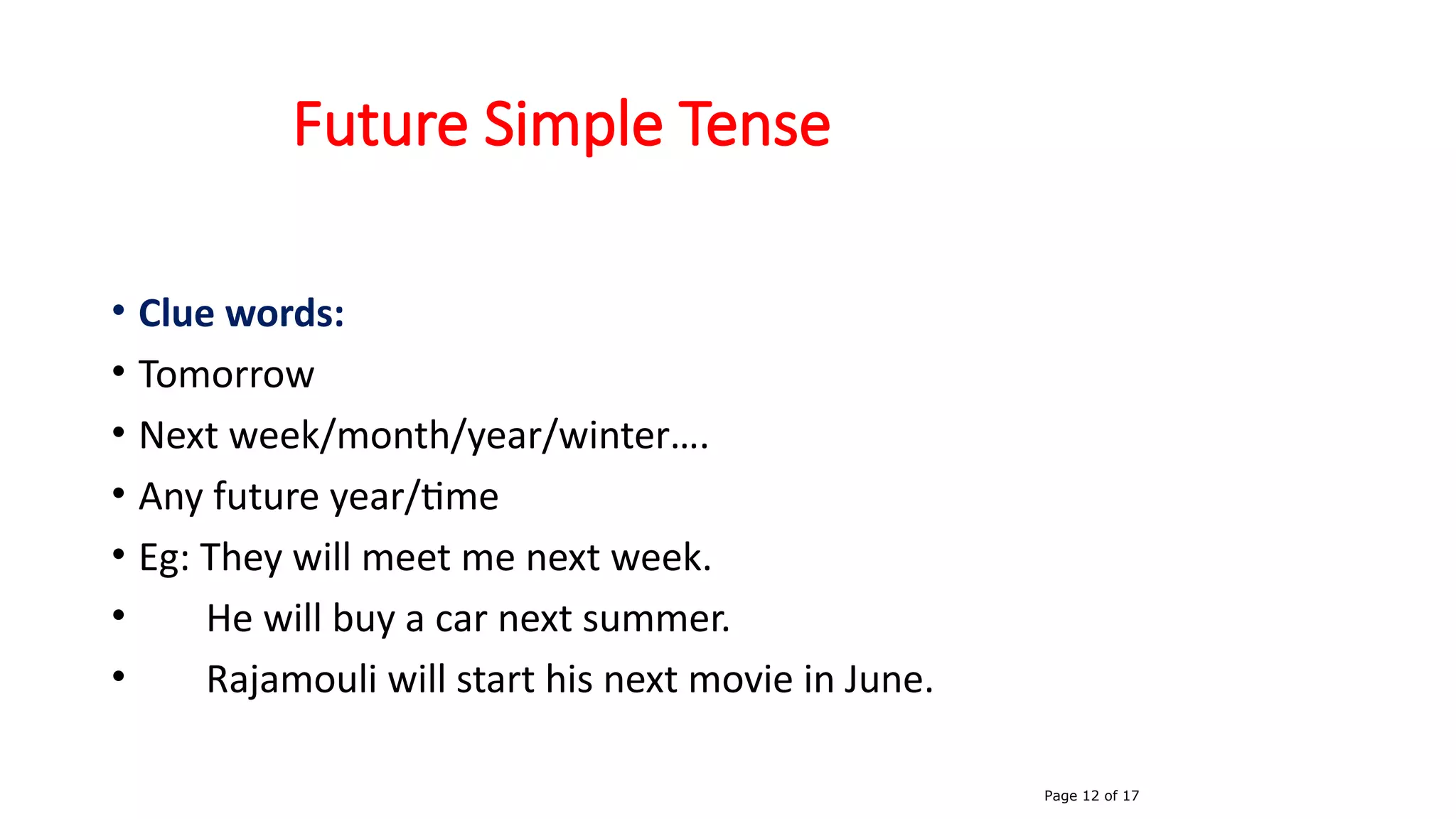
Future Simple Tense
• Clue words:
• Tomorrow
• Next week/month/year/winter….
• Any future year/time
• Eg: They will meet me next week.
• He will buy a car next summer.
• Rajamouli will start his next movie in June.
Page 12 of 17
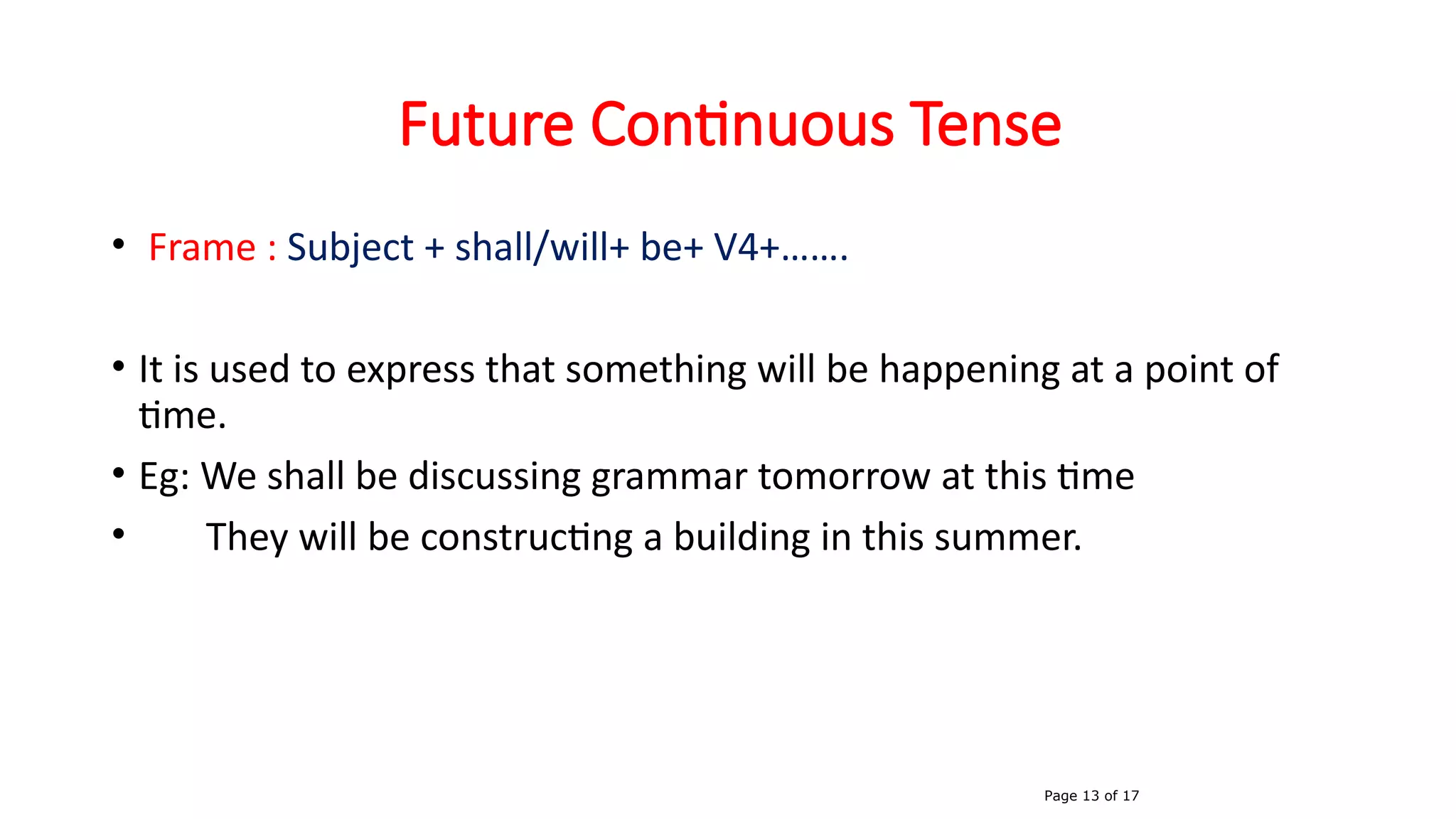
Future Continuous Tense
• Frame : Subject + shall/will+ be+ V4+…….
• It is used to express that something will be happening at a point of
time.
• Eg: We shall be discussing grammar tomorrow at this time
• They will be constructing a building in this summer.
Page 13 of 17
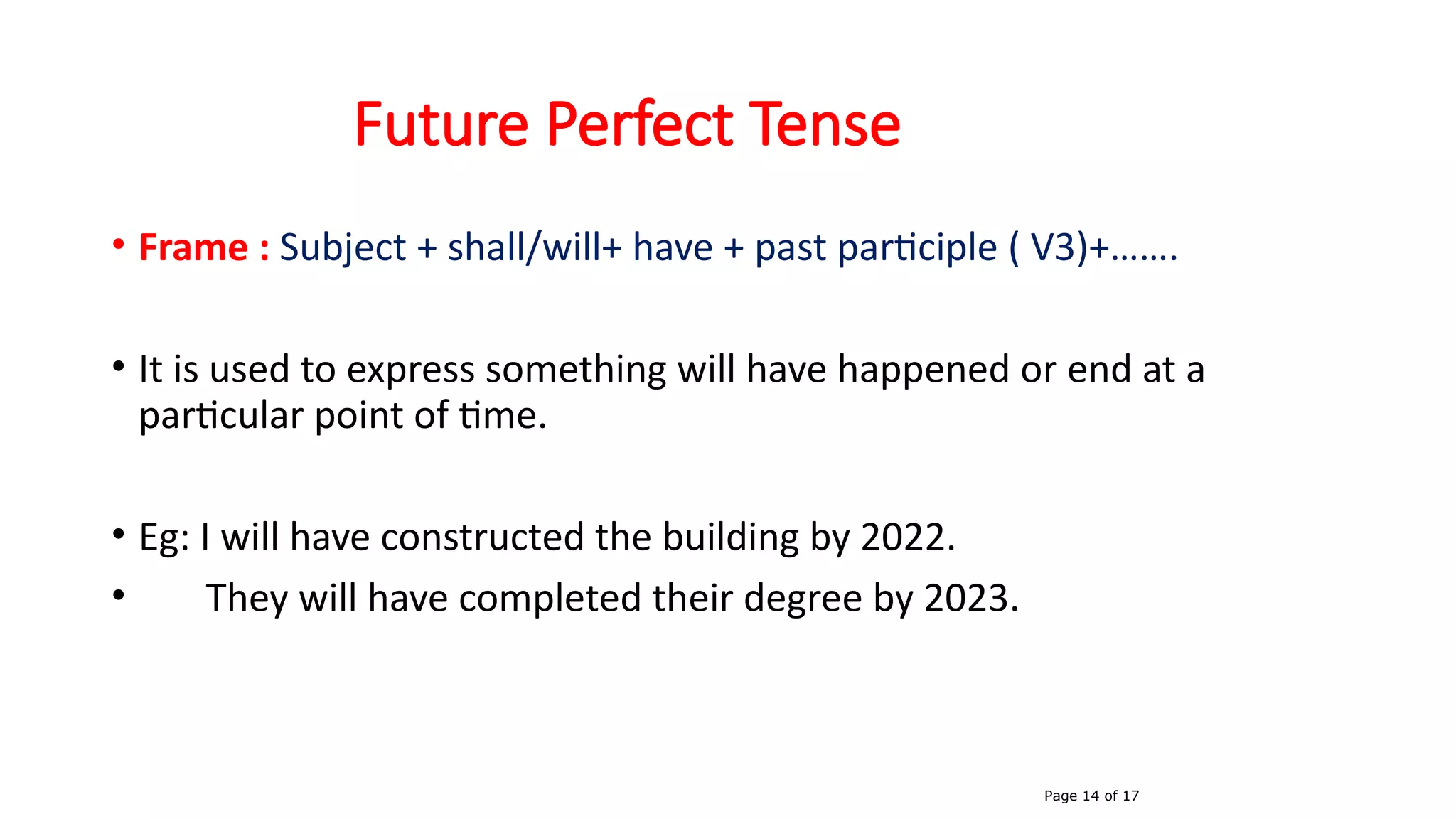
Future Perfect Tense
• Frame : Subject + shall/will+ have + past participle ( V3)+…….
• It is used to express something will have happened or end at a
particular point of time.
• Eg: I will have constructed the building by 2022.
• They will have completed their degree by 2023.
Page 14 of 17
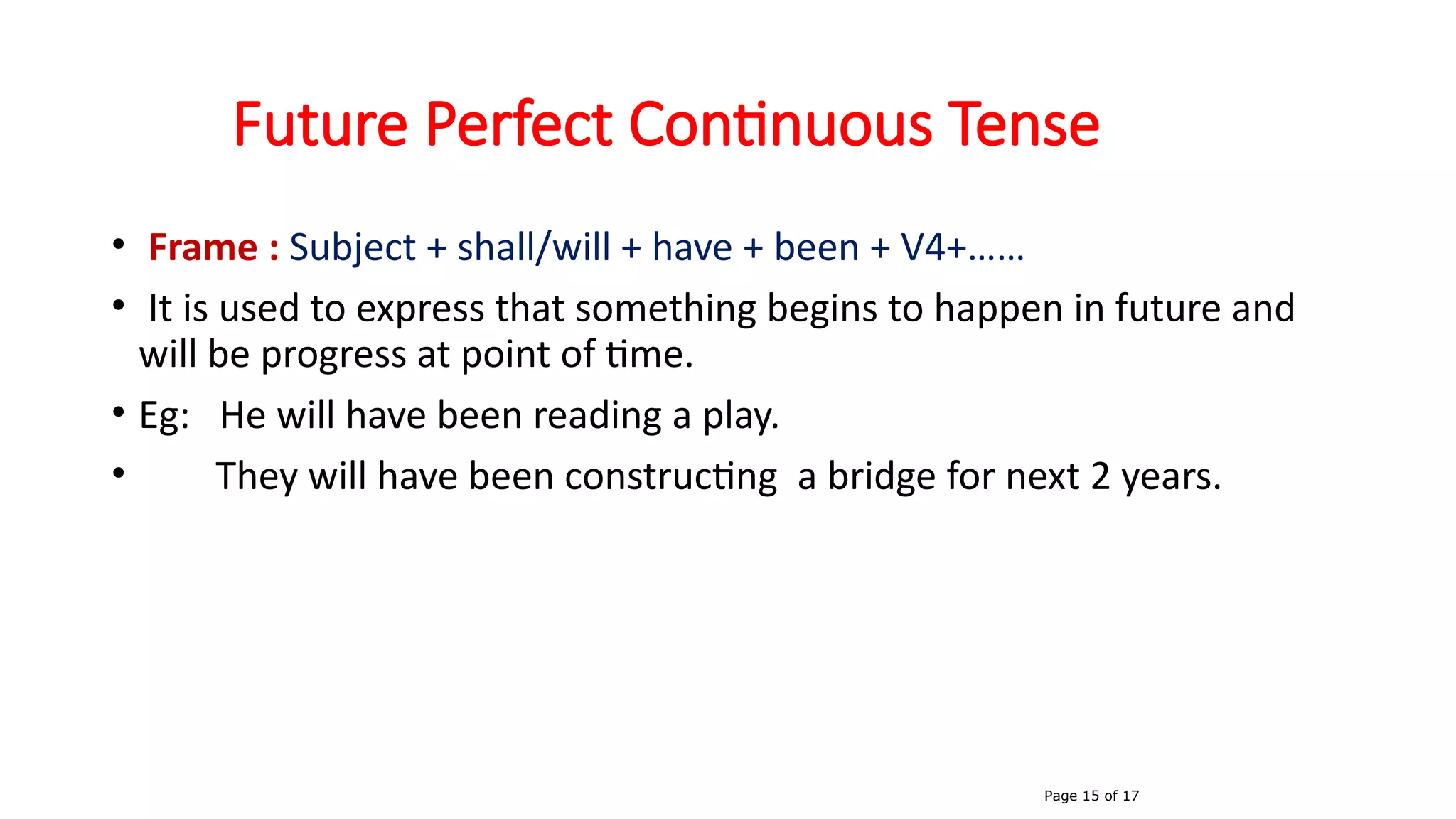
Future Perfect Continuous Tense
• Frame : Subject + shall/will + have + been + V4+……
• It is used to express that something begins to happen in future and
will be progress at point of time.
• Eg: He will have been reading a play.
• They will have been constructing a bridge for next 2 years.
Page 15 of 17
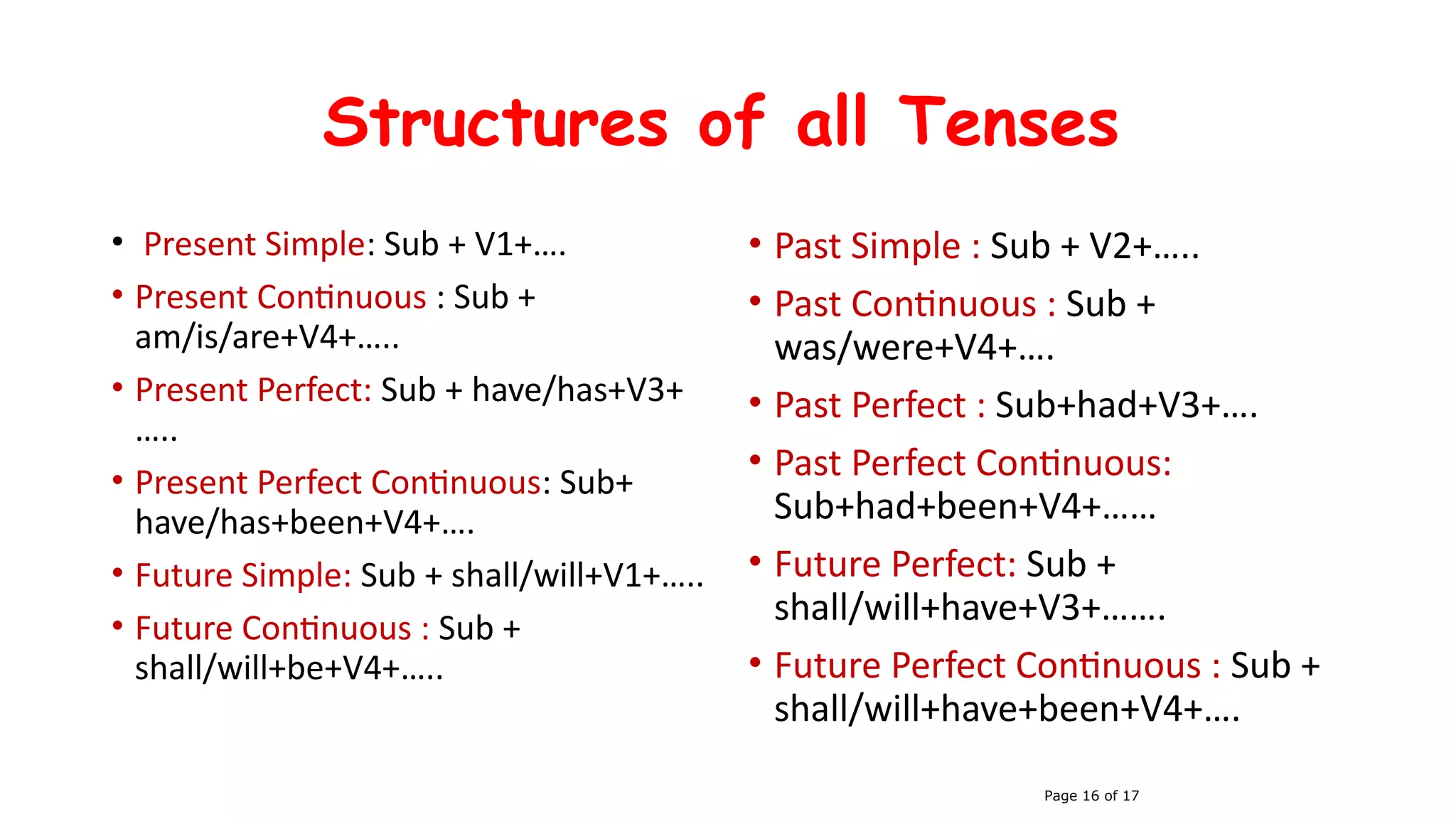
Structures of all Tenses
• Present Simple: Sub + V1+….
• Present Continuous : Sub +
am/is/are+V4+…..
• Present Perfect: Sub + have/has+V3+
…..
• Present Perfect Continuous: Sub+
have/has+been+V4+….
• Future Simple: Sub + shall/will+V1+…..
• Future Continuous : Sub +
shall/will+be+V4+…..
• Past Simple : Sub + V2+…..
• Past Continuous : Sub +
was/were+V4+….
• Past Perfect : Sub+had+V3+….
• Past Perfect Continuous:
Sub+had+been+V4+……
• Future Perfect: Sub +
shall/will+have+V3+…….
• Future Perfect Continuous : Sub +
shall/will+have+been+V4+….
Page 16 of 17
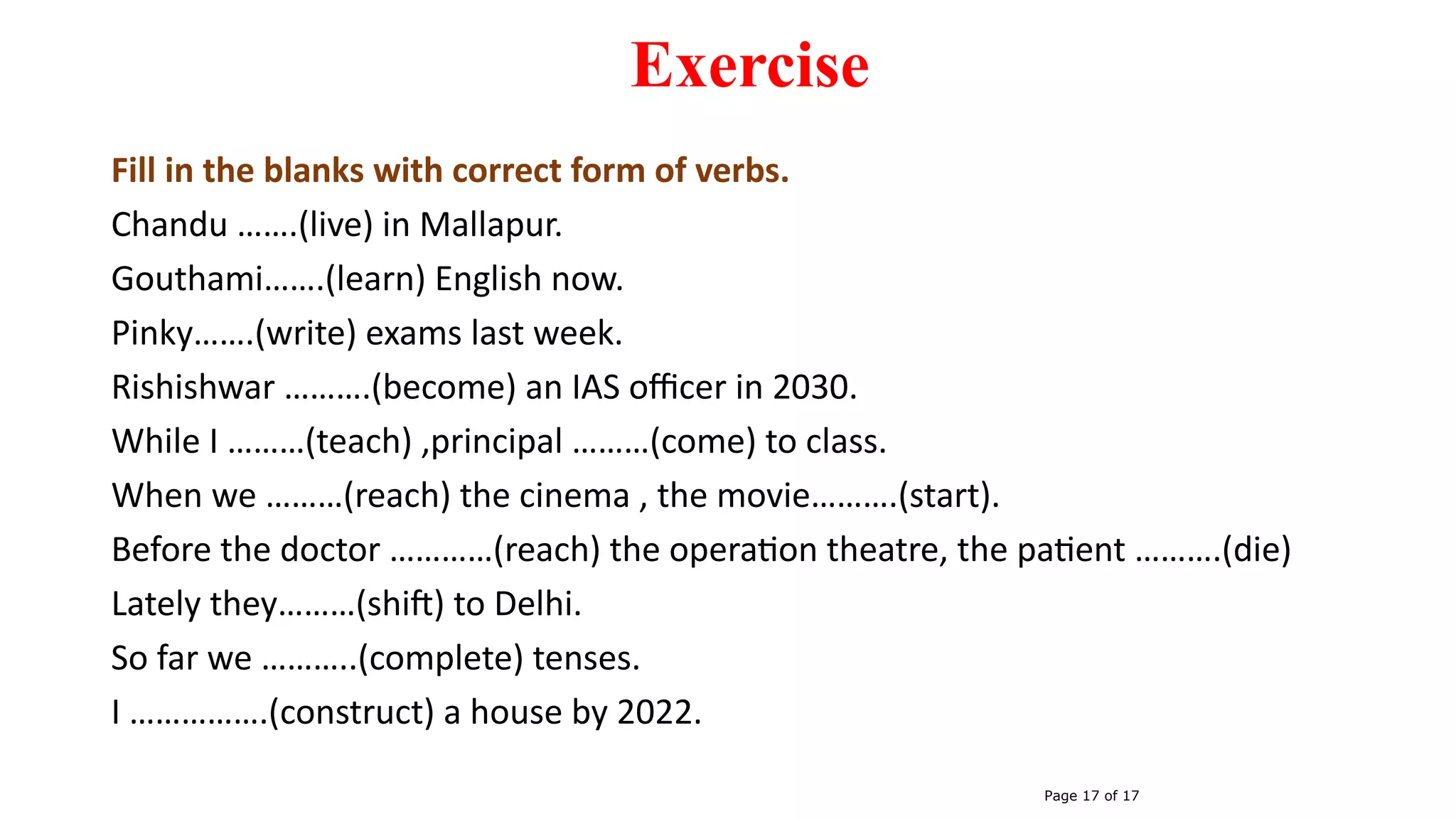
Exercise
Fill in the blanks with correct form of verbs.
Chandu …….(live) in Mallapur.
Gouthami…….(learn) English now.
Pinky…….(write) exams last week.
Rishishwar ……….(become) an IAS officer in 2030.
While I ………(teach) ,principal ………(come) to class.
When we ………(reach) the cinema , the movie……….(start).
Before the doctor …………(reach) the operation theatre, the patient ……….(die)
Lately they………(shift) to Delhi.
So far we ………..(complete) tenses.
I …………….(construct) a house by 2022.
Page 17 of 17

Tenses -learn without tense ppt pdf by Chandra shekar Pendoti

  • 1.
    TENSES - Learnwithout tense Compiled by Chandra shekar Pendoti M.A. English , B.Ed , TS-SET Poet & Author Youtube: chandrashekar’sspokenenglishclasses FB page: Chandu English chanduenglish.blogspot.com Page 1 of 17
  • 2.
    TENSE • Every tenseis divided into four types • Simple Tense Continuous Tense Perfect Tense Perfect continuous Tense I. Present II. Past III. Future Page 2 of 17
  • 3.
    Present & PastSimple Present Simple Tense (Subject+V1+….) • Usages • Universal truths • Routine/regular/daily actions • Fixed time tables & schedules • Proverbs & sayings • Commentaries • News headlines • Habitual actions • Eg: He goes to office at 9 am. Past Simple Tense (Subject+V2+….) • Usages • Habitual/regular actions in the past • Past situations/events that took place in the past • Eg: We visited the Ajantha caves last year. • For states in the past • Eg : Indur had a glorious past. Page 3 of 17
  • 4.
    Present & PastSimple Present Simple • He plays chess(positive sentence) • He does not play chess(negative sentence) • Does he play chess?(Positive Yes/no ?) • Yes, he plays chess.(positive answer) • Does he not play chess?(negative Y/N ?) • No, he does not play chess.(negative answer) • When does he play chess ?(Positive Info ?) • Why does he not play chess?(negative Info?) • Chess is played by him.( Passive voice) Past Simple • He played chess • He did not play chess. • Did he play chess? • Yes , he played chess. • Did he not play chess? • No, he did not play chess. • When did he play chess? • Why did he not play chess? • Chess was played by him. Page 4 of 17
  • 5.
    Present Simple &Past Simple Tense • Clue words • Daily commonly • Once/twice…. generally • Often regularly • Frequently • Seldom • Usually • Always • Never • Every day/week/year/summer…. • Eg: He never goes to temple • Clue words • Yesterday • Last night/week/year/summer….. • Any past year/time ….. • Eg: We visited the Red fort last week. Page 5 of 17
  • 6.
    Present continuous PastContinuous • Frame: Sub + am /is/are + present participle(V4)+…… • Usages: • 1. On going actions in present • Eg: We are discussing grammar now. • 2. for a temporary routine • Eg: They are going home late this week • 3. Near future actions • Eg: He is going to start a new business • Frame: Sub + was/were + present participle (V4)+…….. • Usages: • 1. On going action in the past • Eg: She was watching T.V. 2. If two activities took place in the past , longer activity should be written in Past continuous and shorter activity in Past Simple Eg: While he was going to college, he met his friend. Frame: When/while+ Past Continuous(longer action)+…, Past Simple(shorter action) Page 6 of 17
  • 7.
    Present Continuous PastContinuous • She is playing chess • She is not playing chess • Is she playing chess ? • Yes, she is playing chess. • Is she not playing chess ? • No , she is not playing chess. • Where is she playing chess ? • Why is she not playing chess ? • Chess is being played by her( passive form) • We were watching a movie. • We were not watching a movie. • Were we watching a movie? • Yes , we were watching a movie. • Were we not watching a movie ? • No , we were not watching a movie. • When were we watching a movie ? • Why were we not watching a movie ? • A movie was being watched by us. ( passive form) Page 7 of 17
  • 8.
    Present Continuous PastContinuous • Clue words: • Now • Look • Listen • Now a days • Don’t disturb me/him/us/her/them… • Shhh… • Eg : Don’t disturb them, they are reading. • Clue words • While/when • Eg: They were playing chess • While she was watching T.V. , the power went off. • When he was going to office ,he saw an accident. Page 8 of 17
  • 9.
    Present Perfect PastPerfect • Frame : Sub + have/has + Past participle (V3)+ …… Usages: just finished actions • Eg : He has just finished his work. • A past action that has relevance to the present. • Eg : We have been to Delhi three times. • For states • Eg: The market has been open for two months. • Situations that still exist. • Eg: They have lived in Mallapur for three years • If there no specific time reference that took • Frame : Sub+ had+ Past participle (V3)+…. • Usages If two actions occurred in the past one after the other ,first action should be written in PAST PERFECT & later action in PAST SIMPLE. • Eg : When he reached the stadium , Sachin had already made a century. • It is related to a moment in the past in the same way that the present perfect is related to the present moment, i.e. it describes an action completed before some special past moment we have in mind. • Eg : He had already learnt English • Clue words: when , before ,after……Page 9 of 17
  • 10.
    Present perfect continuousPast Perfect Continuous • Frame: Sub + have/has+ been + present participle(V4)+… • Usage : It is used to denote that an action began in the past and still continuing in the present. • Eg: I have been learning English for 3 years. • Clue words: • Since : point of time • For : period oftime • Frame : Sub + had + been + present participle ( V4) +…. • It is used to denote two actions in the past , one showing the duration of an action and another showing when it came to an end. • Eg: He had been teaching before he joined in politics. Page 10 of 17
  • 11.
    Future Simple Tense •Frame : Sub + shall/will+ V1+…… • Usages: to express unplanned/tentative actions. • to express futurity • Eg : I shall meet you tomorrow. • He will publish a novel. • Will not =won’t • Shall not =shan’t • She will write a poem • She will not write a poem • Will she write a poem ? • Yes , she will write a poem • Will she not write a poem ? • No, she will write a poem • When will she write a poem ? • Why will she not write a poem ? • A poem will be written by her. ( passive form) Page 11 of 17
  • 12.
    Future Simple Tense •Clue words: • Tomorrow • Next week/month/year/winter…. • Any future year/time • Eg: They will meet me next week. • He will buy a car next summer. • Rajamouli will start his next movie in June. Page 12 of 17
  • 13.
    Future Continuous Tense •Frame : Subject + shall/will+ be+ V4+……. • It is used to express that something will be happening at a point of time. • Eg: We shall be discussing grammar tomorrow at this time • They will be constructing a building in this summer. Page 13 of 17
  • 14.
    Future Perfect Tense •Frame : Subject + shall/will+ have + past participle ( V3)+……. • It is used to express something will have happened or end at a particular point of time. • Eg: I will have constructed the building by 2022. • They will have completed their degree by 2023. Page 14 of 17
  • 15.
    Future Perfect ContinuousTense • Frame : Subject + shall/will + have + been + V4+…… • It is used to express that something begins to happen in future and will be progress at point of time. • Eg: He will have been reading a play. • They will have been constructing a bridge for next 2 years. Page 15 of 17
  • 16.
    Structures of allTenses • Present Simple: Sub + V1+…. • Present Continuous : Sub + am/is/are+V4+….. • Present Perfect: Sub + have/has+V3+ ….. • Present Perfect Continuous: Sub+ have/has+been+V4+…. • Future Simple: Sub + shall/will+V1+….. • Future Continuous : Sub + shall/will+be+V4+….. • Past Simple : Sub + V2+….. • Past Continuous : Sub + was/were+V4+…. • Past Perfect : Sub+had+V3+…. • Past Perfect Continuous: Sub+had+been+V4+…… • Future Perfect: Sub + shall/will+have+V3+……. • Future Perfect Continuous : Sub + shall/will+have+been+V4+…. Page 16 of 17
  • 17.
    Exercise Fill in theblanks with correct form of verbs. Chandu …….(live) in Mallapur. Gouthami…….(learn) English now. Pinky…….(write) exams last week. Rishishwar ……….(become) an IAS officer in 2030. While I ………(teach) ,principal ………(come) to class. When we ………(reach) the cinema , the movie……….(start). Before the doctor …………(reach) the operation theatre, the patient ……….(die) Lately they………(shift) to Delhi. So far we ………..(complete) tenses. I …………….(construct) a house by 2022. Page 17 of 17