Object Oriented Programming
using C++
Topic :Templates in C++
Templates
• Templates support generic programming, which allows to
develop reusable software components such as function,
class, etc.
• Supporting different data types in a single framework.
• A template in C++ allows the construction of a family of
template functions and classes to perform the same
operation on different data types.
• The templates declared for functions are called function
templates and those declared for classes are called class
templates.
• It allows a single template to deal with a generic data
type T.
Function Templates
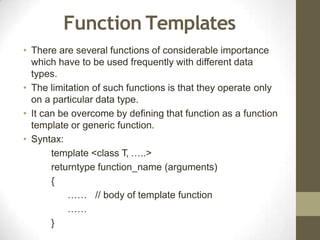
• There are several functions of considerable importance
which have to be used frequently with different data
types.
• The limitation of such functions is that they operate only
on a particular data type.
• It can be overcome by defining that function as a function
template or generic function.
• Syntax:
template <class T, …..>
returntype function_name (arguments)
{
…… // body of template function
……
}
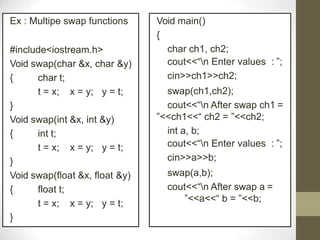
Ex : Multipe swap functions
#include<iostream.h>
Void swap(char &x, char &y)
{ char t;
t = x; x = y; y = t;
}
Void swap(int &x, int &y)
{ int t;
t = x; x = y; y = t;
}
Void swap(float &x, float &y)
{ float t;
t = x; x = y; y = t;
}
Void main()
{
char ch1, ch2;
cout<<“n Enter values : ”;
cin>>ch1>>ch2;
swap(ch1,ch2);
cout<<“n After swap ch1 =
”<<ch1<<“ ch2 = ”<<ch2;
int a, b;
cout<<“n Enter values : ”;
cin>>a>>b;
swap(a,b);
cout<<“n After swap a =
”<<a<<“ b = ”<<b;
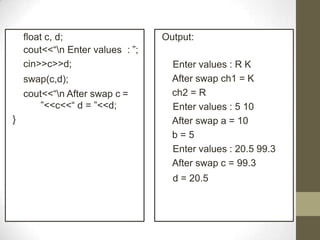
float c, d;
cout<<“n Enter values : ”;
cin>>c>>d;
swap(c,d);
cout<<“n After swap c =
”<<c<<“ d = ”<<d;
}
Output:
Enter values : R K
After swap ch1 = K
ch2 = R
Enter values : 5 10
After swap a = 10
b = 5
Enter values : 20.5 99.3
After swap c = 99.3
d = 20.5
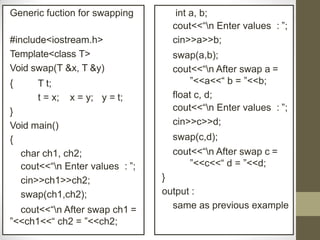
Generic fuction for swapping
#include<iostream.h>
Template<class T>
Void swap(T &x, T &y)
{ T t;
t = x; x = y; y = t;
}
Void main()
{
char ch1, ch2;
cout<<“n Enter values : ”;
cin>>ch1>>ch2;
swap(ch1,ch2);
cout<<“n After swap ch1 =
”<<ch1<<“ ch2 = ”<<ch2;
int a, b;
cout<<“n Enter values : ”;
cin>>a>>b;
swap(a,b);
cout<<“n After swap a =
”<<a<<“ b = ”<<b;
float c, d;
cout<<“n Enter values : ”;
cin>>c>>d;
swap(c,d);
cout<<“n After swap c =
”<<c<<“ d = ”<<d;
}
output :
same as previous example
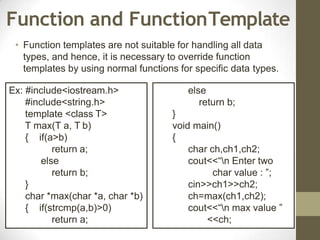
Function and FunctionTemplate
• Function templates are not suitable for handling all data
types, and hence, it is necessary to override function
templates by using normal functions for specific data types.
Ex: #include<iostream.h>
#include<string.h>
template <class T>
T max(T a, T b)
{ if(a>b)
return a;
else
return b;
}
char *max(char *a, char *b)
{ if(strcmp(a,b)>0)
return a;
else
return b;
}
void main()
{
char ch,ch1,ch2;
cout<<“n Enter two
char value : ”;
cin>>ch1>>ch2;
ch=max(ch1,ch2);
cout<<“n max value ”
<<ch;
int a,b,c;
cout<<“n Enter two int
values : ”;
cin>>a>>b;
c=max(a,b);
cout<<“n max value : ”<<c;
char str1[20],str2[20];
cout<<“n Enter two str
values : ”;
cin>>str1>>str2;
cout<<“n max value : ”
<<max(str1,str2);
}
Output :
Enter two char value : A Z
Max value : Z
Enter two int value : 12 20
Max value : 20
Enter two char value :
Tejaswi Rajkumar
Max value : Tejaswi
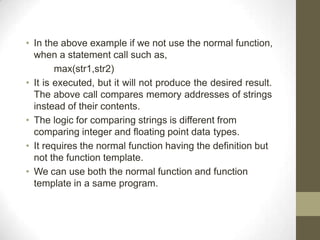
• In the above example if we not use the normal function,
when a statement call such as,
max(str1,str2)
• It is executed, but it will not produce the desired result.
The above call compares memory addresses of strings
instead of their contents.
• The logic for comparing strings is different from
comparing integer and floating point data types.
• It requires the normal function having the definition but
not the function template.
• We can use both the normal function and function
template in a same program.
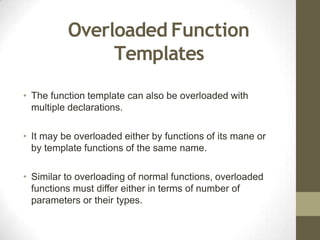
Overloaded Function
Templates
• The function template can also be overloaded with
multiple declarations.
• It may be overloaded either by functions of its mane or
by template functions of the same name.
• Similar to overloading of normal functions, overloaded
functions must differ either in terms of number of
parameters or their types.
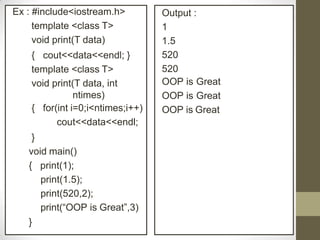
Ex : #include<iostream.h>
template <class T>
void print(T data)
{ cout<<data<<endl; }
template <class T>
void print(T data, int
ntimes)
{ for(int i=0;i<ntimes;i++)
cout<<data<<endl;
}
void main()
{ print(1);
print(1.5);
print(520,2);
print(“OOP is Great”,3)
}
Output :
1
1.5
520
520
OOP is Great
OOP is Great
OOP is Great
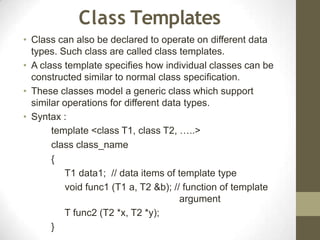
Class Templates
• Class can also be declared to operate on different data
types. Such class are called class templates.
• A class template specifies how individual classes can be
constructed similar to normal class specification.
• These classes model a generic class which support
similar operations for different data types.
• Syntax :
template <class T1, class T2, …..>
class class_name
{
T1 data1; // data items of template type
void func1 (T1 a, T2 &b); // function of template
argument
T func2 (T2 *x, T2 *y);
}
Example :
Class charstack
{ char array[25];
unsigned int top;
public:
charstack();
void push(const char
&element);
char pop(void);
unsigned int getsize
(void) const;
};
Class intstack
{ int array[25];
unsigned int top;
public:
intstack();
void push(const int
&element);
int pop(void);
unsigned int getsize
(void) const;
};
Class doublestack
{ double array[25];
unsigned int top;
public:
doublestack();
void push(const
double &element);
double pop(void);
unsigned int getsize
(void) const;
};
• In the previous example, a separate stack class is
required for each and every data types. Templates
declaration enables subatitution of code for all the three
declarations of stacks with a single template class as
follows :
template<class T>
class datastack
{ T array[25];
unsigned int top;
public:
doublestack();
void push(const double &element);
double pop(void);
unsigned int getsize (void) const;
};
Inheritance of Class Template
Use of templates with respect to inheritance involves the
followings :
• Derive a class template from a base class, which is a
template class.
• Derive a class template from a base class, which is a
template class, add more template members in the
derived class.
• Derive a class from a base class which is not a template,
and template member to that class.
• Derive a class from a base class which is a template
class and restrict the template feature, so that the
derived class and its derivatives do not have the
template feature.
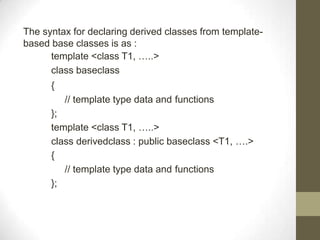
The syntax for declaring derived classes from template-
based base classes is as :
template <class T1, …..>
class baseclass
{
// template type data and functions
};
template <class T1, …..>
class derivedclass : public baseclass <T1, ….>
{
// template type data and functions
};

Templates2

  • 1.
    Object Oriented Programming usingC++ Topic :Templates in C++
  • 2.
    Templates • Templates supportgeneric programming, which allows to develop reusable software components such as function, class, etc. • Supporting different data types in a single framework. • A template in C++ allows the construction of a family of template functions and classes to perform the same operation on different data types. • The templates declared for functions are called function templates and those declared for classes are called class templates. • It allows a single template to deal with a generic data type T.
  • 3.
    Function Templates • Thereare several functions of considerable importance which have to be used frequently with different data types. • The limitation of such functions is that they operate only on a particular data type. • It can be overcome by defining that function as a function template or generic function. • Syntax: template <class T, …..> returntype function_name (arguments) { …… // body of template function …… }
  • 4.
    Ex : Multipeswap functions #include<iostream.h> Void swap(char &x, char &y) { char t; t = x; x = y; y = t; } Void swap(int &x, int &y) { int t; t = x; x = y; y = t; } Void swap(float &x, float &y) { float t; t = x; x = y; y = t; } Void main() { char ch1, ch2; cout<<“n Enter values : ”; cin>>ch1>>ch2; swap(ch1,ch2); cout<<“n After swap ch1 = ”<<ch1<<“ ch2 = ”<<ch2; int a, b; cout<<“n Enter values : ”; cin>>a>>b; swap(a,b); cout<<“n After swap a = ”<<a<<“ b = ”<<b;
  • 5.
    float c, d; cout<<“nEnter values : ”; cin>>c>>d; swap(c,d); cout<<“n After swap c = ”<<c<<“ d = ”<<d; } Output: Enter values : R K After swap ch1 = K ch2 = R Enter values : 5 10 After swap a = 10 b = 5 Enter values : 20.5 99.3 After swap c = 99.3 d = 20.5
  • 6.
    Generic fuction forswapping #include<iostream.h> Template<class T> Void swap(T &x, T &y) { T t; t = x; x = y; y = t; } Void main() { char ch1, ch2; cout<<“n Enter values : ”; cin>>ch1>>ch2; swap(ch1,ch2); cout<<“n After swap ch1 = ”<<ch1<<“ ch2 = ”<<ch2; int a, b; cout<<“n Enter values : ”; cin>>a>>b; swap(a,b); cout<<“n After swap a = ”<<a<<“ b = ”<<b; float c, d; cout<<“n Enter values : ”; cin>>c>>d; swap(c,d); cout<<“n After swap c = ”<<c<<“ d = ”<<d; } output : same as previous example
  • 7.
    Function and FunctionTemplate •Function templates are not suitable for handling all data types, and hence, it is necessary to override function templates by using normal functions for specific data types. Ex: #include<iostream.h> #include<string.h> template <class T> T max(T a, T b) { if(a>b) return a; else return b; } char *max(char *a, char *b) { if(strcmp(a,b)>0) return a; else return b; } void main() { char ch,ch1,ch2; cout<<“n Enter two char value : ”; cin>>ch1>>ch2; ch=max(ch1,ch2); cout<<“n max value ” <<ch;
  • 8.
    int a,b,c; cout<<“n Entertwo int values : ”; cin>>a>>b; c=max(a,b); cout<<“n max value : ”<<c; char str1[20],str2[20]; cout<<“n Enter two str values : ”; cin>>str1>>str2; cout<<“n max value : ” <<max(str1,str2); } Output : Enter two char value : A Z Max value : Z Enter two int value : 12 20 Max value : 20 Enter two char value : Tejaswi Rajkumar Max value : Tejaswi
  • 9.
    • In theabove example if we not use the normal function, when a statement call such as, max(str1,str2) • It is executed, but it will not produce the desired result. The above call compares memory addresses of strings instead of their contents. • The logic for comparing strings is different from comparing integer and floating point data types. • It requires the normal function having the definition but not the function template. • We can use both the normal function and function template in a same program.
  • 10.
    Overloaded Function Templates • Thefunction template can also be overloaded with multiple declarations. • It may be overloaded either by functions of its mane or by template functions of the same name. • Similar to overloading of normal functions, overloaded functions must differ either in terms of number of parameters or their types.
  • 11.
    Ex : #include<iostream.h> template<class T> void print(T data) { cout<<data<<endl; } template <class T> void print(T data, int ntimes) { for(int i=0;i<ntimes;i++) cout<<data<<endl; } void main() { print(1); print(1.5); print(520,2); print(“OOP is Great”,3) } Output : 1 1.5 520 520 OOP is Great OOP is Great OOP is Great
  • 12.
    Class Templates • Classcan also be declared to operate on different data types. Such class are called class templates. • A class template specifies how individual classes can be constructed similar to normal class specification. • These classes model a generic class which support similar operations for different data types. • Syntax : template <class T1, class T2, …..> class class_name { T1 data1; // data items of template type void func1 (T1 a, T2 &b); // function of template argument T func2 (T2 *x, T2 *y); }
  • 13.
    Example : Class charstack {char array[25]; unsigned int top; public: charstack(); void push(const char &element); char pop(void); unsigned int getsize (void) const; }; Class intstack { int array[25]; unsigned int top; public: intstack(); void push(const int &element); int pop(void); unsigned int getsize (void) const; }; Class doublestack { double array[25]; unsigned int top; public: doublestack(); void push(const double &element); double pop(void); unsigned int getsize (void) const; };
  • 14.
    • In theprevious example, a separate stack class is required for each and every data types. Templates declaration enables subatitution of code for all the three declarations of stacks with a single template class as follows : template<class T> class datastack { T array[25]; unsigned int top; public: doublestack(); void push(const double &element); double pop(void); unsigned int getsize (void) const; };
  • 15.
    Inheritance of ClassTemplate Use of templates with respect to inheritance involves the followings : • Derive a class template from a base class, which is a template class. • Derive a class template from a base class, which is a template class, add more template members in the derived class. • Derive a class from a base class which is not a template, and template member to that class. • Derive a class from a base class which is a template class and restrict the template feature, so that the derived class and its derivatives do not have the template feature.
  • 16.
    The syntax fordeclaring derived classes from template- based base classes is as : template <class T1, …..> class baseclass { // template type data and functions }; template <class T1, …..> class derivedclass : public baseclass <T1, ….> { // template type data and functions };