Scala
Session 4
Muhammad Asif Fayyaz
Course Contents
1. The Basics
2. Getting up to speed
3. Higher-Order functions
4. Classes and Objects
5. Inheritance and Traits
6. Collections
Today’s Session (Getting Up to Speed)
● First-Class Functions
● Function Types
● Anonymous Functions
● Shortening Anonymous Functions
● Place Holders
● Currying
● Tail Recursion
● Classes and Objects
Higher Order (First Class) Functions
- Scala treat functions as first-class values.
- This means that like any other value, a function can be
passed as a parameter and returned as a result.
- This provides a flexible way to compose programs.
- Functions that take other functions as parameters or
that return functions are called higher order functions
Example
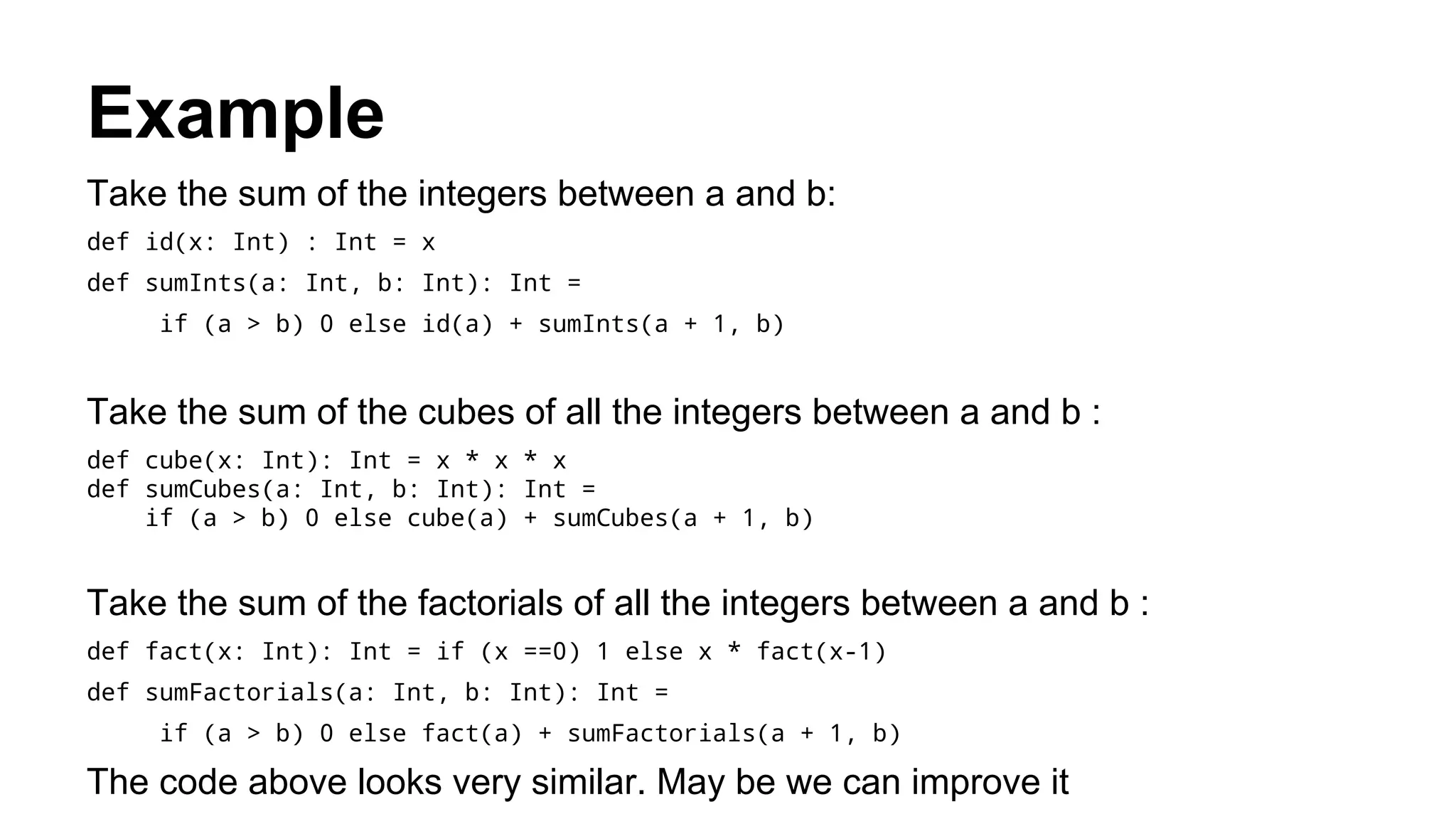
Take the sum of the integers between a and b:
def id(x: Int) : Int = x
def sumInts(a: Int, b: Int): Int =
if (a > b) 0 else id(a) + sumInts(a + 1, b)
Take the sum of the cubes of all the integers between a and b :
def cube(x: Int): Int = x * x * x
def sumCubes(a: Int, b: Int): Int =
if (a > b) 0 else cube(a) + sumCubes(a + 1, b)
Take the sum of the factorials of all the integers between a and b :
def fact(x: Int): Int = if (x ==0) 1 else x * fact(x-1)
def sumFactorials(a: Int, b: Int): Int =
if (a > b) 0 else fact(a) + sumFactorials(a + 1, b)
The code above looks very similar. May be we can improve it
Summing with Higher-Order Function
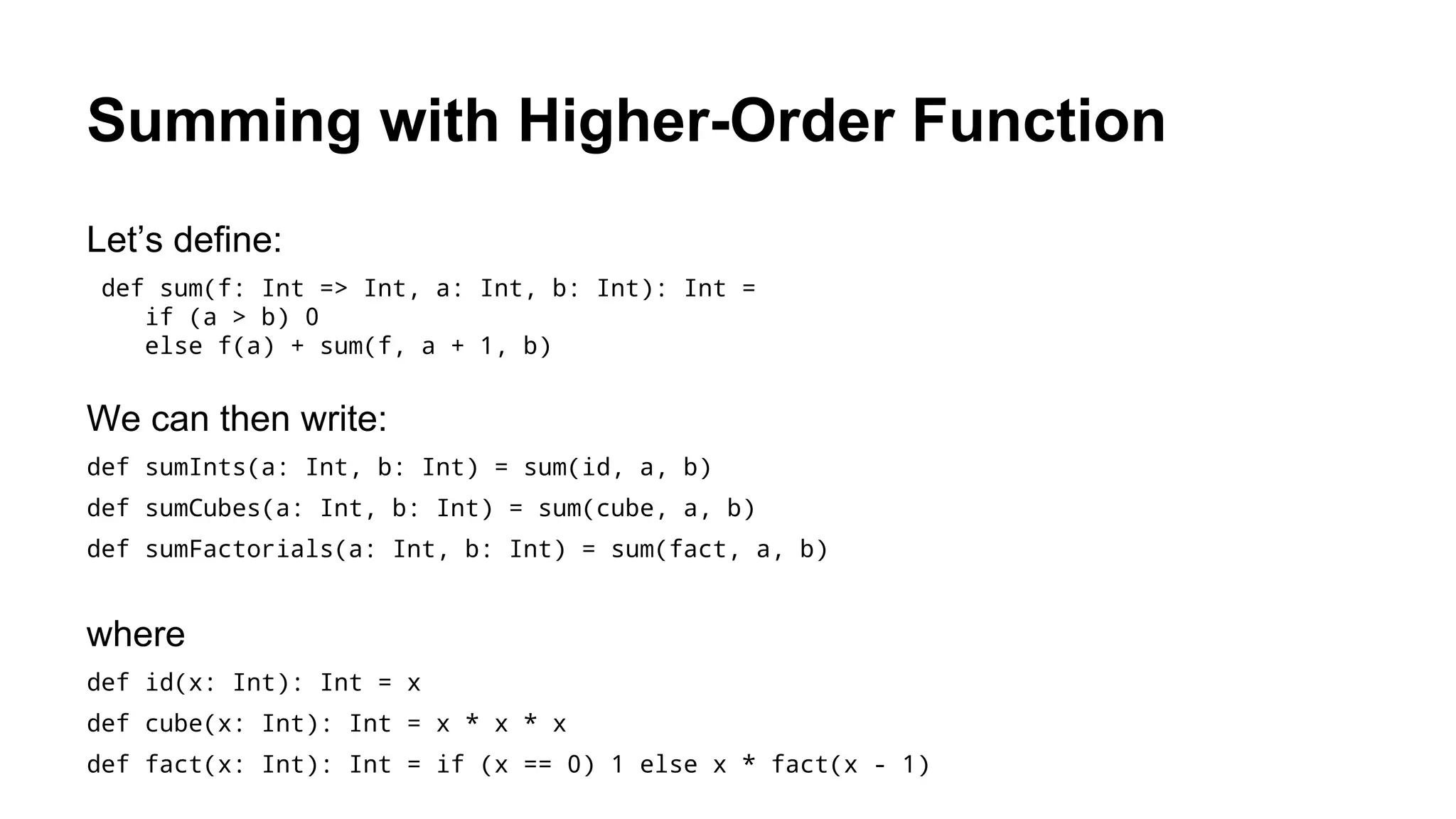
Let’s define:
def sum(f: Int => Int, a: Int, b: Int): Int =
if (a > b) 0
else f(a) + sum(f, a + 1, b)
We can then write:
def sumInts(a: Int, b: Int) = sum(id, a, b)
def sumCubes(a: Int, b: Int) = sum(cube, a, b)
def sumFactorials(a: Int, b: Int) = sum(fact, a, b)
where
def id(x: Int): Int = x
def cube(x: Int): Int = x * x * x
def fact(x: Int): Int = if (x == 0) 1 else x * fact(x - 1)
Function Types
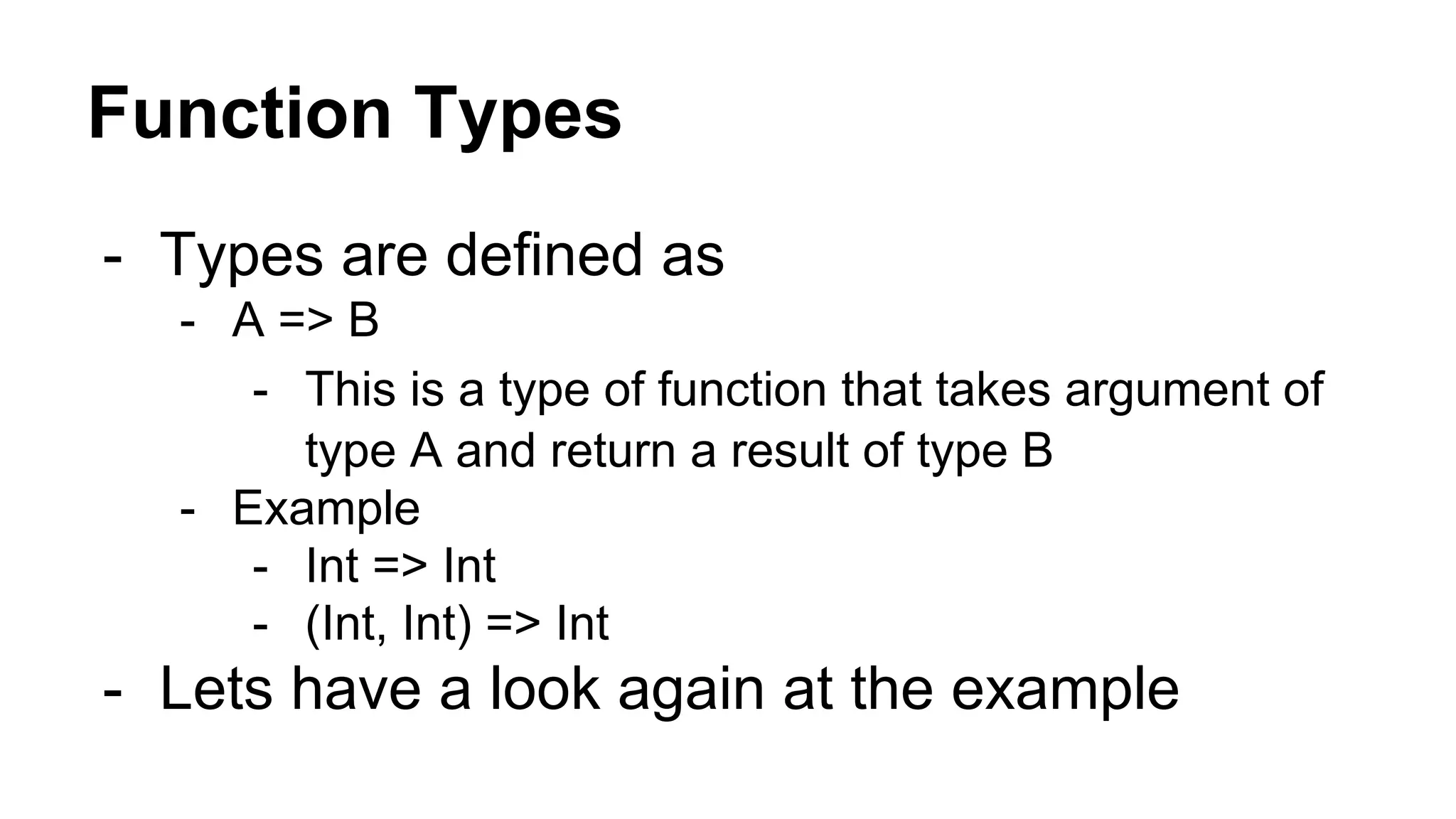
- Types are defined as
- A => B
- This is a type of function that takes argument of
type A and return a result of type B
- Example
- Int => Int
- (Int, Int) => Int
- Lets have a look again at the example
Anonymous Functions
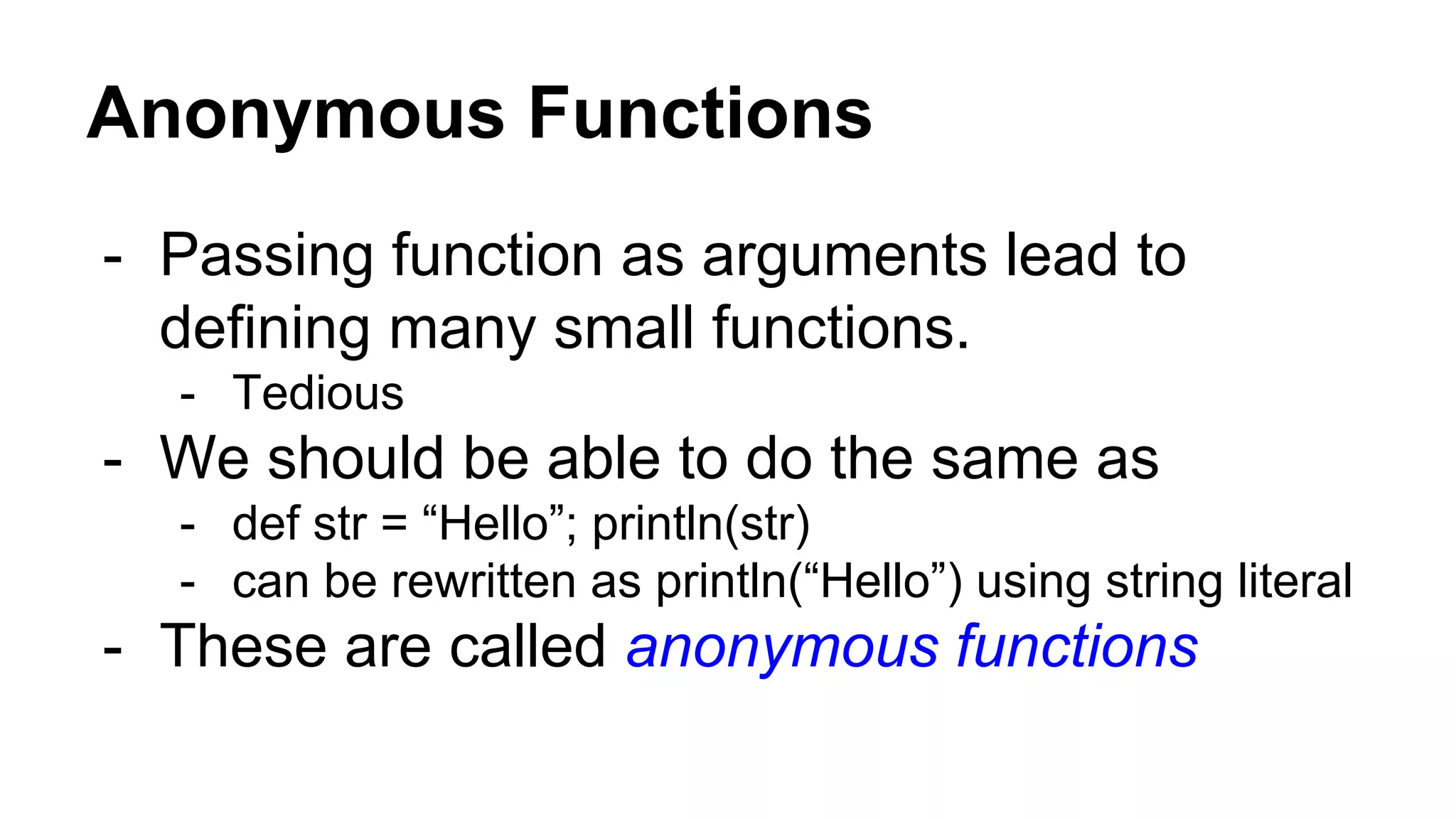
- Passing function as arguments lead to
defining many small functions.
- Tedious
- We should be able to do the same as
- def str = “Hello”; println(str)
- can be rewritten as println(“Hello”) using string literal
- These are called anonymous functions
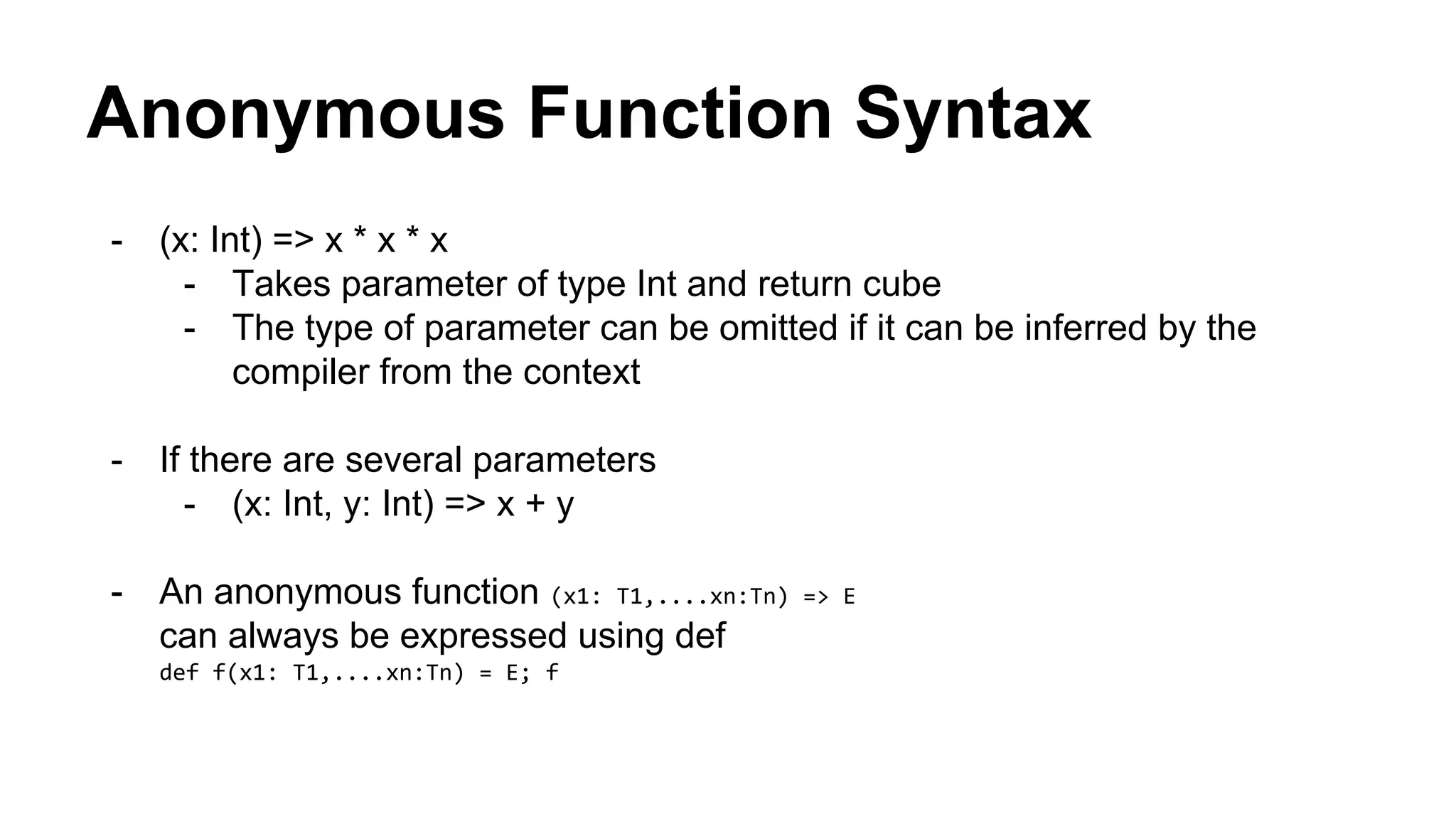
Anonymous Function Syntax
- (x: Int) => x * x * x
- Takes parameter of type Int and return cube
- The type of parameter can be omitted if it can be inferred by the
compiler from the context
- If there are several parameters
- (x: Int, y: Int) => x + y
- An anonymous function (x1: T1,....xn:Tn) => E
can always be expressed using def
def f(x1: T1,....xn:Tn) = E; f
Anonymous Function Usage
- Heavily used in scala libraries
- Examples
- operations on data structures like List, Seq, Hashtable
- foreach
- filter
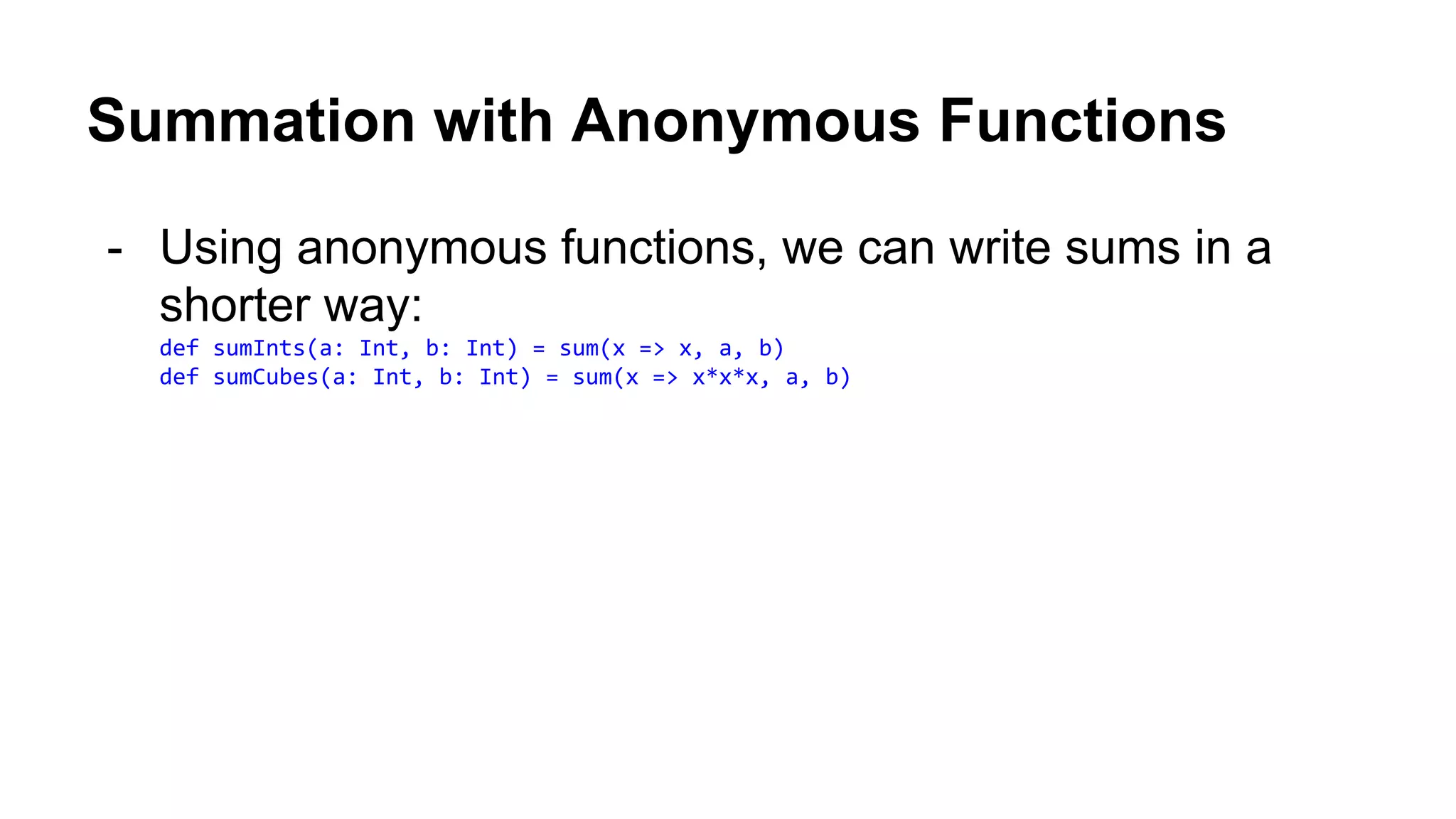
Summation with Anonymous Functions
- Using anonymous functions, we can write sums in a
shorter way:
def sumInts(a: Int, b: Int) = sum(x => x, a, b)
def sumCubes(a: Int, b: Int) = sum(x => x*x*x, a, b)
Shortening Anonymous Function
- Shortening the syntax
- Types can be omitted if can be inferred
- Using Placeholders (Further make the syntax concise)
Currying
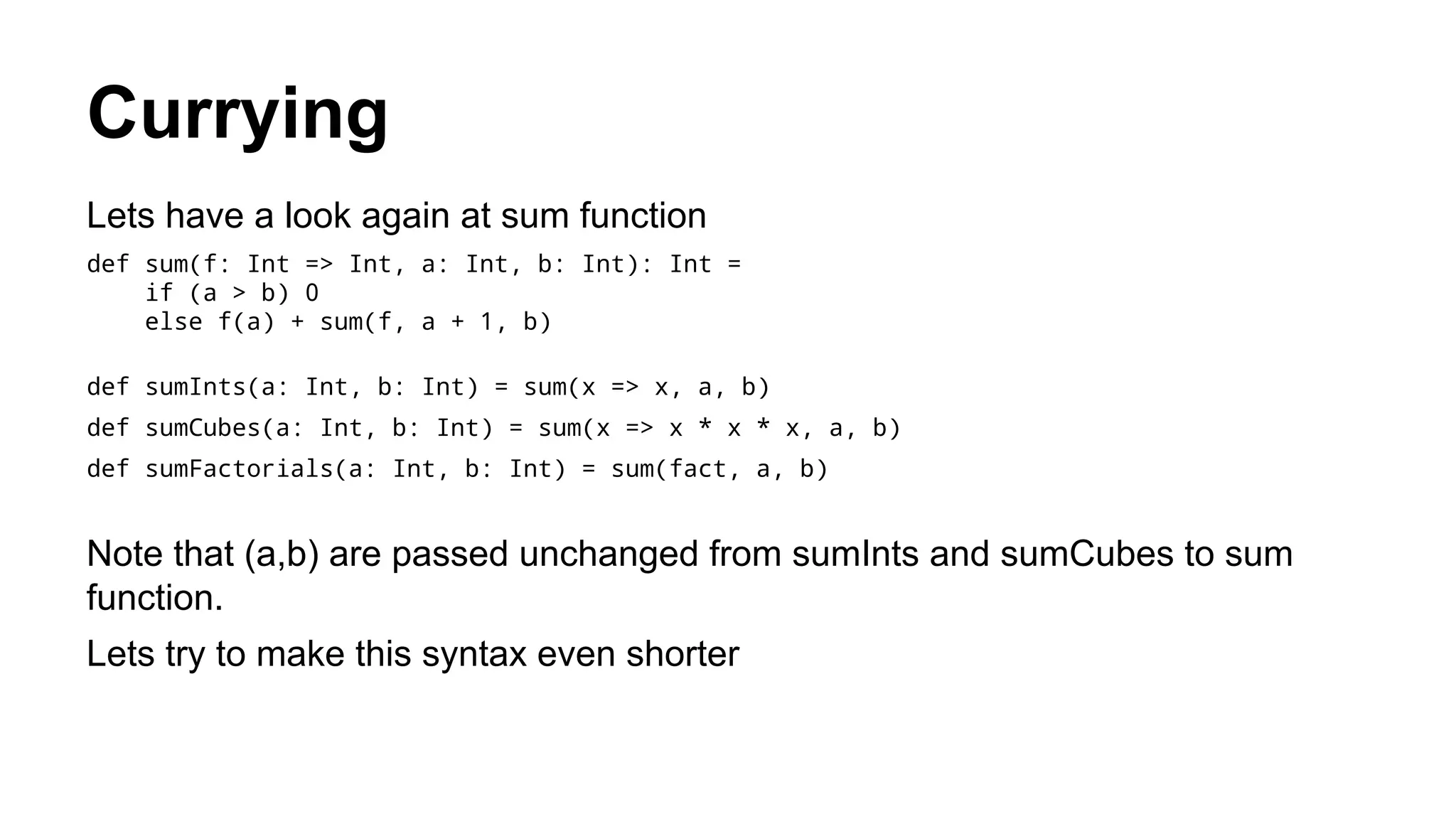
Lets have a look again at sum function
def sum(f: Int => Int, a: Int, b: Int): Int =
if (a > b) 0
else f(a) + sum(f, a + 1, b)
def sumInts(a: Int, b: Int) = sum(x => x, a, b)
def sumCubes(a: Int, b: Int) = sum(x => x * x * x, a, b)
def sumFactorials(a: Int, b: Int) = sum(fact, a, b)
Note that (a,b) are passed unchanged from sumInts and sumCubes to sum
function.
Lets try to make this syntax even shorter
Currying (Cont…)
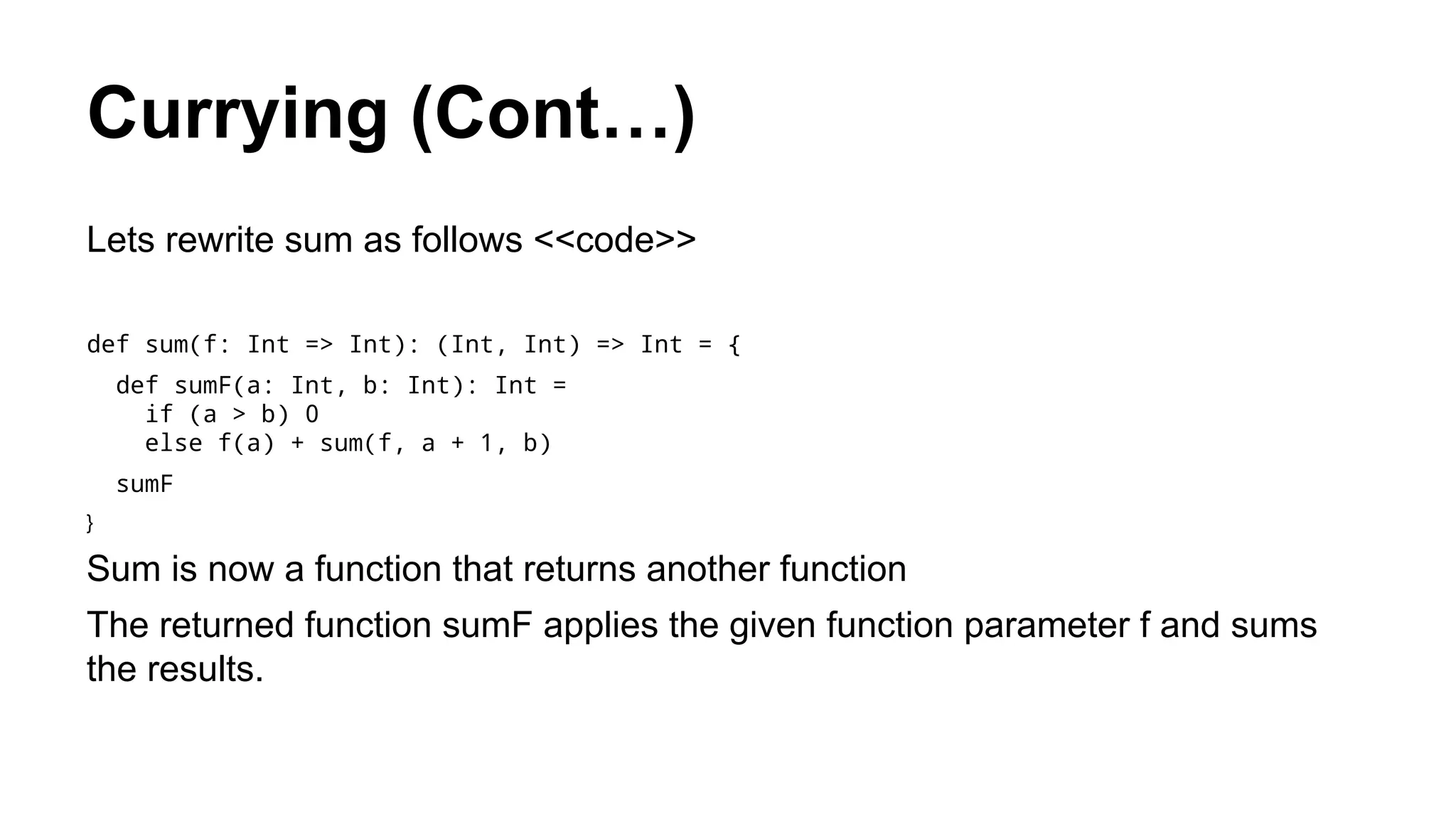
Lets rewrite sum as follows <<code>>
def sum(f: Int => Int): (Int, Int) => Int = {
def sumF(a: Int, b: Int): Int =
if (a > b) 0
else f(a) + sum(f, a + 1, b)
sumF
}
Sum is now a function that returns another function
The returned function sumF applies the given function parameter f and sums
the results.
Currying -> Multiple Parameter Lists
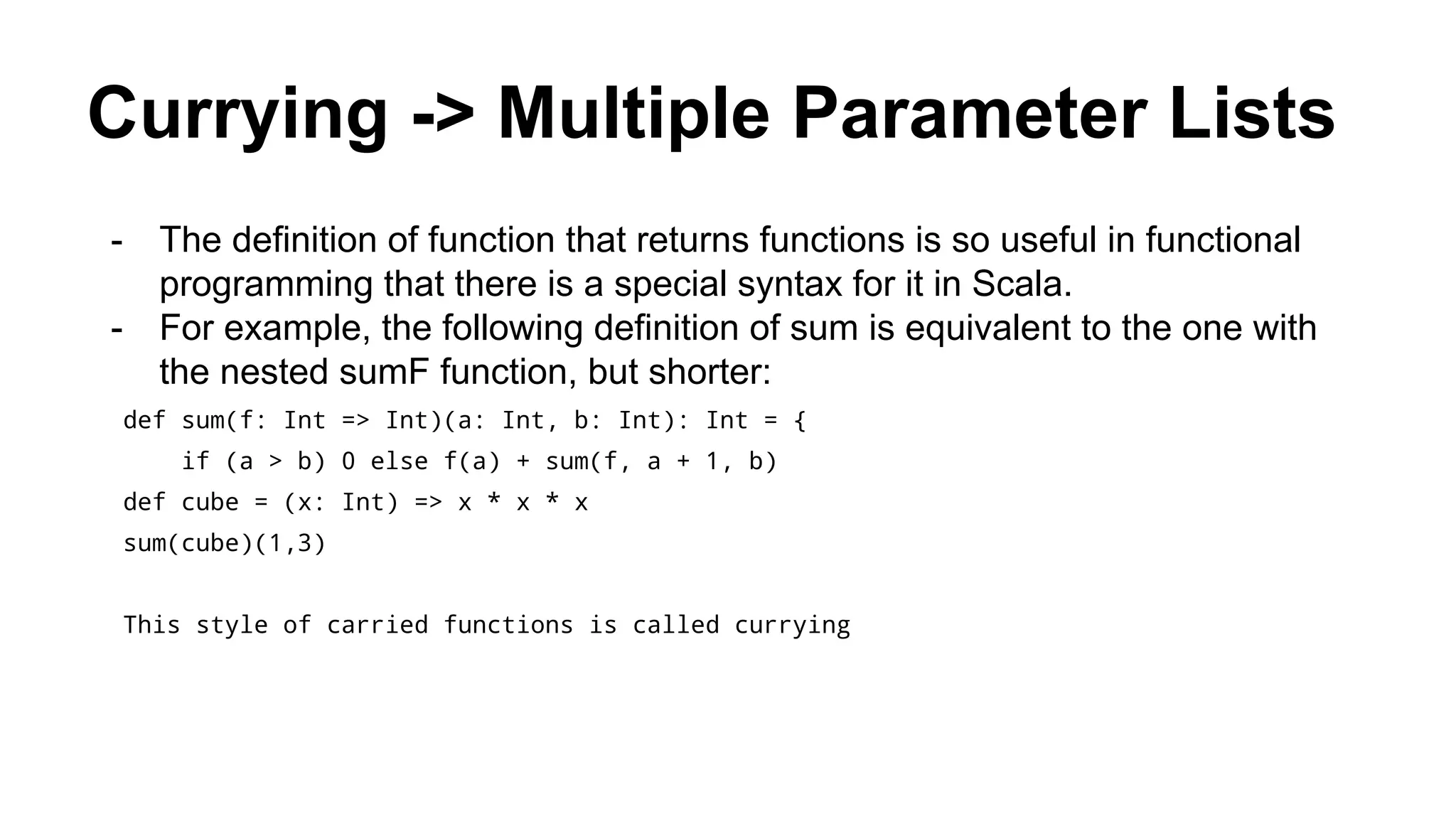
- The definition of function that returns functions is so useful in functional
programming that there is a special syntax for it in Scala.
- For example, the following definition of sum is equivalent to the one with
the nested sumF function, but shorter:
def sum(f: Int => Int)(a: Int, b: Int): Int = {
if (a > b) 0 else f(a) + sum(f, a + 1, b)
def cube = (x: Int) => x * x * x
sum(cube)(1,3)
This style of carried functions is called currying
Tail Recursion
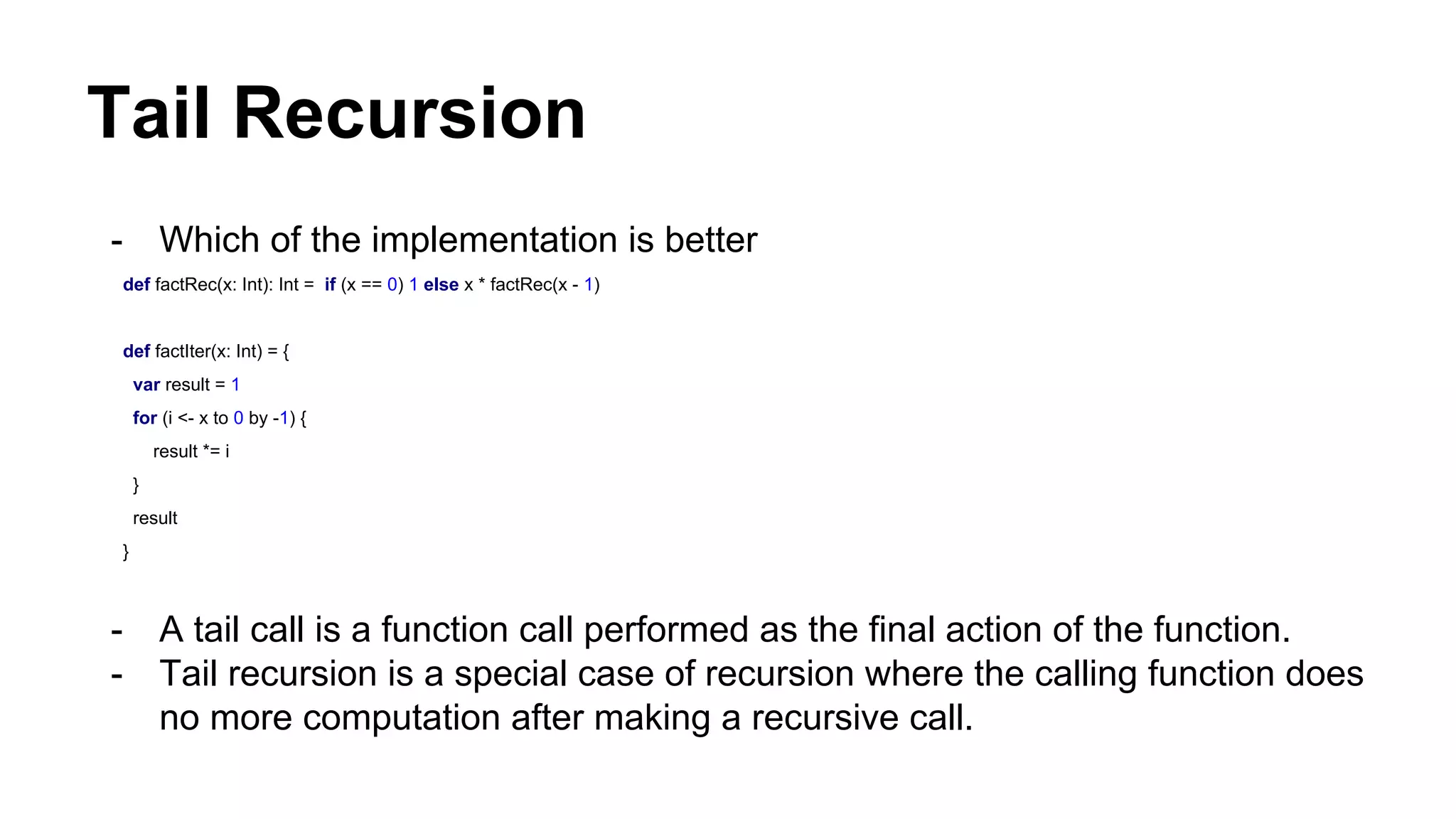
- Which of the implementation is better
def factRec(x: Int): Int = if (x == 0) 1 else x * factRec(x - 1)
def factIter(x: Int) = {
var result = 1
for (i <- x to 0 by -1) {
result *= i
}
result
}
- A tail call is a function call performed as the final action of the function.
- Tail recursion is a special case of recursion where the calling function does
no more computation after making a recursive call.
Classes and Objects
- Private members
- Creating and Accessing Objects
- Inheritance and Overriding
- Parameterless Methods
- Abstract Classes
- Traits
- Implementing Abstract Classes
- Dynamic Binding
- Objects
- Companion Objects
- Standard Classes
Partial Functions
Closure

Lecture 4

  • 1.
  • 2.
    Course Contents 1. TheBasics 2. Getting up to speed 3. Higher-Order functions 4. Classes and Objects 5. Inheritance and Traits 6. Collections
  • 3.
    Today’s Session (GettingUp to Speed) ● First-Class Functions ● Function Types ● Anonymous Functions ● Shortening Anonymous Functions ● Place Holders ● Currying ● Tail Recursion ● Classes and Objects
  • 4.
    Higher Order (FirstClass) Functions - Scala treat functions as first-class values. - This means that like any other value, a function can be passed as a parameter and returned as a result. - This provides a flexible way to compose programs. - Functions that take other functions as parameters or that return functions are called higher order functions
  • 5.
    Example Take the sumof the integers between a and b: def id(x: Int) : Int = x def sumInts(a: Int, b: Int): Int = if (a > b) 0 else id(a) + sumInts(a + 1, b) Take the sum of the cubes of all the integers between a and b : def cube(x: Int): Int = x * x * x def sumCubes(a: Int, b: Int): Int = if (a > b) 0 else cube(a) + sumCubes(a + 1, b) Take the sum of the factorials of all the integers between a and b : def fact(x: Int): Int = if (x ==0) 1 else x * fact(x-1) def sumFactorials(a: Int, b: Int): Int = if (a > b) 0 else fact(a) + sumFactorials(a + 1, b) The code above looks very similar. May be we can improve it
  • 6.
    Summing with Higher-OrderFunction Let’s define: def sum(f: Int => Int, a: Int, b: Int): Int = if (a > b) 0 else f(a) + sum(f, a + 1, b) We can then write: def sumInts(a: Int, b: Int) = sum(id, a, b) def sumCubes(a: Int, b: Int) = sum(cube, a, b) def sumFactorials(a: Int, b: Int) = sum(fact, a, b) where def id(x: Int): Int = x def cube(x: Int): Int = x * x * x def fact(x: Int): Int = if (x == 0) 1 else x * fact(x - 1)
  • 7.
    Function Types - Typesare defined as - A => B - This is a type of function that takes argument of type A and return a result of type B - Example - Int => Int - (Int, Int) => Int - Lets have a look again at the example
  • 8.
    Anonymous Functions - Passingfunction as arguments lead to defining many small functions. - Tedious - We should be able to do the same as - def str = “Hello”; println(str) - can be rewritten as println(“Hello”) using string literal - These are called anonymous functions
  • 9.
    Anonymous Function Syntax -(x: Int) => x * x * x - Takes parameter of type Int and return cube - The type of parameter can be omitted if it can be inferred by the compiler from the context - If there are several parameters - (x: Int, y: Int) => x + y - An anonymous function (x1: T1,....xn:Tn) => E can always be expressed using def def f(x1: T1,....xn:Tn) = E; f
  • 10.
    Anonymous Function Usage -Heavily used in scala libraries - Examples - operations on data structures like List, Seq, Hashtable - foreach - filter
  • 11.
    Summation with AnonymousFunctions - Using anonymous functions, we can write sums in a shorter way: def sumInts(a: Int, b: Int) = sum(x => x, a, b) def sumCubes(a: Int, b: Int) = sum(x => x*x*x, a, b)
  • 12.
    Shortening Anonymous Function -Shortening the syntax - Types can be omitted if can be inferred - Using Placeholders (Further make the syntax concise)
  • 13.
    Currying Lets have alook again at sum function def sum(f: Int => Int, a: Int, b: Int): Int = if (a > b) 0 else f(a) + sum(f, a + 1, b) def sumInts(a: Int, b: Int) = sum(x => x, a, b) def sumCubes(a: Int, b: Int) = sum(x => x * x * x, a, b) def sumFactorials(a: Int, b: Int) = sum(fact, a, b) Note that (a,b) are passed unchanged from sumInts and sumCubes to sum function. Lets try to make this syntax even shorter
  • 14.
    Currying (Cont…) Lets rewritesum as follows <<code>> def sum(f: Int => Int): (Int, Int) => Int = { def sumF(a: Int, b: Int): Int = if (a > b) 0 else f(a) + sum(f, a + 1, b) sumF } Sum is now a function that returns another function The returned function sumF applies the given function parameter f and sums the results.
  • 15.
    Currying -> MultipleParameter Lists - The definition of function that returns functions is so useful in functional programming that there is a special syntax for it in Scala. - For example, the following definition of sum is equivalent to the one with the nested sumF function, but shorter: def sum(f: Int => Int)(a: Int, b: Int): Int = { if (a > b) 0 else f(a) + sum(f, a + 1, b) def cube = (x: Int) => x * x * x sum(cube)(1,3) This style of carried functions is called currying
  • 16.
    Tail Recursion - Whichof the implementation is better def factRec(x: Int): Int = if (x == 0) 1 else x * factRec(x - 1) def factIter(x: Int) = { var result = 1 for (i <- x to 0 by -1) { result *= i } result } - A tail call is a function call performed as the final action of the function. - Tail recursion is a special case of recursion where the calling function does no more computation after making a recursive call.
  • 17.
    Classes and Objects -Private members - Creating and Accessing Objects - Inheritance and Overriding - Parameterless Methods - Abstract Classes - Traits - Implementing Abstract Classes - Dynamic Binding - Objects - Companion Objects - Standard Classes
  • 18.
  • 19.