Templates
Object Oriented Programming Copyright © 2012 IM
Group. All rights
reserved
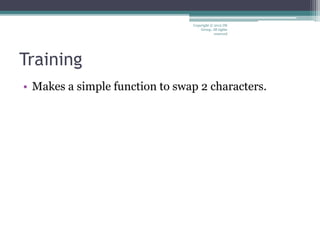
Training
• Makes a simple function to swap 2 characters.
Copyright © 2012 IM
Group. All rights
reserved
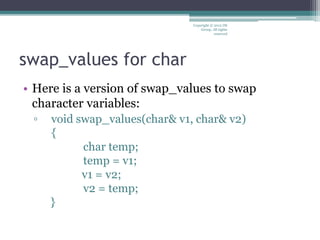
swap_values for char
• Here is a version of swap_values to swap
character variables:
▫ void swap_values(char& v1, char& v2)
{
char temp;
temp = v1;
v1 = v2;
v2 = temp;
}
Copyright © 2012 IM
Group. All rights
reserved
A General swap_values
• A generalized version of swap_values is shown
here.
▫ void swap_values(type_of_var& v1, type_of_var& v2)
{
type_of_var temp;
temp = v1;
v1 = v2;
v2 = temp;
}
▫ This function, if type_of_var could accept any type,
could be used to swap values of any type
Copyright © 2012 IM
Group. All rights
reserved
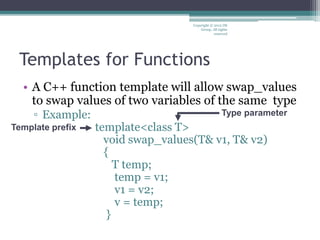
• A C++ function template will allow swap_values
to swap values of two variables of the same type
▫ Example:
template<class T>
void swap_values(T& v1, T& v2)
{
T temp;
temp = v1;
v1 = v2;
v = temp;
}
Template prefix
Type parameter
Templates for Functions
Copyright © 2012 IM
Group. All rights
reserved
Template Details
• template<class T> is the template prefix
▫ Tells compiler that the declaration or definition that
follows is a template
▫ Tells compiler that T is a type parameter
 class means type in this context
(typename could replace class but class is usually used)
 T can be replaced by any type argument
(whether the type is a class or not)
• A template overloads the function name by
replacing T with the type used in a function call
Copyright © 2012 IM
Group. All rights
reserved
Calling a Template Function
• Calling a function defined with a template is
identical to calling a normal function
▫ Example:
To call the template version of swap_values
char s1, s2;
int i1, i2;
…
swap_values(s1, s2);
swap_values(i1, i2);
 The compiler checks the argument types and
generates an appropriate version of swap_values
Copyright © 2012 IM
Group. All rights
reserved
Templates and Declarations
• A function template may also have a separate
declaration
▫ The template prefix and type parameter are used
▫ Depending on your compiler
 You may, or may not, be able to separate declaration and
definitions of template functions just as you do with regular
functions
▫ To be safe, place template function definitions in the same file
where they are used…with no declaration
 A file included with #include is, in most cases, equivalent to
being "in the same file“
 This means including the .cpp file or .h file with
implementation code
Copyright © 2012 IM
Group. All rights
reserved
Templates with Multiple Parameters
• Function templates may use more than one
parameter
▫ Example:
template<class T1, class T2>
 All parameters must be used in the template
function
Copyright © 2012 IM
Group. All rights
reserved
Defining Templates
• When defining a template it is a good idea…
▫ To start with an ordinary function that
accomplishes the task with one type
 It is often easier to deal with a concrete case rather
than the general case
▫ Then debug the ordinary function
▫ Next convert the function to a template by
replacing type names with a type parameter
Copyright © 2012 IM
Group. All rights
reserved
Copyright ©
2012 IM
Group. All
rights reserved
Templates for Data Abstraction
Object Oriented Programming
Templates for Data Abstraction
• Class definitions can also be made more general
with templates
▫ The syntax for class templates is basically the
same as for function templates
 template<class T> comes before the template
definition
 Type parameter T is used in the class definition just
like any other type
 Type parameter T can represent any type
Copyright © 2012 IM
Group. All rights
reserved
A Class Template
• The following is a class template
▫ An object of this class contains a pair of values of
type T
▫ template <class T>
class Pair
{
public:
Pair( );
Pair( T first_value, T second_value);
…
continued on next slide
Copyright © 2012 IM
Group. All rights
reserved
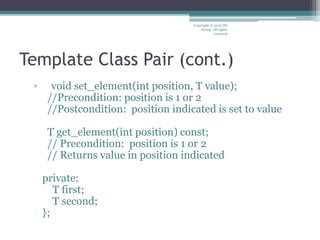
Template Class Pair (cont.)
▫ void set_element(int position, T value);
//Precondition: position is 1 or 2
//Postcondition: position indicated is set to value
T get_element(int position) const;
// Precondition: position is 1 or 2
// Returns value in position indicated
private:
T first;
T second;
};
Copyright © 2012 IM
Group. All rights
reserved
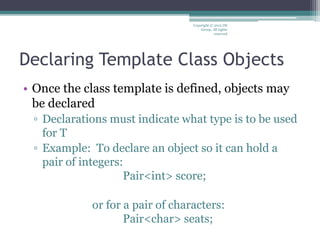
Declaring Template Class Objects
• Once the class template is defined, objects may
be declared
▫ Declarations must indicate what type is to be used
for T
▫ Example: To declare an object so it can hold a
pair of integers:
Pair<int> score;
or for a pair of characters:
Pair<char> seats;
Copyright © 2012 IM
Group. All rights
reserved
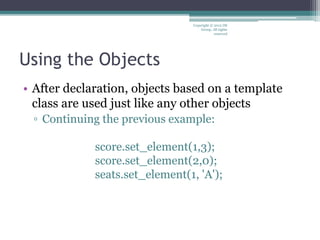
Using the Objects
• After declaration, objects based on a template
class are used just like any other objects
▫ Continuing the previous example:
score.set_element(1,3);
score.set_element(2,0);
seats.set_element(1, 'A');
Copyright © 2012 IM
Group. All rights
reserved
Defining the Member Functions
• Member functions of a template class are
defined
the same way as member functions of ordinary
classes
▫ The only difference is that the member function
definitions are themselves templates
Copyright © 2012 IM
Group. All rights
reserved
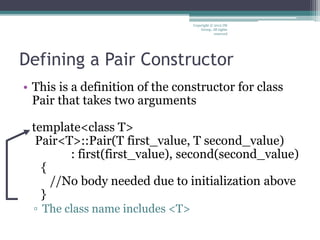
• This is a definition of the constructor for class
Pair that takes two arguments
template<class T>
Pair<T>::Pair(T first_value, T second_value)
: first(first_value), second(second_value)
{
//No body needed due to initialization above
}
▫ The class name includes <T>
Defining a Pair Constructor
Copyright © 2012 IM
Group. All rights
reserved
Defining set_element
• Here is a definition for set_element in the
template class Pair
void Pair<T>::set_element(int position, T value)
{
if (position = = 1)
first = value;
else if (position = = 2)
second = value;
else
…
}
Copyright © 2012 IM
Group. All rights
reserved
Template Class Names as Parameters
• The name of a template class may be used as the
type of a function parameter
▫ Example: To create a parameter of type
Pair<int>:
int add_up(const Pair<int>& the_pair);
//Returns the sum of two integers in the_pair
Copyright © 2012 IM
Group. All rights
reserved
Template Functions with Template
Class Parameters
• Function add_up from a previous example can
be made more general as a template function:
template<class T>
T add_up(const Pair<T>& the_pair)
//Precondition: operator + is defined for T
//Returns sum of the two values in
the_pair
Copyright © 2012 IM
Group. All rights
reserved
typedef and Templates
• You specialize a class template by giving a type
argument to the class name such as Pair<int>
▫ The specialized name, Pair<int>, is used just
like any class name
• You can define a new class type name with the
same meaning as the specialized name:
typedef Class_Name<Type_Arg>
New_Type_Name;
For example: typedef Pair<int> PairOfInt;
PairOfInt pair1, pair2;
Copyright © 2012 IM
Group. All rights
reserved
Any Questions
Session 6 Copyright © 2012 IM
Group. All rights
reserved

OOP - Templates

  • 1.
    Templates Object Oriented ProgrammingCopyright © 2012 IM Group. All rights reserved
  • 2.
    Training • Makes asimple function to swap 2 characters. Copyright © 2012 IM Group. All rights reserved
  • 3.
    swap_values for char •Here is a version of swap_values to swap character variables: ▫ void swap_values(char& v1, char& v2) { char temp; temp = v1; v1 = v2; v2 = temp; } Copyright © 2012 IM Group. All rights reserved
  • 4.
    A General swap_values •A generalized version of swap_values is shown here. ▫ void swap_values(type_of_var& v1, type_of_var& v2) { type_of_var temp; temp = v1; v1 = v2; v2 = temp; } ▫ This function, if type_of_var could accept any type, could be used to swap values of any type Copyright © 2012 IM Group. All rights reserved
  • 5.
    • A C++function template will allow swap_values to swap values of two variables of the same type ▫ Example: template<class T> void swap_values(T& v1, T& v2) { T temp; temp = v1; v1 = v2; v = temp; } Template prefix Type parameter Templates for Functions Copyright © 2012 IM Group. All rights reserved
  • 6.
    Template Details • template<classT> is the template prefix ▫ Tells compiler that the declaration or definition that follows is a template ▫ Tells compiler that T is a type parameter  class means type in this context (typename could replace class but class is usually used)  T can be replaced by any type argument (whether the type is a class or not) • A template overloads the function name by replacing T with the type used in a function call Copyright © 2012 IM Group. All rights reserved
  • 7.
    Calling a TemplateFunction • Calling a function defined with a template is identical to calling a normal function ▫ Example: To call the template version of swap_values char s1, s2; int i1, i2; … swap_values(s1, s2); swap_values(i1, i2);  The compiler checks the argument types and generates an appropriate version of swap_values Copyright © 2012 IM Group. All rights reserved
  • 8.
    Templates and Declarations •A function template may also have a separate declaration ▫ The template prefix and type parameter are used ▫ Depending on your compiler  You may, or may not, be able to separate declaration and definitions of template functions just as you do with regular functions ▫ To be safe, place template function definitions in the same file where they are used…with no declaration  A file included with #include is, in most cases, equivalent to being "in the same file“  This means including the .cpp file or .h file with implementation code Copyright © 2012 IM Group. All rights reserved
  • 9.
    Templates with MultipleParameters • Function templates may use more than one parameter ▫ Example: template<class T1, class T2>  All parameters must be used in the template function Copyright © 2012 IM Group. All rights reserved
  • 10.
    Defining Templates • Whendefining a template it is a good idea… ▫ To start with an ordinary function that accomplishes the task with one type  It is often easier to deal with a concrete case rather than the general case ▫ Then debug the ordinary function ▫ Next convert the function to a template by replacing type names with a type parameter Copyright © 2012 IM Group. All rights reserved
  • 11.
    Copyright © 2012 IM Group.All rights reserved Templates for Data Abstraction Object Oriented Programming
  • 12.
    Templates for DataAbstraction • Class definitions can also be made more general with templates ▫ The syntax for class templates is basically the same as for function templates  template<class T> comes before the template definition  Type parameter T is used in the class definition just like any other type  Type parameter T can represent any type Copyright © 2012 IM Group. All rights reserved
  • 13.
    A Class Template •The following is a class template ▫ An object of this class contains a pair of values of type T ▫ template <class T> class Pair { public: Pair( ); Pair( T first_value, T second_value); … continued on next slide Copyright © 2012 IM Group. All rights reserved
  • 14.
    Template Class Pair(cont.) ▫ void set_element(int position, T value); //Precondition: position is 1 or 2 //Postcondition: position indicated is set to value T get_element(int position) const; // Precondition: position is 1 or 2 // Returns value in position indicated private: T first; T second; }; Copyright © 2012 IM Group. All rights reserved
  • 15.
    Declaring Template ClassObjects • Once the class template is defined, objects may be declared ▫ Declarations must indicate what type is to be used for T ▫ Example: To declare an object so it can hold a pair of integers: Pair<int> score; or for a pair of characters: Pair<char> seats; Copyright © 2012 IM Group. All rights reserved
  • 16.
    Using the Objects •After declaration, objects based on a template class are used just like any other objects ▫ Continuing the previous example: score.set_element(1,3); score.set_element(2,0); seats.set_element(1, 'A'); Copyright © 2012 IM Group. All rights reserved
  • 17.
    Defining the MemberFunctions • Member functions of a template class are defined the same way as member functions of ordinary classes ▫ The only difference is that the member function definitions are themselves templates Copyright © 2012 IM Group. All rights reserved
  • 18.
    • This isa definition of the constructor for class Pair that takes two arguments template<class T> Pair<T>::Pair(T first_value, T second_value) : first(first_value), second(second_value) { //No body needed due to initialization above } ▫ The class name includes <T> Defining a Pair Constructor Copyright © 2012 IM Group. All rights reserved
  • 19.
    Defining set_element • Hereis a definition for set_element in the template class Pair void Pair<T>::set_element(int position, T value) { if (position = = 1) first = value; else if (position = = 2) second = value; else … } Copyright © 2012 IM Group. All rights reserved
  • 20.
    Template Class Namesas Parameters • The name of a template class may be used as the type of a function parameter ▫ Example: To create a parameter of type Pair<int>: int add_up(const Pair<int>& the_pair); //Returns the sum of two integers in the_pair Copyright © 2012 IM Group. All rights reserved
  • 21.
    Template Functions withTemplate Class Parameters • Function add_up from a previous example can be made more general as a template function: template<class T> T add_up(const Pair<T>& the_pair) //Precondition: operator + is defined for T //Returns sum of the two values in the_pair Copyright © 2012 IM Group. All rights reserved
  • 22.
    typedef and Templates •You specialize a class template by giving a type argument to the class name such as Pair<int> ▫ The specialized name, Pair<int>, is used just like any class name • You can define a new class type name with the same meaning as the specialized name: typedef Class_Name<Type_Arg> New_Type_Name; For example: typedef Pair<int> PairOfInt; PairOfInt pair1, pair2; Copyright © 2012 IM Group. All rights reserved
  • 23.
    Any Questions Session 6Copyright © 2012 IM Group. All rights reserved