Agenda
• Abstraction
• Abstract class
– Formal definition
– Example
– When to use abstract class
• Interface
– Formal definition
– Example
– When to use interface
• Difference between abstract class and interface
Abstraction
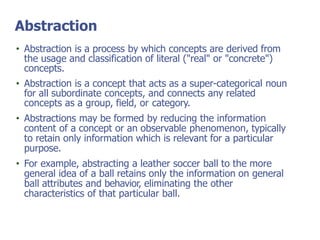
• Abstraction is a process by which concepts are derived from
the usage and classification of literal ("real" or "concrete")
concepts.
• Abstraction is a concept that acts as a super-categorical noun
for all subordinate concepts, and connects any related
concepts as a group, field, or category.
• Abstractions may be formed by reducing the information
content of a concept or an observable phenomenon, typically
to retain only information which is relevant for a particular
purpose.
• For example, abstracting a leather soccer ball to the more
general idea of a ball retains only the information on general
ball attributes and behavior, eliminating the other
characteristics of that particular ball.
Abstraction
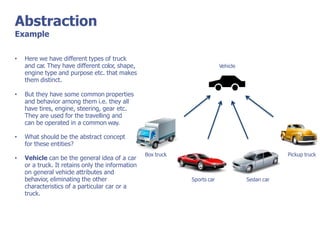
Example
Vehicle
Box truck
Sports car Sedan car
Pickup truck
• Here we have different types of truck
and car. They have different color, shape,
engine type and purpose etc. that makes
them distinct.
• But they have some common properties
and behavior among them i.e. they all
have tires, engine, steering, gear etc.
They are used for the travelling and
can be operated in a common way.
• What should be the abstract concept
for these entities?
• Vehicle can be the general idea of a car
or a truck. It retains only the information
on general vehicle attributes and
behavior, eliminating the other
characteristics of a particular car or a
truck.
Abstraction
Example
Sedan carSports car
Car
Classic truckBox truck
Truck
Vehicle
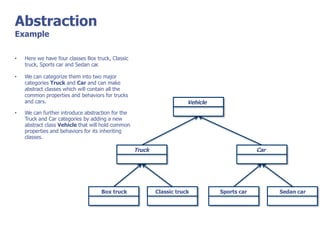
• Here we have four classes Box truck, Classic
truck, Sports car and Sedan car.
• We can categorize them into two major
categories Truck and Car and can make
abstract classes which will contain all the
common properties and behaviors for trucks
and cars.
• We can further introduce abstraction for the
Truck and Car categories by adding a new
abstract class Vehicle that will hold common
properties and behaviors for its inheriting
classes.
Abstraction
Example
Dog Tiger Horse
Animal
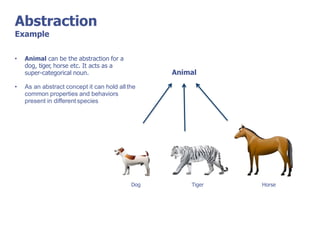
• Animal can be the abstraction for a
dog, tiger, horse etc. It acts as a
super-categorical noun.
• As an abstract concept it can hold allthe
common properties and behaviors
present in different species
Abstraction
Example
Animal
color : String
pattern : String
sound()
eat()
run()
Horse
sound()
Tiger
sound()
attack()
Dog
sound()
guard()
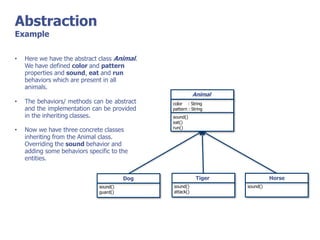
• Here we have the abstract class Animal.
We have defined color and pattern
properties and sound, eat and run
behaviors which are present in all
animals.
• The behaviors/ methods can be abstract
and the implementation can be provided
in the inheriting classes.
• Now we have three concrete classes
inheriting from the Animal class.
Overriding the sound behavior and
adding some behaviors specific to the
entities.
Abstraction
Example
Aircraft
Propeller plane Fighter plane Passenger plane
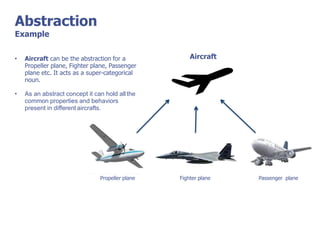
• Aircraft can be the abstraction for a
Propeller plane, Fighter plane, Passenger
plane etc. It acts as a super-categorical
noun.
• As an abstract concept it can hold allthe
common properties and behaviors
present in different aircrafts.
Abstraction
Example
Aircraft
color : String
engine : Object
start()
stop()
takeOff()
land()
Passenger planeFighter planePropeller plane
start()
stop()
takeOff()
land()
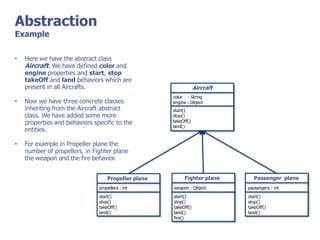
• Here we have the abstract class
Aircraft. We have defined color and
engine properties and start, stop
takeOff and land behaviors which are
present in all Aircrafts.
• Now we have three concrete classes
inheriting from the Aircraft abstract
class. We have added some more
properties and behaviors specific to the
entities.
• For example in Propeller plane the
number of propellers, in Fighter plane
the weapon and the fire behavior.
propellers : int
start()
stop()
takeOff()
land()
fire()
weapon : Object passengers : int
start()
stop()
takeOff()
land()
Abstract class
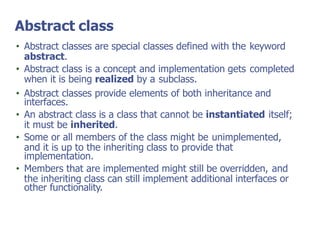
• Abstract classes are special classes defined with the keyword
abstract.
• Abstract class is a concept and implementation gets completed
when it is being realized by a subclass.
• Abstract classes provide elements of both inheritance and
interfaces.
• An abstract class is a class that cannot be instantiated itself;
it must be inherited.
• Some or all members of the class might be unimplemented,
and it is up to the inheriting class to provide that
implementation.
• Members that are implemented might still be overridden, and
the inheriting class can still implement additional interfaces or
other functionality.
Abstract class
Example
Bank Account
owner : String
balance : Dollar
deposit(amount : Dollar)
withdraw(amount : Dollar)
Checking Account
owner : String
balance : Dollar
insufficientFundsFee : Dollar
deposit(amount : Dollar)
processCheck(checkToProcess : Check)
withdraw(amount : Dollar)
Saving Account
owner : String
balance : Dollar
annualInterestRate : Percentage
deposit(amount : Dollar)
depositMonthlyInterest()
withdraw(amount : Dollar)
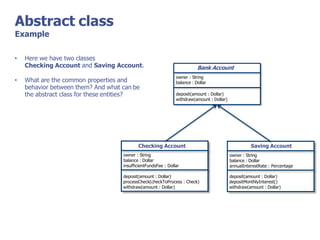
• Here we have two classes
Checking Account and Saving Account.
• What are the common properties and
behavior between them? And what can be
the abstract class for these entities?
When to use abstract class?
• Abstract class provides a template for future specific classes.
• Use an abstract class to provide default behaviors (Code reusability).
• Abstract class defines common interface for its subclasses.
• Abstract operations (methods) can be declared and their
implementation can be provided later in the concrete classes.
• Abstract classes are useful when creating components because they
allow us to specify an invariant level of functionality in some
methods, but leave the implementation of other methods until a
specific implementation of that class is needed.
• When creating a class library which will be widely distributed or
reused especially to clients, use an abstract class in preference to
an interface; because it simplifies versioning. This is the practice
used by the Microsoft team which developed the Base Class Library.
Interface
• Every method declared by an object specifies the method's name,
the object/value it takes as parameters, and the method's return
value. This is known as the operation signature.
• The set of all signatures defined by an object's methods is called
the interface to the object. An object's interface characterizes the
complete set of requests that can be sent to the object.
• An interface is like an abstract class that cannot be instantiated.
Interfaces are better suited to situations in which your applications
require many possibly unrelated object types to provide certain
functionality.
• Explicitly implementing interface in a class enables us to define a
set of methods that are mandatory for that class.
• Interface definition begins with the keyword interface.
Interface
Example
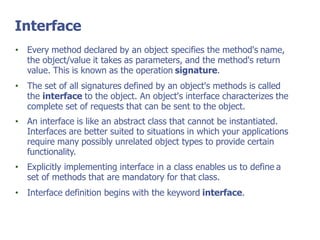
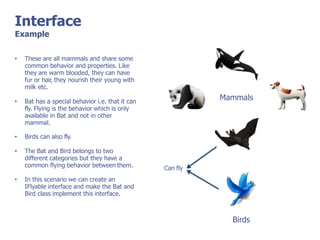
Mammals
• These are all mammals and share some
common behavior and properties. Like
they are warm blooded, they can have
fur or hair, they nourish their young with
milk etc.
• Bat has a special behavior i.e. that it can
fly. Flying is the behavior which is only
available in Bat and not in other
mammal.
• Birds can also fly.
• The Bat and Bird belongs to two
different categories but they have a
common flying behavior between them.
• In this scenario we can create an
IFlyable interface and make the Bat and
Bird class implement this interface.
Can fly
Birds
Interface
Example
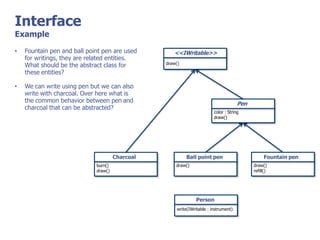
• Fountain pen and ball point pen are used
for writings, they are related entities.
What should be the abstract class for
these entities?
• We can write using pen but we can also
write with charcoal. Over here what is
the common behavior between pen and
charcoal that can be abstracted?
Ball point pen
draw()
Fountain pen
draw()
refill()
Charcoal
burn()
draw()
Pen
color : String
draw()
<<IWritable>>
draw()
Person
write(IWritable : instrument)
Interface
Example: IDisposible Interface in .Net
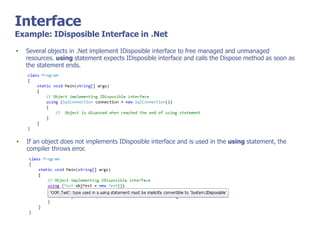
• Several objects in .Net implement IDisposible interface to free managed and unmanaged
resources. using statement expects IDisposible interface and calls the Dispose method as soon as
the statement ends.
• If an object does not implements IDisposible interface and is used in the using statement, the
compiler throws error.
When to use Interface?
• Use an interface when an immutable contract is really
intended.
• Interfaces are better suited in situations when your
applications require many possibly unrelated object types
to provide certain functionality.
• Interfaces are better in situations in which you do not
need to inherit implementation from a base class.
• Interfaces can be used for multiple inheritance.
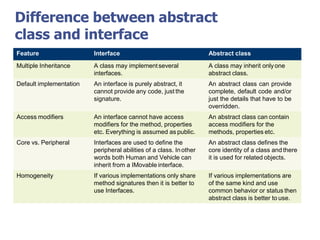
Difference between abstract
class and interface
Feature Interface Abstract class
Multiple Inheritance A class may implementseveral
interfaces.
A class may inherit onlyone
abstract class.
Default implementation An interface is purely abstract, it
cannot provide any code, just the
signature.
An abstract class can provide
complete, default code and/or
just the details that have to be
overridden.
Access modifiers An interface cannot have access
modifiers for the method, properties
etc. Everything is assumed as public.
An abstract class can contain
access modifiers for the
methods, properties etc.
Core vs. Peripheral Interfaces are used to define the
peripheral abilities of a class. Inother
words both Human and Vehicle can
inherit from a IMovable interface.
An abstract class defines the
core identity of a class and there
it is used for related objects.
Homogeneity If various implementations only share
method signatures then it is better to
use Interfaces.
If various implementations are
of the same kind and use
common behavior or status then
abstract class is better to use.
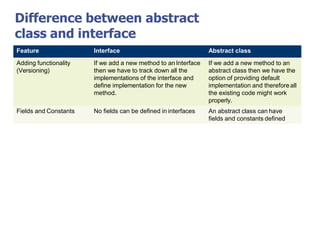
Difference between abstract
class and interface
Feature Interface Abstract class
Adding functionality
(Versioning)
If we add a new method to an Interface
then we have to track down all the
implementations of the interface and
define implementation for the new
method.
If we add a new method to an
abstract class then we have the
option of providing default
implementation and therefore all
the existing code might work
properly.
Fields and Constants No fields can be defined in interfaces An abstract class can have
fields and constants defined
Is-a, can-do analogy
• Abstract classes are classes that can be purely abstract.
• It serves as a base for other classes. When a class is derived
from a base class, that derived class has an "is-a" relationship
with the base.
• For example an Employee is a person and a Triangle is a shape
so these cases could easily justify a base class and “is-a”
relationship.
• Interfaces are purely abstract and guarantee member
invariance. They represent "can-do" or an invariant contract
that specifies "can do and will always do as expected to do“.
• Its appropriate to use an interface when it will be used by
many, unrelated types or in situations when multiple
inheritance is required.

Abstraction1

  • 1.
    Agenda • Abstraction • Abstractclass – Formal definition – Example – When to use abstract class • Interface – Formal definition – Example – When to use interface • Difference between abstract class and interface
  • 2.
    Abstraction • Abstraction isa process by which concepts are derived from the usage and classification of literal ("real" or "concrete") concepts. • Abstraction is a concept that acts as a super-categorical noun for all subordinate concepts, and connects any related concepts as a group, field, or category. • Abstractions may be formed by reducing the information content of a concept or an observable phenomenon, typically to retain only information which is relevant for a particular purpose. • For example, abstracting a leather soccer ball to the more general idea of a ball retains only the information on general ball attributes and behavior, eliminating the other characteristics of that particular ball.
  • 3.
    Abstraction Example Vehicle Box truck Sports carSedan car Pickup truck • Here we have different types of truck and car. They have different color, shape, engine type and purpose etc. that makes them distinct. • But they have some common properties and behavior among them i.e. they all have tires, engine, steering, gear etc. They are used for the travelling and can be operated in a common way. • What should be the abstract concept for these entities? • Vehicle can be the general idea of a car or a truck. It retains only the information on general vehicle attributes and behavior, eliminating the other characteristics of a particular car or a truck.
  • 4.
    Abstraction Example Sedan carSports car Car ClassictruckBox truck Truck Vehicle • Here we have four classes Box truck, Classic truck, Sports car and Sedan car. • We can categorize them into two major categories Truck and Car and can make abstract classes which will contain all the common properties and behaviors for trucks and cars. • We can further introduce abstraction for the Truck and Car categories by adding a new abstract class Vehicle that will hold common properties and behaviors for its inheriting classes.
  • 5.
    Abstraction Example Dog Tiger Horse Animal •Animal can be the abstraction for a dog, tiger, horse etc. It acts as a super-categorical noun. • As an abstract concept it can hold allthe common properties and behaviors present in different species
  • 6.
    Abstraction Example Animal color : String pattern: String sound() eat() run() Horse sound() Tiger sound() attack() Dog sound() guard() • Here we have the abstract class Animal. We have defined color and pattern properties and sound, eat and run behaviors which are present in all animals. • The behaviors/ methods can be abstract and the implementation can be provided in the inheriting classes. • Now we have three concrete classes inheriting from the Animal class. Overriding the sound behavior and adding some behaviors specific to the entities.
  • 7.
    Abstraction Example Aircraft Propeller plane Fighterplane Passenger plane • Aircraft can be the abstraction for a Propeller plane, Fighter plane, Passenger plane etc. It acts as a super-categorical noun. • As an abstract concept it can hold allthe common properties and behaviors present in different aircrafts.
  • 8.
    Abstraction Example Aircraft color : String engine: Object start() stop() takeOff() land() Passenger planeFighter planePropeller plane start() stop() takeOff() land() • Here we have the abstract class Aircraft. We have defined color and engine properties and start, stop takeOff and land behaviors which are present in all Aircrafts. • Now we have three concrete classes inheriting from the Aircraft abstract class. We have added some more properties and behaviors specific to the entities. • For example in Propeller plane the number of propellers, in Fighter plane the weapon and the fire behavior. propellers : int start() stop() takeOff() land() fire() weapon : Object passengers : int start() stop() takeOff() land()
  • 9.
    Abstract class • Abstractclasses are special classes defined with the keyword abstract. • Abstract class is a concept and implementation gets completed when it is being realized by a subclass. • Abstract classes provide elements of both inheritance and interfaces. • An abstract class is a class that cannot be instantiated itself; it must be inherited. • Some or all members of the class might be unimplemented, and it is up to the inheriting class to provide that implementation. • Members that are implemented might still be overridden, and the inheriting class can still implement additional interfaces or other functionality.
  • 10.
    Abstract class Example Bank Account owner: String balance : Dollar deposit(amount : Dollar) withdraw(amount : Dollar) Checking Account owner : String balance : Dollar insufficientFundsFee : Dollar deposit(amount : Dollar) processCheck(checkToProcess : Check) withdraw(amount : Dollar) Saving Account owner : String balance : Dollar annualInterestRate : Percentage deposit(amount : Dollar) depositMonthlyInterest() withdraw(amount : Dollar) • Here we have two classes Checking Account and Saving Account. • What are the common properties and behavior between them? And what can be the abstract class for these entities?
  • 11.
    When to useabstract class? • Abstract class provides a template for future specific classes. • Use an abstract class to provide default behaviors (Code reusability). • Abstract class defines common interface for its subclasses. • Abstract operations (methods) can be declared and their implementation can be provided later in the concrete classes. • Abstract classes are useful when creating components because they allow us to specify an invariant level of functionality in some methods, but leave the implementation of other methods until a specific implementation of that class is needed. • When creating a class library which will be widely distributed or reused especially to clients, use an abstract class in preference to an interface; because it simplifies versioning. This is the practice used by the Microsoft team which developed the Base Class Library.
  • 12.
    Interface • Every methoddeclared by an object specifies the method's name, the object/value it takes as parameters, and the method's return value. This is known as the operation signature. • The set of all signatures defined by an object's methods is called the interface to the object. An object's interface characterizes the complete set of requests that can be sent to the object. • An interface is like an abstract class that cannot be instantiated. Interfaces are better suited to situations in which your applications require many possibly unrelated object types to provide certain functionality. • Explicitly implementing interface in a class enables us to define a set of methods that are mandatory for that class. • Interface definition begins with the keyword interface.
  • 13.
    Interface Example Mammals • These areall mammals and share some common behavior and properties. Like they are warm blooded, they can have fur or hair, they nourish their young with milk etc. • Bat has a special behavior i.e. that it can fly. Flying is the behavior which is only available in Bat and not in other mammal. • Birds can also fly. • The Bat and Bird belongs to two different categories but they have a common flying behavior between them. • In this scenario we can create an IFlyable interface and make the Bat and Bird class implement this interface. Can fly Birds
  • 14.
    Interface Example • Fountain penand ball point pen are used for writings, they are related entities. What should be the abstract class for these entities? • We can write using pen but we can also write with charcoal. Over here what is the common behavior between pen and charcoal that can be abstracted? Ball point pen draw() Fountain pen draw() refill() Charcoal burn() draw() Pen color : String draw() <<IWritable>> draw() Person write(IWritable : instrument)
  • 15.
    Interface Example: IDisposible Interfacein .Net • Several objects in .Net implement IDisposible interface to free managed and unmanaged resources. using statement expects IDisposible interface and calls the Dispose method as soon as the statement ends. • If an object does not implements IDisposible interface and is used in the using statement, the compiler throws error.
  • 16.
    When to useInterface? • Use an interface when an immutable contract is really intended. • Interfaces are better suited in situations when your applications require many possibly unrelated object types to provide certain functionality. • Interfaces are better in situations in which you do not need to inherit implementation from a base class. • Interfaces can be used for multiple inheritance.
  • 17.
    Difference between abstract classand interface Feature Interface Abstract class Multiple Inheritance A class may implementseveral interfaces. A class may inherit onlyone abstract class. Default implementation An interface is purely abstract, it cannot provide any code, just the signature. An abstract class can provide complete, default code and/or just the details that have to be overridden. Access modifiers An interface cannot have access modifiers for the method, properties etc. Everything is assumed as public. An abstract class can contain access modifiers for the methods, properties etc. Core vs. Peripheral Interfaces are used to define the peripheral abilities of a class. Inother words both Human and Vehicle can inherit from a IMovable interface. An abstract class defines the core identity of a class and there it is used for related objects. Homogeneity If various implementations only share method signatures then it is better to use Interfaces. If various implementations are of the same kind and use common behavior or status then abstract class is better to use.
  • 18.
    Difference between abstract classand interface Feature Interface Abstract class Adding functionality (Versioning) If we add a new method to an Interface then we have to track down all the implementations of the interface and define implementation for the new method. If we add a new method to an abstract class then we have the option of providing default implementation and therefore all the existing code might work properly. Fields and Constants No fields can be defined in interfaces An abstract class can have fields and constants defined
  • 19.
    Is-a, can-do analogy •Abstract classes are classes that can be purely abstract. • It serves as a base for other classes. When a class is derived from a base class, that derived class has an "is-a" relationship with the base. • For example an Employee is a person and a Triangle is a shape so these cases could easily justify a base class and “is-a” relationship. • Interfaces are purely abstract and guarantee member invariance. They represent "can-do" or an invariant contract that specifies "can do and will always do as expected to do“. • Its appropriate to use an interface when it will be used by many, unrelated types or in situations when multiple inheritance is required.