Teknologiatuettu oppiminen
ja opetus
Jari Laru, KT, yliopistonlehtori, teknologiatuettu oppiminen ja opetus, Oulun
KTK,yliopisto
Pohjois-Pohjanmaan liiton asiantuntijafoorumi 1/2017
KEHITTYVÄ KOULUYMPÄRISTÖ
Käsitteet
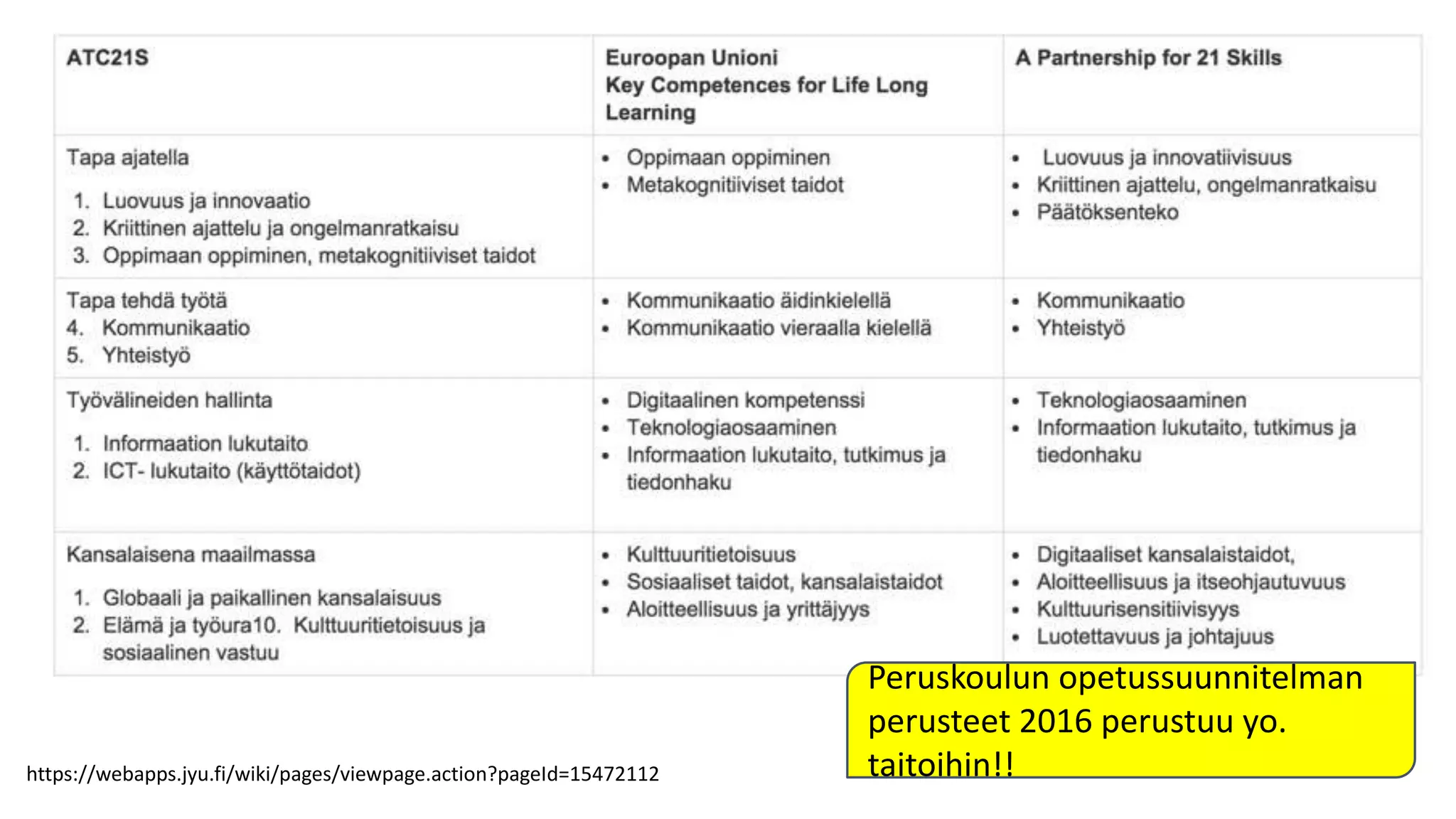
https://webapps.jyu.fi/wiki/pages/viewpage.action?pageId=15472112
Peruskoulun opetussuunnitelman
perusteet 2016 perustuu yo.
taitoihin!!
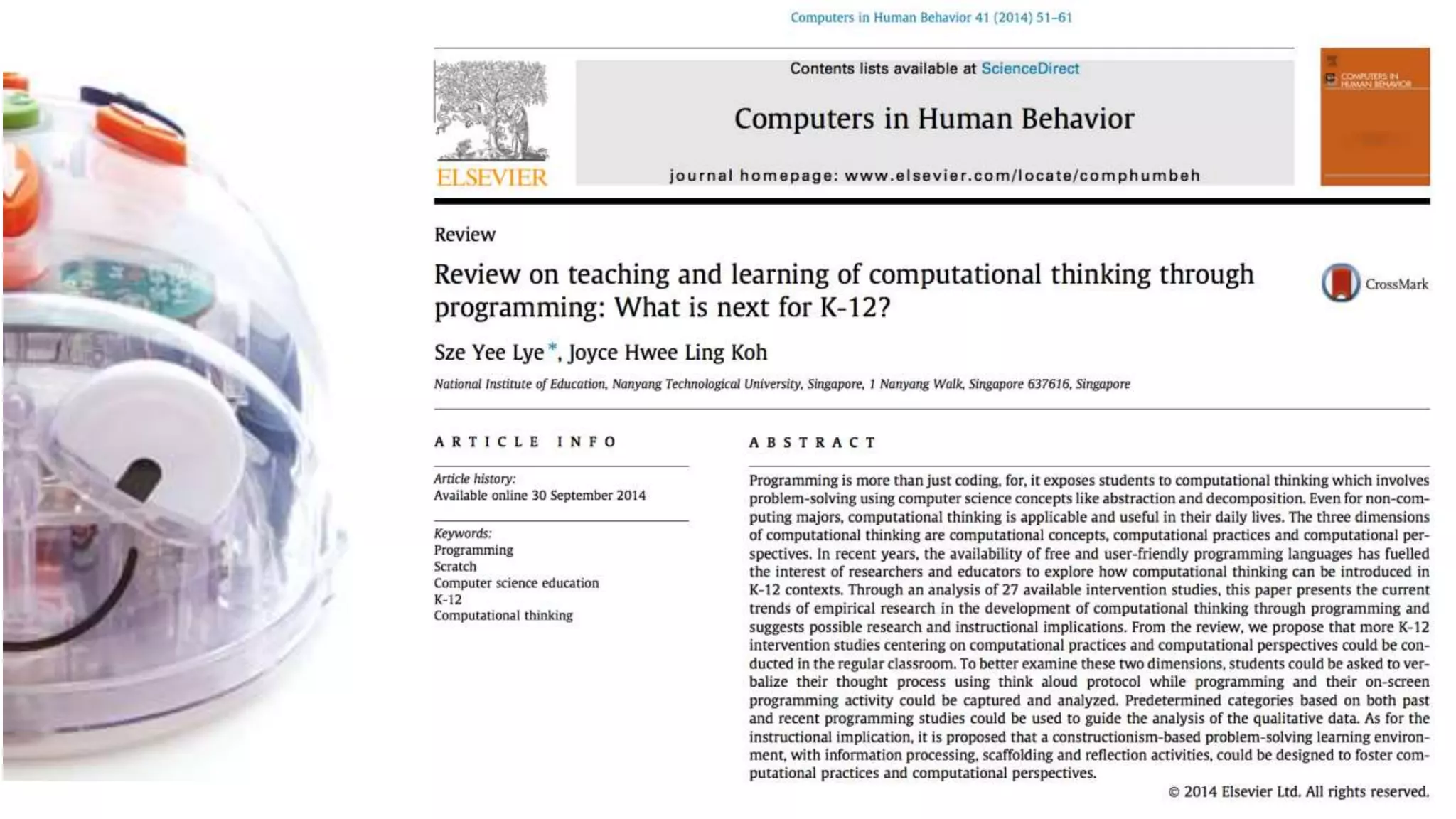
Koivisto & Laru (submitted, 2016). Redesigning activities and Minecraft
world of afterschool code club for learning computational thinking and 21st
century skills
https://k12cs.org/
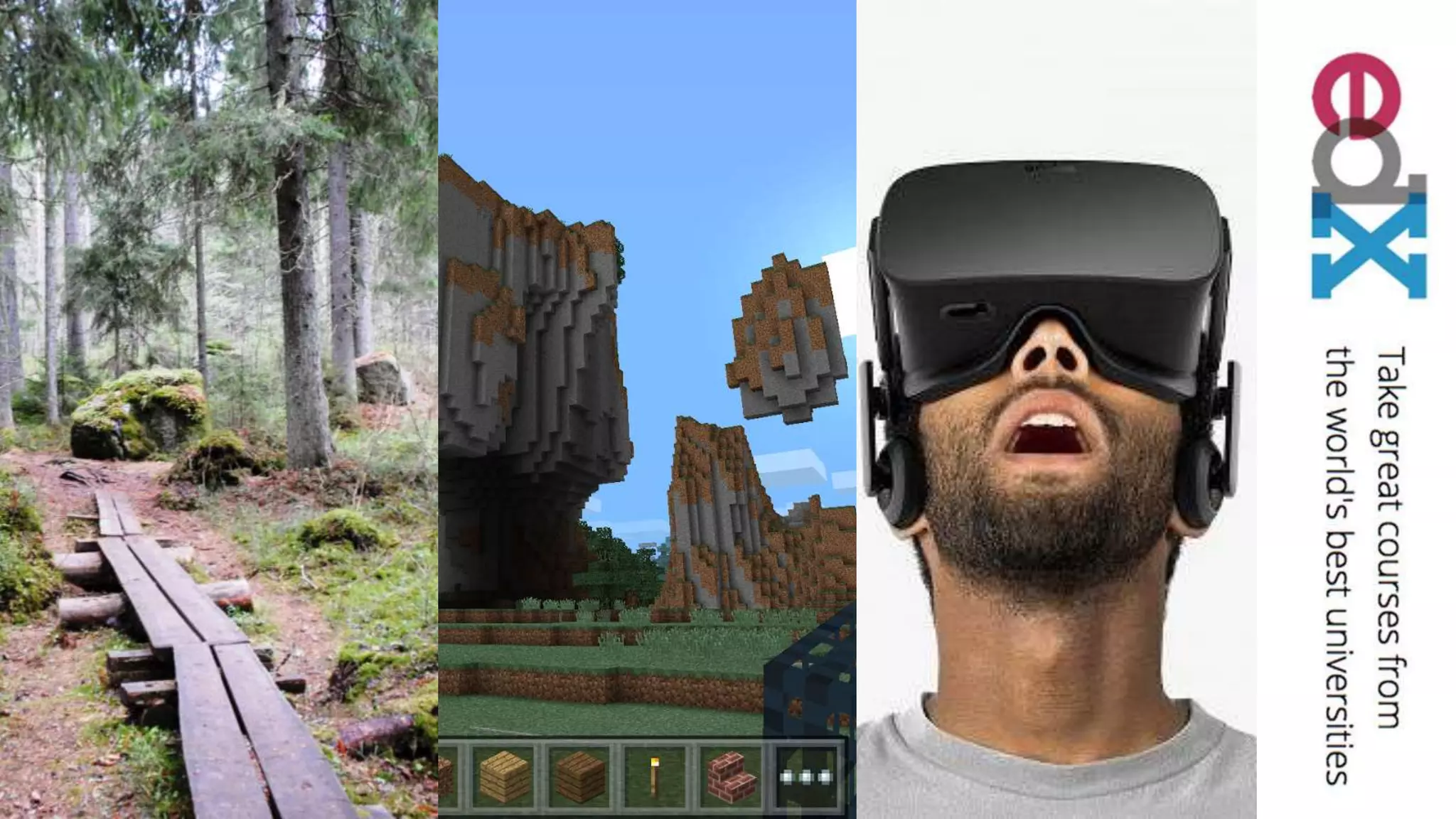
Oppimisympäristöt
https://www.youtube.com/watch?v=7LPyHCnuYJE
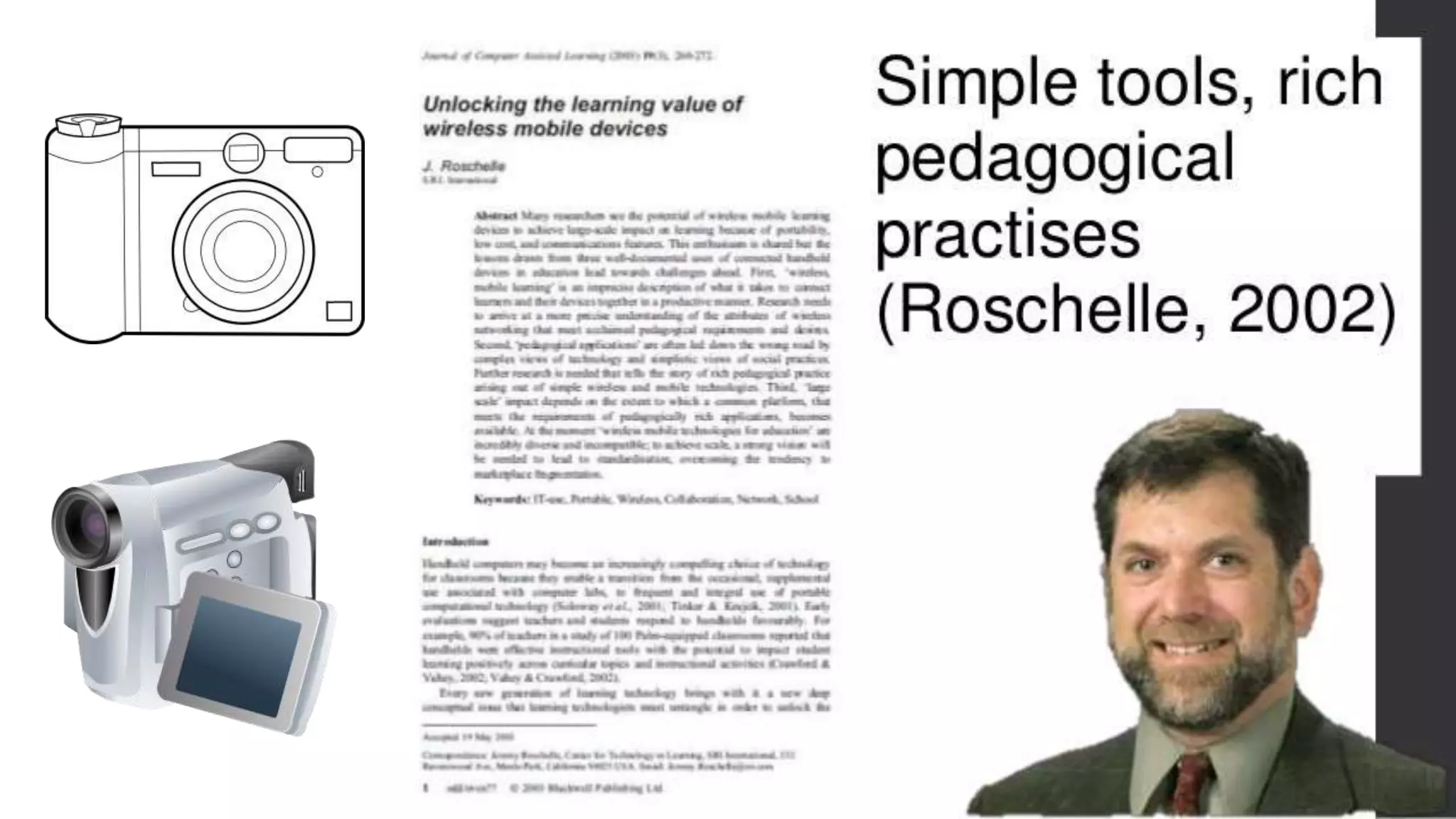
Välineet
https://www.youtube.com/watch?v=TIi1tTZqHvU&t=34s
Oppiminen ei ole
itsestäänselvyys
Teknologiatuettu oppiminen ei ole hopealuoti
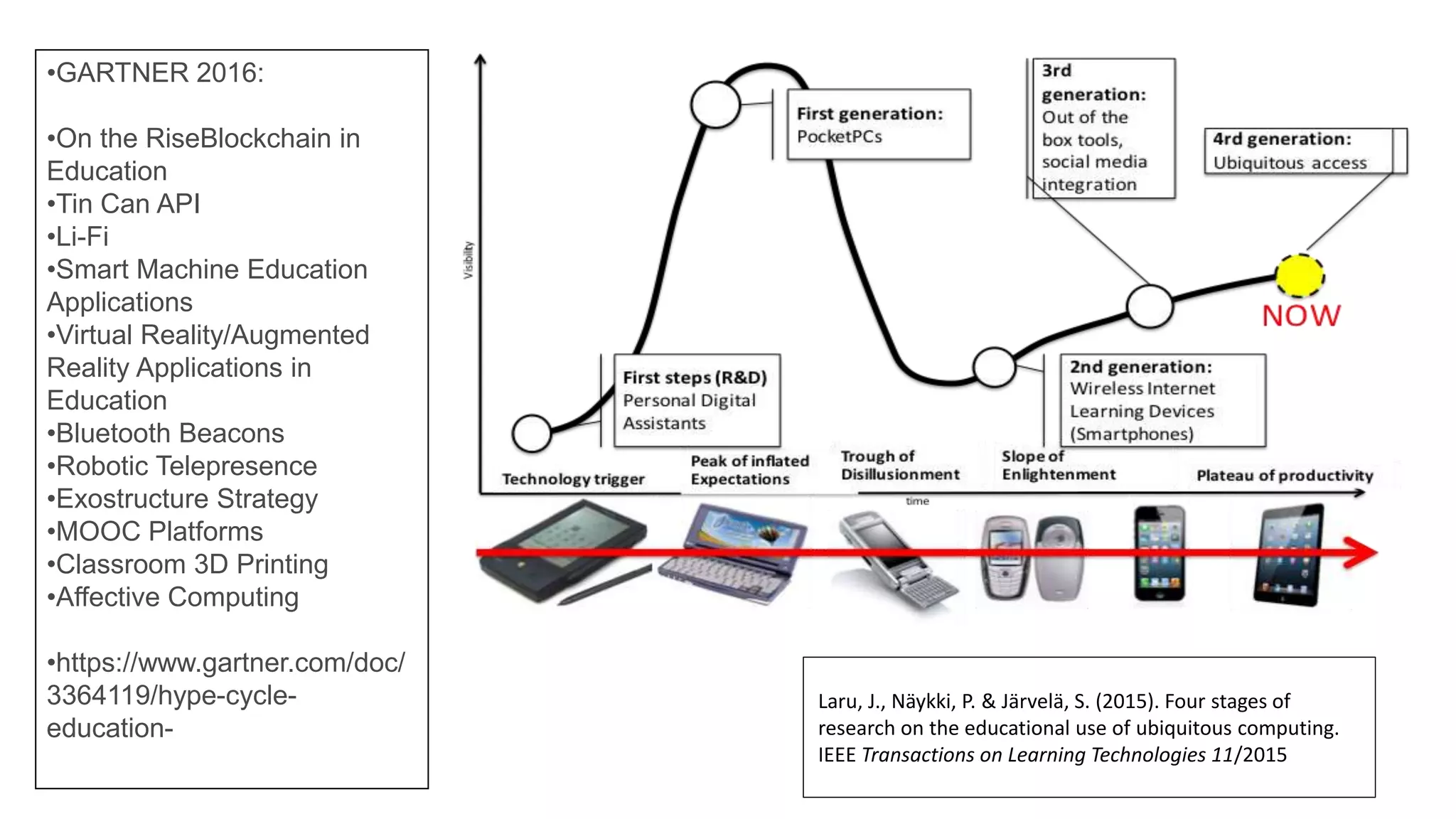
Laru, J., Näykki, P. & Järvelä, S. (2015). Four stages of
research on the educational use of ubiquitous computing.
IEEE Transactions on Learning Technologies 11/2015
•GARTNER 2016:
•On the RiseBlockchain in
Education
•Tin Can API
•Li-Fi
•Smart Machine Education
Applications
•Virtual Reality/Augmented
Reality Applications in
Education
•Bluetooth Beacons
•Robotic Telepresence
•Exostructure Strategy
•MOOC Platforms
•Classroom 3D Printing
•Affective Computing
•https://www.gartner.com/doc/
3364119/hype-cycle-
education-
MOOC
vs.
SOOC
vs.
Flipped
Classroom
• Assessment, P. I. N. (2012). Research & practice in assessment, (March 2012), 5–15.
Balakrishnan, G., & Coetzee, D. (2013). Predicting Student Retention in Massive Open Online Courses using Hidden Markov Models.
EECS Department, University of California, Berkeley. Retrieved from http://www.eecs.berkeley.edu/Pubs/TechRpts/2013/EECS-2013-
109.pdf
Belanger, Y., & Thornton, J. (2013). Bioelectricity: A quantitative approach. Bioelectricity: A Quantitative Approach, 1–528.
https://doi.org/10.1007/978-0-387-48865-3
Berge, Z. L., & Huang, Y. (2004). Volume 13 – Issue 5 May 2004. Deosnews, 13(5). Retrieved from
http://www.ed.psu.edu/acsde/deos/deosnews/deosarchives.asp
Christine, W., Roe, B., & Paterson, B. L. (2007). Coming Out as Ill: Understanding Self-Disclosure in Chronic Illness from a Meta-
Synthesis of Qualitative Research. https://doi.org/10.1002/9780470692127.ch7
Cormier, D., & Siemens, G. (2010). “Through the Open Door: Open Courses as Research, Learning, and Engagement.” Educause
Review, 45(4), 30–39. Retrieved from
http://www.educause.edu/EDUCAUSE+Review/EDUCAUSEReviewMagazineVolume45/ThroughtheOpenDoorOpenCoursesa/209320
Halawa, S., Greene, D., & Mitchell, J. (2014). Dropout Prediction in MOOCs using Learner Activity Features. eLearning Papers,
37(March), 1–10. Retrieved from https://oerknowledgecloud.org/sites/oerknowledgecloud.org/files/In_depth_37_1 (1).pdf
Hew, K. F., & Cheung, W. S. (2014). Students’ and instructors’ use of massive open online courses (MOOCs): Motivations and
challenges. Educational Research Review, 12, 45–58. https://doi.org/10.1016/j.edurev.2014.05.001
Hone, K. S., & El Said, G. R. (2016). Exploring the factors affecting MOOC retention: A survey study. Computers and Education, 98,
157–168. https://doi.org/10.1016/j.compedu.2016.03.016
Kerka, S. (1988). Strategies for retaining adult students: the educationally disadvantaged. ERIC Digest, No. 76.(76), 76. Retrieved from
http://www.eric.ed.gov/ERICWebPortal/search/detailmini.jsp?_nfpb=true&_&ERICExtSearch_SearchValue_0=ED299455&ERICExtSe
arch_SearchType_0=no&accno=ED299455
Khalil, H., & Ebner, M. (2014). MOOCs Completion Rates and Possible Methods to Improve Retention - A Literature Review. EdMedia:
World Conference on Educational Media and Technology, 2014(1), 1305–1313. Retrieved from /p/147656/
Kizilcec, R. F., Piech, C., & Schneider, E. (2013). Deconstructing Disengagement : Analyzing Learner Subpopulations in Massive Open
Online Courses. Lak ’13, 10. https://doi.org/10.1145/2460296.2460330
Koller, D., Ng, A., Do, C., & Chen, Z. (2013). “Retention and Intention in Massive Open Online Courses” (New Horizons). Educause
Review, 62–63.
Larry, H. (2012). Lessons learned from MITx’s prototype course. Retrieved December 13, 2014, from http://news.mit.edu/2012/mitx-
edx-first-course-recap-0716
Lee, Y., & Choi, J. (2011). A review of online course dropout research: Implications for practice and future research. Educational
Technology Research and Development, 59(5), 593–618. https://doi.org/10.1007/s11423-010-9177-y
MEYER, R. (n.d.). What It’s Like to Teach a MOOC (and What the Heck’s a MOOC?). Retrieved December 13, 2016, from
http://www.theatlantic.com/technology/archive/2012/07/what-its-like-to-teach-a-mooc-and-what-the-hecks-a-mooc/260000/
Paterson, B., & Dubouloz, C. (2009). Conducting qualitative metasynthesis research: Insights from a metasynthesis project.
International Journal of Qualitative Methods, 8(3), 22–33. Retrieved from
http://scholar.google.com/scholar?hl=en&btnG=Search&q=intitle:Conducting+Qualitative+Metasynthesis+Research+:+Insights+from
+a+Metasynthesis+Project#0%5Cnhttp://scholar.google.com/scholar?hl=en&btnG=Search&q=intitle:Conducting+Qualitative+Metasy
nthesis+Resea
Xiong, Y., Li, H., Kornhaber, M. L., Suen, H. K., Pursel, B., & Goins, D. D. (2015). Examining the Relations among Student Motivation,
Engagement, and Retention in a MOOC: A Structural Equation Modeling Approach. Global Education Review, 2(3), 23–33. Retrieved
from http://ger.mercy.edu/index.php/ger/article/view/124
Yang, D., Sinha, T., & Adamson, D. (2013). “Turn on, Tune in, Drop out”: Anticipating student dropouts in Massive Open Online
Courses. Proceedings of the NIPS Workshop on Data Driven Education, 1–8. Retrieved from
http://lytics.stanford.edu/datadriveneducation/papers/yangetal.pdf
Yuan, B. L., Powell, S., Yuan, L., Powell, S., & Cetis, J. (2013). MOOCs and Open Education : Implications for Higher Education A w hite
p aper.
Zheng, S., Rosson, M. B., Shih, P. C., & Carroll, J. M. (2015). Understanding Student Motivation, Behaviors and Perceptions in MOOCs.
CSCW ’15: Proceedings of the 18th ACM Conference on Computer Supported Cooperative Work & Social Computing, 1882–1895.
https://www.youtube.com/watch?v=Mk7ExsojYgI&list=UUXiKgucoUVd47d
PnUrMtrPg
Itsesäätely ym. taidot ova ERITTÄIN tärkeitä
teknologiatuetun oppimisen kontekstissa
Oppimisprosessin suunnittelu
Tutkijan kammiossa..
LeaForum - Eudaimonia
tutkimuskeskus
http://www.oulu.fi/eudaimonia-
tutkimuskeskus/
SLAM - Strategic regulation of learning through Learning Analytics and
Mobile clouds for individual and collaborative learning success
http://www.slamproject.org/blog
Kiitos!
http://www.oulu.fi/let
http://www.jarilaru.eu

Teknologiatuettu oppiminen ja opetus - luento asiantuntijafoorumissa

  • 1.
    Teknologiatuettu oppiminen ja opetus JariLaru, KT, yliopistonlehtori, teknologiatuettu oppiminen ja opetus, Oulun KTK,yliopisto Pohjois-Pohjanmaan liiton asiantuntijafoorumi 1/2017 KEHITTYVÄ KOULUYMPÄRISTÖ
  • 2.
  • 3.
  • 4.
    Koivisto & Laru(submitted, 2016). Redesigning activities and Minecraft world of afterschool code club for learning computational thinking and 21st century skills
  • 6.
  • 7.
  • 10.
  • 11.
  • 12.
  • 15.
  • 16.
  • 17.
    Laru, J., Näykki,P. & Järvelä, S. (2015). Four stages of research on the educational use of ubiquitous computing. IEEE Transactions on Learning Technologies 11/2015 •GARTNER 2016: •On the RiseBlockchain in Education •Tin Can API •Li-Fi •Smart Machine Education Applications •Virtual Reality/Augmented Reality Applications in Education •Bluetooth Beacons •Robotic Telepresence •Exostructure Strategy •MOOC Platforms •Classroom 3D Printing •Affective Computing •https://www.gartner.com/doc/ 3364119/hype-cycle- education-
  • 18.
    MOOC vs. SOOC vs. Flipped Classroom • Assessment, P.I. N. (2012). Research & practice in assessment, (March 2012), 5–15. Balakrishnan, G., & Coetzee, D. (2013). Predicting Student Retention in Massive Open Online Courses using Hidden Markov Models. EECS Department, University of California, Berkeley. Retrieved from http://www.eecs.berkeley.edu/Pubs/TechRpts/2013/EECS-2013- 109.pdf Belanger, Y., & Thornton, J. (2013). Bioelectricity: A quantitative approach. Bioelectricity: A Quantitative Approach, 1–528. https://doi.org/10.1007/978-0-387-48865-3 Berge, Z. L., & Huang, Y. (2004). Volume 13 – Issue 5 May 2004. Deosnews, 13(5). Retrieved from http://www.ed.psu.edu/acsde/deos/deosnews/deosarchives.asp Christine, W., Roe, B., & Paterson, B. L. (2007). Coming Out as Ill: Understanding Self-Disclosure in Chronic Illness from a Meta- Synthesis of Qualitative Research. https://doi.org/10.1002/9780470692127.ch7 Cormier, D., & Siemens, G. (2010). “Through the Open Door: Open Courses as Research, Learning, and Engagement.” Educause Review, 45(4), 30–39. Retrieved from http://www.educause.edu/EDUCAUSE+Review/EDUCAUSEReviewMagazineVolume45/ThroughtheOpenDoorOpenCoursesa/209320 Halawa, S., Greene, D., & Mitchell, J. (2014). Dropout Prediction in MOOCs using Learner Activity Features. eLearning Papers, 37(March), 1–10. Retrieved from https://oerknowledgecloud.org/sites/oerknowledgecloud.org/files/In_depth_37_1 (1).pdf Hew, K. F., & Cheung, W. S. (2014). Students’ and instructors’ use of massive open online courses (MOOCs): Motivations and challenges. Educational Research Review, 12, 45–58. https://doi.org/10.1016/j.edurev.2014.05.001 Hone, K. S., & El Said, G. R. (2016). Exploring the factors affecting MOOC retention: A survey study. Computers and Education, 98, 157–168. https://doi.org/10.1016/j.compedu.2016.03.016 Kerka, S. (1988). Strategies for retaining adult students: the educationally disadvantaged. ERIC Digest, No. 76.(76), 76. Retrieved from http://www.eric.ed.gov/ERICWebPortal/search/detailmini.jsp?_nfpb=true&_&ERICExtSearch_SearchValue_0=ED299455&ERICExtSe arch_SearchType_0=no&accno=ED299455 Khalil, H., & Ebner, M. (2014). MOOCs Completion Rates and Possible Methods to Improve Retention - A Literature Review. EdMedia: World Conference on Educational Media and Technology, 2014(1), 1305–1313. Retrieved from /p/147656/ Kizilcec, R. F., Piech, C., & Schneider, E. (2013). Deconstructing Disengagement : Analyzing Learner Subpopulations in Massive Open Online Courses. Lak ’13, 10. https://doi.org/10.1145/2460296.2460330 Koller, D., Ng, A., Do, C., & Chen, Z. (2013). “Retention and Intention in Massive Open Online Courses” (New Horizons). Educause Review, 62–63. Larry, H. (2012). Lessons learned from MITx’s prototype course. Retrieved December 13, 2014, from http://news.mit.edu/2012/mitx- edx-first-course-recap-0716 Lee, Y., & Choi, J. (2011). A review of online course dropout research: Implications for practice and future research. Educational Technology Research and Development, 59(5), 593–618. https://doi.org/10.1007/s11423-010-9177-y MEYER, R. (n.d.). What It’s Like to Teach a MOOC (and What the Heck’s a MOOC?). Retrieved December 13, 2016, from http://www.theatlantic.com/technology/archive/2012/07/what-its-like-to-teach-a-mooc-and-what-the-hecks-a-mooc/260000/ Paterson, B., & Dubouloz, C. (2009). Conducting qualitative metasynthesis research: Insights from a metasynthesis project. International Journal of Qualitative Methods, 8(3), 22–33. Retrieved from http://scholar.google.com/scholar?hl=en&btnG=Search&q=intitle:Conducting+Qualitative+Metasynthesis+Research+:+Insights+from +a+Metasynthesis+Project#0%5Cnhttp://scholar.google.com/scholar?hl=en&btnG=Search&q=intitle:Conducting+Qualitative+Metasy nthesis+Resea Xiong, Y., Li, H., Kornhaber, M. L., Suen, H. K., Pursel, B., & Goins, D. D. (2015). Examining the Relations among Student Motivation, Engagement, and Retention in a MOOC: A Structural Equation Modeling Approach. Global Education Review, 2(3), 23–33. Retrieved from http://ger.mercy.edu/index.php/ger/article/view/124 Yang, D., Sinha, T., & Adamson, D. (2013). “Turn on, Tune in, Drop out”: Anticipating student dropouts in Massive Open Online Courses. Proceedings of the NIPS Workshop on Data Driven Education, 1–8. Retrieved from http://lytics.stanford.edu/datadriveneducation/papers/yangetal.pdf Yuan, B. L., Powell, S., Yuan, L., Powell, S., & Cetis, J. (2013). MOOCs and Open Education : Implications for Higher Education A w hite p aper. Zheng, S., Rosson, M. B., Shih, P. C., & Carroll, J. M. (2015). Understanding Student Motivation, Behaviors and Perceptions in MOOCs. CSCW ’15: Proceedings of the 18th ACM Conference on Computer Supported Cooperative Work & Social Computing, 1882–1895.
  • 19.
  • 20.
  • 21.
  • 24.
  • 25.
    SLAM - Strategicregulation of learning through Learning Analytics and Mobile clouds for individual and collaborative learning success http://www.slamproject.org/blog
  • 26.

Editor's Notes

  • #18 Personal, portable and wirelessly networked technologies are now ubiquitous. However, more pedagogically grounded instructional design is needed (Laru, Näykki & Järvelä, 2015) potential role of tools and appropriate instructional design for guiding and supporting learning processes has been virtually ignored (Järvelä & Hadwin, 2013).