TEETH STRUCTURE
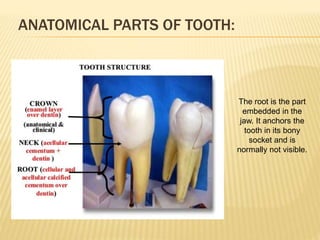
ANATOMICAL PARTS OF TOOTH:
The root is the part
embedded in the
jaw. It anchors the
tooth in its bony
socket and is
normally not visible.
DESCRIPTION:
 Enamel The hard outer layer of the crown. Enamel is the hardest substance in the
body.
 Dentine Not as hard as enamel, forms the bulk of the tooth and can be sensitive if the
protection of the enamel is lost.
 Pulp Soft tissue containing the blood and nerve supply to the tooth. The pulp extends
from the crown to the tip of the root.
 Cementum The layer of bone-like tissue covering the root. It is not as hard as enamel.
 Structures around the tooth
 Periodontal ligament: Made up of thousands of fibres which fasten the cementum to
the bony socket. These fibres anchor the tooth to the jaw bone and act as shock
absorbers for the tooth which is subjected to heavy forces during chewing.
 Oral Mucosa: This is the term ussed to describe the moist tissue that lines the mouth.
 Gingivae (gums): Soft tissue that immediately surrounds the teeth and bone. It
protects the bone and the roots of the teeth and provides an easily lubricated surface.
 Bone: Provides a socket to surround and support the roots of the teeth.
 Nerves and blood supply: Each tooth and periodontal ligament has a nerve supply
and the teeth are sensitive to a wide variety of stimuli. The blood supply is necessary to
maintain the vitality of the tooth.
CAVITIES
WHAT IS A CAVITY?
 A cavity is a hole that can grow bigger
and deeper over time. Cavities are also
called dental caries, and if you have a
cavity, it's important to get it repaired.
WHAT KIND OF CAVITIES CAN YOU HAVE?
 Class I: Cavities located in pits or fissures. These are located in
the occlusal surfaces of molars and premolars, the occlusal two-
thirds of the buccal surfaces of molars, the lingual surfaces of
upper incisors, and occasionally in the lingual surfaces of upper
molars.
 Class II: Cavities located in the proximal surfaces of molars and
premolars.
 Class III: Cavities in the proximal surfaces of canines, and
incisors not involving the incisal angles.
 Class IV: Cavities in the proximal surfaces of incisors or canines
which also involve one or both of the incisal angles.
 Class V: Cavities located in the gingival third of the labial,
buccal, lingual, or palatal surfaces of any tooth
Teeth structure and cavities

Teeth structure and cavities

  • 1.
  • 2.
    ANATOMICAL PARTS OFTOOTH: The root is the part embedded in the jaw. It anchors the tooth in its bony socket and is normally not visible.
  • 4.
    DESCRIPTION:  Enamel Thehard outer layer of the crown. Enamel is the hardest substance in the body.  Dentine Not as hard as enamel, forms the bulk of the tooth and can be sensitive if the protection of the enamel is lost.  Pulp Soft tissue containing the blood and nerve supply to the tooth. The pulp extends from the crown to the tip of the root.  Cementum The layer of bone-like tissue covering the root. It is not as hard as enamel.  Structures around the tooth  Periodontal ligament: Made up of thousands of fibres which fasten the cementum to the bony socket. These fibres anchor the tooth to the jaw bone and act as shock absorbers for the tooth which is subjected to heavy forces during chewing.  Oral Mucosa: This is the term ussed to describe the moist tissue that lines the mouth.  Gingivae (gums): Soft tissue that immediately surrounds the teeth and bone. It protects the bone and the roots of the teeth and provides an easily lubricated surface.  Bone: Provides a socket to surround and support the roots of the teeth.  Nerves and blood supply: Each tooth and periodontal ligament has a nerve supply and the teeth are sensitive to a wide variety of stimuli. The blood supply is necessary to maintain the vitality of the tooth.
  • 5.
  • 6.
    WHAT IS ACAVITY?  A cavity is a hole that can grow bigger and deeper over time. Cavities are also called dental caries, and if you have a cavity, it's important to get it repaired.
  • 7.
    WHAT KIND OFCAVITIES CAN YOU HAVE?  Class I: Cavities located in pits or fissures. These are located in the occlusal surfaces of molars and premolars, the occlusal two- thirds of the buccal surfaces of molars, the lingual surfaces of upper incisors, and occasionally in the lingual surfaces of upper molars.  Class II: Cavities located in the proximal surfaces of molars and premolars.  Class III: Cavities in the proximal surfaces of canines, and incisors not involving the incisal angles.  Class IV: Cavities in the proximal surfaces of incisors or canines which also involve one or both of the incisal angles.  Class V: Cavities located in the gingival third of the labial, buccal, lingual, or palatal surfaces of any tooth