

Dental anatomy and histology
Dr.sinu jayaprakash
contents
• Introduction
• Mechanism of eruption
• Chronology of eruption
• Eruption disorders
introduction
eruption
• It is the developmental process responsible
for moving a tooth from its crypt position
through the alveolar process into the oral
cavity to its final position of occlusion with its
antagonist.
emergence
• It should be reserved for describing
the moment of appearance of any part
of the cusp or crown through the
gingiva.emergence is synonymous with
moment of eruption,which is often used
as a clinical marker for eruption.
Tooth movements
Pre eruptive tooth movement
made by the deciduous
and permanent tooth germ within tissues of
the jaw before they begin to erupt.
Eruptive tooth movement
made by tooth to move from its position
within the bone of the jaws to its functional
position in occlusion.it is divided into
intraosseous and extraosseous components.
Posteruptive tooth movement
maintaining the position of
the erupted tooth in occlusion while the
jaws continue to grow and compensate for
occlusal and proximal tooth wear
Mechanisms of eruption
• Root formation
• Hydrostatic pressure
• Bone remodelling
• Periodontal ligament
• Root formation
Root formation appears to be an obvious
cause of tooth eruption because it undoubtedly
causes an overall increase in the length of the
tooth that must be accommodated by the
growth of the root into bone of the jaw, by an
increase in jaw height, or by the occlusal
movement of the crown.
• Root formation is accomodated during
tooth eruption
• It is not cause of eruption but may
accelerate tooth eruption
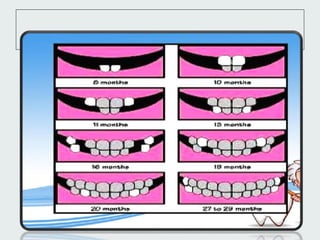
Chronology of eruption
DEFINITION
• Chronos –time
• Logos-study
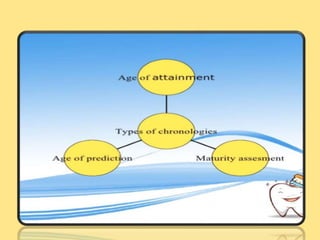
• Chronology is defined as the study which deals with
the timing of various stages of tooth development.
Starting with the initiation of first dental tissue laid
down to the emergence of tooth in the oral cavity and
its completion of calcification.
Age of attainment
• It is based upon tooth emergence
• It is used clinically to avoid damage to
developing tooth during treatment
Age of prediction
• It is based on the average age of the
subjects in a stage of development
• Age prediction are used for assessing
unknown age of patients and forensic
archealogical appearance
Maturity assessment
• Here the stages are averaged rather
then subject ages
• Such scales are useful when maturity is
assessed of known age
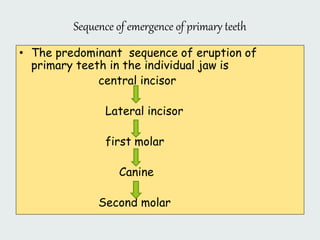
Sequence of emergence of primary teeth
• The predominant sequence of eruption of
primary teeth in the individual jaw is
central incisor
Lateral incisor
first molar
Canine
Second molar
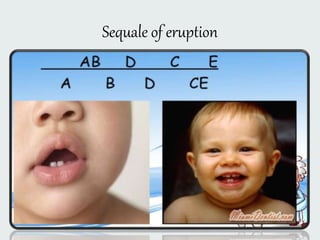
Sequale of eruption
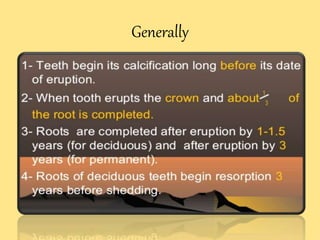
Generally
Primary teeth
• Primary teeth are smaller in overall size and
dimension
• More prominent cervical ridges
• narrower at their ‘necks’
• Lighter in colour
• Roots are more widely flared
• Buccolingual diameter is less than permanent
teeth
Primary teeth
• The teeth function an average of 8 yrs for
maxillary teeth
• Teeth function an average of 7.6 yrs for
mandibular teeth
• Hold an important role in reserving space for
permanent teeth
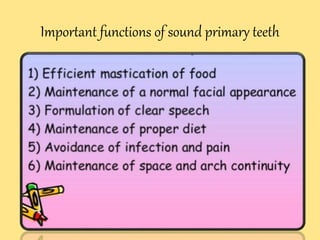
Important functions of sound primary teeth
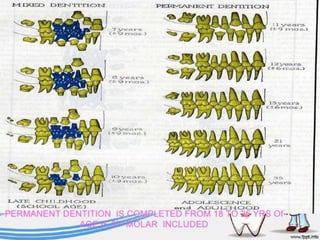
Mixed dentition period
• First mixed dentition begins with the
emergence and eruption of mandibular first
permanent molar.
• It ends with the loss of last primary tooth
which usually occurs at 11-12yrs.
PERMANENT TEETH
At birth,1st per molar is the only per
tooth which shows evidence of
calicfication
Dates of eruption per incisor is same as
primary incisor but in years
Premolar start calicification b/w 1-2yrs
Permanent teeth
Lower teeth sequence of eruption 6 1 2 3 4 5
Upper teeth sequence of eruption 6 1 2 4 3 5
Lower teeth erupts before upper
opposing teeth
• 1st,2nd 3rd molar erupt at age of 6,12,18
yrs resp.
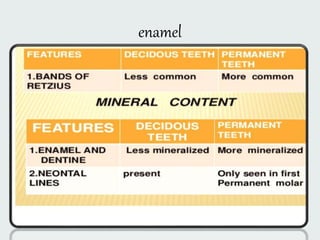
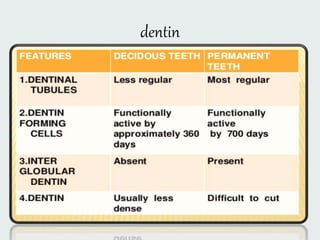
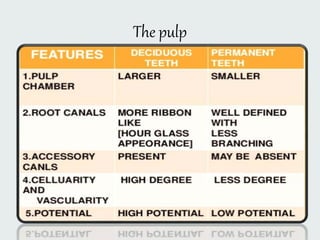
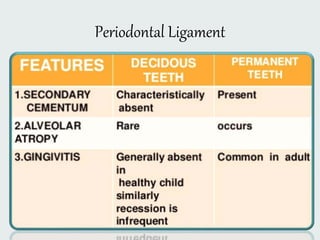
Difference b/w primary and permanent teeth
enamel
dentin
The pulp
Periodontal Ligament
Eruption disorders
Etiology of eruption problems
• Disturbance occur in any phases of
eruption
• 3 main causes of eruption disturbance
1.Ectopic position of the tooth germ
Etiology of eruption problems
2.Obstacles in eruption path
-lack of space
-follicular collision
-presence of compact bone
-supernumerary teeth
-Odontomas
-scar tissue
-non –attached mucosa
-giant cell fibromatosis
-odontogenic tumour or cyst
Etiology of eruption problems
3.Failures in the eruption mechanisms
follicle or pdl defects according to
the stage of eruption due to trauma ,
surgery, congenital diseases or other
causes
Etiology of eruption problems
• 1st ,2nd conditions lead to impaction
• 3rd according to stage in which eruption
disturbance occurs will lead to primary
teeth disorders or secondary
retention(aftr emergence)
Etiology of eruption problems
• So its necessary to develop a rational
treatment approach inorder to diagnose
which of the prerequisites for eruption
have been violated and to what extent
Supernumerary teeth
• cause crowding, displacement, rotation,
impaction, delayed eruption.
• Most common- mesiodens 4th molar
in max arch
Supernumerary teeth
• Different forms assosiated with
different effects on dentition-
tuberculate type is most common with
delayed tooth eruption
. Conical form is associated with
displacement
Treatment
• Removal of hard tissue obstacle
Regional odontodysplasia
• Also called ghost teeth
• Unusual anomaly that result from somatic
mutation or latent virus in odontogenic
epithelium
• Affected teeth-delay or failure in eruption
• Shapes are very irregular,defective
mineralization
Regional odontodysplasia
• Central incisor, lateral incisor, canine –
most frequently affected
• Abnormality in tooth structure can also
be responsible for the eruptive
disorders
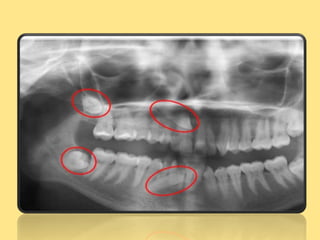
IMPACTED TEETH
Condition of being firmly lodged
(impacted in alveolar bone) or wedged by a
physical barrier ,usually other teeth,so it
is prevented from erupting.
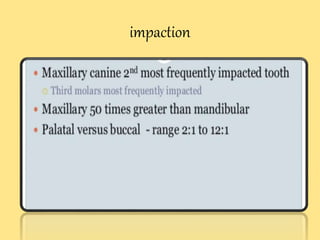
impaction
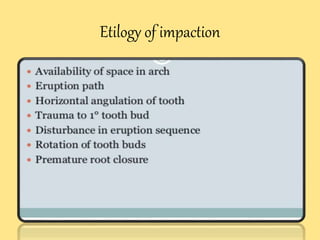
Etilogy of impaction
impaction
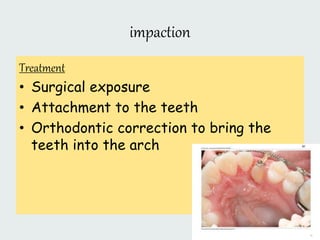
Treatment
• Surgical exposure
• Attachment to the teeth
• Orthodontic correction to bring the
teeth into the arch
ankylosis
• Resulting from fusion of cementum or
dentin in the alveolar bone
• Most common cause-delayed deciduous
exfoliation
• Common in mandibular molars
odontomas
.Odontomas occur in maxilla than mandible
• More than half is combined with
impacted teeth-lead to impacted teeth
odontomas
• Treatment
Removal of odontoma
So 3 out of 4 impacted teeth can be
expected to erupt subsequent to removal of
odontomas
Scar tissue
• Seen after cleft palate surgery and
trauma
• Apparently obstruct the collagenolytic
capacity of the follicle
• Treatment of choice is uncovering
procedure, including enamel exposure.
Mucosal barrier
Any failure of the follicle of an erupting
tooth to unite with the mucosa will entail
in a delay in the breakdown of the mucosa
and constitute a barrier to emergence
Gingival hyperplasia
• It results from various causes
(hormonal or hereditary causes ,vitamin
c deficiency, drugs such as phenytoin)
might causes an abundance of dense
connective tissue or acellular collagen
that can be an impediment to tooth
eruption
Arch length deficiency
• Often an etiological factor for crowding
and impaction.
• In a recent study of the relationship
between formation and eruption of the
maxillary teeth and the skeletal pattern of
the maxilla, a shortened palatal length was
found to delay the eruption of the
maxillary 2nd molar, although no delay in
tooth formation was observed
X-radiation
• X-ray also has been shown to impair tooth
eruption.
• Ankylosis of bone to tooth was the most
relevant finding in irradiated animals.
• Root formation impairment, periodontal cell
damage and insufficient mandibular growth
also seem to be linked to tooth eruption
disturbances due to x-radiation
THANK YOU

Chronology

  • 1.
    Dental anatomy andhistology Dr.sinu jayaprakash
  • 2.
    contents • Introduction • Mechanismof eruption • Chronology of eruption • Eruption disorders
  • 3.
  • 4.
    eruption • It isthe developmental process responsible for moving a tooth from its crypt position through the alveolar process into the oral cavity to its final position of occlusion with its antagonist.
  • 5.
    emergence • It shouldbe reserved for describing the moment of appearance of any part of the cusp or crown through the gingiva.emergence is synonymous with moment of eruption,which is often used as a clinical marker for eruption.
  • 6.
    Tooth movements Pre eruptivetooth movement made by the deciduous and permanent tooth germ within tissues of the jaw before they begin to erupt. Eruptive tooth movement made by tooth to move from its position within the bone of the jaws to its functional position in occlusion.it is divided into intraosseous and extraosseous components.
  • 7.
    Posteruptive tooth movement maintainingthe position of the erupted tooth in occlusion while the jaws continue to grow and compensate for occlusal and proximal tooth wear
  • 8.
  • 9.
    Mechanisms of eruption •Root formation • Hydrostatic pressure • Bone remodelling • Periodontal ligament
  • 10.
    • Root formation Rootformation appears to be an obvious cause of tooth eruption because it undoubtedly causes an overall increase in the length of the tooth that must be accommodated by the growth of the root into bone of the jaw, by an increase in jaw height, or by the occlusal movement of the crown.
  • 11.
    • Root formationis accomodated during tooth eruption • It is not cause of eruption but may accelerate tooth eruption
  • 12.
  • 13.
    DEFINITION • Chronos –time •Logos-study • Chronology is defined as the study which deals with the timing of various stages of tooth development. Starting with the initiation of first dental tissue laid down to the emergence of tooth in the oral cavity and its completion of calcification.
  • 15.
    Age of attainment •It is based upon tooth emergence • It is used clinically to avoid damage to developing tooth during treatment
  • 16.
    Age of prediction •It is based on the average age of the subjects in a stage of development • Age prediction are used for assessing unknown age of patients and forensic archealogical appearance
  • 17.
    Maturity assessment • Herethe stages are averaged rather then subject ages • Such scales are useful when maturity is assessed of known age
  • 19.
    Sequence of emergenceof primary teeth • The predominant sequence of eruption of primary teeth in the individual jaw is central incisor Lateral incisor first molar Canine Second molar
  • 20.
  • 21.
  • 22.
    Primary teeth • Primaryteeth are smaller in overall size and dimension • More prominent cervical ridges • narrower at their ‘necks’ • Lighter in colour • Roots are more widely flared • Buccolingual diameter is less than permanent teeth
  • 23.
    Primary teeth • Theteeth function an average of 8 yrs for maxillary teeth • Teeth function an average of 7.6 yrs for mandibular teeth • Hold an important role in reserving space for permanent teeth
  • 24.
    Important functions ofsound primary teeth
  • 25.
    Mixed dentition period •First mixed dentition begins with the emergence and eruption of mandibular first permanent molar. • It ends with the loss of last primary tooth which usually occurs at 11-12yrs.
  • 27.
    PERMANENT TEETH At birth,1stper molar is the only per tooth which shows evidence of calicfication Dates of eruption per incisor is same as primary incisor but in years Premolar start calicification b/w 1-2yrs
  • 28.
    Permanent teeth Lower teethsequence of eruption 6 1 2 3 4 5 Upper teeth sequence of eruption 6 1 2 4 3 5 Lower teeth erupts before upper opposing teeth • 1st,2nd 3rd molar erupt at age of 6,12,18 yrs resp.
  • 29.
    Difference b/w primaryand permanent teeth
  • 30.
  • 31.
  • 32.
  • 33.
  • 34.
  • 35.
    Etiology of eruptionproblems • Disturbance occur in any phases of eruption • 3 main causes of eruption disturbance 1.Ectopic position of the tooth germ
  • 36.
    Etiology of eruptionproblems 2.Obstacles in eruption path -lack of space -follicular collision -presence of compact bone -supernumerary teeth -Odontomas -scar tissue -non –attached mucosa -giant cell fibromatosis -odontogenic tumour or cyst
  • 37.
    Etiology of eruptionproblems 3.Failures in the eruption mechanisms follicle or pdl defects according to the stage of eruption due to trauma , surgery, congenital diseases or other causes
  • 38.
    Etiology of eruptionproblems • 1st ,2nd conditions lead to impaction • 3rd according to stage in which eruption disturbance occurs will lead to primary teeth disorders or secondary retention(aftr emergence)
  • 39.
    Etiology of eruptionproblems • So its necessary to develop a rational treatment approach inorder to diagnose which of the prerequisites for eruption have been violated and to what extent
  • 40.
    Supernumerary teeth • causecrowding, displacement, rotation, impaction, delayed eruption. • Most common- mesiodens 4th molar in max arch
  • 41.
    Supernumerary teeth • Differentforms assosiated with different effects on dentition- tuberculate type is most common with delayed tooth eruption . Conical form is associated with displacement Treatment • Removal of hard tissue obstacle
  • 42.
    Regional odontodysplasia • Alsocalled ghost teeth • Unusual anomaly that result from somatic mutation or latent virus in odontogenic epithelium • Affected teeth-delay or failure in eruption • Shapes are very irregular,defective mineralization
  • 43.
    Regional odontodysplasia • Centralincisor, lateral incisor, canine – most frequently affected • Abnormality in tooth structure can also be responsible for the eruptive disorders
  • 44.
    IMPACTED TEETH Condition ofbeing firmly lodged (impacted in alveolar bone) or wedged by a physical barrier ,usually other teeth,so it is prevented from erupting.
  • 45.
  • 46.
  • 48.
    impaction Treatment • Surgical exposure •Attachment to the teeth • Orthodontic correction to bring the teeth into the arch
  • 49.
    ankylosis • Resulting fromfusion of cementum or dentin in the alveolar bone • Most common cause-delayed deciduous exfoliation • Common in mandibular molars
  • 50.
    odontomas .Odontomas occur inmaxilla than mandible • More than half is combined with impacted teeth-lead to impacted teeth
  • 51.
    odontomas • Treatment Removal ofodontoma So 3 out of 4 impacted teeth can be expected to erupt subsequent to removal of odontomas
  • 52.
    Scar tissue • Seenafter cleft palate surgery and trauma • Apparently obstruct the collagenolytic capacity of the follicle • Treatment of choice is uncovering procedure, including enamel exposure.
  • 53.
    Mucosal barrier Any failureof the follicle of an erupting tooth to unite with the mucosa will entail in a delay in the breakdown of the mucosa and constitute a barrier to emergence
  • 54.
    Gingival hyperplasia • Itresults from various causes (hormonal or hereditary causes ,vitamin c deficiency, drugs such as phenytoin) might causes an abundance of dense connective tissue or acellular collagen that can be an impediment to tooth eruption
  • 55.
    Arch length deficiency •Often an etiological factor for crowding and impaction. • In a recent study of the relationship between formation and eruption of the maxillary teeth and the skeletal pattern of the maxilla, a shortened palatal length was found to delay the eruption of the maxillary 2nd molar, although no delay in tooth formation was observed
  • 56.
    X-radiation • X-ray alsohas been shown to impair tooth eruption. • Ankylosis of bone to tooth was the most relevant finding in irradiated animals. • Root formation impairment, periodontal cell damage and insufficient mandibular growth also seem to be linked to tooth eruption disturbances due to x-radiation
  • 57.