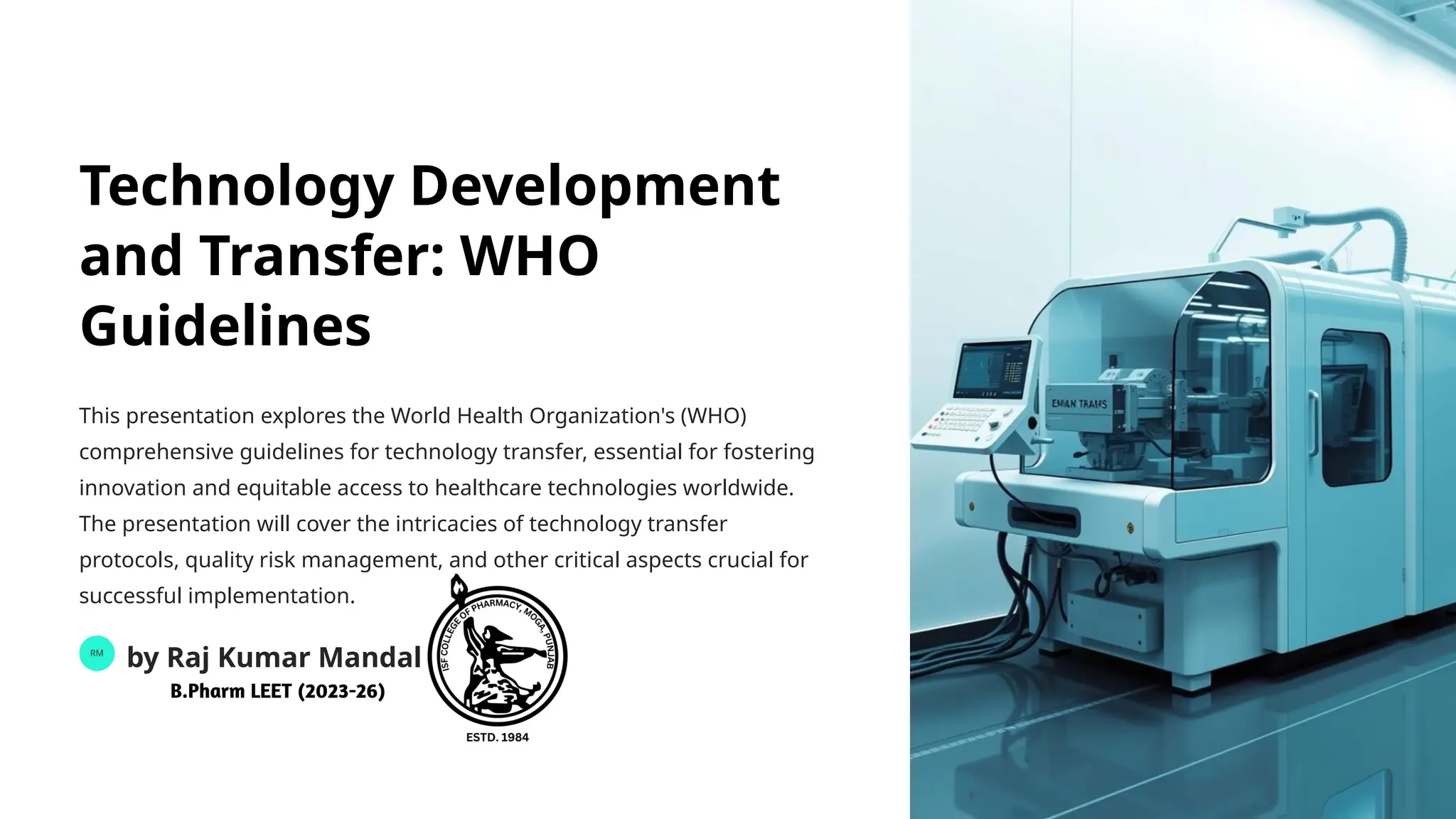
Technology Development
and Transfer: WHO
Guidelines
This presentation explores the World Health Organization's (WHO)
comprehensive guidelines for technology transfer, essential for fostering
innovation and equitable access to healthcare technologies worldwide.
The presentation will cover the intricacies of technology transfer
protocols, quality risk management, and other critical aspects crucial for
successful implementation.
RM
by Raj Kumar Mandal
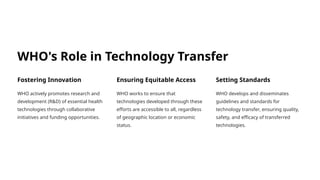
WHO's Role in Technology Transfer
Fostering Innovation
WHO actively promotes research and
development (R&D) of essential health
technologies through collaborative
initiatives and funding opportunities.
Ensuring Equitable Access
WHO works to ensure that
technologies developed through these
efforts are accessible to all, regardless
of geographic location or economic
status.
Setting Standards
WHO develops and disseminates
guidelines and standards for
technology transfer, ensuring quality,
safety, and efficacy of transferred
technologies.
Understanding Key Terminologies
Technology
Refers to knowledge, processes, and
tools used to create or improve
products, services, or systems.
Transfer
Involves the sharing of technology
between different entities, typically
from a source to a recipient.
Licensing
Grants permission to use intellectual
property rights, such as patents or
trademarks, for a specified purpose
and duration.
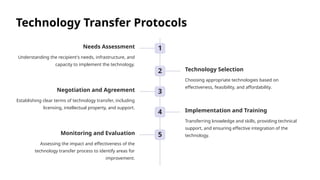
Technology Transfer Protocols
1
Needs Assessment
Understanding the recipient's needs, infrastructure, and
capacity to implement the technology.
2 Technology Selection
Choosing appropriate technologies based on
effectiveness, feasibility, and affordability.
3
Negotiation and Agreement
Establishing clear terms of technology transfer, including
licensing, intellectual property, and support.
4 Implementation and Training
Transferring knowledge and skills, providing technical
support, and ensuring effective integration of the
technology.
5
Monitoring and Evaluation
Assessing the impact and effectiveness of the
technology transfer process to identify areas for
improvement.
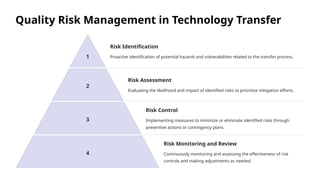
Quality Risk Management in Technology Transfer
1
Risk Identification
Proactive identification of potential hazards and vulnerabilities related to the transfer process.
2
Risk Assessment
Evaluating the likelihood and impact of identified risks to prioritize mitigation efforts.
3
Risk Control
Implementing measures to minimize or eliminate identified risks through
preventive actions or contingency plans.
4
Risk Monitoring and Review
Continuously monitoring and assessing the effectiveness of risk
controls and making adjustments as needed.
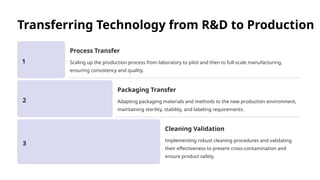
Transferring Technology from R&D to Production
1
Process Transfer
Scaling up the production process from laboratory to pilot and then to full-scale manufacturing,
ensuring consistency and quality.
2
Packaging Transfer
Adapting packaging materials and methods to the new production environment,
maintaining sterility, stability, and labeling requirements.
3
Cleaning Validation
Implementing robust cleaning procedures and validating
their effectiveness to prevent cross-contamination and
ensure product safety.
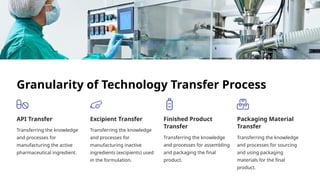
Granularity of Technology Transfer Process
API Transfer
Transferring the knowledge
and processes for
manufacturing the active
pharmaceutical ingredient.
Excipient Transfer
Transferring the knowledge
and processes for
manufacturing inactive
ingredients (excipients) used
in the formulation.
Finished Product
Transfer
Transferring the knowledge
and processes for assembling
and packaging the final
product.
Packaging Material
Transfer
Transferring the knowledge
and processes for sourcing
and using packaging
materials for the final
product.
Documentation, Premises, and
Equipments
1
Documentation
Comprehensive documentation, including
protocols, procedures, and training
materials, is essential for successful
technology transfer.
2
Premises
Adequate infrastructure, including
laboratories, production facilities, and
storage areas, is crucial for implementing
the technology.
3
Equipment
Appropriate equipment, calibrated and
validated, is necessary for manufacturing
and quality control of the transferred
technology.
Qualification and Validation, Quality Control, Analytical Method
Transfer
Qualification and Validation
Ensuring that equipment, facilities, and processes meet predetermined standards and perform as intended.
Quality Control
Implementing rigorous testing procedures and monitoring throughout the production process to ensure consistent quality.
Analytical Method Transfer
Ensuring that analytical methods used for quality control are transferred and validated for the new production environment.
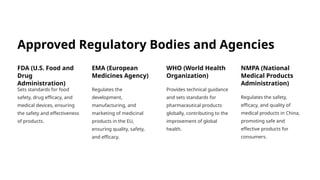
Approved Regulatory Bodies and Agencies
FDA (U.S. Food and
Drug
Administration)
Sets standards for food
safety, drug efficacy, and
medical devices, ensuring
the safety and effectiveness
of products.
EMA (European
Medicines Agency)
Regulates the
development,
manufacturing, and
marketing of medicinal
products in the EU,
ensuring quality, safety,
and efficacy.
WHO (World Health
Organization)
Provides technical guidance
and sets standards for
pharmaceutical products
globally, contributing to the
improvement of global
health.
NMPA (National
Medical Products
Administration)
Regulates the safety,
efficacy, and quality of
medical products in China,
promoting safe and
effective products for
consumers.
Commercialization & SUPAC
Guidelines
1 Market Research
Understanding the market needs,
potential competitors, and target
audience is crucial for successful
commercialization. Identifying unmet
needs and developing a strong value
proposition is key.
2 Intellectual Property
Protection
Securing patents, trademarks, or other
forms of intellectual property
protection is essential to safeguard
the technology and control its
commercialization.
3 Pricing Strategy
Developing a competitive and
sustainable pricing strategy is crucial
for commercial success. Factors like
production costs, market demand, and
competitor pricing should be
considered.
4 Marketing & Distribution
Establishing effective marketing and
distribution channels to reach the
target market is essential for success.
Building strong relationships with key
stakeholders, including distributors
and healthcare professionals, is
important.
Practical Aspects and Problems
(Case Studies)
Regulatory Challenges
Navigating different regulatory systems
across countries can be challenging,
requiring thorough documentation and
potential modifications to meet specific
requirements.
Funding and Investment
Securing sufficient funding to support
technology development, research, and
commercialization can be a major hurdle,
especially for early-stage technologies.
Partnering and Collaboration
Finding suitable partners or collaborators to
share expertise, resources, and market
access is crucial for success, but forming
effective partnerships can be complex.
Time and Resources
Technology transfer can be a lengthy
process requiring significant time and
resources, potentially impacting timelines
and overall project feasibility.
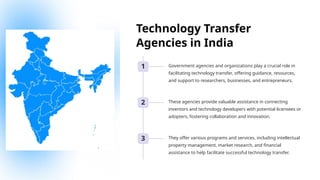
Technology Transfer
Agencies in India
1 Government agencies and organizations play a crucial role in
facilitating technology transfer, offering guidance, resources,
and support to researchers, businesses, and entrepreneurs.
2 These agencies provide valuable assistance in connecting
inventors and technology developers with potential licensees or
adopters, fostering collaboration and innovation.
3 They offer various programs and services, including intellectual
property management, market research, and financial
assistance to help facilitate successful technology transfer.
Asian and Pacific Centre for
Transfer of Technology (APCTD)
Mission
To facilitate technology transfer in
the Asia-Pacific region, promoting
sustainable economic development
and improving the lives of people.
Services
Provides training programs,
technology assessments, and
networking opportunities for
researchers and businesses seeking
to engage in technology transfer.
Focus Areas
Focuses on key areas like
biotechnology, agriculture, and
renewable energy, supporting the
development and transfer of critical
technologies in these fields.
Impact
Has a significant impact on fostering
innovation and sustainable
development by connecting
researchers and businesses with
opportunities for technology
transfer.
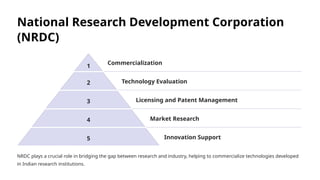
National Research Development Corporation
(NRDC)
1
Commercialization
2 Technology Evaluation
3 Licensing and Patent Management
4 Market Research
5 Innovation Support
NRDC plays a crucial role in bridging the gap between research and industry, helping to commercialize technologies developed
in Indian research institutions.
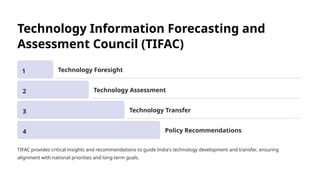
Technology Information Forecasting and
Assessment Council (TIFAC)
1 Technology Foresight
2 Technology Assessment
3 Technology Transfer
4 Policy Recommendations
TIFAC provides critical insights and recommendations to guide India's technology development and transfer, ensuring
alignment with national priorities and long-term goals.
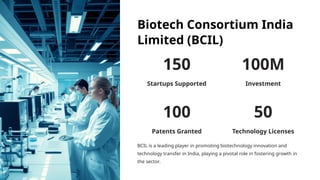
Biotech Consortium India
Limited (BCIL)
150
Startups Supported
100M
Investment
100
Patents Granted
50
Technology Licenses
BCIL is a leading player in promoting biotechnology innovation and
technology transfer in India, playing a pivotal role in fostering growth in
the sector.
Technology Bureau for Small Enterprises
(TBSE) / Small Industries Development Bank of
India (SIDBI)
These agencies provide vital support to small and medium-sized enterprises (SMEs) in accessing and adopting new
technologies, enhancing their competitiveness and fostering innovation.The Technology Bureau for Small Enterprises (TBSE) is a
program by the Small Industries Development Bank of India (SIDBI) designed to assist small businesses in adopting advanced
technologies. TBSE provides support for technology transfer, upgradation, and consultancy services to enhance the
competitiveness of small enterprises. It connects businesses with technology providers, facilitates funding, and offers expert
guidance to ensure smooth implementation of technological solutions. By promoting innovation and modernization, TBSE aims
to improve productivity, reduce costs, and help small enterprises compete effectively in domestic and global markets, fostering
growth and sustainability in the small-scale industry sector.
Conclusion and Next Steps
WHO's guidelines provide a comprehensive framework for successful
technology transfer, promoting innovation and ensuring equitable access
to healthcare technologies worldwide. Collaboration between
stakeholders, including national governments, research institutions, and
pharmaceutical companies, is crucial for effective implementation of
these guidelines. By working together, we can leverage technology to
improve health outcomes for all.
Technology Development and Transfer : WHO Guideline on Slideshare by Raj Kumar Mandal.

Technology Development and Transfer : WHO Guideline on Slideshare by Raj Kumar Mandal.

  • 1.
    Technology Development and Transfer:WHO Guidelines This presentation explores the World Health Organization's (WHO) comprehensive guidelines for technology transfer, essential for fostering innovation and equitable access to healthcare technologies worldwide. The presentation will cover the intricacies of technology transfer protocols, quality risk management, and other critical aspects crucial for successful implementation. RM by Raj Kumar Mandal
  • 2.
    WHO's Role inTechnology Transfer Fostering Innovation WHO actively promotes research and development (R&D) of essential health technologies through collaborative initiatives and funding opportunities. Ensuring Equitable Access WHO works to ensure that technologies developed through these efforts are accessible to all, regardless of geographic location or economic status. Setting Standards WHO develops and disseminates guidelines and standards for technology transfer, ensuring quality, safety, and efficacy of transferred technologies.
  • 3.
    Understanding Key Terminologies Technology Refersto knowledge, processes, and tools used to create or improve products, services, or systems. Transfer Involves the sharing of technology between different entities, typically from a source to a recipient. Licensing Grants permission to use intellectual property rights, such as patents or trademarks, for a specified purpose and duration.
  • 4.
    Technology Transfer Protocols 1 NeedsAssessment Understanding the recipient's needs, infrastructure, and capacity to implement the technology. 2 Technology Selection Choosing appropriate technologies based on effectiveness, feasibility, and affordability. 3 Negotiation and Agreement Establishing clear terms of technology transfer, including licensing, intellectual property, and support. 4 Implementation and Training Transferring knowledge and skills, providing technical support, and ensuring effective integration of the technology. 5 Monitoring and Evaluation Assessing the impact and effectiveness of the technology transfer process to identify areas for improvement.
  • 5.
    Quality Risk Managementin Technology Transfer 1 Risk Identification Proactive identification of potential hazards and vulnerabilities related to the transfer process. 2 Risk Assessment Evaluating the likelihood and impact of identified risks to prioritize mitigation efforts. 3 Risk Control Implementing measures to minimize or eliminate identified risks through preventive actions or contingency plans. 4 Risk Monitoring and Review Continuously monitoring and assessing the effectiveness of risk controls and making adjustments as needed.
  • 6.
    Transferring Technology fromR&D to Production 1 Process Transfer Scaling up the production process from laboratory to pilot and then to full-scale manufacturing, ensuring consistency and quality. 2 Packaging Transfer Adapting packaging materials and methods to the new production environment, maintaining sterility, stability, and labeling requirements. 3 Cleaning Validation Implementing robust cleaning procedures and validating their effectiveness to prevent cross-contamination and ensure product safety.
  • 7.
    Granularity of TechnologyTransfer Process API Transfer Transferring the knowledge and processes for manufacturing the active pharmaceutical ingredient. Excipient Transfer Transferring the knowledge and processes for manufacturing inactive ingredients (excipients) used in the formulation. Finished Product Transfer Transferring the knowledge and processes for assembling and packaging the final product. Packaging Material Transfer Transferring the knowledge and processes for sourcing and using packaging materials for the final product.
  • 8.
    Documentation, Premises, and Equipments 1 Documentation Comprehensivedocumentation, including protocols, procedures, and training materials, is essential for successful technology transfer. 2 Premises Adequate infrastructure, including laboratories, production facilities, and storage areas, is crucial for implementing the technology. 3 Equipment Appropriate equipment, calibrated and validated, is necessary for manufacturing and quality control of the transferred technology.
  • 9.
    Qualification and Validation,Quality Control, Analytical Method Transfer Qualification and Validation Ensuring that equipment, facilities, and processes meet predetermined standards and perform as intended. Quality Control Implementing rigorous testing procedures and monitoring throughout the production process to ensure consistent quality. Analytical Method Transfer Ensuring that analytical methods used for quality control are transferred and validated for the new production environment.
  • 10.
    Approved Regulatory Bodiesand Agencies FDA (U.S. Food and Drug Administration) Sets standards for food safety, drug efficacy, and medical devices, ensuring the safety and effectiveness of products. EMA (European Medicines Agency) Regulates the development, manufacturing, and marketing of medicinal products in the EU, ensuring quality, safety, and efficacy. WHO (World Health Organization) Provides technical guidance and sets standards for pharmaceutical products globally, contributing to the improvement of global health. NMPA (National Medical Products Administration) Regulates the safety, efficacy, and quality of medical products in China, promoting safe and effective products for consumers.
  • 11.
    Commercialization & SUPAC Guidelines 1Market Research Understanding the market needs, potential competitors, and target audience is crucial for successful commercialization. Identifying unmet needs and developing a strong value proposition is key. 2 Intellectual Property Protection Securing patents, trademarks, or other forms of intellectual property protection is essential to safeguard the technology and control its commercialization. 3 Pricing Strategy Developing a competitive and sustainable pricing strategy is crucial for commercial success. Factors like production costs, market demand, and competitor pricing should be considered. 4 Marketing & Distribution Establishing effective marketing and distribution channels to reach the target market is essential for success. Building strong relationships with key stakeholders, including distributors and healthcare professionals, is important.
  • 12.
    Practical Aspects andProblems (Case Studies) Regulatory Challenges Navigating different regulatory systems across countries can be challenging, requiring thorough documentation and potential modifications to meet specific requirements. Funding and Investment Securing sufficient funding to support technology development, research, and commercialization can be a major hurdle, especially for early-stage technologies. Partnering and Collaboration Finding suitable partners or collaborators to share expertise, resources, and market access is crucial for success, but forming effective partnerships can be complex. Time and Resources Technology transfer can be a lengthy process requiring significant time and resources, potentially impacting timelines and overall project feasibility.
  • 13.
    Technology Transfer Agencies inIndia 1 Government agencies and organizations play a crucial role in facilitating technology transfer, offering guidance, resources, and support to researchers, businesses, and entrepreneurs. 2 These agencies provide valuable assistance in connecting inventors and technology developers with potential licensees or adopters, fostering collaboration and innovation. 3 They offer various programs and services, including intellectual property management, market research, and financial assistance to help facilitate successful technology transfer.
  • 14.
    Asian and PacificCentre for Transfer of Technology (APCTD) Mission To facilitate technology transfer in the Asia-Pacific region, promoting sustainable economic development and improving the lives of people. Services Provides training programs, technology assessments, and networking opportunities for researchers and businesses seeking to engage in technology transfer. Focus Areas Focuses on key areas like biotechnology, agriculture, and renewable energy, supporting the development and transfer of critical technologies in these fields. Impact Has a significant impact on fostering innovation and sustainable development by connecting researchers and businesses with opportunities for technology transfer.
  • 15.
    National Research DevelopmentCorporation (NRDC) 1 Commercialization 2 Technology Evaluation 3 Licensing and Patent Management 4 Market Research 5 Innovation Support NRDC plays a crucial role in bridging the gap between research and industry, helping to commercialize technologies developed in Indian research institutions.
  • 16.
    Technology Information Forecastingand Assessment Council (TIFAC) 1 Technology Foresight 2 Technology Assessment 3 Technology Transfer 4 Policy Recommendations TIFAC provides critical insights and recommendations to guide India's technology development and transfer, ensuring alignment with national priorities and long-term goals.
  • 17.
    Biotech Consortium India Limited(BCIL) 150 Startups Supported 100M Investment 100 Patents Granted 50 Technology Licenses BCIL is a leading player in promoting biotechnology innovation and technology transfer in India, playing a pivotal role in fostering growth in the sector.
  • 18.
    Technology Bureau forSmall Enterprises (TBSE) / Small Industries Development Bank of India (SIDBI) These agencies provide vital support to small and medium-sized enterprises (SMEs) in accessing and adopting new technologies, enhancing their competitiveness and fostering innovation.The Technology Bureau for Small Enterprises (TBSE) is a program by the Small Industries Development Bank of India (SIDBI) designed to assist small businesses in adopting advanced technologies. TBSE provides support for technology transfer, upgradation, and consultancy services to enhance the competitiveness of small enterprises. It connects businesses with technology providers, facilitates funding, and offers expert guidance to ensure smooth implementation of technological solutions. By promoting innovation and modernization, TBSE aims to improve productivity, reduce costs, and help small enterprises compete effectively in domestic and global markets, fostering growth and sustainability in the small-scale industry sector.
  • 19.
    Conclusion and NextSteps WHO's guidelines provide a comprehensive framework for successful technology transfer, promoting innovation and ensuring equitable access to healthcare technologies worldwide. Collaboration between stakeholders, including national governments, research institutions, and pharmaceutical companies, is crucial for effective implementation of these guidelines. By working together, we can leverage technology to improve health outcomes for all.