The document discusses the integration of pharmaceutical technology transfer practices into design control systems for combination products, emphasizing the importance of aligning development processes with regulatory requirements. It outlines a strategy for incorporating key pharmaceutical deliverables into product development roadmaps, ensuring compliance with applicable standards while leveraging best practices from industry literature. The document also highlights the differences between pharmaceutical and device development, proposing methods for efficient communication and coordination among teams during the technology transfer process.
Pharmaceutical Technology Transfer
Practicesinto Design Control Systems
for Combination/Convergent Products
Roy Fennimore
Research Fellow
Product & Process Scientific Solutions (P2S2)
Johnson & Johnson
INTERPHEX New York City, NY 24 April 2013
1
2.
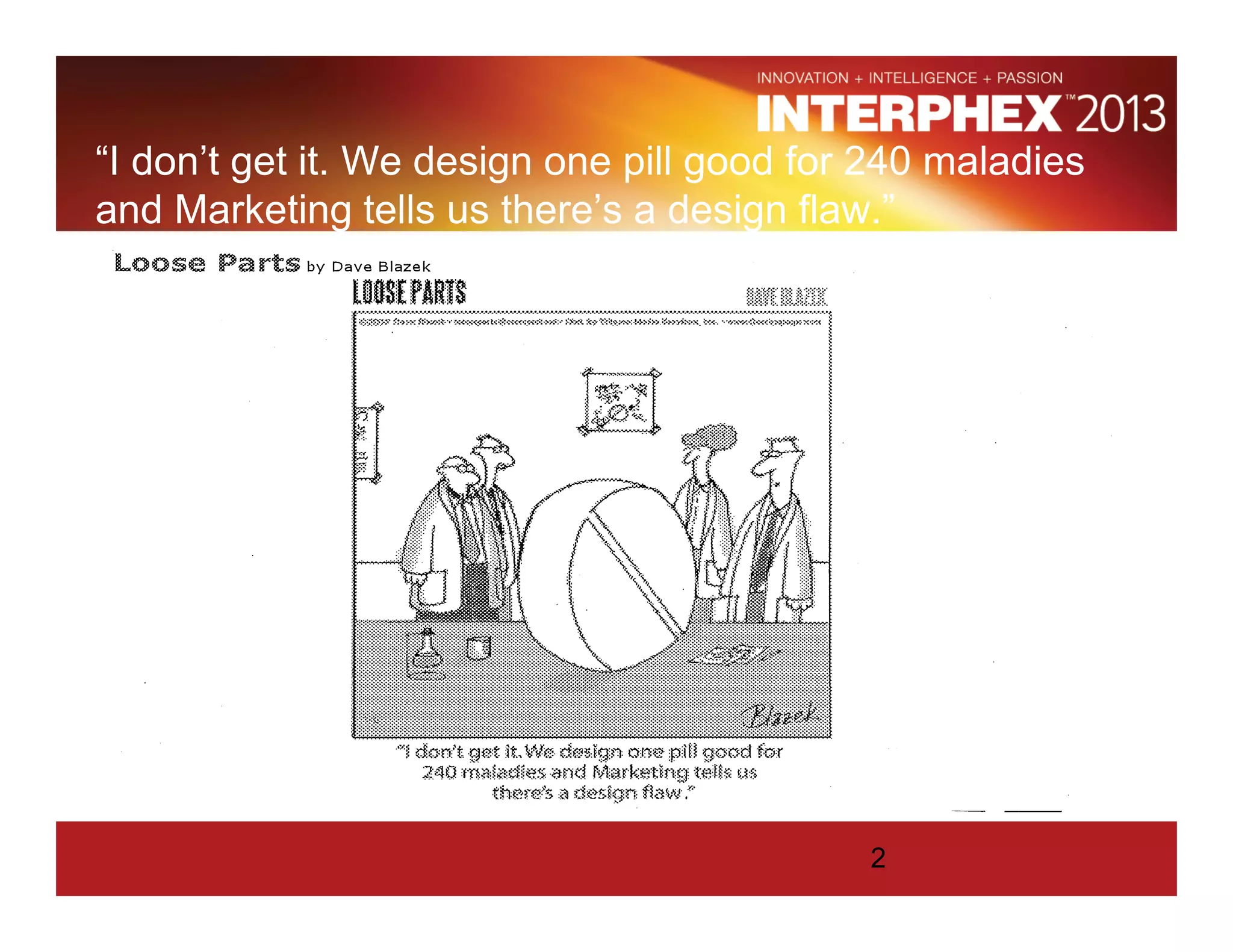
“I don’t getit. We design one pill good for 240 maladies
and Marketing tells us there’s a design flaw.”
2
3.
The 5th WaveBy Rich Tennant
“Oh sure, I’ve used historical data analysis in the past,
but lately it’s been pretty much hysterical data analysis at work.”
3
4.
Agenda
Adapting Pharmaceutical TechnologyTransfer (TT) into a
Design Control System
Integration Strategy
Linking Pharmaceutical Development to the Design Control
System
Technology Transfer Guideline: Key Concepts for Integration
New Product Development Process – Roadmap and Guides
Translation from Pharmaceutical to Design Control
Deliverables
Design Control Waterfall Diagram vs. Pharmaceutical
Deliverables for Integration
Review Report Outlines: Such as Product Development,
Analytical Test Methods and Process Transfer, if time permits
4
5.
Overview
A high levelview where Technology
Transfer integration aligns with Design
Control (DC) and the New Product
Development (NPD) Process
Review Report Outlines: Such as Product
Development, Analytical Test Methods
and Process Transfer, if time permits
5
6.
Purpose
Provide an overviewof how
pharmaceutical technology transfer
deliverables and best practices can
be integrated into the Design
Control (DC) System and the New
Product Development Process for
Combination/Convergent Products
6
7.
Integrating Pharmaceutical TechnologyTransfer (TT) into
Design Control (DC) for New Product Development Process
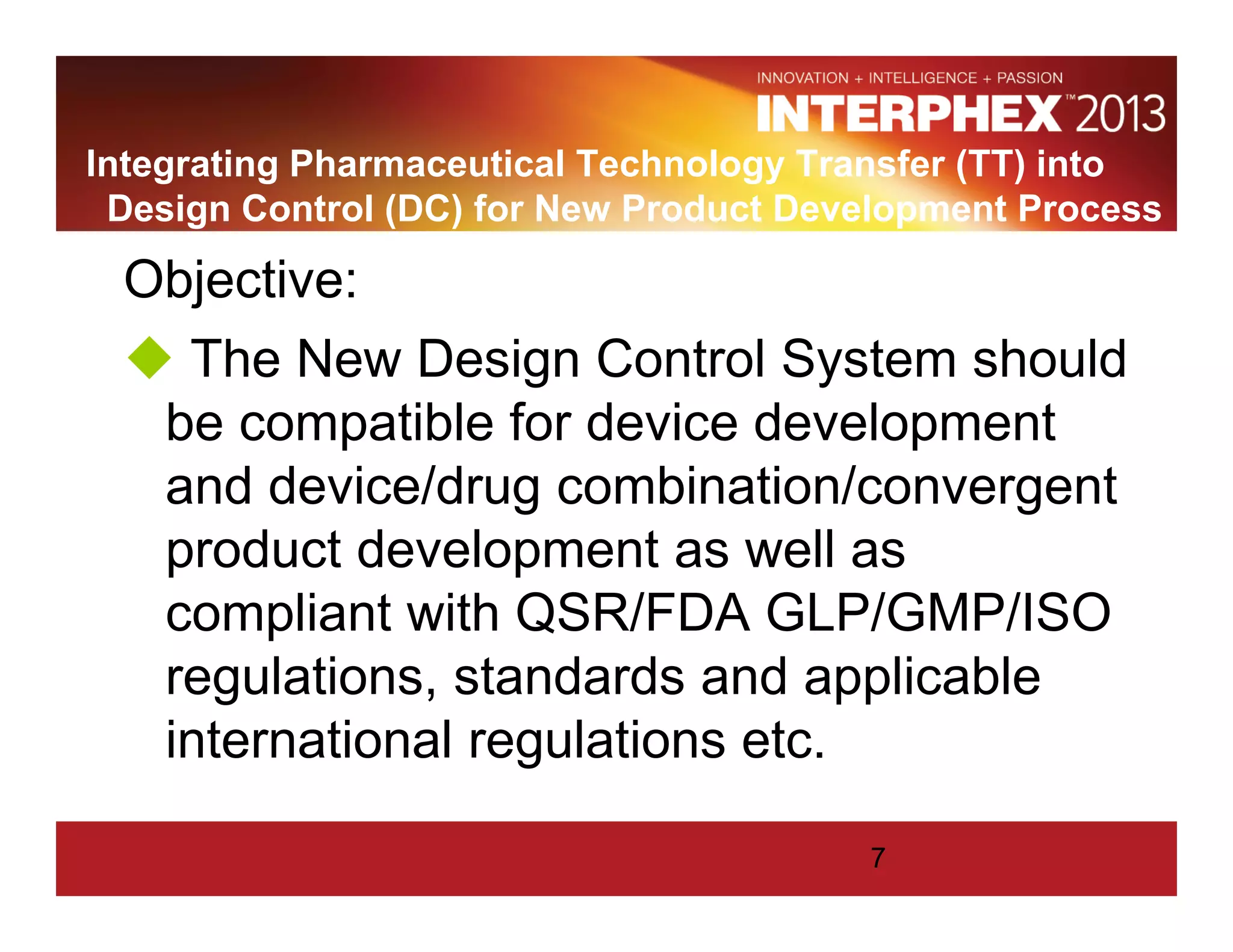
Objective:
The New Design Control System should
be compatible for device development
and device/drug combination/convergent
product development as well as
compliant with QSR/FDA GLP/GMP/ISO
regulations, standards and applicable
international regulations etc.
7
8.
Adapting Pharmaceutical TechnologyTransfer into
Design Control (DC) for New Product Development Process (NPD)
Leveraging:
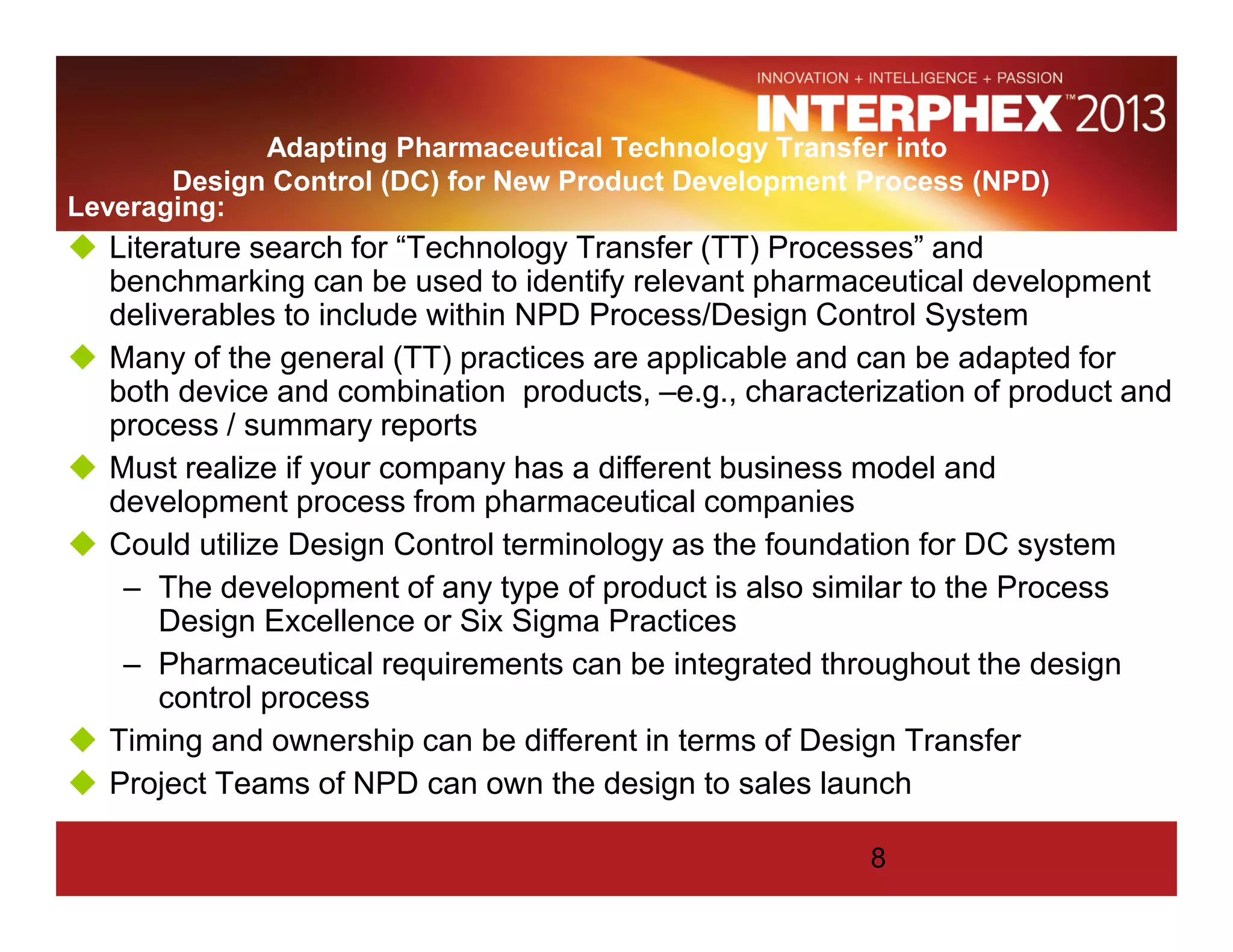
Literature search for “Technology Transfer (TT) Processes” and
benchmarking can be used to identify relevant pharmaceutical development
deliverables to include within NPD Process/Design Control System
Many of the general (TT) practices are applicable and can be adapted for
both device and combination products, –e.g., characterization of product and
process / summary reports
Must realize if your company has a different business model and
development process from pharmaceutical companies
Could utilize Design Control terminology as the foundation for DC system
– The development of any type of product is also similar to the Process
Design Excellence or Six Sigma Practices
– Pharmaceutical requirements can be integrated throughout the design
control process
Timing and ownership can be different in terms of Design Transfer
Project Teams of NPD can own the design to sales launch
8
9.
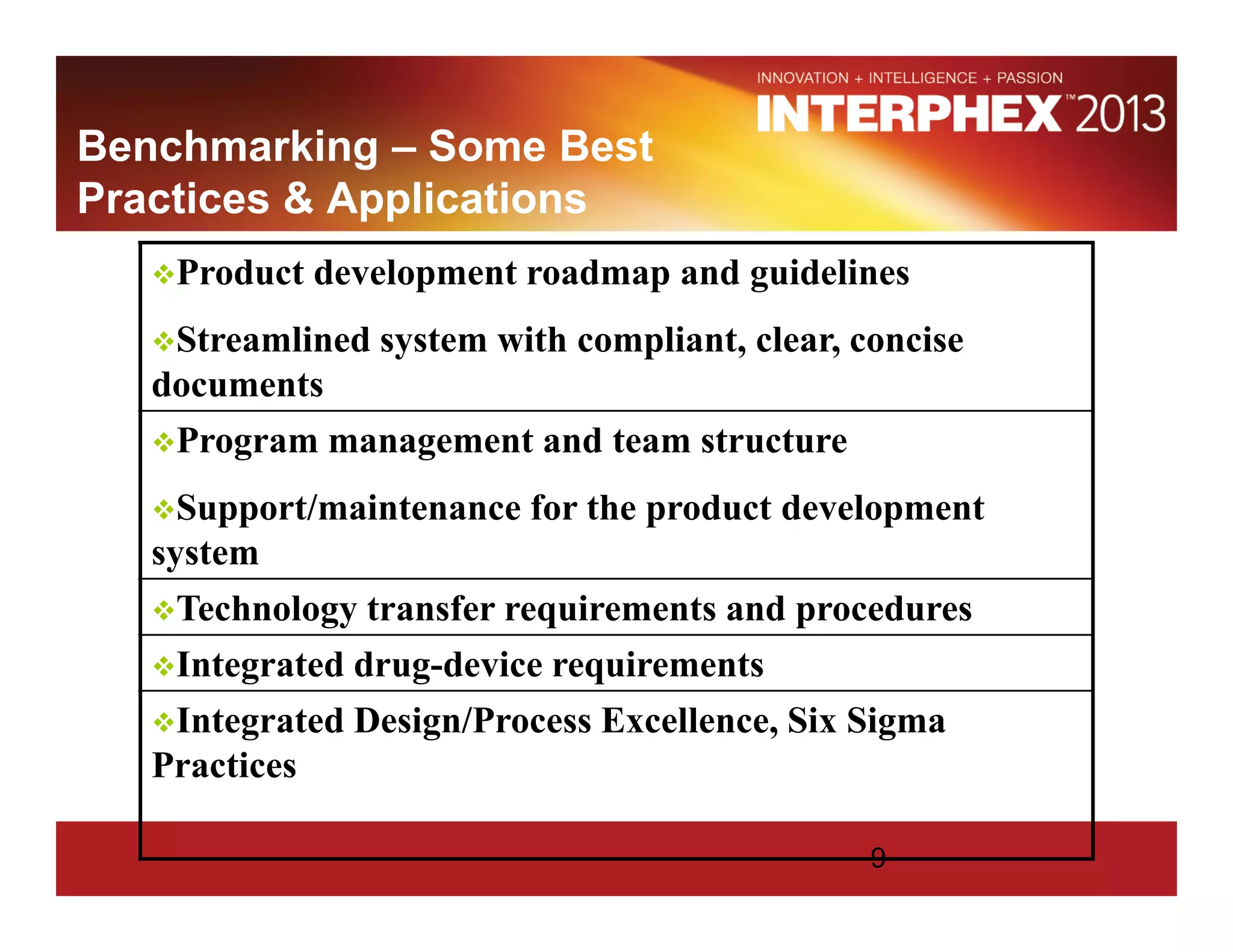
Benchmarking – SomeBest
Practices & Applications
Product development roadmap and guidelines
Streamlined system with compliant, clear, concise
documents
Program management and team structure
Support/maintenance for the product development
system
Technology transfer requirements and procedures
Integrated drug-device requirements
Integrated Design/Process Excellence, Six Sigma
Practices
9
10.
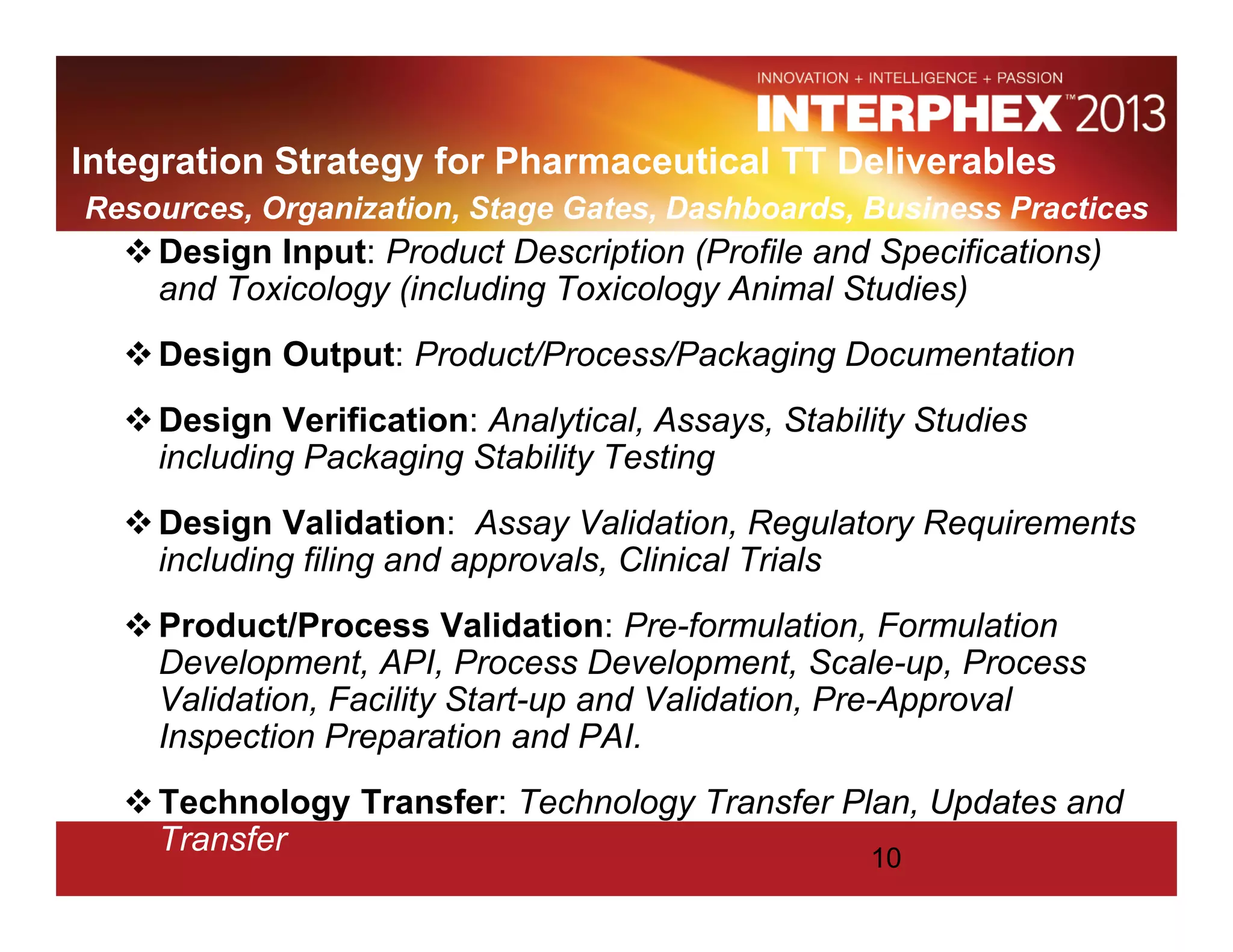
Integration Strategy forPharmaceutical TT Deliverables
Resources, Organization, Stage Gates, Dashboards, Business Practices
Design Input: Product Description (Profile and Specifications)
and Toxicology (including Toxicology Animal Studies)
Design Output: Product/Process/Packaging Documentation
Design Verification: Analytical, Assays, Stability Studies
including Packaging Stability Testing
Design Validation: Assay Validation, Regulatory Requirements
including filing and approvals, Clinical Trials
Product/Process Validation: Pre-formulation, Formulation
Development, API, Process Development, Scale-up, Process
Validation, Facility Start-up and Validation, Pre-Approval
Inspection Preparation and PAI.
Technology Transfer: Technology Transfer Plan, Updates and
Transfer 10
11.
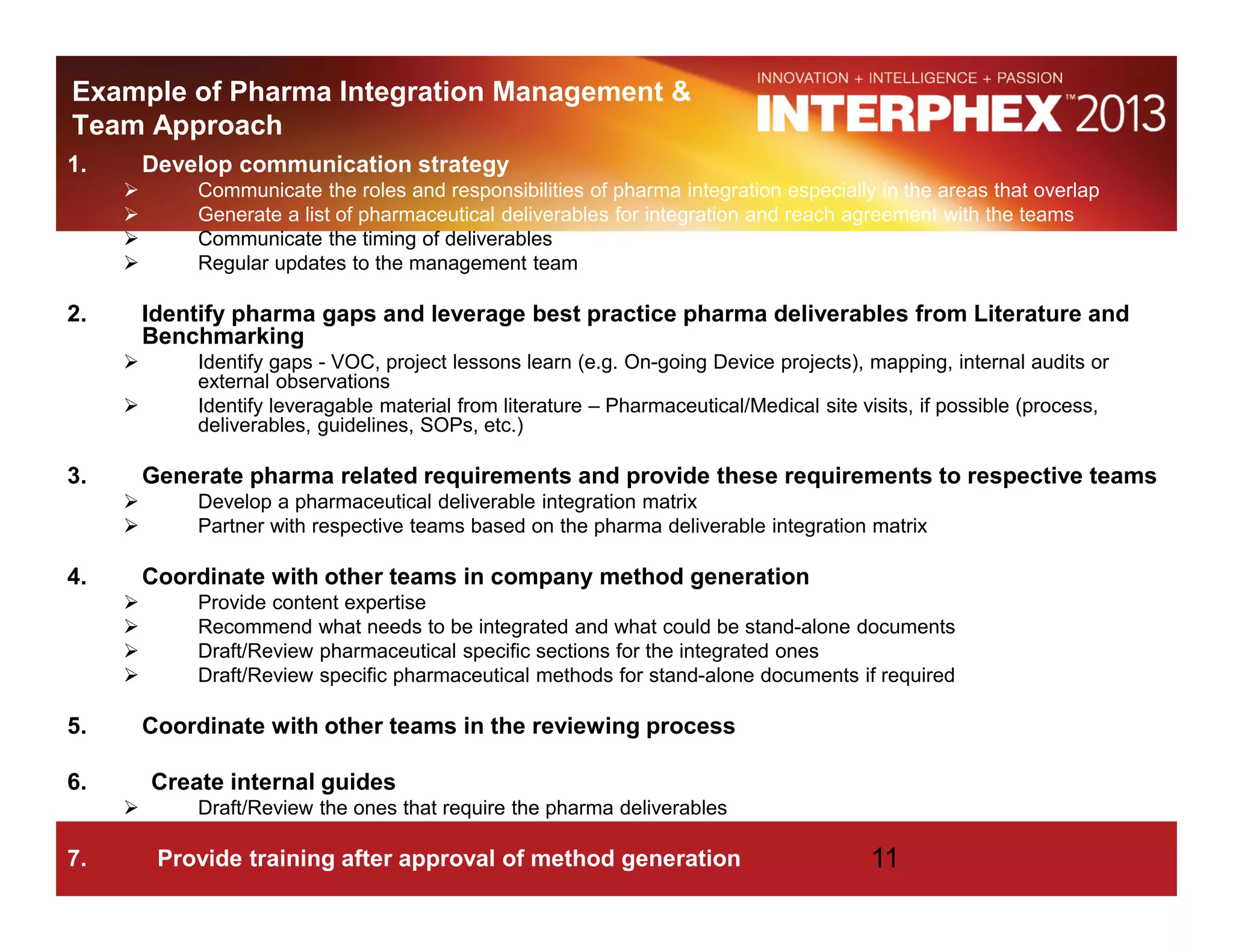
Example of PharmaIntegration Management &
Team Approach
1. Develop communication strategy
Communicate the roles and responsibilities of pharma integration especially in the areas that overlap
Generate a list of pharmaceutical deliverables for integration and reach agreement with the teams
Communicate the timing of deliverables
Regular updates to the management team
2. Identify pharma gaps and leverage best practice pharma deliverables from Literature and
Benchmarking
Identify gaps - VOC, project lessons learn (e.g. On-going Device projects), mapping, internal audits or
external observations
Identify leveragable material from literature – Pharmaceutical/Medical site visits, if possible (process,
deliverables, guidelines, SOPs, etc.)
3. Generate pharma related requirements and provide these requirements to respective teams
Develop a pharmaceutical deliverable integration matrix
Partner with respective teams based on the pharma deliverable integration matrix
4. Coordinate with other teams in company method generation
Provide content expertise
Recommend what needs to be integrated and what could be stand-alone documents
Draft/Review pharmaceutical specific sections for the integrated ones
Draft/Review specific pharmaceutical methods for stand-alone documents if required
5. Coordinate with other teams in the reviewing process
6. Create internal guides
Draft/Review the ones that require the pharma deliverables
7. Provide training after approval of method generation 11
12.
Linking Pharmaceutical Developmentto
Design Control Pharmaceutical Product Development
can be Viewed as Two Separate but Integrated Processes
“Claims” development
– Integrates clinical, regulatory, and marketing strategies
– Optimizes claim structure, product positioning and promotional
messages
“Product/Process” development
– Integrates chemistry, formulation, and manufacturing
– Optimizes product/process specifications, cost and production
“Claims” Development
“Process” Development
Pharmaceutical Product Development
Discovery Commercialization
“Claims” Development
“Process” Development
Pharmaceutical Product Development
Discovery Commercialization
12
13.
Pharmaceutical Product Developmentand Device
Development Can Differ in Several Key Areas
• Product development cycle time
– Pharma development can be as long as ten years
– Device development is usually less than three years
• Product design and specification
– Drug products are defined by the results of clinical trials
• Discovery-driven and little can be done to modify the drug substance to meet customer
needs
• Process focuses on maximizing what is discovered to get best label for given indication
• Development more like a legal process as in “claims” made
– Devices are specified to meet market needs
• Products can usually be engineered to a much greater degree
• Process focuses on optimizing commercial potential by focusing on trade-offs between
options
• Development can be heavily customer-driven
• Magnitude of development effort
– Since pharmaceutical drugs take so long to develop and typically require over $500M to bring to
market, a significant number of personnel are involved with a project (as many as several
hundred)
– Device development can be tailored to the size of the project—from minor upgrades to significant
technology implementations; however, their size is usually no where near that of drug
development 13
14.
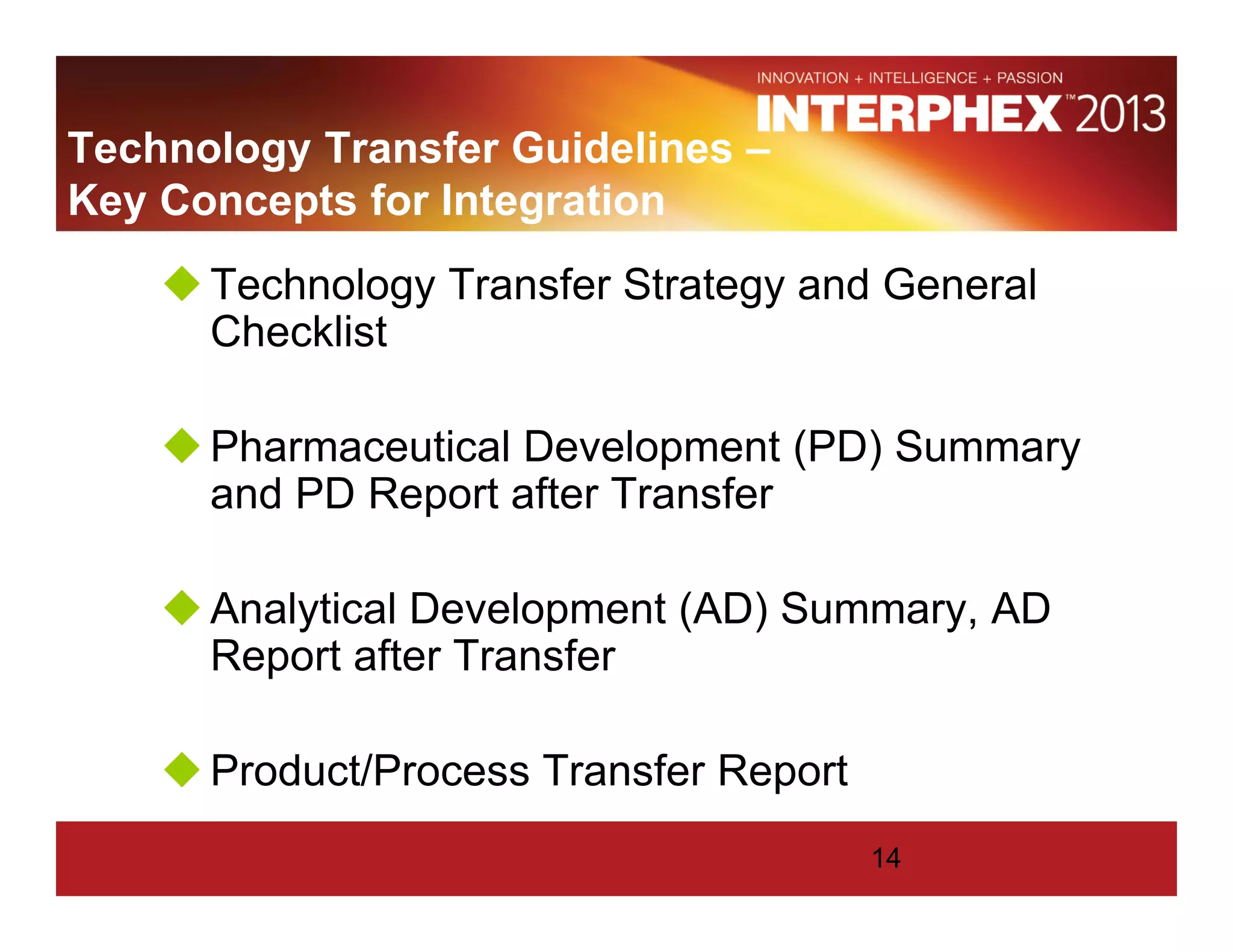
Technology Transfer Guidelines–
Key Concepts for Integration
Technology Transfer Strategy and General
Checklist
Pharmaceutical Development (PD) Summary
and PD Report after Transfer
Analytical Development (AD) Summary, AD
Report after Transfer
Product/Process Transfer Report
14
15.
Technology Transfer Strategyand General Checklist
The Strategy is a written document that outlines the agreements made between
Development and Operations concerning the technology transfer.
The “Checklist” is a detailed list of development requirements and
corresponding documentation that guide the collection of technology transfer
knowledge for a specific project.
Definitions
Product/Process Transfer Report
Locks in the core product and process information prior to manufacture of the
registration batches and to document comparability between the new product
developed in R&D and the final to-be-marketed product.
Analytical, Pharmaceutical Development Summaries and Reports
The summaries are a compilation of technical product knowledge, according
to the strategy established, takes place during the NPD phase. The activities
performed during NPD phase are within the R&D environment and in
accordance with Operations expectations. Reports document production
scale development activities that occur after the actual transfer from
Development to Operations has taken place.
15
CDA1
16.
Slide 15
CDA1 Maywant to consider making this into 3 slides (or have each definition fade in so that you focus the viewer on what you want him/her
to see/read.
CAllman1, 2/10/2009
17.
1
Technology Transfer (TT)Pharmaceutical Overview
Filing and
Launch
Product and Process Evaluation
Product and Process
Development
Commercial
Concept
Evaluation
Initiation Starting
Gate
Product Defined
Gate
Product Evaluated
Gate Closing
Registration Batches
TT Start
(Sourcing Decision)
File PAI
•Technology Transfer
Strategy and Checklist
•Pharmaceutical
Development
Summary
•Analytical
Development
Summary
•Product
Transfer
Report
•Analytical
Development Report
•Pharmaceutical
Development Report
Product Development File
Define & Measure Analyze Design Verify and Validate
•API Characterization,
•Pre-formulation,
Formulation, Early
Process Dev
•Route of Administration
•Early Analytical Dev
•Early Stability
Monitor
Manufacturing
Operations
File
I16
18.
Linking Pharmaceutical ProductDevelopment to Design Control
(Example of a Roadmap)
Stage 0
Proof of Concept
Stage 1
Product & Process Def
Stage 2
Dose & Scale Def
Stage 3
Efficacy & M FG
Stage 4
Licensure & Launch
Stage 5
Life CycleManagement
Discovery
Design Input - Product Specification
Define Product Specifications
Pre-Formulation Formulation Development Production Support
API Process Development & Scale up
Process Development and Validation
Concept Phase Feasibility Phase Development Phase
Implementation
Phase
Base Business
Phase
Chronic Toxicology Animal Studies.
In Vitro Toxicology
Acute Toxicology Animal Studies
Facility Start-up & Validation Commercial ProductionPAI
PAI Preparation
AssayValidation
Process Validation
Phase II
T rials Phase IV T rialsPhase I T rials Phase III T rials
Design Validation (P roduct) – Safety and Efficacy
Regulatory Filing Preparation and Submission
IND
Subm ission
FIH Pivotal Trial Starts
NDA Subm ission Regulatory Approval
Design
Freeze
Phase Review Phase Review Phase Review Phase ReviewPhase Review Phase Review
GMP Starts
Design Transfer/Design Change
T echnologyT ransfer
Plan (TT P)
TTP
Update
TTP
Update
T echnologyT ransfer
Technolog y
Transfer Strateg y
Product StabilityStudies
Packaging StabilityStudies Stability Study Updates
Design Verification – Test Methods & Stability Studies
Start Final Stability Study
T ransfer AssaysAnalytics Development
Analyt ical Developm ent Summar y
Analyt ical Developm ent Report
Develop & Qualify Characterization & Release Assays for RM, Process, & Product
GLP Starts
• Product Development File (DHF)
• Product Transfer Report
• Pharmaceutical D evelopment Report
• Analyt ical Developm ent Report
Produc t/Proc ess/Pac kaging Doc umentation
• Pharmaceutical D evelopment Summ ar y
• Analyt ical Developm ent Summar y
Design Output
Risk Management – Animal Studies
Expiration Date
Established
• Product Dev. Plan
(Clinical, R egulator y,
CMC, etc.)
• PDP Updates • PDP Updates
• Launch Strateg y
T arget Product Profile
Planning/Review
17
19.
Generate a Roadmapfor New Product
Commercialization Process
• What it is….
– Could be a one-page
overview of New Product
Development Process for
Commercialization
– Captures steps, timing and
sequence, phase
deliverables, and roles and
responsibilities
– Describes timing and
sequence of Design and
Business Reviews
– Can be aligned with
Process Design Excellence
/ Six Sigma methodology
• What is it used for…
– Used by project teams
as a template for
repeatable and
disciplined project
planning and
management
– Can serve as a
reference to
management oversight
18
20.
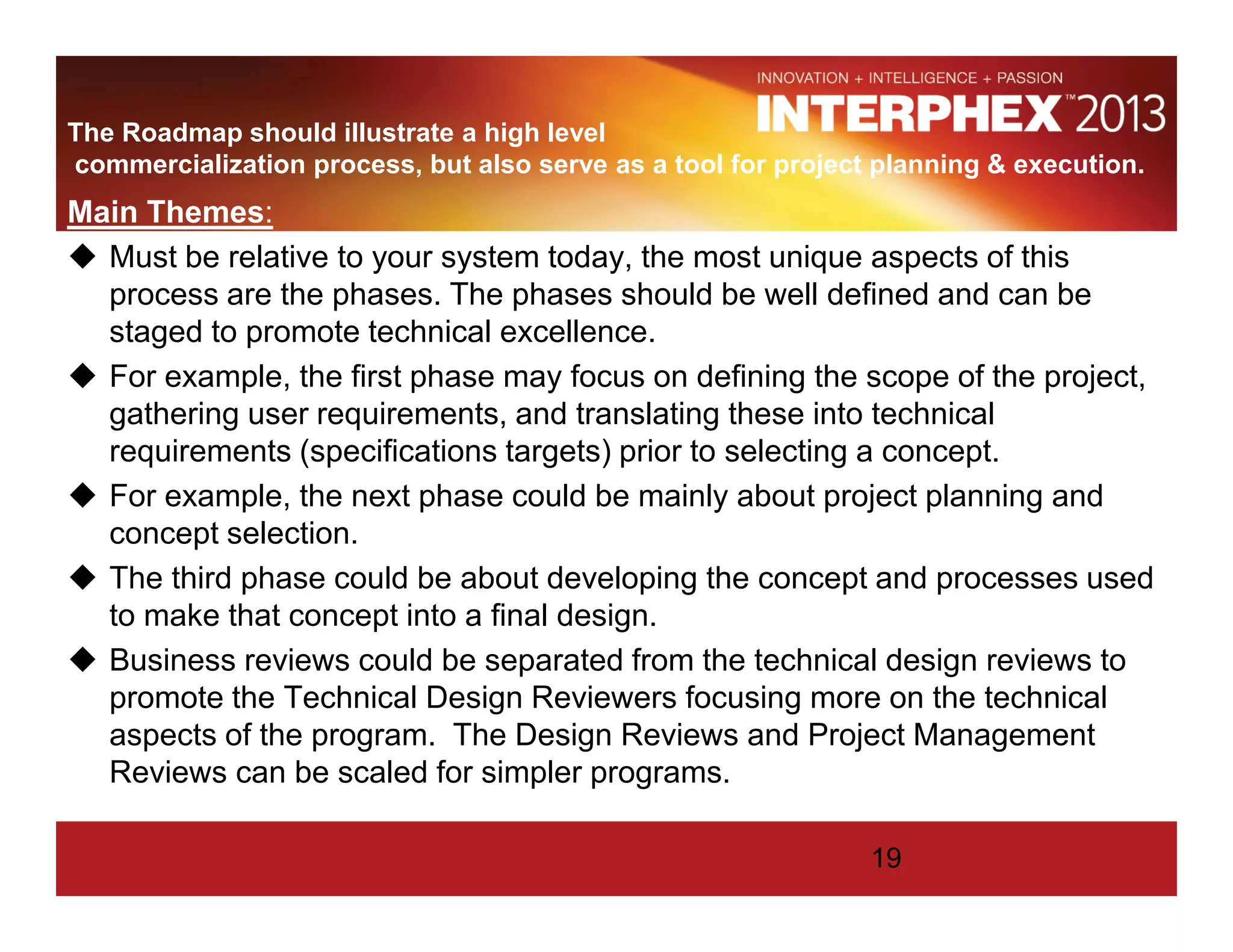
The Roadmap shouldillustrate a high level
commercialization process, but also serve as a tool for project planning & execution.
Main Themes:
Must be relative to your system today, the most unique aspects of this
process are the phases. The phases should be well defined and can be
staged to promote technical excellence.
For example, the first phase may focus on defining the scope of the project,
gathering user requirements, and translating these into technical
requirements (specifications targets) prior to selecting a concept.
For example, the next phase could be mainly about project planning and
concept selection.
The third phase could be about developing the concept and processes used
to make that concept into a final design.
Business reviews could be separated from the technical design reviews to
promote the Technical Design Reviewers focusing more on the technical
aspects of the program. The Design Reviews and Project Management
Reviews can be scaled for simpler programs.
19
21.
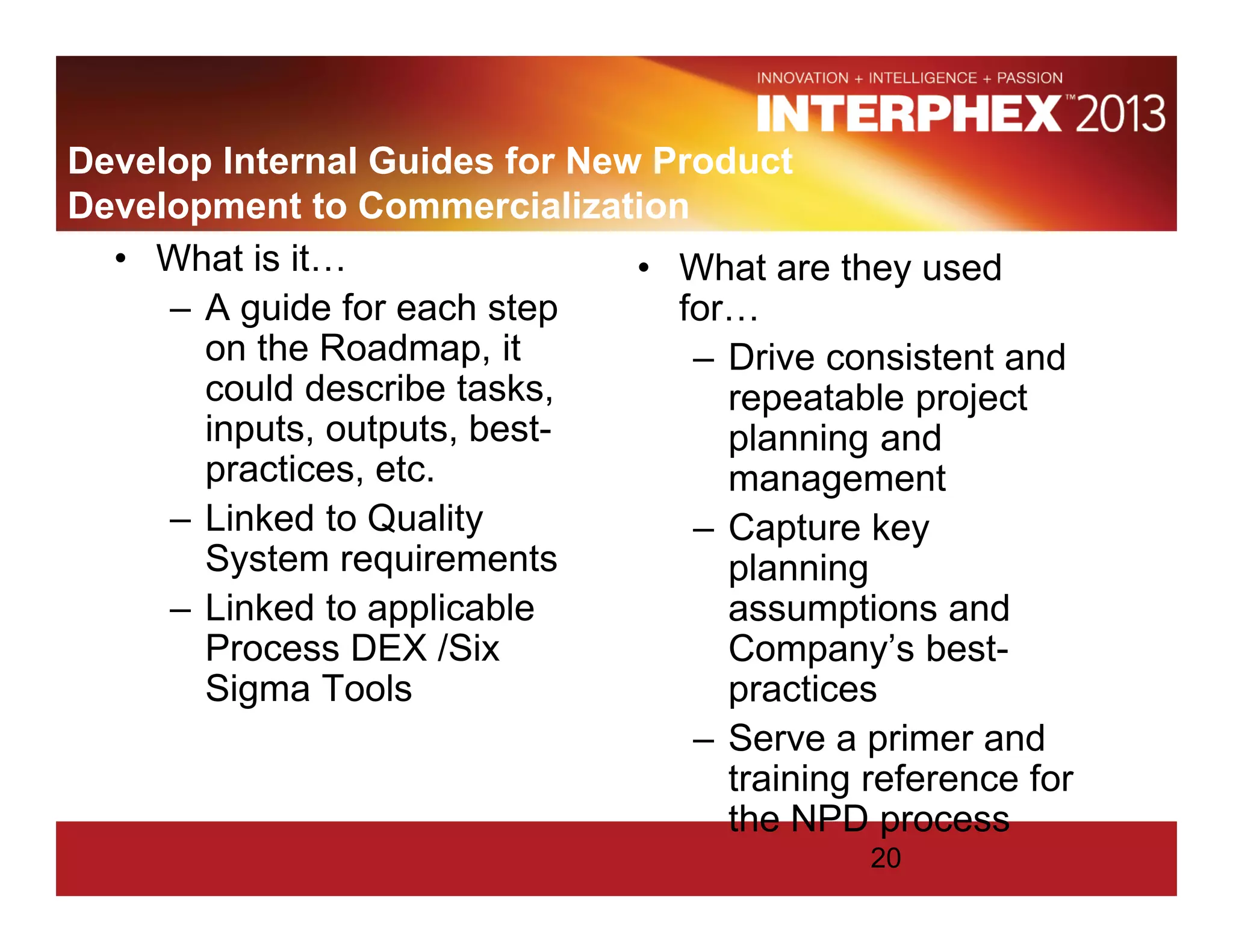
Develop Internal Guidesfor New Product
Development to Commercialization
• What is it…
– A guide for each step
on the Roadmap, it
could describe tasks,
inputs, outputs, best-
practices, etc.
– Linked to Quality
System requirements
– Linked to applicable
Process DEX /Six
Sigma Tools
• What are they used
for…
– Drive consistent and
repeatable project
planning and
management
– Capture key
planning
assumptions and
Company’s best-
practices
– Serve a primer and
training reference for
the NPD process
20
22.
Design Control WaterfallDiagram vs.
Pharmaceutical Deliverables for Integration
User
Requirements
Technical
Design
Input
Design
Output
Design Verification
Design Validation
Design &
Development
Planning
Medical Product
Design Process
Process Validation
Analytical Development
Summary
Pharmaceutical Dev Summary
Final Documentation for Product &
Process Specifications
Validations Including:
Cleaning, Facility, Analytical Method
Technology Transfer
Strategy and Checklist
Product Transfer Report
Pharmaceutical Dev
Report
Analytical Dev Reports
Analytical Method
Transfer
Technology Transfer of Knowledge from R+D to Commercial Operations
Technical
Requirements
Design Input – Output
Product/Process Development Reports
Design Characterization and Design Summaries
Design and Development
Planning
Verification and Validation
Summaries
Facility Validation
Cleaning Validation
Test Method Validation
Validations Including:
Cleaning, Facility, Analytical
Method, Equipment
Product/ Process Transfer
Report
Pharmaceutical Dev
Report
Analytical Dev Report
21
23.
Integration of KeyPharmaceutical
Reports/Summaries Concepts
1. Summary of the development history and any changes since development.
2. Documents comparability of the product and process from development to
commercialization. This is accomplished in the summaries by documenting that the
impact of any relevant design changes does not affect the validity of the verification
and validation activities.
3. Documents the critical links between the product and process from pivotal clinical
activities, registration, and finally to commercialization. This can be documented
through an equivalency assessment in the summary or report.
4. Justification and rationale to support the final commercial product and manufacturing
process through an equivalency assessment in the summary or report.
5. Locks the critical product, process and analytical information prior to the manufacture
of initial registration and ISS batches. This can be accomplished through the
successful completion of validation and summarized in the process validation
summary or report.
22
24.
Technology Transfer GeneralChecklist
Detailed List could have 10 more Items per Subject Bullet
Active Pharmaceutical Ingredient
(API)
• General API Information
• Physical Description
• Characterization and Proof of
Structure
• API Manufacturer
• Synthesis/Method of Manufacture
• API Process Controls
• Reference Standard
• Specifications and Analytical Test
Methods
• API Container Closure System
• API Stability
General Product Information
Drug Product
• Components
• Composition
• Specification and Test Methods for
Inactive Components
• Manufacturer
• Methods of Manufacturing and
Packaging
• Specifications and Test Methods
for Drug Product
• Drug Product Container Closure
System
• Drug Product
Microbiology/Sterility
• Drug Product Stability
23
25.
Pharmaceutical Development
Summary Outline
ExecutiveSummary:
• Comprehensive summary focusing on the
development of the drug product and manufacturing
process.
Introduction:
Development Strategy:
• Describe of the decision path and supporting rationale
and justifications taken in during the development of
the drug product and manufacturing process. Include
all issues and risks.
Information on the API:
• Chemical Structure and molecular formula.
• List special properties relevant for the product and/or
process development.
• Specifications
Drug product:
• Formula rationale for excipients (include sensitivities
such as heat, light, etc.).
• Formulation history.
• Specifications/suppliers of excipient.
• Product specifications.
Manufacturing process:
• Manufacturing process rationale.
• Manufacturing history
Process Flow Diagram with process parameters
and acceptable ranges.
• Manufacturing equipment requirements and
principle of operation.
• In process controls.
• Cleaning assessment
Packaging:
• Rationale for immediate container selection.
• Immediate container
description/supplier/specification .
Batch overview:
• Development batches trending table to include:
• Batch number and size
• API lot number
• Where and when batch was made
• Purpose of the batch
• Analytical result of the batches
Critical parameters:
• Discussion of critical parameters identified
from lab and pilot scale.
• Process Capability Report/Results
References: References to detailed reports that are
identified in your checklist.
24
26.
Analytical Development
Summary Outline
Introduction:
•General information on the API: chemical
structure, name and code number.
Impurities and degradants:
• Rationale for the selection of the specified
impurities and degradants (if applicable).
• Provide historical data from explorative and
full product development.
Analytical methods:
• Rationale for the choice of the analytical
method for a particular specification and also
provide in this section:
• Analytical method evaluation (ring test)
and validation
• Analytical Method Development Report
• Robustness testing
• Drug Product stress degradation studies
• Analytical Method transfer reports
Instrumentation:
• Rationale for critical instrumentation
parameters, reagents, utilities and other
relative instrumentation information.
Control of change:
• Description and rationale for method
changes.
Training:
• Training requirements and support on all
methods used for the testing of raw
materials, active ingredient(s) and
finished drug product.
Conclusion:
• Conclusions resulting from the available
method development data supporting
the methods presented in the regulatory
filing.
25
27.
Product/Process Transfer ReportOutline
Pharmaceutical development summary:
• Brief description of the drug product
development history.
Scale-up summary:
• Brief description of the manufacturing
development history from pilot scale to full
scale.
Product Composition:
• Comparison of each separate ingredient in
the product and corresponding quantitative
composition between the development site
and manufacturing site.
• Explanation of any differences encountered
between the development site and
manufacturing site.
Raw Materials:
• Comparison of each separate raw material
and corresponding code number, supplier,
trademark and specification reference
between the development site and
manufacturing site.
• Explanation of any differences
encountered between the development site
and manufacturing site.
Immediate container:
• Comparison of each immediate container
component, supplier and specification
reference between the development site
and manufacturing site and any differences
encountered.
Product specifications and test methods:
• A summary table identifying the test,
specification and corresponding
analytical method.
Manufacturing process:
• Comparison of the manufacturing
equipment, operating parameters and
IPC limits for each step of the process
between the development site and the
manufacturing site.
• Explanation of any differences
encountered between the development
site and manufacturing site.
• Process flow diagram
• Manufacturing instructions
Packaging:
• Packaging description including
reference to specifications.
Validation:
• Process and cleaning validation
strategies and/or reports
• Sterilization validation strategy and/or
reports (if required)
Stability:
• Registration stability strategy and
stability protocol.
Conclusions:
• Conclusions concerning the scale-up
experiences.
• Development team and Operations team
approval signatures.
26
28.
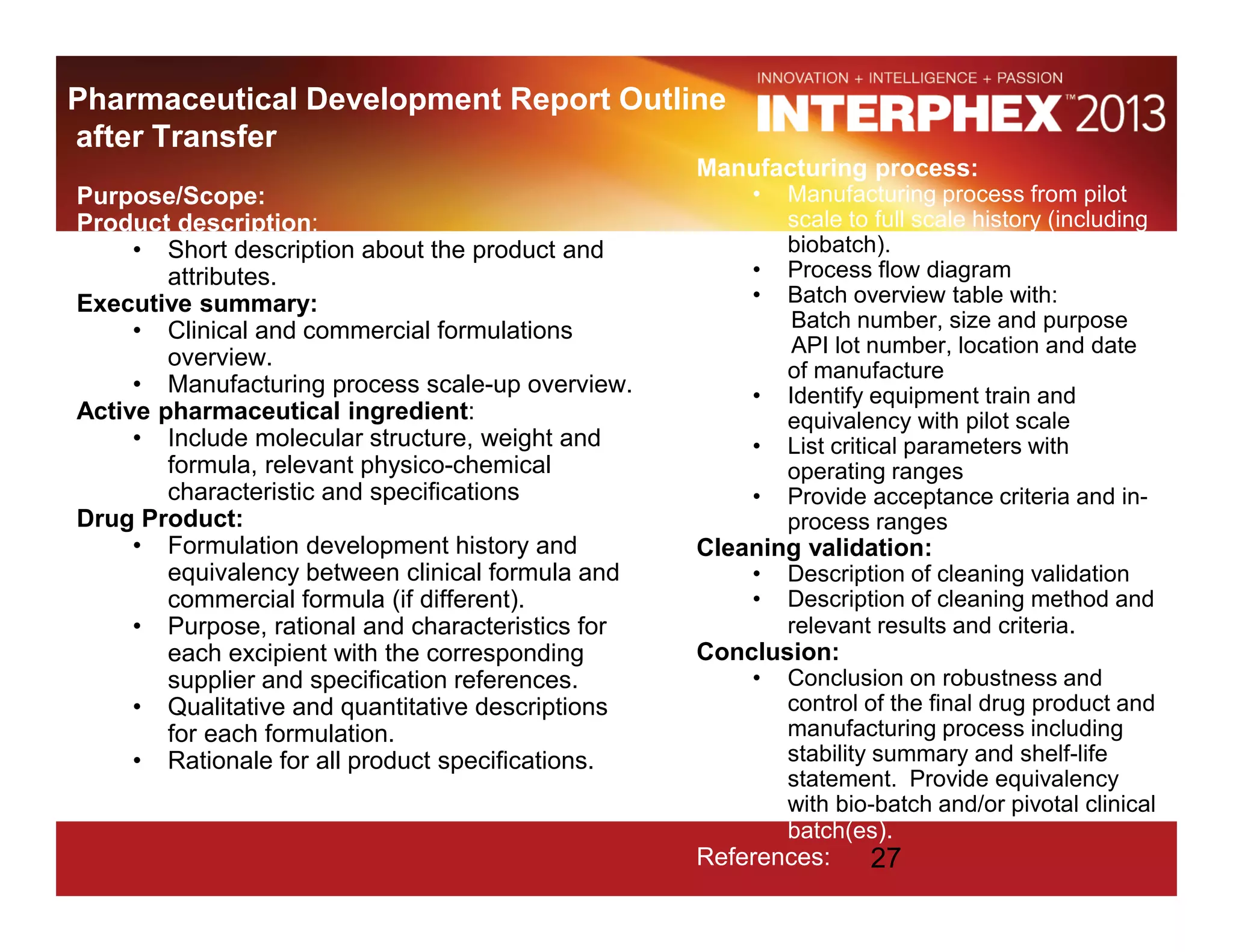
Pharmaceutical Development ReportOutline
after Transfer
Purpose/Scope:
Product description:
• Short description about the product and
attributes.
Executive summary:
• Clinical and commercial formulations
overview.
• Manufacturing process scale-up overview.
Active pharmaceutical ingredient:
• Include molecular structure, weight and
formula, relevant physico-chemical
characteristic and specifications
Drug Product:
• Formulation development history and
equivalency between clinical formula and
commercial formula (if different).
• Purpose, rational and characteristics for
each excipient with the corresponding
supplier and specification references.
• Qualitative and quantitative descriptions
for each formulation.
• Rationale for all product specifications.
Manufacturing process:
• Manufacturing process from pilot
scale to full scale history (including
biobatch).
• Process flow diagram
• Batch overview table with:
Batch number, size and purpose
API lot number, location and date
of manufacture
• Identify equipment train and
equivalency with pilot scale
• List critical parameters with
operating ranges
• Provide acceptance criteria and in-
process ranges
Cleaning validation:
• Description of cleaning validation
• Description of cleaning method and
relevant results and criteria.
Conclusion:
• Conclusion on robustness and
control of the final drug product and
manufacturing process including
stability summary and shelf-life
statement. Provide equivalency
with bio-batch and/or pivotal clinical
batch(es).
References: 27
29.
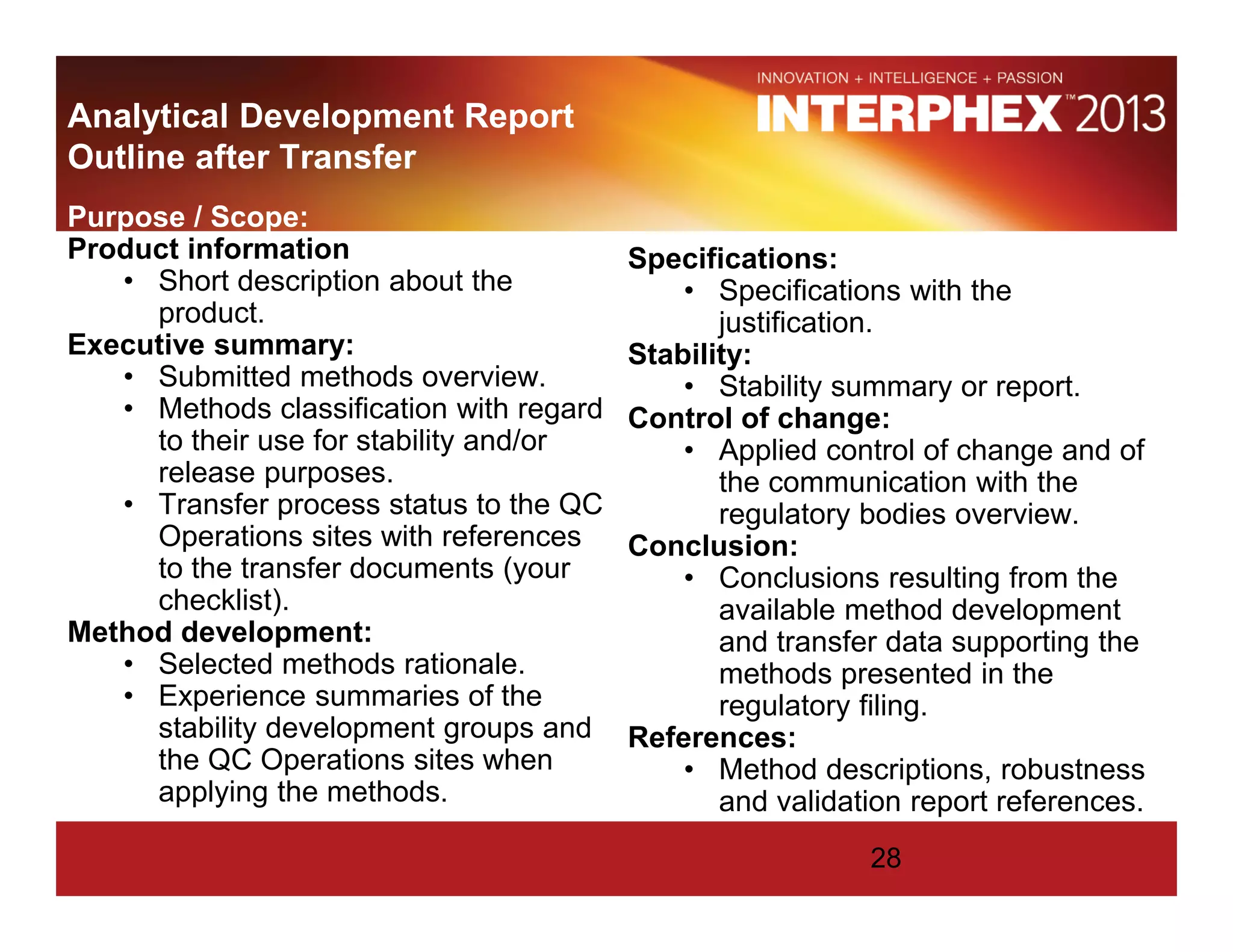
Analytical Development Report
Outlineafter Transfer
Purpose / Scope:
Product information:
• Short description about the
product.
Executive summary:
• Submitted methods overview.
• Methods classification with regard
to their use for stability and/or
release purposes.
• Transfer process status to the QC
Operations sites with references
to the transfer documents (your
checklist).
Method development:
• Selected methods rationale.
• Experience summaries of the
stability development groups and
the QC Operations sites when
applying the methods.
Specifications:
• Specifications with the
justification.
Stability:
• Stability summary or report.
Control of change:
• Applied control of change and of
the communication with the
regulatory bodies overview.
Conclusion:
• Conclusions resulting from the
available method development
and transfer data supporting the
methods presented in the
regulatory filing.
References:
• Method descriptions, robustness
and validation report references.
28
30.
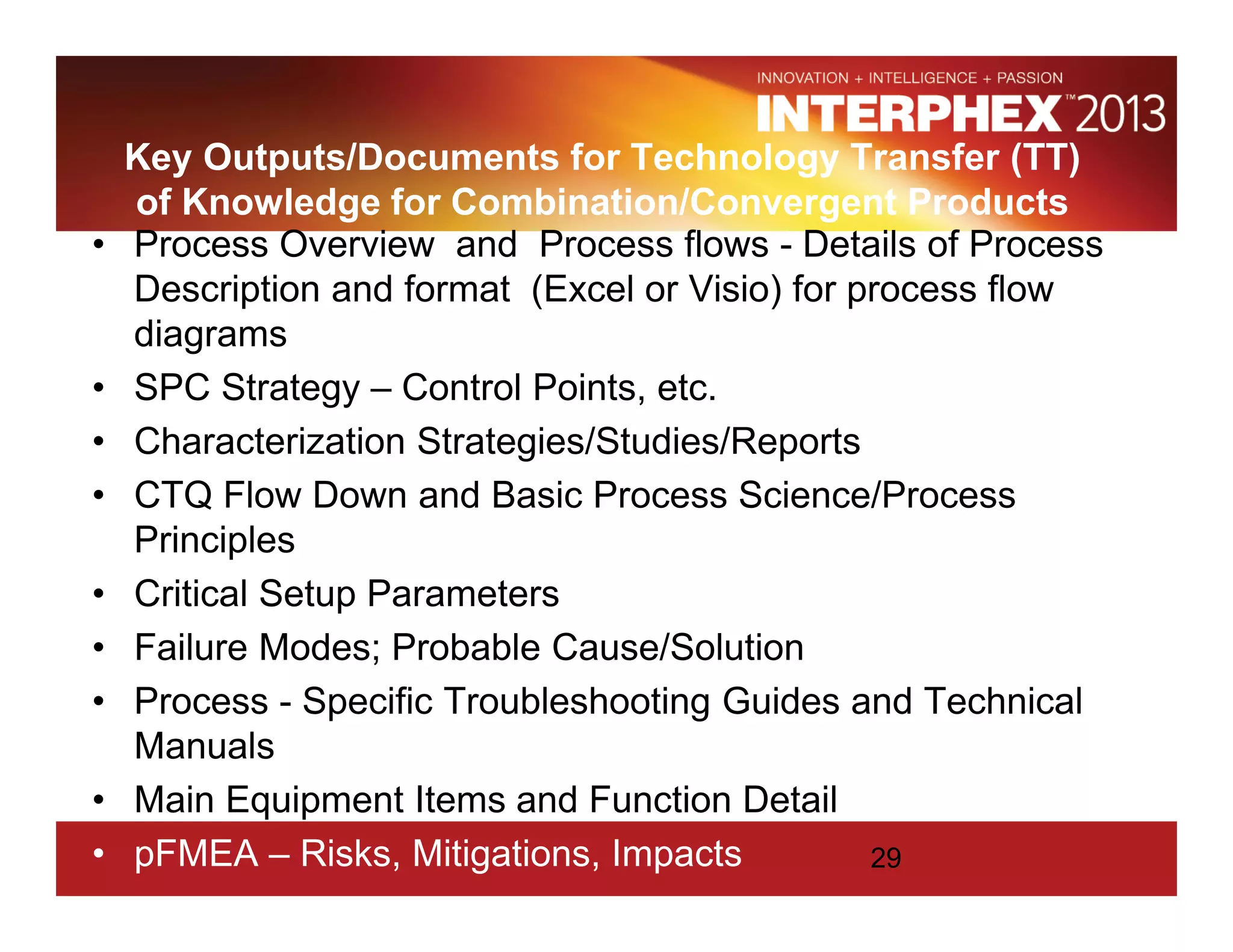
Key Outputs/Documents forTechnology Transfer (TT)
of Knowledge for Combination/Convergent Products
• Process Overview and Process flows - Details of Process
Description and format (Excel or Visio) for process flow
diagrams
• SPC Strategy – Control Points, etc.
• Characterization Strategies/Studies/Reports
• CTQ Flow Down and Basic Process Science/Process
Principles
• Critical Setup Parameters
• Failure Modes; Probable Cause/Solution
• Process - Specific Troubleshooting Guides and Technical
Manuals
• Main Equipment Items and Function Detail
• pFMEA – Risks, Mitigations, Impacts 29
31.
Key Take-aways fromthe Technology Transfer Guidelines
• Standardize checklist for transferring product development, process
development and analytical method development knowledge
– Describes the key requirements that must be completed or addressed
throughout the pharmaceutical development process
• Requirements are summarized in key deliverables and reports such as:
– Technology Transfer Strategy, Technology Transfer Checklist,
Pharmaceutical Development Summary, Analytical Development
Summary, Product Transfer Report, Pharmaceutical Development
Report, Analytical Development Report
• In developing a drug-device development model, must identify applicable
requirements and integrate them into the development process
– Product description to be updated to include inputs for active
pharmaceutical agent
– New pharma-specific requirements such as dose, route of administration,
elution kinetics and metabolism of the drug substance
30
32.
Thank you foryour participation today
Special Thanks to the following individuals:
• Angela Falzone
• Saurabh Palkar
• Theresa Scheuble
• Diana Dai
• Dave Blazek
• Rich Tennant
If time allows, audience can share some of their best-
practices, experiences and lessons-learned
Don’t forget to complete the evaluation forms !
31