WADI PROGRAMME BEST PRACTICES
PLOT SELECTION Well drained soil Sloppy Avoid land under High tension electric  supply Dense canopy Proper distance should kept when plot is near to highways, big roads Plot should belong to Family
PLOT MARKING Preparation of measured rope Distance between two plants 10 x 10 meter for mango 7 x 7 meter for cashew, Awala, Cusraed apple, lemon etc. Distance from Fencing Staggered layout for high slope
PIT DIGGING Size 1x1x1 meter for fruit 0.3 x 0.3 x0.3 for forestry Marked area Keep soil separately On sloppy land  keep uppermost layer soil on top  Pit should be 1 meter from down stream side Size should maintained from top to bottom No pits should be under canopy /electric / telephone lines
Pit filling Pit filling should be completed when the pit is dry i.e. by end of May.  Keep ready the fertilizer, pesticides ready Dust pesticides before filling Fill pit layer by layer At bottom 15 cm of dry leaves + layer of top soil 10 cm layer of green leaves and small twigs + layer of top soil second layer of 25 cm consisting of mixture of soil (excavated from the upper layers of the pit) and FYM or dried dung  followed by a layer of 45 cm consisting of mixture of soil.  Bone Meal and Neem Cake.  A small heap of 30 cm should be made on the top  Insert one wooden peg at center
Selection of Grafts Procured from genuine source Healthy, sturdy graft At least one year old Height 2  to 2.5 ft Care should be taken during transportation
Plantation of Grafts  Before plantation: Ensure no water stagnation in pit. Pit should be filled above ground level. Graft should be healthy Grafts should be planted same day when it received
Plantation of Grafts During plantation: Dig out small pit and apply light irrigation (if possible / if needed) Remove plastic bag carefully by using sharp blade and without disturbing soil ball. Keep graft in pit and add soil and press it. Ensure that no air in pit Keep grafted portion one inch above ground level
Plantation of Grafts After plantation: ‘ H’  type staking should be given immediately.  Irrigate the plant if no rains occurred (for more than 3 days)
Plantation of Forestry Time:  End of June to first week of July after monsoon settled. Planting should be done in late afternoon or evening. Planting in morning period should be avoided. While planting teak stump / cutting care should be taken to plant it at slanting position and not vertical.
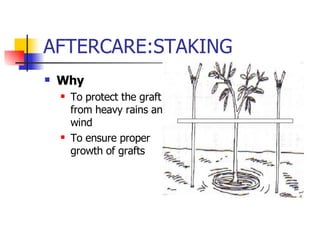
AFTERCARE:STAKING Why To protect the graft from heavy rains and wind To ensure proper growth of grafts
AFTERCARE:STAKING How Collect 4 ft. long sticks  Give ‘H’ type staking to each graft Use only cotton thread or local material for tying  Do not use nylon rope  Use ‘8’ type knot during tying Distance between two sticks should be maintained properly  Strips should be straight and sound.  It should not be inclined and thin. As far as possible use dry sticks  (avoid fresh cuttings).  The staking should be done in the proper direction (East-West) As the graft grows taller, height of the staking should be increased . When Technically staking should be done immediately after plantation..
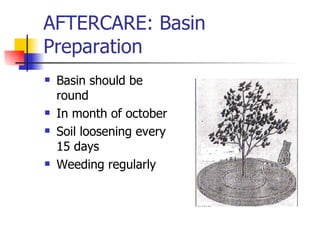
AFTERCARE: Basin Preparation Basin should be round In month of october Soil loosening every 15 days Weeding regularly
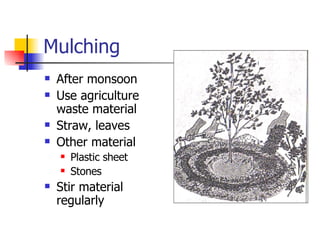
Mulching After monsoon Use agriculture waste material  Straw, leaves Other material Plastic sheet Stones  Stir material regularly
AFTERCARE: Shade  for trees Benefits Tender leaves and shoots protected Scorching avoided Protects soil moisture by preventing heavy evaporation loss Prevent cracking in soil, which in helps to reduce evaporation water loss Cracks near the stock are not developed which reduces evaporation Keeps soil cool/soil temperature is maintained.
AFTERCARE: Shade  for trees Care should be taken Height of the sticks should be more than grafts top is thatched with Grasses or leaves or Gunny sheet.  Bottom of the sticks are to be painted with tar paint before fixing it into the soil.
AFTERCARE: Removal of offshoots Method With the secateur unwanted branches are removed.  Spray of Disinfectant lie Bavistin, copper oxichlosile is to be sprayed. In first year below the joint and from second year upto 1 mt. from the ground level to develop spherical shape or umbrella shape of the tree.
Removal of offshoots Benefits One can develop spherical shape canopy Strong branches can be developed More flowering More fruit setting and yield Healthy fruits can be obtained
Live hedge Fencing The fencing should be done for whole WADI plots instead of individual tree. Material used for dry fencing:  Dry branches of Karvand, Ber, sadada, bamboo, nirgudi, karvi and other thorny material available in the area
Fencing When Dry fencing should be done after pit digging in month of May  Live hedge fencing should be done in June to July (onset of monsoon).  Species belong to cactus family and Sagargota should be planted in May. The live hedge could be planted in two or three strips and it should be in zigzag pattern.
Inter cropping pattern Kharif (Cereals):  Dwarf varieties of finger millet, (Heavy feeder like maize should be avoided) Legumes kharif:  Green gram, Black gram, Matki, Kulthi Rabi:  Chickpea, Peas, Masur, Bitter beans Oil seeds kharif: Soybean, Groundnut Rabi:  Safflower  Vegetable kharif:  Tomato, Brinjal, Chilies, Onion, Spinach Rabi:  Fenugreek, Spinach, tomato, Brinjal, Chilies, Onion  shade loving plants (carrot, turmeric, sweet potato, medicinal plants) should be planted after 7 to 8 years
Inter crops in horticulture plantation Due considerations Proper combinations of fruit trees and improved dwarf varieties of cereals. Proper combination of fruit trees and improved varieties of Legumes. Proper combination of fruit trees and imp-varieties of vegetables. Application of diversity (more species) and complexity (multiple functions) Manage cropping patterns diversified in root structure, which will explore different soil strata. It should fulfill nutritional needs of the family throughout the year and manage crops accordingly. High yielding improved varieties should be used. Cropping pattern should be useful to protect soil from erosion (by wind or water), heat and toxic substances and supply of organic matter to soil life. Combination should have symbiotic activity.
Aftercare for Forestry Weeding whenever weeds are they, must be removed. Earthing up and basin preparation is essential. Plantation on trench-cum-bunds will have fast growth. 15 to 20 Gram DAP applications in the month of August. In second year weeding in August and October is essential due to which maximum nutrition supply will be provided to the forest plants. Pruning of unwanted branches is beneficial, so that plant nutrients will be diverted to plants, will receive sunlight and growth will be fast . Watering at early stage is equally important to enhance the Growth. Protection from trace passers and animals.
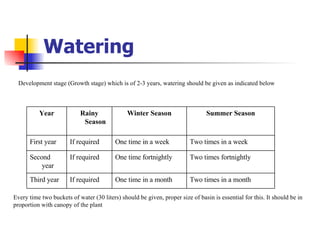
Watering Development stage (Growth stage) which is of 2-3 years, watering should be given as indicated below  Every time two buckets of water (30 liters) should be given, proper size of basin is essential for this. It should be in proportion with canopy of the plant  Two times in a month One time in a month If required Third year Two times fortnightly One time fortnightly If required Second year Two times in a week One time in a week If required First year Summer Season Winter Season Rainy Season Year
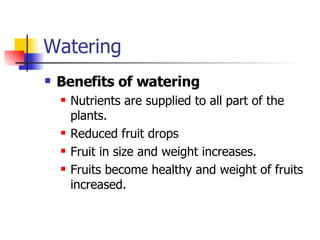
Watering Benefits of watering Nutrients are supplied to all part of the plants. Reduced fruit drops Fruit in size and weight increases. Fruits become healthy and weight of fruits increased.
SOIL CONSERVATION WADI  Presently 2 activities of soil conservation have been identified Trench cum bund for slopes less than 10% Trench and platform for slopes more tan 10% Other conservation activities may be done area specific.
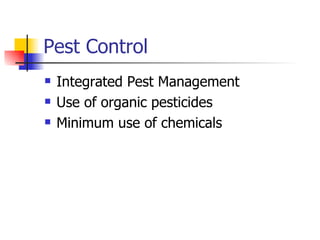
Pest Control Integrated Pest Management Use of organic pesticides Minimum use of chemicals

Wadi Best Practices

  • 1.
  • 2.
    PLOT SELECTION Welldrained soil Sloppy Avoid land under High tension electric supply Dense canopy Proper distance should kept when plot is near to highways, big roads Plot should belong to Family
  • 3.
    PLOT MARKING Preparationof measured rope Distance between two plants 10 x 10 meter for mango 7 x 7 meter for cashew, Awala, Cusraed apple, lemon etc. Distance from Fencing Staggered layout for high slope
  • 4.
    PIT DIGGING Size1x1x1 meter for fruit 0.3 x 0.3 x0.3 for forestry Marked area Keep soil separately On sloppy land keep uppermost layer soil on top Pit should be 1 meter from down stream side Size should maintained from top to bottom No pits should be under canopy /electric / telephone lines
  • 5.
    Pit filling Pitfilling should be completed when the pit is dry i.e. by end of May. Keep ready the fertilizer, pesticides ready Dust pesticides before filling Fill pit layer by layer At bottom 15 cm of dry leaves + layer of top soil 10 cm layer of green leaves and small twigs + layer of top soil second layer of 25 cm consisting of mixture of soil (excavated from the upper layers of the pit) and FYM or dried dung followed by a layer of 45 cm consisting of mixture of soil. Bone Meal and Neem Cake. A small heap of 30 cm should be made on the top Insert one wooden peg at center
  • 6.
    Selection of GraftsProcured from genuine source Healthy, sturdy graft At least one year old Height 2 to 2.5 ft Care should be taken during transportation
  • 7.
    Plantation of Grafts Before plantation: Ensure no water stagnation in pit. Pit should be filled above ground level. Graft should be healthy Grafts should be planted same day when it received
  • 8.
    Plantation of GraftsDuring plantation: Dig out small pit and apply light irrigation (if possible / if needed) Remove plastic bag carefully by using sharp blade and without disturbing soil ball. Keep graft in pit and add soil and press it. Ensure that no air in pit Keep grafted portion one inch above ground level
  • 9.
    Plantation of GraftsAfter plantation: ‘ H’ type staking should be given immediately. Irrigate the plant if no rains occurred (for more than 3 days)
  • 10.
    Plantation of ForestryTime: End of June to first week of July after monsoon settled. Planting should be done in late afternoon or evening. Planting in morning period should be avoided. While planting teak stump / cutting care should be taken to plant it at slanting position and not vertical.
  • 11.
    AFTERCARE:STAKING Why Toprotect the graft from heavy rains and wind To ensure proper growth of grafts
  • 12.
    AFTERCARE:STAKING How Collect4 ft. long sticks Give ‘H’ type staking to each graft Use only cotton thread or local material for tying Do not use nylon rope Use ‘8’ type knot during tying Distance between two sticks should be maintained properly Strips should be straight and sound. It should not be inclined and thin. As far as possible use dry sticks (avoid fresh cuttings). The staking should be done in the proper direction (East-West) As the graft grows taller, height of the staking should be increased . When Technically staking should be done immediately after plantation..
  • 13.
    AFTERCARE: Basin PreparationBasin should be round In month of october Soil loosening every 15 days Weeding regularly
  • 14.
    Mulching After monsoonUse agriculture waste material Straw, leaves Other material Plastic sheet Stones Stir material regularly
  • 15.
    AFTERCARE: Shade for trees Benefits Tender leaves and shoots protected Scorching avoided Protects soil moisture by preventing heavy evaporation loss Prevent cracking in soil, which in helps to reduce evaporation water loss Cracks near the stock are not developed which reduces evaporation Keeps soil cool/soil temperature is maintained.
  • 16.
    AFTERCARE: Shade for trees Care should be taken Height of the sticks should be more than grafts top is thatched with Grasses or leaves or Gunny sheet. Bottom of the sticks are to be painted with tar paint before fixing it into the soil.
  • 17.
    AFTERCARE: Removal ofoffshoots Method With the secateur unwanted branches are removed. Spray of Disinfectant lie Bavistin, copper oxichlosile is to be sprayed. In first year below the joint and from second year upto 1 mt. from the ground level to develop spherical shape or umbrella shape of the tree.
  • 18.
    Removal of offshootsBenefits One can develop spherical shape canopy Strong branches can be developed More flowering More fruit setting and yield Healthy fruits can be obtained
  • 19.
    Live hedge FencingThe fencing should be done for whole WADI plots instead of individual tree. Material used for dry fencing: Dry branches of Karvand, Ber, sadada, bamboo, nirgudi, karvi and other thorny material available in the area
  • 20.
    Fencing When Dryfencing should be done after pit digging in month of May Live hedge fencing should be done in June to July (onset of monsoon). Species belong to cactus family and Sagargota should be planted in May. The live hedge could be planted in two or three strips and it should be in zigzag pattern.
  • 21.
    Inter cropping patternKharif (Cereals): Dwarf varieties of finger millet, (Heavy feeder like maize should be avoided) Legumes kharif: Green gram, Black gram, Matki, Kulthi Rabi: Chickpea, Peas, Masur, Bitter beans Oil seeds kharif: Soybean, Groundnut Rabi: Safflower Vegetable kharif: Tomato, Brinjal, Chilies, Onion, Spinach Rabi: Fenugreek, Spinach, tomato, Brinjal, Chilies, Onion shade loving plants (carrot, turmeric, sweet potato, medicinal plants) should be planted after 7 to 8 years
  • 22.
    Inter crops inhorticulture plantation Due considerations Proper combinations of fruit trees and improved dwarf varieties of cereals. Proper combination of fruit trees and improved varieties of Legumes. Proper combination of fruit trees and imp-varieties of vegetables. Application of diversity (more species) and complexity (multiple functions) Manage cropping patterns diversified in root structure, which will explore different soil strata. It should fulfill nutritional needs of the family throughout the year and manage crops accordingly. High yielding improved varieties should be used. Cropping pattern should be useful to protect soil from erosion (by wind or water), heat and toxic substances and supply of organic matter to soil life. Combination should have symbiotic activity.
  • 23.
    Aftercare for ForestryWeeding whenever weeds are they, must be removed. Earthing up and basin preparation is essential. Plantation on trench-cum-bunds will have fast growth. 15 to 20 Gram DAP applications in the month of August. In second year weeding in August and October is essential due to which maximum nutrition supply will be provided to the forest plants. Pruning of unwanted branches is beneficial, so that plant nutrients will be diverted to plants, will receive sunlight and growth will be fast . Watering at early stage is equally important to enhance the Growth. Protection from trace passers and animals.
  • 24.
    Watering Development stage(Growth stage) which is of 2-3 years, watering should be given as indicated below Every time two buckets of water (30 liters) should be given, proper size of basin is essential for this. It should be in proportion with canopy of the plant Two times in a month One time in a month If required Third year Two times fortnightly One time fortnightly If required Second year Two times in a week One time in a week If required First year Summer Season Winter Season Rainy Season Year
  • 25.
    Watering Benefits ofwatering Nutrients are supplied to all part of the plants. Reduced fruit drops Fruit in size and weight increases. Fruits become healthy and weight of fruits increased.
  • 26.
    SOIL CONSERVATION WADI Presently 2 activities of soil conservation have been identified Trench cum bund for slopes less than 10% Trench and platform for slopes more tan 10% Other conservation activities may be done area specific.
  • 27.
    Pest Control IntegratedPest Management Use of organic pesticides Minimum use of chemicals