Technological
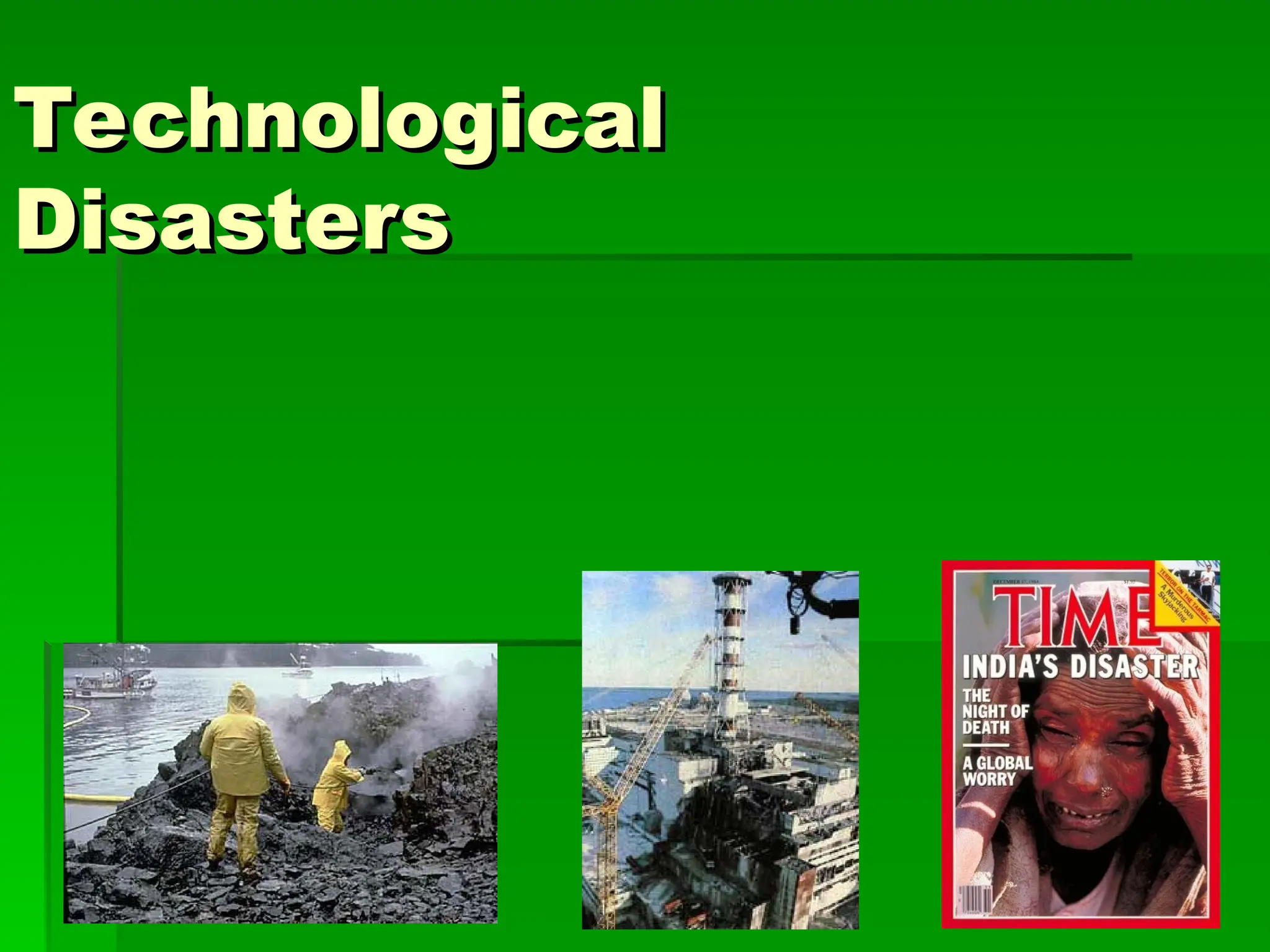
Technological
Disasters
Disasters
Are they the same as
“natural” disasters?
Examples
Examples
 Love Canal (chemical hazards)
Love Canal (chemical hazards)
 Three Mile Island (1979,radiation)
Three Mile Island (1979,radiation)
 Chernobyl (1986, Ukraine, nuclear
Chernobyl (1986, Ukraine, nuclear
accident)
accident)
 Bhopal, India
Bhopal, India
Disaster Agent
Disaster Agent
 Who or what caused the disaster?
Who or what caused the disaster?
 Who is to blame?
Who is to blame?
“
“Natural” Disasters
Natural” Disasters
 Altruism
Altruism
 Support
Support
 Camaraderie
Camaraderie
 Enact Solidarity
Enact Solidarity
Therapeutic Community
 “
“Community of Sufferers” (Fritz)
Community of Sufferers” (Fritz)
 Emergence of Consensus
Emergence of Consensus
 Expansion of citizenship role
Expansion of citizenship role
Technological
Technological
Disasters =
Disasters =
Nontherapeutic
Nontherapeutic
Community
Community
Nontherapeutic
Nontherapeutic
Community
Community
 Considerable conflict
Considerable conflict
 Conflictive Adaptation
Conflictive Adaptation
 Disaster Agent not random
Disaster Agent not random
Blame
Blame
 Injustice
Injustice
 Not defined as a disaster
Not defined as a disaster
 Damage is invisible
Damage is invisible
Ambiguity
Ambiguity
 Nature of disaster agent
Nature of disaster agent
 Consequences
Consequences
Victims
Victims
 Who are the true victims?
Who are the true victims?
 Conflict between victims
Conflict between victims
 Views of industry personnel
Views of industry personnel
 Relocation
Relocation
2 Types of Victims
2 Types of Victims
 Hazard-endangered victims
Hazard-endangered victims
 Hazard disclaimer victims
Hazard disclaimer victims
Time Dimension
Time Dimension
 Chronic, ongoing events
Chronic, ongoing events
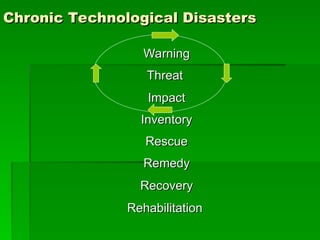
Chronic Technological Disasters
Warning
Warning
Threat
Threat
Impact
Impact
Inventory
Inventory
Rescue
Rescue
Remedy
Remedy
Recovery
Recovery
Rehabilitation
Rehabilitation
Normal Accidents
Normal Accidents
Charles Perrow
Charles Perrow
High Risk Technologies
 Increased risk
Increased risk
 Catastrophic potential
Catastrophic potential
 Accidents inevitable
Accidents inevitable
Interactive Complexity
 Failures can interact
Failures can interact
 Systems are “tightly coupled”
Systems are “tightly coupled”
 Failed parts cannot be isolated
Failed parts cannot be isolated
 Operators, safety systems make it worse
Operators, safety systems make it worse
Normal Accidents
Normal Accidents
 Initiating event can be trivial
Initiating event can be trivial
 Problems happen fast
Problems happen fast
NA-TECH Disasters
NA-TECH Disasters
 Natural Disasters trigger Technological
Natural Disasters trigger Technological
Disasters
Disasters
 J. Steven Picou
J. Steven Picou
 Enormous damage
Enormous damage
 Overlooked
Overlooked
Fukushima, Japan
Fukushima, Japan
 March 2011
March 2011
 Earthquake – Tsunami – Nuclear
Earthquake – Tsunami – Nuclear
Meltdown
Meltdown
 Decades to decontaminate
Decades to decontaminate
 Long term psychological consequences
Long term psychological consequences

Presentation on Technology and disaster management