



Investor Education Part - Technical Analysis   Presentation by  CA RAJESH RAMPAL
“ Are traders born or made? There is no simple answer. Both aptitude and learning are important, but in different proportions for different people. At one extreme are born geniuses who require very little learning. At the other are gamblers and dunces, whom no classes are likely to help. The rest of us are in the middle of the curve, with some aptitude but in need of education…” - Dr. Alexander Elder Investor Education Part - Technical Analysis
Technical Analysis Method of evaluating securities by analyzing statistics generated by market activity, mainly price and volume. -  The first objective of the Analyst is to ascertain the direction of the trend.   - The second objective is to monitor the trend on a continuous basis till analysis leads him to conclude that the trend has reversed direction.
Assumption in Technical Analysis The market discounts everything The market moves in trend History repeats itself ------------------------------------------------- Technical Analysis can fail at times hence cannot be followed blindly. Technical analysis works best when there is confluence of indicators and patterns
Two types of Price Charts  Bar Chart Japanese Candlestick Chart
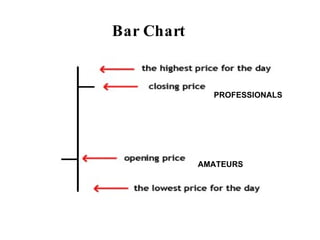
Bar Chart AMATEURS PROFESSIONALS
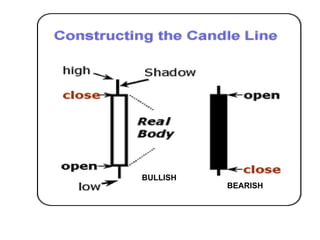
Candlestick Chart Easy to understand. Oriental Japanese Wisdom. Earlier indications of market turns Enhances Western charting analysis Depicts intraday market action using one bar
BULLISH BEARISH
Trends A  trend  is a series of rising or declining prices over any length of time. An  Uptrend  is goes higher over time. A  Downtrend  seeks lower prices over time. Primary trend -  a series of rising or declining prices. Primary Trends can last from one to several years. Secondary trends  are intermediate corrective trends to the primary trend. One to three months and retrace one-third to two-thirds of the primary trend. Fibonacci number.Retracements.  0,1,1,2,3,5,8,13,21,34…… Ratios are also same between two successive numbers. 1.62. Minor Trends  are short – term movements.
Rising Trend line .  Uptrend is when each successive peak and trough is higher than the ones found earlier. A trend line is drawn and is used for when to sell as it can be an early indication of a trend reversal. A Falling trend line is the opposite movement A flat trend line denotes parallel trend lines
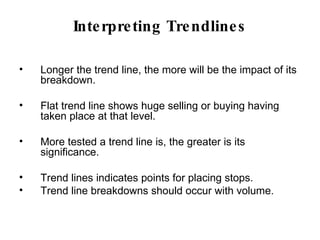
Interpreting Trendlines Longer the trend line, the more will be the impact of its breakdown.  Flat trend line shows huge selling or buying having taken place at that level. More tested a trend line is, the greater is its significance. Trend lines indicates points for placing stops.  Trend line breakdowns should occur with volume.
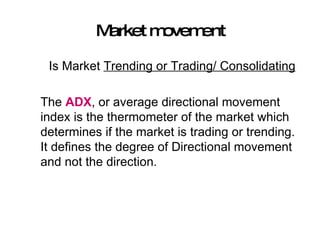
Market movement Is Market  Trending or Trading/ Consolidating The  ADX , or average directional movement index is the thermometer of the market which determines if the market is trading or trending. It defines the degree of Directional movement and not the direction.
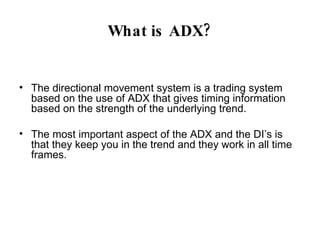
What is ADX? The directional movement system is a trading system based on the use of ADX that gives timing information based on the strength of the underlying trend. The most important aspect of the ADX and the DI’s is that they keep you in the trend and they work in all time frames.
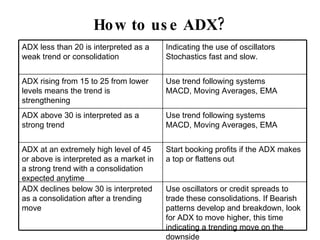
How to use ADX? Use oscillators or credit spreads to trade these consolidations. If Bearish patterns develop and breakdown, look for ADX to move higher, this time indicating a trending move on the downside  ADX declines below 30 is interpreted as a consolidation after a trending move  Start booking profits if the ADX makes a top or flattens out  ADX at an extremely high level of 45 or above is interpreted as a market in a strong trend with a consolidation expected anytime  Use trend following systems MACD, Moving Averages, EMA ADX above 30 is interpreted as a strong trend  Use trend following systems  MACD, Moving Averages, EMA ADX rising from 15 to 25 from lower levels means the trend is strengthening  Indicating the use of oscillators  Stochastics fast and slow. ADX less than 20 is interpreted as a weak trend or consolidation


Candlestick and Volume analysis When the price nears a trendline many questions arise.  Will price break out or break down at the trendline?  Will there be a false breakout?  Will the trendline prove to be formidable resistance to overcome, or will it provide support?  Candlesticks may provide an answer.
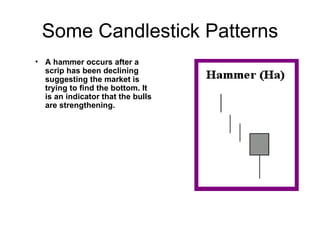
Some Candlestick Patterns A hammer occurs after a scrip has been declining suggesting the market is trying to find the bottom. It is an indicator that the bulls are strengthening.
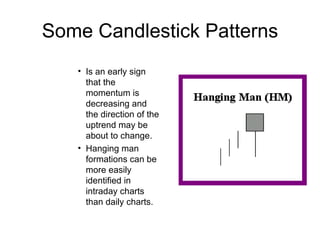
Some Candlestick Patterns Is an early sign that the momentum is decreasing and the direction of the uptrend may be about to change.  Hanging man formations can be more easily identified in intraday charts than daily charts.
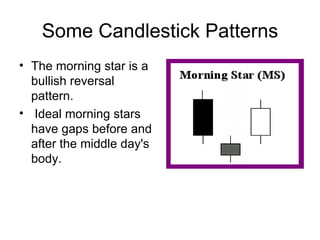
Some Candlestick Patterns The morning star is a bullish reversal pattern. Ideal morning stars have gaps before and after the middle day's body.
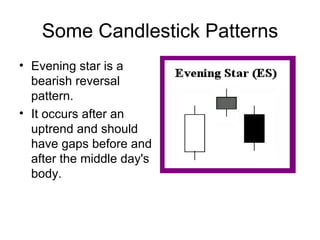
Some Candlestick Patterns Evening star is a bearish reversal pattern.  It occurs after an uptrend and should have gaps before and after the middle day's body.
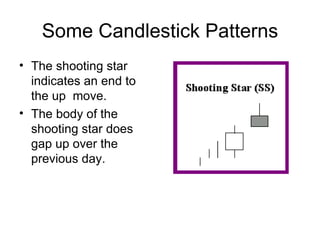
Some Candlestick Patterns The shooting star indicates an end to the up  move.  The body of the shooting star does gap up over the previous day.
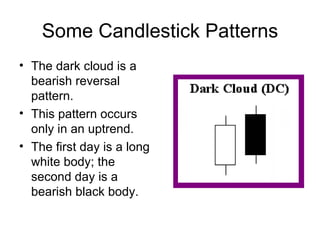
Some Candlestick Patterns The dark cloud is a bearish reversal pattern. This pattern occurs only in an uptrend. The first day is a long white body; the second day is a bearish black body.
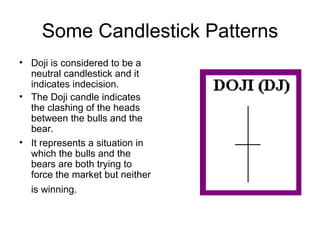
Some Candlestick Patterns Doji is considered to be a neutral candlestick and it indicates indecision.  The Doji candle indicates the clashing of the heads between the bulls and the bear. It represents a situation in which the bulls and the bears are both trying to force the market but neither is winning.
Some Candlestick Patterns If one finds a long white candlestick during an up move or in an overbought condition and if this white candle is followed by a Doji then the possibility of a trend reversal is quite high. A Doji occurring at lower levels during down move or in an oversold condition indicates the possibility of a bottom in the making.  Doji signifies the matching of the powers of the bulls and bears and it is well known that for the market to move upwards, forceful follow- up by the bulls is necessary.
Volume Analysis Volume often  leads  price, which offers an advance warning of a potential price trend reversal Main trend is in the price with high volume If prices increase and volume decreases – it implies a corrective move If prices decrease and volume decreases – it implies a corrective move If prices increase and volume increases – it implies a uptrend
Some other chart patterns Trend reversal and continuation patterns Head and shoulders and Inverse Double Top/ Double bottom
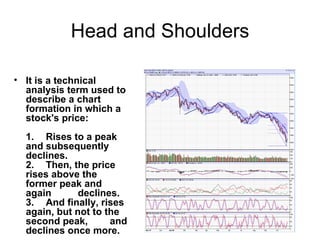
Head and Shoulders It is a technical analysis term used to describe a chart formation in which a stock's price:  1.  Rises to a peak and subsequently declines. 2.  Then, the price rises above the former peak and again  declines. 3.  And finally, rises again, but not to the second peak,  and declines once more.
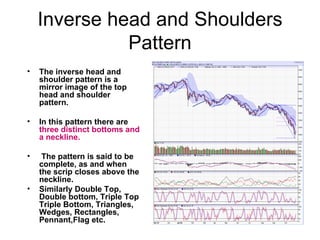
Inverse head and Shoulders Pattern The inverse head and shoulder pattern is a mirror image of the top head and shoulder pattern.  In this pattern there are  three distinct bottoms and a neckline. The pattern is said to be complete, as and when the scrip closes above the neckline.  Similarly Double Top, Double bottom, Triple Top Triple Bottom, Triangles, Wedges, Rectangles, Pennant,Flag etc.
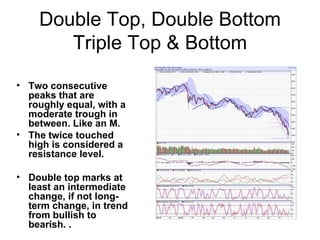
Double Top, Double Bottom Triple Top & Bottom Two consecutive peaks that are roughly equal, with a moderate trough in between. Like an M. The twice touched high is considered a resistance level. Double top marks at least an intermediate change, if not long-term change, in trend from bullish to bearish. .
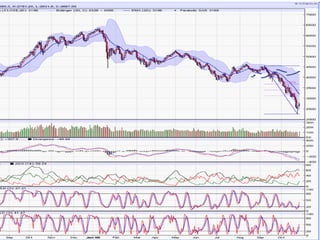
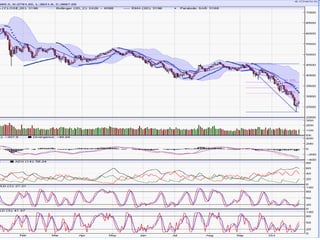
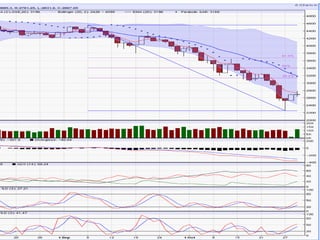
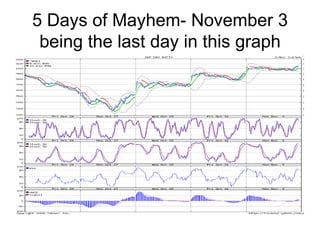
5 Days of Mayhem- November 3 being the last day in this graph
Technical Indicators The principal purpose of most technical indicators is  to determine the trend.  Another purpose of the indicators is to try to  determine when the trend may change , based on watching a combination of volume, price, and other indicators.
Types of Market  Trending or Trading Indicators for Trending Market   1. MA (Moving Average) MACD (Moving Average Convergence Divergence) Indicators for Trading/Consolidating  Market Stochastic RSI (Relative Strength Index)
Moving Averages/EMA A moving average is a composite photograph of the market – it combines prices for several days. The market consists of huge crowds and a moving average identifies the direction of mass movement.
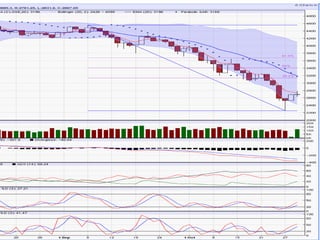
Understanding MA/EMA A rising MA denotes rise in prices and a falling MA denotes a fall in prices. When the Market price is above all MA’s the market is rising and when the Market price is below the MA’s it denotes a fall. MA crossovers denote change in momentum and can be used to exit or enter trades.
 
Rising Market Indicators ADX  rising above 30 Stochastics in the Overbought Zone RSI shifting from a bearish range to bullish phase Formation of a Bull Flag Volume Increasing Breakout from consolidation Making new highs
Stochastics Usage Methodology The overbought zone is above the 70 mark and oversold is below the 30 mark. In an uptrend b est Buy Signals are generated when the Stochastics is in an oversold zone and in a downtrend the best Sell signals are when Stochastics is in an overbought zone.    Warning –It is an Oscillator and not a trending indicator. ALWAYS USE A CONFLUENCE OF APPROPRIATE INDICATORS
Clarification Objective of this presentation is not to present trading strategies hence we do not discuss Oscillators and usage in further detail. For similar reason we do not discuss options and trading in options. Please understand basics first. Day Trading is full of pits and falls –Please avoid it. Swing Trades can be equally dangerous unless you are a professional Trader.
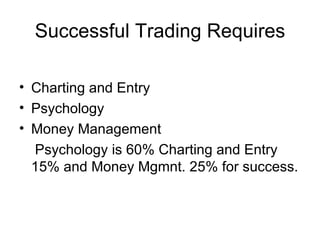
Successful Trading Requires Charting and Entry Psychology Money Management Psychology is 60% Charting and Entry 15% and Money Mgmnt. 25% for success.
Objective of Investment Mangement Protect Capital & Protect Capital & Protect Capital Important web sites. http://www.icharts.in/charts-beta.html http://in.finance.yahoo.com/q/ta?s=^NSEI&t=1d&l=on&z=l&q=l&p=e5,e20,p,b&a=fs,ss,r14,m26-12-9&c = http://in.finance.yahoo.com/regional/asia http://in.finance.yahoo.com/regional/europe http://finance.yahoo.com/indices?e=dow_jones http://in.biz.yahoo.com/international/news_reuters.html http://www.moneycontrol.com/ http://finance.yahoo.com/q/ta?s=^DJA&t=1y&l=on&z=m&q=l&p=e20,b,p&a=ss,w14&c = http://nseindia.com/
Thank You.

Investor Education

  • 1.
    Investor Education Part- Technical Analysis Presentation by CA RAJESH RAMPAL
  • 2.
    “ Are tradersborn or made? There is no simple answer. Both aptitude and learning are important, but in different proportions for different people. At one extreme are born geniuses who require very little learning. At the other are gamblers and dunces, whom no classes are likely to help. The rest of us are in the middle of the curve, with some aptitude but in need of education…” - Dr. Alexander Elder Investor Education Part - Technical Analysis
  • 3.
    Technical Analysis Methodof evaluating securities by analyzing statistics generated by market activity, mainly price and volume. - The first objective of the Analyst is to ascertain the direction of the trend. - The second objective is to monitor the trend on a continuous basis till analysis leads him to conclude that the trend has reversed direction.
  • 4.
    Assumption in TechnicalAnalysis The market discounts everything The market moves in trend History repeats itself ------------------------------------------------- Technical Analysis can fail at times hence cannot be followed blindly. Technical analysis works best when there is confluence of indicators and patterns
  • 5.
    Two types ofPrice Charts Bar Chart Japanese Candlestick Chart
  • 6.
    Bar Chart AMATEURSPROFESSIONALS
  • 7.
    Candlestick Chart Easyto understand. Oriental Japanese Wisdom. Earlier indications of market turns Enhances Western charting analysis Depicts intraday market action using one bar
  • 8.
  • 9.
    Trends A trend is a series of rising or declining prices over any length of time. An Uptrend is goes higher over time. A Downtrend seeks lower prices over time. Primary trend - a series of rising or declining prices. Primary Trends can last from one to several years. Secondary trends are intermediate corrective trends to the primary trend. One to three months and retrace one-third to two-thirds of the primary trend. Fibonacci number.Retracements. 0,1,1,2,3,5,8,13,21,34…… Ratios are also same between two successive numbers. 1.62. Minor Trends are short – term movements.
  • 10.
    Rising Trend line. Uptrend is when each successive peak and trough is higher than the ones found earlier. A trend line is drawn and is used for when to sell as it can be an early indication of a trend reversal. A Falling trend line is the opposite movement A flat trend line denotes parallel trend lines
  • 11.
    Interpreting Trendlines Longerthe trend line, the more will be the impact of its breakdown. Flat trend line shows huge selling or buying having taken place at that level. More tested a trend line is, the greater is its significance. Trend lines indicates points for placing stops. Trend line breakdowns should occur with volume.
  • 12.
    Market movement IsMarket Trending or Trading/ Consolidating The ADX , or average directional movement index is the thermometer of the market which determines if the market is trading or trending. It defines the degree of Directional movement and not the direction.
  • 13.
    What is ADX?The directional movement system is a trading system based on the use of ADX that gives timing information based on the strength of the underlying trend. The most important aspect of the ADX and the DI’s is that they keep you in the trend and they work in all time frames.
  • 14.
    How to useADX? Use oscillators or credit spreads to trade these consolidations. If Bearish patterns develop and breakdown, look for ADX to move higher, this time indicating a trending move on the downside ADX declines below 30 is interpreted as a consolidation after a trending move Start booking profits if the ADX makes a top or flattens out ADX at an extremely high level of 45 or above is interpreted as a market in a strong trend with a consolidation expected anytime Use trend following systems MACD, Moving Averages, EMA ADX above 30 is interpreted as a strong trend Use trend following systems MACD, Moving Averages, EMA ADX rising from 15 to 25 from lower levels means the trend is strengthening Indicating the use of oscillators Stochastics fast and slow. ADX less than 20 is interpreted as a weak trend or consolidation
  • 15.
  • 16.
  • 17.
  • 18.
    Candlestick and Volumeanalysis When the price nears a trendline many questions arise. Will price break out or break down at the trendline? Will there be a false breakout? Will the trendline prove to be formidable resistance to overcome, or will it provide support? Candlesticks may provide an answer.
  • 19.
    Some Candlestick PatternsA hammer occurs after a scrip has been declining suggesting the market is trying to find the bottom. It is an indicator that the bulls are strengthening.
  • 20.
    Some Candlestick PatternsIs an early sign that the momentum is decreasing and the direction of the uptrend may be about to change. Hanging man formations can be more easily identified in intraday charts than daily charts.
  • 21.
    Some Candlestick PatternsThe morning star is a bullish reversal pattern. Ideal morning stars have gaps before and after the middle day's body.
  • 22.
    Some Candlestick PatternsEvening star is a bearish reversal pattern. It occurs after an uptrend and should have gaps before and after the middle day's body.
  • 23.
    Some Candlestick PatternsThe shooting star indicates an end to the up move. The body of the shooting star does gap up over the previous day.
  • 24.
    Some Candlestick PatternsThe dark cloud is a bearish reversal pattern. This pattern occurs only in an uptrend. The first day is a long white body; the second day is a bearish black body.
  • 25.
    Some Candlestick PatternsDoji is considered to be a neutral candlestick and it indicates indecision. The Doji candle indicates the clashing of the heads between the bulls and the bear. It represents a situation in which the bulls and the bears are both trying to force the market but neither is winning.
  • 26.
    Some Candlestick PatternsIf one finds a long white candlestick during an up move or in an overbought condition and if this white candle is followed by a Doji then the possibility of a trend reversal is quite high. A Doji occurring at lower levels during down move or in an oversold condition indicates the possibility of a bottom in the making. Doji signifies the matching of the powers of the bulls and bears and it is well known that for the market to move upwards, forceful follow- up by the bulls is necessary.
  • 27.
    Volume Analysis Volumeoften leads price, which offers an advance warning of a potential price trend reversal Main trend is in the price with high volume If prices increase and volume decreases – it implies a corrective move If prices decrease and volume decreases – it implies a corrective move If prices increase and volume increases – it implies a uptrend
  • 28.
    Some other chartpatterns Trend reversal and continuation patterns Head and shoulders and Inverse Double Top/ Double bottom
  • 29.
    Head and ShouldersIt is a technical analysis term used to describe a chart formation in which a stock's price: 1. Rises to a peak and subsequently declines. 2. Then, the price rises above the former peak and again declines. 3. And finally, rises again, but not to the second peak, and declines once more.
  • 30.
    Inverse head andShoulders Pattern The inverse head and shoulder pattern is a mirror image of the top head and shoulder pattern. In this pattern there are three distinct bottoms and a neckline. The pattern is said to be complete, as and when the scrip closes above the neckline. Similarly Double Top, Double bottom, Triple Top Triple Bottom, Triangles, Wedges, Rectangles, Pennant,Flag etc.
  • 31.
    Double Top, DoubleBottom Triple Top & Bottom Two consecutive peaks that are roughly equal, with a moderate trough in between. Like an M. The twice touched high is considered a resistance level. Double top marks at least an intermediate change, if not long-term change, in trend from bullish to bearish. .
  • 32.
    5 Days ofMayhem- November 3 being the last day in this graph
  • 33.
    Technical Indicators Theprincipal purpose of most technical indicators is to determine the trend. Another purpose of the indicators is to try to determine when the trend may change , based on watching a combination of volume, price, and other indicators.
  • 34.
    Types of Market Trending or Trading Indicators for Trending Market 1. MA (Moving Average) MACD (Moving Average Convergence Divergence) Indicators for Trading/Consolidating Market Stochastic RSI (Relative Strength Index)
  • 35.
    Moving Averages/EMA Amoving average is a composite photograph of the market – it combines prices for several days. The market consists of huge crowds and a moving average identifies the direction of mass movement.
  • 36.
    Understanding MA/EMA Arising MA denotes rise in prices and a falling MA denotes a fall in prices. When the Market price is above all MA’s the market is rising and when the Market price is below the MA’s it denotes a fall. MA crossovers denote change in momentum and can be used to exit or enter trades.
  • 37.
  • 38.
    Rising Market IndicatorsADX rising above 30 Stochastics in the Overbought Zone RSI shifting from a bearish range to bullish phase Formation of a Bull Flag Volume Increasing Breakout from consolidation Making new highs
  • 39.
    Stochastics Usage MethodologyThe overbought zone is above the 70 mark and oversold is below the 30 mark. In an uptrend b est Buy Signals are generated when the Stochastics is in an oversold zone and in a downtrend the best Sell signals are when Stochastics is in an overbought zone.   Warning –It is an Oscillator and not a trending indicator. ALWAYS USE A CONFLUENCE OF APPROPRIATE INDICATORS
  • 40.
    Clarification Objective ofthis presentation is not to present trading strategies hence we do not discuss Oscillators and usage in further detail. For similar reason we do not discuss options and trading in options. Please understand basics first. Day Trading is full of pits and falls –Please avoid it. Swing Trades can be equally dangerous unless you are a professional Trader.
  • 41.
    Successful Trading RequiresCharting and Entry Psychology Money Management Psychology is 60% Charting and Entry 15% and Money Mgmnt. 25% for success.
  • 42.
    Objective of InvestmentMangement Protect Capital & Protect Capital & Protect Capital Important web sites. http://www.icharts.in/charts-beta.html http://in.finance.yahoo.com/q/ta?s=^NSEI&t=1d&l=on&z=l&q=l&p=e5,e20,p,b&a=fs,ss,r14,m26-12-9&c = http://in.finance.yahoo.com/regional/asia http://in.finance.yahoo.com/regional/europe http://finance.yahoo.com/indices?e=dow_jones http://in.biz.yahoo.com/international/news_reuters.html http://www.moneycontrol.com/ http://finance.yahoo.com/q/ta?s=^DJA&t=1y&l=on&z=m&q=l&p=e20,b,p&a=ss,w14&c = http://nseindia.com/
  • 43.