Technical Analysis Created  By:- Pandya Ashish  Tejani Mahesh
Agenda Introduction Basic Assumptions Dow Theory Elliot Wave Theory Trend Support & Resistance Volume Chart Mathematical Indicators Conclusion
Introduction  It is the one type of approach for Security Analysis. Technicians (also known as quantitative analysts or chartists) usually look at price, volume and psychological indicators over time. They are looking for trends and patterns in the data that indicate future price movements.
Technical analysis is the attempt to forecast stock prices on the basis of market-derived data.( i.e. Demand and Supply). What Is Technical Analysis?   Technical analysis is a method of evaluating securities by analyzing the statistics generated by market activity, such as past prices and  volume . Technical analysts do not attempt to measure a security's  intrinsic value , but instead use charts and other tools to identify  patterns  that can suggest future activity  Introduction
Basic Assumption The Market Discount Everything. Price Moves In Trends. History tends to repeat itself
Basic Technical Tools Trend Lines Moving Averages Price Patterns Indicators Cycles
Dow Theory This theory was first stated by Charles Dow in a series of columns in the WSJ between 1900 and 1902. Dow (and later Hamilton and Rhea) believed that market trends forecast trends in the economy. A change in the trend of the DJIA must be confirmed by a trend change in the DJTA in order to generate a valid signal.
Dow Theory Trends (1) Primary Trend Called “the tide” by Dow, this is the trend that defines the long-term direction (up to several years).  Others have called this a “secular” bull or bear market. Secondary Trend Called “the waves” by Dow, this is shorter-term departures from the primary trend (weeks to months) Day to day fluctuations Not significant in Dow Theory
Dow Theory Trends (2)
Does Dow Theory Work? According to Martin Pring, if you had invested $44 in 1897 and followed all buy and sell signals, by 1981 you would have accumulated about $18,000. If you had simply invested $44 and held that portfolio, by 1981 you would have accumulated about $960.
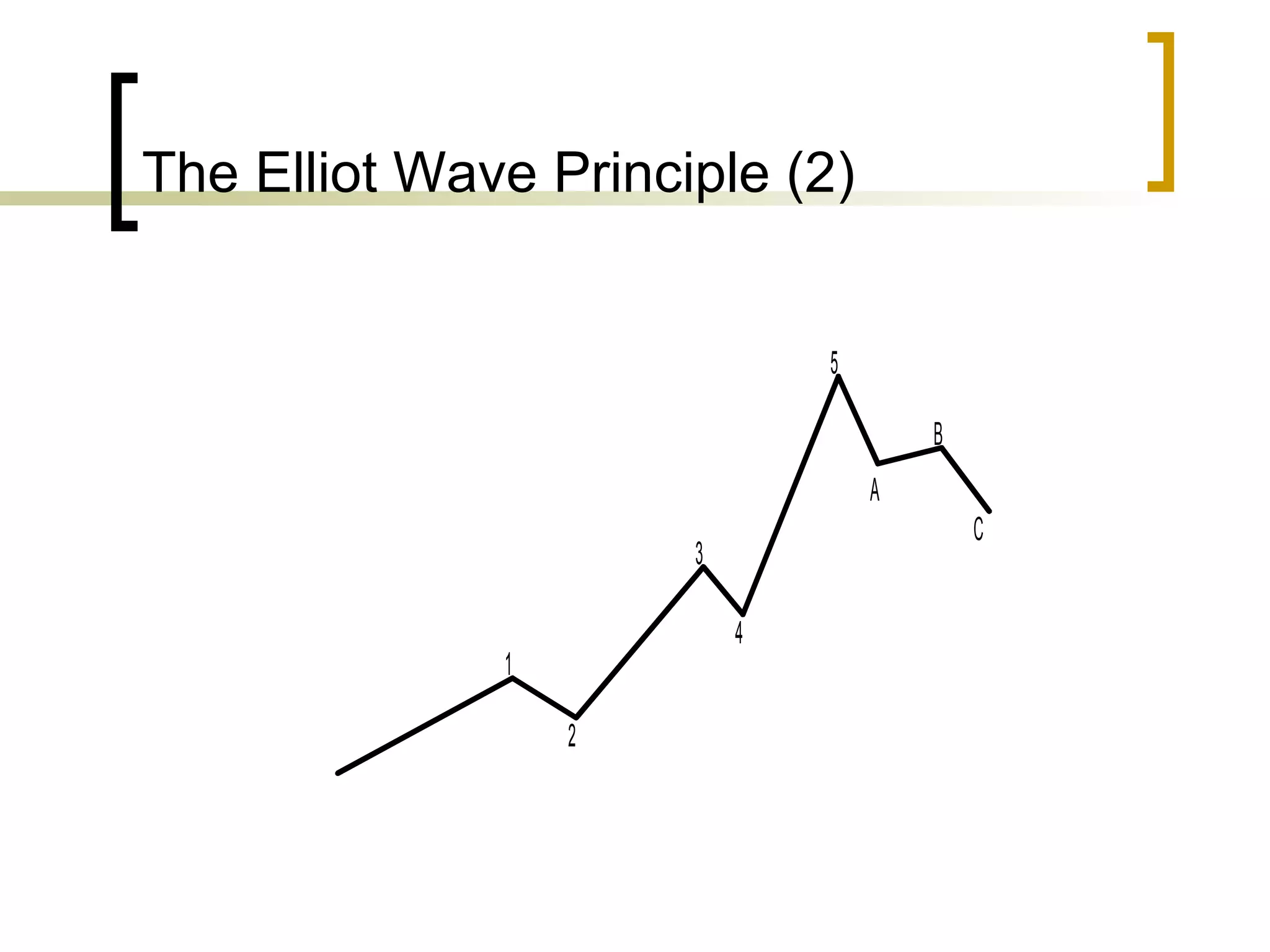
Elliot Wave Principle (1) R.N. Elliot formulated this idea in a series of articles in Financial World in 1939. Elliot believed that the market has a rhythmic regularity that can be used to predict future prices. The Elliot Wave Principle is based on a repeating 8-wave cycle, and each cycle is made up of similar shorter-term cycles (“Big fleas have little fleas upon their backs to bite 'em - little fleas have smaller fleas and so on ad infinitem”). Elliot Wave adherents also make extensive use of the Fibonacci series.
The Elliot Wave Principle (2)
Does Elliot Wave Work? Who knows?  One of the biggest problems with Elliot Wave is that no two practitioners seem to agree on the wave count, and therefore on the prediction of what’s to come. Robert Prechter (the most famous EW practitioner) made several astoundingly correct predictions in the 1980’s, but hasn’t been so prescient since (he no longer gets much press attention). For example, in 1985 he predicted that the market would peak in 1987 (correct), but he thought it would peak at 3686 (± 100 points). The DJIA actually peaked on 25 August 1987 at 2722.42, more than 960 points lower.
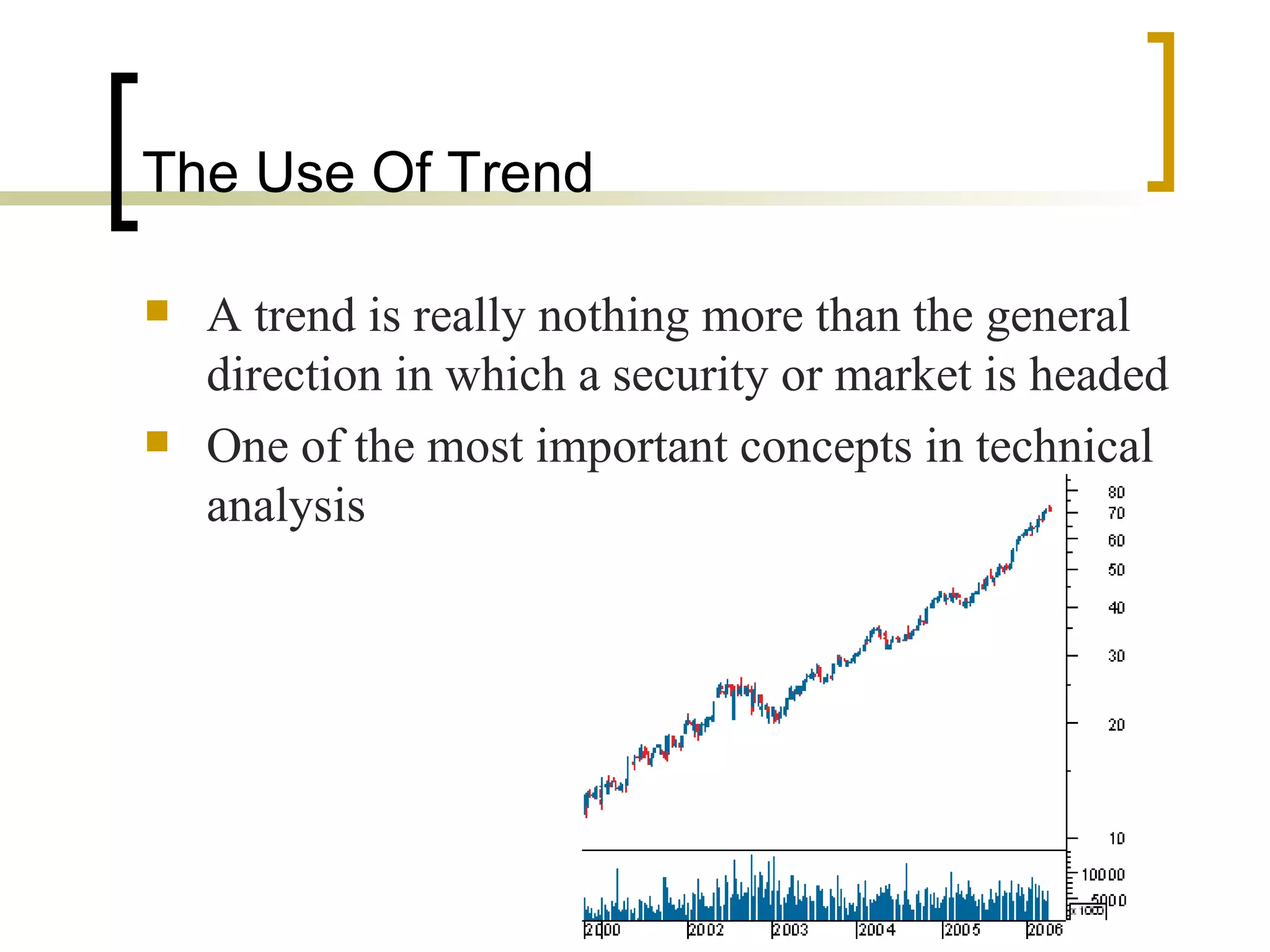
The Use Of Trend  A trend is really nothing more than the general direction in which a security or market is headed  One of the most important concepts in technical analysis
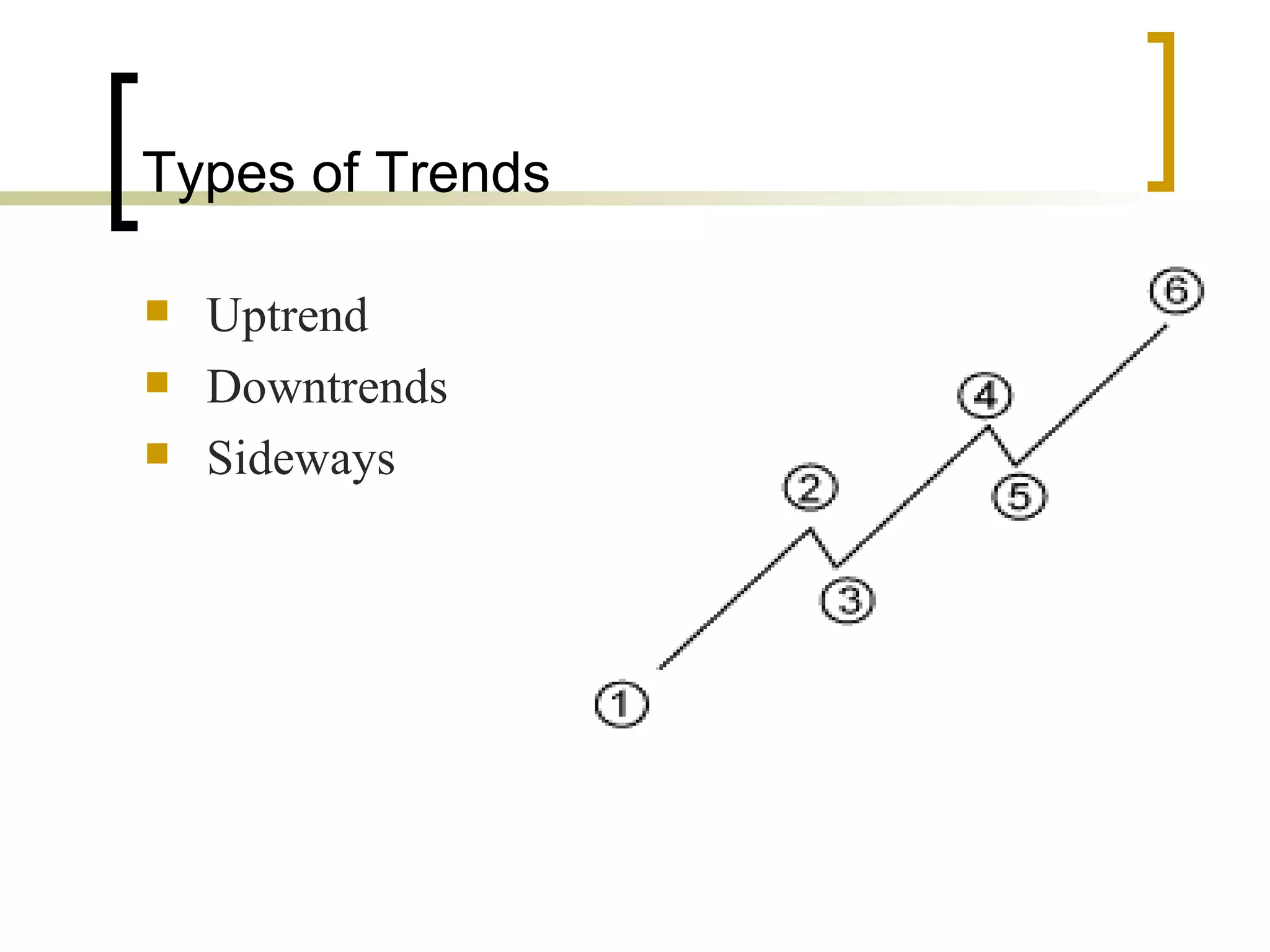
Types of Trends Uptrend  Downtrends  Sideways
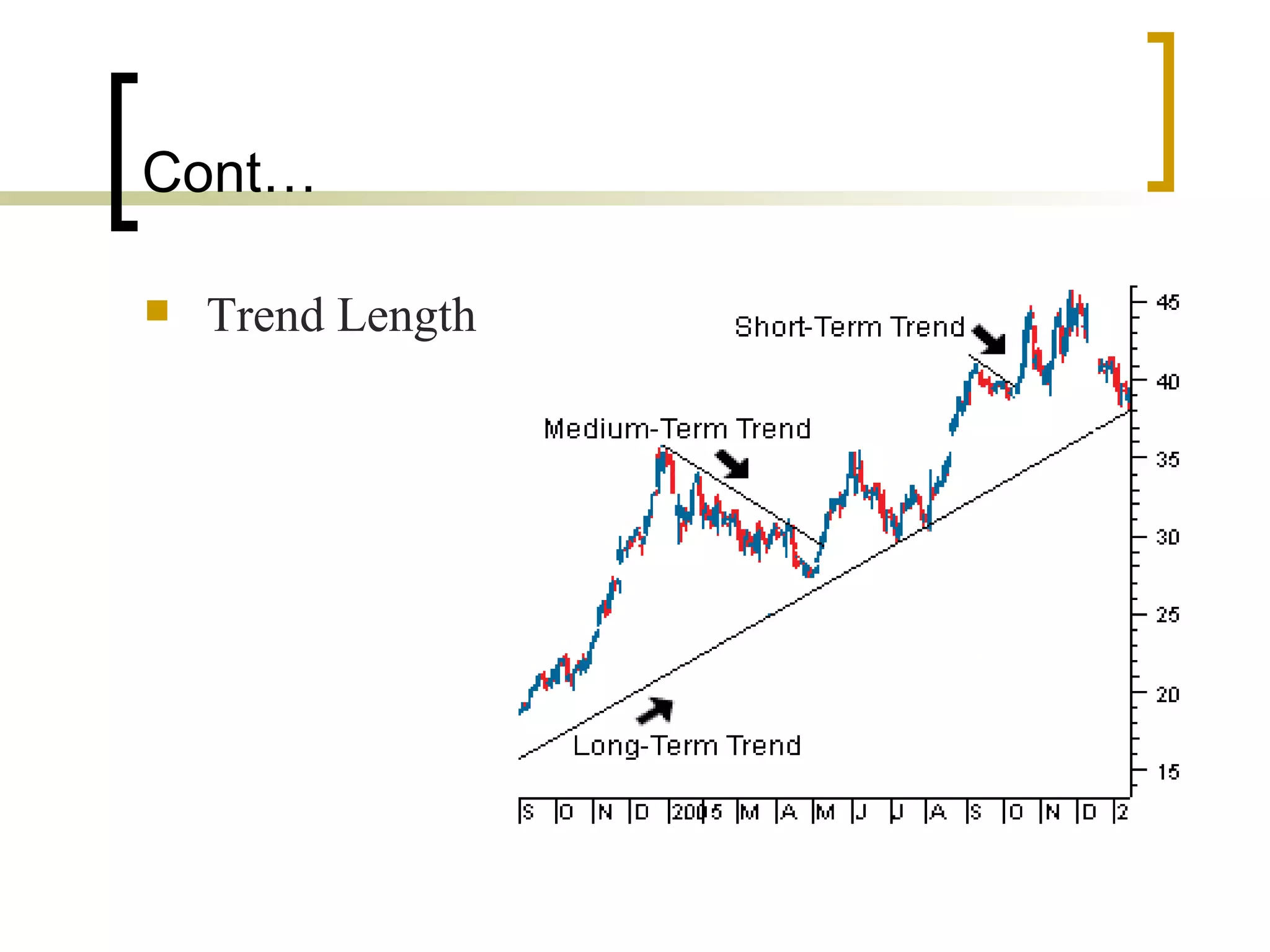
Cont… Trend Length
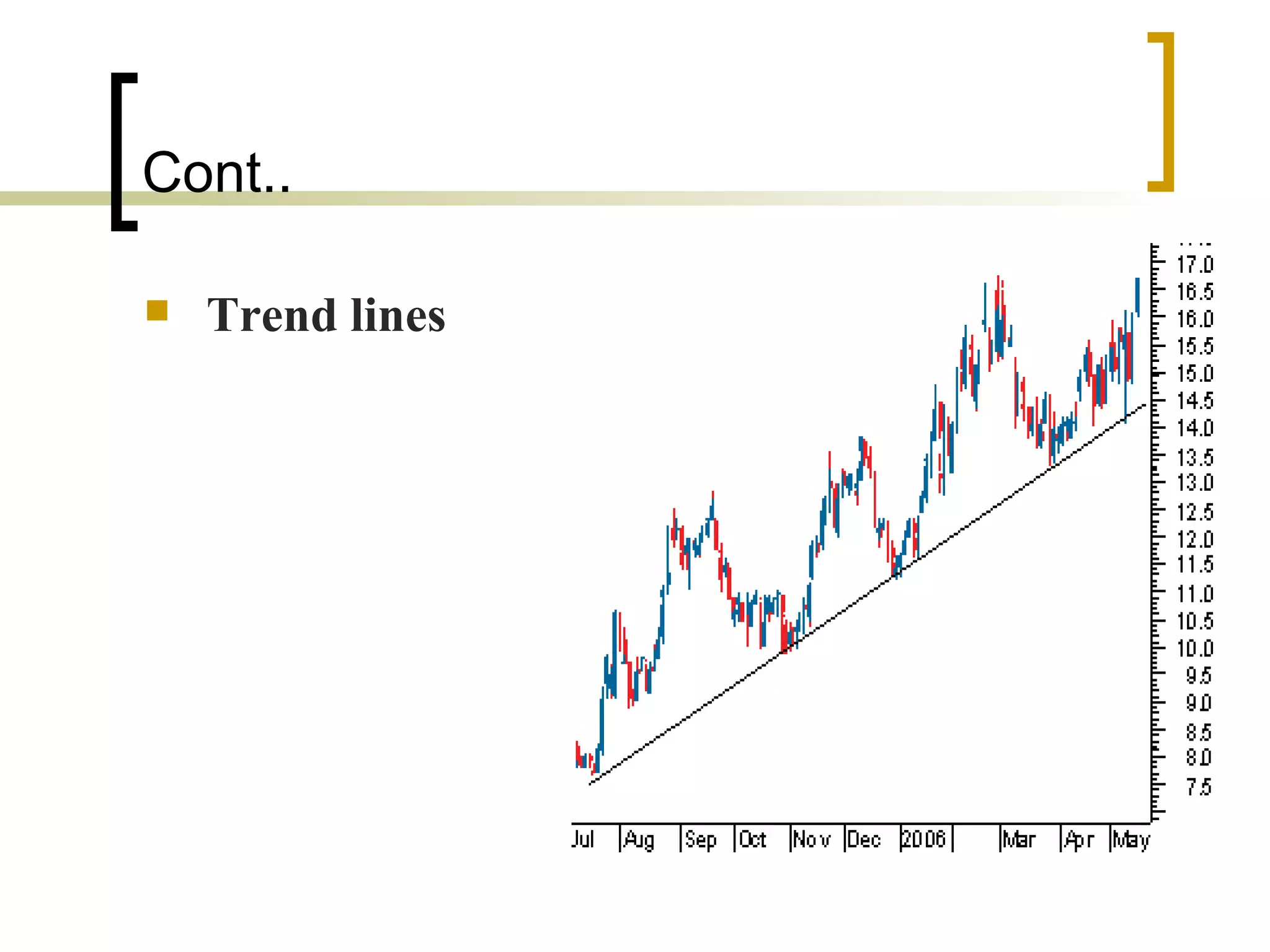
Cont.. Trend lines
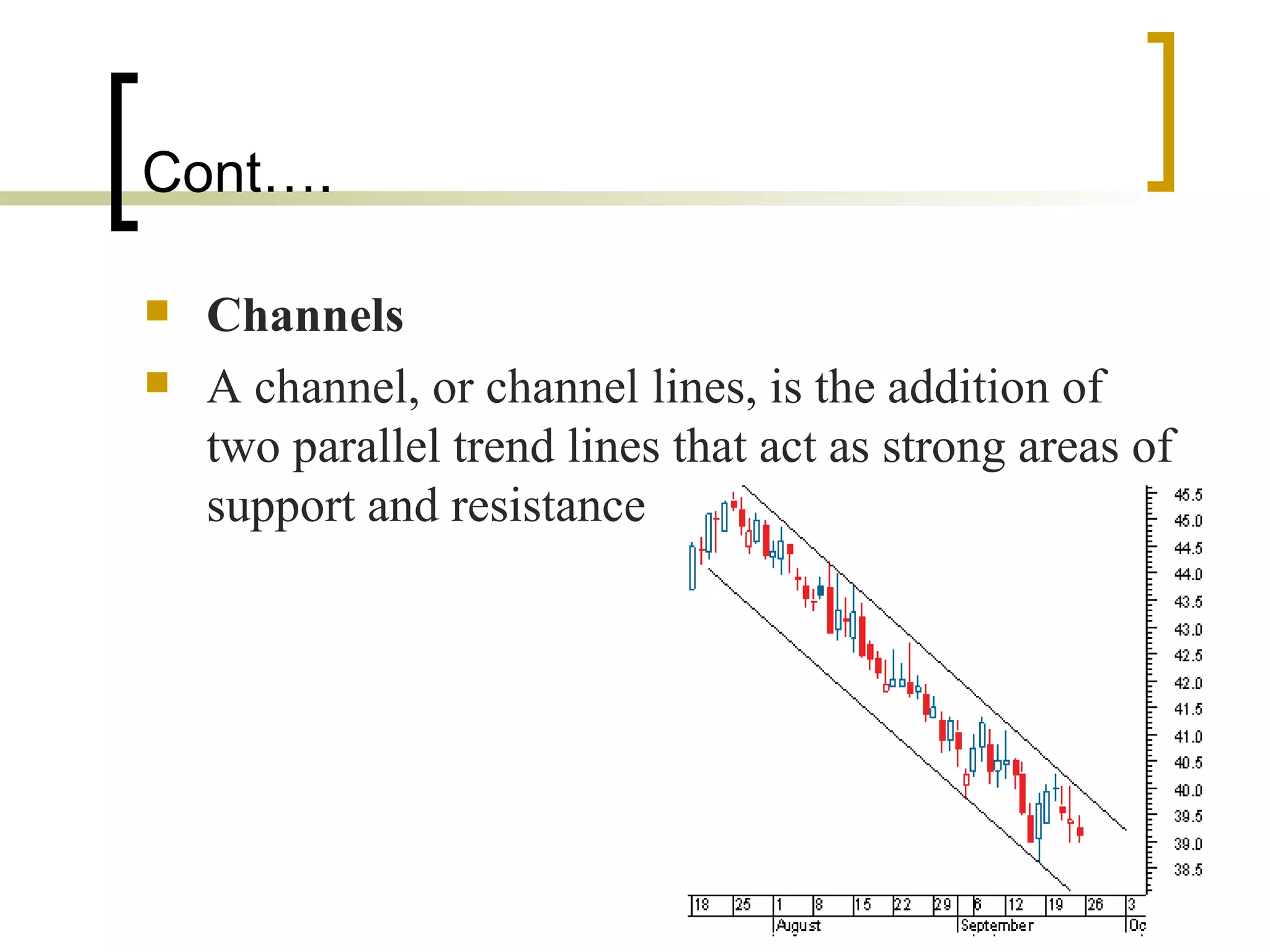
Cont…. Channels   A channel, or channel lines, is the addition of two parallel trend lines that act as strong areas of support and resistance
The Importance of Trend   Two important sayings in technical analysis  1. "the trend is your friend"  2. "don't buck the trend."
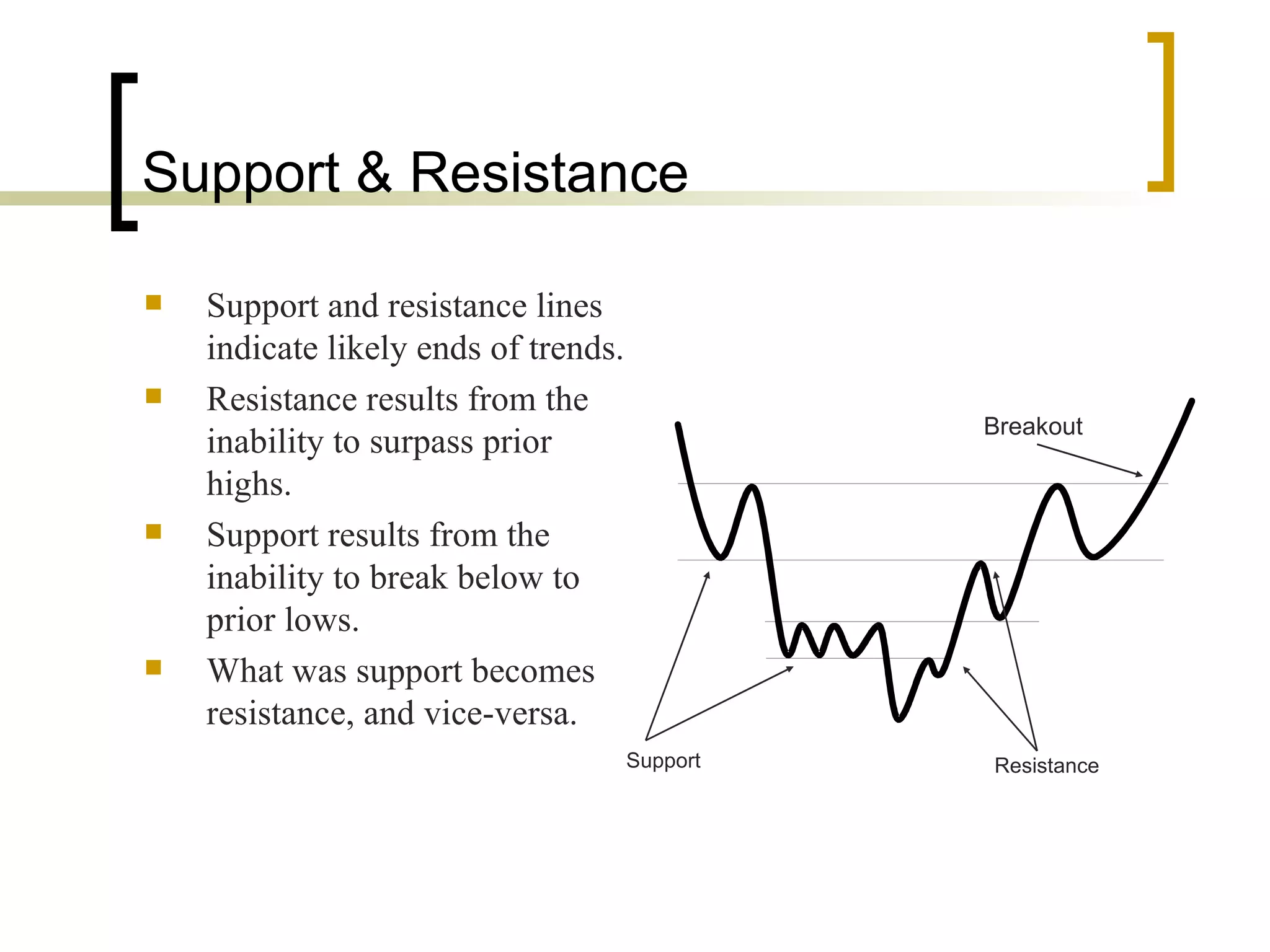
Support & Resistance Support and resistance lines indicate likely ends of trends. Resistance results from the inability to surpass prior highs. Support results from the inability to break below to prior lows. What was support becomes resistance, and vice-versa. Support Resistance Breakout
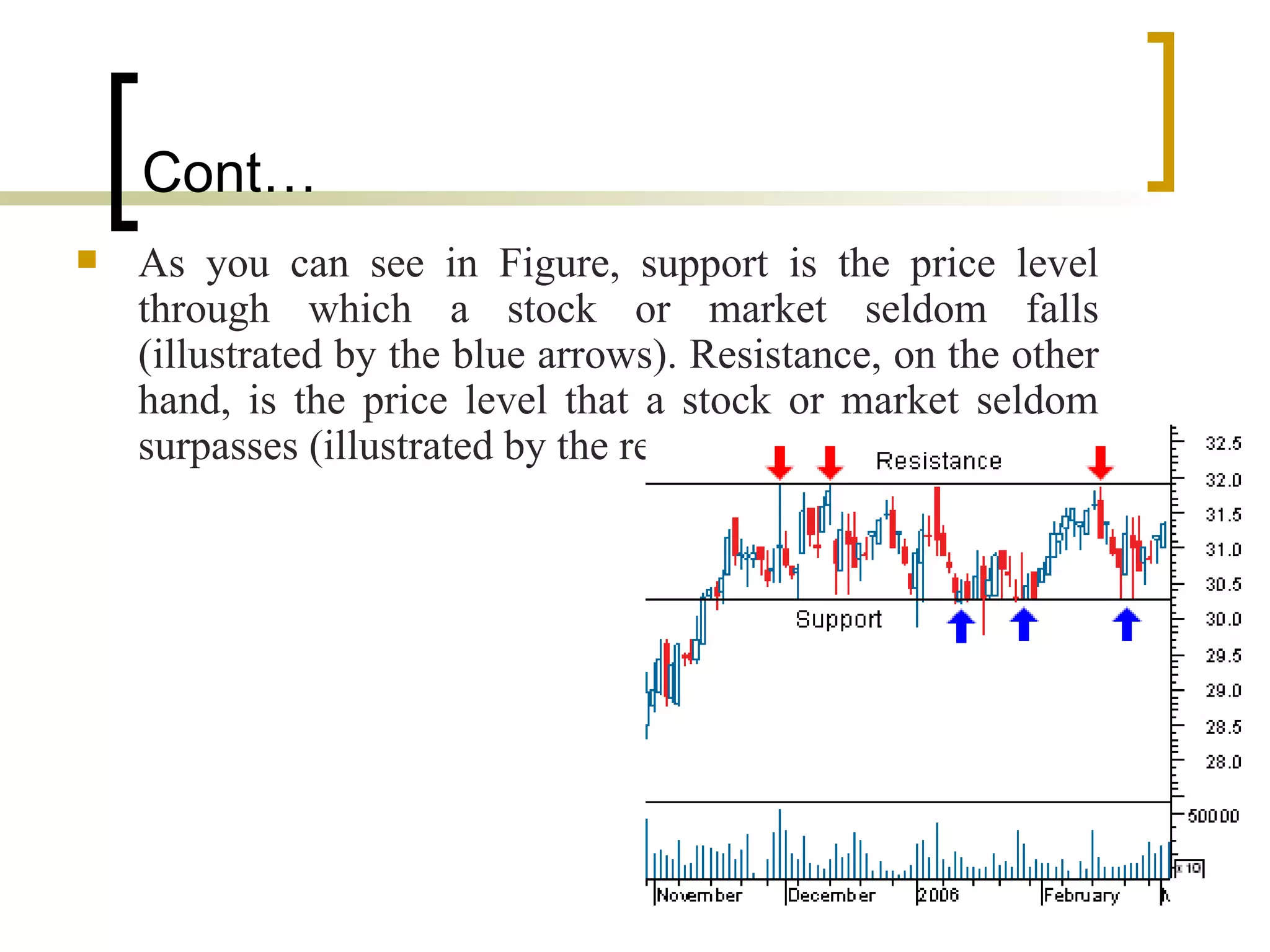
Cont…  As you can see in Figure, support is the price level through which a stock or market seldom falls (illustrated by the blue arrows). Resistance, on the other hand, is the price level that a stock or market seldom surpasses (illustrated by the red arrows).
Cont..  Why Does it Happen?   These support and resistance levels are seen as important in terms of market psychology and supply and demand. Support and resistance levels are the levels at which a lot of traders are willing to buy the stock (in the case of a support) or sell it (in the case of resistance).
Cont.. Round Numbers and Support and Resistance Round numbers like 10, 20, 35, 50, 100 and 1,000 tend be important in support and resistance levels because they often represent the major psychological turning points at which many traders will make buy or sell decisions.  Importance of Support and Resistance
Volume  What is Volume?   Volume is simply the number of shares or contracts that trade over a given period of time, usually a day. The higher the volume, the more active the security.  Why Volume is Important   ? 1. It is used to confirm trends and chart patterns. 2.Movement influences by higher and lower  volumes.
Volume in Chart
What Is A Chart ?  A chart is simply a graphical representation of a series of prices over a set time frame. For example, a chart may show a stock's price movement over a one-year period, where each point on the graph represents the closing price for each day the stock is traded
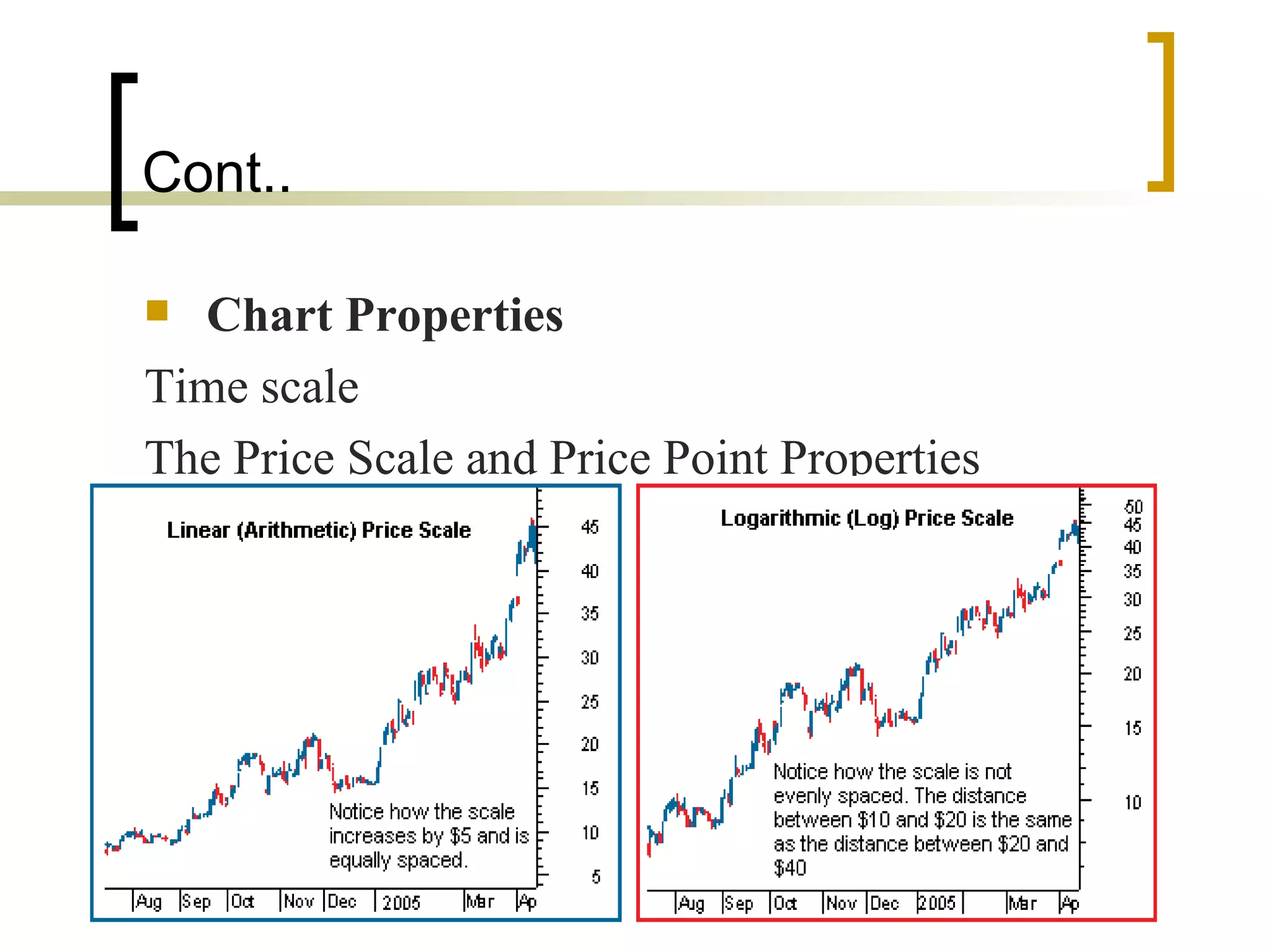
Cont.. Chart Properties   Time scale The Price Scale and Price Point Properties
Types of Charts There are four main types of charts that are used by investors and traders depending on the information that they are seeking and their individual skill levels  1.The Line Chart 2.The Bar Chart 3.The Candlestick Chart  4. The Point and Figure Chart
Line Chart It represents only the closing prices over a set period of time
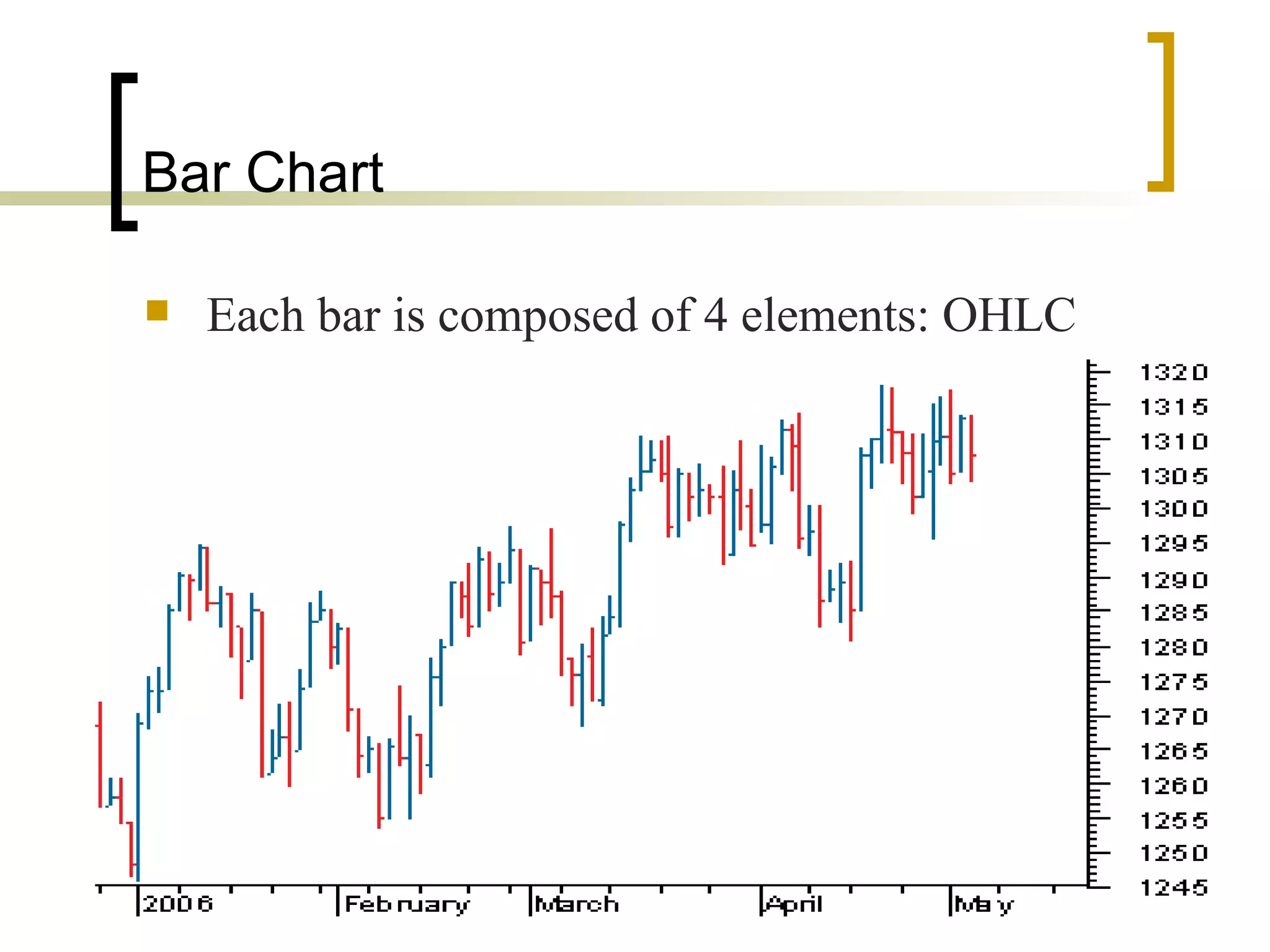
Bar Chart Each bar is composed of 4 elements: OHLC
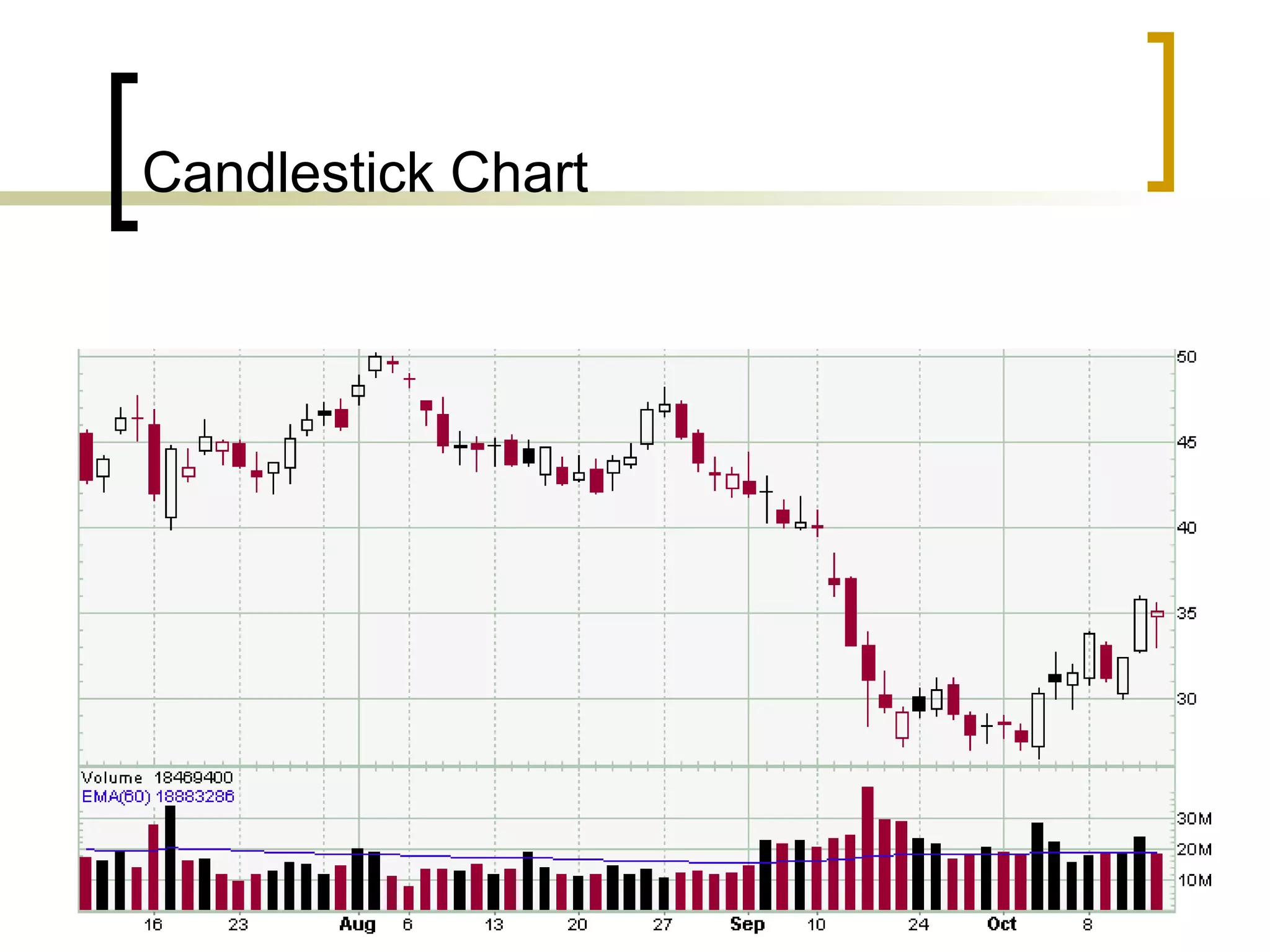
Candlestick Chart
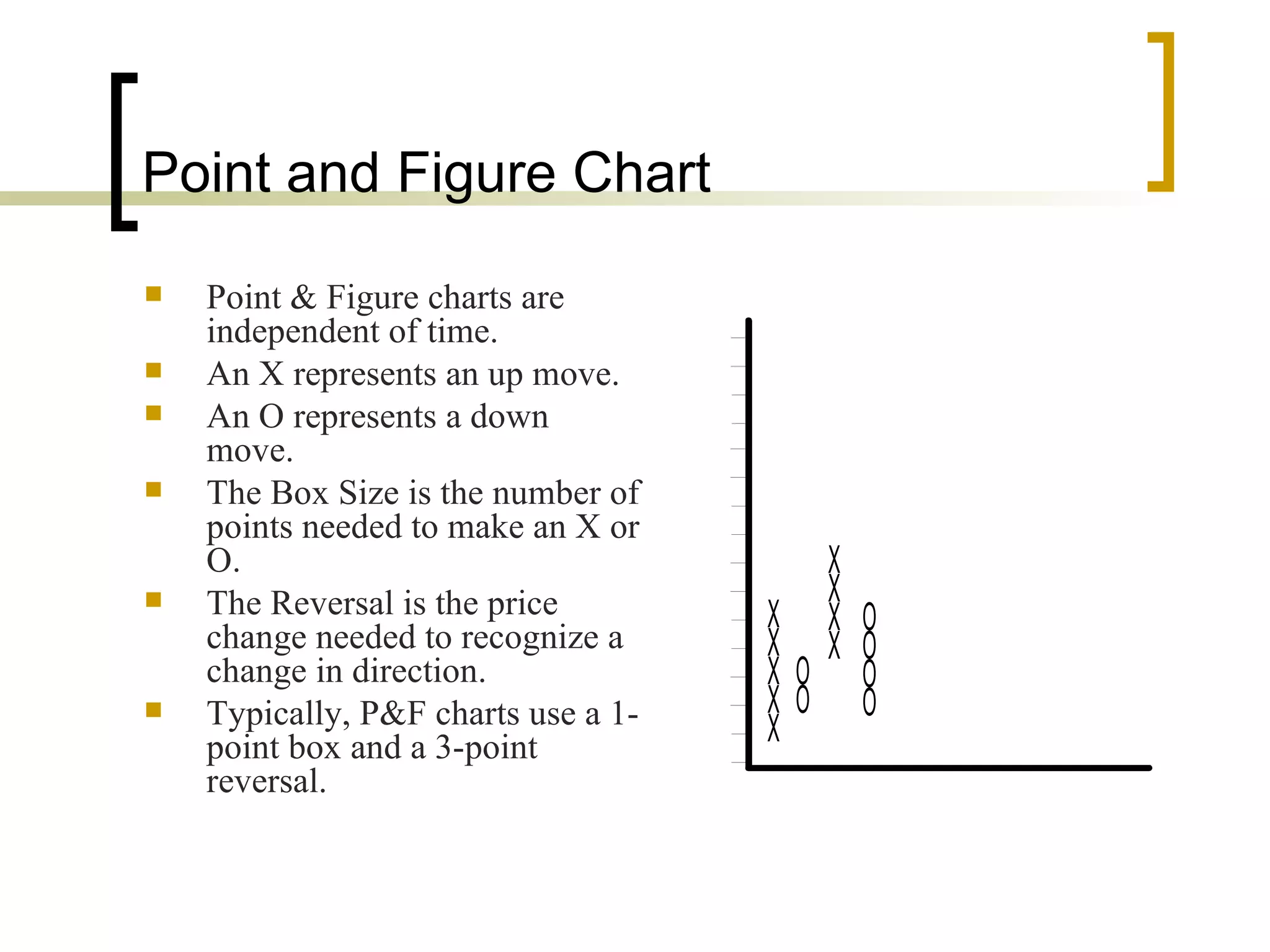
Point and Figure Chart Point & Figure charts are independent of time. An X represents an up move. An O represents a down move. The Box Size is the number of points needed to make an X or O. The Reversal is the price change needed to recognize a change in direction. Typically, P&F charts use a 1-point box and a 3-point reversal.
Chart Patterns  Head and Shoulders  Cup and Handle  Double Tops and Bottoms  Triangles  Flag and Pennant  Wedge  Triple Tops and Bottoms  Rounding Bottom
Head and Shoulders This formation is characterized by two small peaks on either side of a larger peak. This is a reversal pattern, meaning that it signifies a change in the trend.
Cup and Handle
Double Tops and Bottoms These formations are similar to the H&S formations, but there is no head. These are reversal patterns with the same measuring implications as the H&S.
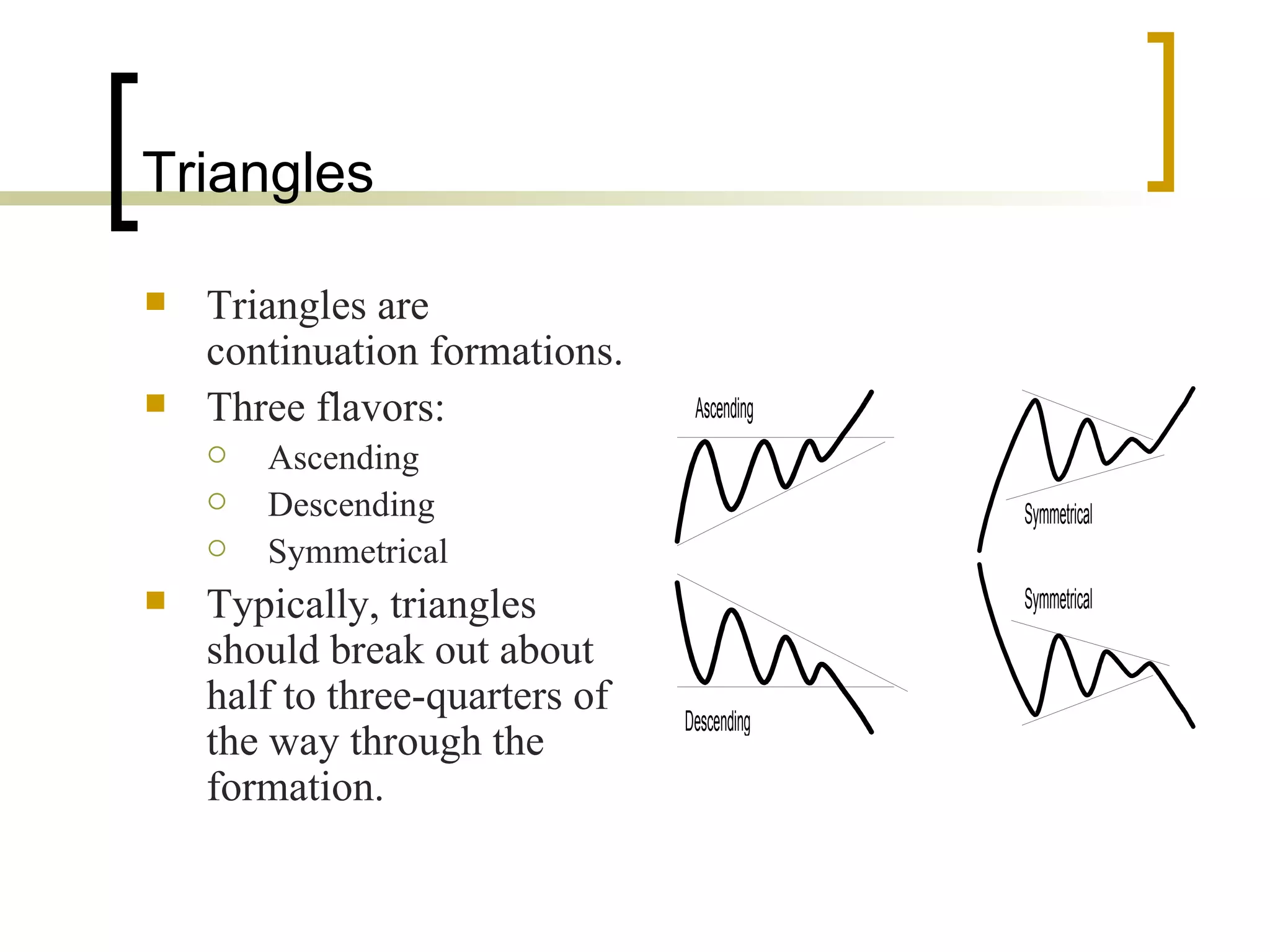
Triangles Triangles are continuation formations. Three flavors: Ascending Descending Symmetrical Typically, triangles should break out about half to three-quarters of the way through the formation.
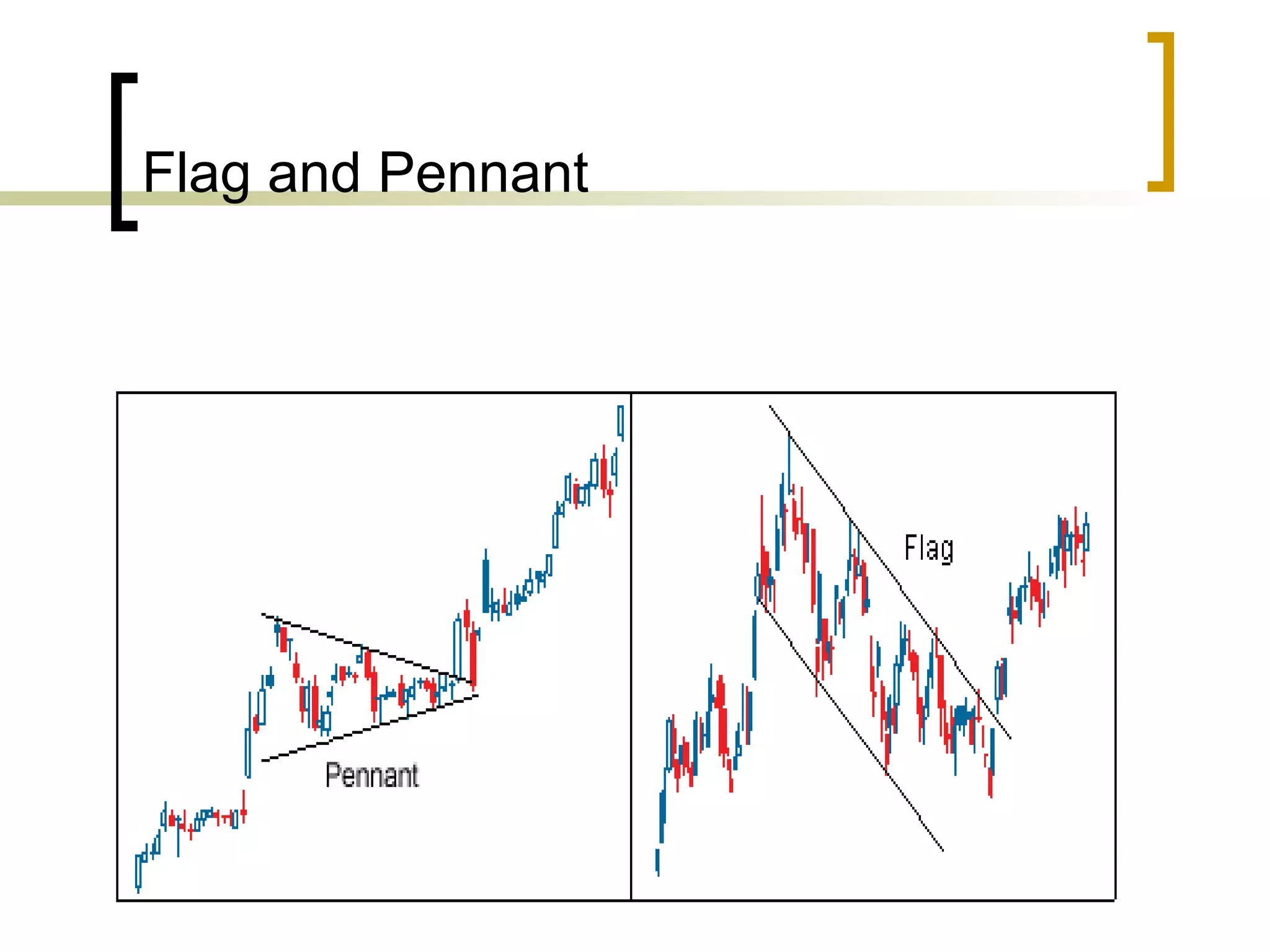
Flag and Pennant
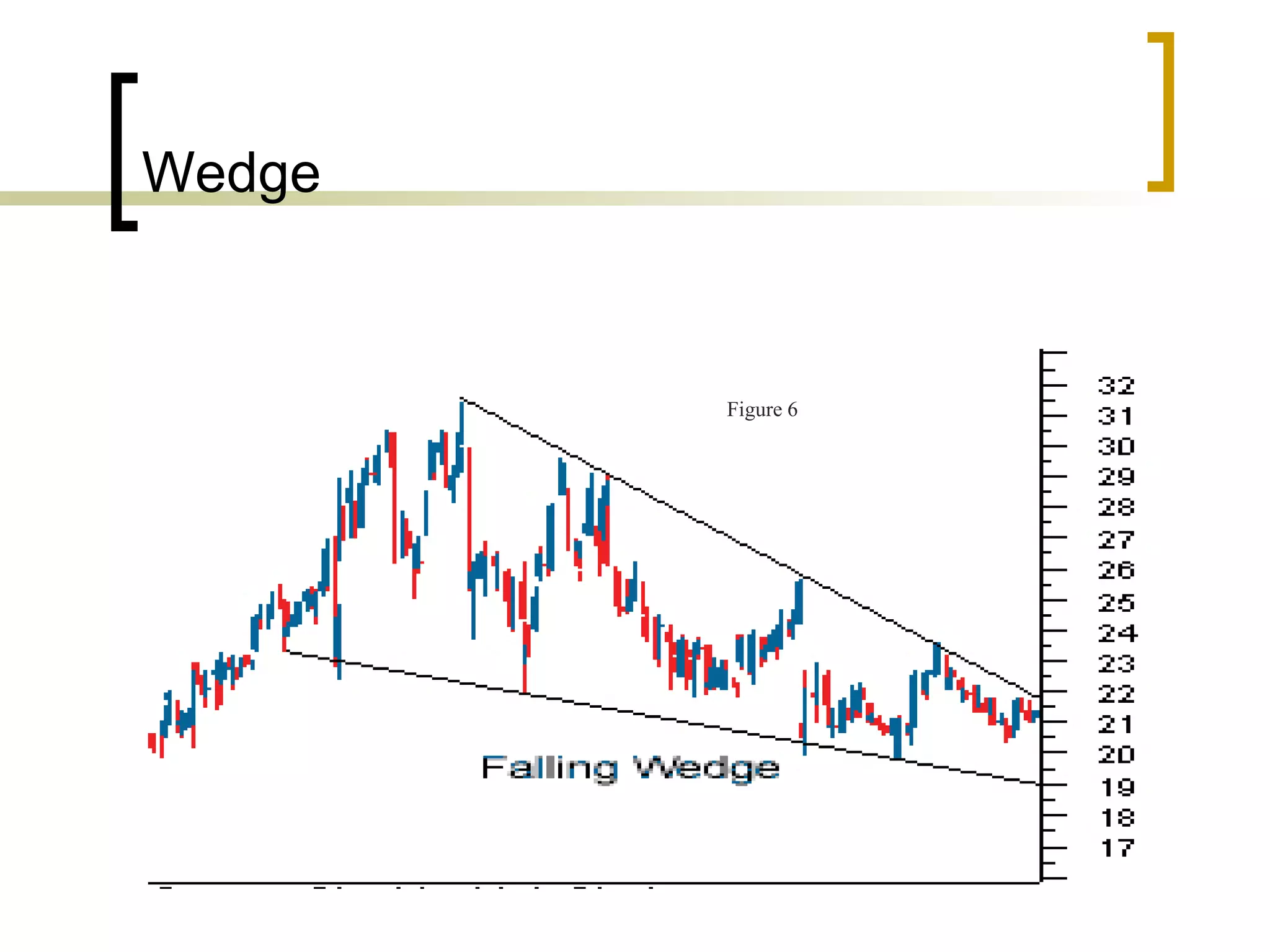
Wedge  Figure 6
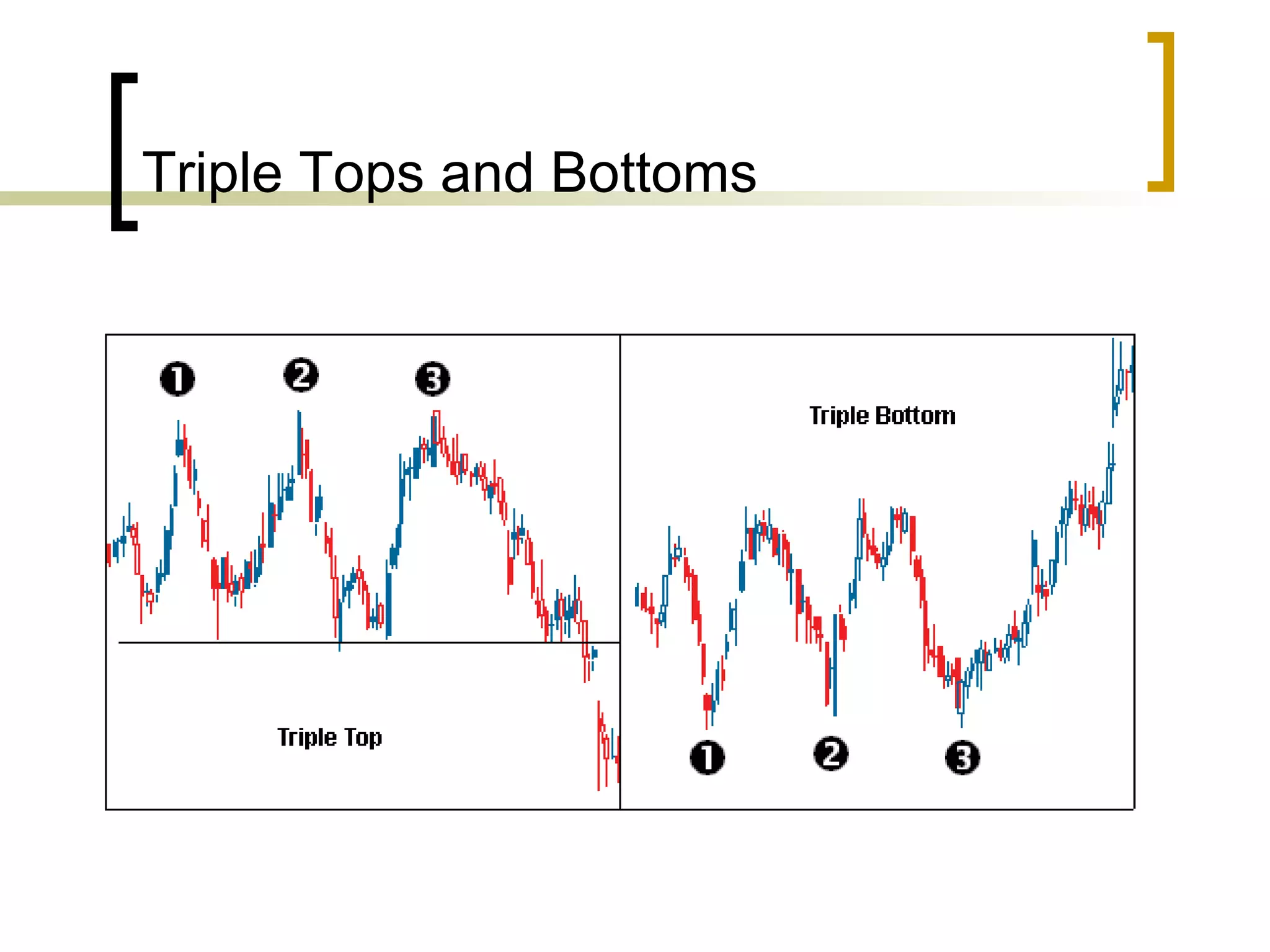
Triple Tops and Bottoms
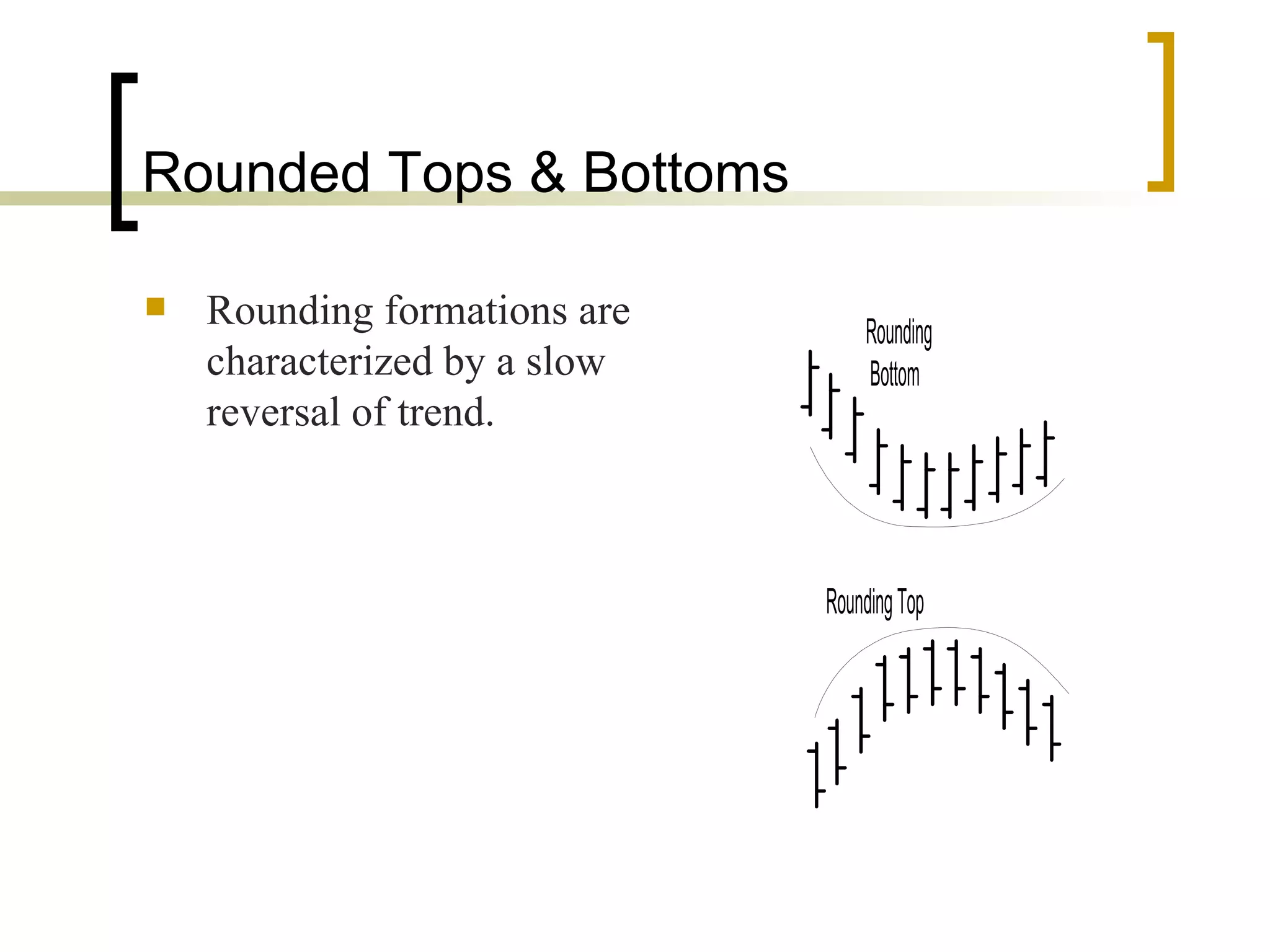
Rounded Tops & Bottoms Rounding formations are characterized by a slow reversal of trend.
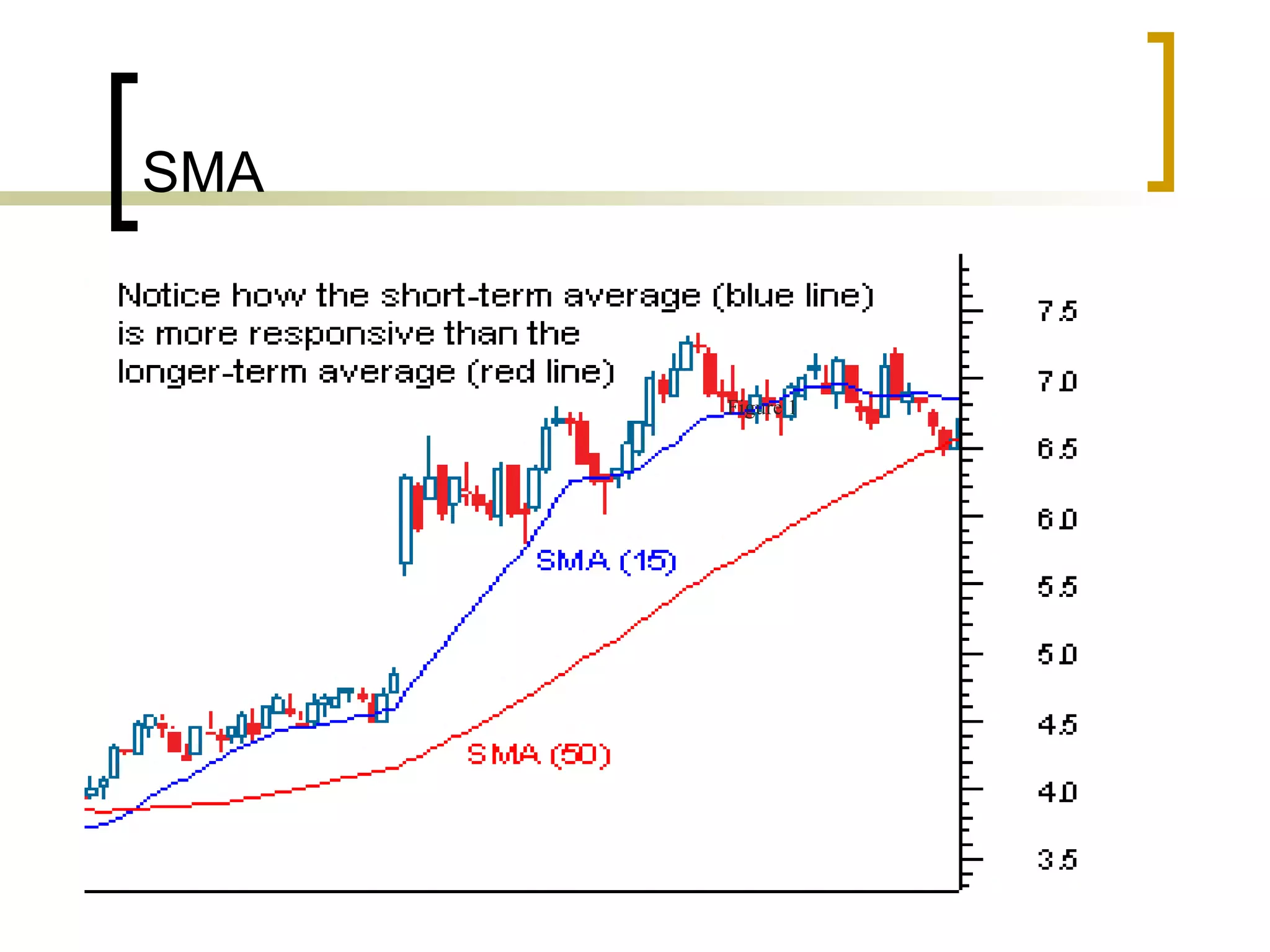
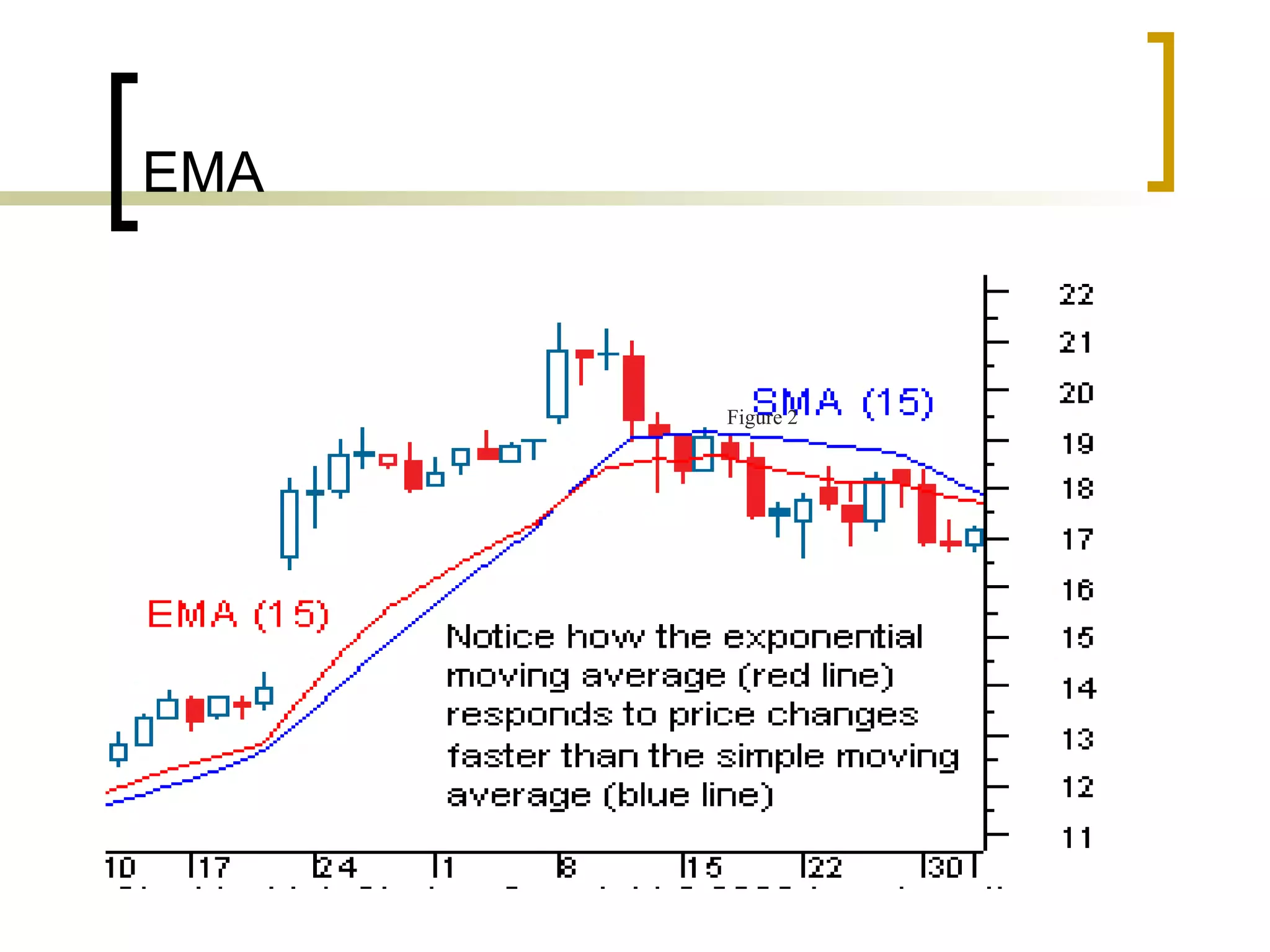
Mathematical Indicators  Moving Average 1. Simple Moving Average (SMA) 2. Linear Weighted Average  3. Exponential Moving Average (EMA)  Oscillators 1.Average Directional Index  2.Moving Average Convergence  3.Relative Strength Index
SMA Figure 1
EMA Figure 2
Average Directional Index The ADX is a combination of two price movement measures: the positive directional indicator (+DI) and the negative directional indicator (-DI).  The ADX measures the strength of a trend but not the direction.
MACD MACD was developed by Gerald Appel as a way to keep track of a moving average crossover system. When this signal line goes from negative to positive, a buy signal is generated. When the signal line goes from positive to negative, a sell signal is generated. MACD is best used in choppy (trendless) markets, and is subject to whipsaws (in and out rapidly with little or no profit). MACD= shorter term moving average - longer term moving average
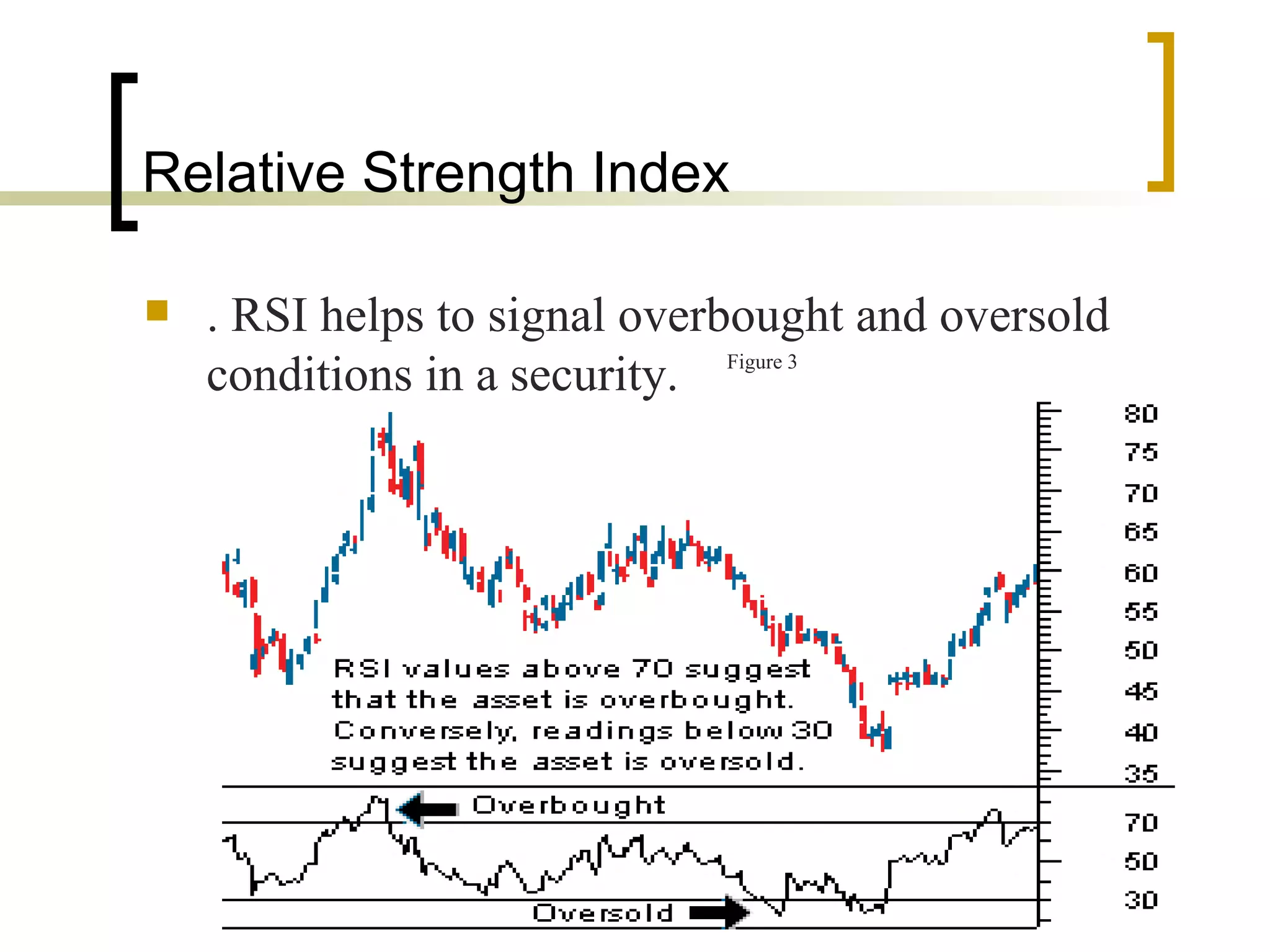
Relative Strength Index . RSI helps to signal overbought and oversold conditions in a security.  Figure 3
Conclusion Technical traders take a short-term approach to analyzing the market  Criticism of technical analysis stems from the efficient market hypothesis, which states that the market price is always the correct one, making any historical analysis useless.  The price scale is on the right-hand side of the chart. It shows a stock's current price and compares it to past data points. It can be either linear or logarithmic. One of the most important concepts in technical analysis is that of a trend, which is the general direction that a security is headed. There are three types of trends: uptrend, downtrends and sideways/horizontal trends.  .
Thank you  for your time As noted, there are literally hundreds of indicators and thousands of trading systems. A whole semester could easily be spent on just a handful of these. To close, just note that there is nothing so crazy that somebody doesn’t use it to trade. For example, many people use astrology, geometry (Gann angles), neural networks, chaos theory, etc. There’s no doubt that each of these (and others) would have made you lots of money at one time or another.  The real question is can they do it consistently? As the carneys used to say, “You pays your money, and you takes your chances.”

Technical Analysis By Pantej

  • 1.
    Technical Analysis Created By:- Pandya Ashish Tejani Mahesh
  • 2.
    Agenda Introduction BasicAssumptions Dow Theory Elliot Wave Theory Trend Support & Resistance Volume Chart Mathematical Indicators Conclusion
  • 3.
    Introduction Itis the one type of approach for Security Analysis. Technicians (also known as quantitative analysts or chartists) usually look at price, volume and psychological indicators over time. They are looking for trends and patterns in the data that indicate future price movements.
  • 4.
    Technical analysis isthe attempt to forecast stock prices on the basis of market-derived data.( i.e. Demand and Supply). What Is Technical Analysis? Technical analysis is a method of evaluating securities by analyzing the statistics generated by market activity, such as past prices and volume . Technical analysts do not attempt to measure a security's intrinsic value , but instead use charts and other tools to identify  patterns that can suggest future activity Introduction
  • 5.
    Basic Assumption TheMarket Discount Everything. Price Moves In Trends. History tends to repeat itself
  • 6.
    Basic Technical ToolsTrend Lines Moving Averages Price Patterns Indicators Cycles
  • 7.
    Dow Theory Thistheory was first stated by Charles Dow in a series of columns in the WSJ between 1900 and 1902. Dow (and later Hamilton and Rhea) believed that market trends forecast trends in the economy. A change in the trend of the DJIA must be confirmed by a trend change in the DJTA in order to generate a valid signal.
  • 8.
    Dow Theory Trends(1) Primary Trend Called “the tide” by Dow, this is the trend that defines the long-term direction (up to several years). Others have called this a “secular” bull or bear market. Secondary Trend Called “the waves” by Dow, this is shorter-term departures from the primary trend (weeks to months) Day to day fluctuations Not significant in Dow Theory
  • 9.
  • 10.
    Does Dow TheoryWork? According to Martin Pring, if you had invested $44 in 1897 and followed all buy and sell signals, by 1981 you would have accumulated about $18,000. If you had simply invested $44 and held that portfolio, by 1981 you would have accumulated about $960.
  • 11.
    Elliot Wave Principle(1) R.N. Elliot formulated this idea in a series of articles in Financial World in 1939. Elliot believed that the market has a rhythmic regularity that can be used to predict future prices. The Elliot Wave Principle is based on a repeating 8-wave cycle, and each cycle is made up of similar shorter-term cycles (“Big fleas have little fleas upon their backs to bite 'em - little fleas have smaller fleas and so on ad infinitem”). Elliot Wave adherents also make extensive use of the Fibonacci series.
  • 12.
    The Elliot WavePrinciple (2)
  • 13.
    Does Elliot WaveWork? Who knows? One of the biggest problems with Elliot Wave is that no two practitioners seem to agree on the wave count, and therefore on the prediction of what’s to come. Robert Prechter (the most famous EW practitioner) made several astoundingly correct predictions in the 1980’s, but hasn’t been so prescient since (he no longer gets much press attention). For example, in 1985 he predicted that the market would peak in 1987 (correct), but he thought it would peak at 3686 (± 100 points). The DJIA actually peaked on 25 August 1987 at 2722.42, more than 960 points lower.
  • 14.
    The Use OfTrend A trend is really nothing more than the general direction in which a security or market is headed One of the most important concepts in technical analysis
  • 15.
    Types of TrendsUptrend Downtrends Sideways
  • 16.
  • 17.
  • 18.
    Cont…. Channels A channel, or channel lines, is the addition of two parallel trend lines that act as strong areas of support and resistance
  • 19.
    The Importance ofTrend Two important sayings in technical analysis 1. "the trend is your friend" 2. "don't buck the trend."
  • 20.
    Support & ResistanceSupport and resistance lines indicate likely ends of trends. Resistance results from the inability to surpass prior highs. Support results from the inability to break below to prior lows. What was support becomes resistance, and vice-versa. Support Resistance Breakout
  • 21.
    Cont… Asyou can see in Figure, support is the price level through which a stock or market seldom falls (illustrated by the blue arrows). Resistance, on the other hand, is the price level that a stock or market seldom surpasses (illustrated by the red arrows).
  • 22.
    Cont.. WhyDoes it Happen? These support and resistance levels are seen as important in terms of market psychology and supply and demand. Support and resistance levels are the levels at which a lot of traders are willing to buy the stock (in the case of a support) or sell it (in the case of resistance).
  • 23.
    Cont.. Round Numbersand Support and Resistance Round numbers like 10, 20, 35, 50, 100 and 1,000 tend be important in support and resistance levels because they often represent the major psychological turning points at which many traders will make buy or sell decisions. Importance of Support and Resistance
  • 24.
    Volume Whatis Volume? Volume is simply the number of shares or contracts that trade over a given period of time, usually a day. The higher the volume, the more active the security. Why Volume is Important ? 1. It is used to confirm trends and chart patterns. 2.Movement influences by higher and lower volumes.
  • 25.
  • 26.
    What Is AChart ? A chart is simply a graphical representation of a series of prices over a set time frame. For example, a chart may show a stock's price movement over a one-year period, where each point on the graph represents the closing price for each day the stock is traded
  • 27.
    Cont.. Chart Properties Time scale The Price Scale and Price Point Properties
  • 28.
    Types of ChartsThere are four main types of charts that are used by investors and traders depending on the information that they are seeking and their individual skill levels 1.The Line Chart 2.The Bar Chart 3.The Candlestick Chart 4. The Point and Figure Chart
  • 29.
    Line Chart Itrepresents only the closing prices over a set period of time
  • 30.
    Bar Chart Eachbar is composed of 4 elements: OHLC
  • 31.
  • 32.
    Point and FigureChart Point & Figure charts are independent of time. An X represents an up move. An O represents a down move. The Box Size is the number of points needed to make an X or O. The Reversal is the price change needed to recognize a change in direction. Typically, P&F charts use a 1-point box and a 3-point reversal.
  • 33.
    Chart Patterns Head and Shoulders Cup and Handle Double Tops and Bottoms Triangles Flag and Pennant Wedge Triple Tops and Bottoms Rounding Bottom
  • 34.
    Head and ShouldersThis formation is characterized by two small peaks on either side of a larger peak. This is a reversal pattern, meaning that it signifies a change in the trend.
  • 35.
  • 36.
    Double Tops andBottoms These formations are similar to the H&S formations, but there is no head. These are reversal patterns with the same measuring implications as the H&S.
  • 37.
    Triangles Triangles arecontinuation formations. Three flavors: Ascending Descending Symmetrical Typically, triangles should break out about half to three-quarters of the way through the formation.
  • 38.
  • 39.
  • 40.
  • 41.
    Rounded Tops &Bottoms Rounding formations are characterized by a slow reversal of trend.
  • 42.
    Mathematical Indicators Moving Average 1. Simple Moving Average (SMA) 2. Linear Weighted Average 3. Exponential Moving Average (EMA) Oscillators 1.Average Directional Index 2.Moving Average Convergence 3.Relative Strength Index
  • 43.
  • 44.
  • 45.
    Average Directional IndexThe ADX is a combination of two price movement measures: the positive directional indicator (+DI) and the negative directional indicator (-DI). The ADX measures the strength of a trend but not the direction.
  • 46.
    MACD MACD wasdeveloped by Gerald Appel as a way to keep track of a moving average crossover system. When this signal line goes from negative to positive, a buy signal is generated. When the signal line goes from positive to negative, a sell signal is generated. MACD is best used in choppy (trendless) markets, and is subject to whipsaws (in and out rapidly with little or no profit). MACD= shorter term moving average - longer term moving average
  • 47.
    Relative Strength Index. RSI helps to signal overbought and oversold conditions in a security. Figure 3
  • 48.
    Conclusion Technical traderstake a short-term approach to analyzing the market Criticism of technical analysis stems from the efficient market hypothesis, which states that the market price is always the correct one, making any historical analysis useless. The price scale is on the right-hand side of the chart. It shows a stock's current price and compares it to past data points. It can be either linear or logarithmic. One of the most important concepts in technical analysis is that of a trend, which is the general direction that a security is headed. There are three types of trends: uptrend, downtrends and sideways/horizontal trends. .
  • 49.
    Thank you for your time As noted, there are literally hundreds of indicators and thousands of trading systems. A whole semester could easily be spent on just a handful of these. To close, just note that there is nothing so crazy that somebody doesn’t use it to trade. For example, many people use astrology, geometry (Gann angles), neural networks, chaos theory, etc. There’s no doubt that each of these (and others) would have made you lots of money at one time or another. The real question is can they do it consistently? As the carneys used to say, “You pays your money, and you takes your chances.”