MEANING OF TECHNICAL
ANALYSIS:
 Technical an analysis is applied to find out
the future direction of the market by
analyzing the past and current price as
well as volume movements.
Market activity
Past Prices
Volume
ASSUMTION OF TECHNICAL
ANALYSIS:
 The Market Discounts Everything
 Price Moves in Trends
 History Tends to Repeat Itself
Fundamental
Analysis
Technical
Analysis
It is based on the
information regarding
the Economy, Industry
and Company.
It is based on
analysis of Price
movements and the
volume.
It helps the investor to
find out the Intrinsic
value of the Stock.
It helps to predict
the trend of Price
movements.
Fundamental Analysis Technical Analysis
It uses the accounting
tools like ratio and fund
flow analysis.
It uses the tools like
technical indications
and Charting methods.
Mainly focus the long
term Investment
prospects, looks at data
over a number of years.
Mainly focus the
short term investments,
timeframe of weeks,
days or even minutes.
The Fundamental
analysis is used by long
term investors.
Technical analysis
used by Speculators.
CHARTING METHOD
 Technical analysis uses charts as important tool to
predict the future trend of share price movement. A
chart is simply a graphical representation of a series of
prices over a set time frame.
CHART PROPERTIES
 The Time Scale
 The Price Scale and Price Point Properties
VARIOUS CHARTING
METHOD
 Bar chart
 Line chart
 Point and figure chart
 Japanese candlestick
BAR CHART
 The bar chart shows the complete price
movements of a stock.
 It reveals the day’s opening price, low
price, high price, closing price and the
volume of a stock.
 The closing price and opening price are
marked in between the high price and low
price by marking a tick on the vertical bar.
 The volume of transactions is shown as
separate vertical bars in the bottom portion
LINE CHART
 It is the simple presentation of price
movement of a stock over a specified
period.
 The period is represented by “X” axis
and the price movement is represented
by “Y” axis.
 The closing price of the stock for
various period are plotted in the chart
with dots and then all the dots are
joined by a line.
CONT…
 Line charts can be prepared by considering
daily closing price, weekly closing price or
monthly closing price.
 To predict short term movements’, daily
closing price can be used to prepare line
charts.
 To predict medium term and long term
movements the weekly and monthly
closing price can be considered.
 Traders in the stock market prepare intra –
POINT AND FIGURE CHART
 It is useful to predict the change of
price direction.
 The price interval of the stock is
entered on the left side of the chart.
 When the price of the scrip moves up
to the next price interval then it is
marked up with “X” symbol and as
long as the share price increases the "X"
symbols are plotted in the vertical
column.
CONT…
 When the share price declines by the
price intervals then the chart is plotted
with “O” symbols in the next column.
 The price movements are analyzed and
interpreted by reading the ‘X” and “O”
symbols on the chart.
 The point and figure chart shows the
support and resistance levels and also
indicates the buy and sells signals.
JAPANESE CANDLESTICK
CHART
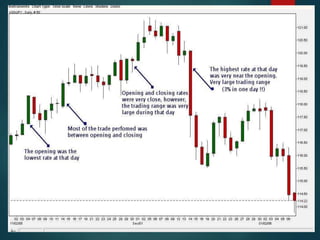
 It shows the price movements of the stock
in vertical form.
 The top and bottom points of the stock
passes through the candle.
 A clear candle without any shading
indicates increase in price and a shaded
candle indicate decrease in price.
 When the day’s closing price is higher
than the opening price then it is considered
as increase in price.
CONT…
 When the day’s closing price is less
than the opening price it is considered
as decrease in price and the candle is
shaded.
 It shows the day’s opening price, low
price, high price and closing price and
the price movements.
 It can be prepared for weekly or
monthly.
PATTERNS
What is mean by
Patterns?
 A chart pattern is a distinct formation
on a stock chart that creates a
trading signal, or a sign of
future price movements.
 Chartists use these patterns to
identify current trends and trend
reversals and to trigger buy and sell
signals.
Types
 Double Top
 Double Bottom
 Head and Shoulder
 Inverted Head and Shoulder Pattern
 Symmetrical Triangle
 Ascending Triangle
 Descending Triangle
 Flag and Pennant
 Support and Resistance
Double Top
 A double top consists of two well-defined,
sharp peaks at approximately the same
price level.
 A double top occurs when prices are in an
uptrend.
 The pattern is complete when prices decline
below the lowest low in the formation. The
lowest low is called the confirmation point.
 In this the prices are expected to fall
i.e., this is the signal to sell.
Double Bottom
 In a double bottom, the price of the
stock falls to a certain level and
increasing with diminishing activity.
 Then it falls again to the same or to a
lower and turns up to a higher level.
 The double bottom resembles the letter
‘W’. Technical analysis view double
bottom as a sign for the Bull market
i.e., it is a signal to buy.
Head and Shoulder
 It is generally regarded as up trends.
 It is also most reliable when found in an
uptrend as well.
Sellers come in at the highs (left
shoulder) and the downside is probed
(beginning neckline).
 Buyers soon return to the market and
ultimately push through to new highs
(head).
Inverted Head and Shoulder
Pattern
 The head and shoulders pattern can
sometimes be inverted.
 The inverted head and shoulders are typically
seen in downtrends.
 The inverted head and shoulders is the
volume aspect.
 The inverted left shoulder should be
accompanied by an increase in volume.
 The inverted head should be made on lighter
volume.
Symmetrical Triangle
 The symmetrical triangle, which can
also be referred to as a coil, usually
forms during a trend as a continuation
pattern.
 The pattern contains at least two lower
highs and two higher lows.
 When these points are connected, the
lines converge as they are extended and
the symmetrical triangle takes shape.
Ascending Triangle
 Ascending triangle patterns are bullish
and often form within uptrend’s in
stocks as continuation patterns.
 The ascending triangle pattern
resembles a narrowing triangle with a
horizontal line of overhead resistance
for the stock and an ascending trend line
or rising trend line beneath the stock.
Descending Triangle
 Descending triangle patterns are
bearish and often form within
downtrends in stocks as continuation
patterns.
 The descending triangle pattern
resembles a narrowing triangle with a
horizontal line of support beneath the
stock and a descending trend line
or downtrend line above the stock.
Flag and Pennant
 These two short-term chart patterns are
continuation patterns that are formed when
there is a sharp price movement followed by
a generally sideways price movement.
 This pattern is then completed upon another
sharp price movement in the same direction
as the move that started the trend.
 The patterns are generally thought to last
from one to three weeks.
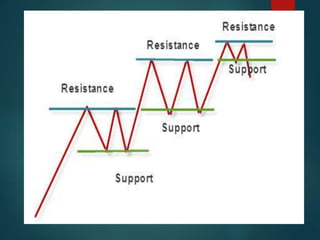
Support and Resistance
 Technical analysts often talk about the
ongoing battle between the bulls and the
bears, or the struggle between buyers
(demand) and sellers (supply).
 This is revealed by the prices a security
seldom moves above (resistance) or
below (support).
 Support and resistance levels are the levels
at which a lot of traders are willing to buy
the stock (in the case of a support) or sell it
(in the case of resistance).
EFFICIENT MARKET
THEORY
Introduction
 Efficient Market Theory states that
the share prices fluctuations are
random and do not follow any
regular pattern.
 Meanwhile technical analysts see
meaningful patterns in their
charts.
Meaning
 In 1970, Fama stated that efficient
market fully reflect the available
information.
 If markets are efficient, securities
price reflect normal returns for their
level of risk.
Fama suggested that efficient
market hypothesis can be divided
into three categories.
Cont…
 Weak Form of EM
Which absorbs only market’s past price
information.
 Semi strong Form
Which absorbs past price information
and also all other public information
and
 Strong Form
Which absorbs all types of information
including insider information.
Weak form of EMH
 The type of information used in
the weak form of EMH is the
Historical prices.
 According to it, current prices
reflect all information found in the
past prices and traded volumes.
Semi – Strong Form
 It states that the security price adjusts rapidly
to all publicly available information.
 The prices not only reflect the past price
data, but also the available information
regarding the Earnings of the Corporate,
Dividend, Bonus issue, Right Issue,
mergers, Acquisitions and so on.
 In this market a few insiders can earn Profit
on a short run price changes rather than the
investors who adopt the Buy and hold Policy.
DOW THEORY
Introduction
 Dow Theory was formulated from a
series of Wall Street Journal editorials
authored by Charles H. Dow from 1900
until the time of his death in 1902.
 These editorials reflected Dow’s beliefs
on how the stock market behaved and
how the market could be used to
measure the health of the business
environment.
Cont….
 Dow first used his theory to create the Dow
Jones Industrial Index and the Dow
Jones Rail Index (now Transportation
Index), which were originally compiled by Dow
for The Wall Street Journal.
 Dow created these indexes because he felt they were an
accurate reflection of the business conditions within
the economy because they covered two major economic
segments: industrial and rail.
 While these indexes have changed over the last
100 years, the theory still applies to current
market indexes.
RANDOM WALK THEORY
Theory
 Random walk theory gained popularity in
1973 when Burton Malkiel wrote "A
Random Walk down Wall Street", a book
that is now regarded as an investment
classic.
 Random walk is a stock market theory
that states that the past movement or
direction of the price of a stock or
overall market cannot be used to
predict its future movement.
Cont…
 In his book, Malkiel preaches that both
technical analysis and fundamental
analysis are largely a waste of time and are
still unproven in outperforming the markets.
 Malkiel constantly states that a long-term
buy-and-hold strategy is the best.
 Attempts based on technical, fundamental,
or any other analysis are futile.
 It's hard to say how much truth there is to
this theory;

SAPM-33.pptx

  • 2.
    MEANING OF TECHNICAL ANALYSIS: Technical an analysis is applied to find out the future direction of the market by analyzing the past and current price as well as volume movements. Market activity Past Prices Volume
  • 3.
    ASSUMTION OF TECHNICAL ANALYSIS: The Market Discounts Everything  Price Moves in Trends  History Tends to Repeat Itself
  • 4.
    Fundamental Analysis Technical Analysis It is basedon the information regarding the Economy, Industry and Company. It is based on analysis of Price movements and the volume. It helps the investor to find out the Intrinsic value of the Stock. It helps to predict the trend of Price movements.
  • 5.
    Fundamental Analysis TechnicalAnalysis It uses the accounting tools like ratio and fund flow analysis. It uses the tools like technical indications and Charting methods. Mainly focus the long term Investment prospects, looks at data over a number of years. Mainly focus the short term investments, timeframe of weeks, days or even minutes. The Fundamental analysis is used by long term investors. Technical analysis used by Speculators.
  • 6.
    CHARTING METHOD  Technicalanalysis uses charts as important tool to predict the future trend of share price movement. A chart is simply a graphical representation of a series of prices over a set time frame.
  • 7.
    CHART PROPERTIES  TheTime Scale  The Price Scale and Price Point Properties
  • 9.
    VARIOUS CHARTING METHOD  Barchart  Line chart  Point and figure chart  Japanese candlestick
  • 10.
    BAR CHART  Thebar chart shows the complete price movements of a stock.  It reveals the day’s opening price, low price, high price, closing price and the volume of a stock.  The closing price and opening price are marked in between the high price and low price by marking a tick on the vertical bar.  The volume of transactions is shown as separate vertical bars in the bottom portion
  • 13.
    LINE CHART  Itis the simple presentation of price movement of a stock over a specified period.  The period is represented by “X” axis and the price movement is represented by “Y” axis.  The closing price of the stock for various period are plotted in the chart with dots and then all the dots are joined by a line.
  • 14.
    CONT…  Line chartscan be prepared by considering daily closing price, weekly closing price or monthly closing price.  To predict short term movements’, daily closing price can be used to prepare line charts.  To predict medium term and long term movements the weekly and monthly closing price can be considered.  Traders in the stock market prepare intra –
  • 16.
    POINT AND FIGURECHART  It is useful to predict the change of price direction.  The price interval of the stock is entered on the left side of the chart.  When the price of the scrip moves up to the next price interval then it is marked up with “X” symbol and as long as the share price increases the "X" symbols are plotted in the vertical column.
  • 17.
    CONT…  When theshare price declines by the price intervals then the chart is plotted with “O” symbols in the next column.  The price movements are analyzed and interpreted by reading the ‘X” and “O” symbols on the chart.  The point and figure chart shows the support and resistance levels and also indicates the buy and sells signals.
  • 19.
    JAPANESE CANDLESTICK CHART  Itshows the price movements of the stock in vertical form.  The top and bottom points of the stock passes through the candle.  A clear candle without any shading indicates increase in price and a shaded candle indicate decrease in price.  When the day’s closing price is higher than the opening price then it is considered as increase in price.
  • 20.
    CONT…  When theday’s closing price is less than the opening price it is considered as decrease in price and the candle is shaded.  It shows the day’s opening price, low price, high price and closing price and the price movements.  It can be prepared for weekly or monthly.
  • 23.
  • 24.
    What is meanby Patterns?  A chart pattern is a distinct formation on a stock chart that creates a trading signal, or a sign of future price movements.  Chartists use these patterns to identify current trends and trend reversals and to trigger buy and sell signals.
  • 25.
    Types  Double Top Double Bottom  Head and Shoulder  Inverted Head and Shoulder Pattern  Symmetrical Triangle  Ascending Triangle  Descending Triangle  Flag and Pennant  Support and Resistance
  • 26.
    Double Top  Adouble top consists of two well-defined, sharp peaks at approximately the same price level.  A double top occurs when prices are in an uptrend.  The pattern is complete when prices decline below the lowest low in the formation. The lowest low is called the confirmation point.  In this the prices are expected to fall i.e., this is the signal to sell.
  • 28.
    Double Bottom  Ina double bottom, the price of the stock falls to a certain level and increasing with diminishing activity.  Then it falls again to the same or to a lower and turns up to a higher level.  The double bottom resembles the letter ‘W’. Technical analysis view double bottom as a sign for the Bull market i.e., it is a signal to buy.
  • 30.
    Head and Shoulder It is generally regarded as up trends.  It is also most reliable when found in an uptrend as well. Sellers come in at the highs (left shoulder) and the downside is probed (beginning neckline).  Buyers soon return to the market and ultimately push through to new highs (head).
  • 31.
    Inverted Head andShoulder Pattern  The head and shoulders pattern can sometimes be inverted.  The inverted head and shoulders are typically seen in downtrends.  The inverted head and shoulders is the volume aspect.  The inverted left shoulder should be accompanied by an increase in volume.  The inverted head should be made on lighter volume.
  • 33.
    Symmetrical Triangle  Thesymmetrical triangle, which can also be referred to as a coil, usually forms during a trend as a continuation pattern.  The pattern contains at least two lower highs and two higher lows.  When these points are connected, the lines converge as they are extended and the symmetrical triangle takes shape.
  • 34.
    Ascending Triangle  Ascendingtriangle patterns are bullish and often form within uptrend’s in stocks as continuation patterns.  The ascending triangle pattern resembles a narrowing triangle with a horizontal line of overhead resistance for the stock and an ascending trend line or rising trend line beneath the stock.
  • 35.
    Descending Triangle  Descendingtriangle patterns are bearish and often form within downtrends in stocks as continuation patterns.  The descending triangle pattern resembles a narrowing triangle with a horizontal line of support beneath the stock and a descending trend line or downtrend line above the stock.
  • 37.
    Flag and Pennant These two short-term chart patterns are continuation patterns that are formed when there is a sharp price movement followed by a generally sideways price movement.  This pattern is then completed upon another sharp price movement in the same direction as the move that started the trend.  The patterns are generally thought to last from one to three weeks.
  • 39.
    Support and Resistance Technical analysts often talk about the ongoing battle between the bulls and the bears, or the struggle between buyers (demand) and sellers (supply).  This is revealed by the prices a security seldom moves above (resistance) or below (support).  Support and resistance levels are the levels at which a lot of traders are willing to buy the stock (in the case of a support) or sell it (in the case of resistance).
  • 41.
  • 42.
    Introduction  Efficient MarketTheory states that the share prices fluctuations are random and do not follow any regular pattern.  Meanwhile technical analysts see meaningful patterns in their charts.
  • 43.
    Meaning  In 1970,Fama stated that efficient market fully reflect the available information.  If markets are efficient, securities price reflect normal returns for their level of risk. Fama suggested that efficient market hypothesis can be divided into three categories.
  • 44.
    Cont…  Weak Formof EM Which absorbs only market’s past price information.  Semi strong Form Which absorbs past price information and also all other public information and  Strong Form Which absorbs all types of information including insider information.
  • 46.
    Weak form ofEMH  The type of information used in the weak form of EMH is the Historical prices.  According to it, current prices reflect all information found in the past prices and traded volumes.
  • 47.
    Semi – StrongForm  It states that the security price adjusts rapidly to all publicly available information.  The prices not only reflect the past price data, but also the available information regarding the Earnings of the Corporate, Dividend, Bonus issue, Right Issue, mergers, Acquisitions and so on.  In this market a few insiders can earn Profit on a short run price changes rather than the investors who adopt the Buy and hold Policy.
  • 48.
  • 49.
    Introduction  Dow Theorywas formulated from a series of Wall Street Journal editorials authored by Charles H. Dow from 1900 until the time of his death in 1902.  These editorials reflected Dow’s beliefs on how the stock market behaved and how the market could be used to measure the health of the business environment.
  • 50.
    Cont….  Dow firstused his theory to create the Dow Jones Industrial Index and the Dow Jones Rail Index (now Transportation Index), which were originally compiled by Dow for The Wall Street Journal.  Dow created these indexes because he felt they were an accurate reflection of the business conditions within the economy because they covered two major economic segments: industrial and rail.  While these indexes have changed over the last 100 years, the theory still applies to current market indexes.
  • 52.
  • 53.
    Theory  Random walktheory gained popularity in 1973 when Burton Malkiel wrote "A Random Walk down Wall Street", a book that is now regarded as an investment classic.  Random walk is a stock market theory that states that the past movement or direction of the price of a stock or overall market cannot be used to predict its future movement.
  • 54.
    Cont…  In hisbook, Malkiel preaches that both technical analysis and fundamental analysis are largely a waste of time and are still unproven in outperforming the markets.  Malkiel constantly states that a long-term buy-and-hold strategy is the best.  Attempts based on technical, fundamental, or any other analysis are futile.  It's hard to say how much truth there is to this theory;