Technical Analysis
for Intraday
trading
Here is where your presentation begins
01 Section 1.1 + Definition and Purpose of
Technical Analysis
02 Section 1.2 + Key Concepts in Technical
Analysis
03 Trend Analysis Tools
04 Momentum Indicators
05 Volume Indicators
07 Building a Trading Strategy with Technical
Analysis
08 Case Studies and Examples
09 Risk Management and Emotional
Discipline
10 Summary of Technical Analysis for
Intraday Trading
11 Additional Resources for Intraday Trading
06 Pattern Recognition Tools
Content
s
01
Section 1.1 + Definition
and Purpose of Technical
Analysis
01
Content Title 1.1.1.1 + Explanation of
Technical Analysis in Intraday Trading
Technical analysis is a method used by traders to evaluate and forecast future price movements of securities,
such as stocks, currencies, and commodities, based on historical price and volume data.
In intraday trading, technical analysis is particularly useful as it helps traders make short- term trading decisions
by analyzing price patterns, trends, and market indicators within the same trading day.
By understanding technical analysis, traders can identify potential entry and exit points, determine levels of
support and resistance, and manage risk through the use of various technical indicators.
02
Content Title 1.1.1.2 + Benefits and Limitations of Using
Technical Analysis in Intraday Trading
The use of technical analysis in intraday trading allows traders to exploit short- term price movements and
capitalize on market inefficiencies.
Technical analysis provides traders with a systematic approach to analyze and interpret market data, leading to
more informed trading decisions.
However, it is important to note that technical analysis is not foolproof and has limitations. Market volatility and
unpredictable events can cause price movements that may not be accurately predicted using only technical
analysis.
Subsection 1.1.1 + Understanding Technical Analysis in Intraday Trading
Content Title 1.1.2.1 + Utilizing Historical Data for Analysis
and Prediction
Content Title 1.1.2.2 + Timing and Risk
Management
Technical analysis relies on historical price data to identify patterns,
trends, and support/resistance levels. By analyzing the past, traders
can make educated predictions about future price movements.
It helps traders understand market sentiment and identify potential
buying or selling opportunities based on the behavior of other
traders in the market.
Technical analysis helps traders make objective trading decisions by
removing emotions and biases from the equation, as it focuses solely
on price and volume data.
Technical analysis is crucial in intraday trading for timing entry
and exit points based on the identification of patterns and
trends.
It enables traders to manage risk by setting stop- loss orders
and determining target prices based on support and
resistance levels.
By utilizing technical analysis, traders can optimize their risk-
reward ratio and make informed decisions about position
sizing and risk management.
Subsection 1.1.2 + Importance of Technical Analysis in Intraday Trading
02
Section 1.2 + Key
Concepts in Technical
Analysis
Price is the primary focus of technical analysis. Traders use price charts
to identify patterns, trends, and potential levels of support and
resistance.
The study of price patterns and trends can help traders forecast future
price movements, identify entry and exit points, and assess the overall
strength or weakness of a security.
Content Title 1.2.1.1 + Understanding the Role of
Price in Technical Analysis
Volume refers to the number of shares or contracts traded in a security. It is an important
indicator in technical analysis as it helps gauge the strength of price movements.
By analyzing volume alongside price, traders can confirm the validity of trends, spot potential
trend reversals, and identify periods of accumulation or distribution.
Volume analysis can provide insights into market participation and the intensity of buying or
selling pressure, giving traders a better understanding of market dynamics.
Content Title 1.2.1.2 + Volume Analysis and Its
Significance in Technical Analysis
Subsection 1.2.1 + Price, Volume, and Market Trends
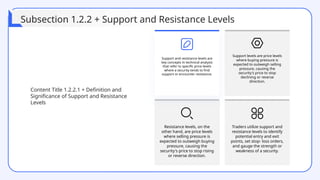
Resistance levels, on the
other hand, are price levels
where selling pressure is
expected to outweigh buying
pressure, causing the
security's price to stop rising
or reverse direction.
Traders utilize support and
resistance levels to identify
potential entry and exit
points, set stop- loss orders,
and gauge the strength or
weakness of a security.
Support and resistance levels are
key concepts in technical analysis
that refer to specific price levels
where a security tends to find
support or encounter resistance.
Support levels are price levels
where buying pressure is
expected to outweigh selling
pressure, causing the
security's price to stop
declining or reverse
direction.
Content Title 1.2.2.1 + Definition and
Significance of Support and Resistance
Levels
Subsection 1.2.2 + Support and Resistance Levels
Candlestick patterns are graphical representations of
price movements over a specified time period, commonly
used in technical analysis to identify potential trend
reversals or continuations.
Each candlestick represents the open, high, low, and close
prices for the specified time period, forming various
patterns that indicate different market sentiments, such
as bullishness or bearishness.
By recognizing and understanding candlestick patterns,
traders can make more accurate predictions about future
price movements and adjust their trading strategies
accordingly.
Content Title 1.2.3.1 + Understanding Candlestick
Patterns and Their Meaning
Content Title 1.2.3.2 + Exploring Common Chart
Patterns and Their Interpretation
Chart patterns are visual representations of
historical price movements that can indicate
potential future price movements.
Common chart patterns include support and
resistance levels, trendlines, head and shoulders,
double tops and bottoms, triangles, and flags.
Traders analyze these chart patterns to identify
trend reversals, trend continuations, and
potential breakout opportunities to make trading
decisions.
Subsection 1.2.3 + Candlestick Patterns and Chart Patterns
01
Content Title 1.2.4.1 + Overview of Technical Indicators and Their Applications
Technical indicators are mathematical calculations applied to price and volume data to generate signals and insights for
trading decisions.
They help traders confirm trends, identify overbought or oversold conditions, detect potential trend reversals, and
generate buy or sell signals.
Examples of technical indicators include moving averages, relative strength index (RSI), stochastic oscillator, and MACD.
02
Content Title 1.2.4.2 + Understanding Oscillators and Their Role in Technical
Analysis
Oscillators are a subset of technical indicators that measure the speed and magnitude of price movements. They oscillate
within a defined range, typically between 0 and 100.
Oscillators help traders identify overbought or oversold conditions, divergence between price and indicator, and potential
trend reversals.
Popular oscillators include RSI, stochastic oscillator, and moving average convergence divergence (MACD).
Subsection 1.2.4 + Indicators and Oscillators
03
Trend Analysis Tools
01
Moving averages are widely
used trend analysis tools in
technical analysis.
02
They are calculated by
taking the average price of
a security over a specified
time period.
03
Moving averages help
identify the direction of a
trend and smooth out price
fluctuations.
04
Common types of moving
averages include simple
moving averages (SMA) and
exponential moving
averages (EMA).
Moving Averages
01
Trendlines are graphical tools
used to identify the direction
and strength of a trend in
technical analysis.
02
They are drawn by connecting
two or more significant highs or
lows on a price chart.
03
Trendlines can act as support or
resistance levels, and their
breakouts or bounces can
provide trading signals.
04
Trendlines help traders
anticipate potential reversals or
continuation of trends.
Trendlines
Bollinger Bands are volatility
indicators used to measure
the price volatility of a
security.
They consist of a simple
moving average (SMA) and
two standard deviation bands.
Bollinger Bands expand and
contract based on the
market's volatility.
They are commonly used to
identify overbought or
oversold conditions and
potential price reversals.
Bollinger Bands
04
Momentum Indicators
01 02
The Relative Strength Index (RSI) is a popular
momentum indicator used to measure the speed and
change of price movements.
Traders use RSI to identify potential trend reversals or
confirm trend continuation.
It compares the magnitude of recent gains to recent
losses to determine overbought or oversold
conditions.
RSI values range from 0 to 100, with values above 70
indicating overbought conditions and values below 30
indicating oversold conditions.
04
03
Relative Strength Index (RSI)
The Stochastic Oscillator is
another widely used
momentum indicator in
technical analysis.
It compares a security's
closing price to its price
range over a specified time
period.
The Stochastic Oscillator
generates values between 0 and
100, with values above 80
indicating overbought conditions
and values below 20 indicating
oversold conditions.
Traders use the Stochastic
Oscillator to identify
potential trend reversals and
generate buy or sell signals.
Stochastic Oscillator
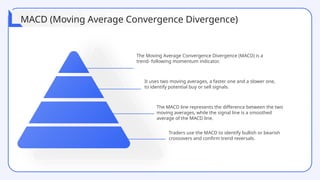
The Moving Average Convergence Divergence (MACD) is a
trend- following momentum indicator.
It uses two moving averages, a faster one and a slower one,
to identify potential buy or sell signals.
The MACD line represents the difference between the two
moving averages, while the signal line is a smoothed
average of the MACD line.
Traders use the MACD to identify bullish or bearish
crossovers and confirm trend reversals.
MACD (Moving Average Convergence Divergence)
05
Volume Indicators
On- Balance Volume
(OBV) is a volume
indicator that measures
the cumulative buying
and selling pressure of a
security.
It adds the volume on up
days and subtracts the
volume on down days,
creating a cumulative
line.
OBV helps traders
identify the strength of a
trend and potential trend
reversals.
Part 01 Part 02 Part 03 Part 04
Divergences between
OBV and price can
indicate a change in
trend direction.
On-Balance Volume (OBV)
Volume Weighted Average
Price (VWAP) is a technical
indicator that calculates the
average price a security has
traded at throughout the day,
weighted by trading volume.
VWAP is commonly used by
institutional traders to assess
the average price they paid
for a large position.
Traders also use VWAP to
identify support or resistance
levels and potential favorable
entry or exit points.
Volume Weighted Average Price (VWAP)
The
Accumulation/Distribution
Line is a volume indicator
that measures the
cumulative flow of money
into or out of a security.
The line is calculated by
adding volume on up
days and subtracting
volume on down days,
adjusted for the security's
close relative to its range.
Traders use the
Accumulation/Distribution
Line to identify potential
trend reversals and
confirm trend strength.
It takes into account
both price and volume
to assess buying and
selling pressure.
Accumulation/Distribution Line
06
Pattern Recognition
Tools
The Head and Shoulders pattern is a technical analysis chart
pattern that signals a potential trend reversal.
It consists of a peak (head) flanked by two smaller peaks
(shoulders) on either side.
A neckline connects the lows between the shoulders.
The breakdown of the neckline confirms the pattern and
generates a sell signal, while a breakout above the neckline
indicates a potential trend reversal.
01
02
03
04
Head and Shoulders Pattern
01
03
02
04
Double bottoms occur when a
security reaches a valley
(support) twice, with a peak
(resistance) in between.
Double tops and double bottoms
are chart patterns that signal a
potential trend reversal.
Double tops occur when a
security reaches a peak
(resistance) twice, with a valley
(support) in between.
The breakdown of the support level in a
double top pattern or the breakout of
the resistance level in a double bottom
pattern confirms the pattern and
generates a sell or buy signal,
respectively.
Double Tops and Double Bottoms
Triangle patterns are
chart patterns
characterized by
converging
trendlines.
Ascending triangles
have a flat upper
trendline and a
rising lower
trendline.
Descending
triangles have a flat
lower trendline and
a declining upper
trendline.
Symmetrical
triangles have both
trendlines
converging at a
similar angle.
Breakouts from
these triangle
patterns can signal
the continuation or
reversal of a trend.
Triangle Patterns
01
03
05
02
04
Flags and pennants are short- term continuation chart
patterns.
Flags are characterized by a small rectangle or
parallelogram shape that forms against the prevailing
trend.
Pennants are similar to flags but have converging
trendlines, creating a triangular shape.
Flag and pennant patterns indicate temporary consolidation
before the continuation of the previous trend.
Traders often look for breakout or breakdown signals from
these patterns to enter trades.
Flags and Pennants
07
Building a Trading
Strategy with Technical
Analysis
Understanding the importance of setting clear and achievable trading goals.
Identifying short- term and long- term goals.
Developing a trading plan based on defined goals.
Defining Intraday Trading Goals
Explaining common risk management techniques, such as setting stop- loss levels.
Developing a risk management plan to minimize losses.
Discussing the importance of risk management in intraday trading.
Implementing Risk Management Techniques
Setting up Intraday Trading Goals and Risk Management
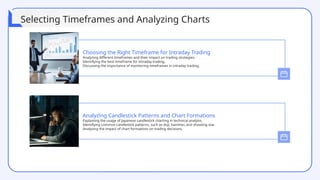
Analyzing different timeframes and their impact on trading strategies.
Identifying the best timeframe for intraday trading.
Discussing the importance of monitoring timeframes in intraday trading.
Choosing the Right Timeframe for Intraday Trading
Explaining the usage of Japanese candlestick charting in technical analysis.
Identifying common candlestick patterns, such as doji, hammer, and shooting star.
Analyzing the impact of chart formations on trading decisions.
Analyzing Candlestick Patterns and Chart Formations
Selecting Timeframes and Analyzing Charts
01
Identifying common technical indicators such as moving averages, MACD, and RSI.
Analyzing how to combine different indicators to confirm trading signals.
Developing a solid technical analysis plan.
Combining Multiple Indicators for Confirmation
02
Understanding the concepts of overbought and oversold conditions.
Identifying common indicators to identify overbought and oversold conditions.
Developing a trading plan based on identified conditions.
Identifying Overbought and Oversold Conditions
Using Technical Indicators to Confirm Signals
Placing Stop Loss
Orders
Determining Take
Profit Levels
Adjusting Stop Loss and Take
Profit Based on Market
Conditions
Understanding the concept of
stop- loss orders and their
impact on trading.
Identifying the best stop- loss
levels for intraday trading.
Developing a trading plan
based on identified stop- loss
levels.
Identifying the importance of
take- profit levels in intraday
trading.
Understanding how to calculate
take- profit levels.
Developing a plan to adjust
take- profit levels based on
market conditions.
Explaining how to adjust stop- loss
and take- profit levels based on
market conditions.
Identifying the importance of
monitoring market conditions in
intraday trading.
Developing a trading plan to adjust
stop- loss and take- profit levels
based on market conditions.
01 03
02
Implementing Stop Loss and Take Profit Strategies
08
Case Studies and
Examples
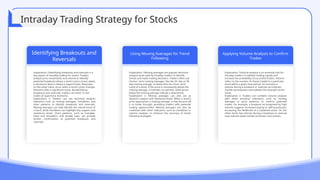
Identifying Breakouts and
Reversals
Explanation 1Identifying breakouts and reversals is a
key aspect of intraday trading for stocks. Traders
analyze price movements and volume to identify
potential breakouts where a stock's price moves above
a resistance level or below a support level. Reversals,
on the other hand, occur when a stock's price changes
direction after a significant move. By identifying
breakouts and reversals, traders can enter or exit
trades at opportune moments.
Explanation 2: Traders can use technical analysis
indicators such as moving averages, trendlines, and
chart patterns to identify breakouts and reversals.
Moving averages can help identify the overall trend of
a stock, while trendlines can highlight key support and
resistance levels. Chart patterns, such as triangles,
head and shoulders, and double tops, can provide
further confirmation of potential breakouts and
reversals.
Using Moving Averages for Trend
Following
Explanation 1Moving averages are popular technical
analysis tools used by intraday traders to identify
trends and make trading decisions. Traders often use
shorter- term moving averages, like the 20- day or 50-
day moving average, to determine the short- term
trend of a stock. If the price is consistently above the
moving average, it indicates an uptrend, while prices
below the moving average indicate a downtrend.
Explanation 2: Moving averages can also act as
dynamic support and resistance levels. When a stock's
price approaches a moving average, it may bounce off
it or break through, providing traders with potential
trading opportunities. Moving averages can also be
combined with other indicators, such as trendlines or
volume analysis, to enhance the accuracy of trend-
following strategies.
Applying Volume Analysis to Confirm
Trades
Explanation 1Volume analysis is an essential tool for
intraday traders to validate trading signals and
increase the probability of successful trades. Volume
refers to the number of shares traded in a particular
stock within a given time period. An increase in
volume during a breakout or reversal can indicate
market participation and validate the strength of the
move.
Explanation 2: Traders can combine volume analysis
with other technical indicators, such as moving
averages or price patterns, to confirm potential
trades. For example, a breakout accompanied by high
volume suggests increased buying or selling pressure,
increasing the likelihood of a sustained move. On the
other hand, low volume during a breakout or reversal
may indicate weak market conviction and caution.
Intraday Trading Strategy for Stocks
Incorporating Fibonacci
Retracement Levels
Explanation 1Fibonacci retracement levels are based on the Fibonacci
sequence and are used by forex traders to identify potential price
reversal levels after a significant trend. These levels, including 38.2%,
50%, and 61.8%, are derived from mathematical ratios and are believed
to indicate areas of support or resistance.
Explanation 2: Forex traders use Fibonacci retracement levels in
combination with other technical analysis tools, such as trendlines or
candlestick patterns, to confirm potential trade setups. The
convergence of Fibonacci retracement levels with other indicators can
increase the probability of successful trades.
Analyzing Forex Chart Patterns
for Intraday Trading
Explanation 1Chart patterns, such as head and shoulders,
triangles, and flags, provide valuable insights into the future
direction of forex currency pairs. These patterns are formed
based on price movements and can indicate potential
breakouts, reversals, or continuation of trends.
Explanation 2: Forex traders use chart patterns in
combination with other technical analysis tools, such as
support and resistance levels or moving averages, to confirm
potential trade setups. The recognition and interpretation of
chart patterns require experience and practice, as different
patterns may have varying degrees of reliability and
effectiveness.
Using Support and Resistance
Levels in Forex Trading
Explanation 1Support and resistance levels are vital concepts in
forex trading, helping traders identify potential entry and exit
points. Support levels act as price floors, where the buying
demand is strong enough to prevent the price from falling further.
Resistance levels, on the other hand, act as price ceilings, where
selling pressure may prevent the price from rising further.
Explanation 2: Traders can identify support and resistance levels
using various techniques, such as trendlines, horizontal lines, or
pivot points. These levels can provide valuable insights into the
strength or weakness of a currency pair, allowing traders to make
informed decisions based on potential price reactions at these
levels.
Intraday Trading Strategy for Forex
09
Risk Management and
Emotional Discipline
28M+
Psychology of
Trading and
Emotional Biases
Techniques for
Emotional Discipline
Discussing the psychological factors
that affect the decision- making
process in trading.
Identifying common emotional biases
that traders experience.
Highlighting the importance of self-
awareness and self- reflection in
managing emotions.
Listing practical techniques that
traders can use to manage their
emotions.
Exploring the benefits of mindfulness,
visualization, and breathing exercises.
Outlining strategies for developing
emotional resilience and discipline.
Controlling Emotions in Intraday Trading
Setting Risk-to-Reward Ratios
Defining risk- to- reward ratios and explain
their significance in risk management.
Discussing various methods for calculating
and using risk- to- reward ratios.
Highlighting the importance of identifying
and understanding risk tolerance levels.
Determining Position Sizing and Leverage
Explaining the concept of position sizing
and its relationship with risk
management.
Discussing methods for calculating
optimal position sizes based on risk and
portfolio size.
Describing the impact of leverage on
position sizing and risk management.
Using Trailing Stops to Protect Profits
Defining trailing stops and their role in
protecting profits and minimizing losses.
Discussing different types of trailing
stops and their applications in different
market conditions.
Providing examples of trailing stop
strategies in intraday trading.
Monitoring Economic and Market News
Outlining the importance of staying up- to-
date with the latest news and events that
can impact the market.
Discussing sources and methods for
monitoring economic indicators and
market news.
Identifying potential risks and
opportunities that can arise from market
news and events.
Implementing Proper Risk Management
10
Summary of Technical
Analysis for Intraday
Trading
Reviewing the key concepts and tools used in technical analysis
for intraday trading.
Discussing the importance of understanding support and
resistance levels.
Exploring the significance of trend lines and moving averages in
analyzing price movements.
Highlighting the role of indicators such as RSI and MACD in
identifying market trends.
Recap of Key Concepts and Tools
01 02 03 04
Emphasizing the
significance of
continuous learning in
improving technical
analysis skills.
Discussing the benefits
of practicing different
technical analysis
techniques.
Exploring the value of
analyzing historical
market data for
enhancing decision-
making.
Highlighting the need to
adapt strategies and
approaches in response
to changing market
conditions.
Importance of Continuous Learning and Practice
11
Additional Resources for
Intraday Trading
Recommending books on technical analysis for intraday
trading.
Providing a list of reputable websites that offer educational
resources on technical analysis.
Discussing the importance of reading and studying different
perspectives on technical analysis.
Highlighting the value of joining online communities and
forums dedicated to intraday trading.
Books and Websites on Technical Analysis
Introducing trading
simulators as valuable
tools for practicing
intraday trading
strategies.
Exploring features
and functionalities of
popular trading
simulators.
Providing
recommendations for
reputable trading
simulators and online
brokers that offer practice
accounts.
Discussing the
benefits of using
practice accounts to
gain hands- on
experience without
risking real money.
Trading Simulators and Practice Accounts
Thanks
Edited by Sangeetha Kumar

Technical Analysis for Intraday trading.pptx

  • 1.
    Technical Analysis for Intraday trading Hereis where your presentation begins
  • 2.
    01 Section 1.1+ Definition and Purpose of Technical Analysis 02 Section 1.2 + Key Concepts in Technical Analysis 03 Trend Analysis Tools 04 Momentum Indicators 05 Volume Indicators 07 Building a Trading Strategy with Technical Analysis 08 Case Studies and Examples 09 Risk Management and Emotional Discipline 10 Summary of Technical Analysis for Intraday Trading 11 Additional Resources for Intraday Trading 06 Pattern Recognition Tools Content s
  • 3.
    01 Section 1.1 +Definition and Purpose of Technical Analysis
  • 4.
    01 Content Title 1.1.1.1+ Explanation of Technical Analysis in Intraday Trading Technical analysis is a method used by traders to evaluate and forecast future price movements of securities, such as stocks, currencies, and commodities, based on historical price and volume data. In intraday trading, technical analysis is particularly useful as it helps traders make short- term trading decisions by analyzing price patterns, trends, and market indicators within the same trading day. By understanding technical analysis, traders can identify potential entry and exit points, determine levels of support and resistance, and manage risk through the use of various technical indicators. 02 Content Title 1.1.1.2 + Benefits and Limitations of Using Technical Analysis in Intraday Trading The use of technical analysis in intraday trading allows traders to exploit short- term price movements and capitalize on market inefficiencies. Technical analysis provides traders with a systematic approach to analyze and interpret market data, leading to more informed trading decisions. However, it is important to note that technical analysis is not foolproof and has limitations. Market volatility and unpredictable events can cause price movements that may not be accurately predicted using only technical analysis. Subsection 1.1.1 + Understanding Technical Analysis in Intraday Trading
  • 5.
    Content Title 1.1.2.1+ Utilizing Historical Data for Analysis and Prediction Content Title 1.1.2.2 + Timing and Risk Management Technical analysis relies on historical price data to identify patterns, trends, and support/resistance levels. By analyzing the past, traders can make educated predictions about future price movements. It helps traders understand market sentiment and identify potential buying or selling opportunities based on the behavior of other traders in the market. Technical analysis helps traders make objective trading decisions by removing emotions and biases from the equation, as it focuses solely on price and volume data. Technical analysis is crucial in intraday trading for timing entry and exit points based on the identification of patterns and trends. It enables traders to manage risk by setting stop- loss orders and determining target prices based on support and resistance levels. By utilizing technical analysis, traders can optimize their risk- reward ratio and make informed decisions about position sizing and risk management. Subsection 1.1.2 + Importance of Technical Analysis in Intraday Trading
  • 6.
    02 Section 1.2 +Key Concepts in Technical Analysis
  • 7.
    Price is theprimary focus of technical analysis. Traders use price charts to identify patterns, trends, and potential levels of support and resistance. The study of price patterns and trends can help traders forecast future price movements, identify entry and exit points, and assess the overall strength or weakness of a security. Content Title 1.2.1.1 + Understanding the Role of Price in Technical Analysis Volume refers to the number of shares or contracts traded in a security. It is an important indicator in technical analysis as it helps gauge the strength of price movements. By analyzing volume alongside price, traders can confirm the validity of trends, spot potential trend reversals, and identify periods of accumulation or distribution. Volume analysis can provide insights into market participation and the intensity of buying or selling pressure, giving traders a better understanding of market dynamics. Content Title 1.2.1.2 + Volume Analysis and Its Significance in Technical Analysis Subsection 1.2.1 + Price, Volume, and Market Trends
  • 8.
    Resistance levels, onthe other hand, are price levels where selling pressure is expected to outweigh buying pressure, causing the security's price to stop rising or reverse direction. Traders utilize support and resistance levels to identify potential entry and exit points, set stop- loss orders, and gauge the strength or weakness of a security. Support and resistance levels are key concepts in technical analysis that refer to specific price levels where a security tends to find support or encounter resistance. Support levels are price levels where buying pressure is expected to outweigh selling pressure, causing the security's price to stop declining or reverse direction. Content Title 1.2.2.1 + Definition and Significance of Support and Resistance Levels Subsection 1.2.2 + Support and Resistance Levels
  • 9.
    Candlestick patterns aregraphical representations of price movements over a specified time period, commonly used in technical analysis to identify potential trend reversals or continuations. Each candlestick represents the open, high, low, and close prices for the specified time period, forming various patterns that indicate different market sentiments, such as bullishness or bearishness. By recognizing and understanding candlestick patterns, traders can make more accurate predictions about future price movements and adjust their trading strategies accordingly. Content Title 1.2.3.1 + Understanding Candlestick Patterns and Their Meaning Content Title 1.2.3.2 + Exploring Common Chart Patterns and Their Interpretation Chart patterns are visual representations of historical price movements that can indicate potential future price movements. Common chart patterns include support and resistance levels, trendlines, head and shoulders, double tops and bottoms, triangles, and flags. Traders analyze these chart patterns to identify trend reversals, trend continuations, and potential breakout opportunities to make trading decisions. Subsection 1.2.3 + Candlestick Patterns and Chart Patterns
  • 10.
    01 Content Title 1.2.4.1+ Overview of Technical Indicators and Their Applications Technical indicators are mathematical calculations applied to price and volume data to generate signals and insights for trading decisions. They help traders confirm trends, identify overbought or oversold conditions, detect potential trend reversals, and generate buy or sell signals. Examples of technical indicators include moving averages, relative strength index (RSI), stochastic oscillator, and MACD. 02 Content Title 1.2.4.2 + Understanding Oscillators and Their Role in Technical Analysis Oscillators are a subset of technical indicators that measure the speed and magnitude of price movements. They oscillate within a defined range, typically between 0 and 100. Oscillators help traders identify overbought or oversold conditions, divergence between price and indicator, and potential trend reversals. Popular oscillators include RSI, stochastic oscillator, and moving average convergence divergence (MACD). Subsection 1.2.4 + Indicators and Oscillators
  • 11.
  • 12.
    01 Moving averages arewidely used trend analysis tools in technical analysis. 02 They are calculated by taking the average price of a security over a specified time period. 03 Moving averages help identify the direction of a trend and smooth out price fluctuations. 04 Common types of moving averages include simple moving averages (SMA) and exponential moving averages (EMA). Moving Averages
  • 13.
    01 Trendlines are graphicaltools used to identify the direction and strength of a trend in technical analysis. 02 They are drawn by connecting two or more significant highs or lows on a price chart. 03 Trendlines can act as support or resistance levels, and their breakouts or bounces can provide trading signals. 04 Trendlines help traders anticipate potential reversals or continuation of trends. Trendlines
  • 14.
    Bollinger Bands arevolatility indicators used to measure the price volatility of a security. They consist of a simple moving average (SMA) and two standard deviation bands. Bollinger Bands expand and contract based on the market's volatility. They are commonly used to identify overbought or oversold conditions and potential price reversals. Bollinger Bands
  • 15.
  • 16.
    01 02 The RelativeStrength Index (RSI) is a popular momentum indicator used to measure the speed and change of price movements. Traders use RSI to identify potential trend reversals or confirm trend continuation. It compares the magnitude of recent gains to recent losses to determine overbought or oversold conditions. RSI values range from 0 to 100, with values above 70 indicating overbought conditions and values below 30 indicating oversold conditions. 04 03 Relative Strength Index (RSI)
  • 17.
    The Stochastic Oscillatoris another widely used momentum indicator in technical analysis. It compares a security's closing price to its price range over a specified time period. The Stochastic Oscillator generates values between 0 and 100, with values above 80 indicating overbought conditions and values below 20 indicating oversold conditions. Traders use the Stochastic Oscillator to identify potential trend reversals and generate buy or sell signals. Stochastic Oscillator
  • 18.
    The Moving AverageConvergence Divergence (MACD) is a trend- following momentum indicator. It uses two moving averages, a faster one and a slower one, to identify potential buy or sell signals. The MACD line represents the difference between the two moving averages, while the signal line is a smoothed average of the MACD line. Traders use the MACD to identify bullish or bearish crossovers and confirm trend reversals. MACD (Moving Average Convergence Divergence)
  • 19.
  • 20.
    On- Balance Volume (OBV)is a volume indicator that measures the cumulative buying and selling pressure of a security. It adds the volume on up days and subtracts the volume on down days, creating a cumulative line. OBV helps traders identify the strength of a trend and potential trend reversals. Part 01 Part 02 Part 03 Part 04 Divergences between OBV and price can indicate a change in trend direction. On-Balance Volume (OBV)
  • 21.
    Volume Weighted Average Price(VWAP) is a technical indicator that calculates the average price a security has traded at throughout the day, weighted by trading volume. VWAP is commonly used by institutional traders to assess the average price they paid for a large position. Traders also use VWAP to identify support or resistance levels and potential favorable entry or exit points. Volume Weighted Average Price (VWAP)
  • 22.
    The Accumulation/Distribution Line is avolume indicator that measures the cumulative flow of money into or out of a security. The line is calculated by adding volume on up days and subtracting volume on down days, adjusted for the security's close relative to its range. Traders use the Accumulation/Distribution Line to identify potential trend reversals and confirm trend strength. It takes into account both price and volume to assess buying and selling pressure. Accumulation/Distribution Line
  • 23.
  • 24.
    The Head andShoulders pattern is a technical analysis chart pattern that signals a potential trend reversal. It consists of a peak (head) flanked by two smaller peaks (shoulders) on either side. A neckline connects the lows between the shoulders. The breakdown of the neckline confirms the pattern and generates a sell signal, while a breakout above the neckline indicates a potential trend reversal. 01 02 03 04 Head and Shoulders Pattern
  • 25.
    01 03 02 04 Double bottoms occurwhen a security reaches a valley (support) twice, with a peak (resistance) in between. Double tops and double bottoms are chart patterns that signal a potential trend reversal. Double tops occur when a security reaches a peak (resistance) twice, with a valley (support) in between. The breakdown of the support level in a double top pattern or the breakout of the resistance level in a double bottom pattern confirms the pattern and generates a sell or buy signal, respectively. Double Tops and Double Bottoms
  • 26.
    Triangle patterns are chartpatterns characterized by converging trendlines. Ascending triangles have a flat upper trendline and a rising lower trendline. Descending triangles have a flat lower trendline and a declining upper trendline. Symmetrical triangles have both trendlines converging at a similar angle. Breakouts from these triangle patterns can signal the continuation or reversal of a trend. Triangle Patterns
  • 27.
    01 03 05 02 04 Flags and pennantsare short- term continuation chart patterns. Flags are characterized by a small rectangle or parallelogram shape that forms against the prevailing trend. Pennants are similar to flags but have converging trendlines, creating a triangular shape. Flag and pennant patterns indicate temporary consolidation before the continuation of the previous trend. Traders often look for breakout or breakdown signals from these patterns to enter trades. Flags and Pennants
  • 28.
    07 Building a Trading Strategywith Technical Analysis
  • 29.
    Understanding the importanceof setting clear and achievable trading goals. Identifying short- term and long- term goals. Developing a trading plan based on defined goals. Defining Intraday Trading Goals Explaining common risk management techniques, such as setting stop- loss levels. Developing a risk management plan to minimize losses. Discussing the importance of risk management in intraday trading. Implementing Risk Management Techniques Setting up Intraday Trading Goals and Risk Management
  • 30.
    Analyzing different timeframesand their impact on trading strategies. Identifying the best timeframe for intraday trading. Discussing the importance of monitoring timeframes in intraday trading. Choosing the Right Timeframe for Intraday Trading Explaining the usage of Japanese candlestick charting in technical analysis. Identifying common candlestick patterns, such as doji, hammer, and shooting star. Analyzing the impact of chart formations on trading decisions. Analyzing Candlestick Patterns and Chart Formations Selecting Timeframes and Analyzing Charts
  • 31.
    01 Identifying common technicalindicators such as moving averages, MACD, and RSI. Analyzing how to combine different indicators to confirm trading signals. Developing a solid technical analysis plan. Combining Multiple Indicators for Confirmation 02 Understanding the concepts of overbought and oversold conditions. Identifying common indicators to identify overbought and oversold conditions. Developing a trading plan based on identified conditions. Identifying Overbought and Oversold Conditions Using Technical Indicators to Confirm Signals
  • 32.
    Placing Stop Loss Orders DeterminingTake Profit Levels Adjusting Stop Loss and Take Profit Based on Market Conditions Understanding the concept of stop- loss orders and their impact on trading. Identifying the best stop- loss levels for intraday trading. Developing a trading plan based on identified stop- loss levels. Identifying the importance of take- profit levels in intraday trading. Understanding how to calculate take- profit levels. Developing a plan to adjust take- profit levels based on market conditions. Explaining how to adjust stop- loss and take- profit levels based on market conditions. Identifying the importance of monitoring market conditions in intraday trading. Developing a trading plan to adjust stop- loss and take- profit levels based on market conditions. 01 03 02 Implementing Stop Loss and Take Profit Strategies
  • 33.
  • 34.
    Identifying Breakouts and Reversals Explanation1Identifying breakouts and reversals is a key aspect of intraday trading for stocks. Traders analyze price movements and volume to identify potential breakouts where a stock's price moves above a resistance level or below a support level. Reversals, on the other hand, occur when a stock's price changes direction after a significant move. By identifying breakouts and reversals, traders can enter or exit trades at opportune moments. Explanation 2: Traders can use technical analysis indicators such as moving averages, trendlines, and chart patterns to identify breakouts and reversals. Moving averages can help identify the overall trend of a stock, while trendlines can highlight key support and resistance levels. Chart patterns, such as triangles, head and shoulders, and double tops, can provide further confirmation of potential breakouts and reversals. Using Moving Averages for Trend Following Explanation 1Moving averages are popular technical analysis tools used by intraday traders to identify trends and make trading decisions. Traders often use shorter- term moving averages, like the 20- day or 50- day moving average, to determine the short- term trend of a stock. If the price is consistently above the moving average, it indicates an uptrend, while prices below the moving average indicate a downtrend. Explanation 2: Moving averages can also act as dynamic support and resistance levels. When a stock's price approaches a moving average, it may bounce off it or break through, providing traders with potential trading opportunities. Moving averages can also be combined with other indicators, such as trendlines or volume analysis, to enhance the accuracy of trend- following strategies. Applying Volume Analysis to Confirm Trades Explanation 1Volume analysis is an essential tool for intraday traders to validate trading signals and increase the probability of successful trades. Volume refers to the number of shares traded in a particular stock within a given time period. An increase in volume during a breakout or reversal can indicate market participation and validate the strength of the move. Explanation 2: Traders can combine volume analysis with other technical indicators, such as moving averages or price patterns, to confirm potential trades. For example, a breakout accompanied by high volume suggests increased buying or selling pressure, increasing the likelihood of a sustained move. On the other hand, low volume during a breakout or reversal may indicate weak market conviction and caution. Intraday Trading Strategy for Stocks
  • 35.
    Incorporating Fibonacci Retracement Levels Explanation1Fibonacci retracement levels are based on the Fibonacci sequence and are used by forex traders to identify potential price reversal levels after a significant trend. These levels, including 38.2%, 50%, and 61.8%, are derived from mathematical ratios and are believed to indicate areas of support or resistance. Explanation 2: Forex traders use Fibonacci retracement levels in combination with other technical analysis tools, such as trendlines or candlestick patterns, to confirm potential trade setups. The convergence of Fibonacci retracement levels with other indicators can increase the probability of successful trades. Analyzing Forex Chart Patterns for Intraday Trading Explanation 1Chart patterns, such as head and shoulders, triangles, and flags, provide valuable insights into the future direction of forex currency pairs. These patterns are formed based on price movements and can indicate potential breakouts, reversals, or continuation of trends. Explanation 2: Forex traders use chart patterns in combination with other technical analysis tools, such as support and resistance levels or moving averages, to confirm potential trade setups. The recognition and interpretation of chart patterns require experience and practice, as different patterns may have varying degrees of reliability and effectiveness. Using Support and Resistance Levels in Forex Trading Explanation 1Support and resistance levels are vital concepts in forex trading, helping traders identify potential entry and exit points. Support levels act as price floors, where the buying demand is strong enough to prevent the price from falling further. Resistance levels, on the other hand, act as price ceilings, where selling pressure may prevent the price from rising further. Explanation 2: Traders can identify support and resistance levels using various techniques, such as trendlines, horizontal lines, or pivot points. These levels can provide valuable insights into the strength or weakness of a currency pair, allowing traders to make informed decisions based on potential price reactions at these levels. Intraday Trading Strategy for Forex
  • 36.
  • 37.
    28M+ Psychology of Trading and EmotionalBiases Techniques for Emotional Discipline Discussing the psychological factors that affect the decision- making process in trading. Identifying common emotional biases that traders experience. Highlighting the importance of self- awareness and self- reflection in managing emotions. Listing practical techniques that traders can use to manage their emotions. Exploring the benefits of mindfulness, visualization, and breathing exercises. Outlining strategies for developing emotional resilience and discipline. Controlling Emotions in Intraday Trading

  • 38.
    Setting Risk-to-Reward Ratios Definingrisk- to- reward ratios and explain their significance in risk management. Discussing various methods for calculating and using risk- to- reward ratios. Highlighting the importance of identifying and understanding risk tolerance levels. Determining Position Sizing and Leverage Explaining the concept of position sizing and its relationship with risk management. Discussing methods for calculating optimal position sizes based on risk and portfolio size. Describing the impact of leverage on position sizing and risk management. Using Trailing Stops to Protect Profits Defining trailing stops and their role in protecting profits and minimizing losses. Discussing different types of trailing stops and their applications in different market conditions. Providing examples of trailing stop strategies in intraday trading. Monitoring Economic and Market News Outlining the importance of staying up- to- date with the latest news and events that can impact the market. Discussing sources and methods for monitoring economic indicators and market news. Identifying potential risks and opportunities that can arise from market news and events. Implementing Proper Risk Management
  • 39.
  • 40.
    Reviewing the keyconcepts and tools used in technical analysis for intraday trading. Discussing the importance of understanding support and resistance levels. Exploring the significance of trend lines and moving averages in analyzing price movements. Highlighting the role of indicators such as RSI and MACD in identifying market trends. Recap of Key Concepts and Tools
  • 41.
    01 02 0304 Emphasizing the significance of continuous learning in improving technical analysis skills. Discussing the benefits of practicing different technical analysis techniques. Exploring the value of analyzing historical market data for enhancing decision- making. Highlighting the need to adapt strategies and approaches in response to changing market conditions. Importance of Continuous Learning and Practice
  • 42.
  • 43.
    Recommending books ontechnical analysis for intraday trading. Providing a list of reputable websites that offer educational resources on technical analysis. Discussing the importance of reading and studying different perspectives on technical analysis. Highlighting the value of joining online communities and forums dedicated to intraday trading. Books and Websites on Technical Analysis

  • 44.

    Introducing trading simulators asvaluable tools for practicing intraday trading strategies. Exploring features and functionalities of popular trading simulators. Providing recommendations for reputable trading simulators and online brokers that offer practice accounts. Discussing the benefits of using practice accounts to gain hands- on experience without risking real money. Trading Simulators and Practice Accounts
  • 45.