



Accelerating Your Business into the Global Market Mexico’s Premier Source for Innovative Technology Companies Serving the Global Market
Agenda Understanding the US Market The Importance of Value Differentiation in the Market Effective Presentations
The Value Message
Understanding the Market 5 Core Components Target Market Pain Point(s) Solution Proof Points Differentiation
Understanding the Market 5 Core Components Target Market:   Ideal customer profile, basic demographic information (industry/SIC code, geography, size) Psychographic profile:  preferences, values, and interests  Pain:   What is your target market’s pain, problem or issue that requires assistance?  Is your offer the pill or vitamin?
Understanding the Market 5 Core Components 3 .  Solution:   What  results  can you produce when working with your customers?  Expected outcomes, business value? 4.  Proof Points:  References, testimonials, case studies, success stories. 5. Differentiation:   What makes you stand apart from the competition? What is the true advantage you deliver?
Understanding the Need What is the issue you are trying to solve? What pain, need or want does your product solve or meet? How is this need met without your solution? How else could the issue be resolved? Who has the problem or need? What are demographics of your ideal target market? Why do they have a need, issue or desire? What motivates them to buy?
What is Value? An amount considered a suitable equivalent for something else Different kinds of value: Financial Social Career Well-being Enjoyment
Value Proposition:  What is it? An  implicit   promise  your company makes to deliver upon a combination of values such as price, performance, quality, convenience, expected outcome and more.
In other words…. How does your solution  positively   impact the customer’s business?
How Value is Relevant Creates a strong difference between you and the competition Forms the basis of a sales strategy Can increase the quantity and  quality  of prospective sales leads Can help gain market share in your targeted segments Enhances your sales tools with a clear message that helps close more business Can improve your operational efficiency
Origin and Impact Value propositions are not made up or determined.  They grow out of the needs of your customers.  Corporations devote extensive time and energy to their delivery and supply chains but  fail   to assess the most fundamental of their success factors: their value proposition
Positive Impact on the Customer’s Business Increased revenue  ↑ Reducing expenses  ↓ Acquire more customers  ↑ Increased shareholder value  ↑ Improved efficiency  ↑ Decreased employee turnover  ↓
Real  Results -- What Buyers Care About “ Our customers experience 30-40%  shorter   project lead times.” “ Our tracking system has  reduced  their materials loss by $6000 per month or more than $70,000 annually. ” “ Today, the company now experiences a 100%  on-time  export shipping record. ” We provide competitive pricing and guaranteed  cost-savings   of 25% or more.” New product sales for the second quarter  increased  93% to $1.57 million due to these improvements.”
Yet Another Consideration Your value proposition is not what you say.  It is what you are. It has to be what you DO and who you ARE; not what you SAY or WANT!
Common Misunderstandings Customers never buy technology. They buy solutions to a problem or “ pain management .” Technology is an enabler to alleviate their problem. Is your solution a pain killer ( must  have)?  Or a vitamin  (nice  to have) ?
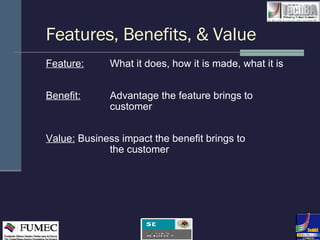
Features, Benefits, & Value Feature: What it does, how it is made, what it is Benefit: Advantage the feature brings to  customer Value: Business impact the benefit brings to  the customer
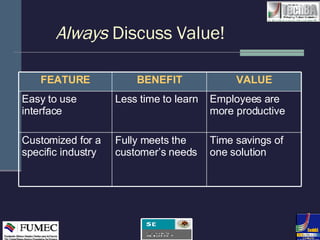
Always  Discuss Value! FEATURE BENEFIT VALUE Easy to use interface Less time to learn Employees are more productive Customized for a specific industry Fully meets the customer’s needs Time savings of one solution
Weak   Value Propositions are Everywhere It's the most technologically advanced and robust system on the market.  We improve communication and morale.  It has a simple architecture.  Our product was rated the best-in-class by leading authorities. We have good quality and low prices .
Strong  Value Propositions mean  Tangible Results Increased revenues ↑ Faster time to market ↑ Decreased costs ↓ Improved operational efficiency↑  Increased market share ↑ Decreased employee turnover ↓ Improved customer retention levels ↑
When to Use Value Propositions In email correspondence, email signatures In voice mail messages In sales presentations, brochures, company website, business cards, taglines, press release boilerplates At networking events, user groups, speaking engagements  At EVERY opportunity to discuss your company’s value
Developing the Value Proposition For (target audience) Who wants/needs (customer issue you solve) The offering (what you do) Which provides (your solution to the issue) Unlike (your other competitors) The offer (key differentiator) The evidence or proof
Testing Your Value Proposition Can your competitors’ name be inserted easily? Does your differentiator relate to the reason to buy or the specific need? Is the want or need compelling enough to warrant a purchase TODAY?
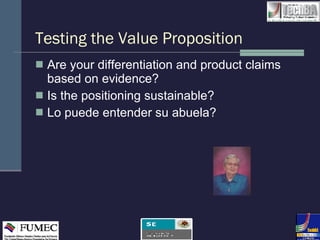
Testing the Value Proposition Are your differentiation and product claims based on evidence? Is the positioning sustainable? Lo puede entender su abuela?
Elevator Speech  Subset of the value proposition Brief statement of the company’s offer, customer profile and return on investment (ROI) When spoken, it is only 1-2 minutes in length
Elevator Speech Tip “ _____ companies call us when they want ________,_______, and __________.”
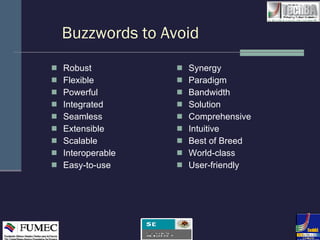
Buzzwords to Avoid Robust Flexible Powerful Integrated Seamless Extensible Scalable Interoperable Easy-to-use Synergy Paradigm Bandwidth Solution Comprehensive Intuitive Best of Breed World-class User-friendly
Write Your Elevator Speech What your company and product/service do For whom (the customer)  The results or value you deliver (the Return on Investment---ROI) For example, our customers include ___, ____, and ____. Keep it to just 1-2 minutes in length
QUESTIONS ?
Agenda Understanding the US Market The Importance of Value Differentiation in the Market Effective Presentations
Effective Presentations
1. Before You Begin What is the goal of your presentation Advance planning and preparation Manage your time Adapt for different audiences
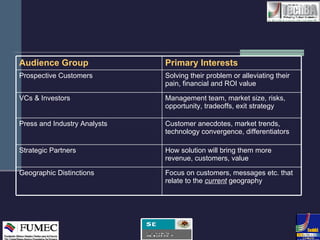
Audience Group Primary Interests Prospective Customers Solving their problem or alleviating their pain, financial and ROI value VCs & Investors Management team, market size, risks, opportunity, tradeoffs, exit strategy Press and Industry Analysts Customer anecdotes, market trends, technology convergence, differentiators Strategic Partners How solution will bring them more revenue, customers, value Geographic Distinctions Focus on customers, messages etc. that relate to the  current  geography
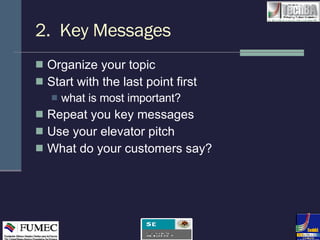
2.  Key Messages Organize your topic Start with the last point first what is most important? Repeat you key messages Use your elevator pitch What do your customers say?
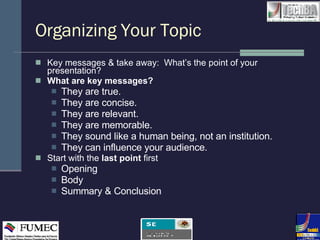
Organizing Your Topic Key messages & take away:  What’s the point of your presentation?  What are key messages? They are true. They are concise. They are relevant. They are memorable. They sound like a human being, not an institution. They can influence your audience. Start with the  last point  first Opening Body Summary & Conclusion
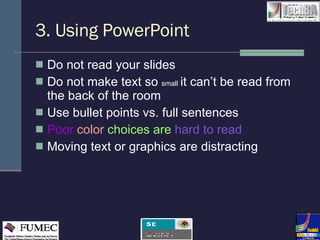
3. Using PowerPoint Do not read your slides    Do not make text so  small   it can’t be read from the back of the room Use bullet points vs. full sentences  Poor   color  choices are  hard to read Moving text or graphics are distracting
4.  Confident Delivery Opening Remarks Build credibility and rapport Content vs. voice and [persona Use stories & anecdotes effectively Reinforce your key messages Manage the time Rehearse, rehearse and rehearse again The Q & A session
Opening Remarks  Opening Remarks:  Take a few extra minutes here.  Help yourself to relax.  Help your audience to relax and focus. Building Credibility and Rapport Why are you here speaking on this topic? Who are you? What are the stories and anecdotes you will share? How will you help your audience?
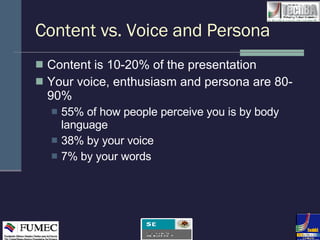
Content vs. Voice and Persona Content is 10-20% of the presentation Your voice, enthusiasm and persona are 80-90% 55% of how people perceive you is by body language 38% by your voice 7% by your words
Anecdotes & Stories Tell anecdotes, personal and customer experiences  “ In my experience…” = anecdotal evidence  “ This feature came at the request of our customers in the insurance sector and delivers this benefit.” “ I have found more often, than not, that IT directors want ___ because___.  For example, Mike Patel of SJ Medical Group requested ____ this last year.”
The Q & A Session Anticipate questions Understand the question Plan the answer Do not digress  Be honest Reinterpret loaded questions Control interchanges Use the last question to summarize your key points
Thank you for your attention Questions? Jorge Zavala CEO TechBA Silicon Valley [email_address]

TechBA roadshow 2008 V3

  • 1.
    Accelerating Your Businessinto the Global Market Mexico’s Premier Source for Innovative Technology Companies Serving the Global Market
  • 2.
    Agenda Understanding theUS Market The Importance of Value Differentiation in the Market Effective Presentations
  • 3.
  • 4.
    Understanding the Market5 Core Components Target Market Pain Point(s) Solution Proof Points Differentiation
  • 5.
    Understanding the Market5 Core Components Target Market: Ideal customer profile, basic demographic information (industry/SIC code, geography, size) Psychographic profile: preferences, values, and interests Pain: What is your target market’s pain, problem or issue that requires assistance? Is your offer the pill or vitamin?
  • 6.
    Understanding the Market5 Core Components 3 . Solution: What results can you produce when working with your customers? Expected outcomes, business value? 4. Proof Points: References, testimonials, case studies, success stories. 5. Differentiation: What makes you stand apart from the competition? What is the true advantage you deliver?
  • 7.
    Understanding the NeedWhat is the issue you are trying to solve? What pain, need or want does your product solve or meet? How is this need met without your solution? How else could the issue be resolved? Who has the problem or need? What are demographics of your ideal target market? Why do they have a need, issue or desire? What motivates them to buy?
  • 8.
    What is Value?An amount considered a suitable equivalent for something else Different kinds of value: Financial Social Career Well-being Enjoyment
  • 9.
    Value Proposition: What is it? An implicit promise your company makes to deliver upon a combination of values such as price, performance, quality, convenience, expected outcome and more.
  • 10.
    In other words….How does your solution positively impact the customer’s business?
  • 11.
    How Value isRelevant Creates a strong difference between you and the competition Forms the basis of a sales strategy Can increase the quantity and quality of prospective sales leads Can help gain market share in your targeted segments Enhances your sales tools with a clear message that helps close more business Can improve your operational efficiency
  • 12.
    Origin and ImpactValue propositions are not made up or determined. They grow out of the needs of your customers. Corporations devote extensive time and energy to their delivery and supply chains but fail to assess the most fundamental of their success factors: their value proposition
  • 13.
    Positive Impact onthe Customer’s Business Increased revenue ↑ Reducing expenses ↓ Acquire more customers ↑ Increased shareholder value ↑ Improved efficiency ↑ Decreased employee turnover ↓
  • 14.
    Real Results-- What Buyers Care About “ Our customers experience 30-40% shorter project lead times.” “ Our tracking system has reduced their materials loss by $6000 per month or more than $70,000 annually. ” “ Today, the company now experiences a 100% on-time export shipping record. ” We provide competitive pricing and guaranteed cost-savings of 25% or more.” New product sales for the second quarter increased 93% to $1.57 million due to these improvements.”
  • 15.
    Yet Another ConsiderationYour value proposition is not what you say. It is what you are. It has to be what you DO and who you ARE; not what you SAY or WANT!
  • 16.
    Common Misunderstandings Customersnever buy technology. They buy solutions to a problem or “ pain management .” Technology is an enabler to alleviate their problem. Is your solution a pain killer ( must have)? Or a vitamin (nice to have) ?
  • 17.
    Features, Benefits, &Value Feature: What it does, how it is made, what it is Benefit: Advantage the feature brings to customer Value: Business impact the benefit brings to the customer
  • 18.
    Always DiscussValue! FEATURE BENEFIT VALUE Easy to use interface Less time to learn Employees are more productive Customized for a specific industry Fully meets the customer’s needs Time savings of one solution
  • 19.
    Weak Value Propositions are Everywhere It's the most technologically advanced and robust system on the market. We improve communication and morale. It has a simple architecture. Our product was rated the best-in-class by leading authorities. We have good quality and low prices .
  • 20.
    Strong ValuePropositions mean Tangible Results Increased revenues ↑ Faster time to market ↑ Decreased costs ↓ Improved operational efficiency↑ Increased market share ↑ Decreased employee turnover ↓ Improved customer retention levels ↑
  • 21.
    When to UseValue Propositions In email correspondence, email signatures In voice mail messages In sales presentations, brochures, company website, business cards, taglines, press release boilerplates At networking events, user groups, speaking engagements At EVERY opportunity to discuss your company’s value
  • 22.
    Developing the ValueProposition For (target audience) Who wants/needs (customer issue you solve) The offering (what you do) Which provides (your solution to the issue) Unlike (your other competitors) The offer (key differentiator) The evidence or proof
  • 23.
    Testing Your ValueProposition Can your competitors’ name be inserted easily? Does your differentiator relate to the reason to buy or the specific need? Is the want or need compelling enough to warrant a purchase TODAY?
  • 24.
    Testing the ValueProposition Are your differentiation and product claims based on evidence? Is the positioning sustainable? Lo puede entender su abuela?
  • 25.
    Elevator Speech Subset of the value proposition Brief statement of the company’s offer, customer profile and return on investment (ROI) When spoken, it is only 1-2 minutes in length
  • 26.
    Elevator Speech Tip“ _____ companies call us when they want ________,_______, and __________.”
  • 27.
    Buzzwords to AvoidRobust Flexible Powerful Integrated Seamless Extensible Scalable Interoperable Easy-to-use Synergy Paradigm Bandwidth Solution Comprehensive Intuitive Best of Breed World-class User-friendly
  • 28.
    Write Your ElevatorSpeech What your company and product/service do For whom (the customer) The results or value you deliver (the Return on Investment---ROI) For example, our customers include ___, ____, and ____. Keep it to just 1-2 minutes in length
  • 29.
  • 30.
    Agenda Understanding theUS Market The Importance of Value Differentiation in the Market Effective Presentations
  • 31.
  • 32.
    1. Before YouBegin What is the goal of your presentation Advance planning and preparation Manage your time Adapt for different audiences
  • 33.
    Audience Group PrimaryInterests Prospective Customers Solving their problem or alleviating their pain, financial and ROI value VCs & Investors Management team, market size, risks, opportunity, tradeoffs, exit strategy Press and Industry Analysts Customer anecdotes, market trends, technology convergence, differentiators Strategic Partners How solution will bring them more revenue, customers, value Geographic Distinctions Focus on customers, messages etc. that relate to the current geography
  • 34.
    2. KeyMessages Organize your topic Start with the last point first what is most important? Repeat you key messages Use your elevator pitch What do your customers say?
  • 35.
    Organizing Your TopicKey messages & take away: What’s the point of your presentation? What are key messages? They are true. They are concise. They are relevant. They are memorable. They sound like a human being, not an institution. They can influence your audience. Start with the last point first Opening Body Summary & Conclusion
  • 36.
    3. Using PowerPointDo not read your slides Do not make text so small it can’t be read from the back of the room Use bullet points vs. full sentences Poor color choices are hard to read Moving text or graphics are distracting
  • 37.
    4. ConfidentDelivery Opening Remarks Build credibility and rapport Content vs. voice and [persona Use stories & anecdotes effectively Reinforce your key messages Manage the time Rehearse, rehearse and rehearse again The Q & A session
  • 38.
    Opening Remarks Opening Remarks: Take a few extra minutes here. Help yourself to relax. Help your audience to relax and focus. Building Credibility and Rapport Why are you here speaking on this topic? Who are you? What are the stories and anecdotes you will share? How will you help your audience?
  • 39.
    Content vs. Voiceand Persona Content is 10-20% of the presentation Your voice, enthusiasm and persona are 80-90% 55% of how people perceive you is by body language 38% by your voice 7% by your words
  • 40.
    Anecdotes & StoriesTell anecdotes, personal and customer experiences “ In my experience…” = anecdotal evidence “ This feature came at the request of our customers in the insurance sector and delivers this benefit.” “ I have found more often, than not, that IT directors want ___ because___. For example, Mike Patel of SJ Medical Group requested ____ this last year.”
  • 41.
    The Q &A Session Anticipate questions Understand the question Plan the answer Do not digress Be honest Reinterpret loaded questions Control interchanges Use the last question to summarize your key points
  • 42.
    Thank you foryour attention Questions? Jorge Zavala CEO TechBA Silicon Valley [email_address]