Winning Value Propositions

         July 2012
            Jedii
Why Value Propositions
• Creating a value proposition is a part of
  business strategy. Kaplan and Norton say

"Strategy is based on a differentiated customer
  value proposition. Satisfying customers is the
  source of sustainable value creation."
What is a Value Proposition?
• A value proposition is the collection of reasons why a
  person or company benefits from buying something.
• A value proposition is the solution to your
  customer’s problem. It goes hand in hand with the
  problem you are solving. I am a customer, I walk in
  with a problem, I walk out with a solution. The
  solution then is not your product or service, but the
  solution your product or service provides. i.e.: the
  end result, the value given to the customer.
From Investopedia
What Does ’Value Proposition’ Mean?
•A business or marketing statement that
summarizes why a consumer should buy a
product or use a service.
•This statement should convince a potential
consumer that one particular product or service
will add more value or better solve a problem
than other similar offerings.
Investopedia explains Value
             Proposition
• Companies use this statement to target
  customers who will benefit most from using the
  company’s products, and this helps maintain an
  economic moat.
• The ideal value proposition is concise and appeals to
  the customer’s strongest decision-making drivers.
• Companies pay a high price when customers lose
  sight of the company’s value proposition.
Reasons why people buy - Winning
       Value Propositions
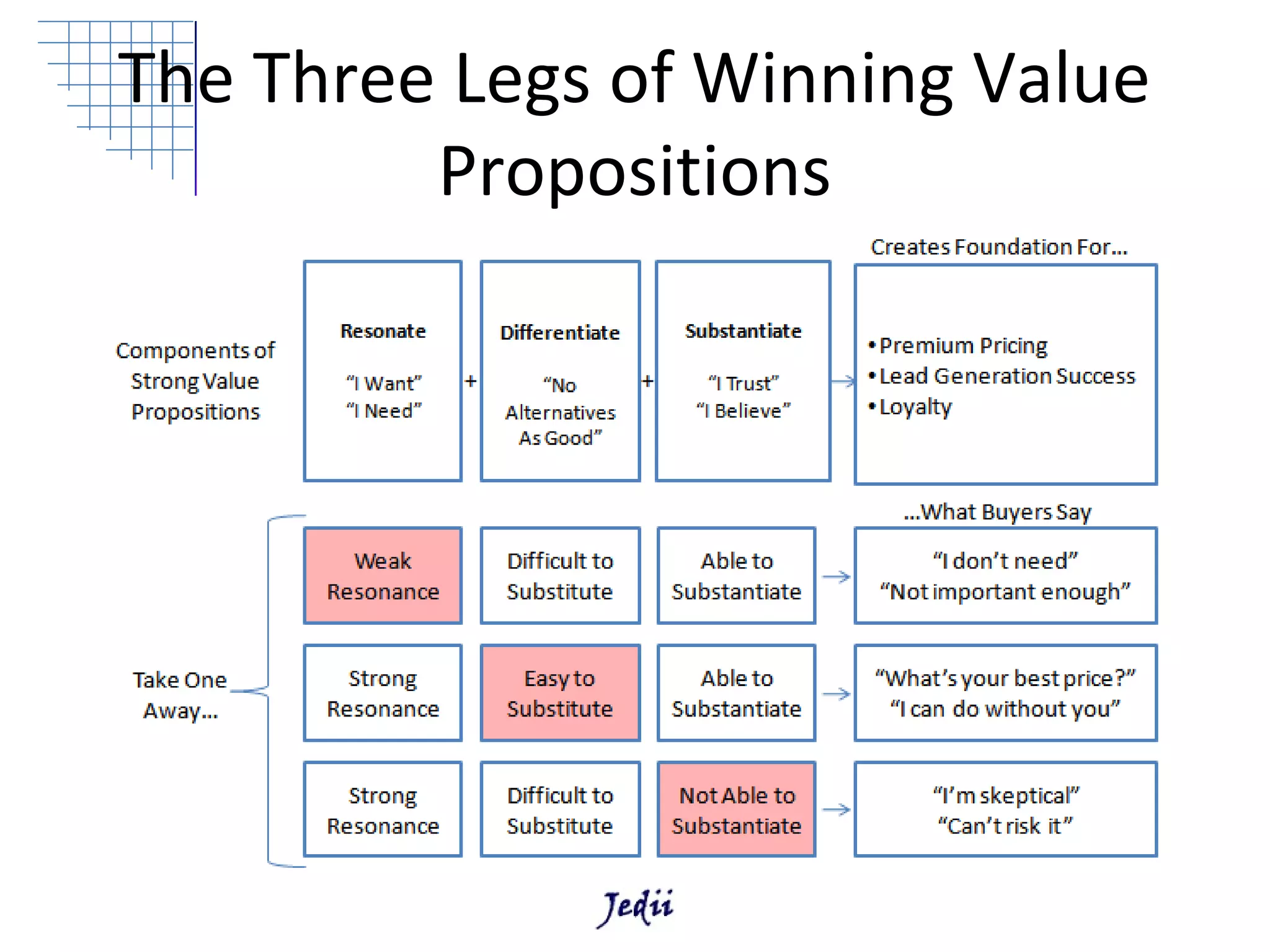
• Potential buyers have to need what you’re
  proposing. It has to resonate with them.
• Potential buyers have to see why you stand
  out from the other available options. You have
  to differentiate.
• Potential buyers have to believe that you can
  deliver on your promises. You have
  to substantiate.
Resonating Value Propositions
• Deep knowledge and understanding of
  challenges of the target segment(s) of
  users/buyers, and what they mean to them.
• Belief about the most important benefits of
  solutions, provided to the target segment
  based on experience, data, proof.
• Price, schemes, and variations considering the
  challenges and the benefits (above).
Differentiating Value Props
• Better, Faster, Cheaper
• First, Different, Great
• Stability, Flexibility

• The idea is to identify critical attributes of
  competitors’ offerings, and identify the attributes
  that are the most discouraging for potential buyers –
  and then to identify opportunities to conver those
  into our Differentiators.
Substantiating Value Props
• Value props could be substantiated based on
  identical or similar value props’ Track Record,
  Endorsements, Recommendations, Analysis
  Reports, Demos, Trials, Expression of
  Conviction, etc.
The Three Legs of Winning Value
         Propositions
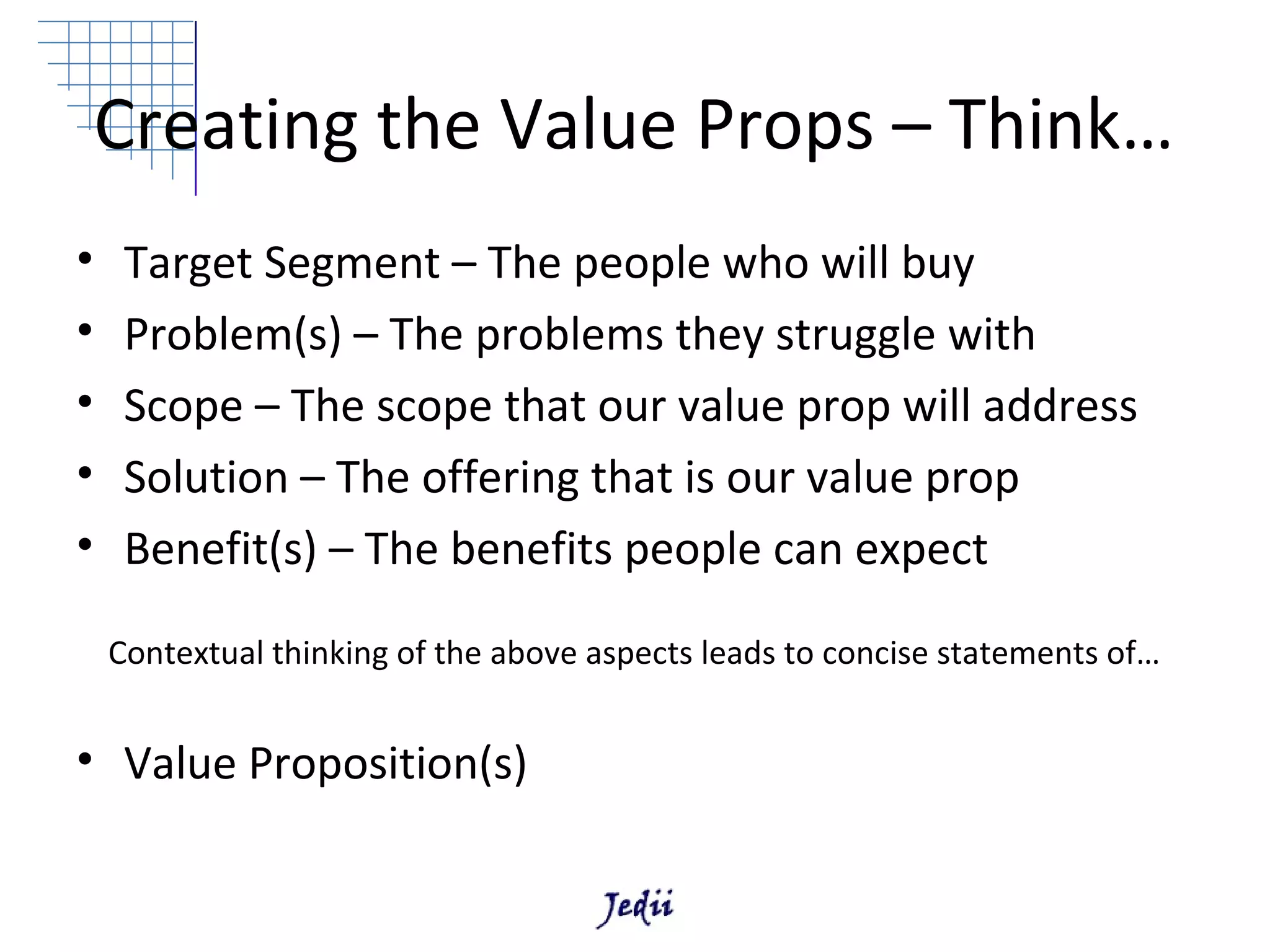
Creating the Value Props – Think…
•    Target Segment – The people who will buy
•    Problem(s) – The problems they struggle with
•    Scope – The scope that our value prop will address
•    Solution – The offering that is our value prop
•    Benefit(s) – The benefits people can expect

    Contextual thinking of the above aspects leads to concise statements of…


• Value Proposition(s)
The Value Proposition Formula
• We help [your most promising prospects] that
  [need help with their pressing concerns you
  address] succeed by [providing the material
  improvement(s) you will deliver]. Unlike [the
  alternative solution], [your solution] [describe
  the reason why your company is a better
  choice] as demonstrated by [evidence that
  you will deliver as promised].
To add value to Thinking
• Try if doing this thinking/discussion in
  workshop mode works better for you. Usually
  it does, with the right people involved.
• Do the contextual thinking and drafting of
  Value Prop statements in the same session.
• Force the Value Prop Statement(s) to be
  concise and crisp, must be clear and coherent.
• Generate divergent thinking before
  converging – SCAMPER
Sample Value Props
• Look at some sample statements of Value
  Propositions and identify how they Resonate,
  Differentiate, or Substantiate.
• Also, rate each Value Proposition on a scale of
  1 to 10, 1 being poor in effectiveness and 10
  being outstanding in effectiveness as a value
  proposition.
Summary
• Value Propositions are the most important
  first step in communicating why your offering
  should be bought.
• VPs need to Resonate, Differentiate,
  Substantiate.
• VPs must address (5) Target, Problem, Scope,
  Solution, and Benefits.
Thank you!

Winning Value Propositions

  • 1.
  • 2.
    Why Value Propositions •Creating a value proposition is a part of business strategy. Kaplan and Norton say "Strategy is based on a differentiated customer value proposition. Satisfying customers is the source of sustainable value creation."
  • 3.
    What is aValue Proposition? • A value proposition is the collection of reasons why a person or company benefits from buying something. • A value proposition is the solution to your customer’s problem. It goes hand in hand with the problem you are solving. I am a customer, I walk in with a problem, I walk out with a solution. The solution then is not your product or service, but the solution your product or service provides. i.e.: the end result, the value given to the customer.
  • 4.
    From Investopedia What Does’Value Proposition’ Mean? •A business or marketing statement that summarizes why a consumer should buy a product or use a service. •This statement should convince a potential consumer that one particular product or service will add more value or better solve a problem than other similar offerings.
  • 5.
    Investopedia explains Value Proposition • Companies use this statement to target customers who will benefit most from using the company’s products, and this helps maintain an economic moat. • The ideal value proposition is concise and appeals to the customer’s strongest decision-making drivers. • Companies pay a high price when customers lose sight of the company’s value proposition.
  • 6.
    Reasons why peoplebuy - Winning Value Propositions • Potential buyers have to need what you’re proposing. It has to resonate with them. • Potential buyers have to see why you stand out from the other available options. You have to differentiate. • Potential buyers have to believe that you can deliver on your promises. You have to substantiate.
  • 7.
    Resonating Value Propositions •Deep knowledge and understanding of challenges of the target segment(s) of users/buyers, and what they mean to them. • Belief about the most important benefits of solutions, provided to the target segment based on experience, data, proof. • Price, schemes, and variations considering the challenges and the benefits (above).
  • 8.
    Differentiating Value Props •Better, Faster, Cheaper • First, Different, Great • Stability, Flexibility • The idea is to identify critical attributes of competitors’ offerings, and identify the attributes that are the most discouraging for potential buyers – and then to identify opportunities to conver those into our Differentiators.
  • 9.
    Substantiating Value Props •Value props could be substantiated based on identical or similar value props’ Track Record, Endorsements, Recommendations, Analysis Reports, Demos, Trials, Expression of Conviction, etc.
  • 10.
    The Three Legsof Winning Value Propositions
  • 11.
    Creating the ValueProps – Think… • Target Segment – The people who will buy • Problem(s) – The problems they struggle with • Scope – The scope that our value prop will address • Solution – The offering that is our value prop • Benefit(s) – The benefits people can expect Contextual thinking of the above aspects leads to concise statements of… • Value Proposition(s)
  • 12.
    The Value PropositionFormula • We help [your most promising prospects] that [need help with their pressing concerns you address] succeed by [providing the material improvement(s) you will deliver]. Unlike [the alternative solution], [your solution] [describe the reason why your company is a better choice] as demonstrated by [evidence that you will deliver as promised].
  • 13.
    To add valueto Thinking • Try if doing this thinking/discussion in workshop mode works better for you. Usually it does, with the right people involved. • Do the contextual thinking and drafting of Value Prop statements in the same session. • Force the Value Prop Statement(s) to be concise and crisp, must be clear and coherent. • Generate divergent thinking before converging – SCAMPER
  • 14.
    Sample Value Props •Look at some sample statements of Value Propositions and identify how they Resonate, Differentiate, or Substantiate. • Also, rate each Value Proposition on a scale of 1 to 10, 1 being poor in effectiveness and 10 being outstanding in effectiveness as a value proposition.
  • 15.
    Summary • Value Propositionsare the most important first step in communicating why your offering should be bought. • VPs need to Resonate, Differentiate, Substantiate. • VPs must address (5) Target, Problem, Scope, Solution, and Benefits.
  • 16.

Editor's Notes

  • #14 SCAMPER: Scamper is an acronym for a set of techniques that help you see things different. S ubstitute - Replace all or part of your product, service, or process with something else. Change out the people, place, time or situation with something else. C ombine - Put parts together. Mix and integrate typically disconnected parts. Bring together other ideas and situations. What ideas can be combined? What about a blend? What about an ensemble? What materials could you combine? What else can be merged with this. A dapt - How can you alter, change, or use part of another element? Can you change it to meet your purpose? Is there something you could copy? What style could you emulate? What could you make it look like? What idea can you incorporate? M odify - What if this were somewhat changed? How can this be altered for the better? How about a new twist? What change can we make in the process? What about changing its shape? P ut To Other Use - What are other ways you can put your challenge to use? E liminate - What can be taken away? What isn't truly necessary? What isn't required for functionality? What if it were smaller? R earrange - What if the order were changed? Where should this part be placed in relation to that? What other layout might be better? What about timing? Or a change of pace?