

Creating Customer Value
PREPARED BY ANDRÉ HARRELL
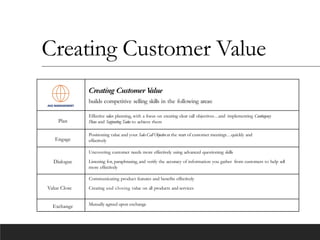
Creating Customer Value
Creating Customer V
alue
builds competitive selling skills in the following areas:
Plan
Effective sales planning, with a focus on creating clear call objectives…and implementing Contingency
Plans and Supporting Tactics to achieve them
Engage
Positioning value and your SalesCall Objectiveat the start of customer meetings…quickly and
effectively
Dialogue
Uncovering customer needs more effectively using advanced questioning skills
Listening for, paraphrasing, and verify the accuracy of information you gather from customers to help sell
more effectively
Value Close
Communicating product features and benefits effectively
Creating and closing value on all products and services
Exchange Mutually agreed upon exchange
Plan
• Sales Call Objectives
• Contingency Plans
/Supporting Tactics
Plan
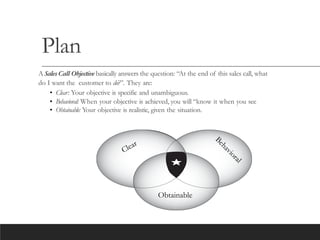
A SalesCall Objective basically answers the question: “At the end of this sales call, what
do I want the customer to do?”. They are:
• Clear: Your objective is specific and unambiguous.
• Behavioral: When your objective is achieved, you will “know it when you see
• Obtainable: Your objective is realistic, given the situation.
B
e
h
a
v
i
o
r
a
l
Clear
Obtainable
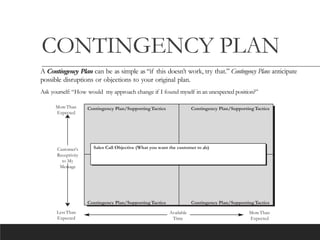
CONTINGENCY PLAN
A Contingency Plan can be as simple as “if this doesn’t work, try that.” Contingency Plans anticipate
possible disruptions or objections to your original plan.
Ask yourself: “How would my approach change if I found myself in an unexpected position?”
Contingency Plan/SupportingTactics
Contingency Plan/SupportingTactics Contingency Plan/SupportingTactics
Contingency Plan/SupportingTactics
MoreThan
Expected
LessThan
Expected
Available
Time
MoreThan
Expected
Sales Call Objective (What you want the customer to do)
Customer’s
Receptivity
to My
Message
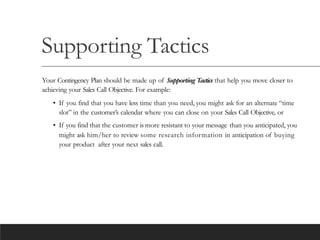
Supporting Tactics
Your Contingency Plan should be made up of Supporting Tactics that help you move closer to
achieving your Sales Call Objective. For example:
• If you find that you have less time than you need, you might ask for an alternate “time
slot” in the customer’s calendar where you can close on your Sales Call Objective, or
• If you find that the customer is more resistant to your message than you anticipated, you
might ask him/her to review some research information in anticipation of buying
your product after your next sales call.
Engage
• Position the Sales
Call Objective
Engage
To sell competitively, we need a compelling message in every customer interaction. Most actual
selling opportunities are limited. Every word counts, especially the first words we speak on each
sales call. To be prepared, we need good answers to two key questions: “Who should I
approach?” and “How should I approach them?”
Position Sales Call Objective
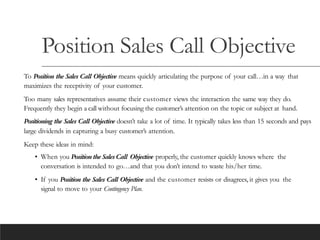
To Position the Sales Call Objective means quickly articulating the purpose of your call…in a way that
maximizes the receptivity of your customer.
Too many sales representatives assume their customer views the interaction the same way they do.
Frequently they begin a call without focusing the customer’s attention on the topic or subject at hand.
Positioning the Sales Call Objective doesn’t take a lot of time. It typically takes less than 15 seconds and pays
large dividends in capturing a busy customer’s attention.
Keep these ideas in mind:
• When you Position the SalesCall Objective properly, the customer quickly knows where the
conversation is intended to go…and that you don’t intend to waste his/her time.
• If you Position the Sales Call Objective and the customer resists or disagrees, it gives you the
signal to move to your Contingency Plan.
Position Sales Call Objective
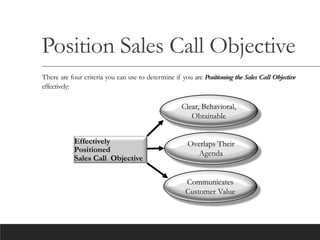
There are four criteria you can use to determine if you are Positioning the Sales Call Objective
effectively:
Effectively
Positioned
Sales Call Objective
Clear, Behavioral,
Obtainable
Overlaps Their
Agenda
Communicates
Customer Value
Dialogue
• Stage 2 Questions
• Paraphrase and Verify
Dialogue
The ability to sell the value of your product/service is greatly enhanced when you know more about
the customer, his or her needs, pain points, buying habits, inspiration. The better you can uncover
the subtle or less-apparent motivation of the customer, the better you can sell to it.
CAN YOU ANSWER THE KEY QUESTIONS?
• What’s important to this customer? Why?
• How do they view my product/service versus our competitor?
• What issues/challenges does he/she encounter when treating a disease state specific to
my drug (or the competitions’)?
• Why does he/she use my drug (or my competitions’)?
There is so much emphasis on asking questions. The purpose is not to ask a question just to ask a
question. The purpose is to uncover a need/inspiration.
Dialogue
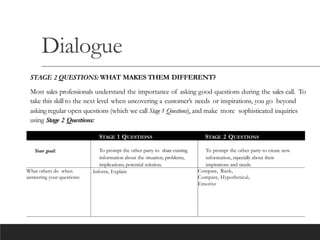
STAGE 2 QUESTIONS: WHAT MAKES THEM DIFFERENT?
Most sales professionals understand the importance of asking good questions during the sales call. To
take this skill to the next level when uncovering a customer’s needs or inspirations, you go beyond
asking regular open questions (which we call Stage 1 Questions), and make more sophisticated inquiries
using Stage 2 Questions:
STAGE 1 QUESTIONS STAGE 2 QUESTIONS
Your goal: To prompt the other party to share existing
information about the situation, problems,
implications, potential solution.
To prompt the other party to create new
information, especially about their
inspirations and needs.
What others do when
answering your questions:
Inform, Explain Compare, Rank,
Compare, Hypothetical,
Emotive
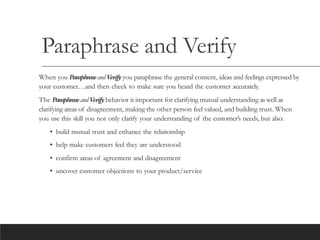
Paraphrase and Verify
When you ParaphraseandVerify you paraphrase the general content, ideas and feelings expressed by
your customer…and then check to make sure you heard the customer accurately.
The ParaphraseandVerify behavior is important for clarifying mutual understanding aswell as
clarifying areas of disagreement, making the other person feel valued, and building trust. When
you use this skill you not only clarify your understanding of the customer’s needs, but also:
• build mutual trust and enhance the relationship
• help make customers feel they are understood
• confirm areas of agreement and disagreement
• uncover customer objections to your product/service
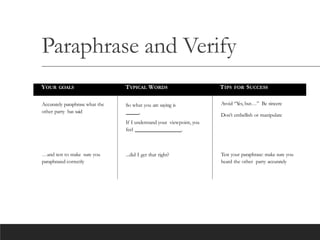
Paraphrase and Verify
YOUR GOALS TYPICAL WORDS TIPS FOR SUCCESS
Accurately paraphrase what the
other party has said
So what you are saying is
.
If I understand your viewpoint, you
feel .
Avoid “Y
es, but…” Be sincere
Don’t embellish or manipulate
…and test to make sure you
paraphrased correctly
...did I get that right? Test your paraphrase: make sure you
heard the other party accurately
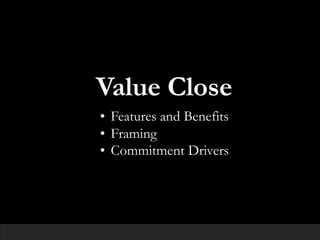
Value Close
• Features and Benefits
• Framing
• Commitment Drivers
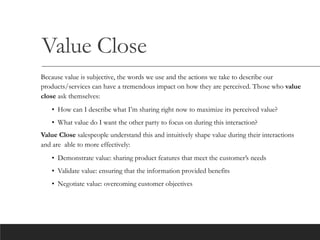
Value Close
Because value is subjective, the words we use and the actions we take to describe our
products/services can have a tremendous impact on how they are perceived. Those who value
close ask themselves:
• How can I describe what I’m sharing right now to maximize its perceived value?
• What value do I want the other party to focus on during this interaction?
Value Close salespeople understand this and intuitively shape value during their interactions
and are able to more effectively:
• Demonstrate value: sharing product features that meet the customer’s needs
• Validate value: ensuring that the information provided benefits
• Negotiate value: overcoming customer objectives
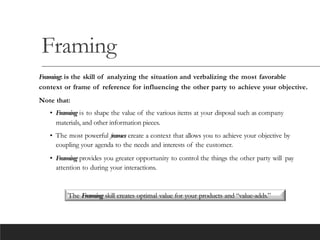
Framing
Framing: is the skill of analyzing the situation and verbalizing the most favorable
context or frame of reference for influencing the other party to achieve your objective.
Note that:
• Framing is to shape the value of the various items at your disposal such as company
materials, and other information pieces.
• The most powerful frames create a context that allows you to achieve your objective by
coupling your agenda to the needs and interests of the customer.
• Framing provides you greater opportunity to control the things the other party will pay
attention to during your interactions.
The Framing skill creates optimal value for your products and “value-adds.”
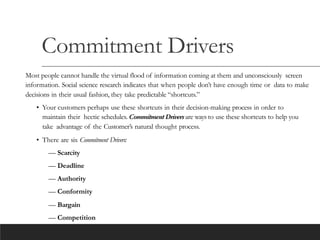
Commitment Drivers
Most people cannot handle the virtual flood of information coming at them and unconsciously screen
information. Social science research indicates that when people don’t have enough time or data to make
decisions in their usual fashion, they take predictable “shortcuts.”
• Your customers perhaps use these shortcuts in their decision-making process in order to
maintain their hectic schedules. Commitment Driversare ways to use these shortcuts to help you
take advantage of the Customer’s natural thought process.
• There are six Commitment Drivers:
— Scarcity
— Deadline
— Authority
— Conformity
— Bargain
— Competition
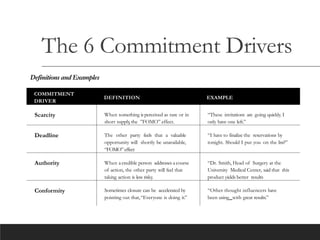
The 6 Commitment Drivers
Definitions and Examples
COMMITMENT
DRIVER
DEFINITION EXAMPLE
Scarcity When something isperceived as rare or in
short supply
, the ”FOMO” effect.
“These invitations are going quickly. I
only have one left.”
Deadline The other party feels that a valuable
opportunity will shortly be unavailable,
“FOMO”effect
“I have to finalize the reservations by
tonight. Should I put you on the list?”
Authority When a credible person addresses a course
of action, the other party will feel that
taking action is less risky.
“Dr. Smith, Head of Surgery at the
University Medical Center, said that this
product yields better results
Conformity Sometimes closure can be accelerated by
pointing out that,“Everyone is doing it.”
“Other thought influencers have
been using with great results.”
The 6 Commitment Drivers
Definitions and Examples cont.
COMMITMENT
DRIVER DEFINITION EXAMPLE
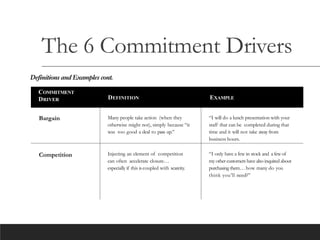
Bargain Many people take action (when they
otherwise might not), simply because “it
was too good a deal to pass up.”
“I will do a lunch presentation with your
staff that can be completed during that
time and it will not take away from
business hours.
Competition Injecting an element of competition
can often accelerate closure…
especially if this iscoupled with scarcity.
“I only have a few in stock and a few of
my other customers have also inquired about
purchasing them… how many do you
think you’ll need?”
Exchange
• Expectations
Exchange
In a world (“global pandemic”) where the sales process has become so fluid and, in many
cases, uncertain due to uncertainty, the ability to ensure there’s a valued exchange is so
important. Great sales performers understand that when value is agreed upon the exchange of
products/services for capital should happen naturally.
Great sales performers ask themselves:
• Did I gain agreement on the value of our products/services during the value/close sales
process?
• What small exchange commitments can I ask for that will improve my relationship or help
differentiate my products?
• What items that I have might increase the value when entering the exchange with the customer?
Expectations
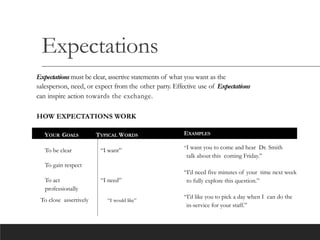
Expectations must be clear, assertive statements of what you want as the
salesperson, need, or expect from the other party. Effective use of Expectations
can inspire action towards the exchange.
EXAMPLES
To close assertively
HOW EXPECTATIONS WORK
YOUR GOALS TYPICAL WORDS
To be clear “I want”
To gain respect
To act “I need”
professionally
“I would like”
“I want you to come and hear Dr. Smith
talk about this coming Friday.”
“I’d need five minutes of your time next week
to fully explore this question.”
“I’d like you to pick a day when I can do the
in-service for your staff.”
Thank You!
ANDRÉ HARRELL (AH2 MANAGEMENT)

Creating Customer Value Selling

  • 1.
  • 2.
    Creating Customer Value CreatingCustomer V alue builds competitive selling skills in the following areas: Plan Effective sales planning, with a focus on creating clear call objectives…and implementing Contingency Plans and Supporting Tactics to achieve them Engage Positioning value and your SalesCall Objectiveat the start of customer meetings…quickly and effectively Dialogue Uncovering customer needs more effectively using advanced questioning skills Listening for, paraphrasing, and verify the accuracy of information you gather from customers to help sell more effectively Value Close Communicating product features and benefits effectively Creating and closing value on all products and services Exchange Mutually agreed upon exchange
  • 3.
    Plan • Sales CallObjectives • Contingency Plans /Supporting Tactics
  • 4.
    Plan A SalesCall Objectivebasically answers the question: “At the end of this sales call, what do I want the customer to do?”. They are: • Clear: Your objective is specific and unambiguous. • Behavioral: When your objective is achieved, you will “know it when you see • Obtainable: Your objective is realistic, given the situation. B e h a v i o r a l Clear Obtainable
  • 5.
    CONTINGENCY PLAN A ContingencyPlan can be as simple as “if this doesn’t work, try that.” Contingency Plans anticipate possible disruptions or objections to your original plan. Ask yourself: “How would my approach change if I found myself in an unexpected position?” Contingency Plan/SupportingTactics Contingency Plan/SupportingTactics Contingency Plan/SupportingTactics Contingency Plan/SupportingTactics MoreThan Expected LessThan Expected Available Time MoreThan Expected Sales Call Objective (What you want the customer to do) Customer’s Receptivity to My Message
  • 6.
    Supporting Tactics Your ContingencyPlan should be made up of Supporting Tactics that help you move closer to achieving your Sales Call Objective. For example: • If you find that you have less time than you need, you might ask for an alternate “time slot” in the customer’s calendar where you can close on your Sales Call Objective, or • If you find that the customer is more resistant to your message than you anticipated, you might ask him/her to review some research information in anticipation of buying your product after your next sales call.
  • 7.
    Engage • Position theSales Call Objective
  • 8.
    Engage To sell competitively,we need a compelling message in every customer interaction. Most actual selling opportunities are limited. Every word counts, especially the first words we speak on each sales call. To be prepared, we need good answers to two key questions: “Who should I approach?” and “How should I approach them?”
  • 9.
    Position Sales CallObjective To Position the Sales Call Objective means quickly articulating the purpose of your call…in a way that maximizes the receptivity of your customer. Too many sales representatives assume their customer views the interaction the same way they do. Frequently they begin a call without focusing the customer’s attention on the topic or subject at hand. Positioning the Sales Call Objective doesn’t take a lot of time. It typically takes less than 15 seconds and pays large dividends in capturing a busy customer’s attention. Keep these ideas in mind: • When you Position the SalesCall Objective properly, the customer quickly knows where the conversation is intended to go…and that you don’t intend to waste his/her time. • If you Position the Sales Call Objective and the customer resists or disagrees, it gives you the signal to move to your Contingency Plan.
  • 10.
    Position Sales CallObjective There are four criteria you can use to determine if you are Positioning the Sales Call Objective effectively: Effectively Positioned Sales Call Objective Clear, Behavioral, Obtainable Overlaps Their Agenda Communicates Customer Value
  • 11.
    Dialogue • Stage 2Questions • Paraphrase and Verify
  • 12.
    Dialogue The ability tosell the value of your product/service is greatly enhanced when you know more about the customer, his or her needs, pain points, buying habits, inspiration. The better you can uncover the subtle or less-apparent motivation of the customer, the better you can sell to it. CAN YOU ANSWER THE KEY QUESTIONS? • What’s important to this customer? Why? • How do they view my product/service versus our competitor? • What issues/challenges does he/she encounter when treating a disease state specific to my drug (or the competitions’)? • Why does he/she use my drug (or my competitions’)? There is so much emphasis on asking questions. The purpose is not to ask a question just to ask a question. The purpose is to uncover a need/inspiration.
  • 13.
    Dialogue STAGE 2 QUESTIONS:WHAT MAKES THEM DIFFERENT? Most sales professionals understand the importance of asking good questions during the sales call. To take this skill to the next level when uncovering a customer’s needs or inspirations, you go beyond asking regular open questions (which we call Stage 1 Questions), and make more sophisticated inquiries using Stage 2 Questions: STAGE 1 QUESTIONS STAGE 2 QUESTIONS Your goal: To prompt the other party to share existing information about the situation, problems, implications, potential solution. To prompt the other party to create new information, especially about their inspirations and needs. What others do when answering your questions: Inform, Explain Compare, Rank, Compare, Hypothetical, Emotive
  • 14.
    Paraphrase and Verify Whenyou ParaphraseandVerify you paraphrase the general content, ideas and feelings expressed by your customer…and then check to make sure you heard the customer accurately. The ParaphraseandVerify behavior is important for clarifying mutual understanding aswell as clarifying areas of disagreement, making the other person feel valued, and building trust. When you use this skill you not only clarify your understanding of the customer’s needs, but also: • build mutual trust and enhance the relationship • help make customers feel they are understood • confirm areas of agreement and disagreement • uncover customer objections to your product/service
  • 15.
    Paraphrase and Verify YOURGOALS TYPICAL WORDS TIPS FOR SUCCESS Accurately paraphrase what the other party has said So what you are saying is . If I understand your viewpoint, you feel . Avoid “Y es, but…” Be sincere Don’t embellish or manipulate …and test to make sure you paraphrased correctly ...did I get that right? Test your paraphrase: make sure you heard the other party accurately
  • 16.
    Value Close • Featuresand Benefits • Framing • Commitment Drivers
  • 17.
    Value Close Because valueis subjective, the words we use and the actions we take to describe our products/services can have a tremendous impact on how they are perceived. Those who value close ask themselves: • How can I describe what I’m sharing right now to maximize its perceived value? • What value do I want the other party to focus on during this interaction? Value Close salespeople understand this and intuitively shape value during their interactions and are able to more effectively: • Demonstrate value: sharing product features that meet the customer’s needs • Validate value: ensuring that the information provided benefits • Negotiate value: overcoming customer objectives
  • 18.
    Framing Framing: is theskill of analyzing the situation and verbalizing the most favorable context or frame of reference for influencing the other party to achieve your objective. Note that: • Framing is to shape the value of the various items at your disposal such as company materials, and other information pieces. • The most powerful frames create a context that allows you to achieve your objective by coupling your agenda to the needs and interests of the customer. • Framing provides you greater opportunity to control the things the other party will pay attention to during your interactions. The Framing skill creates optimal value for your products and “value-adds.”
  • 19.
    Commitment Drivers Most peoplecannot handle the virtual flood of information coming at them and unconsciously screen information. Social science research indicates that when people don’t have enough time or data to make decisions in their usual fashion, they take predictable “shortcuts.” • Your customers perhaps use these shortcuts in their decision-making process in order to maintain their hectic schedules. Commitment Driversare ways to use these shortcuts to help you take advantage of the Customer’s natural thought process. • There are six Commitment Drivers: — Scarcity — Deadline — Authority — Conformity — Bargain — Competition
  • 20.
    The 6 CommitmentDrivers Definitions and Examples COMMITMENT DRIVER DEFINITION EXAMPLE Scarcity When something isperceived as rare or in short supply , the ”FOMO” effect. “These invitations are going quickly. I only have one left.” Deadline The other party feels that a valuable opportunity will shortly be unavailable, “FOMO”effect “I have to finalize the reservations by tonight. Should I put you on the list?” Authority When a credible person addresses a course of action, the other party will feel that taking action is less risky. “Dr. Smith, Head of Surgery at the University Medical Center, said that this product yields better results Conformity Sometimes closure can be accelerated by pointing out that,“Everyone is doing it.” “Other thought influencers have been using with great results.”
  • 21.
    The 6 CommitmentDrivers Definitions and Examples cont. COMMITMENT DRIVER DEFINITION EXAMPLE Bargain Many people take action (when they otherwise might not), simply because “it was too good a deal to pass up.” “I will do a lunch presentation with your staff that can be completed during that time and it will not take away from business hours. Competition Injecting an element of competition can often accelerate closure… especially if this iscoupled with scarcity. “I only have a few in stock and a few of my other customers have also inquired about purchasing them… how many do you think you’ll need?”
  • 22.
  • 23.
    Exchange In a world(“global pandemic”) where the sales process has become so fluid and, in many cases, uncertain due to uncertainty, the ability to ensure there’s a valued exchange is so important. Great sales performers understand that when value is agreed upon the exchange of products/services for capital should happen naturally. Great sales performers ask themselves: • Did I gain agreement on the value of our products/services during the value/close sales process? • What small exchange commitments can I ask for that will improve my relationship or help differentiate my products? • What items that I have might increase the value when entering the exchange with the customer?
  • 24.
    Expectations Expectations must beclear, assertive statements of what you want as the salesperson, need, or expect from the other party. Effective use of Expectations can inspire action towards the exchange. EXAMPLES To close assertively HOW EXPECTATIONS WORK YOUR GOALS TYPICAL WORDS To be clear “I want” To gain respect To act “I need” professionally “I would like” “I want you to come and hear Dr. Smith talk about this coming Friday.” “I’d need five minutes of your time next week to fully explore this question.” “I’d like you to pick a day when I can do the in-service for your staff.”
  • 25.
    Thank You! ANDRÉ HARRELL(AH2 MANAGEMENT)