Value
Proposition
“Value is the core of
any business, and it
directs all future
decisions, innovations,
and customers that
get targeted.
Definition/
Background of the
Value Proposition
What is a Value Proposition?
⬡ Typically, a value proposition is a
sentence or paragraph that clearly
articulates what your service,
business, or organization does,
who it brings value to, and why it’s
valuable for those people
✨
Worth
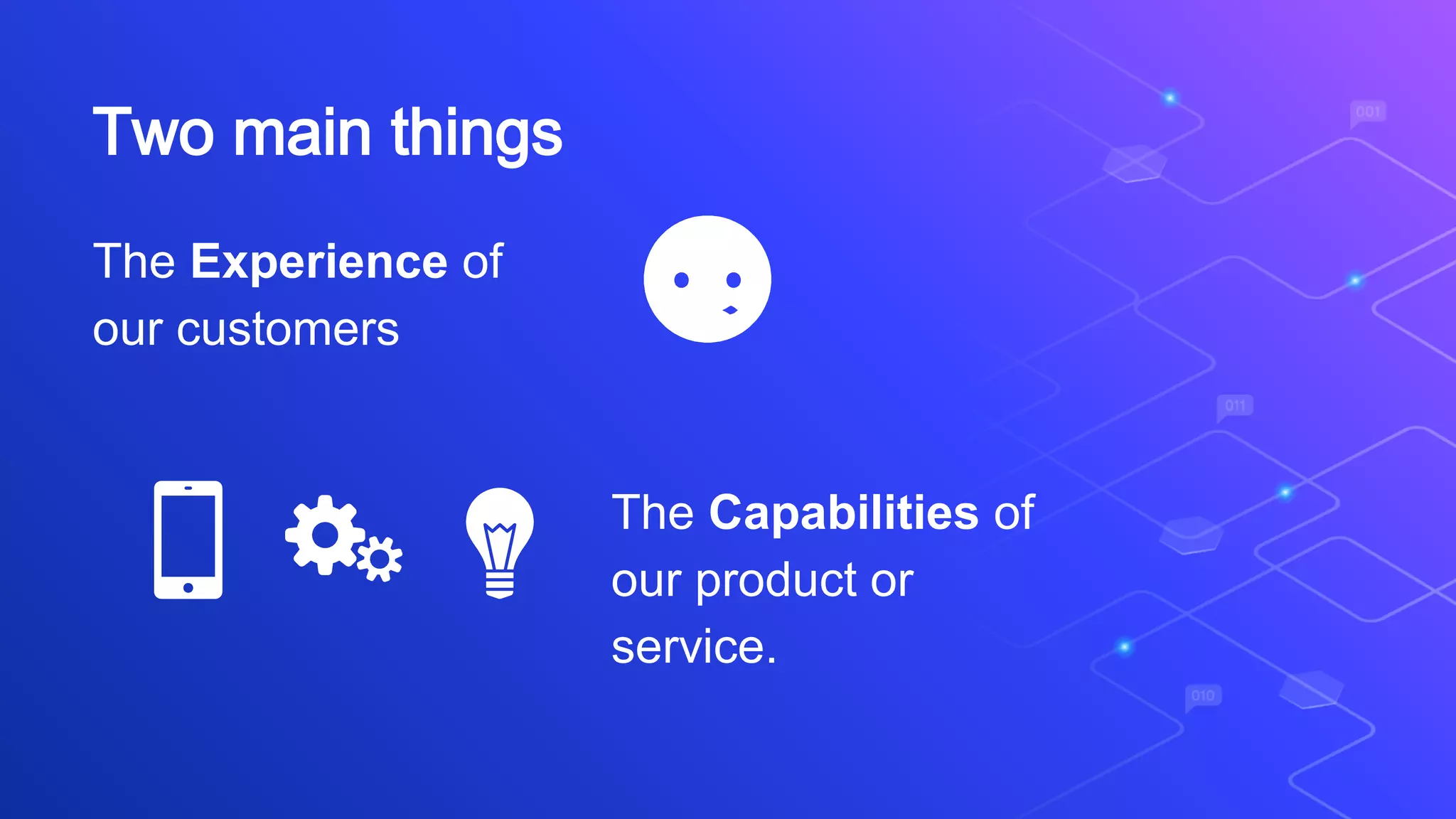
The Experience of
our customers
Two main things
The Capabilities of
our product or
service.
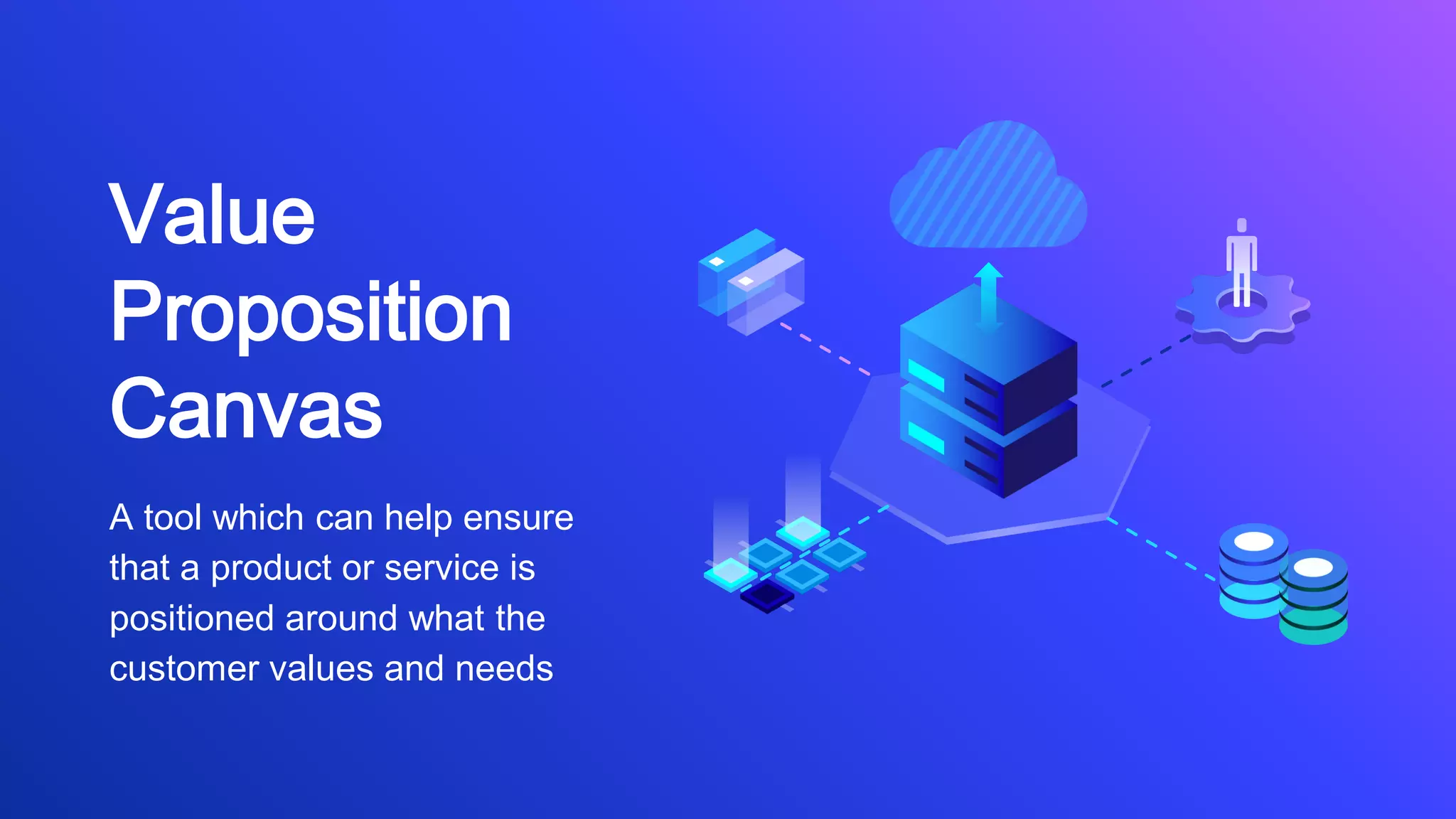
Value
Proposition
Canvas
A tool which can help ensure
that a product or service is
positioned around what the
customer values and needs
Value
Proposition
Canvas
The Value Proposition Canvas
can be used when there is need
to refine an existing product or
service offering or where a new
offering is being developed from
scratch.
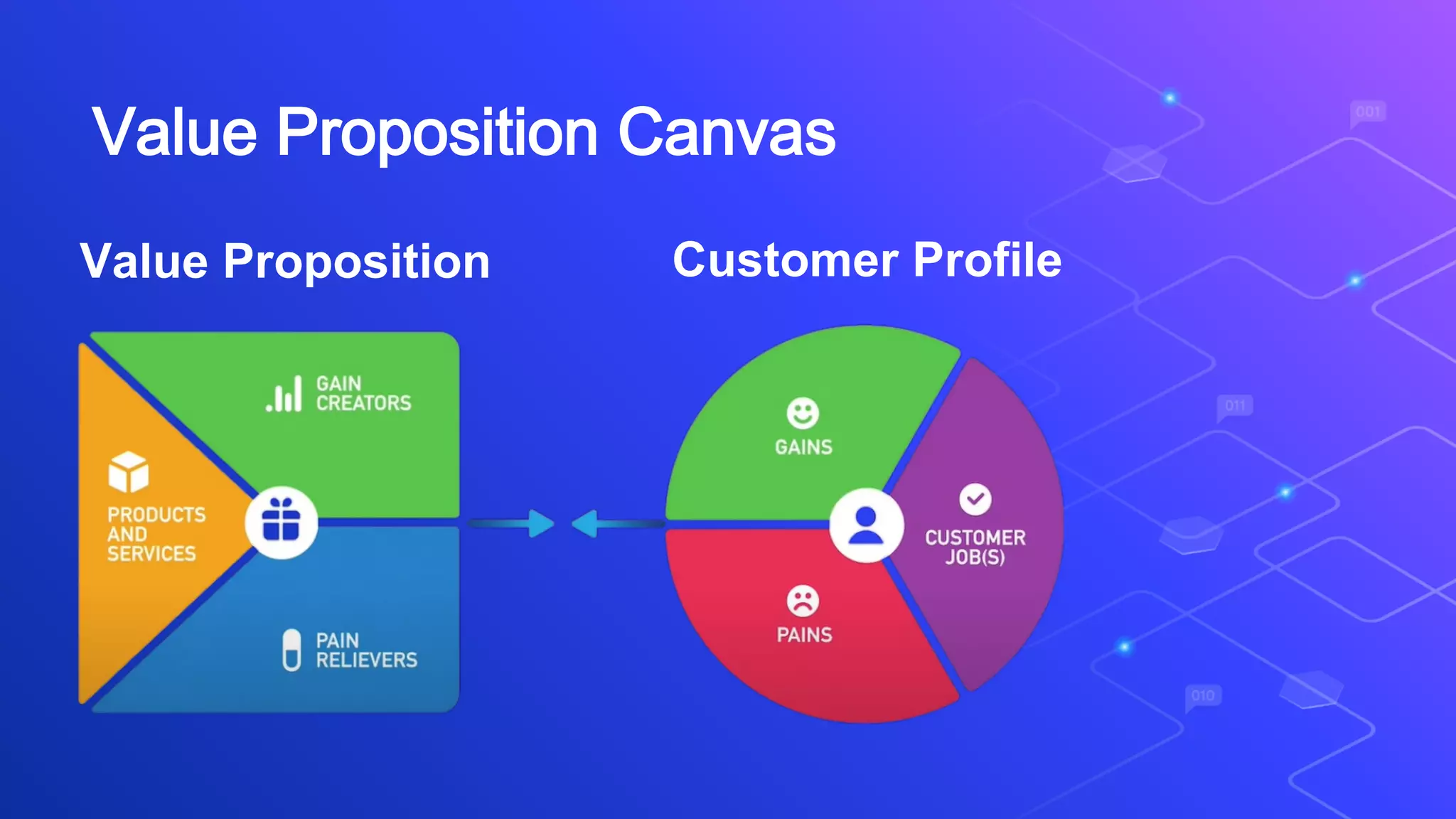
Value Proposition
Value Proposition Canvas
Customer Profile
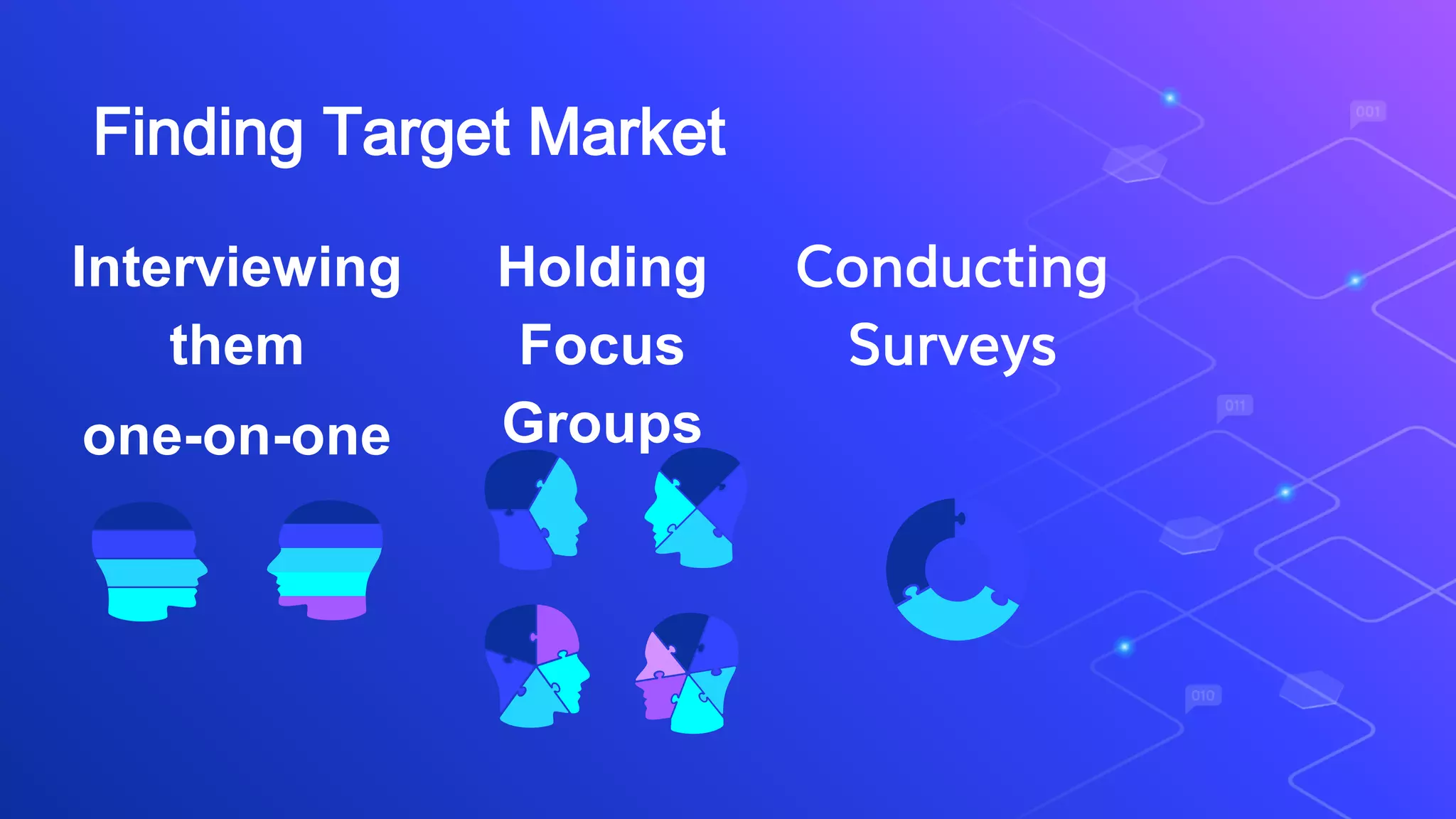
Finding Target Market
Interviewing
them
one-on-one
Holding
Focus
Groups
Conducting
Surveys
To investigate the who, what, where,
when, why, and how of your target
market.
Finding Target Market
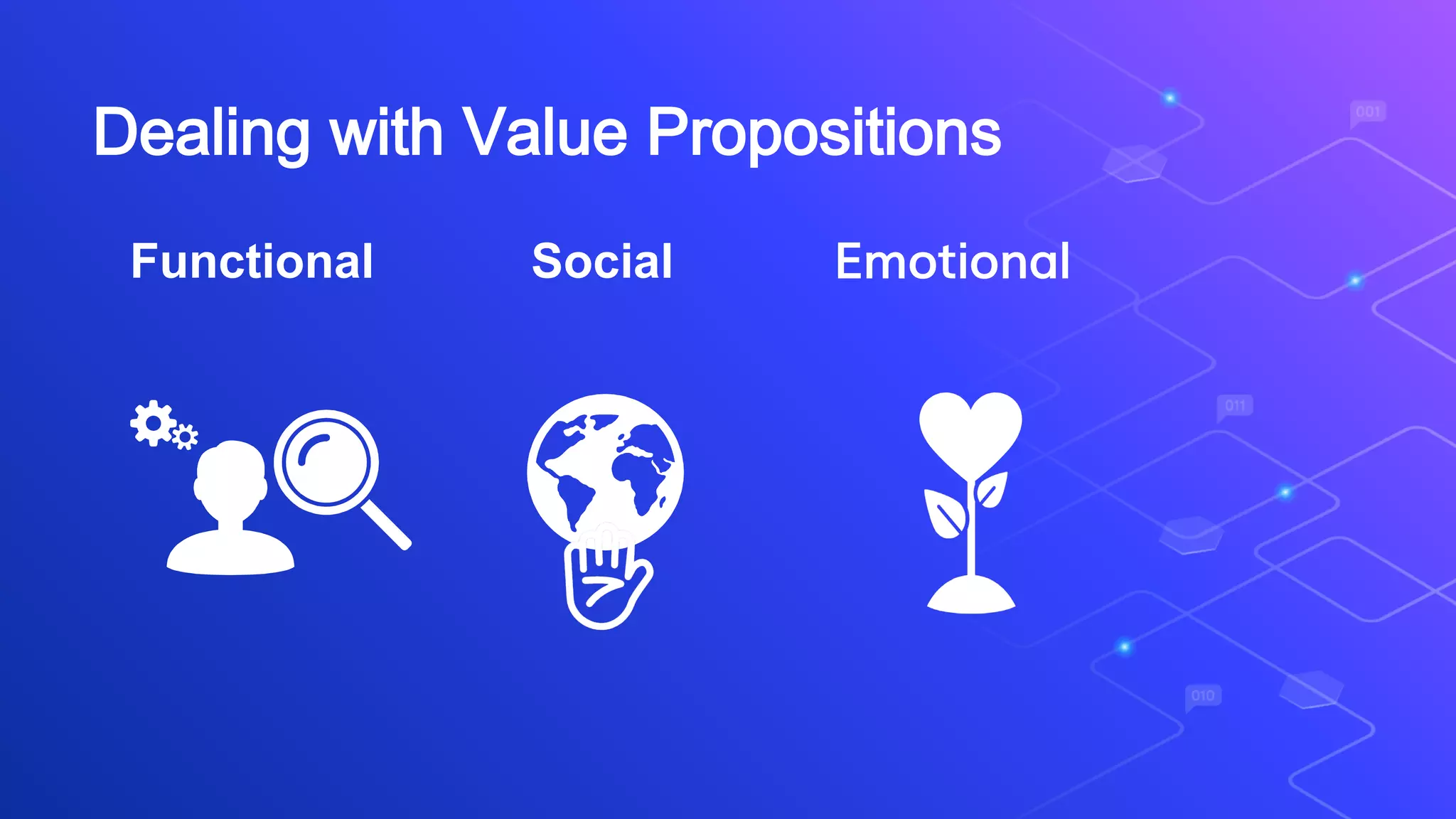
Dealing with Value Propositions
Functional Social Emotional
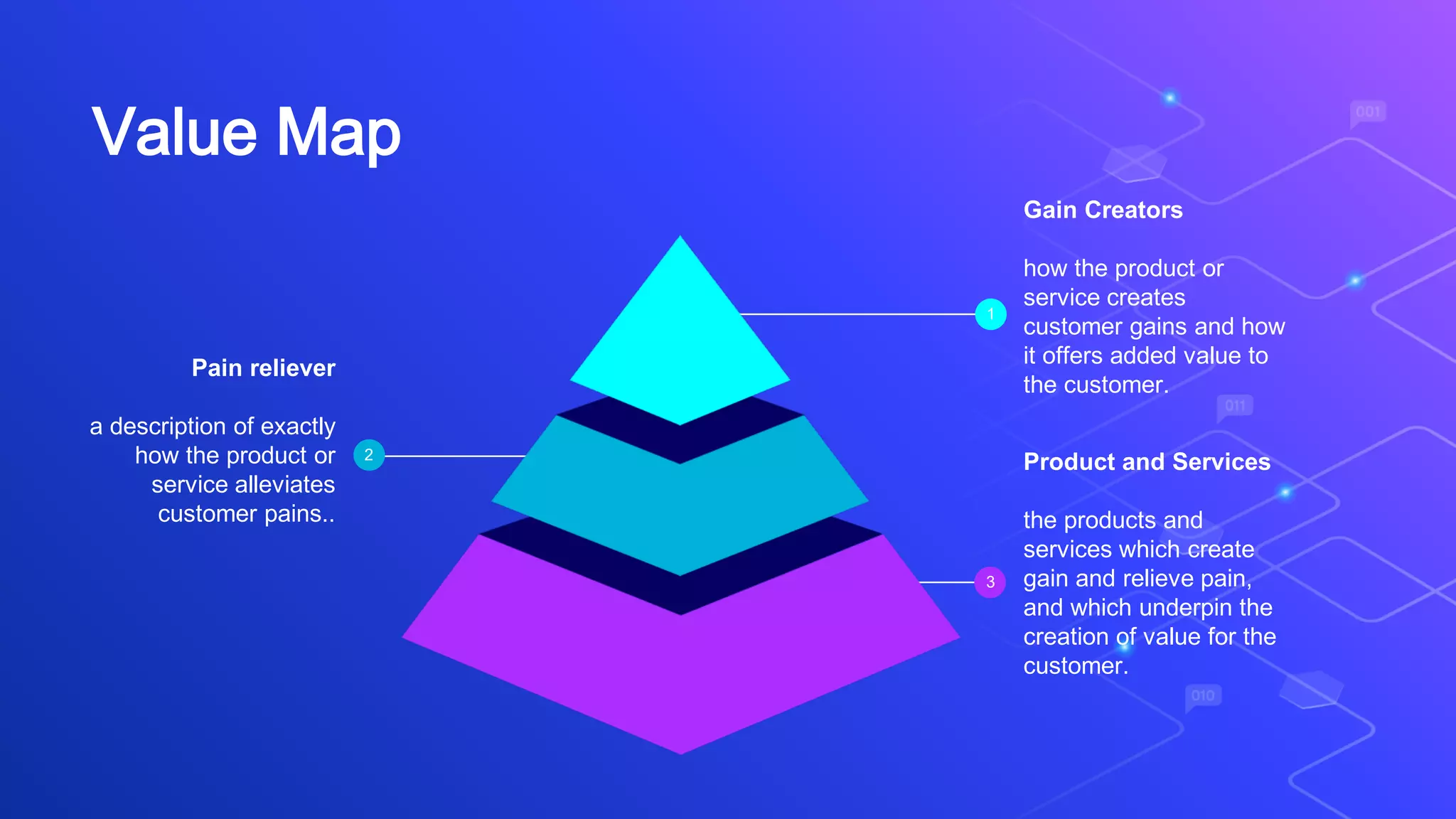
Value Map
Gain Creators
how the product or
service creates
customer gains and how
it offers added value to
the customer.
1
Product and Services
the products and
services which create
gain and relieve pain,
and which underpin the
creation of value for the
customer.
3
Pain reliever
a description of exactly
how the product or
service alleviates
customer pains..
2
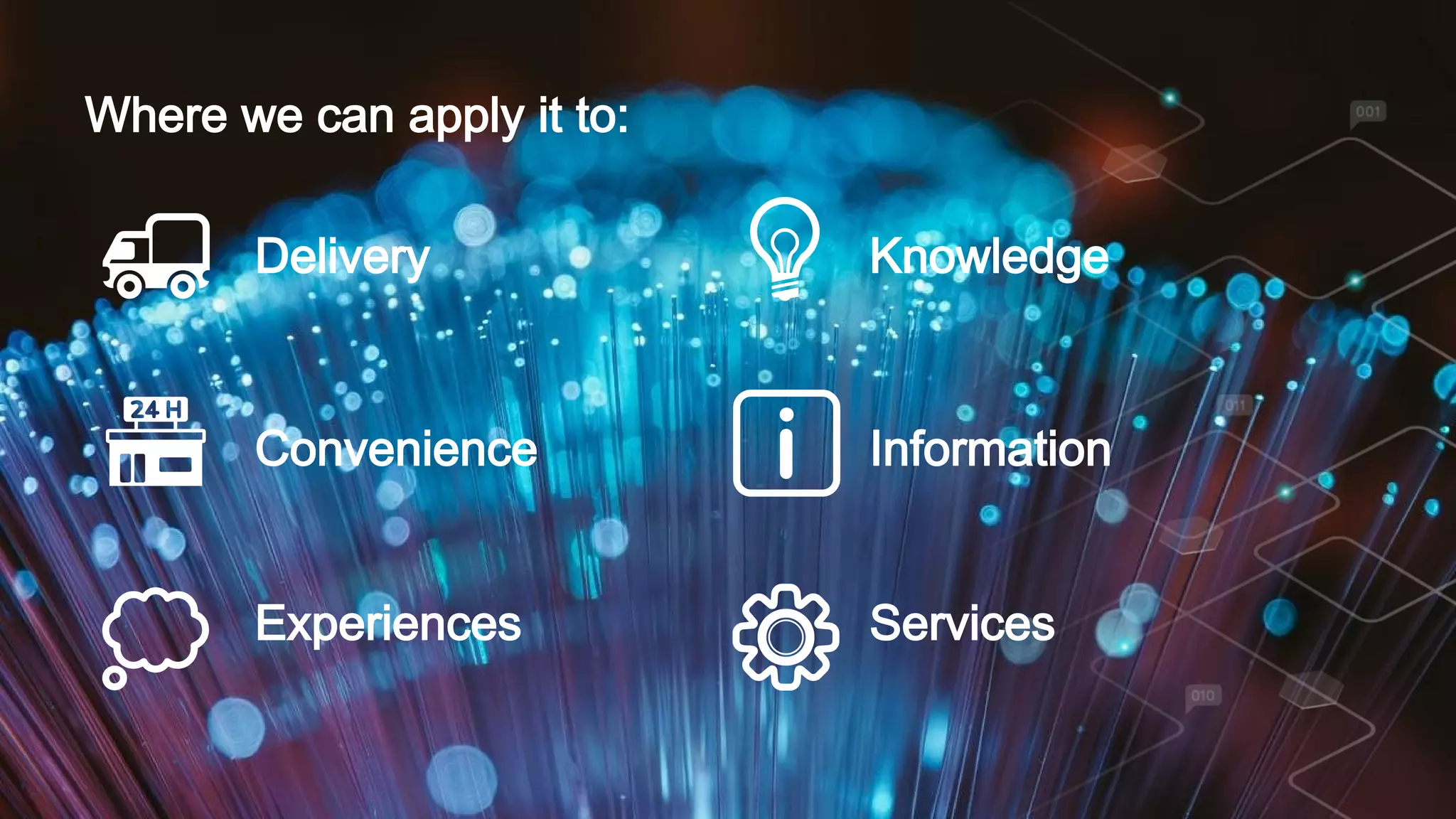
Where we can apply it to:
Delivery
Convenience
Experiences
Knowledge
Information
Services
Thanks!
Any questions?
BENEFITS VS FEATURES,
RELATION TO NEEDS AND
HIGH VALUE ADDING
DARVIN D. PAYOS
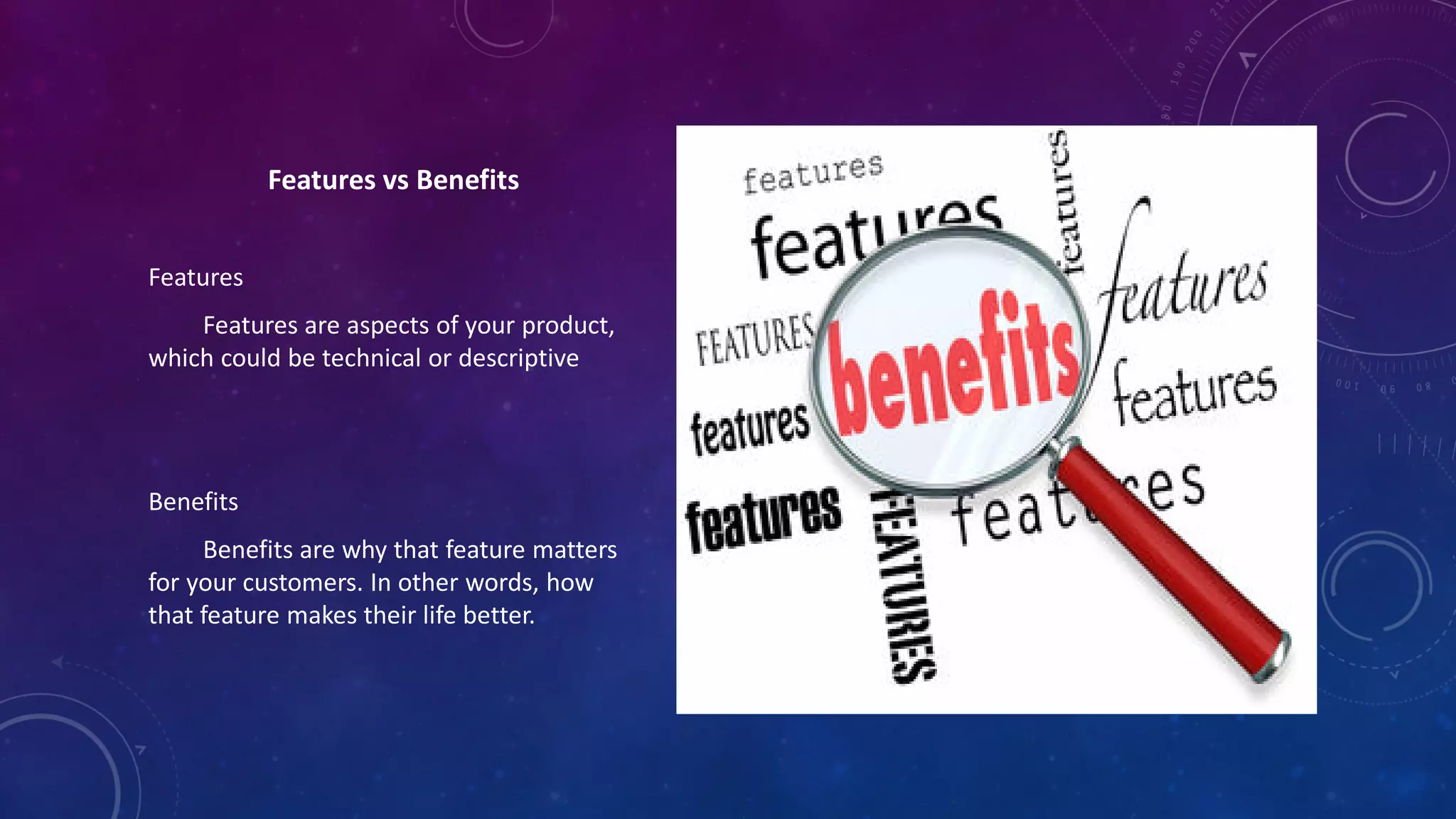
Features vs Benefits
Features
Features are aspects of your product,
which could be technical or descriptive
Benefits
Benefits are why that feature matters
for your customers. In other words, how
that feature makes their life better.
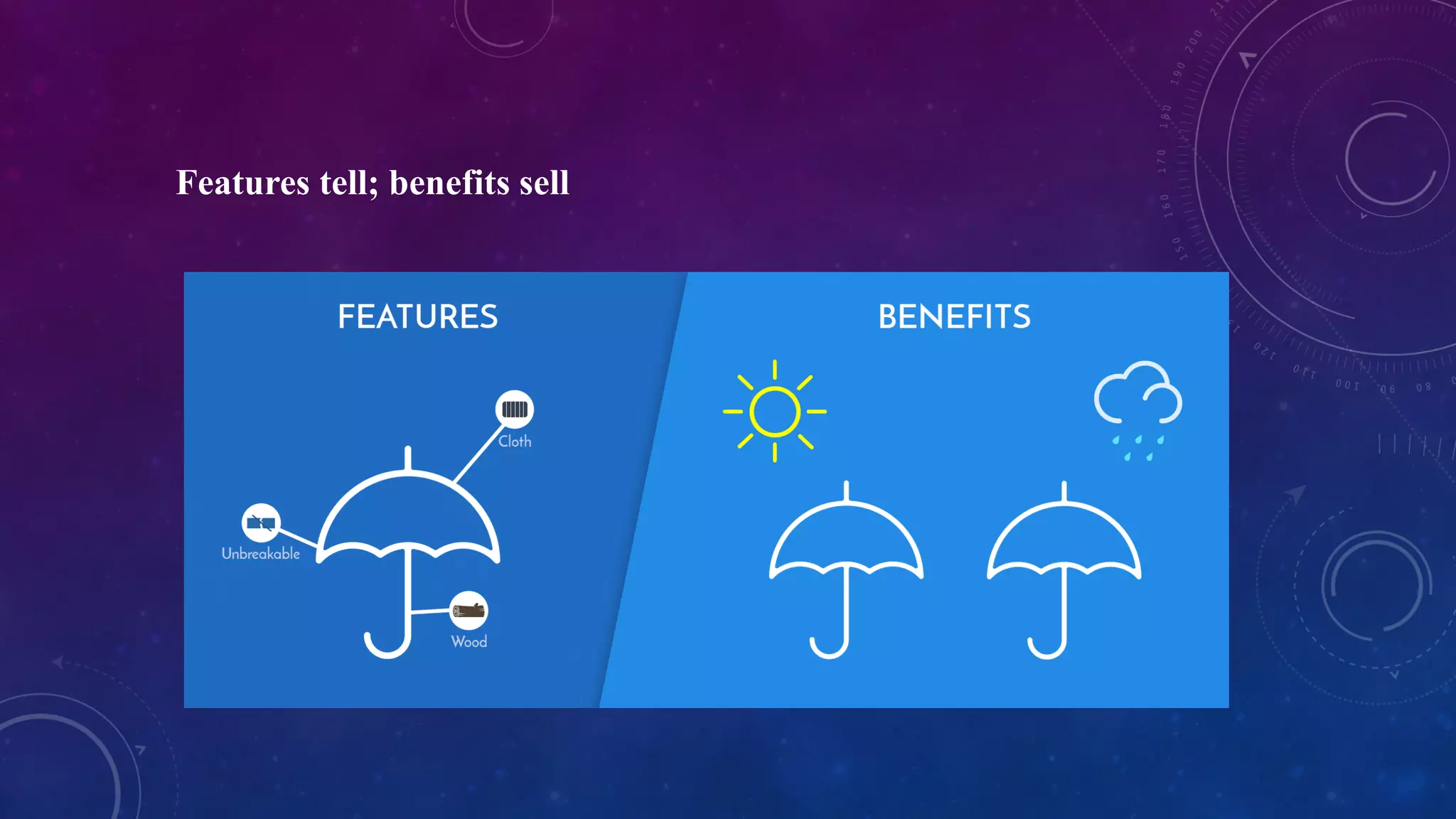
Features tell; benefits sell
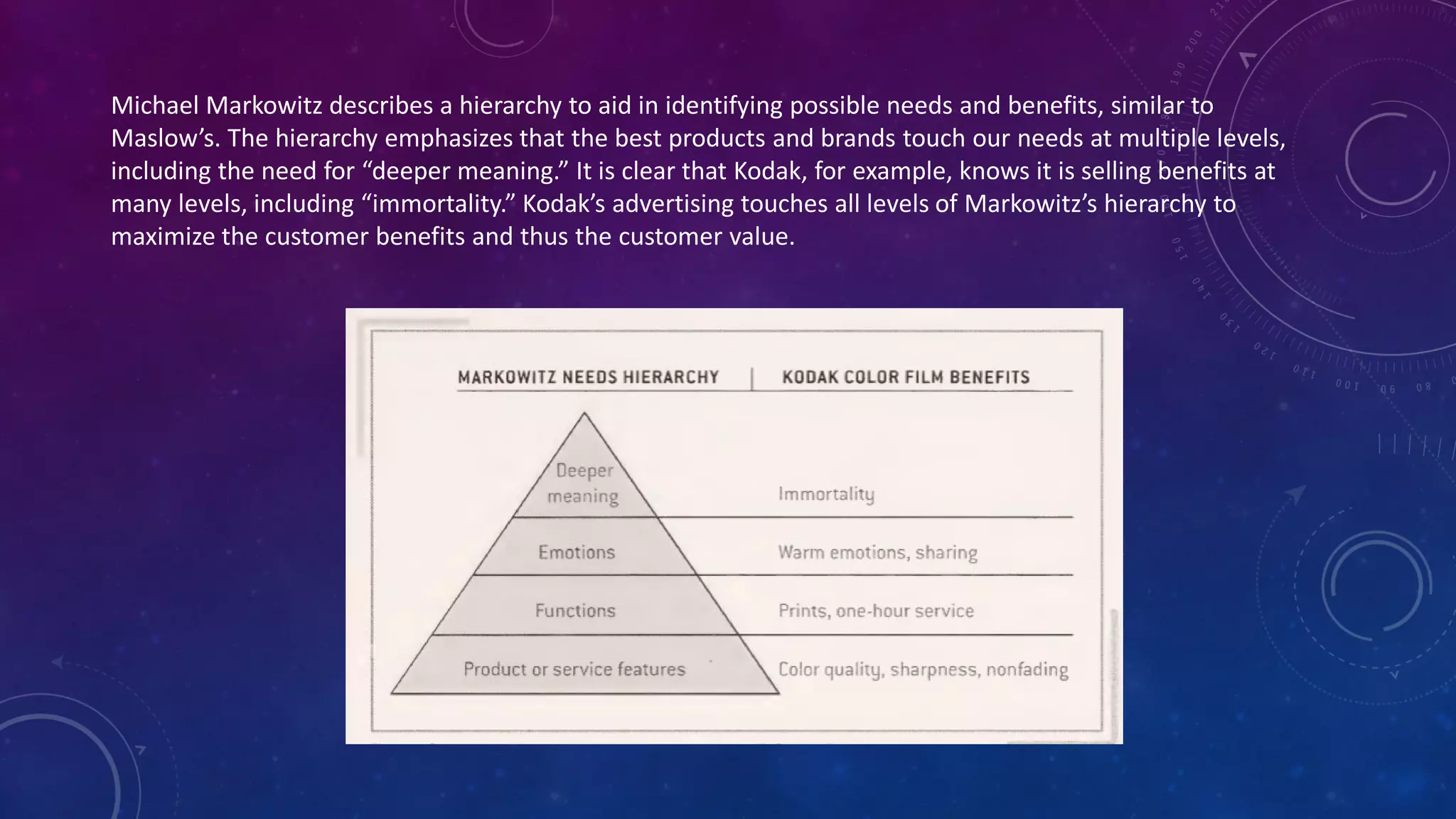
Michael Markowitz describes a hierarchy to aid in identifying possible needs and benefits, similar to
Maslow’s. The hierarchy emphasizes that the best products and brands touch our needs at multiple levels,
including the need for “deeper meaning.” It is clear that Kodak, for example, knows it is selling benefits at
many levels, including “immortality.” Kodak’s advertising touches all levels of Markowitz’s hierarchy to
maximize the customer benefits and thus the customer value.
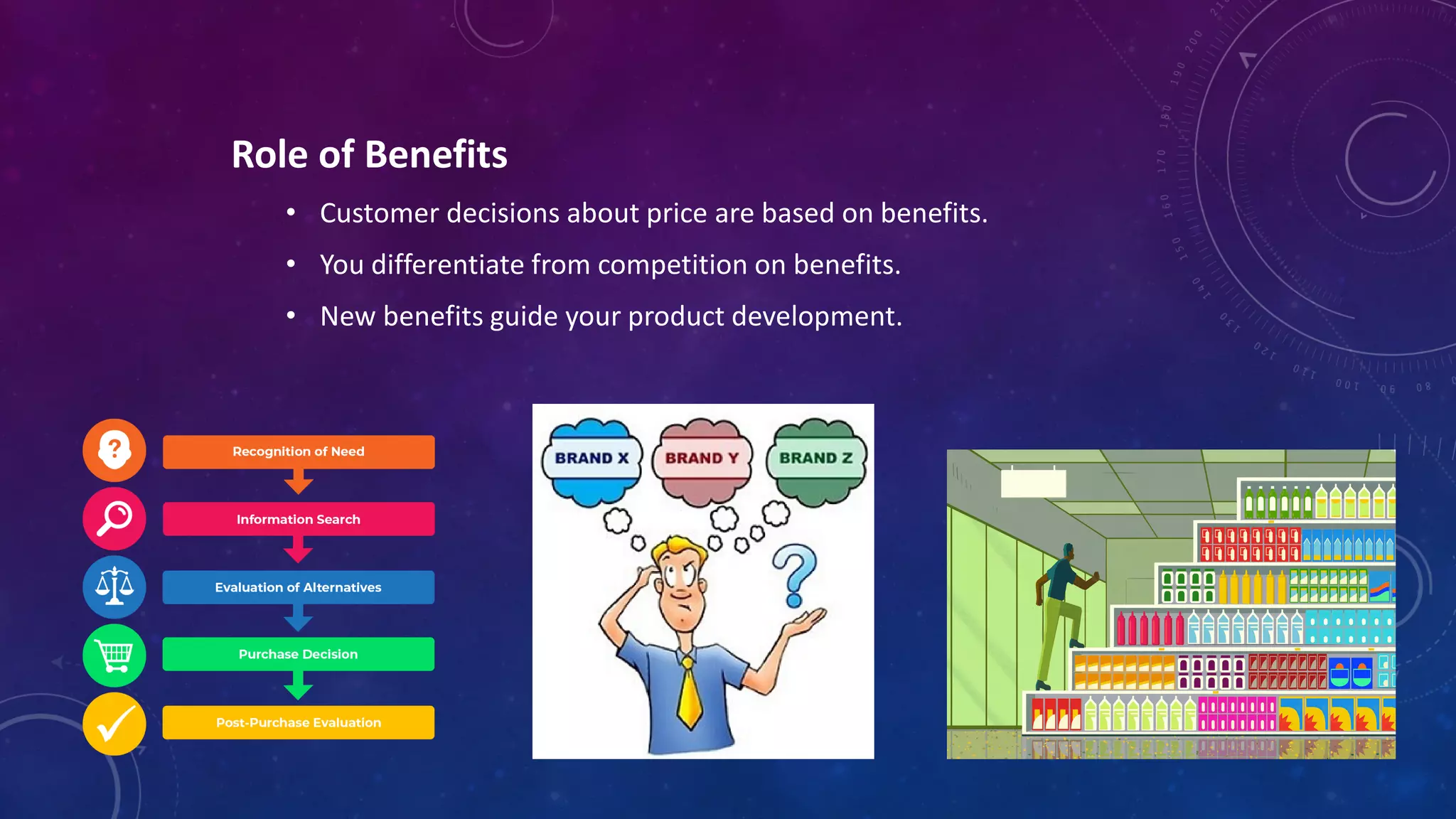
Role of Benefits
• Customer decisions about price are based on benefits.
• You differentiate from competition on benefits.
• New benefits guide your product development.
Benefits Overview
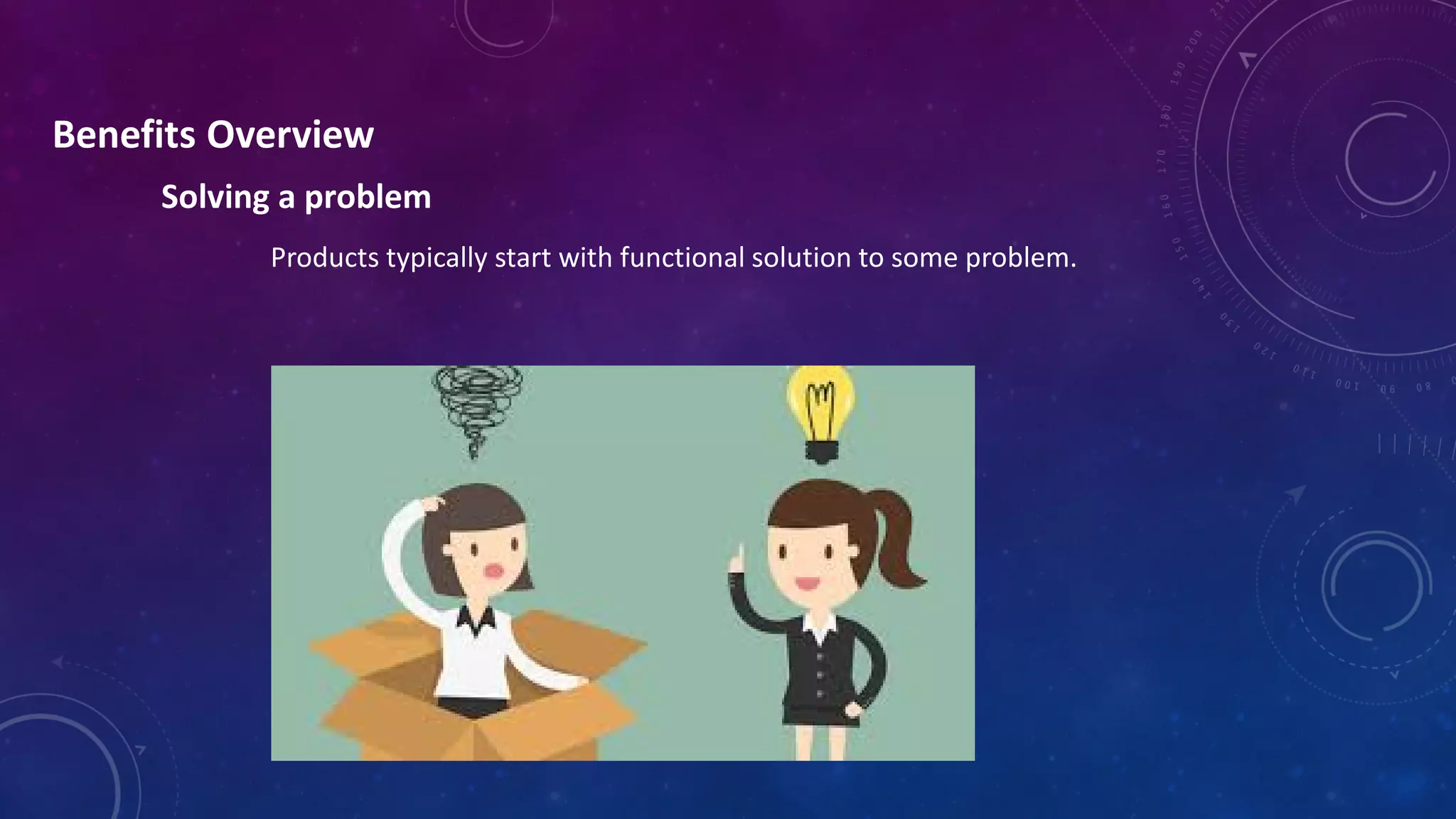
Solving a problem
Products typically start with functional solution to some problem.
Emotions
Make people laugh, happy. Save from fear and uncertainty.
Social benefits
Make other people think well about your customers. Give them high social status through your
products.
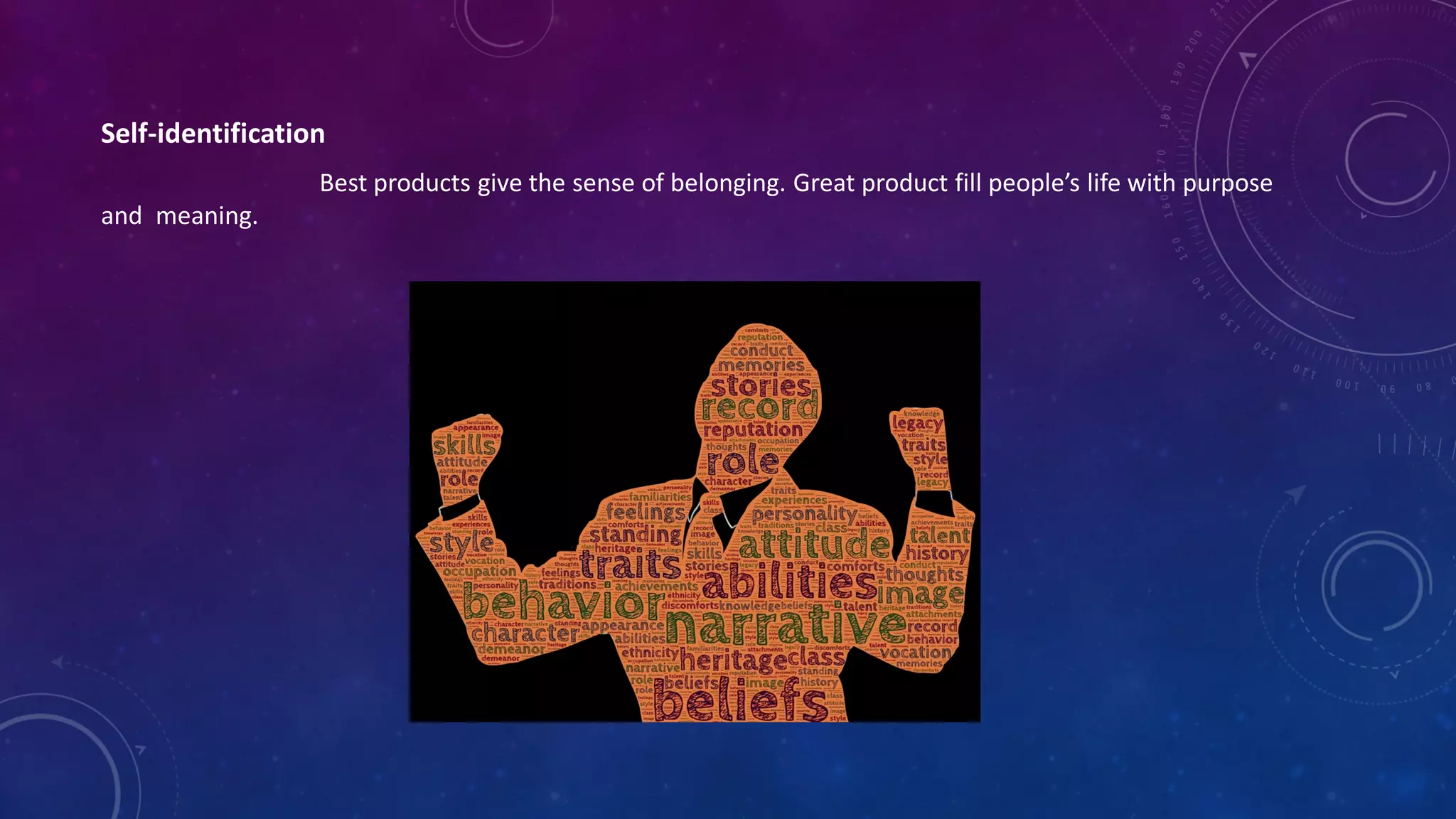
Self-identification
Best products give the sense of belonging. Great product fill people’s life with purpose
and meaning.
Increasing Benefits
Adding Value
Convenience. Immediacy. Free and fast delivery. Inventory breadth. Quality.
Price. Choices. Customization.
Solving many needs at once
People have many needs. Once you’ve satisfied one, you can extend the
product to satisfy more.
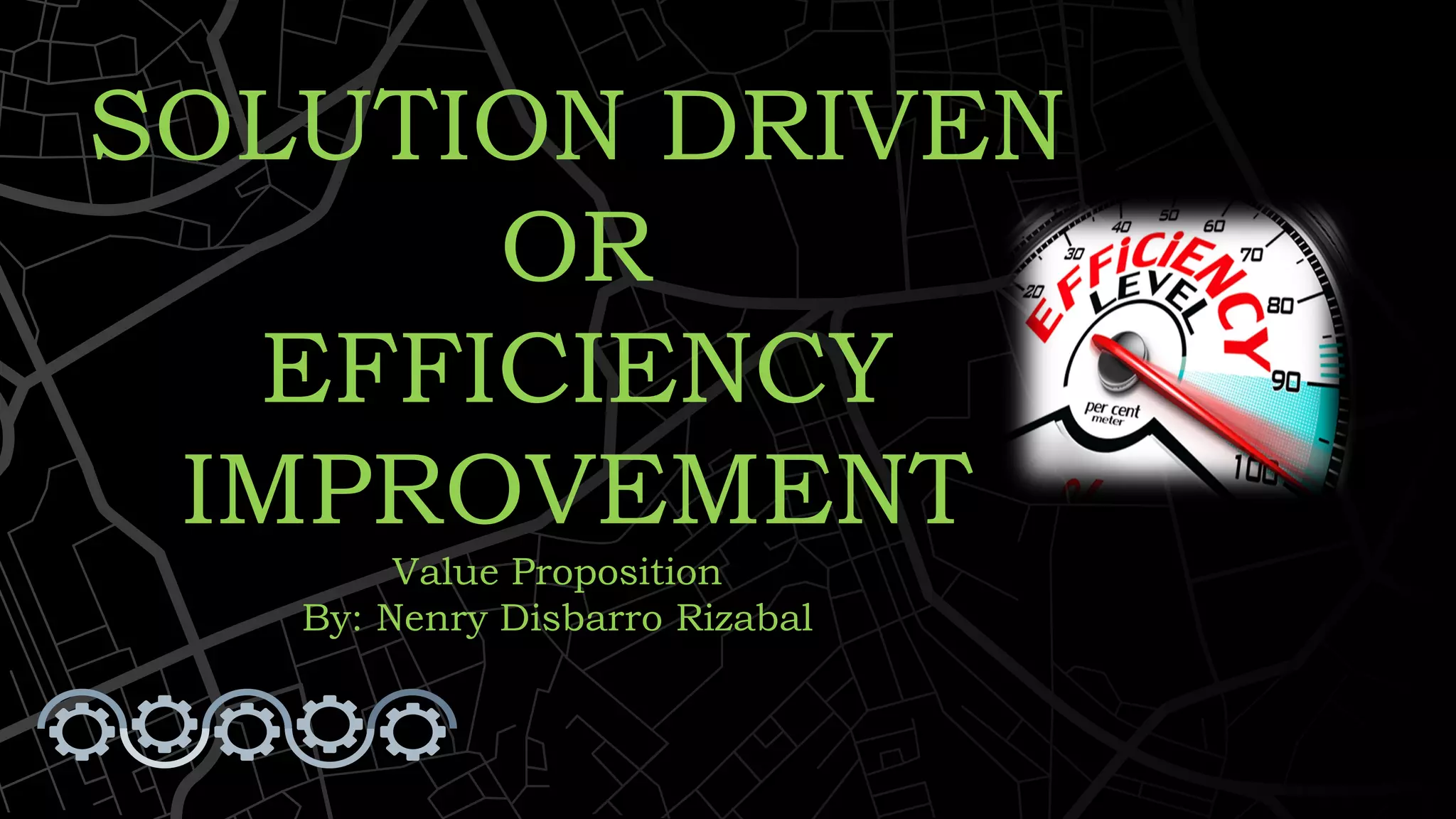
SOLUTION DRIVEN
OR
EFFICIENCY
IMPROVEMENT
Value Proposition
By: Nenry Disbarro Rizabal
• Determine the concept of value proposition, or
how it driven solution when it comes to
marketing purposes, using the product/market
fit pyramid;
• Define problem space and solution space;
• Different tips on how to improve value
proposition; and
• Benefits of having a good and effective value
proposition
OBJECTIVES:
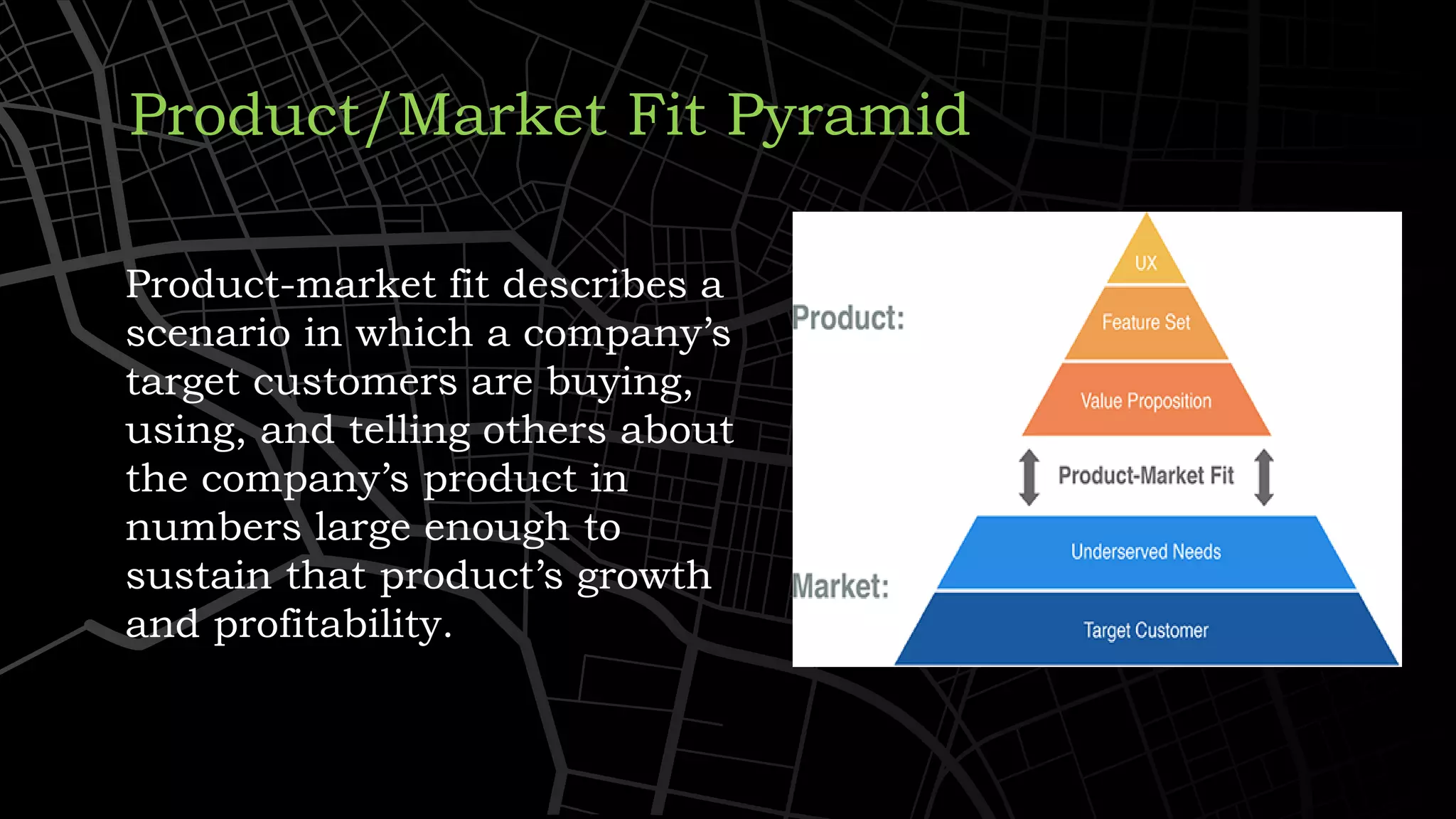
Product/Market Fit Pyramid
Product-market fit describes a
scenario in which a company’s
target customers are buying,
using, and telling others about
the company’s product in
numbers large enough to
sustain that product’s growth
and profitability.
Problem Space
vs.
Solution Space
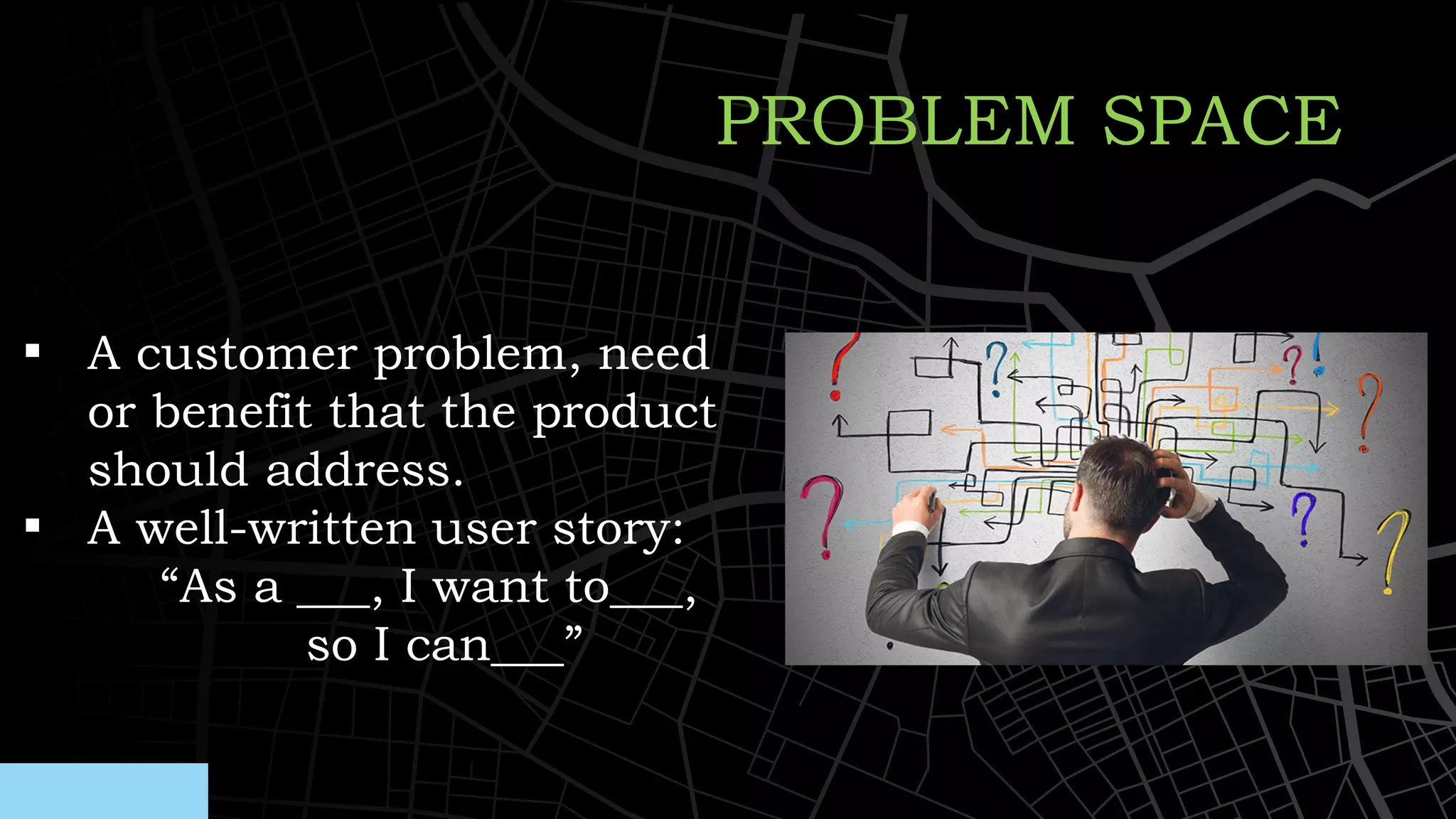
▪ A customer problem, need
or benefit that the product
should address.
▪ A well-written user story:
“As a ___, I want to___,
so I can___”
PROBLEM SPACE
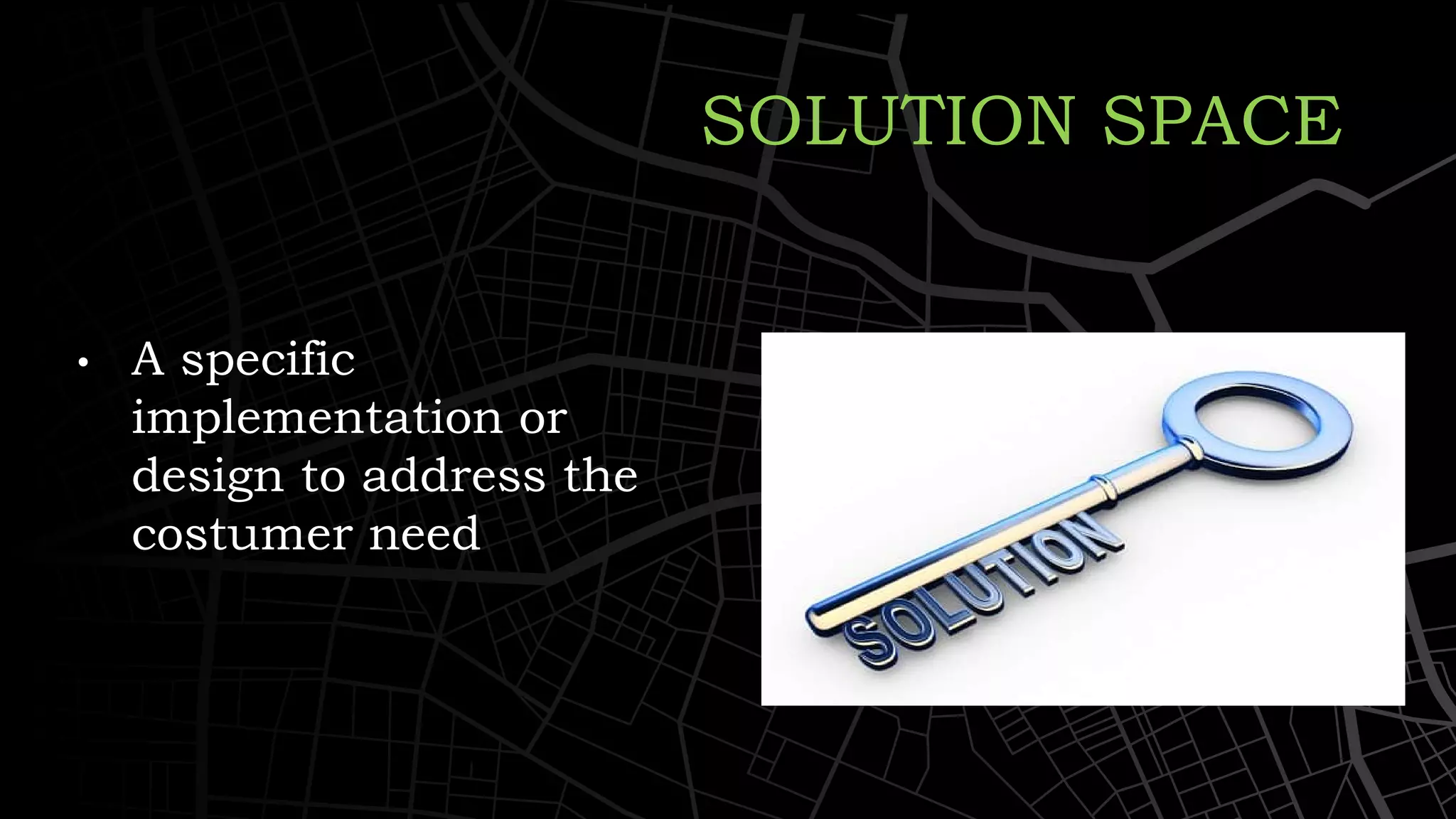
• A specific
implementation or
design to address the
costumer need
SOLUTION SPACE
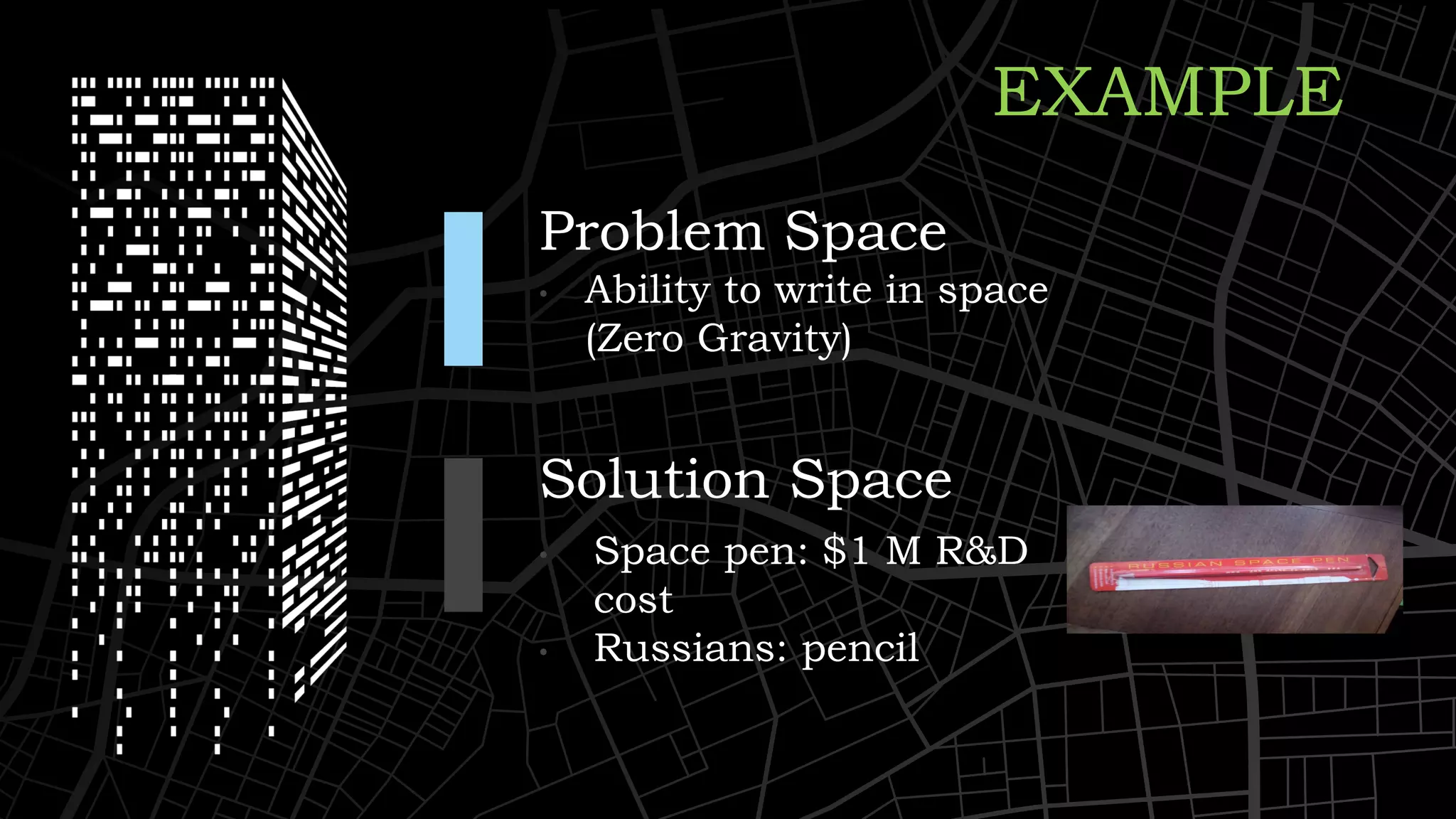
• Ability to write in space
(Zero Gravity)
• Space pen: $1 M R&D
cost
• Russians: pencil
Problem Space
Solution Space
EXAMPLE
TIPS ON HOW TO IMPROVE
VALUE PROPOSITION
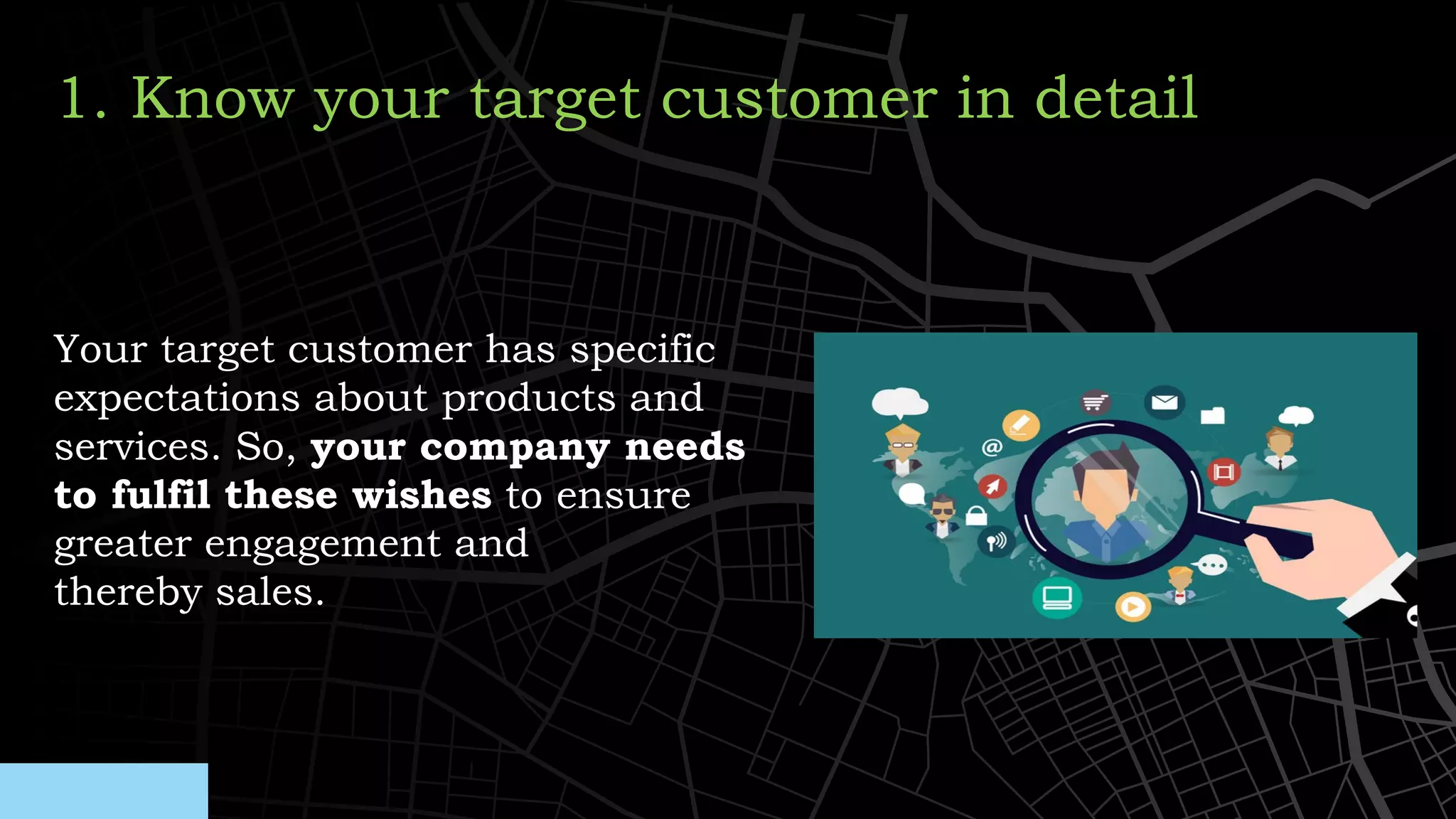
Your target customer has specific
expectations about products and
services. So, your company needs
to fulfil these wishes to ensure
greater engagement and
thereby sales.
1. Know your target customer in detail
• the expectations of this audience regarding
prices
• the financial limitations of these people
• the sort of product they seek
• the correct target audience
This simulation of the average
consumer will help you to understand
points such as:
You can improve your brand’s
value proposition if you know which
is the main product or service that
has to offer. It must always be on
highlight, especially on brand
promotion campaigns.
This understanding allows the
brand to improve the quality of such
a product. Besides, it can stay ahead
of the competition.
2. Understand your business’ strong point
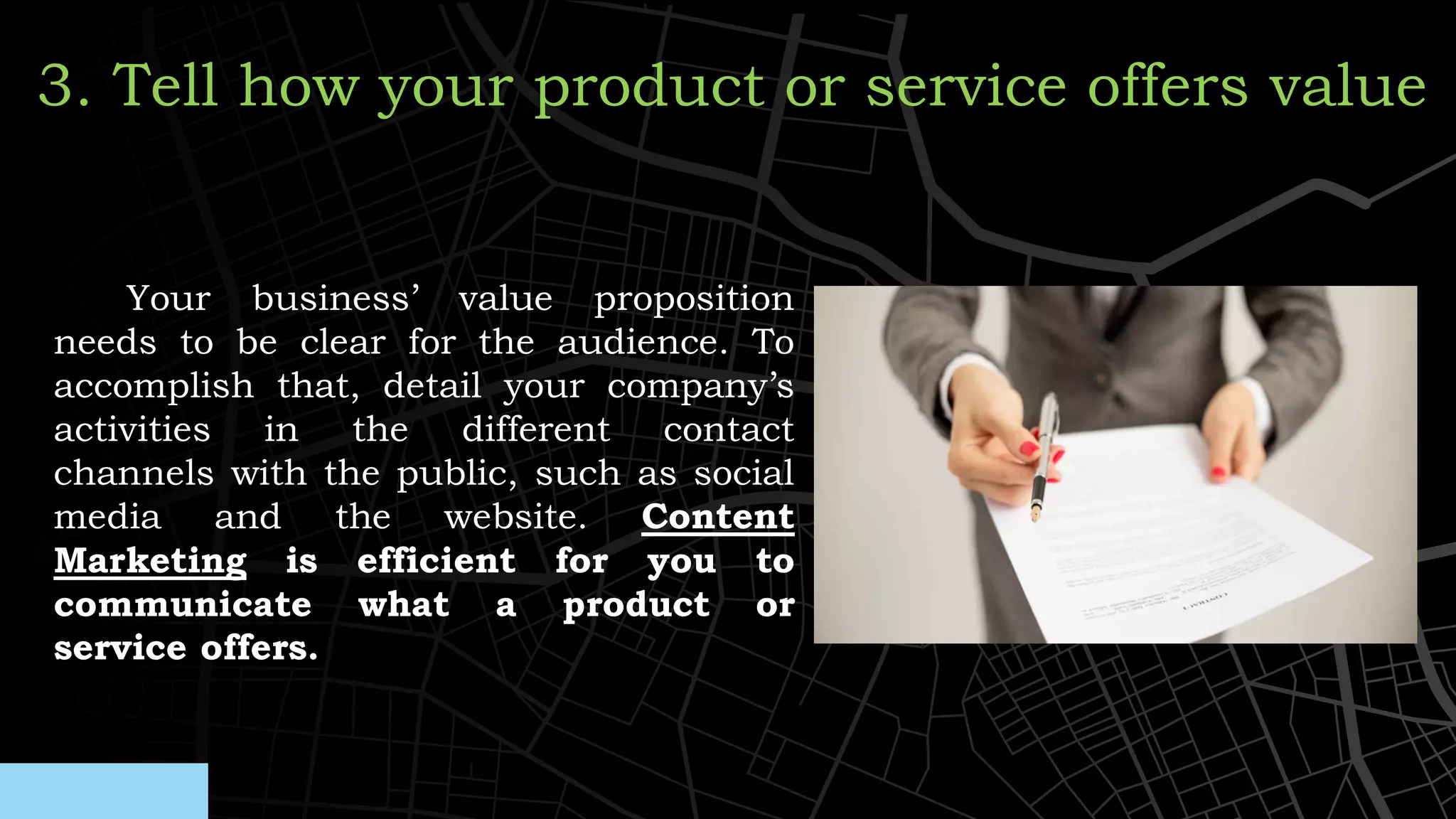
Your business’ value proposition
needs to be clear for the audience. To
accomplish that, detail your company’s
activities in the different contact
channels with the public, such as social
media and the website. Content
Marketing is efficient for you to
communicate what a product or
service offers.
3. Tell how your product or service offers value
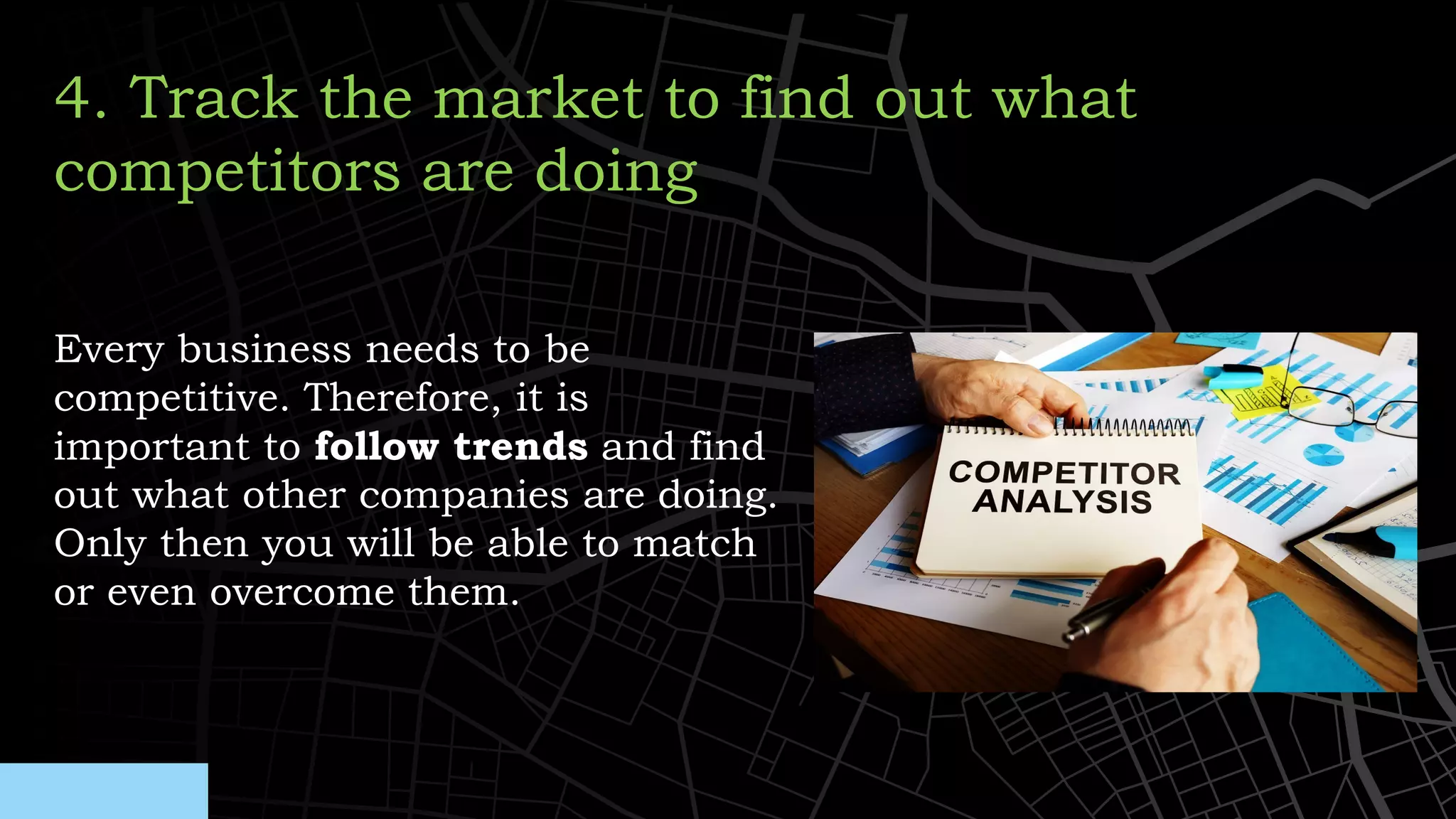
Every business needs to be
competitive. Therefore, it is
important to follow trends and find
out what other companies are doing.
Only then you will be able to match
or even overcome them.
4. Track the market to find out what
competitors are doing
Numbers always help the
consumer to understand what
your company can do for
them. That means you should
quantify to improve your value
proposition.
5. Quantify your value
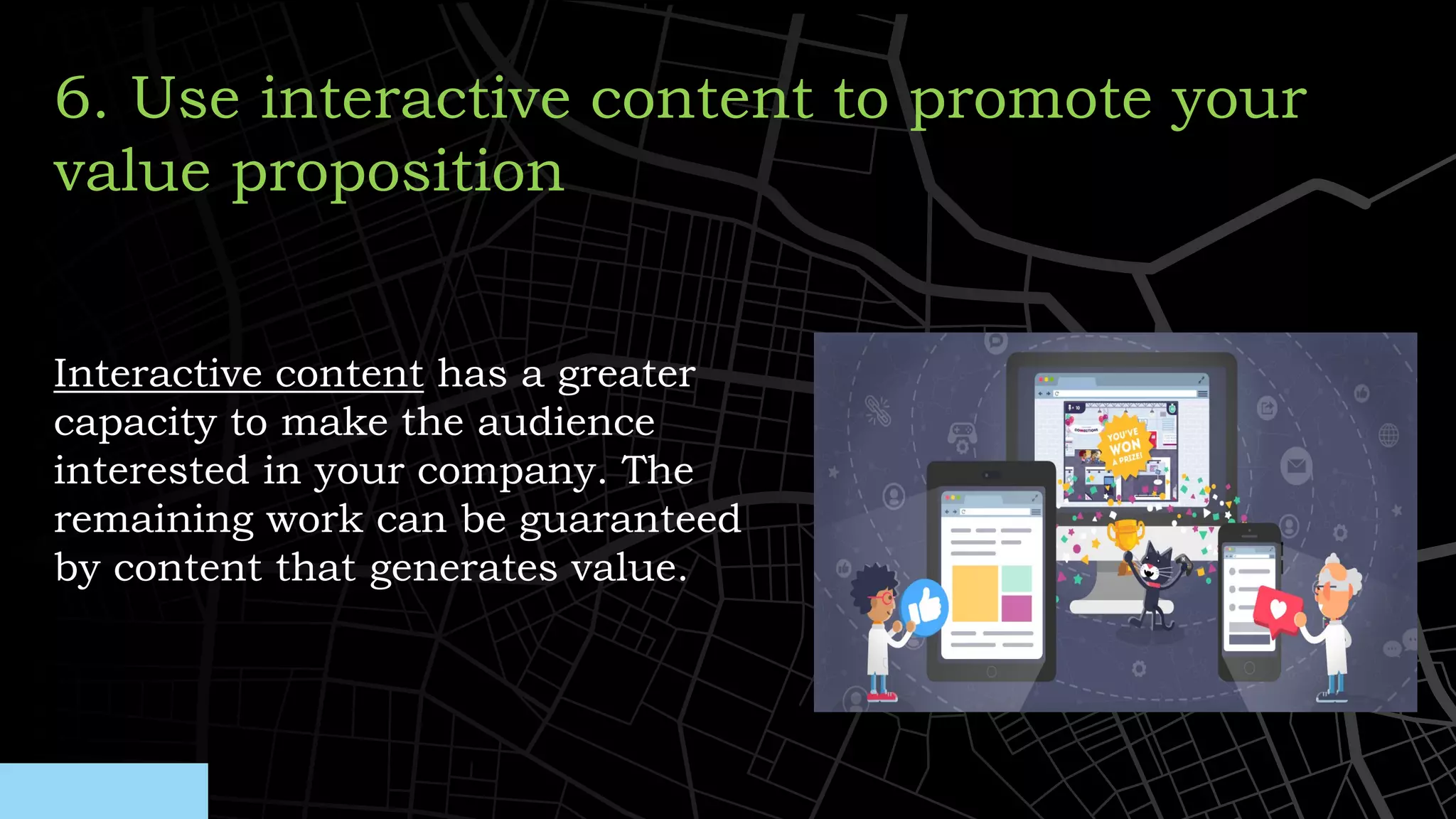
Interactive content has a greater
capacity to make the audience
interested in your company. The
remaining work can be guaranteed
by content that generates value.
6. Use interactive content to promote your
value proposition
• ebooks;
• white papers;
• calculators;
• quizzes;
• infographics;
• landing pages;
• videos.
You can use interactivity to create incredible
presentations. Among the main materials we
can highlight:
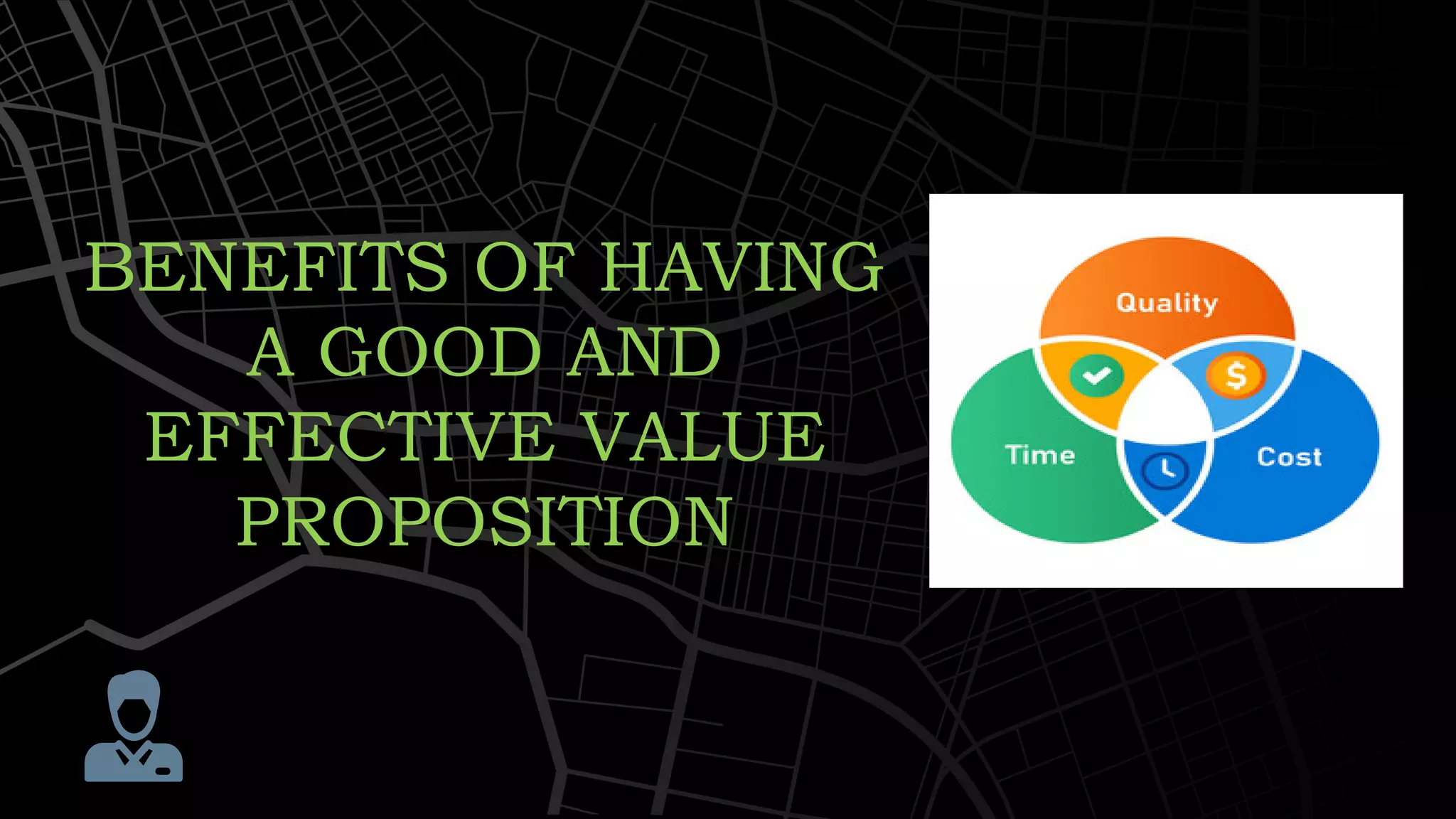
BENEFITS OF HAVING
A GOOD AND
EFFECTIVE VALUE
PROPOSITION
BENEFITS OF HAVING A GOOD AND EFFECTIVE
VALUE PROPOSITION
1. Gives Direction
A Value Proposition gives you direction by defining your
ideal target audience right up-front, and then identifying and
understanding a core need that you look to satisfy with your
planned solution
2. Creates Focus
A robust Value Proposition gives you and your team focus
by identifying the fundamental initiatives, activities and aspects
of your business that will have the greatest impact on meeting
your defined target audience's needs.
3. Breeds Confidence
Having a strong and honed Value Proposition gives you,
your team, and your stakeholders clarity so that you can
progress without questioning and second-guessing your every
move
4. Improves Customer Understanding and
Engagement
The Value Proposition gives you the basis to engage with
customers in a compelling and resonant manner by
understanding how they view you, and your products or
services
5. Provides Clarity of Messaging
Especially as a start-up without any brand recognition,
you're going to have to paint a very clear picture as to why
you’re worth people's time. The Value Proposition frames not
only how you're creating value for your audience by addressing
a core need, but critically why your solution is better than what
they are currently doing or using, or versus whatever else is
potentially out there that could do so.
6. Increases Effectiveness of Marketing`
By truly understanding your desired customers and their
core need that you're solving for, you're able to focus on the
channels and vehicles that are most relevant, and will
effectively communicate the benefits and advantages of your
solution.
THANK
YOU!!
B E S 5 T E C H N O P R E N E U R S H I P 1 0 1
Value Proposition: Value =
Benefits/Costs
0 2 / 1 7 / 2 0 2 2
What is Value, Benefits, and Costs?
Value – Value measures a product or service's worth and compares it to its possible
alternatives. This determines whether the customer feels like they received enough value
for the price they paid for the product/service. The customer’s perception of the worth of
your product or service. Worth can mean several things: the benefit these products or
services provide to your target market, or the value for money they offer.
What are the customer benefits?
What are the customer costs?
0 2 / 1 7 / 2 0 2 2
Customer Benefits – The term customer benefit is tied to the customer’s needs, which
are satisfied by a particular product or service. This need determines which product or
service the customer buys. The term benefit sounds very rational. But even needs like
fun, luxury or a certain image can be a customer benefit.
Measuring customer benefits
Customer benefits can include:
• The quality of your product or service
• Your public image and company values
• Your ability to provide a better offering that competitors
• The customer experience you provide
• The quality of your customer service
• The value you impart on them when they choose to buy with you
0 2 / 1 7 / 2 0 2 2
Customer Costs
Tangible costs might include:
• The financial cost of your product or service
• Upfront costs, such as installation or onboarding fees
• Maintenance costs
• Renewal or repurchasing costs
• Access costs for your product or service
The costs that are hard to quantify (intangible) are:
• Bad customer experience
• The time it takes to make a purchase
• The emotional cost of engaging with your brand and making a purchase
• The social cost of choosing you over competitors
• The time cost of undergoing the learning curve for your products or services
0 2 / 1 7 / 2 0 2 2
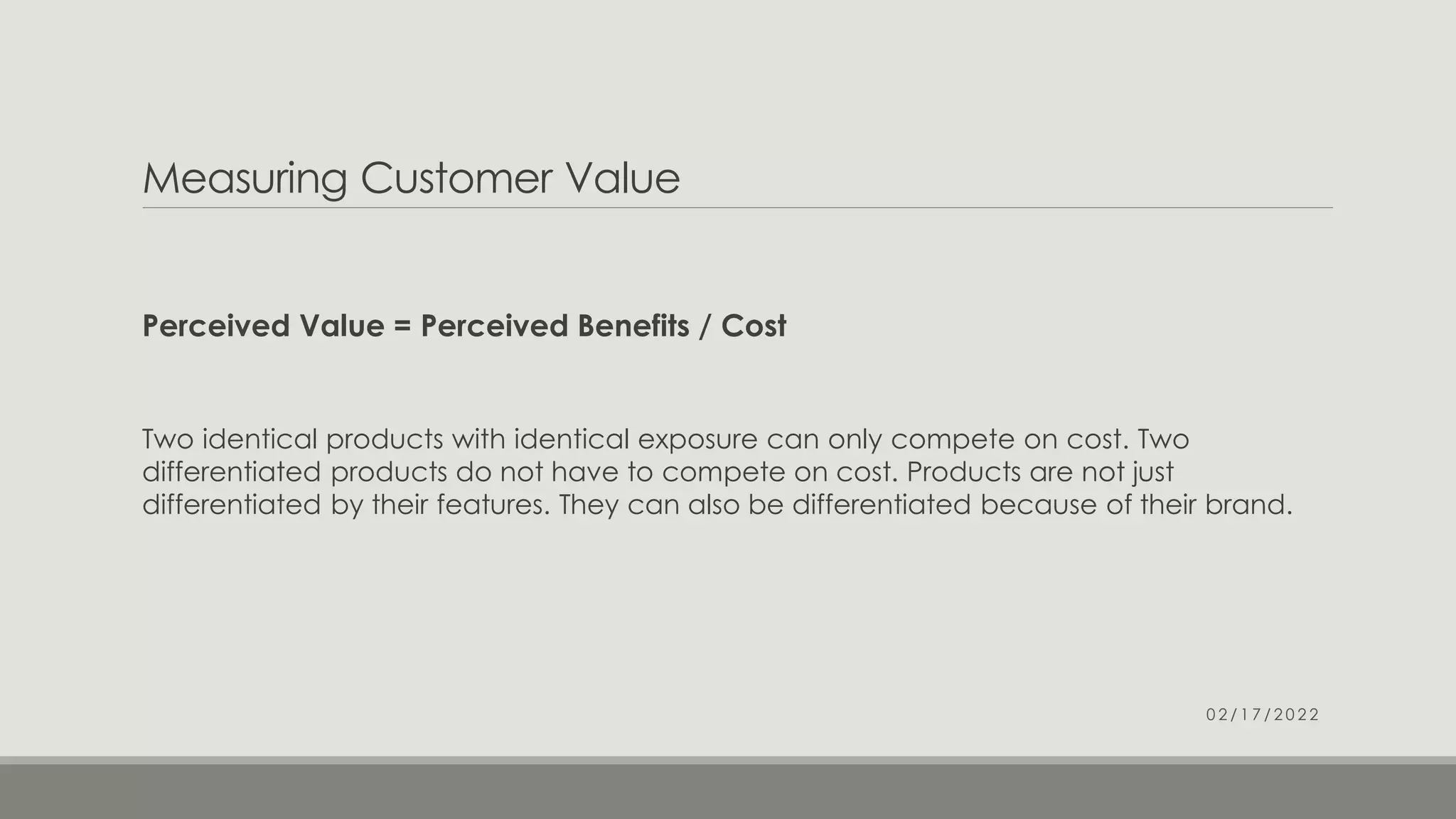
Measuring Customer Value
Perceived Value = Perceived Benefits / Cost
Two identical products with identical exposure can only compete on cost. Two
differentiated products do not have to compete on cost. Products are not just
differentiated by their features. They can also be differentiated because of their brand.
0 2 / 1 7 / 2 0 2 2
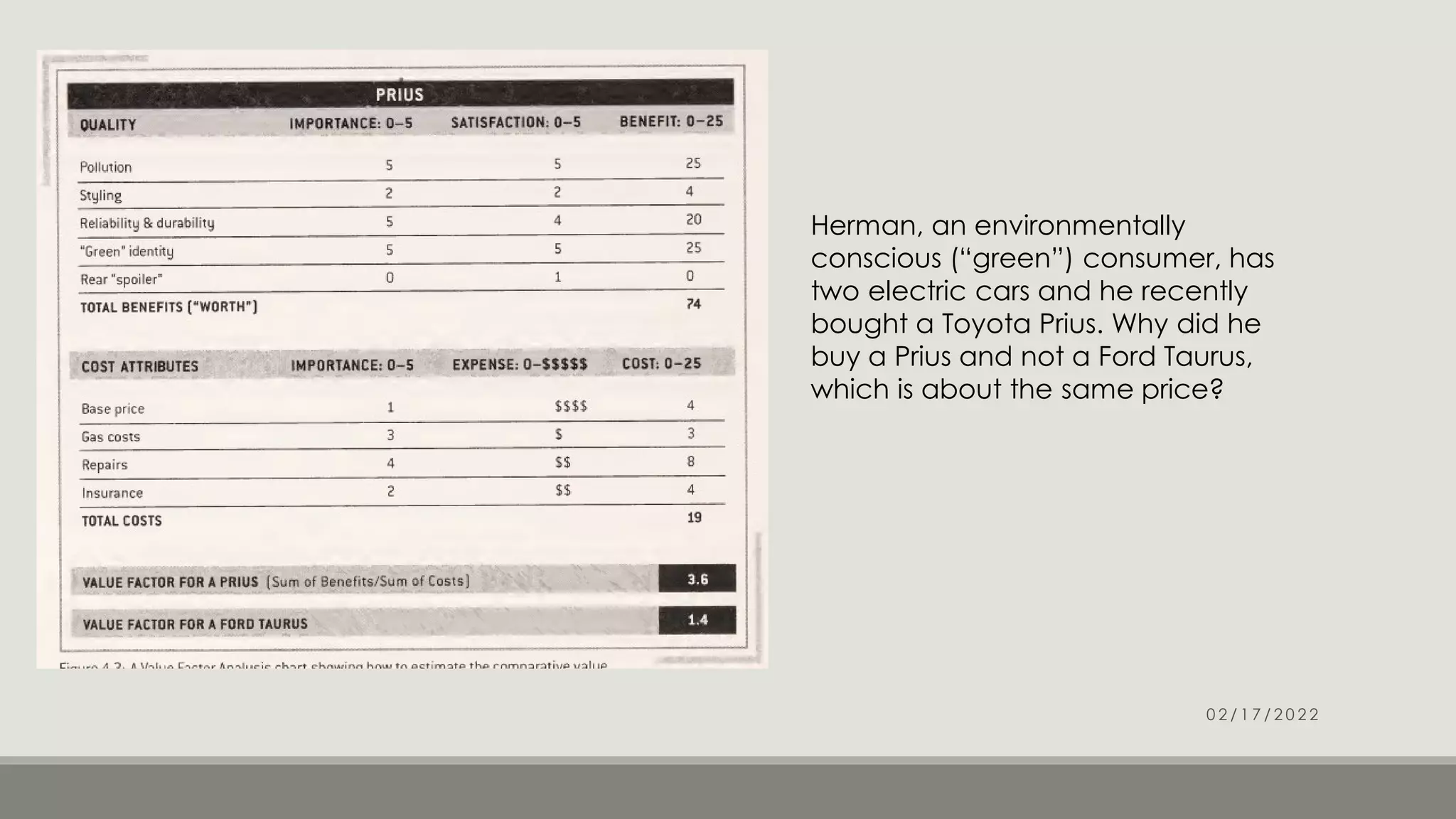
Herman, an environmentally
conscious (“green”) consumer, has
two electric cars and he recently
bought a Toyota Prius. Why did he
buy a Prius and not a Ford Taurus,
which is about the same price?
0 2 / 1 7 / 2 0 2 2
VALUE PROPOSITION
STATEMENT
Hello!
I am Mike O.
Sumayang
Civil Engineering Students 3A.
You can find me at @sumayang.mike@nwssu.edu.ph
2
What is the Value Proposition Statement?
- a simple statement that summarizes why a
customer would choose your product or service. It
communicate the clearest benefit that customer
receive by giving you their business.
“
THE ELEMENTS OF A VALUE PROPOSITION
◇ Headline - The headline of your value proposition
describes the benefit the customer will receive as a
result of making a purchase from your business.
◇ Subheadline - The subheadline or paragraph should
explain in detail what your company offers, who it
serves, and why.
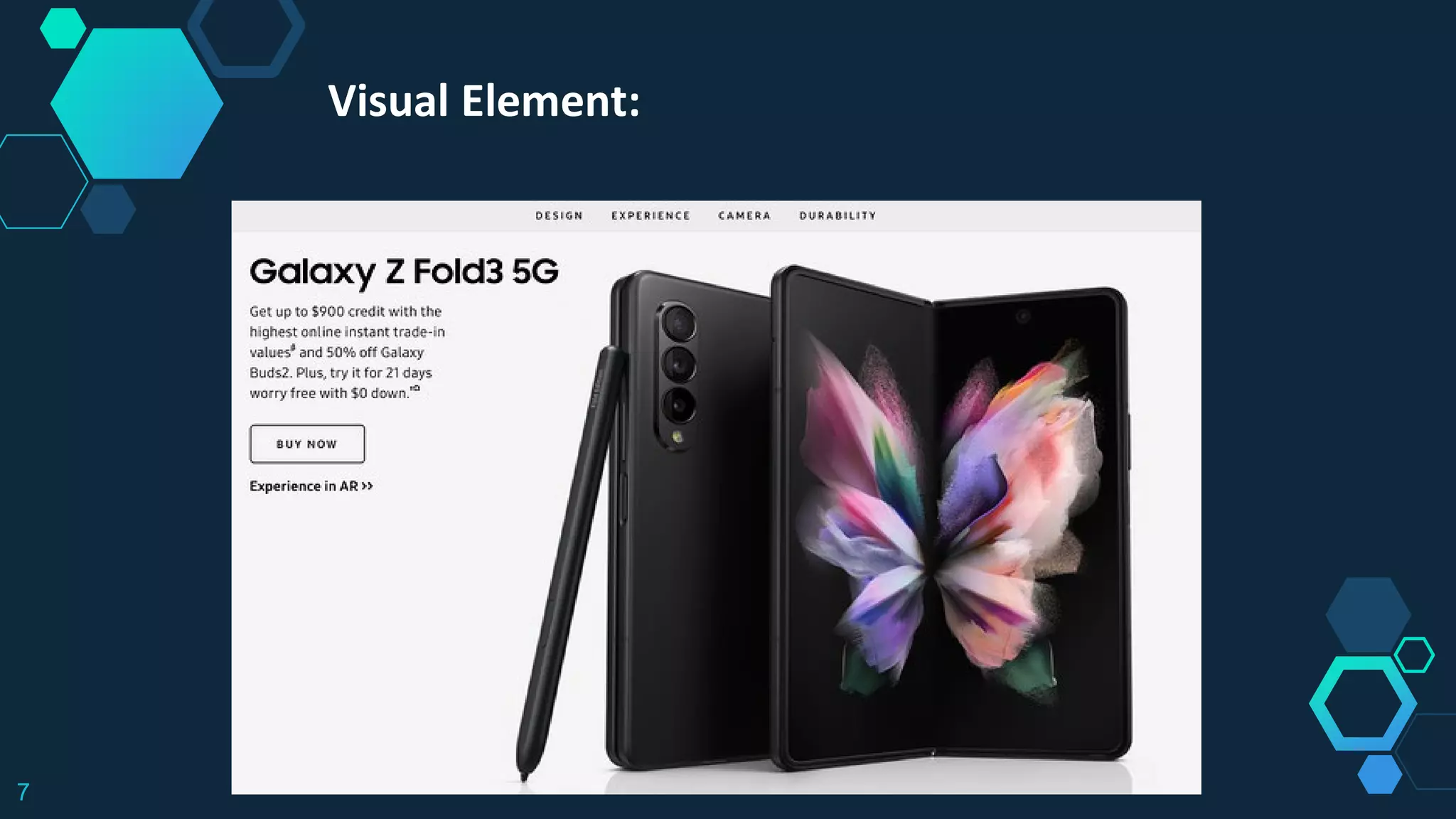
◇ Visual Element - In some cases, a video,
infographic, or image may convey your value
proposition better than words alone can.
4
5
Value Proposition Templates
Samsung: Get Ready to Unfold Your
World
EXAMPLE OF VALUE PROPOSITION STATEMENT
6
Headline: Get Ready to Unfold Your World
Subheadline/paragraph: This is everything you’d want in a
premium, durable, 5G smartphone. Then we made it unfold
— revealing a massive screen so you can watch, work and
play like never before.
7
Visual Element:
8
Customer Profile for Samsung
Customer Jobs: Samsung customers are tech-savvy and
follow the latest trends, driven by efficiency and
aspirational lifestyles.
Gains: Customers want an all-in-one way to enjoy media,
work productively, and have a fun experience all in the
palm of their hands.
Pains: Common smartphones have size limitations that
strain entertainment viewing, gameplay, and work
capabilities.
9
Value Map for Samsung
Gain Creators: Samsung offers a unique and expansive
design with capabilities beyond that of an average
smartphone, offering the most advanced technology to
help customers perform tasks to fulfill work and play.
Pain Relievers: Samsung provides a smartphone that
displays content in tablet-like viewing and displays up to
three apps simultaneously.
10
Products & Services: One of Samsung’s most popular
phones is the Galaxy Z Fold3 5G folding 6.2-inch
smartphone with dynamic AMOLED 2X screens, ultra-thin
glass with S Penfold edition, and super-strong lightweight
armor aluminum frame.
Thanks!
Any questions?
You can find me at:
◇ @mikeobrerosumayang
◇ user@sumayang.mike@gmail.com
11
How to Write a Value
Proposition
• Identify your customer’s main problem.
• Identify all the benefits your product offers.
• Describe what makes these benefits valuable.
• Connect this value to your buyer’s problem.
• Differentiate yourself as the preferred
provider of this value.
Step 1: Identify your customer’s
main problem.
“
Step 2: Identify all the benefits
your products offer.
4
Step 3: Describe what makes these benefits
valuable.
5
Step 4: Connect this value to
your buyer’s problem.
6
7
Step 5: Differentiate yourself as the
preferred provider of this
value.
8
Tactics to Develop an Effective
Value Proposition
9
• Conduct research to determine the value proposition of
your competitors.
• Explain the value of your products and services.
• Describe the benefits your ideal customer will experience
when they choose your product or service over the
competition.
• Develop a unique value proposition for each buyer
persona you serve.
• Test your value proposition with your audience using
various marketing channels.
10
1. Conduct research to determine the
value proposition of your
competitors.
11
2. Explain the value of your
products and services.
12
3. Describe the benefits your ideal
customer will experience when
they choose your product or
service over the competition.
13
4. Develop a unique value proposition
for each buyer persona you serve.
14
5. Test your value proposition with
your audience using various
marketing channels.

GROUP-2-VALUE-PROPOSITION.pdf

  • 1.
  • 2.
    “Value is thecore of any business, and it directs all future decisions, innovations, and customers that get targeted.
  • 3.
  • 4.
    What is aValue Proposition? ⬡ Typically, a value proposition is a sentence or paragraph that clearly articulates what your service, business, or organization does, who it brings value to, and why it’s valuable for those people
  • 5.
  • 6.
    The Experience of ourcustomers Two main things The Capabilities of our product or service.
  • 7.
    Value Proposition Canvas A tool whichcan help ensure that a product or service is positioned around what the customer values and needs
  • 8.
    Value Proposition Canvas The Value PropositionCanvas can be used when there is need to refine an existing product or service offering or where a new offering is being developed from scratch.
  • 9.
    Value Proposition Value PropositionCanvas Customer Profile
  • 10.
  • 11.
    To investigate thewho, what, where, when, why, and how of your target market. Finding Target Market
  • 12.
    Dealing with ValuePropositions Functional Social Emotional
  • 13.
    Value Map Gain Creators howthe product or service creates customer gains and how it offers added value to the customer. 1 Product and Services the products and services which create gain and relieve pain, and which underpin the creation of value for the customer. 3 Pain reliever a description of exactly how the product or service alleviates customer pains.. 2
  • 14.
    Where we canapply it to: Delivery Convenience Experiences Knowledge Information Services
  • 15.
  • 16.
    BENEFITS VS FEATURES, RELATIONTO NEEDS AND HIGH VALUE ADDING DARVIN D. PAYOS
  • 17.
    Features vs Benefits Features Featuresare aspects of your product, which could be technical or descriptive Benefits Benefits are why that feature matters for your customers. In other words, how that feature makes their life better.
  • 18.
  • 19.
    Michael Markowitz describesa hierarchy to aid in identifying possible needs and benefits, similar to Maslow’s. The hierarchy emphasizes that the best products and brands touch our needs at multiple levels, including the need for “deeper meaning.” It is clear that Kodak, for example, knows it is selling benefits at many levels, including “immortality.” Kodak’s advertising touches all levels of Markowitz’s hierarchy to maximize the customer benefits and thus the customer value.
  • 20.
    Role of Benefits •Customer decisions about price are based on benefits. • You differentiate from competition on benefits. • New benefits guide your product development.
  • 21.
    Benefits Overview Solving aproblem Products typically start with functional solution to some problem.
  • 22.
    Emotions Make people laugh,happy. Save from fear and uncertainty.
  • 23.
    Social benefits Make otherpeople think well about your customers. Give them high social status through your products.
  • 24.
    Self-identification Best products givethe sense of belonging. Great product fill people’s life with purpose and meaning.
  • 25.
    Increasing Benefits Adding Value Convenience.Immediacy. Free and fast delivery. Inventory breadth. Quality. Price. Choices. Customization. Solving many needs at once People have many needs. Once you’ve satisfied one, you can extend the product to satisfy more.
  • 26.
  • 27.
    • Determine theconcept of value proposition, or how it driven solution when it comes to marketing purposes, using the product/market fit pyramid; • Define problem space and solution space; • Different tips on how to improve value proposition; and • Benefits of having a good and effective value proposition OBJECTIVES:
  • 28.
    Product/Market Fit Pyramid Product-marketfit describes a scenario in which a company’s target customers are buying, using, and telling others about the company’s product in numbers large enough to sustain that product’s growth and profitability.
  • 29.
  • 30.
    ▪ A customerproblem, need or benefit that the product should address. ▪ A well-written user story: “As a ___, I want to___, so I can___” PROBLEM SPACE
  • 31.
    • A specific implementationor design to address the costumer need SOLUTION SPACE
  • 32.
    • Ability towrite in space (Zero Gravity) • Space pen: $1 M R&D cost • Russians: pencil Problem Space Solution Space EXAMPLE
  • 33.
    TIPS ON HOWTO IMPROVE VALUE PROPOSITION
  • 34.
    Your target customerhas specific expectations about products and services. So, your company needs to fulfil these wishes to ensure greater engagement and thereby sales. 1. Know your target customer in detail
  • 35.
    • the expectationsof this audience regarding prices • the financial limitations of these people • the sort of product they seek • the correct target audience This simulation of the average consumer will help you to understand points such as:
  • 36.
    You can improveyour brand’s value proposition if you know which is the main product or service that has to offer. It must always be on highlight, especially on brand promotion campaigns. This understanding allows the brand to improve the quality of such a product. Besides, it can stay ahead of the competition. 2. Understand your business’ strong point
  • 37.
    Your business’ valueproposition needs to be clear for the audience. To accomplish that, detail your company’s activities in the different contact channels with the public, such as social media and the website. Content Marketing is efficient for you to communicate what a product or service offers. 3. Tell how your product or service offers value
  • 38.
    Every business needsto be competitive. Therefore, it is important to follow trends and find out what other companies are doing. Only then you will be able to match or even overcome them. 4. Track the market to find out what competitors are doing
  • 39.
    Numbers always helpthe consumer to understand what your company can do for them. That means you should quantify to improve your value proposition. 5. Quantify your value
  • 40.
    Interactive content hasa greater capacity to make the audience interested in your company. The remaining work can be guaranteed by content that generates value. 6. Use interactive content to promote your value proposition
  • 41.
    • ebooks; • whitepapers; • calculators; • quizzes; • infographics; • landing pages; • videos. You can use interactivity to create incredible presentations. Among the main materials we can highlight:
  • 42.
    BENEFITS OF HAVING AGOOD AND EFFECTIVE VALUE PROPOSITION
  • 43.
    BENEFITS OF HAVINGA GOOD AND EFFECTIVE VALUE PROPOSITION 1. Gives Direction A Value Proposition gives you direction by defining your ideal target audience right up-front, and then identifying and understanding a core need that you look to satisfy with your planned solution 2. Creates Focus A robust Value Proposition gives you and your team focus by identifying the fundamental initiatives, activities and aspects of your business that will have the greatest impact on meeting your defined target audience's needs.
  • 44.
    3. Breeds Confidence Havinga strong and honed Value Proposition gives you, your team, and your stakeholders clarity so that you can progress without questioning and second-guessing your every move 4. Improves Customer Understanding and Engagement The Value Proposition gives you the basis to engage with customers in a compelling and resonant manner by understanding how they view you, and your products or services
  • 45.
    5. Provides Clarityof Messaging Especially as a start-up without any brand recognition, you're going to have to paint a very clear picture as to why you’re worth people's time. The Value Proposition frames not only how you're creating value for your audience by addressing a core need, but critically why your solution is better than what they are currently doing or using, or versus whatever else is potentially out there that could do so. 6. Increases Effectiveness of Marketing` By truly understanding your desired customers and their core need that you're solving for, you're able to focus on the channels and vehicles that are most relevant, and will effectively communicate the benefits and advantages of your solution.
  • 46.
  • 47.
    B E S5 T E C H N O P R E N E U R S H I P 1 0 1 Value Proposition: Value = Benefits/Costs 0 2 / 1 7 / 2 0 2 2
  • 48.
    What is Value,Benefits, and Costs? Value – Value measures a product or service's worth and compares it to its possible alternatives. This determines whether the customer feels like they received enough value for the price they paid for the product/service. The customer’s perception of the worth of your product or service. Worth can mean several things: the benefit these products or services provide to your target market, or the value for money they offer. What are the customer benefits? What are the customer costs? 0 2 / 1 7 / 2 0 2 2
  • 49.
    Customer Benefits –The term customer benefit is tied to the customer’s needs, which are satisfied by a particular product or service. This need determines which product or service the customer buys. The term benefit sounds very rational. But even needs like fun, luxury or a certain image can be a customer benefit. Measuring customer benefits Customer benefits can include: • The quality of your product or service • Your public image and company values • Your ability to provide a better offering that competitors • The customer experience you provide • The quality of your customer service • The value you impart on them when they choose to buy with you 0 2 / 1 7 / 2 0 2 2
  • 50.
    Customer Costs Tangible costsmight include: • The financial cost of your product or service • Upfront costs, such as installation or onboarding fees • Maintenance costs • Renewal or repurchasing costs • Access costs for your product or service The costs that are hard to quantify (intangible) are: • Bad customer experience • The time it takes to make a purchase • The emotional cost of engaging with your brand and making a purchase • The social cost of choosing you over competitors • The time cost of undergoing the learning curve for your products or services 0 2 / 1 7 / 2 0 2 2
  • 51.
    Measuring Customer Value PerceivedValue = Perceived Benefits / Cost Two identical products with identical exposure can only compete on cost. Two differentiated products do not have to compete on cost. Products are not just differentiated by their features. They can also be differentiated because of their brand. 0 2 / 1 7 / 2 0 2 2
  • 52.
    Herman, an environmentally conscious(“green”) consumer, has two electric cars and he recently bought a Toyota Prius. Why did he buy a Prius and not a Ford Taurus, which is about the same price? 0 2 / 1 7 / 2 0 2 2
  • 53.
  • 54.
    Hello! I am MikeO. Sumayang Civil Engineering Students 3A. You can find me at @sumayang.mike@nwssu.edu.ph 2
  • 55.
    What is theValue Proposition Statement? - a simple statement that summarizes why a customer would choose your product or service. It communicate the clearest benefit that customer receive by giving you their business.
  • 56.
    “ THE ELEMENTS OFA VALUE PROPOSITION ◇ Headline - The headline of your value proposition describes the benefit the customer will receive as a result of making a purchase from your business. ◇ Subheadline - The subheadline or paragraph should explain in detail what your company offers, who it serves, and why. ◇ Visual Element - In some cases, a video, infographic, or image may convey your value proposition better than words alone can. 4
  • 57.
    5 Value Proposition Templates Samsung:Get Ready to Unfold Your World EXAMPLE OF VALUE PROPOSITION STATEMENT
  • 58.
    6 Headline: Get Readyto Unfold Your World Subheadline/paragraph: This is everything you’d want in a premium, durable, 5G smartphone. Then we made it unfold — revealing a massive screen so you can watch, work and play like never before.
  • 59.
  • 60.
    8 Customer Profile forSamsung Customer Jobs: Samsung customers are tech-savvy and follow the latest trends, driven by efficiency and aspirational lifestyles. Gains: Customers want an all-in-one way to enjoy media, work productively, and have a fun experience all in the palm of their hands. Pains: Common smartphones have size limitations that strain entertainment viewing, gameplay, and work capabilities.
  • 61.
    9 Value Map forSamsung Gain Creators: Samsung offers a unique and expansive design with capabilities beyond that of an average smartphone, offering the most advanced technology to help customers perform tasks to fulfill work and play. Pain Relievers: Samsung provides a smartphone that displays content in tablet-like viewing and displays up to three apps simultaneously.
  • 62.
    10 Products & Services:One of Samsung’s most popular phones is the Galaxy Z Fold3 5G folding 6.2-inch smartphone with dynamic AMOLED 2X screens, ultra-thin glass with S Penfold edition, and super-strong lightweight armor aluminum frame.
  • 63.
    Thanks! Any questions? You canfind me at: ◇ @mikeobrerosumayang ◇ user@sumayang.mike@gmail.com 11
  • 64.
    How to Writea Value Proposition
  • 65.
    • Identify yourcustomer’s main problem. • Identify all the benefits your product offers. • Describe what makes these benefits valuable. • Connect this value to your buyer’s problem. • Differentiate yourself as the preferred provider of this value.
  • 66.
    Step 1: Identifyyour customer’s main problem.
  • 67.
    “ Step 2: Identifyall the benefits your products offer. 4
  • 68.
    Step 3: Describewhat makes these benefits valuable. 5
  • 69.
    Step 4: Connectthis value to your buyer’s problem. 6
  • 70.
    7 Step 5: Differentiateyourself as the preferred provider of this value.
  • 71.
    8 Tactics to Developan Effective Value Proposition
  • 72.
    9 • Conduct researchto determine the value proposition of your competitors. • Explain the value of your products and services. • Describe the benefits your ideal customer will experience when they choose your product or service over the competition. • Develop a unique value proposition for each buyer persona you serve. • Test your value proposition with your audience using various marketing channels.
  • 73.
    10 1. Conduct researchto determine the value proposition of your competitors.
  • 74.
    11 2. Explain thevalue of your products and services.
  • 75.
    12 3. Describe thebenefits your ideal customer will experience when they choose your product or service over the competition.
  • 76.
    13 4. Develop aunique value proposition for each buyer persona you serve.
  • 77.
    14 5. Test yourvalue proposition with your audience using various marketing channels.