


“Customer Insight”
How to get it…How to use it
Presented By André Harrell
In this slide presentation AH2 & Beyond Consulting takes a thorough look
on how to gather “Customer Insight” and how to use such intelligence to
grow your “Customer Database”. We also delve into the aspects of
“Creating Customer Value”
This presentation is for illustration purposes only
THOUGHT
Ultimately, by bringing into sharper focus the emotional and
rational drivers that influence customers’ perceptions and
usage of a particular product, it helps to get a clearer
perspective on what opportunities can be gained by this
unique intelligence.
INTRODUCTION
• The goal is to try to uncover the powerful yet hidden forces that shape
customer’s attitudes, beliefs, motivations and behaviors.
• In this presentation we will look at the cultural drivers that shape and inform
how customers think about and navigate choices, including understanding
their belief systems particularly as it pertains to risk taking.
“WHY I BUY”
There was a survey conducted of more
than 1,000 customers who were asked
“Why do you buy”?
• When there’s a need 1st, customers buy
from people they know, trust, and like.
• Customer Service, Value, and Cost head up
as being the top 3 parameters.
• The company’s vision
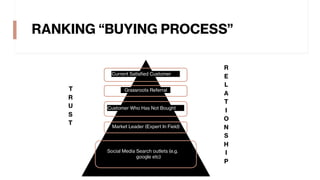
RANKING “BUYING PROCESS”
T
R
U
S
T
R
E
L
A
T
I
O
N
S
H
I
P
Current Satisfied Customer
Grassroots Referral
Customer Who Has Not Bought
Market Leader (Expert In Field)
Social Media Search outlets (e.g.
google etc)
RANKING “BUYING PROCESS”
• Current Satisfied Customer: Of course, customers are going to continue buying from their
satisfaction/comfort, however it’s “Value” that’s satisfying….staying as a current customer is dependent
on that.
• Grassroots Referral: As a customer you may not have the information on a product/company so you
rely on a friend/confidant for opinion (e.g. word of mouth grassroots referral).
• Customer Who Has Not Bought: You’re a current customer who has not purchased anything yet, the
key is for the company to stay top of mind when a need occurs.
• Market Leader (Expert In Field): Customers are attracted to the market leader because there’s a sense
of better quality and confidence. Companies strive to get to this level of competence.
• Social Media Search: The last-ditch effort for customers who have no knowledge of the product,
company or service. Google becomes the “Yellow Pages” for information. It would serve the company to
have a stellar reputation and SEO optimization benefits.
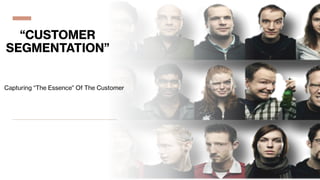
“CUSTOMER
SEGMENTATION”
Capturing “The Essence” Of The Customer
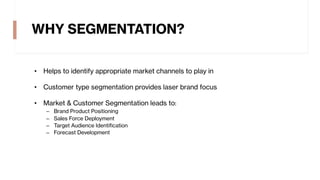
WHY SEGMENTATION?
• Helps to identify appropriate market channels to play in
• Customer type segmentation provides laser brand focus
• Market & Customer Segmentation leads to:
– Brand Product Positioning
– Sales Force Deployment
– Target Audience Identification
– Forecast Development
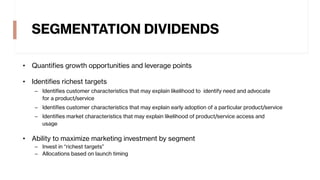
SEGMENTATION DIVIDENDS
• Quantifies growth opportunities and leverage points
• Identifies richest targets
– Identifies customer characteristics that may explain likelihood to identify need and advocate
for a product/service
– Identifies customer characteristics that may explain early adoption of a particular product/service
– Identifies market characteristics that may explain likelihood of product/service access and
usage
• Ability to maximize marketing investment by segment
– Invest in “richest targets”
– Allocations based on launch timing
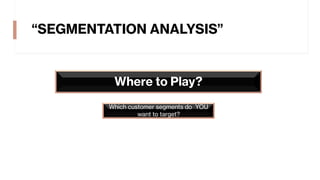
“SEGMENTATION ANALYSIS”
Where to Play?
Which customer segments do YOU
want to target?
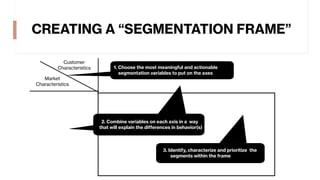
CREATING A “SEGMENTATION FRAME”
Market
Characteristics
Customer
Characteristics 1. Choose the most meaningful and actionable
segmentation variables to put on the axes
2. Combine variables on each axis in a way
that will explain the differences in behavior(s)
3. Identify, characterize and prioritize the
segments within the frame
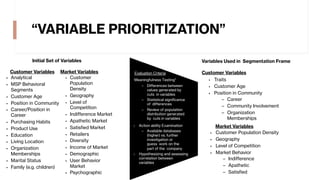
“VARIABLE PRIORITIZATION”
§ Analytical
§ MSP Behavioral
Segments
§ Customer Age
§ Position in Community
§ Career/Position in
Career
§ Purchasing Habits
§ Product Use
§ Education
§ Living Location
§ Organization
Memberships
§ Marital Status
§ Family (e.g. children)
Initial Set of Variables
Customer Variables Market Variables
§ Customer
Population
Density
§ Geography
§ Level of
Competition
§ Indifference Market
§ Apathetic Market
§ Satisfied Market
§ Retailers
§ Diversity
§ Income of Market
§ Demographic
§ User Behavior
Market
§ Psychographic
Evaluation Criteria
§ Meaningfulness Testing*
– Differences between
values generated by
cuts in variables
– Statistical significance
of differences
– Review of population
distribution generated
by cuts in variables
§ Action ability Examination
– Available databases
(higher) vs. further
investigation or
guess work on the
part of the company
§ Hypothesizing and assessing
correlation between
variables
§ Traits
§ Customer Age
§ Position in Community
– Career
– Community Involvement
– Organization
Memberships
Market Variables
§ Customer Population Density
§ Geography
§ Level of Competition
§ Market Behavior
– Indifference
– Apathetic
– Satisfied
Variables Used in Segmentation Frame
Customer Variables
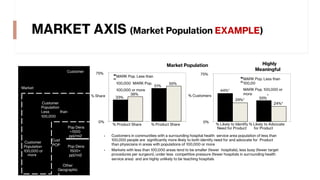
MARKET AXIS (Market Population EXAMPLE)
§ Customers in communities with a surrounding hospital health service area population of less than
100,000 people are significantly more likely to both identify need for and advocate for Product
than physicians in areas with populations of 100,000 or more
§ Markets with less than 100,000 areas tend to be smaller (fewer hospitals), less busy (fewer target
procedures per surgeon), under less competitive pressure (fewer hospitals in surrounding health
service area) and are highly unlikely to be teaching hospitals
Customer
Market
Customer
Population
Less than
100,000
Customer
Population
100,000 or
more
Cust
POP
Pop Dens
<1500
ppl/mi2
Pop Dens
1500+
ppl/mi2
Other
Geographic
s
Market Population
33%
0%
75%
% Likely to Identify % Likely to Advocate
Need for Product for Product
MARK Pop. Less than
100,00
MARK Pop. 100,000 or
more
33%
51%
38%
55%
0%
75%
% Product Share % Product Share
MARK Pop. Less than
100,000 MARK Pop.
100,000 or more
% Share % Customers
Highly
Meaningful
44%*
29%*
*
24%*
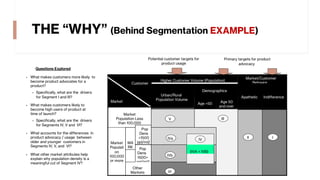
THE “WHY” (Behind Segmentation EXAMPLE)
Questions Explored
§ What makes customers more likely to
become product advocates for a
product?
– Specifically, what are the drivers
for Segment I and III?
§ What makes customers likely to
become high users of product at
time of launch?
– Specifically, what are the drivers
for Segments IV, V and VI?
§ What accounts for the differences in
product advocacy / usage between
older and younger customers in
Segments IV, V, and VI?
§ What other market attributes help
explain why population density is a
meaningful cut of Segment IV?
Customer
Market
Higher Customer Volume (Population)
Market/Customer
Behavior
Urban/Rural
Population Volume
Demographics
Apathetic Indifference
Age <50 Age 50
and over
Market
Population Less
than 100,000
Market
Populati
on
100,000
or more
MA
RK
Pop
Dens
<1500
ppl/mi2
Pop
Dens
1500+
ppl/mi2
Other
Markets
I
II
III
IVa
V
VI
IVb
Primary targets for product
advocacy
Potential customer targets for
product usage
(IVA + IVB)
IV
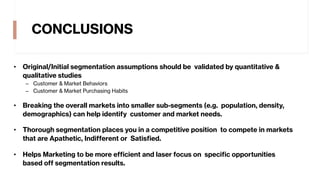
CONCLUSIONS
• Original/Initial segmentation assumptions should be validated by quantitative &
qualitative studies
– Customer & Market Behaviors
– Customer & Market Purchasing Habits
• Breaking the overall markets into smaller sub-segments (e.g. population, density,
demographics) can help identify customer and market needs.
• Thorough segmentation places you in a competitive position to compete in markets
that are Apathetic, Indifferent or Satisfied.
• Helps Marketing to be more efficient and laser focus on specific opportunities
based off segmentation results.
“Customer Loyalty”
What is the STICKY solution?
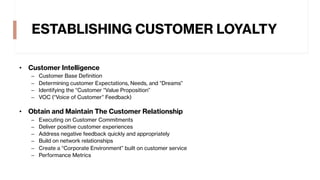
ESTABLISHING CUSTOMER LOYALTY
• Customer Intelligence
– Customer Base Definition
– Determining customer Expectations, Needs, and “Dreams”
– Identifying the “Customer “Value Proposition”
– VOC (“Voice of Customer” Feedback)
• Obtain and Maintain The Customer Relationship
– Executing on Customer Commitments
– Deliver positive customer experiences
– Address negative feedback quickly and appropriately
– Build on network relationships
– Create a “Corporate Environment” built on customer service
– Performance Metrics
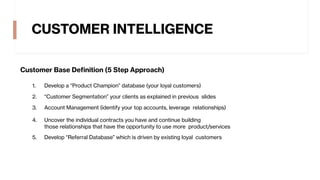
CUSTOMER INTELLIGENCE
Customer Base Definition (5 Step Approach)
1. Develop a “Product Champion” database (your loyal customers)
2. “Customer Segmentation” your clients as explained in previous slides
3. Account Management (identify your top accounts, leverage relationships)
4. Uncover the individual contracts you have and continue building
those relationships that have the opportunity to use more product/services
5. Develop “Referral Database” which is driven by existing loyal customers
CUSTOMER INTELLIGENCE
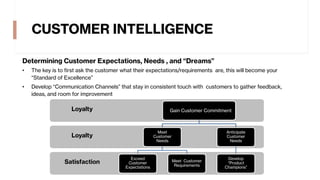
Determining Customer Expectations, Needs , and “Dreams”
• The key is to first ask the customer what their expectations/requirements are, this will become your
“Standard of Excellence”
• Develop “Communication Channels” that stay in consistent touch with customers to gather feedback,
ideas, and room for improvement
Satisfaction
Loyalty
Loyalty Gain Customer Commitment
Meet
Customer
Needs
Exceed
Customer
Expectations
Meet Customer
Requirements
Anticipate
Customer
Needs
Develop
“Product
Champions”
CUSTOMER INTELLIGENCE
Identifying The Customer “Value Proposition”
• A somewhat controversial strategy is to have customers a part of the innovation process, this
creates “Personal Value”
• Build “Focus Groups” that are transparent in terms of providing “Real Time” feedback
• Develop a “VOC” funnel process that receives consistent feedback from the customer on what “Value”
means to them
CUSTOMER RELATIONSHIPS
Executing On Customer Commitments
• Ensure you “Inspect What You Expect” from the feedback you gather from your current customer base.
Fully understand your customer’s expectations
• “Time-Bound”…never deliver or execute “Tardy”. “Perception” and “Reality” of poor quality will be
determined by the customer if timelines are not met
• Creating a “Culture” where honoring customer commitments has to be priority #1, this can be done by
adequate training, competency development, and employee performance metrics
• Again, develop a customer “Communication Channel” so that there’s accountability to ensure
commitments are met
CUSTOMER RELATIONSHIPS
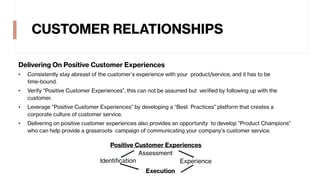
Delivering On Positive Customer Experiences
• Consistently stay abreast of the customer’s experience with your product/service, and it has to be
time-bound.
• Verify “Positive Customer Experiences”, this can not be assumed but verified by following up with the
customer.
• Leverage “Positive Customer Experiences” by developing a “Best Practices” platform that creates a
corporate culture of customer service.
• Delivering on positive customer experiences also provides an opportunity to develop “Product Champions”
who can help provide a grassroots campaign of communicating your company’s customer service.
Positive Customer Experiences
Assessment
Identification Experience
Execution
MAINTAIN CUSTOMER RELATIONSHIPS
Address Negative Feedback Quickly and Appropriately
• Depending on how efficiently you address or recover from a negative occurrence will define whether a
customer stays or leaves your business.
• Business School 101…always accept the negative feedback even though it’s misplaced or incorrect. It’s how
you handle the crisis that’s important.
• Empathize with the customer, and yes “The Customer Is Always Right” to a point. Customer “Education
Programs” provide a connection from the company to the customer on how to rebuild from the mistake or
negative feedback.
• Learn from your mistakes, and again this should be part of your company’s “Best Practices” to ensure a
similar mistake/poor feedback is handle properly in the future.
MAINTAIN CUSTOMER RELATIONSHIPS
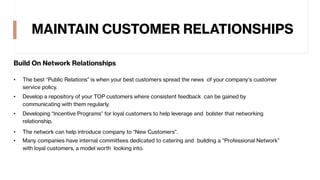
Build On Network Relationships
• The best “Public Relations” is when your best customers spread the news of your company’s customer
service policy.
• Develop a repository of your TOP customers where consistent feedback can be gained by
communicating with them regularly.
• Developing “Incentive Programs” for loyal customers to help leverage and bolster that networking
relationship.
• The network can help introduce company to “New Customers”.
• Many companies have internal committees dedicated to catering and building a “Professional Network”
with loyal customers, a model worth looking into.
MAINTAIN CUSTOMER RELATIONSHIPS
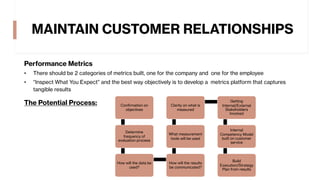
Performance Metrics
• There should be 2 categories of metrics built, one for the company and one for the employee
• “Inspect What You Expect” and the best way objectively is to develop a metrics platform that captures
tangible results
The Potential Process: Confirmation on
objectives
Determine
frequency of
evaluation process
How will the data be
used?
How will the results
be communicated?
What measurement
tools will be used
Clarity on what is
measured
Getting
Internal/External
Stakeholders
Involved
Internal
Competency Model
built on customer
service
Build
Execution/Strategy
Plan from results
“CUSTOMER
FOCUSED TEAM”
Building a “Customer Focused”
Standard Of Excellence Team”
HIRING “CUSTOMER FOCUSED” TEAM”
The initial hiring period is a critical time for any company. The learning
curve is steep with an expansive amount of knowledge to acquire and
understand – about a company, culture, products, customers, and
competitors.
The new hire should have and obtain customer focused skills that are
required to help sell our products in a variety of settings and in a complex
and dynamic market.
HIRING “CUSTOMER FOCUSED” TEAM”
The Goals of a New Hire “Customer Focused” Training Process
§ Deliver continuity and consistency in the training of the “Customer Experience” for more
predictable success
§ Accelerate the time to positive impact on customer/business results
§ Ensure that training focuses on what a “Positive Experience” looks like for a customer (“What Good
Looks Like Training”)
§ Provide “Customer Simulations” training to address variability outcomes and realistic business
needs
§ Develop shared ownership for “Customer Focused” success between Manager, New Hire, and the
Training Department
HIRING “CUSTOMER FOCUSED” TEAM”
The Guidelines of a New Hire “Customer Focused” Training Process
The guidelines are meant to provide structure to set the New Hire up for “Customer
Focused” success by:
§ Crafting a balance of individual work and support, where the New Hire takes ownership of their
learning, while being guided by the Manager and Company.
§ Providing a blend of “Customer Learning” opportunities that include self-study, field-based customer
interactions, and home office classroom application.
§ Ensuring frequent contact and constant communication, including a comprehensive progress report and a formal
readiness review by the Manager.
“CREATING
CUSTOMER
VALUE”
Building “The Culture”
“CREATING CUSTOMER VALUE CULTURE”
GOALS:
• Create a professional and engaging approach to “Creating Customer Value” that is
based on providing value
• Help our employees to engage customers using confidence, integrity, pride, and
empathy
• Moving our customers quickly to the “Loyal” phase so that we maintain a “Customer
Relationship Base”
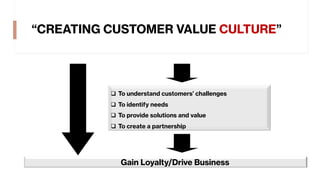
“CREATING CUSTOMER VALUE CULTURE”
Gain Loyalty/Drive Business
q To understand customers’ challenges
q To identify needs
q To provide solutions and value
q To create a partnership
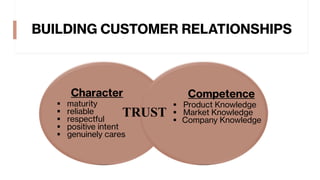
BUILDING CUSTOMER RELATIONSHIPS
Character
§ maturity
§ reliable
§ respectful
§ positive intent
§ genuinely cares
Competence
§ Product Knowledge
§ Market Knowledge
§ Company Knowledge
TRUST
“CREATING CUSTOMER VALUE CULTURE”
Educating Your Company On The Virtues of “CREATING CUSTOMER VALUE”
Establishing a culture that’s “Customer Focused” first one has to build a “Vision”
where the customer is an integral part of the company’s credo. Your organization
must understand and buy into the organization's service vision and “Customer
Focused Plan. Training has to be a priority when educating employees and
orientating them to a “Customer Focused” infrastructure. Corporate Leaders must
demonstrate by example the customer focused “Vision” on a daily basis.
Performance metrics must be put in place in order to track performance and
provide opportunities for improvement and development.
THANK YOU! André Harrell

CUSTOMER INSIGHT

  • 1.
    “Customer Insight” How toget it…How to use it Presented By André Harrell
  • 2.
    In this slidepresentation AH2 & Beyond Consulting takes a thorough look on how to gather “Customer Insight” and how to use such intelligence to grow your “Customer Database”. We also delve into the aspects of “Creating Customer Value” This presentation is for illustration purposes only
  • 3.
    THOUGHT Ultimately, by bringinginto sharper focus the emotional and rational drivers that influence customers’ perceptions and usage of a particular product, it helps to get a clearer perspective on what opportunities can be gained by this unique intelligence.
  • 4.
    INTRODUCTION • The goalis to try to uncover the powerful yet hidden forces that shape customer’s attitudes, beliefs, motivations and behaviors. • In this presentation we will look at the cultural drivers that shape and inform how customers think about and navigate choices, including understanding their belief systems particularly as it pertains to risk taking.
  • 5.
    “WHY I BUY” Therewas a survey conducted of more than 1,000 customers who were asked “Why do you buy”? • When there’s a need 1st, customers buy from people they know, trust, and like. • Customer Service, Value, and Cost head up as being the top 3 parameters. • The company’s vision
  • 6.
    RANKING “BUYING PROCESS” T R U S T R E L A T I O N S H I P CurrentSatisfied Customer Grassroots Referral Customer Who Has Not Bought Market Leader (Expert In Field) Social Media Search outlets (e.g. google etc)
  • 7.
    RANKING “BUYING PROCESS” •Current Satisfied Customer: Of course, customers are going to continue buying from their satisfaction/comfort, however it’s “Value” that’s satisfying….staying as a current customer is dependent on that. • Grassroots Referral: As a customer you may not have the information on a product/company so you rely on a friend/confidant for opinion (e.g. word of mouth grassroots referral). • Customer Who Has Not Bought: You’re a current customer who has not purchased anything yet, the key is for the company to stay top of mind when a need occurs. • Market Leader (Expert In Field): Customers are attracted to the market leader because there’s a sense of better quality and confidence. Companies strive to get to this level of competence. • Social Media Search: The last-ditch effort for customers who have no knowledge of the product, company or service. Google becomes the “Yellow Pages” for information. It would serve the company to have a stellar reputation and SEO optimization benefits.
  • 8.
  • 9.
    WHY SEGMENTATION? • Helpsto identify appropriate market channels to play in • Customer type segmentation provides laser brand focus • Market & Customer Segmentation leads to: – Brand Product Positioning – Sales Force Deployment – Target Audience Identification – Forecast Development
  • 10.
    SEGMENTATION DIVIDENDS • Quantifiesgrowth opportunities and leverage points • Identifies richest targets – Identifies customer characteristics that may explain likelihood to identify need and advocate for a product/service – Identifies customer characteristics that may explain early adoption of a particular product/service – Identifies market characteristics that may explain likelihood of product/service access and usage • Ability to maximize marketing investment by segment – Invest in “richest targets” – Allocations based on launch timing
  • 11.
    “SEGMENTATION ANALYSIS” Where toPlay? Which customer segments do YOU want to target?
  • 12.
    CREATING A “SEGMENTATIONFRAME” Market Characteristics Customer Characteristics 1. Choose the most meaningful and actionable segmentation variables to put on the axes 2. Combine variables on each axis in a way that will explain the differences in behavior(s) 3. Identify, characterize and prioritize the segments within the frame
  • 13.
    “VARIABLE PRIORITIZATION” § Analytical §MSP Behavioral Segments § Customer Age § Position in Community § Career/Position in Career § Purchasing Habits § Product Use § Education § Living Location § Organization Memberships § Marital Status § Family (e.g. children) Initial Set of Variables Customer Variables Market Variables § Customer Population Density § Geography § Level of Competition § Indifference Market § Apathetic Market § Satisfied Market § Retailers § Diversity § Income of Market § Demographic § User Behavior Market § Psychographic Evaluation Criteria § Meaningfulness Testing* – Differences between values generated by cuts in variables – Statistical significance of differences – Review of population distribution generated by cuts in variables § Action ability Examination – Available databases (higher) vs. further investigation or guess work on the part of the company § Hypothesizing and assessing correlation between variables § Traits § Customer Age § Position in Community – Career – Community Involvement – Organization Memberships Market Variables § Customer Population Density § Geography § Level of Competition § Market Behavior – Indifference – Apathetic – Satisfied Variables Used in Segmentation Frame Customer Variables
  • 14.
    MARKET AXIS (MarketPopulation EXAMPLE) § Customers in communities with a surrounding hospital health service area population of less than 100,000 people are significantly more likely to both identify need for and advocate for Product than physicians in areas with populations of 100,000 or more § Markets with less than 100,000 areas tend to be smaller (fewer hospitals), less busy (fewer target procedures per surgeon), under less competitive pressure (fewer hospitals in surrounding health service area) and are highly unlikely to be teaching hospitals Customer Market Customer Population Less than 100,000 Customer Population 100,000 or more Cust POP Pop Dens <1500 ppl/mi2 Pop Dens 1500+ ppl/mi2 Other Geographic s Market Population 33% 0% 75% % Likely to Identify % Likely to Advocate Need for Product for Product MARK Pop. Less than 100,00 MARK Pop. 100,000 or more 33% 51% 38% 55% 0% 75% % Product Share % Product Share MARK Pop. Less than 100,000 MARK Pop. 100,000 or more % Share % Customers Highly Meaningful 44%* 29%* * 24%*
  • 15.
    THE “WHY” (BehindSegmentation EXAMPLE) Questions Explored § What makes customers more likely to become product advocates for a product? – Specifically, what are the drivers for Segment I and III? § What makes customers likely to become high users of product at time of launch? – Specifically, what are the drivers for Segments IV, V and VI? § What accounts for the differences in product advocacy / usage between older and younger customers in Segments IV, V, and VI? § What other market attributes help explain why population density is a meaningful cut of Segment IV? Customer Market Higher Customer Volume (Population) Market/Customer Behavior Urban/Rural Population Volume Demographics Apathetic Indifference Age <50 Age 50 and over Market Population Less than 100,000 Market Populati on 100,000 or more MA RK Pop Dens <1500 ppl/mi2 Pop Dens 1500+ ppl/mi2 Other Markets I II III IVa V VI IVb Primary targets for product advocacy Potential customer targets for product usage (IVA + IVB) IV
  • 16.
    CONCLUSIONS • Original/Initial segmentationassumptions should be validated by quantitative & qualitative studies – Customer & Market Behaviors – Customer & Market Purchasing Habits • Breaking the overall markets into smaller sub-segments (e.g. population, density, demographics) can help identify customer and market needs. • Thorough segmentation places you in a competitive position to compete in markets that are Apathetic, Indifferent or Satisfied. • Helps Marketing to be more efficient and laser focus on specific opportunities based off segmentation results.
  • 17.
    “Customer Loyalty” What isthe STICKY solution?
  • 18.
    ESTABLISHING CUSTOMER LOYALTY •Customer Intelligence – Customer Base Definition – Determining customer Expectations, Needs, and “Dreams” – Identifying the “Customer “Value Proposition” – VOC (“Voice of Customer” Feedback) • Obtain and Maintain The Customer Relationship – Executing on Customer Commitments – Deliver positive customer experiences – Address negative feedback quickly and appropriately – Build on network relationships – Create a “Corporate Environment” built on customer service – Performance Metrics
  • 19.
    CUSTOMER INTELLIGENCE Customer BaseDefinition (5 Step Approach) 1. Develop a “Product Champion” database (your loyal customers) 2. “Customer Segmentation” your clients as explained in previous slides 3. Account Management (identify your top accounts, leverage relationships) 4. Uncover the individual contracts you have and continue building those relationships that have the opportunity to use more product/services 5. Develop “Referral Database” which is driven by existing loyal customers
  • 20.
    CUSTOMER INTELLIGENCE Determining CustomerExpectations, Needs , and “Dreams” • The key is to first ask the customer what their expectations/requirements are, this will become your “Standard of Excellence” • Develop “Communication Channels” that stay in consistent touch with customers to gather feedback, ideas, and room for improvement Satisfaction Loyalty Loyalty Gain Customer Commitment Meet Customer Needs Exceed Customer Expectations Meet Customer Requirements Anticipate Customer Needs Develop “Product Champions”
  • 21.
    CUSTOMER INTELLIGENCE Identifying TheCustomer “Value Proposition” • A somewhat controversial strategy is to have customers a part of the innovation process, this creates “Personal Value” • Build “Focus Groups” that are transparent in terms of providing “Real Time” feedback • Develop a “VOC” funnel process that receives consistent feedback from the customer on what “Value” means to them
  • 22.
    CUSTOMER RELATIONSHIPS Executing OnCustomer Commitments • Ensure you “Inspect What You Expect” from the feedback you gather from your current customer base. Fully understand your customer’s expectations • “Time-Bound”…never deliver or execute “Tardy”. “Perception” and “Reality” of poor quality will be determined by the customer if timelines are not met • Creating a “Culture” where honoring customer commitments has to be priority #1, this can be done by adequate training, competency development, and employee performance metrics • Again, develop a customer “Communication Channel” so that there’s accountability to ensure commitments are met
  • 23.
    CUSTOMER RELATIONSHIPS Delivering OnPositive Customer Experiences • Consistently stay abreast of the customer’s experience with your product/service, and it has to be time-bound. • Verify “Positive Customer Experiences”, this can not be assumed but verified by following up with the customer. • Leverage “Positive Customer Experiences” by developing a “Best Practices” platform that creates a corporate culture of customer service. • Delivering on positive customer experiences also provides an opportunity to develop “Product Champions” who can help provide a grassroots campaign of communicating your company’s customer service. Positive Customer Experiences Assessment Identification Experience Execution
  • 24.
    MAINTAIN CUSTOMER RELATIONSHIPS AddressNegative Feedback Quickly and Appropriately • Depending on how efficiently you address or recover from a negative occurrence will define whether a customer stays or leaves your business. • Business School 101…always accept the negative feedback even though it’s misplaced or incorrect. It’s how you handle the crisis that’s important. • Empathize with the customer, and yes “The Customer Is Always Right” to a point. Customer “Education Programs” provide a connection from the company to the customer on how to rebuild from the mistake or negative feedback. • Learn from your mistakes, and again this should be part of your company’s “Best Practices” to ensure a similar mistake/poor feedback is handle properly in the future.
  • 25.
    MAINTAIN CUSTOMER RELATIONSHIPS BuildOn Network Relationships • The best “Public Relations” is when your best customers spread the news of your company’s customer service policy. • Develop a repository of your TOP customers where consistent feedback can be gained by communicating with them regularly. • Developing “Incentive Programs” for loyal customers to help leverage and bolster that networking relationship. • The network can help introduce company to “New Customers”. • Many companies have internal committees dedicated to catering and building a “Professional Network” with loyal customers, a model worth looking into.
  • 26.
    MAINTAIN CUSTOMER RELATIONSHIPS PerformanceMetrics • There should be 2 categories of metrics built, one for the company and one for the employee • “Inspect What You Expect” and the best way objectively is to develop a metrics platform that captures tangible results The Potential Process: Confirmation on objectives Determine frequency of evaluation process How will the data be used? How will the results be communicated? What measurement tools will be used Clarity on what is measured Getting Internal/External Stakeholders Involved Internal Competency Model built on customer service Build Execution/Strategy Plan from results
  • 27.
    “CUSTOMER FOCUSED TEAM” Building a“Customer Focused” Standard Of Excellence Team”
  • 28.
    HIRING “CUSTOMER FOCUSED”TEAM” The initial hiring period is a critical time for any company. The learning curve is steep with an expansive amount of knowledge to acquire and understand – about a company, culture, products, customers, and competitors. The new hire should have and obtain customer focused skills that are required to help sell our products in a variety of settings and in a complex and dynamic market.
  • 29.
    HIRING “CUSTOMER FOCUSED”TEAM” The Goals of a New Hire “Customer Focused” Training Process § Deliver continuity and consistency in the training of the “Customer Experience” for more predictable success § Accelerate the time to positive impact on customer/business results § Ensure that training focuses on what a “Positive Experience” looks like for a customer (“What Good Looks Like Training”) § Provide “Customer Simulations” training to address variability outcomes and realistic business needs § Develop shared ownership for “Customer Focused” success between Manager, New Hire, and the Training Department
  • 30.
    HIRING “CUSTOMER FOCUSED”TEAM” The Guidelines of a New Hire “Customer Focused” Training Process The guidelines are meant to provide structure to set the New Hire up for “Customer Focused” success by: § Crafting a balance of individual work and support, where the New Hire takes ownership of their learning, while being guided by the Manager and Company. § Providing a blend of “Customer Learning” opportunities that include self-study, field-based customer interactions, and home office classroom application. § Ensuring frequent contact and constant communication, including a comprehensive progress report and a formal readiness review by the Manager.
  • 31.
  • 32.
    “CREATING CUSTOMER VALUECULTURE” GOALS: • Create a professional and engaging approach to “Creating Customer Value” that is based on providing value • Help our employees to engage customers using confidence, integrity, pride, and empathy • Moving our customers quickly to the “Loyal” phase so that we maintain a “Customer Relationship Base”
  • 33.
    “CREATING CUSTOMER VALUECULTURE” Gain Loyalty/Drive Business q To understand customers’ challenges q To identify needs q To provide solutions and value q To create a partnership
  • 34.
    BUILDING CUSTOMER RELATIONSHIPS Character §maturity § reliable § respectful § positive intent § genuinely cares Competence § Product Knowledge § Market Knowledge § Company Knowledge TRUST
  • 35.
    “CREATING CUSTOMER VALUECULTURE” Educating Your Company On The Virtues of “CREATING CUSTOMER VALUE” Establishing a culture that’s “Customer Focused” first one has to build a “Vision” where the customer is an integral part of the company’s credo. Your organization must understand and buy into the organization's service vision and “Customer Focused Plan. Training has to be a priority when educating employees and orientating them to a “Customer Focused” infrastructure. Corporate Leaders must demonstrate by example the customer focused “Vision” on a daily basis. Performance metrics must be put in place in order to track performance and provide opportunities for improvement and development.
  • 36.