Value Propositions
Pre-Work: To be Completed in Advance of
Workshop 1
What will you learn program?
The Village Capital process is unique because you
sit in the investor’s seat.
Village Capital helps you see other businesses—
and your own—through a “Lens of the Investor.”
You learn what you need to do to become ready
for serious investment—and you help other
entrepreneurs like you do the same.
The Value Proposition Statement
Critical to this process is the development of a
value proposition.
We use a specific “value proposition statement”
to get you to be very specific about the value you
offer—and to whom you offer that value.
We want you to present your core value
proposition statement at Workshop 1.
Our agenda
1.We’ll help you develop a value proposition
statement.
• But first we’re going to have you work on a Customer
Persona
• You’ll then create a value proposition statement. We
want you to be ready to read this in Workshop 1.
2.We’ll next add differentiators to your value
prop.
• You’ll also include these in Workshop 1.
3.Finally, a summary competitive analysis.
• Bring this with you to W1.
This very much applies to value props!
“It’s better to be specific and
wrong than vague and right.”
Ross Baird, Executive Director, Village Capital
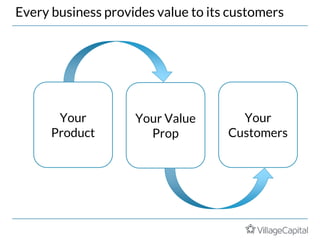
Your Value
Prop
Every business provides value to its customers
Your
Customers
Your
Product
You must demonstrate that customers really care
To build a successful business—and raise
investment—you need to solve a
significant pain point for customers. If you’re
raising investment before you have the ultimate
proof that you solve this pain—sales— you must
provide proof that customers do indeed care
about your solution.
The more pain you solve for customers, the
more likely you’ll get investment.
We call companies that solve real pain for
customers “pain-killer” type companies.
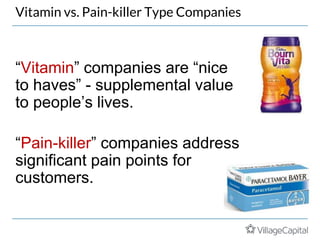
Vitamin vs. Pain-killer Type Companies
“Vitamin” companies are “nice
to haves” - supplemental value
to people’s lives.
“Pain-killer” companies address
significant pain points for
customers.
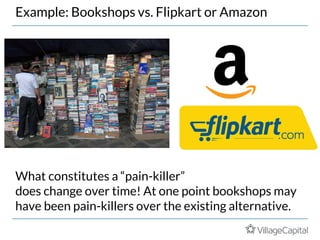
Example: Bookshops vs. Flipkart or Amazon
What constitutes a “pain-killer”
does change over time! At one point bookshops may
have been pain-killers over the existing alternative.
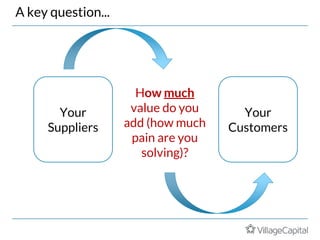
A key question...
Your
Customers
Your
Suppliers
How much
value do you
add (how much
pain are you
solving)?
The more proof you have that
you’re a pain-killer, not a vitamin,
the greater your chance of
success long-term...and of
securing investment short-term.
How MUCH pain do you solve?
During Workshop 1 we’ll work
with you to design experiments
to test your value prop and verify
that you’re a pain-killer.
Testing your value prop
You’ll use a value proposition
statement to secure this
validation.
A value prop is a concise and
testable articulation of the value
you add, the amount of pain you
solve.
A value prop is testable
Where do we start?
In this exercise we’re going to help you develop a
value proposition statement.
Where do we start?
With the customer!
But...let’s check that we all define “customer” in
the same way….
Example: who is Google’s customer?
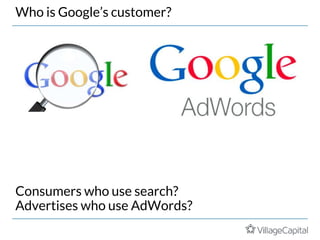
Consumers who use search?
Advertises who use AdWords?
Who is Google’s customer?
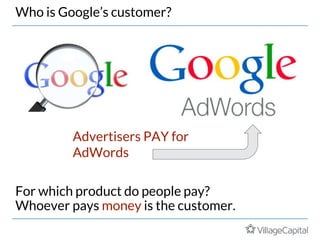
For which product do people pay?
Whoever pays money is the customer.
Who is Google’s customer?
Advertisers PAY for
AdWords
More important—who is the “bullseye” customer?
Who is your current, bullseye customer?
Example: for Bay, when they STARTED?
●Not “everyone”
●Not “buyers and sellers”
●Not “buyers”
No, at its start it was “collectors of niche goods
who used the Internet in 1997” … the very first
customer bought a broken laser pointer!
Only later...auto dealers, real estate agents,
and hundreds of millions more…
Customer Persona
We’ll work first on a very
simple customer persona...
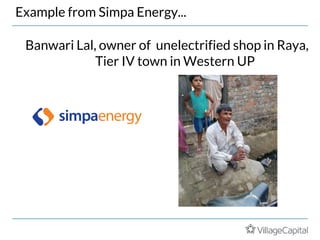
Example from Simpa Energy...
Banwari Lal, owner of unelectrified shop in Raya,
Tier IV town in Western UP
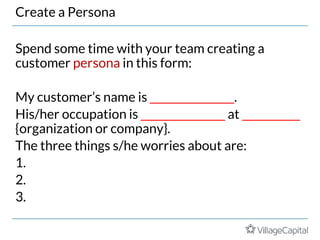
Create a Persona
Spend some time with your team creating a
customer persona in this form:
My customer’s name is ________________.
His/her occupation is ________________ at ___________
{organization or company}.
The three things s/he worries about are:
1.
2.
3.
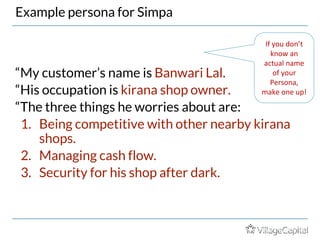
Example persona for Simpa
“My customer’s name is Banwari Lal.
“His occupation is kirana shop owner.
“The three things he worries about are:
1. Being competitive with other nearby kirana
shops.
2. Managing cash flow.
3. Security for his shop after dark.
If you don’t
know an
actual name
of your
Persona,
make one up!
More on “Personas” in Disciplined Entrepreneurship by Aulet
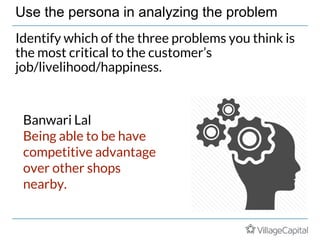
Use the persona in analyzing the problem
Identify which of the three problems you think is
the most critical to the customer’s
job/livelihood/happiness.
Banwari Lal
Being able to be have
competitive advantage
over other shops
nearby.
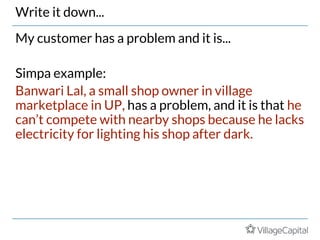
Write it down...
My customer has a problem and it is...
Simpa example:
Banwari Lal, a small shop owner in village
marketplace in UP, has a problem, and it is that he
can’t compete with nearby shops because he lacks
electricity for lighting his shop after dark.
Let’s work on the third part of your value prop
How does your product solve their
problem?
What is the most important benefit you
provide for you customer?
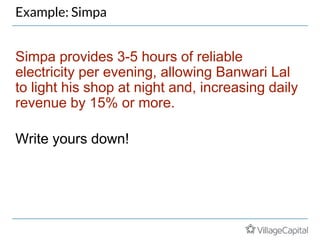
Example: Simpa
Simpa provides 3-5 hours of reliable
electricity per evening, allowing Banwari Lal
to light his shop at night and, increasing daily
revenue by 15% or more.
Write yours down!
Does your solution match the problem?
Critically, your solution has to match the most
important problem your customer has!
1.You wrote down a specific customer.
2.You selected what you think that specific
customer’s most important problem is.
3.You described your solution to that problem
THIS is the essential part of a value prop!
Converting to a value prop
Now we’re going to take that very specific
customer persona and generalize it a little from
the specific individual to the category of customer
that individual represents.
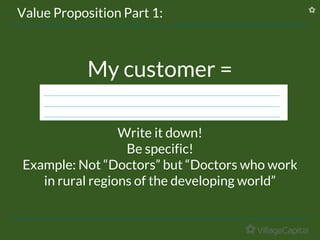
My customer =
Write it down!
Be specific!
Example: Not “Doctors” but “Doctors who work
in rural regions of the developing world”
Value Proposition Part 1:
Example: Simpa Energy
Customer: energy-poor shops and
households in rural UP.
Value Proposition Part 2:
My customer’s problem =
Again, write it down!
Be specific!
Example: Simpa Energy
Customer problem: they can’t
compete with nearby shops
because they lack electricity for
lighting their shops after dark.
What is your product?
Be specific about it.
Explain it in 8 words or less.
Explain it in plain language a 5-year-old could understand.
“Data management software for teachers”
“Pay-as-you-go home energy systems”
“Mobile-based EHR systems for rural doctors”
Value Proposition Part #3:
Example: Simpa Energy
Product: “We sell prepaid solar
energy systems”
How does the product solve
the problem?
Explain it in just a sentence!
What would your customer say about the solution?
(This is HOW it solves the problem not
WHAT your product is.)
Value Proposition Part #4:
Example: Simpa Energy
Solution: “Simpa provides 3-5 hours of
reliable electricity per evening, allowing
our customers to light their shops at
night, increasing daily revenue by 15%
or more.”
Finally, your value prop comes together…
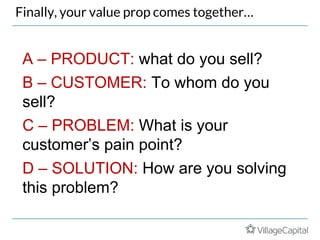
A – PRODUCT: what do you sell?
B – CUSTOMER: To whom do you
sell?
C – PROBLEM: What is your
customer’s pain point?
D – SOLUTION: How are you solving
this problem?
It’s a hypothesis, not a pitch!
For a startup, a value prop is a
HYPOTHESIS.
A value prop is not a PITCH!
It’s a tool for testing your value and how
you deliver that value. CLEAR but not
necessarily elegant.
You don’t just have one value prop
Most companies have more than
one value prop and some have many
or hundreds!
As a startup, we want to focus on
identifying the single thing you want
to do best!
In Workshop 1 we want you
to read your value prop in the
following very specific form...
Use our template!
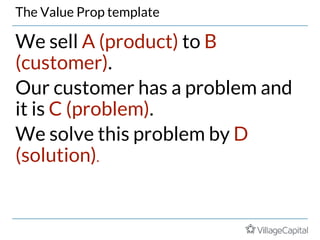
The Value Prop template
We sell A (product) to B
(customer).
Our customer has a problem and
it is C (problem).
We solve this problem by D
(solution).
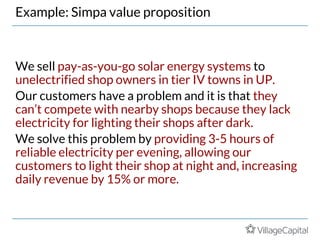
Example: Simpa value proposition
We sell pay-as-you-go solar energy systems to
unelectrified shop owners in tier IV towns in UP.
Our customers have a problem and it is that they
can’t compete with nearby shops because they lack
electricity for lighting their shops after dark.
We solve this problem by providing 3-5 hours of
reliable electricity per evening, allowing our
customers to light their shop at night and, increasing
daily revenue by 15% or more.
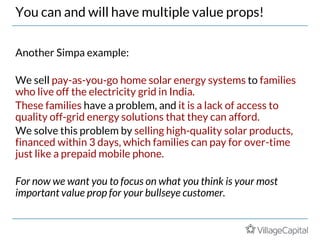
You can and will have multiple value props!
Another Simpa example:
We sell pay-as-you-go home solar energy systems to families
who live off the electricity grid in India.
These families have a problem, and it is a lack of access to
quality off-grid energy solutions that they can afford.
We solve this problem by selling high-quality solar products,
financed within 3 days, which families can pay for over-time
just like a prepaid mobile phone.
For now we want you to focus on what you think is your most
important value prop for your bullseye customer.
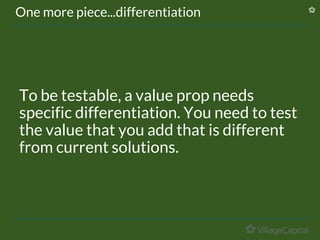
One more piece...differentiation
To be testable, a value prop needs
specific differentiation. You need to test
the value that you add that is different
from current solutions.
About differentiators
Very simply, how different is your product from
available alternatives?
Examples …
– Faster
– Cheaper
– More sustainable
– Stronger
– More durable
– Etc…
Differentiators are
either quantifiable … e.g.
20% cheaper OR they
are binary, which means
you offer something that
someone else simply
does not.
The question for testing:
Is what about your offering is
different enough from the status
quo for your target customers to
care?
How are you different?
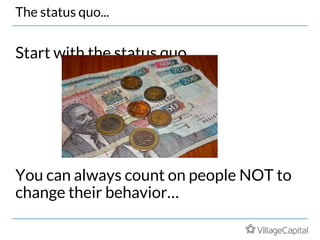
Start with the status quo
You can always count on people NOT to
change their behavior…
The status quo...
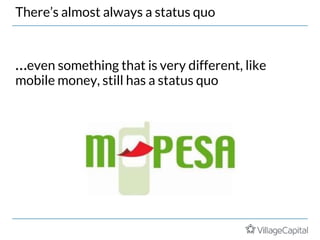
…even something that is very different, like
mobile money, still has a status quo
There’s almost always a status quo
Spell out your differentiators...
Three questions:
1) What is the status quo?
2) How are you different?
– Faster
– Cheaper
– Stronger
– More durable
– Etc.
3) Quantify it!
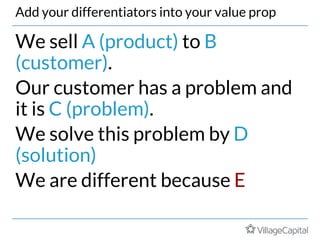
Add your differentiators into your value prop
We sell A (product) to B
(customer).
Our customer has a problem and
it is C (problem).
We solve this problem by D
(solution)
We are different because E
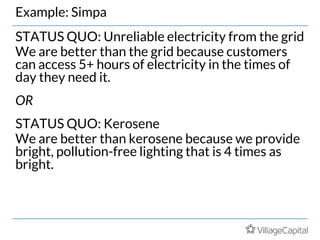
Example: Simpa
STATUS QUO: Unreliable electricity from the grid
We are better than the grid because customers
can access 5+ hours of electricity in the times of
day they need it.
OR
STATUS QUO: Kerosene
We are better than kerosene because we provide
bright, pollution-free lighting that is 4 times as
bright.
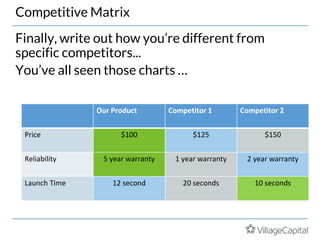
Competitive Matrix
Finally, write out how you’re different from
specific competitors...
You’ve all seen those charts …
Our Product Competitor 1 Competitor 2
Price $100 $125 $150
Reliability 5 year warranty 1 year warranty 2 year warranty
Launch Time 12 second 20 seconds 10 seconds
That’s it …!!
(Phew!)
Remember...
That’s it...
Remember...
1. Bring your value proposition statement to
Workshop 1.
2. Make sure it has differentiators.
3.And you should also have a summary
competitive analysis.

Bootcamp pre work value propositions

  • 1.
    Value Propositions Pre-Work: Tobe Completed in Advance of Workshop 1
  • 2.
    What will youlearn program? The Village Capital process is unique because you sit in the investor’s seat. Village Capital helps you see other businesses— and your own—through a “Lens of the Investor.” You learn what you need to do to become ready for serious investment—and you help other entrepreneurs like you do the same.
  • 3.
    The Value PropositionStatement Critical to this process is the development of a value proposition. We use a specific “value proposition statement” to get you to be very specific about the value you offer—and to whom you offer that value. We want you to present your core value proposition statement at Workshop 1.
  • 4.
    Our agenda 1.We’ll helpyou develop a value proposition statement. • But first we’re going to have you work on a Customer Persona • You’ll then create a value proposition statement. We want you to be ready to read this in Workshop 1. 2.We’ll next add differentiators to your value prop. • You’ll also include these in Workshop 1. 3.Finally, a summary competitive analysis. • Bring this with you to W1.
  • 5.
    This very muchapplies to value props! “It’s better to be specific and wrong than vague and right.” Ross Baird, Executive Director, Village Capital
  • 6.
    Your Value Prop Every businessprovides value to its customers Your Customers Your Product
  • 7.
    You must demonstratethat customers really care To build a successful business—and raise investment—you need to solve a significant pain point for customers. If you’re raising investment before you have the ultimate proof that you solve this pain—sales— you must provide proof that customers do indeed care about your solution. The more pain you solve for customers, the more likely you’ll get investment. We call companies that solve real pain for customers “pain-killer” type companies.
  • 8.
    Vitamin vs. Pain-killerType Companies “Vitamin” companies are “nice to haves” - supplemental value to people’s lives. “Pain-killer” companies address significant pain points for customers.
  • 9.
    Example: Bookshops vs.Flipkart or Amazon What constitutes a “pain-killer” does change over time! At one point bookshops may have been pain-killers over the existing alternative.
  • 10.
    A key question... Your Customers Your Suppliers Howmuch value do you add (how much pain are you solving)?
  • 11.
    The more proofyou have that you’re a pain-killer, not a vitamin, the greater your chance of success long-term...and of securing investment short-term. How MUCH pain do you solve?
  • 12.
    During Workshop 1we’ll work with you to design experiments to test your value prop and verify that you’re a pain-killer. Testing your value prop
  • 13.
    You’ll use avalue proposition statement to secure this validation. A value prop is a concise and testable articulation of the value you add, the amount of pain you solve. A value prop is testable
  • 14.
    Where do westart? In this exercise we’re going to help you develop a value proposition statement. Where do we start? With the customer! But...let’s check that we all define “customer” in the same way…. Example: who is Google’s customer?
  • 15.
    Consumers who usesearch? Advertises who use AdWords? Who is Google’s customer?
  • 16.
    For which productdo people pay? Whoever pays money is the customer. Who is Google’s customer? Advertisers PAY for AdWords
  • 17.
    More important—who isthe “bullseye” customer? Who is your current, bullseye customer? Example: for Bay, when they STARTED? ●Not “everyone” ●Not “buyers and sellers” ●Not “buyers” No, at its start it was “collectors of niche goods who used the Internet in 1997” … the very first customer bought a broken laser pointer! Only later...auto dealers, real estate agents, and hundreds of millions more…
  • 18.
    Customer Persona We’ll workfirst on a very simple customer persona...
  • 19.
    Example from SimpaEnergy... Banwari Lal, owner of unelectrified shop in Raya, Tier IV town in Western UP
  • 20.
    Create a Persona Spendsome time with your team creating a customer persona in this form: My customer’s name is ________________. His/her occupation is ________________ at ___________ {organization or company}. The three things s/he worries about are: 1. 2. 3.
  • 21.
    Example persona forSimpa “My customer’s name is Banwari Lal. “His occupation is kirana shop owner. “The three things he worries about are: 1. Being competitive with other nearby kirana shops. 2. Managing cash flow. 3. Security for his shop after dark. If you don’t know an actual name of your Persona, make one up! More on “Personas” in Disciplined Entrepreneurship by Aulet
  • 22.
    Use the personain analyzing the problem Identify which of the three problems you think is the most critical to the customer’s job/livelihood/happiness. Banwari Lal Being able to be have competitive advantage over other shops nearby.
  • 23.
    Write it down... Mycustomer has a problem and it is... Simpa example: Banwari Lal, a small shop owner in village marketplace in UP, has a problem, and it is that he can’t compete with nearby shops because he lacks electricity for lighting his shop after dark.
  • 24.
    Let’s work onthe third part of your value prop How does your product solve their problem? What is the most important benefit you provide for you customer?
  • 25.
    Example: Simpa Simpa provides3-5 hours of reliable electricity per evening, allowing Banwari Lal to light his shop at night and, increasing daily revenue by 15% or more. Write yours down!
  • 26.
    Does your solutionmatch the problem? Critically, your solution has to match the most important problem your customer has! 1.You wrote down a specific customer. 2.You selected what you think that specific customer’s most important problem is. 3.You described your solution to that problem THIS is the essential part of a value prop!
  • 27.
    Converting to avalue prop Now we’re going to take that very specific customer persona and generalize it a little from the specific individual to the category of customer that individual represents.
  • 28.
    My customer = Writeit down! Be specific! Example: Not “Doctors” but “Doctors who work in rural regions of the developing world” Value Proposition Part 1:
  • 29.
    Example: Simpa Energy Customer:energy-poor shops and households in rural UP.
  • 30.
    Value Proposition Part2: My customer’s problem = Again, write it down! Be specific!
  • 31.
    Example: Simpa Energy Customerproblem: they can’t compete with nearby shops because they lack electricity for lighting their shops after dark.
  • 32.
    What is yourproduct? Be specific about it. Explain it in 8 words or less. Explain it in plain language a 5-year-old could understand. “Data management software for teachers” “Pay-as-you-go home energy systems” “Mobile-based EHR systems for rural doctors” Value Proposition Part #3:
  • 33.
    Example: Simpa Energy Product:“We sell prepaid solar energy systems”
  • 34.
    How does theproduct solve the problem? Explain it in just a sentence! What would your customer say about the solution? (This is HOW it solves the problem not WHAT your product is.) Value Proposition Part #4:
  • 35.
    Example: Simpa Energy Solution:“Simpa provides 3-5 hours of reliable electricity per evening, allowing our customers to light their shops at night, increasing daily revenue by 15% or more.”
  • 36.
    Finally, your valueprop comes together… A – PRODUCT: what do you sell? B – CUSTOMER: To whom do you sell? C – PROBLEM: What is your customer’s pain point? D – SOLUTION: How are you solving this problem?
  • 37.
    It’s a hypothesis,not a pitch! For a startup, a value prop is a HYPOTHESIS. A value prop is not a PITCH! It’s a tool for testing your value and how you deliver that value. CLEAR but not necessarily elegant.
  • 38.
    You don’t justhave one value prop Most companies have more than one value prop and some have many or hundreds! As a startup, we want to focus on identifying the single thing you want to do best!
  • 39.
    In Workshop 1we want you to read your value prop in the following very specific form... Use our template!
  • 40.
    The Value Proptemplate We sell A (product) to B (customer). Our customer has a problem and it is C (problem). We solve this problem by D (solution).
  • 41.
    Example: Simpa valueproposition We sell pay-as-you-go solar energy systems to unelectrified shop owners in tier IV towns in UP. Our customers have a problem and it is that they can’t compete with nearby shops because they lack electricity for lighting their shops after dark. We solve this problem by providing 3-5 hours of reliable electricity per evening, allowing our customers to light their shop at night and, increasing daily revenue by 15% or more.
  • 42.
    You can andwill have multiple value props! Another Simpa example: We sell pay-as-you-go home solar energy systems to families who live off the electricity grid in India. These families have a problem, and it is a lack of access to quality off-grid energy solutions that they can afford. We solve this problem by selling high-quality solar products, financed within 3 days, which families can pay for over-time just like a prepaid mobile phone. For now we want you to focus on what you think is your most important value prop for your bullseye customer.
  • 43.
    One more piece...differentiation Tobe testable, a value prop needs specific differentiation. You need to test the value that you add that is different from current solutions.
  • 44.
    About differentiators Very simply,how different is your product from available alternatives? Examples … – Faster – Cheaper – More sustainable – Stronger – More durable – Etc… Differentiators are either quantifiable … e.g. 20% cheaper OR they are binary, which means you offer something that someone else simply does not.
  • 45.
    The question fortesting: Is what about your offering is different enough from the status quo for your target customers to care? How are you different?
  • 46.
    Start with thestatus quo You can always count on people NOT to change their behavior… The status quo...
  • 47.
    …even something thatis very different, like mobile money, still has a status quo There’s almost always a status quo
  • 48.
    Spell out yourdifferentiators... Three questions: 1) What is the status quo? 2) How are you different? – Faster – Cheaper – Stronger – More durable – Etc. 3) Quantify it!
  • 49.
    Add your differentiatorsinto your value prop We sell A (product) to B (customer). Our customer has a problem and it is C (problem). We solve this problem by D (solution) We are different because E
  • 50.
    Example: Simpa STATUS QUO:Unreliable electricity from the grid We are better than the grid because customers can access 5+ hours of electricity in the times of day they need it. OR STATUS QUO: Kerosene We are better than kerosene because we provide bright, pollution-free lighting that is 4 times as bright.
  • 51.
    Competitive Matrix Finally, writeout how you’re different from specific competitors... You’ve all seen those charts … Our Product Competitor 1 Competitor 2 Price $100 $125 $150 Reliability 5 year warranty 1 year warranty 2 year warranty Launch Time 12 second 20 seconds 10 seconds
  • 52.
  • 53.
    Remember... 1. Bring yourvalue proposition statement to Workshop 1. 2. Make sure it has differentiators. 3.And you should also have a summary competitive analysis.