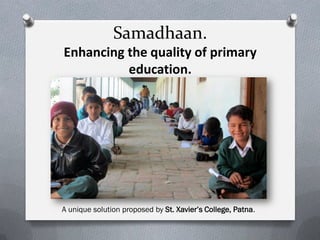
Samadhaan.
Enhancing the quality of primary
education.
A unique solution proposed by St. Xavier’s College, Patna.
The Problem Of Disparity.
In our research the low standard of education and disparity between enrollment
and attendance were the two main problem that we identified.
Source: DISE survey report 2011-2012
Reasons behind the Problem.
• Old structure of
pedagogy.
• No Innovation in the
delivery of content
• Lack of Co-Curricular and
Extra-Curricular
Platforms.
• Low level of interaction
between teachers and
students.
• According to a recent
survey, the percentage of
completion of
Infrastructural facilities is
90%. The total percentage
of teachers are just 60%.
• 52% teachers are below
graduation.
• Only 33% of teachers in
public sector in India are
graduates.
• Only 48% of the teachers in
Government Sectors are
trained.
• 76% of the total private
schools in India have no
trained activity teacher.
• Existing generation gap
between parents and
students.
• Retaliation to adapt the
new technique.
• Excessive faith on the
traditional pedagogy.
• Many illiterate poor
parents in rural India send
their children to earn than
to study .
General facts.
• Total schools in India - 14,12,178
• Total students in primary section - 199.06 million
• Total teachers - 6.69 million.
• Number of repeaters - 5.5 million *Source: DISE survey
report 2011-2012
Proposed Solution
Our solution to the problem is to implement the “PRACTICAL SCHOOLING PROGRAM” in our current
primary education system. We tend to build 6 innovatively designed practical schools for kids to identify
their latent talent and develop their skills by engaging them into live education.
• This program will develop awareness, knowledge, attitude, skill and participation level of kids.
• Creative Workshops, Meets, Activities, Training Camps, Events, Field Trips and development of
Scientific temperament will be promoted both at government and private school levels.
The program is divided into two parts.
• This will encompass grade 1st to 4th. Students will get their training in all the
six schools.
• They will sit for an aptitude test at the end of their session.
Beginner's Level
• Schools will be allotted according to results of the aptitude test.
• Students from class 5th onwards will get the training in their specific school.Advanced Level
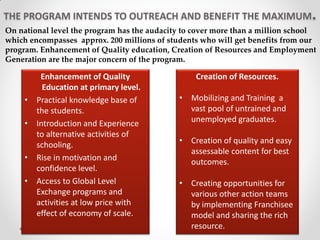
THE PROGRAM INTENDS TO OUTREACH AND BENEFIT THE MAXIMUM.
Enhancement of Quality
Education at primary level.
• Practical knowledge base of
the students.
• Introduction and Experience
to alternative activities of
schooling.
• Rise in motivation and
confidence level.
• Access to Global Level
Exchange programs and
activities at low price with
effect of economy of scale.
Creation of Resources.
• Mobilizing and Training a
vast pool of untrained and
unemployed graduates.
• Creation of quality and easy
assessable content for best
outcomes.
• Creating opportunities for
various other action teams
by implementing Franchisee
model and sharing the rich
resource.
On national level the program has the audacity to cover more than a million school
which encompasses approx. 200 millions of students who will get benefits from our
program. Enhancement of Quality education, Creation of Resources and Employment
Generation are the major concern of the program.
Our program will just not enhance the quality of education at primary level
but will also generate employment for the unemployed graduates.
• Generating the employment opportunity for youth.
10.8
0.7
In millions
Unemployed
Graduates
Unempoyed
Gradutes
from arts
We are going to give paid
internship to the unemployed
graduated from arts
background for the duration of
six months. They will be
working as mentors, trainers
and in administration &
operations . We will give
permanent jobs based merits.
College Students
Unemployed Graduates
Interns/ Permanent
Schools
Trainers
Management
The process of the recruitment and positioning.
*Source: India employment report 2011-2012
Key Steps Involved for the Implementation
Research*
Number of Government and private schools in a zone. Number of Schools with proper infrastructure. Rate of
enrollment and total number students in primary section. Number of train and untrained teachers. Total
requirement of interns and trainers.
Organizational set-up for the Initiative.
Quality Auditing:
• The main function of quality auditing team is check the standard of
quality of the whole program.
• The Intern evaluation will take place at every two months. Students from
grade 5th onwards will evaluate their own intern.
• Interns need to update an e-portal every week to record the progress of
the program.
• Random inspection will be carried out in various schools across the state.
Chief of operations in a zone
Responsible for the
recruitment and training of
the interns.
Responsible for marketing
the program in private schools.
The technology
and content
development unit.
Will conduct all the monthly
and annual events.
Responsible for quality check.
Enhancing the quality of Primary education in India
@ Rs.150/Head.
Organizational
Cost
Operational
Cost
1. Interns
2. Trainers
3. Auditing
4. Content
Marketing and
Publicity
Establishment &
Logistics
Technology
Events
Private Government
7,20,000 7,20,000
2,40,000 2,40,000
3,60,000 3,60,000
6,00,000
5,40,000
10,80,000 4,00,000
5,00,000 5,00,000
10,00,000 3,00,000
* Both the models will run on different source of funding. The private sector is self sustaining. It will work
on b2b model. The schools enrolled in this program will pay a nominal amount of Rs.150 /head only for
six months. Where as the schools in the public sector will run on the funds given by the governments,
corporates and many big N.G.Os. Money collected from the private sector will also be used to expand this
program at rural level for free.
Rs/Annually
Program Development and Implementation
Trainers Bank
• Recruitment of Trainee and
Interns
• 100+ hours of quality
training by industry veterans.
• Low Cost High Quality
Trainee ready to Deliver.
• Availability of trainee at vast
geographical locations.
Content
• Core Content
prepared by experts
in specific field.
• Innovative content to
enhance the latent
talent. Prepared in
accordance to local
conditions.
• 80:20 ratio of
practical and theory
respectively.
CORE ACTIVITIES Non Core Activities
Marketing
Finance
Management
Events
Quality Auditing
Handled by the Franchisee with
support of the organization.
In order to scale the program we have divided the activities into core and non core activities.
The core activities would be “content development” and creating “trainers bank”. All other
activities will be considered as non core and a franchisee will be appointed for to carry out
the same with the support of the organization.
Major Challenges
Process :
Though the program has been
prototyped in various schools of
India the program posses a
challenge with respect to its
process. The laid and planned
process does not guarantees the
success and the original success
rate may differ.
Adaptability:
•The concept of the program is
considerably new and may take
time by the benefiters to adapt
it which posses a challenge and
demands patience.
Building Resource:
•The complete program is
based on the exhaustive pool
of internee and trainees.
Planning the Right Motivational
Factor for this resource is a
Major Challenge.
Start Up:
For any new idea
the start up point
is itself a
challenge.

Samadhaan

  • 1.
    Samadhaan. Enhancing the qualityof primary education. A unique solution proposed by St. Xavier’s College, Patna.
  • 2.
    The Problem OfDisparity. In our research the low standard of education and disparity between enrollment and attendance were the two main problem that we identified. Source: DISE survey report 2011-2012
  • 3.
    Reasons behind theProblem. • Old structure of pedagogy. • No Innovation in the delivery of content • Lack of Co-Curricular and Extra-Curricular Platforms. • Low level of interaction between teachers and students. • According to a recent survey, the percentage of completion of Infrastructural facilities is 90%. The total percentage of teachers are just 60%. • 52% teachers are below graduation. • Only 33% of teachers in public sector in India are graduates. • Only 48% of the teachers in Government Sectors are trained. • 76% of the total private schools in India have no trained activity teacher. • Existing generation gap between parents and students. • Retaliation to adapt the new technique. • Excessive faith on the traditional pedagogy. • Many illiterate poor parents in rural India send their children to earn than to study . General facts. • Total schools in India - 14,12,178 • Total students in primary section - 199.06 million • Total teachers - 6.69 million. • Number of repeaters - 5.5 million *Source: DISE survey report 2011-2012
  • 4.
    Proposed Solution Our solutionto the problem is to implement the “PRACTICAL SCHOOLING PROGRAM” in our current primary education system. We tend to build 6 innovatively designed practical schools for kids to identify their latent talent and develop their skills by engaging them into live education. • This program will develop awareness, knowledge, attitude, skill and participation level of kids. • Creative Workshops, Meets, Activities, Training Camps, Events, Field Trips and development of Scientific temperament will be promoted both at government and private school levels. The program is divided into two parts. • This will encompass grade 1st to 4th. Students will get their training in all the six schools. • They will sit for an aptitude test at the end of their session. Beginner's Level • Schools will be allotted according to results of the aptitude test. • Students from class 5th onwards will get the training in their specific school.Advanced Level
  • 5.
    THE PROGRAM INTENDSTO OUTREACH AND BENEFIT THE MAXIMUM. Enhancement of Quality Education at primary level. • Practical knowledge base of the students. • Introduction and Experience to alternative activities of schooling. • Rise in motivation and confidence level. • Access to Global Level Exchange programs and activities at low price with effect of economy of scale. Creation of Resources. • Mobilizing and Training a vast pool of untrained and unemployed graduates. • Creation of quality and easy assessable content for best outcomes. • Creating opportunities for various other action teams by implementing Franchisee model and sharing the rich resource. On national level the program has the audacity to cover more than a million school which encompasses approx. 200 millions of students who will get benefits from our program. Enhancement of Quality education, Creation of Resources and Employment Generation are the major concern of the program.
  • 6.
    Our program willjust not enhance the quality of education at primary level but will also generate employment for the unemployed graduates. • Generating the employment opportunity for youth. 10.8 0.7 In millions Unemployed Graduates Unempoyed Gradutes from arts We are going to give paid internship to the unemployed graduated from arts background for the duration of six months. They will be working as mentors, trainers and in administration & operations . We will give permanent jobs based merits. College Students Unemployed Graduates Interns/ Permanent Schools Trainers Management The process of the recruitment and positioning. *Source: India employment report 2011-2012
  • 7.
    Key Steps Involvedfor the Implementation Research* Number of Government and private schools in a zone. Number of Schools with proper infrastructure. Rate of enrollment and total number students in primary section. Number of train and untrained teachers. Total requirement of interns and trainers.
  • 8.
    Organizational set-up forthe Initiative. Quality Auditing: • The main function of quality auditing team is check the standard of quality of the whole program. • The Intern evaluation will take place at every two months. Students from grade 5th onwards will evaluate their own intern. • Interns need to update an e-portal every week to record the progress of the program. • Random inspection will be carried out in various schools across the state. Chief of operations in a zone Responsible for the recruitment and training of the interns. Responsible for marketing the program in private schools. The technology and content development unit. Will conduct all the monthly and annual events. Responsible for quality check.
  • 9.
    Enhancing the qualityof Primary education in India @ Rs.150/Head. Organizational Cost Operational Cost 1. Interns 2. Trainers 3. Auditing 4. Content Marketing and Publicity Establishment & Logistics Technology Events Private Government 7,20,000 7,20,000 2,40,000 2,40,000 3,60,000 3,60,000 6,00,000 5,40,000 10,80,000 4,00,000 5,00,000 5,00,000 10,00,000 3,00,000 * Both the models will run on different source of funding. The private sector is self sustaining. It will work on b2b model. The schools enrolled in this program will pay a nominal amount of Rs.150 /head only for six months. Where as the schools in the public sector will run on the funds given by the governments, corporates and many big N.G.Os. Money collected from the private sector will also be used to expand this program at rural level for free. Rs/Annually
  • 10.
    Program Development andImplementation Trainers Bank • Recruitment of Trainee and Interns • 100+ hours of quality training by industry veterans. • Low Cost High Quality Trainee ready to Deliver. • Availability of trainee at vast geographical locations. Content • Core Content prepared by experts in specific field. • Innovative content to enhance the latent talent. Prepared in accordance to local conditions. • 80:20 ratio of practical and theory respectively. CORE ACTIVITIES Non Core Activities Marketing Finance Management Events Quality Auditing Handled by the Franchisee with support of the organization. In order to scale the program we have divided the activities into core and non core activities. The core activities would be “content development” and creating “trainers bank”. All other activities will be considered as non core and a franchisee will be appointed for to carry out the same with the support of the organization.
  • 11.
    Major Challenges Process : Thoughthe program has been prototyped in various schools of India the program posses a challenge with respect to its process. The laid and planned process does not guarantees the success and the original success rate may differ. Adaptability: •The concept of the program is considerably new and may take time by the benefiters to adapt it which posses a challenge and demands patience. Building Resource: •The complete program is based on the exhaustive pool of internee and trainees. Planning the Right Motivational Factor for this resource is a Major Challenge. Start Up: For any new idea the start up point is itself a challenge.