Topic : Stepping stones
Enhancing the quality of primary education
Skills Shortage :
Proper implementation of laws and reforms in education system required
Team Details
ABES ENGG.COLLEGE,GHAZIABAD
Team members :
• Dushyant Pratap Singh (Team Coordinator)
Varun Pundir
• Rishabh Chauhan
• Shashank Shandilya
• Sharad Kumar
India produces 74% of literate every year but our youth still can’t even
read or write properly…!! Big Question..??
• Acc. to Indian government figures 2012-
total 5,816,673 elementary school
teachers in India and 2,127,000
secondary school teachers in India.
• Student enrollment in rural India seen a
rise (96.7%) in 2011, but parallel
decline in students basic reading ,
arithmetic and academic levels.
• The added burden of home chores and
child labour influence a large number
of children, especially girls, to drop out of
school.
• Kerala, Tamil Nadu, Puducherry and
Goa have more than 60% of private
enrollment in primary schools. Andhra,
Maharashtra and Karnataka are at 40
percent, while UP is at 50% means
continuous decline in quality of primary
level.
CAUSES Schemes implementedPRESENT SCENARIO
• Malnutrition, hunger and poor
health are core problems, which
majorily affect attendance and
performance in classes.
• Lack of trained teachers is a major
challenge in many states of India, where
institutions for teacher education are not
widely present. Schools are therefore
forced to hire less qualified teachers
• National Policy on Education
• Strengthening of teachers training
institute
• Sarva Shiksha Abhiyan (SSA)
• Mid Day Meal
 Vast difference between southern and northern states primary
education status.
 In 2008, only about 50% of Standard 3 students could read a
Standard 1 text, by 2012, it declined to 30%. About 50 % of
the Std 3 kids can’t even correctly recognize digits up to 100.
 Not only that the country is unable to improve the learning
skills of half its primary school children, in the last four years,
it has fallen to alarming lows.
 This decrease has certainly proved a major cause for dropout
due to their financial problem.
 Invasion of private schools into primary education has
proved the falling level of quality.
Truth Behind Stats…!!
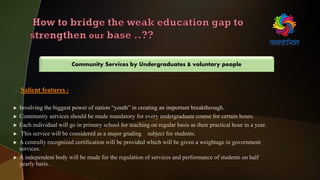
 Salient features :
 Involving the biggest power of nation “youth” in creating an important breakthrough.
 Community services should be made mandatory for every undergraduate course for certain hours.
 Each individual will go in primary school for teaching on regular basis as their practical hour in a year.
 This service will be considered as a major grading subject for students.
 A centrally recognized certification will be provided which will be given a weightage in government
services.
 A independent body will be made for the regulation of services and performance of students on half
yearly basis.
Community Services by Undergraduates & voluntary people
 Students to impart education on regular basis in
primary schools.
 Firstly, A core committee named NTS will be formed
centrally and regional offices will look after the
processing at local level.
 Students will be sent at local primary schools to teach
as a part of their practical hours present in their
curriculum.
 A stipned as a lucrative measure can also be added into
the scheme.
 A student has to complete certain hours of teaching in
each semester.
 Final marks and certification will be presented on
completion of each semester.
 No shortage of teachers in primary schools.
 Quality teaching will be provided.
 New ways of teaching & ideas will enhance attraction
of children towards education.
 Untrained youth will get experience and develop skills
on their part.
 This upcoming undergraduate youth will never finish
so there will be continuous flow .
 More cheaper and beneficial than current existing
system.
 Students will be attracted towards teaching sector as a
proper career.
Implementation
Advantage over current
model
NTS
Central
level
Head Controller
Coordination
Team
Curriculum
Team
Finance Team
State level
Regulation
Dept.
Coordination
Team for
Schools
Amendment
Team
Regional
Level
Regional
controller
School Head
for Monitoring
Student
Volunteers
MHRD
Coordinating between different teams
.
Curriculum design
Funds Management
Continuous basis analysis and progress
.
Regulating demand and input
Any Policy or short time change
Coordinating all school activities of region
.
1
00 schools come under one head for its
regulation
Team of undergraduate students
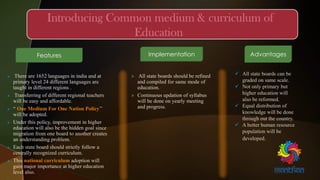
 All state boards should be refined
and compiled for same mode of
education.
 Continuous updation of syllabus
will be done on yearly meeting
and progress.
 There are 1652 languages in india and at
primary level 24 different languages are
taught in different regions .
 Transferring of different regional teachers
will be easy and affordable.
 “ One Medium For One Nation Policy’’
will be adopted.
 Under this policy, improvement in higher
education will also be the hidden goal since
migration from one board to another creates
an understanding problem.
 Each state board should strictly follow a
centrally recognized curriculum.
 This national curriculum adoption will
gain major importance at higher education
level also.
Features Implementation Advantages
 All state boards can be
graded on same scale.
 Not only primary but
higher education will
also be reformed.
 Equal distribution of
knowledge will be done
through out the country.
 A better human resource
population will be
developed.
 Different NGO,volunteer,government organize camps to attract
attention by including various aspects in that like :-
 These aspects are major concern for middle class people.
 Graduates coming on daily basis for teaching children and enhance
faith on primary education schemes.
Primary
Education
Future
money
Free
Education
Schemes
Rise in living
Child Labor
Advantages
 No need of new requirement or change in
policy.
 Different types of issues relating food ,
health, agriculture will also be solved parallely
by acknowledging them about facts &
solutions.
 No extra budget burden on part of
government.
 We have completed an year running our camps.
 More than 100 students are being taught according to
their age levels.
 They can read , write & solve basic mathematical
problems.
 Planning to admit some of these students in English
medium schools on our expenses and donations.
 We run a registered NGO at our college level named
H.U.H.C. (Help us to help the child).
 In this we provide free community services at slums
near our college at Ghaziabad.
 Free education, clothes and stationary are provided
which are not affordable by slum children.
 Students of our own college from every year participate
voluntarily in organizing events among children like
independence day, republic day, children’s day etc. to
boost their morale and participation.
 They are made aware about health, hygiene, and
importance of education.
PROGRESS
 World Bank database
 Census -2011
 ASER (Annual Status of Education Report)
 Primary education in India report by Ranjani Iyer Mohanty .
 Report on primary education by Agustya Foundation.
 Census – 2001,1991
 MHRD report – 2012 on status of primary education.

DrOnEs

  • 1.
    Topic : Steppingstones Enhancing the quality of primary education Skills Shortage : Proper implementation of laws and reforms in education system required Team Details ABES ENGG.COLLEGE,GHAZIABAD Team members : • Dushyant Pratap Singh (Team Coordinator) Varun Pundir • Rishabh Chauhan • Shashank Shandilya • Sharad Kumar
  • 2.
    India produces 74%of literate every year but our youth still can’t even read or write properly…!! Big Question..?? • Acc. to Indian government figures 2012- total 5,816,673 elementary school teachers in India and 2,127,000 secondary school teachers in India. • Student enrollment in rural India seen a rise (96.7%) in 2011, but parallel decline in students basic reading , arithmetic and academic levels. • The added burden of home chores and child labour influence a large number of children, especially girls, to drop out of school. • Kerala, Tamil Nadu, Puducherry and Goa have more than 60% of private enrollment in primary schools. Andhra, Maharashtra and Karnataka are at 40 percent, while UP is at 50% means continuous decline in quality of primary level. CAUSES Schemes implementedPRESENT SCENARIO • Malnutrition, hunger and poor health are core problems, which majorily affect attendance and performance in classes. • Lack of trained teachers is a major challenge in many states of India, where institutions for teacher education are not widely present. Schools are therefore forced to hire less qualified teachers • National Policy on Education • Strengthening of teachers training institute • Sarva Shiksha Abhiyan (SSA) • Mid Day Meal
  • 3.
     Vast differencebetween southern and northern states primary education status.  In 2008, only about 50% of Standard 3 students could read a Standard 1 text, by 2012, it declined to 30%. About 50 % of the Std 3 kids can’t even correctly recognize digits up to 100.  Not only that the country is unable to improve the learning skills of half its primary school children, in the last four years, it has fallen to alarming lows.  This decrease has certainly proved a major cause for dropout due to their financial problem.  Invasion of private schools into primary education has proved the falling level of quality. Truth Behind Stats…!!
  • 4.
     Salient features:  Involving the biggest power of nation “youth” in creating an important breakthrough.  Community services should be made mandatory for every undergraduate course for certain hours.  Each individual will go in primary school for teaching on regular basis as their practical hour in a year.  This service will be considered as a major grading subject for students.  A centrally recognized certification will be provided which will be given a weightage in government services.  A independent body will be made for the regulation of services and performance of students on half yearly basis. Community Services by Undergraduates & voluntary people
  • 5.
     Students toimpart education on regular basis in primary schools.  Firstly, A core committee named NTS will be formed centrally and regional offices will look after the processing at local level.  Students will be sent at local primary schools to teach as a part of their practical hours present in their curriculum.  A stipned as a lucrative measure can also be added into the scheme.  A student has to complete certain hours of teaching in each semester.  Final marks and certification will be presented on completion of each semester.  No shortage of teachers in primary schools.  Quality teaching will be provided.  New ways of teaching & ideas will enhance attraction of children towards education.  Untrained youth will get experience and develop skills on their part.  This upcoming undergraduate youth will never finish so there will be continuous flow .  More cheaper and beneficial than current existing system.  Students will be attracted towards teaching sector as a proper career. Implementation Advantage over current model
  • 6.
    NTS Central level Head Controller Coordination Team Curriculum Team Finance Team Statelevel Regulation Dept. Coordination Team for Schools Amendment Team Regional Level Regional controller School Head for Monitoring Student Volunteers MHRD Coordinating between different teams . Curriculum design Funds Management Continuous basis analysis and progress . Regulating demand and input Any Policy or short time change Coordinating all school activities of region . 1 00 schools come under one head for its regulation Team of undergraduate students
  • 7.
     All stateboards should be refined and compiled for same mode of education.  Continuous updation of syllabus will be done on yearly meeting and progress.  There are 1652 languages in india and at primary level 24 different languages are taught in different regions .  Transferring of different regional teachers will be easy and affordable.  “ One Medium For One Nation Policy’’ will be adopted.  Under this policy, improvement in higher education will also be the hidden goal since migration from one board to another creates an understanding problem.  Each state board should strictly follow a centrally recognized curriculum.  This national curriculum adoption will gain major importance at higher education level also. Features Implementation Advantages  All state boards can be graded on same scale.  Not only primary but higher education will also be reformed.  Equal distribution of knowledge will be done through out the country.  A better human resource population will be developed.
  • 8.
     Different NGO,volunteer,governmentorganize camps to attract attention by including various aspects in that like :-  These aspects are major concern for middle class people.  Graduates coming on daily basis for teaching children and enhance faith on primary education schemes. Primary Education Future money Free Education Schemes Rise in living Child Labor Advantages  No need of new requirement or change in policy.  Different types of issues relating food , health, agriculture will also be solved parallely by acknowledging them about facts & solutions.  No extra budget burden on part of government.
  • 9.
     We havecompleted an year running our camps.  More than 100 students are being taught according to their age levels.  They can read , write & solve basic mathematical problems.  Planning to admit some of these students in English medium schools on our expenses and donations.  We run a registered NGO at our college level named H.U.H.C. (Help us to help the child).  In this we provide free community services at slums near our college at Ghaziabad.  Free education, clothes and stationary are provided which are not affordable by slum children.  Students of our own college from every year participate voluntarily in organizing events among children like independence day, republic day, children’s day etc. to boost their morale and participation.  They are made aware about health, hygiene, and importance of education. PROGRESS
  • 10.
     World Bankdatabase  Census -2011  ASER (Annual Status of Education Report)  Primary education in India report by Ranjani Iyer Mohanty .  Report on primary education by Agustya Foundation.  Census – 2001,1991  MHRD report – 2012 on status of primary education.