Five Dysfunctions of a Team:
Symptoms, Assessment & Intervention
Megan Johnstone, PhD
Jack Kues, PhD
Rebecca Lee, PhD, RN
February 28, 2020
Introduction
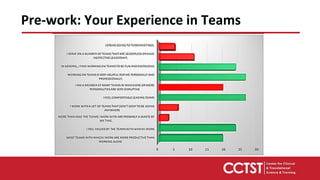
Pre-work: Your Experience in Teams
Objectives
1. Understand the functions of a team
2. Apply tools to assess the functional levels of a team
3. Assess the need for, and value of, interventions to
address team dysfunctions
4. Describe various types of interventions based on
level of dysfunction
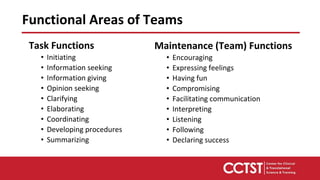
Task Functions
• Initiating
• Information seeking
• Information giving
• Opinion seeking
• Clarifying
• Elaborating
• Coordinating
• Developing procedures
• Summarizing
Maintenance (Team) Functions
• Encouraging
• Expressing feelings
• Having fun
• Compromising
• Facilitating communication
• Interpreting
• Listening
• Following
• Declaring success
Functional Areas of Teams
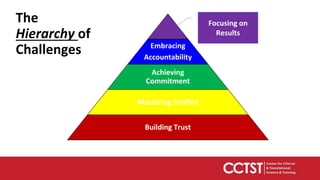
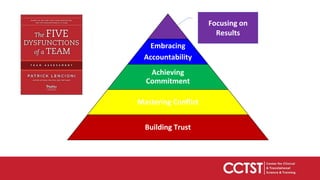
Embracing
Accountability
Achieving
Commitment
Mastering Conflict
Building Trust
The
Hierarchy of
Challenges
Focusing on
Results
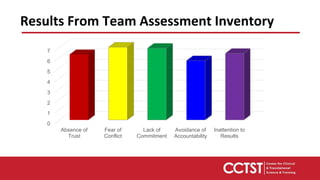
Results From Team Assessment Inventory
0
1
2
3
4
5
6
7
Absence of
Trust
Fear of
Conflict
Lack of
Commitment
Avoidance of
Accountability
Inattention to
Results
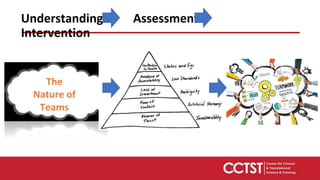
Understanding Assessment
Intervention
The
Nature of
Teams
Embracing
Accountability
Achieving
Commitment
Mastering Conflict
Building Trust
Focusing on
Results
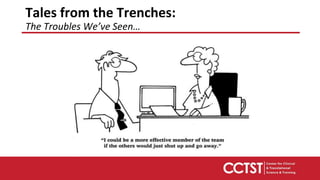
Tales from the Trenches:
The Troubles We’ve Seen…
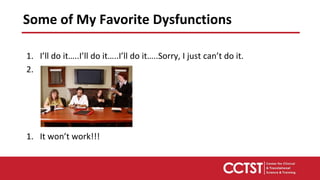
Some of My Favorite Dysfunctions
1. I’ll do it…..I’ll do it…..I’ll do it…..Sorry, I just can’t do it.
2.
1. It won’t work!!!
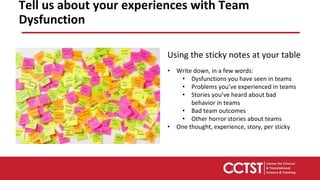
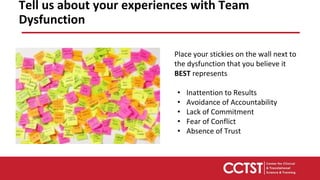
Tell us about your experiences with Team
Dysfunction
Using the sticky notes at your table
• Write down, in a few words:
• Dysfunctions you have seen in teams
• Problems you’ve experienced in teams
• Stories you’ve heard about bad
behavior in teams
• Bad team outcomes
• Other horror stories about teams
• One thought, experience, story, per sticky
Place your stickies on the wall next to
the dysfunction that you believe it
BEST represents
• Inattention to Results
• Avoidance of Accountability
• Lack of Commitment
• Fear of Conflict
• Absence of Trust
Tell us about your experiences with Team
Dysfunction
• Stickies on table (different colors for different dysfunctions)
• Dysfunctions on the board or on the wall (in pyramid shape with
colors).
• Participants write down their dysfunctions and attempt to place them
on the pyramid(s?).
• Read a couple of examples from each dysfunction.
Detailed instructions (not for display)
• Discuss distribution of stickies
• Which dysfunctional areas had the most?
• Which dysfunctional areas had the least?
• Types of problems seen in each
• Think of causes of problems at higher levels
• Root cause analysis
• Problems as they relate to functional areas of a team
Exercise follow-up discussion (Less than 10 Min)
Why Do a Team Assessment?
• To strengthen a team that is having problems
• To get a new team started right
• To help a team grow
• To prevent problems from arising
• When team membership turns over
• To bond teams in situations such as remote teams and startups
• Before a major strategic shift or campaign toward a big goal
• As part of ongoing team development to establish baseline then
compare at intervals
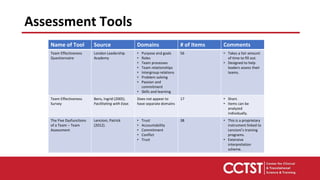
Assessment Tools
Name of Tool Source Domains # of Items Comments
Team Effectiveness
Questionnaire
London Leadership
Academy
• Purpose and goals
• Roles
• Team processes
• Team relationships
• Intergroup relations
• Problem solving
• Passion and
commitment
• Skills and learning
56 • Takes a fair amount
of time to fill out.
• Designed to help
leaders assess their
teams.
Team Effectiveness
Survey
Bens, Ingrid (2005).
Facilitating with Ease.
Does not appear to
have separate domains
17 • Short.
• Items can be
analyzed
individually.
The Five Dysfunctions
of a Team – Team
Assessment
Lencioni, Patrick
(2012).
• Trust
• Accountability
• Commitment
• Conflict
• Trust
38 • This is a proprietary
instrument linked to
Lencioni’s training
programs.
• Extensive
interpretation
scheme.
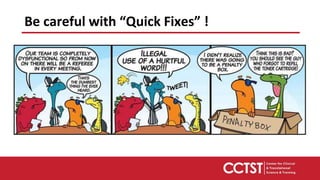
Be careful with “Quick Fixes” !
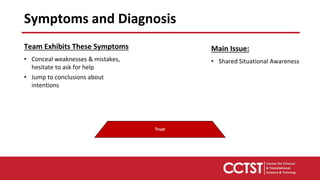
Symptoms and Diagnosis
Team Exhibits These Symptoms
• Conceal weaknesses & mistakes,
hesitate to ask for help
• Jump to conclusions about
intentions
Main Issue:
• Shared Situational Awareness
Trust
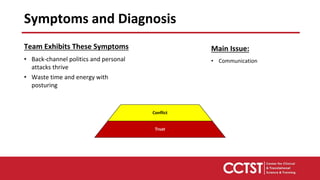
Team Exhibits These Symptoms
• Back-channel politics and personal
attacks thrive
• Waste time and energy with
posturing
Main Issue:
• Communication
Conflict
Trust
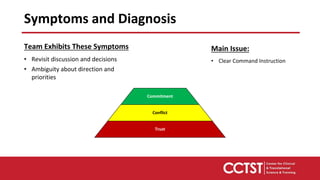
Symptoms and Diagnosis
Team Exhibits These Symptoms
• Revisit discussion and decisions
• Ambiguity about direction and
priorities
Main Issue:
• Clear Command Instruction
Commitment
Conflict
Trust
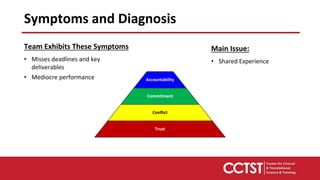
Symptoms and Diagnosis
Team Exhibits These Symptoms
• Misses deadlines and key
deliverables
• Mediocre performance
Main Issue:
• Shared Experience
Accountability
Commitment
Conflict
Trust
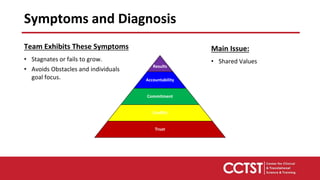
Symptoms and Diagnosis
Team Exhibits These Symptoms
• Stagnates or fails to grow.
• Avoids Obstacles and individuals
goal focus.
Main Issue:
• Shared Values
Results
Accountability
Commitment
Conflict
Trust
Symptoms and Diagnosis
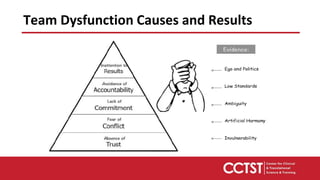
Team Dysfunction Causes and Results
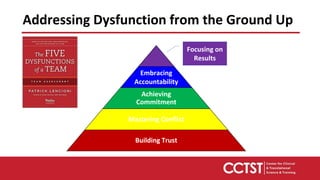
Embracing
Accountability
Achieving
Commitment
Mastering Conflict
Building Trust
Focusing on
Results
Addressing Dysfunction from the Ground Up
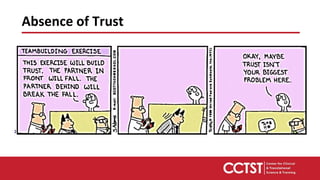
Absence of Trust
• Team members afraid to ask for help
• Mistakes are hidden
• Skills and experience not shared
• Jump to conclusions about the intentions and
aptitudes of others
Absence of Trust
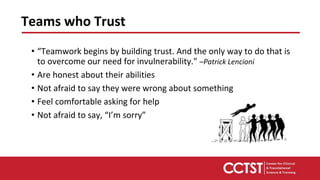
• “Teamwork begins by building trust. And the only way to do that is
to overcome our need for invulnerability." –Patrick Lencioni
• Are honest about their abilities
• Not afraid to say they were wrong about something
• Feel comfortable asking for help
• Not afraid to say, “I’m sorry”
Teams who Trust
Table Activity: Building Trust
• Connect as humans:
• Tell something about yourself that may surprise others
• Discuss the responses of the table members, noting similarities
and differences of experiences
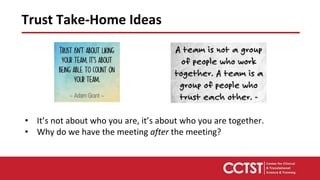
Trust Take-Home Ideas
• It’s not about who you are, it’s about who you are together.
• Why do we have the meeting after the meeting?
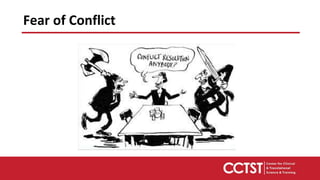
Fear of Conflict
• The meeting-after-the-meeting to vent
• Arguments make people uncomfortable
• Fear of hurting someone’s feelings
Fear of Conflict
Teams that Master Conflict
• Agree on how to handle conflict
• Accept that some have skills others don’t have
• Are not afraid to disagree, challenge and question one another
• Don’t go behind each other’s back
• Get ideas from all the members
• Don’t play politics
Table Activity: Mastering Conflict
• Setting Conflict Management Norms:
• Each person should write down their preferences for acceptable &
unacceptable behaviors around discussions & debates (e.g., tone of voice,
use of language, participation, etc.)
• After sharing, develop a list of no more than 5 items that represent the
team’s idea of productive discussion
• At completion of the activity, we’ll share some of your rules of engagement
• Challenge the idea, not the person.
• If everyone is on the same page at the beginning, it’s probably not going to
be a very interesting story.
• Agreement is the destination, debate and discussion pave the road.
• Assume positive intent.
• Aim for “social, intellectual, and professional” integration of all members
of the team.
• Express appreciation every time you feel it; the more you express it, the
more you feel it, and the more it comes back around.
Conflict Take-Home Ideas
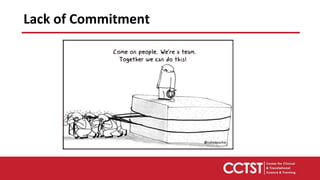
Lack of Commitment
• Members are confused about purpose
• Afraid to take wrong action
• Second guess each other
• Keep discussing the same issues
Lack of Commitment
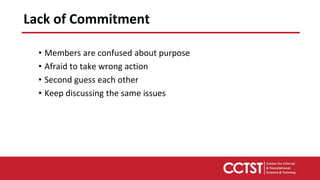
Teams that Achieve Commitment…
• Know where they are going
• Learn from their mistakes
• Move forward
• Get there first
Strategies for Building
Commitment
1. Establishment of a common goal
• Intent is to provide the team with a common sense of
purpose
2. Organizational clarification
• Intent is to clarify team direction
3. Clarification of team principles
• Intent is to create a set of norms for managing the life of
the team:
• e.g., meeting structure & schedule, preferred method(s) of
communication, etc.
Table Activity: Achieving
Commitment
• What symptoms of lack of team commitment have you
observed on your past or current teams? Create a list at
your table.
• Choose a strategy (treatment) from the list provided (or
come up with your own), to address a symptom you listed.
Commitment Take-Home Ideas
• You have to know where you are going before you start your trip.
• Make sure your team is traveling together.
• It may not be a lack of commitment, it may be a lack of direction.
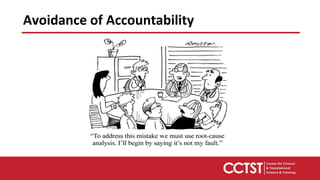
Avoidance of Accountability
• Some members coast
• Team achieves uninspired outcomes
• The project drags out
• One person does all the work
Avoidance of Accountability
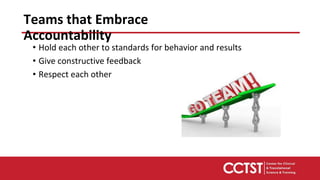
Teams that Embrace
Accountability
• Hold each other to standards for behavior and results
• Give constructive feedback
• Respect each other
Table Activity: Embracing
Accountability
• Team Effectiveness Exercise
• For each person in the group, respond to the following question
about their team members:
• What is the single most important behavioral characteristic
demonstrated by this person that contributes to the team’s strength?
• For higher functioning teams:
• What is one behavior or characteristic demonstrated by a team
member that can sometimes obstruct team progress?
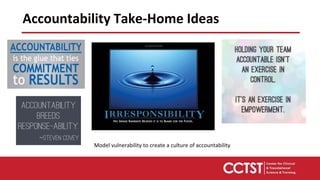
Accountability Take-Home Ideas
Model vulnerability to create a culture of accountability
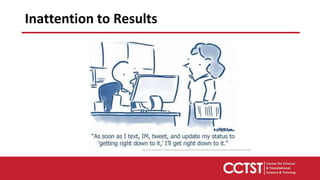
Inattention to Results
• Get nothing accomplished
• Work on the wrong things
• Lose star performers
• Team members take care of themselves
Inattention to Results
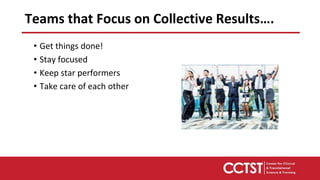
Teams that Focus on Collective Results….
• Get things done!
• Stay focused
• Keep star performers
• Take care of each other
Large Group Discussion: Focusing on
Results
One potential intervention to focus on
results:
1. Clarify a common goal for your team
2. Discuss & agree upon several objectives that must be accomplished in
order to achieve the goal
3. Create a timeline for expected deliverables, including who is responsible
4. Set up a team dashboard to track progress toward your goal! Update the
team regularly.
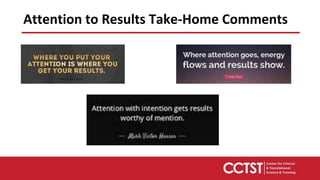
Attention to Results Take-Home Comments
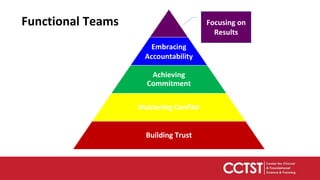
Embracing
Accountability
Achieving
Commitment
Mastering Conflict
Building Trust
Functional Teams Focusing on
Results
Final Thoughts
• Effective Teams:
• Turn common dysfunctions into strengths
• Any thoughts about how you will be able to apply
these skills to your teams?
Citations
• Lencioni P. The Five Dysfunctions of a Team. San Francisco, CA:
Jossey-Bass; 2002.
• Lencioni P. Overcoming the Five Dysfunctions of a Team. San
Francisco, CA: Jossey-Bass; 2005.
• Scholtes PR, Joiner BL, Streibel BJ. The Team Handbook. 3rd ed.
Edison, NJ: Oriel Stat A Matrix; 2010.
More Team Science Resources
• CCTST CIS Website: cctst.org/programs/CIS
• National Cancer Institute (NCI) Team Science Toolkit:
https://www.teamsciencetoolkit.cancer.gov/public/Home.aspx
• Northwestern University Clinical & Translational Sciences Institute:
http://www.teamscience.net
Four learning modules about Team Science (simulations)
• The Science of Team Science​
• Team Science Research Process in Behavioral Science​
• Team Science Research Process in Basic Medical Science​
• Team Science Research Process in Clinical Medical Science

5+Dysfunctions+of+a+Team_Final_20200228.pptx

  • 1.
    Five Dysfunctions ofa Team: Symptoms, Assessment & Intervention Megan Johnstone, PhD Jack Kues, PhD Rebecca Lee, PhD, RN February 28, 2020
  • 2.
  • 3.
  • 4.
    Objectives 1. Understand thefunctions of a team 2. Apply tools to assess the functional levels of a team 3. Assess the need for, and value of, interventions to address team dysfunctions 4. Describe various types of interventions based on level of dysfunction
  • 5.
    Task Functions • Initiating •Information seeking • Information giving • Opinion seeking • Clarifying • Elaborating • Coordinating • Developing procedures • Summarizing Maintenance (Team) Functions • Encouraging • Expressing feelings • Having fun • Compromising • Facilitating communication • Interpreting • Listening • Following • Declaring success Functional Areas of Teams
  • 6.
  • 7.
    Results From TeamAssessment Inventory 0 1 2 3 4 5 6 7 Absence of Trust Fear of Conflict Lack of Commitment Avoidance of Accountability Inattention to Results
  • 8.
  • 9.
  • 10.
    Tales from theTrenches: The Troubles We’ve Seen…
  • 11.
    Some of MyFavorite Dysfunctions 1. I’ll do it…..I’ll do it…..I’ll do it…..Sorry, I just can’t do it. 2. 1. It won’t work!!!
  • 12.
    Tell us aboutyour experiences with Team Dysfunction Using the sticky notes at your table • Write down, in a few words: • Dysfunctions you have seen in teams • Problems you’ve experienced in teams • Stories you’ve heard about bad behavior in teams • Bad team outcomes • Other horror stories about teams • One thought, experience, story, per sticky
  • 13.
    Place your stickieson the wall next to the dysfunction that you believe it BEST represents • Inattention to Results • Avoidance of Accountability • Lack of Commitment • Fear of Conflict • Absence of Trust Tell us about your experiences with Team Dysfunction
  • 14.
    • Stickies ontable (different colors for different dysfunctions) • Dysfunctions on the board or on the wall (in pyramid shape with colors). • Participants write down their dysfunctions and attempt to place them on the pyramid(s?). • Read a couple of examples from each dysfunction. Detailed instructions (not for display)
  • 15.
    • Discuss distributionof stickies • Which dysfunctional areas had the most? • Which dysfunctional areas had the least? • Types of problems seen in each • Think of causes of problems at higher levels • Root cause analysis • Problems as they relate to functional areas of a team Exercise follow-up discussion (Less than 10 Min)
  • 16.
    Why Do aTeam Assessment? • To strengthen a team that is having problems • To get a new team started right • To help a team grow • To prevent problems from arising • When team membership turns over • To bond teams in situations such as remote teams and startups • Before a major strategic shift or campaign toward a big goal • As part of ongoing team development to establish baseline then compare at intervals
  • 17.
    Assessment Tools Name ofTool Source Domains # of Items Comments Team Effectiveness Questionnaire London Leadership Academy • Purpose and goals • Roles • Team processes • Team relationships • Intergroup relations • Problem solving • Passion and commitment • Skills and learning 56 • Takes a fair amount of time to fill out. • Designed to help leaders assess their teams. Team Effectiveness Survey Bens, Ingrid (2005). Facilitating with Ease. Does not appear to have separate domains 17 • Short. • Items can be analyzed individually. The Five Dysfunctions of a Team – Team Assessment Lencioni, Patrick (2012). • Trust • Accountability • Commitment • Conflict • Trust 38 • This is a proprietary instrument linked to Lencioni’s training programs. • Extensive interpretation scheme.
  • 18.
    Be careful with“Quick Fixes” !
  • 19.
    Symptoms and Diagnosis TeamExhibits These Symptoms • Conceal weaknesses & mistakes, hesitate to ask for help • Jump to conclusions about intentions Main Issue: • Shared Situational Awareness Trust
  • 20.
    Team Exhibits TheseSymptoms • Back-channel politics and personal attacks thrive • Waste time and energy with posturing Main Issue: • Communication Conflict Trust Symptoms and Diagnosis
  • 21.
    Team Exhibits TheseSymptoms • Revisit discussion and decisions • Ambiguity about direction and priorities Main Issue: • Clear Command Instruction Commitment Conflict Trust Symptoms and Diagnosis
  • 22.
    Team Exhibits TheseSymptoms • Misses deadlines and key deliverables • Mediocre performance Main Issue: • Shared Experience Accountability Commitment Conflict Trust Symptoms and Diagnosis
  • 23.
    Team Exhibits TheseSymptoms • Stagnates or fails to grow. • Avoids Obstacles and individuals goal focus. Main Issue: • Shared Values Results Accountability Commitment Conflict Trust Symptoms and Diagnosis
  • 24.
  • 25.
  • 26.
  • 27.
    • Team membersafraid to ask for help • Mistakes are hidden • Skills and experience not shared • Jump to conclusions about the intentions and aptitudes of others Absence of Trust
  • 28.
    • “Teamwork beginsby building trust. And the only way to do that is to overcome our need for invulnerability." –Patrick Lencioni • Are honest about their abilities • Not afraid to say they were wrong about something • Feel comfortable asking for help • Not afraid to say, “I’m sorry” Teams who Trust
  • 29.
    Table Activity: BuildingTrust • Connect as humans: • Tell something about yourself that may surprise others • Discuss the responses of the table members, noting similarities and differences of experiences
  • 30.
    Trust Take-Home Ideas •It’s not about who you are, it’s about who you are together. • Why do we have the meeting after the meeting?
  • 31.
  • 32.
    • The meeting-after-the-meetingto vent • Arguments make people uncomfortable • Fear of hurting someone’s feelings Fear of Conflict
  • 33.
    Teams that MasterConflict • Agree on how to handle conflict • Accept that some have skills others don’t have • Are not afraid to disagree, challenge and question one another • Don’t go behind each other’s back • Get ideas from all the members • Don’t play politics
  • 34.
    Table Activity: MasteringConflict • Setting Conflict Management Norms: • Each person should write down their preferences for acceptable & unacceptable behaviors around discussions & debates (e.g., tone of voice, use of language, participation, etc.) • After sharing, develop a list of no more than 5 items that represent the team’s idea of productive discussion • At completion of the activity, we’ll share some of your rules of engagement
  • 35.
    • Challenge theidea, not the person. • If everyone is on the same page at the beginning, it’s probably not going to be a very interesting story. • Agreement is the destination, debate and discussion pave the road. • Assume positive intent. • Aim for “social, intellectual, and professional” integration of all members of the team. • Express appreciation every time you feel it; the more you express it, the more you feel it, and the more it comes back around. Conflict Take-Home Ideas
  • 36.
  • 37.
    • Members areconfused about purpose • Afraid to take wrong action • Second guess each other • Keep discussing the same issues Lack of Commitment
  • 38.
    Teams that AchieveCommitment… • Know where they are going • Learn from their mistakes • Move forward • Get there first
  • 39.
    Strategies for Building Commitment 1.Establishment of a common goal • Intent is to provide the team with a common sense of purpose 2. Organizational clarification • Intent is to clarify team direction 3. Clarification of team principles • Intent is to create a set of norms for managing the life of the team: • e.g., meeting structure & schedule, preferred method(s) of communication, etc.
  • 40.
    Table Activity: Achieving Commitment •What symptoms of lack of team commitment have you observed on your past or current teams? Create a list at your table. • Choose a strategy (treatment) from the list provided (or come up with your own), to address a symptom you listed.
  • 41.
    Commitment Take-Home Ideas •You have to know where you are going before you start your trip. • Make sure your team is traveling together. • It may not be a lack of commitment, it may be a lack of direction.
  • 42.
  • 43.
    • Some memberscoast • Team achieves uninspired outcomes • The project drags out • One person does all the work Avoidance of Accountability
  • 44.
    Teams that Embrace Accountability •Hold each other to standards for behavior and results • Give constructive feedback • Respect each other
  • 45.
    Table Activity: Embracing Accountability •Team Effectiveness Exercise • For each person in the group, respond to the following question about their team members: • What is the single most important behavioral characteristic demonstrated by this person that contributes to the team’s strength? • For higher functioning teams: • What is one behavior or characteristic demonstrated by a team member that can sometimes obstruct team progress?
  • 46.
    Accountability Take-Home Ideas Modelvulnerability to create a culture of accountability
  • 47.
  • 48.
    • Get nothingaccomplished • Work on the wrong things • Lose star performers • Team members take care of themselves Inattention to Results
  • 49.
    Teams that Focuson Collective Results…. • Get things done! • Stay focused • Keep star performers • Take care of each other
  • 50.
    Large Group Discussion:Focusing on Results
  • 51.
    One potential interventionto focus on results: 1. Clarify a common goal for your team 2. Discuss & agree upon several objectives that must be accomplished in order to achieve the goal 3. Create a timeline for expected deliverables, including who is responsible 4. Set up a team dashboard to track progress toward your goal! Update the team regularly.
  • 52.
    Attention to ResultsTake-Home Comments
  • 53.
  • 54.
    Final Thoughts • EffectiveTeams: • Turn common dysfunctions into strengths • Any thoughts about how you will be able to apply these skills to your teams?
  • 55.
    Citations • Lencioni P.The Five Dysfunctions of a Team. San Francisco, CA: Jossey-Bass; 2002. • Lencioni P. Overcoming the Five Dysfunctions of a Team. San Francisco, CA: Jossey-Bass; 2005. • Scholtes PR, Joiner BL, Streibel BJ. The Team Handbook. 3rd ed. Edison, NJ: Oriel Stat A Matrix; 2010.
  • 57.
    More Team ScienceResources • CCTST CIS Website: cctst.org/programs/CIS • National Cancer Institute (NCI) Team Science Toolkit: https://www.teamsciencetoolkit.cancer.gov/public/Home.aspx • Northwestern University Clinical & Translational Sciences Institute: http://www.teamscience.net Four learning modules about Team Science (simulations) • The Science of Team Science​ • Team Science Research Process in Behavioral Science​ • Team Science Research Process in Basic Medical Science​ • Team Science Research Process in Clinical Medical Science