Christina Petersen, Ph.D & David Langley, Ph.D
       Center for Teaching and Learning


Based on the book Made to Stick by Chip and Dan Heath
1. Introduce the SUCCESs model
2. Analyze the appeal and efficacy of this
   model for teaching development
3. Examine the model for alignment with
   current pedagogical theory
CJ
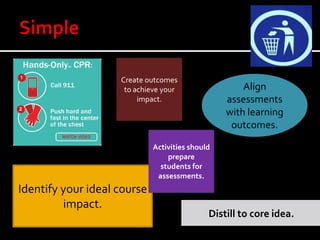
Create outcomes
                     to achieve your                 Align
                         impact.                 assessments
                                                 with learning
                                                  outcomes.

                             Activities should
                                 prepare
                               students for
                              assessments.
Identify your ideal course
         impact.
                                             Distill to core idea.
“ Simplicity isn’t about
   dumbing down: it’s about
   prioritizing
                  ”
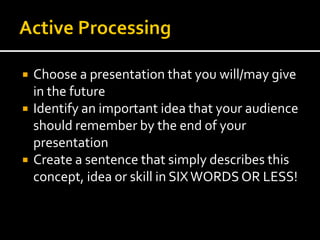
   Choose a presentation that you will/may give
    in the future
   Identify an important idea that your audience
    should remember by the end of your
    presentation
   Create a sentence that simply describes this
    concept, idea or skill in SIX WORDS OR LESS!
Teaching that sticks: Six principles for creating
memorable messages that promote learning.


  Create memorable messages that
  promote learning.
   Choose a presentation that you will/may give
    in the future
   Identify an important idea that your audience
    should remember by the end of your
    presentation
   Create a sentence that simply describes this
    concept, idea or skill in SIX WORDS OR LESS!
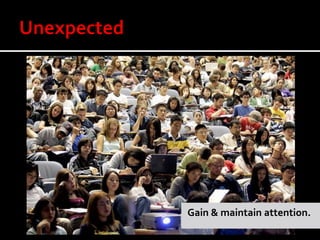
Gain & maintain attention.
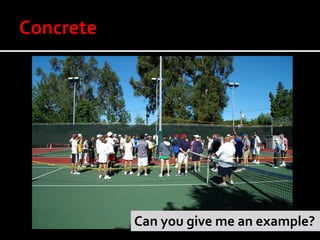
Can you give me an example?
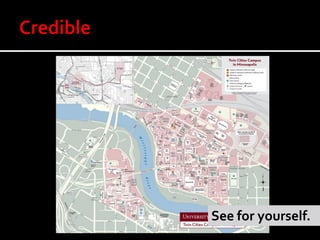
See for yourself.
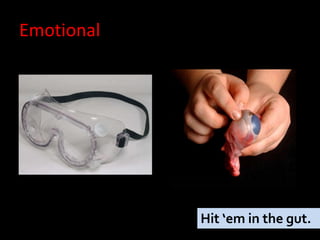
Emotional


            Hit ‘em in the gut.
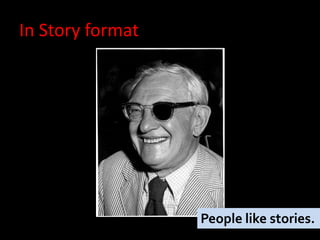
In Story format


                  People like stories.
Active Processing – Part II

   Remember your six word concept, idea, or
    skill?
   Design an activity that purposely
    incorporates emotion or story (or both!)
   Discuss this with the person sitting next to
    you
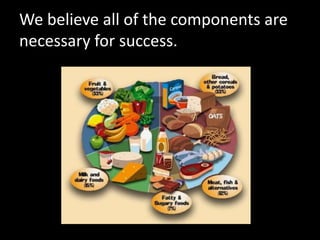
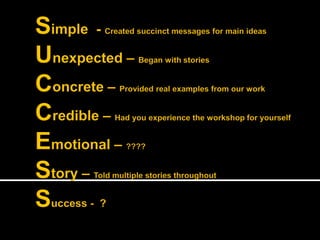
We believe all of the components are
necessary for success.
The SUCCESs model can serves as checklist
AFTER designing a class or workshop.
The University of Minnesota Center for Teaching and
Learning has evidence that the SUCCESs model is a
useful framework for teaching development.
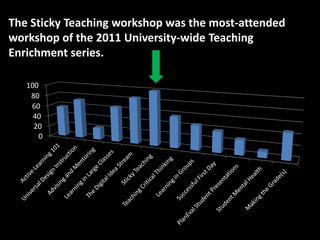
The Sticky Teaching workshop was the most-attended
workshop of the 2011 University-wide Teaching
Enrichment series.

   100
    80
    60
     40
     20
      0
What is the appeal of this approach?
• Simplicity
• Relief from eduspeak
• Inductive approach appealing to those
  without theoretical teaching framework
• Validates intuitive instructor “drives”
What was the most useful aspect of
this workshop?


    “The ‘six principle’
        checklist”
What is the appeal of this approach?
• Simplicity
• Relief from eduspeak
• Inductive approach appealing to those
  without theoretical teaching framework
• Validates intuitive instructor “drives”
What was the most useful aspect of
this workshop?


“I liked the clean and to-the-
   point style on each topic”
What is the appeal of this approach?
• Simplicity
• Relief from eduspeak
• Inductive approach appealing to those
  without theoretical teaching framework
• Validates intuitive instructor “drives”
What was the most useful aspect of
this workshop?


 “People like stories”
What is the appeal of this approach?
• Simplicity
• Relief from eduspeak
• Inductive approach appealing to those
  without theoretical teaching framework
• Validates intuitive instructor “drives”
What was the most useful aspect of
this workshop?


   “The validation that
  stories are an effective
   teaching technique”
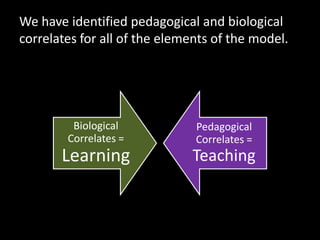
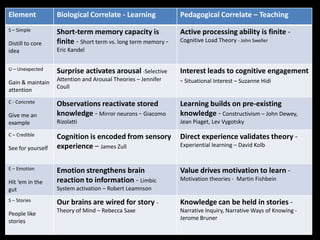
We have identified pedagogical and biological
correlates for all of the elements of the model.
•   Element
•   Pedagogical Correlate
•   S – Simple


•   U – Unexpected


•   C - Concrete


                        Biological    Pedagogical
•   C – Credible
                       Correlates =   Correlates =
•   E – Emotion
                     Learning         Teaching
•   S – Stories
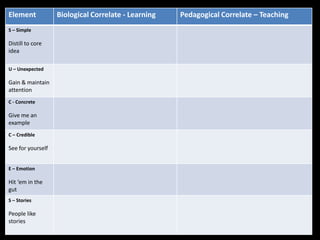
Element            Biological Correlate - Learning   Pedagogical Correlate – Teaching
S – Simple

Distill to core
idea

U – Unexpected

Gain & maintain
attention
C - Concrete

Give me an
example
C – Credible

See for yourself


E – Emotion

Hit ‘em in the
gut
S – Stories

People like
stories
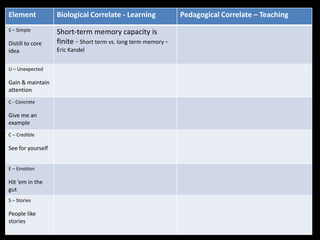
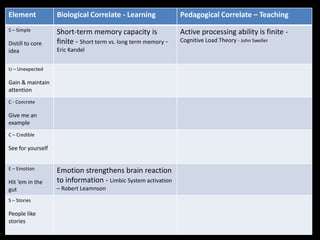
Element            Biological Correlate - Learning              Pedagogical Correlate – Teaching
S – Simple         Short-term memory capacity is
Distill to core    finite - Short term vs. long term memory -
idea               Eric Kandel


U – Unexpected

Gain & maintain
attention
C - Concrete

Give me an
example
C – Credible

See for yourself


E – Emotion

Hit ‘em in the
gut
S – Stories

People like
stories
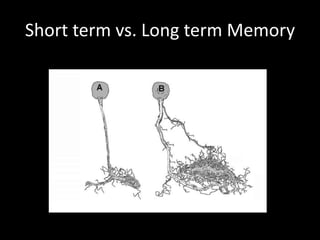
Short term vs. Long term Memory
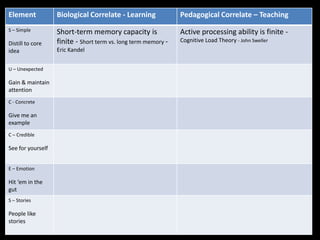
Element            Biological Correlate - Learning              Pedagogical Correlate – Teaching
S – Simple         Short-term memory capacity is                Active processing ability is finite -
                   finite - Short term vs. long term memory -   Cognitive Load Theory - John Sweller
Distill to core
idea               Eric Kandel


U – Unexpected

Gain & maintain
attention
C - Concrete

Give me an
example
C – Credible

See for yourself


E – Emotion

Hit ‘em in the
gut
S – Stories

People like
stories
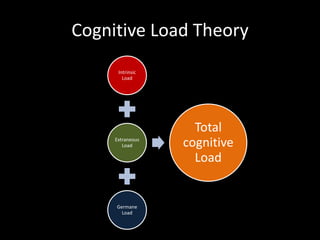
Cognitive Load Theory
      Intrinsic
        Load


                    Total
     Extraneous
        Load      cognitive
                    Load


     Germane
       Load
Element            Biological Correlate - Learning              Pedagogical Correlate – Teaching
S – Simple         Short-term memory capacity is                Active processing ability is finite -
                   finite - Short term vs. long term memory -   Cognitive Load Theory - John Sweller
Distill to core
idea               Eric Kandel


U – Unexpected

Gain & maintain
attention
C - Concrete

Give me an
example
C – Credible

See for yourself


E – Emotion        Emotion strengthens brain reaction
Hit ‘em in the     to information - Limbic System activation
gut                – Robert Leamnson
S – Stories

People like
stories
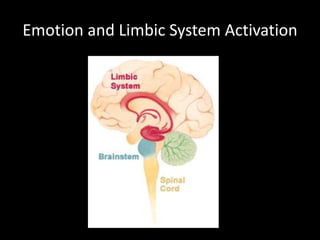
Emotion and Limbic System Activation
Element            Biological Correlate - Learning              Pedagogical Correlate – Teaching
S – Simple         Short-term memory capacity is                Active processing ability is finite -
                   finite - Short term vs. long term memory -   Cognitive Load Theory - John Sweller
Distill to core
idea               Eric Kandel


U – Unexpected

Gain & maintain
attention
C - Concrete

Give me an
example
C – Credible

See for yourself


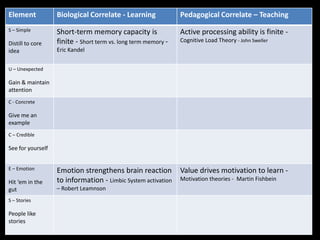
E – Emotion        Emotion strengthens brain reaction           Value drives motivation to learn -
                   to information - Limbic System activation    Motivation theories - Martin Fishbein
Hit ‘em in the
gut                – Robert Leamnson
S – Stories

People like
stories
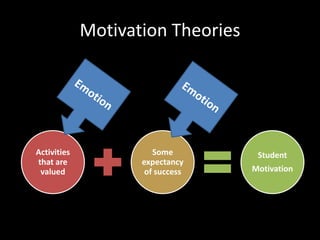
Motivation Theories


Activities             Some         Student
that are            expectancy
 valued              of success    Motivation
Element            Biological Correlate - Learning              Pedagogical Correlate – Teaching
S – Simple         Short-term memory capacity is                Active processing ability is finite -
                   finite - Short term vs. long term memory -   Cognitive Load Theory - John Sweller
Distill to core
idea               Eric Kandel


U – Unexpected     Surprise activates arousal -Selective        Interest leads to cognitive engagement
                   Attention and Arousal Theories – Jennifer    - Situational Interest – Suzanne Hidi
Gain & maintain
                   Coull
attention
C - Concrete       Observations reactivate stored               Learning builds on pre-existing
Give me an         knowledge - Mirror neurons - Giacomo         knowledge - Constructivism – John Dewey,
example            Rizolatti                                    Jean Piaget, Lev Vygotsky

C – Credible       Cognition is encoded from sensory            Direct experience validates theory -
                   experience – James Zull                      Experiential learning – David Kolb
See for yourself


E – Emotion        Emotion strengthens brain                    Value drives motivation to learn -
                   reaction to information - Limbic             Motivation theories - Martin Fishbein
Hit ‘em in the
gut                System activation – Robert Leamnson
S – Stories        Our brains are wired for story -             Knowledge can be held in stories -
                   Theory of Mind – Rebecca Saxe                Narrative Inquiry, Narrative Ways of Knowing -
People like
                                                                Jerome Bruner
stories
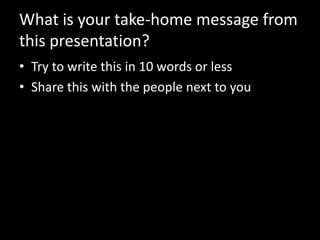
What is your take-home message from
this presentation?
• Try to write this in 10 words or less
• Share this with the people next to you
Teaching that sticks presentation v4

Teaching that sticks presentation v4

  • 1.
    Christina Petersen, Ph.D& David Langley, Ph.D Center for Teaching and Learning Based on the book Made to Stick by Chip and Dan Heath
  • 2.
    1. Introduce theSUCCESs model 2. Analyze the appeal and efficacy of this model for teaching development 3. Examine the model for alignment with current pedagogical theory
  • 5.
  • 6.
    Create outcomes to achieve your Align impact. assessments with learning outcomes. Activities should prepare students for assessments. Identify your ideal course impact. Distill to core idea.
  • 7.
    “ Simplicity isn’tabout dumbing down: it’s about prioritizing ”
  • 8.
    Choose a presentation that you will/may give in the future  Identify an important idea that your audience should remember by the end of your presentation  Create a sentence that simply describes this concept, idea or skill in SIX WORDS OR LESS!
  • 9.
    Teaching that sticks:Six principles for creating memorable messages that promote learning. Create memorable messages that promote learning.
  • 10.
    Choose a presentation that you will/may give in the future  Identify an important idea that your audience should remember by the end of your presentation  Create a sentence that simply describes this concept, idea or skill in SIX WORDS OR LESS!
  • 11.
    Gain & maintainattention.
  • 12.
    Can you giveme an example?
  • 13.
  • 14.
    Emotional Hit ‘em in the gut.
  • 15.
    In Story format People like stories.
  • 16.
    Active Processing –Part II  Remember your six word concept, idea, or skill?  Design an activity that purposely incorporates emotion or story (or both!)  Discuss this with the person sitting next to you
  • 17.
    We believe allof the components are necessary for success.
  • 18.
    The SUCCESs modelcan serves as checklist AFTER designing a class or workshop.
  • 19.
    The University ofMinnesota Center for Teaching and Learning has evidence that the SUCCESs model is a useful framework for teaching development.
  • 20.
    The Sticky Teachingworkshop was the most-attended workshop of the 2011 University-wide Teaching Enrichment series. 100 80 60 40 20 0
  • 21.
    What is theappeal of this approach? • Simplicity • Relief from eduspeak • Inductive approach appealing to those without theoretical teaching framework • Validates intuitive instructor “drives”
  • 22.
    What was themost useful aspect of this workshop? “The ‘six principle’ checklist”
  • 23.
    What is theappeal of this approach? • Simplicity • Relief from eduspeak • Inductive approach appealing to those without theoretical teaching framework • Validates intuitive instructor “drives”
  • 24.
    What was themost useful aspect of this workshop? “I liked the clean and to-the- point style on each topic”
  • 25.
    What is theappeal of this approach? • Simplicity • Relief from eduspeak • Inductive approach appealing to those without theoretical teaching framework • Validates intuitive instructor “drives”
  • 26.
    What was themost useful aspect of this workshop? “People like stories”
  • 27.
    What is theappeal of this approach? • Simplicity • Relief from eduspeak • Inductive approach appealing to those without theoretical teaching framework • Validates intuitive instructor “drives”
  • 28.
    What was themost useful aspect of this workshop? “The validation that stories are an effective teaching technique”
  • 29.
    We have identifiedpedagogical and biological correlates for all of the elements of the model. • Element • Pedagogical Correlate • S – Simple • U – Unexpected • C - Concrete Biological Pedagogical • C – Credible Correlates = Correlates = • E – Emotion Learning Teaching • S – Stories
  • 30.
    Element Biological Correlate - Learning Pedagogical Correlate – Teaching S – Simple Distill to core idea U – Unexpected Gain & maintain attention C - Concrete Give me an example C – Credible See for yourself E – Emotion Hit ‘em in the gut S – Stories People like stories
  • 31.
    Element Biological Correlate - Learning Pedagogical Correlate – Teaching S – Simple Short-term memory capacity is Distill to core finite - Short term vs. long term memory - idea Eric Kandel U – Unexpected Gain & maintain attention C - Concrete Give me an example C – Credible See for yourself E – Emotion Hit ‘em in the gut S – Stories People like stories
  • 32.
    Short term vs.Long term Memory
  • 33.
    Element Biological Correlate - Learning Pedagogical Correlate – Teaching S – Simple Short-term memory capacity is Active processing ability is finite - finite - Short term vs. long term memory - Cognitive Load Theory - John Sweller Distill to core idea Eric Kandel U – Unexpected Gain & maintain attention C - Concrete Give me an example C – Credible See for yourself E – Emotion Hit ‘em in the gut S – Stories People like stories
  • 34.
    Cognitive Load Theory Intrinsic Load Total Extraneous Load cognitive Load Germane Load
  • 35.
    Element Biological Correlate - Learning Pedagogical Correlate – Teaching S – Simple Short-term memory capacity is Active processing ability is finite - finite - Short term vs. long term memory - Cognitive Load Theory - John Sweller Distill to core idea Eric Kandel U – Unexpected Gain & maintain attention C - Concrete Give me an example C – Credible See for yourself E – Emotion Emotion strengthens brain reaction Hit ‘em in the to information - Limbic System activation gut – Robert Leamnson S – Stories People like stories
  • 36.
    Emotion and LimbicSystem Activation
  • 37.
    Element Biological Correlate - Learning Pedagogical Correlate – Teaching S – Simple Short-term memory capacity is Active processing ability is finite - finite - Short term vs. long term memory - Cognitive Load Theory - John Sweller Distill to core idea Eric Kandel U – Unexpected Gain & maintain attention C - Concrete Give me an example C – Credible See for yourself E – Emotion Emotion strengthens brain reaction Value drives motivation to learn - to information - Limbic System activation Motivation theories - Martin Fishbein Hit ‘em in the gut – Robert Leamnson S – Stories People like stories
  • 38.
    Motivation Theories Activities Some Student that are expectancy valued of success Motivation
  • 39.
    Element Biological Correlate - Learning Pedagogical Correlate – Teaching S – Simple Short-term memory capacity is Active processing ability is finite - finite - Short term vs. long term memory - Cognitive Load Theory - John Sweller Distill to core idea Eric Kandel U – Unexpected Surprise activates arousal -Selective Interest leads to cognitive engagement Attention and Arousal Theories – Jennifer - Situational Interest – Suzanne Hidi Gain & maintain Coull attention C - Concrete Observations reactivate stored Learning builds on pre-existing Give me an knowledge - Mirror neurons - Giacomo knowledge - Constructivism – John Dewey, example Rizolatti Jean Piaget, Lev Vygotsky C – Credible Cognition is encoded from sensory Direct experience validates theory - experience – James Zull Experiential learning – David Kolb See for yourself E – Emotion Emotion strengthens brain Value drives motivation to learn - reaction to information - Limbic Motivation theories - Martin Fishbein Hit ‘em in the gut System activation – Robert Leamnson S – Stories Our brains are wired for story - Knowledge can be held in stories - Theory of Mind – Rebecca Saxe Narrative Inquiry, Narrative Ways of Knowing - People like Jerome Bruner stories
  • 40.
    What is yourtake-home message from this presentation? • Try to write this in 10 words or less • Share this with the people next to you