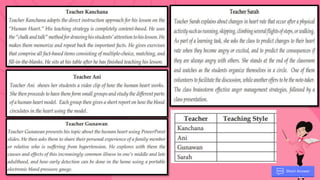
Do you know that your teaching
behaviors are influenced by your
teaching styles?
A teaching style is the way in which
teaching tasks are chosen and
carried out
(Mohanna, Chambers & Wall, 2008).
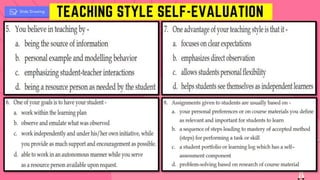
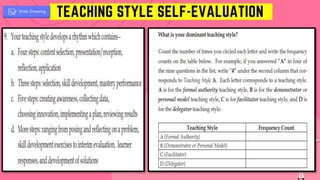
Do you want to know
your own teaching
styles?
Teaching Style
Categories
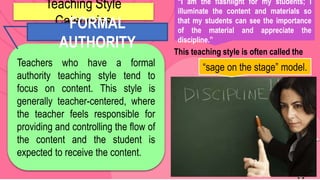
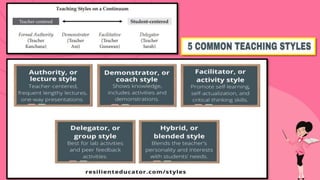
Teachers who have a formal
authority teaching style tend to
focus on content. This style is
generally teacher-centered, where
the teacher feels responsible for
providing and controlling the flow of
the content and the student is
expected to receive the content.
FORMAL
AUTHORITY
“I am the flashlight for my students; I
illuminate the content and materials so
that my students can see the importance
of the material and appreciate the
discipline.”
“sage on the stage” model.
This teaching style is often called the
“I show my students how to do a task properly or
work through a problem and then I’ll help them
master the task or problem solution. It’s important
that my students can solve similar problems
independently by using and adapting
demonstrated methods.”
Instructors with this teaching style are
interested in
Teaching Style
Categories
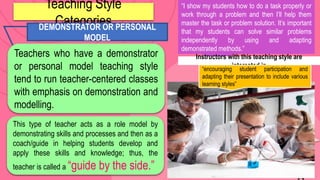
Teachers who have a demonstrator
or personal model teaching style
tend to run teacher-centered classes
with emphasis on demonstration and
modelling.
DEMONSTRATOR OR PERSONAL
MODEL
“encouraging student participation and
adapting their presentation to include various
learning styles”
This type of teacher acts as a role model by
demonstrating skills and processes and then as a
coach/guide in helping students develop and
apply these skills and knowledge; thus, the
teacher is called a “guide by the side.”
“I typically design group activities that
necessitate active learning, student-to-
student collaboration, and problem solving..”
This type of teacher, who is also a
Teaching Style
Categories
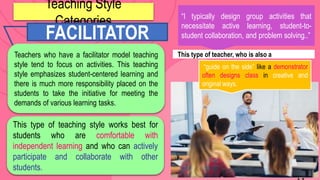
Teachers who have a facilitator model teaching
style tend to focus on activities. This teaching
style emphasizes student-centered learning and
there is much more responsibility placed on the
students to take the initiative for meeting the
demands of various learning tasks.
FACILITATOR
“guide on the side” like a demonstrator
often designs class in creative and
original ways.
This type of teaching style works best for
students who are comfortable with
independent learning and who can actively
participate and collaborate with other
students.
“I will often give students a choice in
designing and implementing their own
complex learning projects and will act in a
consultative role.”
This type of teacher, who is also a
Teaching Style
Categories
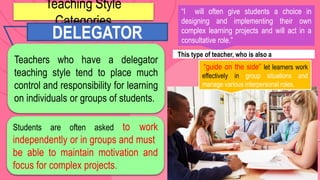
Teachers who have a delegator
teaching style tend to place much
control and responsibility for learning
on individuals or groups of students.
DELEGATOR
“guide on the side” let learners work
effectively in group situations and
manage various interpersonal roles.
Students are often asked to work
independently or in groups and must
be able to maintain motivation and
focus for complex projects.
TEACHING STYLES CATEGORIES

TEACHING STYLES CATEGORIES

  • 2.
    Do you knowthat your teaching behaviors are influenced by your teaching styles? A teaching style is the way in which teaching tasks are chosen and carried out (Mohanna, Chambers & Wall, 2008).
  • 3.
    Do you wantto know your own teaching styles?
  • 7.
    Teaching Style Categories Teachers whohave a formal authority teaching style tend to focus on content. This style is generally teacher-centered, where the teacher feels responsible for providing and controlling the flow of the content and the student is expected to receive the content. FORMAL AUTHORITY “I am the flashlight for my students; I illuminate the content and materials so that my students can see the importance of the material and appreciate the discipline.” “sage on the stage” model. This teaching style is often called the
  • 8.
    “I show mystudents how to do a task properly or work through a problem and then I’ll help them master the task or problem solution. It’s important that my students can solve similar problems independently by using and adapting demonstrated methods.” Instructors with this teaching style are interested in Teaching Style Categories Teachers who have a demonstrator or personal model teaching style tend to run teacher-centered classes with emphasis on demonstration and modelling. DEMONSTRATOR OR PERSONAL MODEL “encouraging student participation and adapting their presentation to include various learning styles” This type of teacher acts as a role model by demonstrating skills and processes and then as a coach/guide in helping students develop and apply these skills and knowledge; thus, the teacher is called a “guide by the side.”
  • 9.
    “I typically designgroup activities that necessitate active learning, student-to- student collaboration, and problem solving..” This type of teacher, who is also a Teaching Style Categories Teachers who have a facilitator model teaching style tend to focus on activities. This teaching style emphasizes student-centered learning and there is much more responsibility placed on the students to take the initiative for meeting the demands of various learning tasks. FACILITATOR “guide on the side” like a demonstrator often designs class in creative and original ways. This type of teaching style works best for students who are comfortable with independent learning and who can actively participate and collaborate with other students.
  • 10.
    “I will oftengive students a choice in designing and implementing their own complex learning projects and will act in a consultative role.” This type of teacher, who is also a Teaching Style Categories Teachers who have a delegator teaching style tend to place much control and responsibility for learning on individuals or groups of students. DELEGATOR “guide on the side” let learners work effectively in group situations and manage various interpersonal roles. Students are often asked to work independently or in groups and must be able to maintain motivation and focus for complex projects.