Teaching strategies:
Introduction to Teaching methods:
• A teaching method comprises the principles and methods used by
teachers to enable student learning. These strategies are determined
partly on subject matter to be taught and partly by the nature of the
learner.
• Teaching methods are the broader techniques used to help students
achieve learning outcomes, while activities are the different ways of
implementing these methods. Teaching methods help students:
master the content of the course. Learn how to apply the content in
particular contexts.
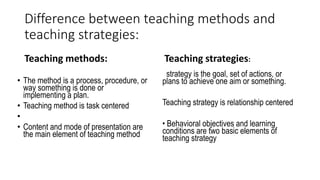
Difference between teaching methods and
teaching strategies:
Teaching methods:
• The method is a process, procedure, or
way something is done or
implementing a plan.
• Teaching method is task centered
•
• Content and mode of presentation are
the main element of teaching method
Teaching strategies:
strategy is the goal, set of actions, or
plans to achieve one aim or something.
Teaching strategy is relationship centered
• Behavioral objectives and learning
conditions are two basic elements of
teaching strategy
Pedagogy and andragogy:
• At a glance, andragogy refers to the methods and approaches used in
adult education and is directed towards self-actualization, gaining
experience, and problem-solving. In contrast, pedagogy is an
education method in which the learner is dependent on the teacher
for guidance, evaluation, and acquisition of knowledge.
Pedagogy:
•Pedagogy is a term derived from the Greek words paid (meaning
“child”) and agogus (meaning “leading”).
•So “pedagogy” means, literally, the art and science of teaching
children (Knowles, 1973)
About pedagogy:
•Evolved in the monastic schools of Europe in 7th 12th centuries.
Concerned teaching young children relatively simple skills mostly
reading and writing.
•Model was adopted and reinforced with the spread of elementary
schools throughout Europe and North America.
•Infact not much knowledge about learning until studies on adult
learning began to appear after World War II.
•Adult learners seemed to feel this was insufficient and frequently resisted
teaching strategies that pedagogy prescribed, such as
✓lectures,
✓assigned readings,
✓ quizzes,
✓note memorizing, and
✓examinations.
• Dropout rates were high.
•Teachers also noted that many of the assumptions about the characteristics
of learners in the pedagogic model did not fit their adult students.
Andragogy:
•The term andragogy was coined in 1833 by the German teacher
Alexander Kapp.
•Andragogy is based on the Greek word aner with the stem andra
meaning “man, and agogus meaning “leader of.” not boy” or adult,
•Andragogy was first introduced to the United States in 1927 by
Martha Anderson and Eduard Linderman, but they did not attempt to
develop the concept.
• •The goal of adult education should be self-actualization; thus, the
learning process should involve the whole emotional, psychological,
and intellectual being.
•
• •The mission of adult educators is to assist adults to develop their full
potential, and andragogy is the teaching methodology used to
achieve this end.
About andragogy:
Andragogy is premised on four crucial assumptions about the
characteristics of learners that are different from the assumptions on
which traditional pedagogy is premised.
These assumptions are that as individuals mature:
1) Their self-concept moves from one of being a dependent personality
toward being a self-directed human being.
• 2) They accumulate a growing reservoir of experience that becomes
an increasingly rich resource for learning.
•
• 3) Their readiness to learn becomes oriented increasingly to the
developmental tasks of their social roles.
•
• 4) Their time perspective changes from one of postponed application
of knowledge to immediacy of application, and accordingly, their
orientation toward learning shifts from one of subject-centeredness
to one of performance centeredness.
Types of traditional methods;
• Lecture method
• Imitation
• Bookish
• Socratic method
Lecture method:
• Lecture method is teacher controlled and information centered
approach in which teacher works as a role resource in classroom
instruction. In this method, the only teacher does the talking and the
student is passive listens.
• Purpose of lecture method:
• A lecture (from the Greek lecture, meaning reading) is an oral
presentation intended to present information or teach people about a
particular subject, for example by a university or college teacher.
Lectures are used to convey critical information, history, background,
theories, and equations.
• Characteristics of lecture method:
• The teacher instructs or gives a lecture on a topic for all most the
complete time in the period.
• Content is presented as a whole and the students learn through
listening and memorization.
• The teacher provides information, concepts, facts, events, theories,
laws, principles etc.
Imitation method:
• The imitation method of teaching focuses on breaking apart skills into
components, providing the learner with a model of the target behavior,
and rewarding the learner for demonstrating the response immediately
after the model.
• Example of imitation:
• Imitation is defined as the act of copying, or a fake or copy of something.
An example of imitation is creating a room to look just like a room pictured
in a decorator magazine. An example of imitation is fish pieces sold as crab.
Principle of imitation:
• Imitation is the tendency of the child to act according to what he sees
or observes. Imitation may be either dramatic or idealistic. Dramatic
imitation is based on mental image formed by the individual.
Imitating a certain character in the story read is a good example of
dramatic imitation.
Bookish method:
a method of expression generally found in books; formal; labored;
pedantic.
Someone who is bookish spends a lot of time reading serious books.
[disapproval] Synonyms: studious, learned, academic, intellectual More
Synonyms of bookish.
Socratic method:
• What is the Socratic Method?
• Developed by the Greek philosopher, Socrates, the Socratic Method
is a dialogue between teacher and students, instigated by the
continual probing questions of the teacher, in a concerted effort to
explore the underlying beliefs that shape the students views and
opinions.
• The Socratic Method provides all students greater confidence about
talking to large groups, allows them to develop the ability to argue
forcefully and persuasively, and teaches them to think critically.
Types of modern teaching methods:
1. Inquiry based teaching methods
2. Collaborative teaching methods
3. Interactive teaching methodS
4. Activity based teaching methods
Inquiry based teaching methods:
• Inquiry-based learning is an approach to learning that emphasizes the student’s role in
the learning process. Rather than the teacher telling students what they need to know,
students are encouraged to explore the material, ask questions, and share ideas.
• The teacher also controls specific learning activities, the resources students will use to
create understanding, and the summative assessment learners will complete to
demonstrate their understanding. In Controlled Inquiry, the teacher
• nquiry-based learning has four types:
• confirmation
• structured
• guided,
• open inquiry
Collaborative teaching methods:
• A collaborative (or cooperative) learning approach involves pupils
working together on activities or learning tasks in a group small
enough to ensure that everyone participates. Pupils in the group may
work on separate tasks contributing to a common overall outcome, or
work together on a shared task.
• When a group of two or more students work together to complete an
activity, discuss a question, or collaborate on a task, we call it
collaborative learning. The intended consequence of accomplishing
tasks together is to help students learn the complexities of solving a
problem and promote deeper learning through doing
• Examples of collaborative learning activities
• Evaluating training systems. Within teams or departments, pair newer
employees with more senior ones. …
• Solving problems across teams. …
• Developing new products. …
• Explaining concepts to other departments. …
• Build a collaborative learning community.
Interactive teaching methods:
• Interactive teaching is a means of instructing whereby the teachers actively
involve the students in their learning process by way of regular teacher-
student interaction, student-student interaction, use of audio-visuals, and
hands-on demonstrations. The students are constantly encouraged to be
active participants.
• Importance:
• Interactive teaching is a means of instructing whereby the teachers actively involve
the students in their learning process by way of regular teacher-student interaction,
student-student interaction, use of audio-visuals, and hands-on demonstrations. The
students are constantly encouraged to be active participants.
• Examples of Interactive Learning activities
• Problem-based learning: students learn about a topic through solving
problems. …
• Project-based learning: students acquire a deeper knowledge through
active exploration of real-world challenges and problems.
Activity based teaching methods:
• Activity based teaching is a method adopted by a teacher to emphasize his
or her technique of teaching through action in which the learners take
interest comprehensively and realize effective learning practices. It is the
procedure in which the child is effectively included in taking interest
rationally and physically
• importance
• Activity-based learning plays an important role in teaching the students to
collaborate, communicate, interact and work in teams. Peers the other
learners who are a part of the social environment contribute to the
knowledge construction by sharing as well as identifying the affordances
within the tasks at hand.
Example:
• An activity based curriculum might also focus on learning through
play. For example, teachers might use interactive games to develop
key skills in English or Maths, like our KS2 Maths Escape Room which
revises Roman numerals, fractions and graphs.
Role of teacher:
• Broadly speaking, the function of teachers is to help students learn by
imparting knowledge to them and by setting up a situation in which
stud
• The primary role of a teacher is to deliver classroom instruction that
helps students learn. To accomplish this, teachers must prepare
effective lessons, grade student work and offer feedback, manage
classroom materials, productively navigate the curriculum, and
collaborate with other staff.
• Here are roles that a teacher often has to fill in order to be the best
educator they can be.
• Mentor. Teachers play the role of a mentor for learners, especially during
formative years at school. …
• Mediator. …
• Inspires. …
• Resourceful. …
• A Continuous Learner. …
• Collaborator. …
• The Participant. …
• A Great Listener.
• Teacher duties and responsibilities
• Establishing and enforcing rules of behavior for students in the
classroom.
• Preparing lessons, units and projects to complete learning objectives.
• Establishing and communicating clear objectives for lessons, units and
projects.
Types of teaching techniques:
• Technique:
• A technique is a detailed list of rules or a guideline for any (teaching)
activity. • It is based on the description of steps, or a set of do’s and
don’ts, and can often be linked to a method or strategy. • Technique is
a procedure or skill for completing a specific a specific task.
• Here are five teaching and learning techniques for teaching Learning
Gamification. Gamification is becoming a hugely popular way to
incorporate more fun and play into perhaps more difficult subjects. …
• Use of Technology. …
• Learning Beyond the Classroom. …
• Project-Based Learning. …
• Students as Autonomous Learners.
New trends in teaching:
• Others, like genius hour and mastery-based grading, are recently arrived
educational trends that may have a helpful place in your classroom.
• Mastery-Based Grading. …
• Personalized Learning. …
• Trauma-Informed Practices. …
• Genius Hour. …
• Digital Citizenship. …
• Bite-Sized Learning. …
• Mindfulness. …
• Brain Break.
Preparation of audio visual aids;
• Audio-Visual Aids
• are the instructional method of education that uses audio and visual
as a mode of learning. The literal meaning of audio is hearing and
visual means that is seen by eyes. Audio-Visual aids are devices that
are used in the classroom to make learning engaging and easy.
• Stick to a single idea for each visual. Make sure each visual has a title
at the top. Key phrases, usually referred to as bullet points, work
better than complete sentences. Limit the text on each visual to no
more than six lines, and no more than six words per line.
Preparation:
• Preparing Visual Aids
• Title of presentation and authors.
• Statement of the purpose or hypothesis.
• A list of the essential steps in the methods.
• Graphs, tables, and figures that show the major findings.
• Clinical photographs or diagrams that illustrate key points or help
explain content.
• Summary of the conclusions.
Applying teaching learning resources in
classroom:
• As well as being sources of knowledge for teachers, learning
resources can be used by teachers and teacher educators to co-
construct knowledge as part of continuing professional development.
For example, observation sheets, feedback forms and action plans can
be used during classroom observation and mentoring.
• purpose
• The purpose and importance of teaching and learning materials is to
make lessons interesting, learning easy and enable teachers to easily
express concepts. Learning materials can significantly increase
learners’ achievement by supporting learning.
Lesson planning and classroom setting:
• If lesson plans are the roadmap of classroom activity, then classroom
management is how teachers drive their students to their destination.
At its core, classroom management is a combination of skills and
techniques teachers use to make sure classes run smoothly and that
students reach their daily learning goals.
• Planning lessons ahead of time means teachers enter the classroom
each day fully prepared to teach new concepts and lead meaningful
discussions – instead of figuring things out as they go. Without a
lesson plan, students can quickly lose focus and teachers may be left
scrambling, thinking of what to do next.

teaching strategies.pptx

  • 1.
  • 2.
    Introduction to Teachingmethods: • A teaching method comprises the principles and methods used by teachers to enable student learning. These strategies are determined partly on subject matter to be taught and partly by the nature of the learner. • Teaching methods are the broader techniques used to help students achieve learning outcomes, while activities are the different ways of implementing these methods. Teaching methods help students: master the content of the course. Learn how to apply the content in particular contexts.
  • 3.
    Difference between teachingmethods and teaching strategies: Teaching methods: • The method is a process, procedure, or way something is done or implementing a plan. • Teaching method is task centered • • Content and mode of presentation are the main element of teaching method Teaching strategies: strategy is the goal, set of actions, or plans to achieve one aim or something. Teaching strategy is relationship centered • Behavioral objectives and learning conditions are two basic elements of teaching strategy
  • 4.
    Pedagogy and andragogy: •At a glance, andragogy refers to the methods and approaches used in adult education and is directed towards self-actualization, gaining experience, and problem-solving. In contrast, pedagogy is an education method in which the learner is dependent on the teacher for guidance, evaluation, and acquisition of knowledge.
  • 5.
    Pedagogy: •Pedagogy is aterm derived from the Greek words paid (meaning “child”) and agogus (meaning “leading”). •So “pedagogy” means, literally, the art and science of teaching children (Knowles, 1973)
  • 6.
    About pedagogy: •Evolved inthe monastic schools of Europe in 7th 12th centuries. Concerned teaching young children relatively simple skills mostly reading and writing. •Model was adopted and reinforced with the spread of elementary schools throughout Europe and North America. •Infact not much knowledge about learning until studies on adult learning began to appear after World War II.
  • 7.
    •Adult learners seemedto feel this was insufficient and frequently resisted teaching strategies that pedagogy prescribed, such as ✓lectures, ✓assigned readings, ✓ quizzes, ✓note memorizing, and ✓examinations. • Dropout rates were high. •Teachers also noted that many of the assumptions about the characteristics of learners in the pedagogic model did not fit their adult students.
  • 8.
    Andragogy: •The term andragogywas coined in 1833 by the German teacher Alexander Kapp. •Andragogy is based on the Greek word aner with the stem andra meaning “man, and agogus meaning “leader of.” not boy” or adult, •Andragogy was first introduced to the United States in 1927 by Martha Anderson and Eduard Linderman, but they did not attempt to develop the concept.
  • 9.
    • •The goalof adult education should be self-actualization; thus, the learning process should involve the whole emotional, psychological, and intellectual being. • • •The mission of adult educators is to assist adults to develop their full potential, and andragogy is the teaching methodology used to achieve this end.
  • 10.
    About andragogy: Andragogy ispremised on four crucial assumptions about the characteristics of learners that are different from the assumptions on which traditional pedagogy is premised. These assumptions are that as individuals mature: 1) Their self-concept moves from one of being a dependent personality toward being a self-directed human being.
  • 11.
    • 2) Theyaccumulate a growing reservoir of experience that becomes an increasingly rich resource for learning. • • 3) Their readiness to learn becomes oriented increasingly to the developmental tasks of their social roles. • • 4) Their time perspective changes from one of postponed application of knowledge to immediacy of application, and accordingly, their orientation toward learning shifts from one of subject-centeredness to one of performance centeredness.
  • 12.
    Types of traditionalmethods; • Lecture method • Imitation • Bookish • Socratic method
  • 13.
    Lecture method: • Lecturemethod is teacher controlled and information centered approach in which teacher works as a role resource in classroom instruction. In this method, the only teacher does the talking and the student is passive listens. • Purpose of lecture method: • A lecture (from the Greek lecture, meaning reading) is an oral presentation intended to present information or teach people about a particular subject, for example by a university or college teacher. Lectures are used to convey critical information, history, background, theories, and equations.
  • 14.
    • Characteristics oflecture method: • The teacher instructs or gives a lecture on a topic for all most the complete time in the period. • Content is presented as a whole and the students learn through listening and memorization. • The teacher provides information, concepts, facts, events, theories, laws, principles etc.
  • 15.
    Imitation method: • Theimitation method of teaching focuses on breaking apart skills into components, providing the learner with a model of the target behavior, and rewarding the learner for demonstrating the response immediately after the model. • Example of imitation: • Imitation is defined as the act of copying, or a fake or copy of something. An example of imitation is creating a room to look just like a room pictured in a decorator magazine. An example of imitation is fish pieces sold as crab.
  • 16.
    Principle of imitation: •Imitation is the tendency of the child to act according to what he sees or observes. Imitation may be either dramatic or idealistic. Dramatic imitation is based on mental image formed by the individual. Imitating a certain character in the story read is a good example of dramatic imitation.
  • 17.
    Bookish method: a methodof expression generally found in books; formal; labored; pedantic. Someone who is bookish spends a lot of time reading serious books. [disapproval] Synonyms: studious, learned, academic, intellectual More Synonyms of bookish.
  • 18.
    Socratic method: • Whatis the Socratic Method? • Developed by the Greek philosopher, Socrates, the Socratic Method is a dialogue between teacher and students, instigated by the continual probing questions of the teacher, in a concerted effort to explore the underlying beliefs that shape the students views and opinions. • The Socratic Method provides all students greater confidence about talking to large groups, allows them to develop the ability to argue forcefully and persuasively, and teaches them to think critically.
  • 19.
    Types of modernteaching methods: 1. Inquiry based teaching methods 2. Collaborative teaching methods 3. Interactive teaching methodS 4. Activity based teaching methods
  • 20.
    Inquiry based teachingmethods: • Inquiry-based learning is an approach to learning that emphasizes the student’s role in the learning process. Rather than the teacher telling students what they need to know, students are encouraged to explore the material, ask questions, and share ideas. • The teacher also controls specific learning activities, the resources students will use to create understanding, and the summative assessment learners will complete to demonstrate their understanding. In Controlled Inquiry, the teacher • nquiry-based learning has four types: • confirmation • structured • guided, • open inquiry
  • 21.
    Collaborative teaching methods: •A collaborative (or cooperative) learning approach involves pupils working together on activities or learning tasks in a group small enough to ensure that everyone participates. Pupils in the group may work on separate tasks contributing to a common overall outcome, or work together on a shared task. • When a group of two or more students work together to complete an activity, discuss a question, or collaborate on a task, we call it collaborative learning. The intended consequence of accomplishing tasks together is to help students learn the complexities of solving a problem and promote deeper learning through doing
  • 22.
    • Examples ofcollaborative learning activities • Evaluating training systems. Within teams or departments, pair newer employees with more senior ones. … • Solving problems across teams. … • Developing new products. … • Explaining concepts to other departments. … • Build a collaborative learning community.
  • 23.
    Interactive teaching methods: •Interactive teaching is a means of instructing whereby the teachers actively involve the students in their learning process by way of regular teacher- student interaction, student-student interaction, use of audio-visuals, and hands-on demonstrations. The students are constantly encouraged to be active participants. • Importance: • Interactive teaching is a means of instructing whereby the teachers actively involve the students in their learning process by way of regular teacher-student interaction, student-student interaction, use of audio-visuals, and hands-on demonstrations. The students are constantly encouraged to be active participants.
  • 24.
    • Examples ofInteractive Learning activities • Problem-based learning: students learn about a topic through solving problems. … • Project-based learning: students acquire a deeper knowledge through active exploration of real-world challenges and problems.
  • 25.
    Activity based teachingmethods: • Activity based teaching is a method adopted by a teacher to emphasize his or her technique of teaching through action in which the learners take interest comprehensively and realize effective learning practices. It is the procedure in which the child is effectively included in taking interest rationally and physically • importance • Activity-based learning plays an important role in teaching the students to collaborate, communicate, interact and work in teams. Peers the other learners who are a part of the social environment contribute to the knowledge construction by sharing as well as identifying the affordances within the tasks at hand.
  • 26.
    Example: • An activitybased curriculum might also focus on learning through play. For example, teachers might use interactive games to develop key skills in English or Maths, like our KS2 Maths Escape Room which revises Roman numerals, fractions and graphs.
  • 27.
    Role of teacher: •Broadly speaking, the function of teachers is to help students learn by imparting knowledge to them and by setting up a situation in which stud • The primary role of a teacher is to deliver classroom instruction that helps students learn. To accomplish this, teachers must prepare effective lessons, grade student work and offer feedback, manage classroom materials, productively navigate the curriculum, and collaborate with other staff.
  • 28.
    • Here areroles that a teacher often has to fill in order to be the best educator they can be. • Mentor. Teachers play the role of a mentor for learners, especially during formative years at school. … • Mediator. … • Inspires. … • Resourceful. … • A Continuous Learner. … • Collaborator. … • The Participant. … • A Great Listener.
  • 29.
    • Teacher dutiesand responsibilities • Establishing and enforcing rules of behavior for students in the classroom. • Preparing lessons, units and projects to complete learning objectives. • Establishing and communicating clear objectives for lessons, units and projects.
  • 30.
    Types of teachingtechniques: • Technique: • A technique is a detailed list of rules or a guideline for any (teaching) activity. • It is based on the description of steps, or a set of do’s and don’ts, and can often be linked to a method or strategy. • Technique is a procedure or skill for completing a specific a specific task.
  • 31.
    • Here arefive teaching and learning techniques for teaching Learning Gamification. Gamification is becoming a hugely popular way to incorporate more fun and play into perhaps more difficult subjects. … • Use of Technology. … • Learning Beyond the Classroom. … • Project-Based Learning. … • Students as Autonomous Learners.
  • 32.
    New trends inteaching: • Others, like genius hour and mastery-based grading, are recently arrived educational trends that may have a helpful place in your classroom. • Mastery-Based Grading. … • Personalized Learning. … • Trauma-Informed Practices. … • Genius Hour. … • Digital Citizenship. … • Bite-Sized Learning. … • Mindfulness. … • Brain Break.
  • 33.
    Preparation of audiovisual aids; • Audio-Visual Aids • are the instructional method of education that uses audio and visual as a mode of learning. The literal meaning of audio is hearing and visual means that is seen by eyes. Audio-Visual aids are devices that are used in the classroom to make learning engaging and easy. • Stick to a single idea for each visual. Make sure each visual has a title at the top. Key phrases, usually referred to as bullet points, work better than complete sentences. Limit the text on each visual to no more than six lines, and no more than six words per line.
  • 34.
    Preparation: • Preparing VisualAids • Title of presentation and authors. • Statement of the purpose or hypothesis. • A list of the essential steps in the methods. • Graphs, tables, and figures that show the major findings. • Clinical photographs or diagrams that illustrate key points or help explain content. • Summary of the conclusions.
  • 35.
    Applying teaching learningresources in classroom: • As well as being sources of knowledge for teachers, learning resources can be used by teachers and teacher educators to co- construct knowledge as part of continuing professional development. For example, observation sheets, feedback forms and action plans can be used during classroom observation and mentoring. • purpose • The purpose and importance of teaching and learning materials is to make lessons interesting, learning easy and enable teachers to easily express concepts. Learning materials can significantly increase learners’ achievement by supporting learning.
  • 36.
    Lesson planning andclassroom setting: • If lesson plans are the roadmap of classroom activity, then classroom management is how teachers drive their students to their destination. At its core, classroom management is a combination of skills and techniques teachers use to make sure classes run smoothly and that students reach their daily learning goals. • Planning lessons ahead of time means teachers enter the classroom each day fully prepared to teach new concepts and lead meaningful discussions – instead of figuring things out as they go. Without a lesson plan, students can quickly lose focus and teachers may be left scrambling, thinking of what to do next.