Alternative Methods Of
Innovative Teaching
Shueb Sultan
Professional Development Centre
North (PDCN)-Gilgit
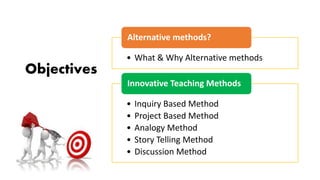
Objectives
• What & Why Alternative methods
Alternative methods?
• Inquiry Based Method
• Project Based Method
• Analogy Method
• Story Telling Method
• Discussion Method
Innovative Teaching Methods
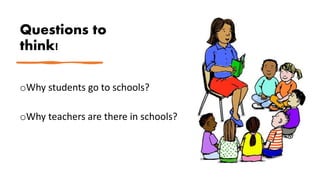
Questions to
think!
oWhy students go to schools?
oWhy teachers are there in schools?
Teaching is a challenge?
oThe biggest challenge for any teacher is capturing each student’s
attention and conveying ideas effectively enough to create a
lasting impression.
oAs a teacher, to tackle this challenge effectively, you should
implement innovative ideas that make the classroom experience
much more lovable for your students
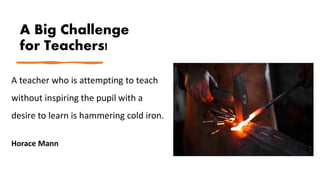
A Big Challenge
for Teachers!
A teacher who is attempting to teach
without inspiring the pupil with a
desire to learn is hammering cold iron.
Horace Mann
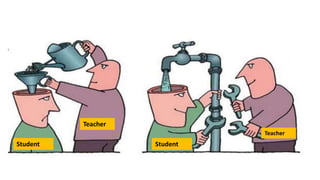
Student Student
Teacher
Teacher
Teaching Method
• The term refers to the general principles, pedagogy and
management strategies used for classroom instruction.
• Your choice of teaching method depends on what fits you — your
educational philosophy, classroom demographic, subject area(s)
and school mission statement.
Teaching Method Cont..
A good method involves the following:
1. Recognition of individual differences;
2. Assurance of students’ learning;
3. Facilitates growth and development;
4. Achieves the desired results of the teacher as reflected in his/her
instructional objectives.
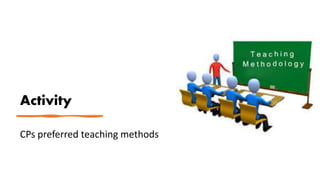
Activity
CPs preferred teaching methods
Why
alternativ
e teaching
methods
• To cater the learning needs and
requirements of students.
• To help students take more
responsibility for their own learning
and enhance the process of learning.
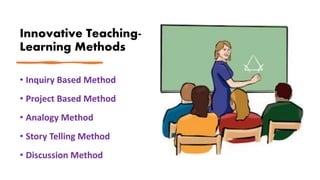
Innovative Teaching-
Learning Methods
• Inquiry Based Method
• Project Based Method
• Analogy Method
• Story Telling Method
• Discussion Method
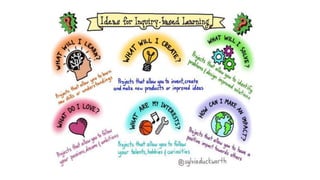
Inquiry Based Learning
It is a form of active learning that starts
by posing questions, problems or
scenarios.
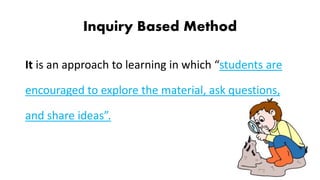
Inquiry Based Method
It is an approach to learning in which “students are
encouraged to explore the material, ask questions,
and share ideas”.
The 4 Types of Inquiry-Based Learning
1. Confirmation Inquiry -- Teacher gives students a question, its answer and the
method of reaching this answer. Their goal is to build investigation and critical-
thinking skills, learning how the specific method works. (3+?=5)
2. Structured Inquiry -- Teacher gives students an open question and an investigation
method. They must use the method to craft an evidence-backed conclusion. (Why
will a small piece of wood sink, but a huge boat will float? Is it magic or is it density?)
The 4 Types of Inquiry-Based Learning
3. Guided Inquiry -- Teacher gives students an open question. Typically in groups,
they design investigation methods to reach a conclusion. (Balloon popping)
4. Open Inquiry -- Teacher gives students time and support. They pose original
questions that they investigate through their own methods, and eventually
present their results to discuss and expand. (Flight Fair- Aeroplane )
Group Activity
The 4 Cs
1. Curious: This is about the concepts embedded in the content that learners can
think about and discuss to drive their curiosity forward.
2. Connect: Bringing the content to learners by making relevant connections to
different concepts inspires real learning.
3. Communicate: Here, we state what message and essential learnings we want
our students to gain.
4. Create: This is what learners will present to demonstrate their understanding of,
and appreciation for, what they’ve learned.
Inquiry Based Learning
•Video
Project Based Method
•Project Based Learning (PBL) is a teaching method
in which students learn by actively engaging in real-
world and personally meaningful projects.
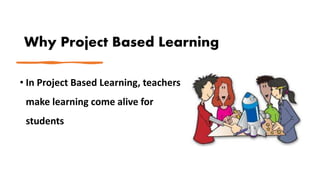
Why Project Based Learning
• In Project Based Learning, teachers
make learning come alive for
students
•Video on Project Based
learning
•Video
1) Students work on a project over an extended period of time – from a
week up to a semester – that engages them in solving a real-world
problem or answering a complex question.
2) They demonstrate their knowledge and skills by creating a public
product or presentation for a real audience.
3) As a result, students develop deep content knowledge as well as
critical thinking, collaboration, creativity, and communication skills.
4) Project Based Learning unleashes a contagious, creative energy among
students and teachers.
Group
Activity
Analogy Method
Analogy Method
•An analogy is a method that uses an analog (that is,
an ideal or material object that adequately reflects
the process or object being studied)
•An analogy is used when you compare two
completely different ideas or things and use its
similarities to give an explanation of things that are
hard to understand or are too sensitive
An example of Analogy
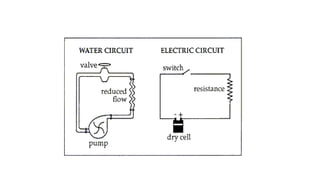
• A common science teaching analogy is to compare electricity in
a circuit to water flowing in the pipes in a house.
• A typical analogy has two parts, the source (familiar to students)
and the target (less familiar)
An example: More Like Analogy
•Video
Story Telling Method
• Storytelling can be used as a method to teach ethics, values and cultural
norms and differences.
• Learning is most effective when it takes place in social environments that
provide authentic social cues about how knowledge is to be applied.
• Stories function as a tool to pass on knowledge in a social context
Group
Activity
Discussion method
What is Discussion?
The action or process of talking about something in order to reach a
decision or to exchange ideas.
Discussion method
• Discussion method of teaching is a group activity involving
the teacher and the student to define the problem and seek

its solution.
• Discussion method is also described as a constructive
process involving listening ,thinking ,as well as the speaking
ability of the students
Discussion Method
• Discussion methods are a variety of forums for open-ended, collaborative
exchange of ideas among a teacher and students or among students for
the purpose of furthering students thinking, learning, problem solving,
understanding, or literary appreciation.
• Participants present multiple points of view, respond to the ideas of
others, and reflect on their own ideas in an effort to build their
knowledge, understanding, or interpretation of the matter at hand.
Group
Activity
Alternative methods of Innovative Teaching.pptx

Alternative methods of Innovative Teaching.pptx

  • 1.
    Alternative Methods Of InnovativeTeaching Shueb Sultan Professional Development Centre North (PDCN)-Gilgit
  • 2.
    Objectives • What &Why Alternative methods Alternative methods? • Inquiry Based Method • Project Based Method • Analogy Method • Story Telling Method • Discussion Method Innovative Teaching Methods
  • 4.
    Questions to think! oWhy studentsgo to schools? oWhy teachers are there in schools?
  • 5.
    Teaching is achallenge? oThe biggest challenge for any teacher is capturing each student’s attention and conveying ideas effectively enough to create a lasting impression. oAs a teacher, to tackle this challenge effectively, you should implement innovative ideas that make the classroom experience much more lovable for your students
  • 7.
    A Big Challenge forTeachers! A teacher who is attempting to teach without inspiring the pupil with a desire to learn is hammering cold iron. Horace Mann
  • 8.
  • 9.
    Teaching Method • Theterm refers to the general principles, pedagogy and management strategies used for classroom instruction. • Your choice of teaching method depends on what fits you — your educational philosophy, classroom demographic, subject area(s) and school mission statement.
  • 10.
    Teaching Method Cont.. Agood method involves the following: 1. Recognition of individual differences; 2. Assurance of students’ learning; 3. Facilitates growth and development; 4. Achieves the desired results of the teacher as reflected in his/her instructional objectives.
  • 11.
  • 12.
    Why alternativ e teaching methods • Tocater the learning needs and requirements of students. • To help students take more responsibility for their own learning and enhance the process of learning.
  • 14.
    Innovative Teaching- Learning Methods •Inquiry Based Method • Project Based Method • Analogy Method • Story Telling Method • Discussion Method
  • 15.
  • 16.
    Inquiry Based Learning Itis a form of active learning that starts by posing questions, problems or scenarios.
  • 17.
    Inquiry Based Method Itis an approach to learning in which “students are encouraged to explore the material, ask questions, and share ideas”.
  • 18.
    The 4 Typesof Inquiry-Based Learning 1. Confirmation Inquiry -- Teacher gives students a question, its answer and the method of reaching this answer. Their goal is to build investigation and critical- thinking skills, learning how the specific method works. (3+?=5) 2. Structured Inquiry -- Teacher gives students an open question and an investigation method. They must use the method to craft an evidence-backed conclusion. (Why will a small piece of wood sink, but a huge boat will float? Is it magic or is it density?)
  • 19.
    The 4 Typesof Inquiry-Based Learning 3. Guided Inquiry -- Teacher gives students an open question. Typically in groups, they design investigation methods to reach a conclusion. (Balloon popping) 4. Open Inquiry -- Teacher gives students time and support. They pose original questions that they investigate through their own methods, and eventually present their results to discuss and expand. (Flight Fair- Aeroplane )
  • 20.
  • 21.
    The 4 Cs 1.Curious: This is about the concepts embedded in the content that learners can think about and discuss to drive their curiosity forward. 2. Connect: Bringing the content to learners by making relevant connections to different concepts inspires real learning. 3. Communicate: Here, we state what message and essential learnings we want our students to gain. 4. Create: This is what learners will present to demonstrate their understanding of, and appreciation for, what they’ve learned.
  • 22.
  • 24.
  • 25.
    Project Based Method •ProjectBased Learning (PBL) is a teaching method in which students learn by actively engaging in real- world and personally meaningful projects.
  • 26.
    Why Project BasedLearning • In Project Based Learning, teachers make learning come alive for students
  • 27.
    •Video on ProjectBased learning •Video
  • 28.
    1) Students workon a project over an extended period of time – from a week up to a semester – that engages them in solving a real-world problem or answering a complex question. 2) They demonstrate their knowledge and skills by creating a public product or presentation for a real audience. 3) As a result, students develop deep content knowledge as well as critical thinking, collaboration, creativity, and communication skills. 4) Project Based Learning unleashes a contagious, creative energy among students and teachers.
  • 29.
  • 30.
  • 31.
    Analogy Method •An analogyis a method that uses an analog (that is, an ideal or material object that adequately reflects the process or object being studied)
  • 32.
    •An analogy isused when you compare two completely different ideas or things and use its similarities to give an explanation of things that are hard to understand or are too sensitive
  • 33.
    An example ofAnalogy • A common science teaching analogy is to compare electricity in a circuit to water flowing in the pipes in a house. • A typical analogy has two parts, the source (familiar to students) and the target (less familiar)
  • 35.
    An example: MoreLike Analogy •Video
  • 37.
  • 38.
    Story Telling Method •Storytelling can be used as a method to teach ethics, values and cultural norms and differences. • Learning is most effective when it takes place in social environments that provide authentic social cues about how knowledge is to be applied. • Stories function as a tool to pass on knowledge in a social context
  • 40.
  • 41.
  • 42.
    What is Discussion? Theaction or process of talking about something in order to reach a decision or to exchange ideas.
  • 43.
    Discussion method • Discussionmethod of teaching is a group activity involving the teacher and the student to define the problem and seek its solution. • Discussion method is also described as a constructive process involving listening ,thinking ,as well as the speaking ability of the students
  • 44.
    Discussion Method • Discussionmethods are a variety of forums for open-ended, collaborative exchange of ideas among a teacher and students or among students for the purpose of furthering students thinking, learning, problem solving, understanding, or literary appreciation. • Participants present multiple points of view, respond to the ideas of others, and reflect on their own ideas in an effort to build their knowledge, understanding, or interpretation of the matter at hand.
  • 45.

Editor's Notes

  • #30 Math: Geometrical shapes, Science: Three states of matter Englsih:
  • #35 Comparing earth with a football, Electrons charge carriers like a van & Passengers