John's Fantastic Study Session #1


              Introductions
              “~have been”
    General and Simple Conversations
         “May I?” vs. “Can I?”
              A / An / The
Welcome and Let's Get Started!
Introductions


What does a good introduction have?
Introductions
●   Greeting             ●   Hello! / Good ~~ !
●   Name                 ●   My name is ~. / I'm ~.
●   Age                  ●   I am ~years old [young].
●   Hometown             ●   I'm from ~.
●   Goal / Desire / Want ● My goal is~. / I want ~ .
●   Likes / Dislike      ●   I like / don't like ~.
●   Special Skill        ●   I can ~ .
●   Hobby / Interest     ●   My hobby is ~ .
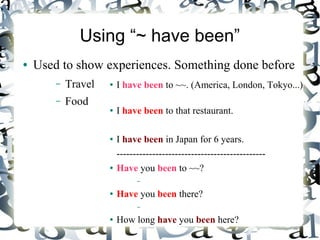
Using “~ have been”
●   Used to show experiences. Something done before
        –   Travel   ●   I have been to ~~. (America, London, Tokyo...)
        –   Food
                     ●   I have been to that restaurant.

                     ●   I have been in Japan for 6 years.
                         ----------------------------------------------
                     ●   Have you been to ~~?
                               –
                     ●   Have you been there?
                               –
                     ●   How long have you been here?
Moving on!
General Conversation


  How to speak naturally!
Keep it Simple!
●   There are many verbs in the English language

●   Use the verbs you know the best!

●   Do not think too much!

●   Relax.
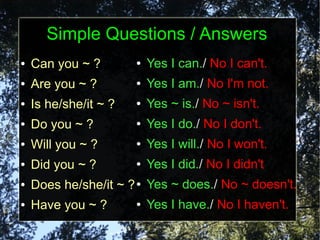
Simple Questions / Answers
●   Can you ~ ?        ●   Yes I can./ No I can't.
●   Are you ~ ?        ●   Yes I am./ No I'm not.
●   Is he/she/it ~ ?   ●   Yes ~ is./ No ~ isn't.
●   Do you ~ ?         ●   Yes I do./ No I don't.
●   Will you ~ ?       ●   Yes I will./ No I won't.
●   Did you ~ ?        ●   Yes I did./ No I didn't
●   Does he/she/it ~ ? ● Yes ~ does./ No ~ doesn't.
●   Have you ~ ?       ●   Yes I have./ No I haven't.
Simple Answers
●       Can you think of any other ways to fix this?
            –   Yes, I can. / No, I can't.
            –   [Explain why]


    ●   Do you like to read books on culture?
                –   Yes, I do. / No, I don't.
                –   [Explain why]
Got it?
(Do you understand?)
General Things in General


       Do not Forget:
      KEEP IT SIMPLE
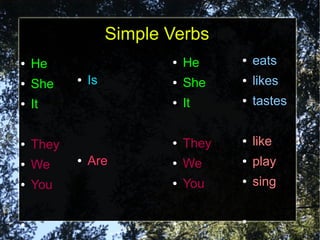
Simple Verbs
●   He                     ●   He     ●   eats
●   She
           ●   Is          ●   She    ●   likes
●   It                     ●   It     ●   tastes


●   They                   ●   They   ●   like
●   We
           ●   Are         ●   We     ●   play
●   You                    ●   You    ●   sing


                           ●          ●
●
Get it? Got it? Good!!

(Can you understand? Do you understand? Nice!)
In relation to Simple Verbs


Differences Between “May I?” and “Can I?”
“May I?”
●   What does it exactly mean?
       –   Asking permission.
       –   “Is it OK?”
              ●   “May I help you?”
              ●   “May I take your coat?”
              ●   “May I get you a drink?”
              ●   “May I have some water?”
              ●   “May you be safe.” [old]
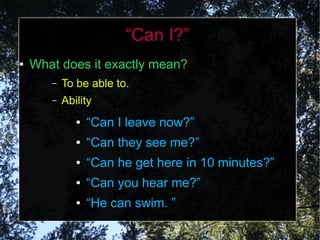
“Can I?”
●   What does it exactly mean?
       –   To be able to.
       –   Ability
              ●   “Can I leave now?”
              ●   “Can they see me?”
              ●   “Can he get here in 10 minutes?”
              ●   “Can you hear me?”
              ●   “He can swim. ”
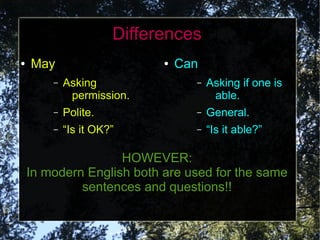
Differences
●   May                     ●   Can
        –   Asking                –   Asking if one is
             permission.               able.
        –   Polite.               –   General.
        –   “Is it OK?”           –   “Is it able?”

                    HOWEVER:
    In modern English both are used for the same
             sentences and questions!!
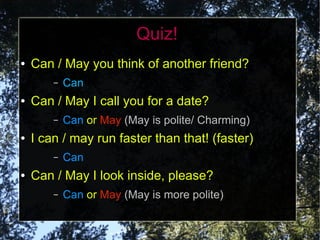
Quiz!
●   Can / May you think of another friend?
        –   Can
●   Can / May I call you for a date?
        –   Can or May (May is polite/ Charming)
●   I can / may run faster than that! (faster)
        –   Can
●   Can / May I look inside, please?
        –   Can or May (May is more polite)
Alright now, STOP!
This is a Story About Articles
                   (or an umbrella)

●   A sad story about an unused umbrella.
●   The umbrella was a sad umbrella.
●   No one wanted to use the umbrella.
●   A boy needed an umbrella.
●   He took the umbrella.
●   A happy umbrella!
When to use “A” or “An”
●   What does the first letter sound like?
        –   Is it a consonant or a vowel?

        –   Consonant : B, C, D, T, G, J, K …
        –   Vowel: A, E, I, O, U [Y]


●   This is a pen.
●   This is a bottle of green tea.
●   Is this an apple pie?
●   Wow, this is an unusual place.
Test Your
                                Understanding


The party starts in _ hour and _ half.
    ●   “Hour” sounds like … ?
           –   “Hour” sounds like “our” which is a vowel
                 sound.

    ●   “Half” sounds like … ?
           –   “Half” sounds like “Hyper”, a strong “H”
                 sound.
Understanding “THE”


“The” is used to show one specific thing.
     Only one. Only this one thing.
   Not any other thing, just this one.
“The” Continued


●   Decided information!
         –   In the world, many pens.
                 ●   BUT, I want to talk about only this one.


     ●   Can you pass me the pen, please?
     ●   I need to use the computer.
     ●   The tea at that restaurant is very good.
     ●   I would like the fish and chips, please.
Practice and Question Time
Thanks for Coming!

ネス外国語会話 スライド1

  • 1.
    John's Fantastic StudySession #1 Introductions “~have been” General and Simple Conversations “May I?” vs. “Can I?” A / An / The
  • 2.
    Welcome and Let'sGet Started!
  • 3.
    Introductions What does agood introduction have?
  • 4.
    Introductions ● Greeting ● Hello! / Good ~~ ! ● Name ● My name is ~. / I'm ~. ● Age ● I am ~years old [young]. ● Hometown ● I'm from ~. ● Goal / Desire / Want ● My goal is~. / I want ~ . ● Likes / Dislike ● I like / don't like ~. ● Special Skill ● I can ~ . ● Hobby / Interest ● My hobby is ~ .
  • 5.
    Using “~ havebeen” ● Used to show experiences. Something done before – Travel ● I have been to ~~. (America, London, Tokyo...) – Food ● I have been to that restaurant. ● I have been in Japan for 6 years. ---------------------------------------------- ● Have you been to ~~? – ● Have you been there? – ● How long have you been here?
  • 6.
  • 7.
    General Conversation How to speak naturally!
  • 8.
    Keep it Simple! ● There are many verbs in the English language ● Use the verbs you know the best! ● Do not think too much! ● Relax.
  • 9.
    Simple Questions /Answers ● Can you ~ ? ● Yes I can./ No I can't. ● Are you ~ ? ● Yes I am./ No I'm not. ● Is he/she/it ~ ? ● Yes ~ is./ No ~ isn't. ● Do you ~ ? ● Yes I do./ No I don't. ● Will you ~ ? ● Yes I will./ No I won't. ● Did you ~ ? ● Yes I did./ No I didn't ● Does he/she/it ~ ? ● Yes ~ does./ No ~ doesn't. ● Have you ~ ? ● Yes I have./ No I haven't.
  • 10.
    Simple Answers ● Can you think of any other ways to fix this? – Yes, I can. / No, I can't. – [Explain why] ● Do you like to read books on culture? – Yes, I do. / No, I don't. – [Explain why]
  • 11.
    Got it? (Do youunderstand?)
  • 12.
    General Things inGeneral Do not Forget: KEEP IT SIMPLE
  • 13.
    Simple Verbs ● He ● He ● eats ● She ● Is ● She ● likes ● It ● It ● tastes ● They ● They ● like ● We ● Are ● We ● play ● You ● You ● sing ● ● ●
  • 15.
    Get it? Gotit? Good!! (Can you understand? Do you understand? Nice!)
  • 16.
    In relation toSimple Verbs Differences Between “May I?” and “Can I?”
  • 17.
    “May I?” ● What does it exactly mean? – Asking permission. – “Is it OK?” ● “May I help you?” ● “May I take your coat?” ● “May I get you a drink?” ● “May I have some water?” ● “May you be safe.” [old]
  • 18.
    “Can I?” ● What does it exactly mean? – To be able to. – Ability ● “Can I leave now?” ● “Can they see me?” ● “Can he get here in 10 minutes?” ● “Can you hear me?” ● “He can swim. ”
  • 19.
    Differences ● May ● Can – Asking – Asking if one is permission. able. – Polite. – General. – “Is it OK?” – “Is it able?” HOWEVER: In modern English both are used for the same sentences and questions!!
  • 20.
    Quiz! ● Can / May you think of another friend? – Can ● Can / May I call you for a date? – Can or May (May is polite/ Charming) ● I can / may run faster than that! (faster) – Can ● Can / May I look inside, please? – Can or May (May is more polite)
  • 21.
  • 22.
    This is aStory About Articles (or an umbrella) ● A sad story about an unused umbrella. ● The umbrella was a sad umbrella. ● No one wanted to use the umbrella. ● A boy needed an umbrella. ● He took the umbrella. ● A happy umbrella!
  • 23.
    When to use“A” or “An” ● What does the first letter sound like? – Is it a consonant or a vowel? – Consonant : B, C, D, T, G, J, K … – Vowel: A, E, I, O, U [Y] ● This is a pen. ● This is a bottle of green tea. ● Is this an apple pie? ● Wow, this is an unusual place.
  • 24.
    Test Your Understanding The party starts in _ hour and _ half. ● “Hour” sounds like … ? – “Hour” sounds like “our” which is a vowel sound. ● “Half” sounds like … ? – “Half” sounds like “Hyper”, a strong “H” sound.
  • 25.
    Understanding “THE” “The” isused to show one specific thing. Only one. Only this one thing. Not any other thing, just this one.
  • 26.
    “The” Continued ● Decided information! – In the world, many pens. ● BUT, I want to talk about only this one. ● Can you pass me the pen, please? ● I need to use the computer. ● The tea at that restaurant is very good. ● I would like the fish and chips, please.
  • 27.
  • 28.