Using library assessment data
in senior decision making:
A perspective from the trenches
Giovanna Badia, Assessment Librarian, McGill University
C. Colleen Cook, Trenholme Dean of Libraries, McGill University
October 30, 2020
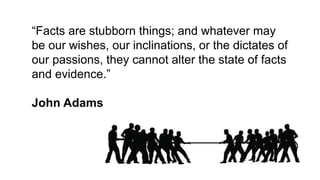
“Facts are stubborn things; and whatever may
be our wishes, our inclinations, or the dictates of
our passions, they cannot alter the state of facts
and evidence.”
John Adams
Relevant data is absolutely
essential to the work of
administrators.
Relevant data = data that has been
collected +
analyzed +
its findings summarized
to answer a particular question or
address a specific objective
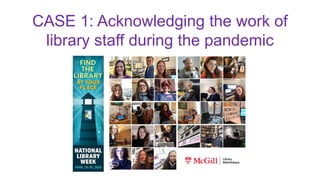
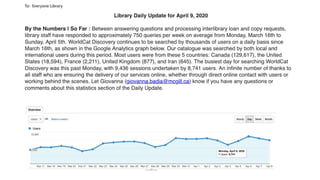
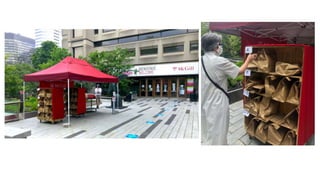
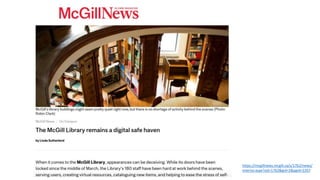
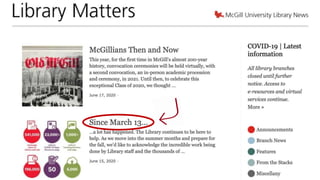
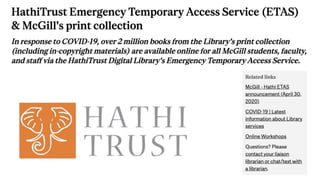
CASE 1: Acknowledging the work of
library staff during the pandemic
https://mcgillnews.mcgill.ca/s/1762/news/
interior.aspx?sid=1762&gid=2&pgid=2207
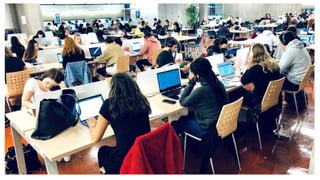
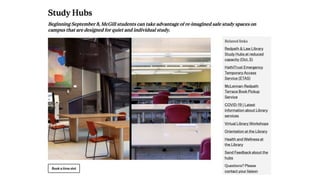
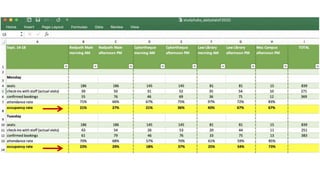
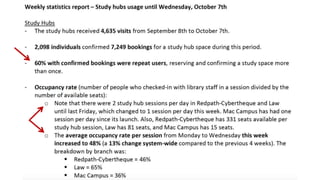
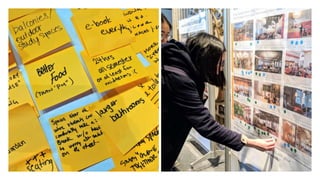
CASE 2: Defining a study hubs service &
assessing it for possible expansion
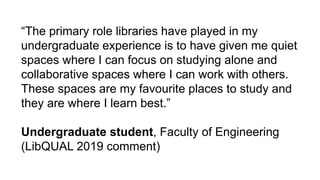
“The primary role libraries have played in my
undergraduate experience is to have given me quiet
spaces where I can focus on studying alone and
collaborative spaces where I can work with others.
These spaces are my favourite places to study and
they are where I learn best.”
Undergraduate student, Faculty of Engineering
(LibQUAL 2019 comment)
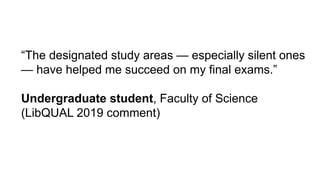
“The designated study areas — especially silent ones
— have helped me succeed on my final exams.”
Undergraduate student, Faculty of Science
(LibQUAL 2019 comment)
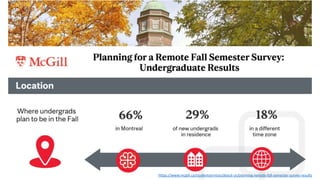
https://www.mcgill.ca/studentservices/about-us/planning-remote-fall-semester-survey-results
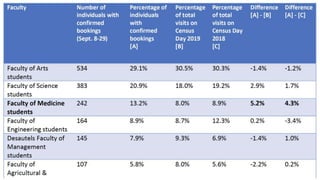
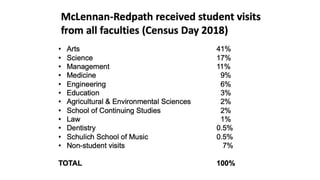
CASE 3: Continued planning for
a new building complex
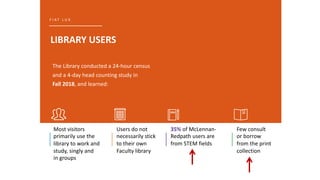
Most visitors
primarily use the
library to work and
study, singly and
in groups
Users do not
necessarily
stick to their
own Faculty
library
Few consult
or borrow
from the print
collection
35% of McLennan-
Redpath users are
from STEM fields
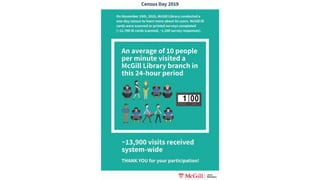
The Library conducted a 24-hour
census and a 4-day head counting
study in Fall 2018, and learned:
LIBRARY USERS
F I A T L U X
Most visitors
primarily use the
library to work and
study, singly and
in groups
Users do not
necessarily stick
to their own
Faculty library
Few consult
or borrow
from the print
collection
35% of McLennan-
Redpath users are
from STEM fields
The Library conducted a 24-hour census
and a 4-day head counting study in
Fall 2018, and learned:
LIBRARY USERS
F I A T L U X
31% of McGill’s print collection [784,324 volumes]
circulated from 2014 to 2016.
However, nearly 40% have not circulated in 20 years.
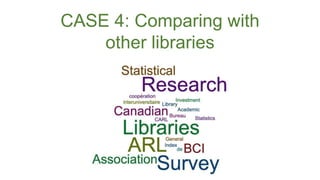
CASE 4: Comparing with
other libraries
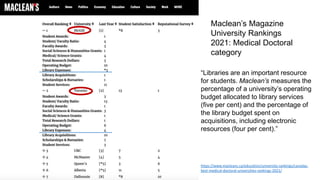
“Libraries are an important resource
for students. Maclean’s measures the
percentage of a university’s operating
budget allocated to library services
(five per cent) and the percentage of
the library budget spent on
acquisitions, including electronic
resources (four per cent).”
Maclean’s Magazine
University Rankings
2021: Medical Doctoral
category
https://www.macleans.ca/education/university-rankings/canadas-
best-medical-doctoral-universities-rankings-2021/
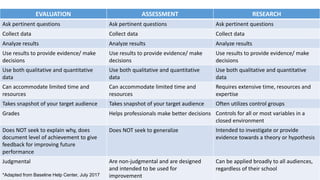
EVALUATION ASSESSMENT RESEARCH
Ask pertinent questions Ask pertinent questions Ask pertinent questions
Collect data Collect data Collect data
Analyze results Analyze results Analyze results
Use results to provide evidence/ make
decisions
Use results to provide evidence/ make
decisions
Use results to provide evidence/ make
decisions
Use both qualitative and quantitative
data
Use both qualitative and quantitative
data
Use both qualitative and quantitative
data
Can accommodate limited time and
resources
Can accommodate limited time and
resources
Requires extensive time, resources and
expertise
Takes snapshot of your target audience Takes snapshot of your target audience Often utilizes control groups
Grades Helps professionals make better decisions Controls for all or most variables in a
closed environment
Does NOT seek to explain why, does
document level of achievement to give
feedback for improving future
performance
Does NOT seek to generalize Intended to investigate or provide
evidence towards a theory or hypothesis
Judgmental Are non-judgmental and are designed
and intended to be used for
improvement
Can be applied broadly to all audiences,
regardless of their school
*Adapted from Baseline Help Center, July 2017
Thank you. Questions?
BONNE JOURNÉE, Y’ALL!

Cook "Using Library Assessment Data in Senior Decision Making: A Perspective from the Trenches"

  • 1.
    Using library assessmentdata in senior decision making: A perspective from the trenches Giovanna Badia, Assessment Librarian, McGill University C. Colleen Cook, Trenholme Dean of Libraries, McGill University October 30, 2020
  • 4.
    “Facts are stubbornthings; and whatever may be our wishes, our inclinations, or the dictates of our passions, they cannot alter the state of facts and evidence.” John Adams
  • 5.
    Relevant data isabsolutely essential to the work of administrators.
  • 6.
    Relevant data =data that has been collected + analyzed + its findings summarized to answer a particular question or address a specific objective
  • 7.
    CASE 1: Acknowledgingthe work of library staff during the pandemic
  • 10.
  • 12.
    CASE 2: Defininga study hubs service & assessing it for possible expansion
  • 14.
    “The primary rolelibraries have played in my undergraduate experience is to have given me quiet spaces where I can focus on studying alone and collaborative spaces where I can work with others. These spaces are my favourite places to study and they are where I learn best.” Undergraduate student, Faculty of Engineering (LibQUAL 2019 comment)
  • 15.
    “The designated studyareas — especially silent ones — have helped me succeed on my final exams.” Undergraduate student, Faculty of Science (LibQUAL 2019 comment)
  • 16.
  • 23.
    CASE 3: Continuedplanning for a new building complex
  • 24.
    Most visitors primarily usethe library to work and study, singly and in groups Users do not necessarily stick to their own Faculty library Few consult or borrow from the print collection 35% of McLennan- Redpath users are from STEM fields The Library conducted a 24-hour census and a 4-day head counting study in Fall 2018, and learned: LIBRARY USERS F I A T L U X Most visitors primarily use the library to work and study, singly and in groups Users do not necessarily stick to their own Faculty library Few consult or borrow from the print collection 35% of McLennan- Redpath users are from STEM fields The Library conducted a 24-hour census and a 4-day head counting study in Fall 2018, and learned: LIBRARY USERS F I A T L U X
  • 26.
    31% of McGill’sprint collection [784,324 volumes] circulated from 2014 to 2016. However, nearly 40% have not circulated in 20 years.
  • 28.
    CASE 4: Comparingwith other libraries
  • 29.
    “Libraries are animportant resource for students. Maclean’s measures the percentage of a university’s operating budget allocated to library services (five per cent) and the percentage of the library budget spent on acquisitions, including electronic resources (four per cent).” Maclean’s Magazine University Rankings 2021: Medical Doctoral category https://www.macleans.ca/education/university-rankings/canadas- best-medical-doctoral-universities-rankings-2021/
  • 32.
    EVALUATION ASSESSMENT RESEARCH Askpertinent questions Ask pertinent questions Ask pertinent questions Collect data Collect data Collect data Analyze results Analyze results Analyze results Use results to provide evidence/ make decisions Use results to provide evidence/ make decisions Use results to provide evidence/ make decisions Use both qualitative and quantitative data Use both qualitative and quantitative data Use both qualitative and quantitative data Can accommodate limited time and resources Can accommodate limited time and resources Requires extensive time, resources and expertise Takes snapshot of your target audience Takes snapshot of your target audience Often utilizes control groups Grades Helps professionals make better decisions Controls for all or most variables in a closed environment Does NOT seek to explain why, does document level of achievement to give feedback for improving future performance Does NOT seek to generalize Intended to investigate or provide evidence towards a theory or hypothesis Judgmental Are non-judgmental and are designed and intended to be used for improvement Can be applied broadly to all audiences, regardless of their school *Adapted from Baseline Help Center, July 2017
  • 33.
  • 34.