SIMPLE WAYS TO ADD ACTIVE LEARNING TO YOUR LIBRARY INSTRUCTION Lilly Ramin , Annie Downey, &Gayla ByerlyTexas Library Association, April 17, 2008Dallas, Texas
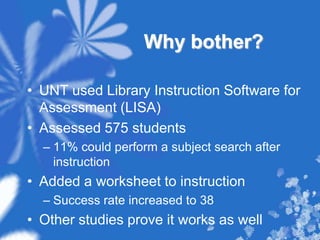
Why bother?UNT used Library Instruction Software for Assessment (LISA)Assessed 575 students11% could perform a subject search after instructionAdded a worksheet to instructionSuccess rate increased to 38Other studies prove it works as well
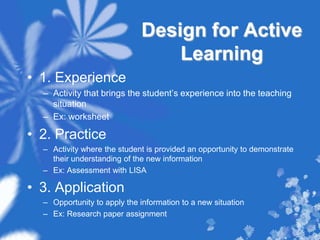
Design for Active Learning1. ExperienceActivity that brings the student’s experience into the teaching situationEx: worksheet2. PracticeActivity where the student is provided an opportunity to demonstrate their understanding of the new informationEx: Assessment with LISA3. ApplicationOpportunity to apply the information to a new situationEx: Research paper assignment
Why it worksStudents take an active role in learningStudents are more engagedStudents feel more comfortable participating and asking questionsTakes into account that learning is a process
Why it works (cont.)Facilitates assessmentLearning is demonstrated to the learner BY the learnerFacilitates teacher learningDifferent learning styles and domains can be accommodated and addressedLearning becomes personally meaningful
Why it’s hardRequires teacher to take risksCan feel chaotic and like classroom control has been lostStrict time limitsWe have a lot of content we want to cover
Simple StrategiesHonor Silence!!!Expect participationGive students time to thinkWhen students answer questions, reward themMake contact with students that look interestedAllow time for informal questions at the endhttp://www.killerclips.com/greeting.php?mqg=23431
WorksheetsIndividually or in groupsShort and simpleCustomized for a specific subject area or audience
Group SearchDivide into groups of fourAssign each group member with a roleLeaderSearcherRecorderReporterAssign each group a searching task
Deck of Cards BooleanGive each student a cardAsk students to hold up cards that meet specific criteria to illustrate Boolean conceptsExplain the concepts as you go(have them hold up a card that meets the criteria for the search)
Questions?Lilly RaminLilly.ramin@unt.eduAnnie DowneyAnnie.downey@unt.eduGayla ByerlyGayla.byerly@unt.edu

Tla2008 Simple

  • 1.
    SIMPLE WAYS TOADD ACTIVE LEARNING TO YOUR LIBRARY INSTRUCTION Lilly Ramin , Annie Downey, &Gayla ByerlyTexas Library Association, April 17, 2008Dallas, Texas
  • 2.
    Why bother?UNT usedLibrary Instruction Software for Assessment (LISA)Assessed 575 students11% could perform a subject search after instructionAdded a worksheet to instructionSuccess rate increased to 38Other studies prove it works as well
  • 3.
    Design for ActiveLearning1. ExperienceActivity that brings the student’s experience into the teaching situationEx: worksheet2. PracticeActivity where the student is provided an opportunity to demonstrate their understanding of the new informationEx: Assessment with LISA3. ApplicationOpportunity to apply the information to a new situationEx: Research paper assignment
  • 4.
    Why it worksStudentstake an active role in learningStudents are more engagedStudents feel more comfortable participating and asking questionsTakes into account that learning is a process
  • 5.
    Why it works(cont.)Facilitates assessmentLearning is demonstrated to the learner BY the learnerFacilitates teacher learningDifferent learning styles and domains can be accommodated and addressedLearning becomes personally meaningful
  • 6.
    Why it’s hardRequiresteacher to take risksCan feel chaotic and like classroom control has been lostStrict time limitsWe have a lot of content we want to cover
  • 7.
    Simple StrategiesHonor Silence!!!ExpectparticipationGive students time to thinkWhen students answer questions, reward themMake contact with students that look interestedAllow time for informal questions at the endhttp://www.killerclips.com/greeting.php?mqg=23431
  • 8.
    WorksheetsIndividually or ingroupsShort and simpleCustomized for a specific subject area or audience
  • 9.
    Group SearchDivide intogroups of fourAssign each group member with a roleLeaderSearcherRecorderReporterAssign each group a searching task
  • 10.
    Deck of CardsBooleanGive each student a cardAsk students to hold up cards that meet specific criteria to illustrate Boolean conceptsExplain the concepts as you go(have them hold up a card that meets the criteria for the search)
  • 11.