English 565  Introduction to Adult/University TESOL Serpil Sonmez
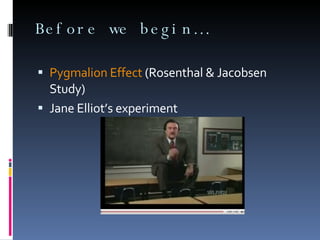
Before we begin… Pygmalion Effect  (Rosenthal & Jacobsen Study) Jane Elliot’s experiment
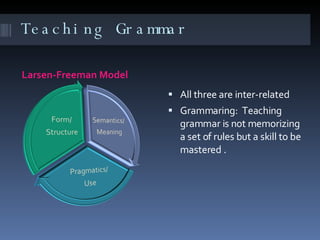
Teaching Grammar Larsen-Freeman Model All three are inter-related Grammaring:  Teaching grammar is not memorizing a set of rules but a skill to be mastered .
The Learning Process Not linear: Learning is a gradual process. Not error-free Backsliding may occur Learners rely on their L1 knowledge Teachers don’t have to teach everything about a structure Different learning processes are responsible for different aspects of language
The Teaching Process Recasting errors as they occur (Nabei & Swain (2002) study) Enhancing input (Sharwood-Smith) Explicit feedback to increase consciousness about certain rules “ Garden path” – Explaining rules partially and correcting only when needed/overgeneralization occurs. Encouraging output production (Swain IIO Model) Collaborative Dialogues (Donato, 1994)
Teaching… Form/Structure Opportunities for meaningful practice Don’t forget having fun! (e.g. information gap activities) Consider Memory Constraints: Limit practicing to 2-6 items at a time. (Asher, 1996) Semantics/Meaning Activities that use props/mime/physical activities (Remember Suggestopedia? TPR?) Pragmatics/Use Role-Plays
Feedback Recasts Explicit or Implicit Feedback Alternative: (Aljaafreh & Lantolf (1994)  13-Point Regulatory Scale)
Teaching Vocabulary Explicit feedback is important 2000-6000 words for beginners make up to 80% of most texts) Word lists (e.g., General Service List of English words; Academic Word List) Word families: (e.g. talk, talks, talking, talked)
Vocabulary Teaching Activities Explicit Learning Implicit (Incidental Learning) Explicit Learning Semantic mapping & word association activities Sugested: pair matching activities for vocabulary items to transfer into long-term memory. Through reading (Explicit learning till 2000 words, then most vocab learning is incidental.
Strategies to learn Vocabulary Guessing Strategy (Clark & Nation, 1980) Mnemonic Devices (Word-object associations) Vocabulary notebooks (noting new words, frequency of them- Schmitt (1990)study Focusing on cognates in L1 & L2 (e.g. night, nacht) Focusing on collocations & lexical phrases –Remember Lexical Approach?

Teaching Grammar & Vocabulary

  • 1.
    English 565 Introduction to Adult/University TESOL Serpil Sonmez
  • 2.
    Before we begin…Pygmalion Effect (Rosenthal & Jacobsen Study) Jane Elliot’s experiment
  • 3.
    Teaching Grammar Larsen-FreemanModel All three are inter-related Grammaring: Teaching grammar is not memorizing a set of rules but a skill to be mastered .
  • 4.
    The Learning ProcessNot linear: Learning is a gradual process. Not error-free Backsliding may occur Learners rely on their L1 knowledge Teachers don’t have to teach everything about a structure Different learning processes are responsible for different aspects of language
  • 5.
    The Teaching ProcessRecasting errors as they occur (Nabei & Swain (2002) study) Enhancing input (Sharwood-Smith) Explicit feedback to increase consciousness about certain rules “ Garden path” – Explaining rules partially and correcting only when needed/overgeneralization occurs. Encouraging output production (Swain IIO Model) Collaborative Dialogues (Donato, 1994)
  • 6.
    Teaching… Form/Structure Opportunitiesfor meaningful practice Don’t forget having fun! (e.g. information gap activities) Consider Memory Constraints: Limit practicing to 2-6 items at a time. (Asher, 1996) Semantics/Meaning Activities that use props/mime/physical activities (Remember Suggestopedia? TPR?) Pragmatics/Use Role-Plays
  • 7.
    Feedback Recasts Explicitor Implicit Feedback Alternative: (Aljaafreh & Lantolf (1994) 13-Point Regulatory Scale)
  • 8.
    Teaching Vocabulary Explicitfeedback is important 2000-6000 words for beginners make up to 80% of most texts) Word lists (e.g., General Service List of English words; Academic Word List) Word families: (e.g. talk, talks, talking, talked)
  • 9.
    Vocabulary Teaching ActivitiesExplicit Learning Implicit (Incidental Learning) Explicit Learning Semantic mapping & word association activities Sugested: pair matching activities for vocabulary items to transfer into long-term memory. Through reading (Explicit learning till 2000 words, then most vocab learning is incidental.
  • 10.
    Strategies to learnVocabulary Guessing Strategy (Clark & Nation, 1980) Mnemonic Devices (Word-object associations) Vocabulary notebooks (noting new words, frequency of them- Schmitt (1990)study Focusing on cognates in L1 & L2 (e.g. night, nacht) Focusing on collocations & lexical phrases –Remember Lexical Approach?