Assessing Teaching Presence in Instructional CMC Susan Lulee Jan., 2009
Introduction A growing number of courses offered online and degrees offered through the Internet. New online technologies have provided a broad spectrum of supportive features for online teaching. How will learning outcomes be ensured and improved? How will effective communication be established through online discussion? How new knowledge and understandings construct through instructional scaffolding?
Research Questions Have the measurement tools (categories & indicators) for assessing teaching presence developed by previous researches sufficient and appropriate? Are there patterns of teaching presence existed, or not existed, in current practices?
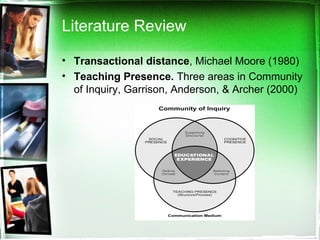
Literature Review Transactional distance , Michael Moore (1980) Teaching Presence.  Three areas in Community of Inquiry,  Garrison, Anderson, & Archer (2000)
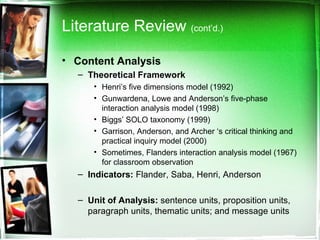
Literature Review  (cont’d.) Content Analysis Theoretical Framework Henri’s five dimensions model (1992) Gunwardena, Lowe and Anderson’s five-phase interaction analysis model (1998) Biggs’ SOLO taxonomy (1999) Garrison, Anderson, and Archer ‘s critical thinking and practical inquiry model (2000) Sometimes, Flanders interaction analysis model (1967) for classroom observation  Indicators:  Flander, Saba, Henri, Anderson Unit of Analysis:  sentence units, proposition units, paragraph units, thematic units; and message units
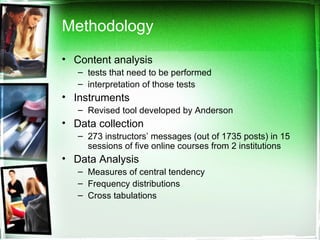
Methodology Content analysis tests that need to be performed  interpretation of those tests Instruments Revised tool developed by Anderson Data collection 273 instructors’ messages (out of 1735 posts) in 15 sessions of five online courses from 2 institutions Data Analysis  Measures of central tendency Frequency distributions Cross tabulations
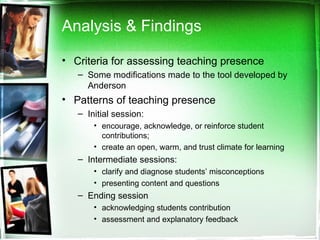
Analysis & Findings Criteria for assessing teaching presence Some modifications made to the tool developed by Anderson  Patterns of teaching presence Initial session:  encourage, acknowledge, or reinforce student contributions;  create an open, warm, and trust climate for learning  Intermediate sessions: clarify and diagnose students’ misconceptions  presenting content and questions  Ending session acknowledging students contribution  assessment and explanatory feedback
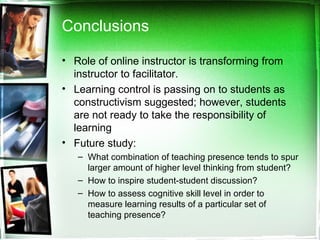
Conclusions Role of online instructor is transforming from instructor to facilitator.  Learning control is passing on to students as constructivism suggested; however, students are not ready to take the responsibility of learning  Future study: What combination of teaching presence tends to spur larger amount of higher level thinking from student?  How to inspire student-student discussion?  How to assess cognitive skill level in order to measure learning results of a particular set of teaching presence?

Assessing Teaching Presence In Instructional Cmc

  • 1.
    Assessing Teaching Presencein Instructional CMC Susan Lulee Jan., 2009
  • 2.
    Introduction A growingnumber of courses offered online and degrees offered through the Internet. New online technologies have provided a broad spectrum of supportive features for online teaching. How will learning outcomes be ensured and improved? How will effective communication be established through online discussion? How new knowledge and understandings construct through instructional scaffolding?
  • 3.
    Research Questions Havethe measurement tools (categories & indicators) for assessing teaching presence developed by previous researches sufficient and appropriate? Are there patterns of teaching presence existed, or not existed, in current practices?
  • 4.
    Literature Review Transactionaldistance , Michael Moore (1980) Teaching Presence. Three areas in Community of Inquiry, Garrison, Anderson, & Archer (2000)
  • 5.
    Literature Review (cont’d.) Content Analysis Theoretical Framework Henri’s five dimensions model (1992) Gunwardena, Lowe and Anderson’s five-phase interaction analysis model (1998) Biggs’ SOLO taxonomy (1999) Garrison, Anderson, and Archer ‘s critical thinking and practical inquiry model (2000) Sometimes, Flanders interaction analysis model (1967) for classroom observation Indicators: Flander, Saba, Henri, Anderson Unit of Analysis: sentence units, proposition units, paragraph units, thematic units; and message units
  • 6.
    Methodology Content analysistests that need to be performed interpretation of those tests Instruments Revised tool developed by Anderson Data collection 273 instructors’ messages (out of 1735 posts) in 15 sessions of five online courses from 2 institutions Data Analysis Measures of central tendency Frequency distributions Cross tabulations
  • 7.
    Analysis & FindingsCriteria for assessing teaching presence Some modifications made to the tool developed by Anderson Patterns of teaching presence Initial session: encourage, acknowledge, or reinforce student contributions; create an open, warm, and trust climate for learning Intermediate sessions: clarify and diagnose students’ misconceptions presenting content and questions Ending session acknowledging students contribution assessment and explanatory feedback
  • 8.
    Conclusions Role ofonline instructor is transforming from instructor to facilitator. Learning control is passing on to students as constructivism suggested; however, students are not ready to take the responsibility of learning Future study: What combination of teaching presence tends to spur larger amount of higher level thinking from student? How to inspire student-student discussion? How to assess cognitive skill level in order to measure learning results of a particular set of teaching presence?