Understanding Interaction in Web-Based Learning Su-Tuan Lulee EDDE 801 Professor: Dr. Patrick Fahy Feb. 2010
Why is interaction important?
Individual cognitive skills are developed in a social context People must learn between people first, before they can learn inside themselves and allow the knowledge to become internalized. (Vygotsky) Why is interaction important?
Anything new [should be] based on what is already known.  (Anderson) What have others done? What did they find? What do they recommend? What can I use? (Fahy)
In this presentation,  What previous studies told us? Two groups of studies  Examining the outcomes and process of Interaction Examining the structure of the network Other factors: group size, technology… Implication for good practices How can interaction theories benefit practices? Learning achievement, choices, limitation…
Previous Studies Two groups of studies (different focuses): Outcomes and Process of Interaction 5-dimension (Henri)  5-stage Model (Garrison) & cognitive presence IA framework (Gunawardena & Anderson)  IPA (Bales) Structure of Interaction Network Message Map (Levin et al.) TAT (Fahy) ENA (Shaffer et al.)
Henri’s 5-Dimension (Henri, 1991) For analyzing the quality of computer-mediated communication
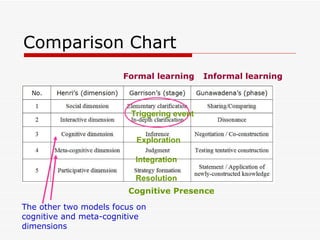
Henri’s 5-Dimension Social dimension Interactive dimension Cognitive dimension Meta-cognitive dimension Participative dimension
5-Stage Critical Thinking Model (Garrison, 1991) For assessing how learners develop  critical thinking
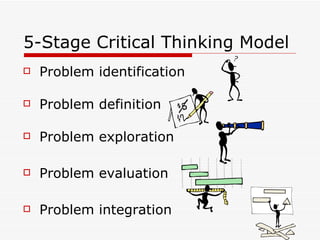
5-Stage Critical Thinking Model Problem identification Problem definition Problem exploration Problem evaluation Problem integration
Interaction Analysis model (IA) (Gunawardena, Lowe & Anderson, 1997) For assessing social construction of knowledge  (in less or no instructor presence)
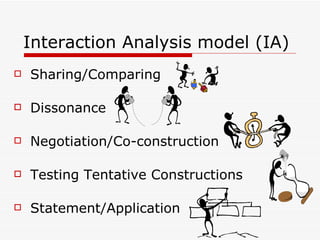
Interaction Analysis model (IA) Sharing/Comparing Dissonance Negotiation/Co-construction Testing Tentative Constructions Statement/Application
Triggering   event Exploration Integration Resolution Comparison Chart The other two models focus on cognitive and meta-cognitive dimensions Informal learning Formal learning Cognitive   Presence
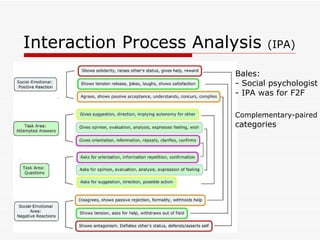
Interaction Process Analysis  (IPA) Bales: - Social psychologist IPA was for F2F C omplementary-paired  categories
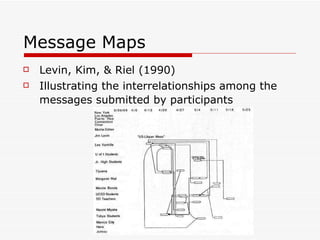
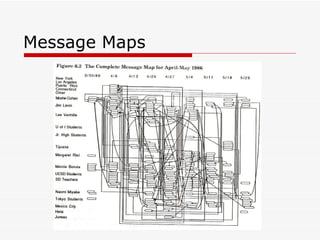
Message Maps  Levin, Kim, & Riel (1990) Illustrating the interrelationships among the messages submitted by participants
Message Maps
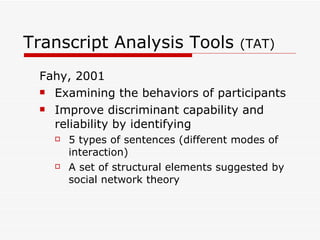
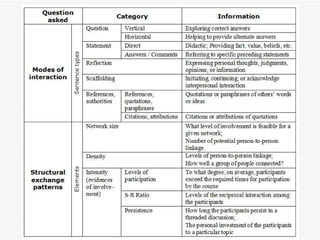
Transcript Analysis Tools  (TAT) Fahy, 2001  Examining the behaviors of participants Improve discriminant capability and reliability by identifying 5 types of sentences (different modes of interaction) A set of structural elements suggested by social network theory
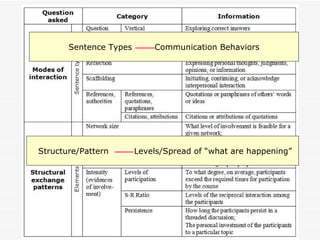
Transcript Analysis Tools  (TAT) Sentence Types  Communication Behaviors Structure/Pattern  Levels/Spread of “what are happening”
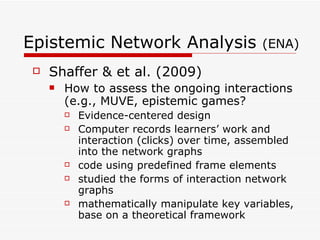
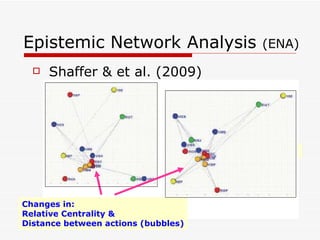
Epistemic Network Analysis  (ENA) Shaffer & et al. (2009)  How to assess the ongoing interactions (e.g., MUVE, epistemic games?  Evidence-centered design Computer records learners’ work and interaction (clicks) over time,  assembled into the network graphs  code using predefined frame elements  studied the forms of interaction network graphs  mathematically manipulate key variables, base on a theoretical framework
Epistemic Network Analysis  (ENA) Shaffer & et al. (2009)  How to assess the ongoing interactions (e.g., MUVE, epistemic games?  Evidence-centered design Computer records learners’ work and interaction (clicks) over time,  assembled into the network graphs  code using predefined frame elements  studied the forms of interaction network graphs  mathematically manipulate key variables, base on a theoretical framework  Ask expert; Get tools; Take note; Answer Q Skills, values, etc. Changes in: Relative Centrality & Distance between actions (bubbles)
Other Influential Factors Group size Learning styles Genders Technology
Other Influential Factors Group size Learning styles Genders Technology The individual interaction  decreased  when the group size  increased   20 is proper, 16 is the best, class size for an online college course taught by a single instructor (Orellana) 5 and above are very unstable and rather quickly divided into subgroups in freely forming groups (James)
Other Influential Factors Group size Learning styles Genders Technology Convergers (Kolb’s LSI) are most comfortable with the online network; Accomodators are less involved.  (Fahy) Independent learners are comfortable online (Gagne) W eb-based learning environment is reforming learning styles due to the limited interactive features provided by digital environment (Dede)
Other Influential Factors Group size Learning styles Genders Technology Women contributed much lesser times & shorter average words per contributions (Herring) Members of the minority gender shift their style in the direction of majority gender norms (Herring) Women preferred for epistolary interaction while men preferred expository interaction (Fahy)
Other Influential Factors Group size Learning styles Genders Technology Kozma & Clark debates Problems Not enough emphasis on pedagogy and instructional design (Wiske) less regard for learning theory and instructional theory (Clark) lacking of studies in situated use of media (Garrison) complexity of systems and interfaces (Fahy)
In this presentation,  What previous studies told us? Two groups of studies  Examining the outcomes and process of Interaction Examining the structure of the network Other factors: group size, technology… Implication for good practices How can interaction theories benefit practices? Learning achievement, choices, limitation…
From Theory to Practice Models as tools for assessing interactions  Address problems Identify opportunities for improvement inducing structured creativity (Fahy) Innovation as needed
One Interaction Fits All? Interactions Choices Not all interaction are equally useful to every individual (Chen & Willits; Fahy) The best interaction for a particular context is the interaction that has the right-mixed of interaction. (Anderson) Equivalence Theorem of Interaction: as long as one of the three forms of interaction is at a high level, the other two may be offered at minimal levels, or even eliminated (Anderson) Not all forms of interaction are equally valued by learners due to learner preferences. (Rhode)
The More Interaction The Better? Limits of interaction human’s capacity for processing information: 7 (+-) 2 to focus attention and avoid distraction: limit the items to 7 (+-)  2 Reducing working memory load (text + audio/video) instructor’s involvement in threaded discussions: 10% - 20% ( Clark, Nguyen, & Sweller;   Simonson et al.   )
Interaction = Achievement Interactions Really Improve  Learner Achievement? All three types of interaction  have positive impact on learner achievement Increasing the strength of interaction treatments affects achievement outcomes Learner-content interaction showed higher added values (Bernard et al.)
Conclusions Various approaches have been explored and a variety of options are available for designing interaction Need for taking a mixed method in studying interaction Call for research on interaction in action  (Simulasive learning/gaming)
Summaries Previous Studies Outcomes & Processes of Interaction Henri, Garrison, Gunawardena, Bales Structure of Interaction Network Levin, Fahy, Shaffer. Other Factors Group size, learning styles, genders, Tech.  Implication for Good Practices Limitation, choices, etc.
Main References Anderson, T. (2003b). Getting the Mix Right Again: An Updated and Theoretical Rationale for Interaction.  The International Review of Research in Open and Distance Learning ,  4 (2).  Bales, R. F. (1950). A Set of Categories for the Analysis of Small Group Interaction.  American Sociological Review ,  15 (2), 257-263.  Fahy, P., Crawford, G., & Ally, M. (2001b). Patterns of Interaction in a Computer Conference Trascript.  International Review of Research in Open and Distance Learning ,  2 (1).  Garrison, D. R. (1992). Critical Thinking and Self-Directed Learning in Adult Education: An Analysis of Responsibility and Control Issues.  Adult Education Quarterly ,  42 (3), 136-148.   Gunawardena, C. N., Lowe, C. A., & Anderson, T. (1998). Transcript Analysis of Computer-Mediated Conferences as a Tool for Testing Constructivist and Social-Constructivist Learning Theories. In  Proceeding of the Annual Conference on Distance Teaching & Learning (14th)  (pp. 139-145).
References Levin, J. A., Kim, H., & Riel, M. M. (1990).  Analyzing Instructional Interactions on Electronic Message Networks. In Harasim, L. (ed.),  Online Education, Perspectives on a New Environment  (pp. 185-213). New York, NY: Praeger Publishers.   Shaffer, D. W., Hatfield, D., Svaronvsky, G. N., Nash, P., Nulty, A., Bagley, E., et al. (2009). Epistemic Network Analysis: A Prototype for 21st Century Assessment of Learning.  International Journal of Learning and Media ,  1 (2).  Wagner, E. D. (1994). In Support of a Functional Definition of Interaction.  American Journal of Distance Education ,  8 (2), 6-29.   

Basic principles of interaction for learning in web based environment

  • 1.
    Understanding Interaction inWeb-Based Learning Su-Tuan Lulee EDDE 801 Professor: Dr. Patrick Fahy Feb. 2010
  • 2.
  • 3.
    Individual cognitive skillsare developed in a social context People must learn between people first, before they can learn inside themselves and allow the knowledge to become internalized. (Vygotsky) Why is interaction important?
  • 4.
    Anything new [shouldbe] based on what is already known. (Anderson) What have others done? What did they find? What do they recommend? What can I use? (Fahy)
  • 5.
    In this presentation, What previous studies told us? Two groups of studies Examining the outcomes and process of Interaction Examining the structure of the network Other factors: group size, technology… Implication for good practices How can interaction theories benefit practices? Learning achievement, choices, limitation…
  • 6.
    Previous Studies Twogroups of studies (different focuses): Outcomes and Process of Interaction 5-dimension (Henri) 5-stage Model (Garrison) & cognitive presence IA framework (Gunawardena & Anderson) IPA (Bales) Structure of Interaction Network Message Map (Levin et al.) TAT (Fahy) ENA (Shaffer et al.)
  • 7.
    Henri’s 5-Dimension (Henri,1991) For analyzing the quality of computer-mediated communication
  • 8.
    Henri’s 5-Dimension Socialdimension Interactive dimension Cognitive dimension Meta-cognitive dimension Participative dimension
  • 9.
    5-Stage Critical ThinkingModel (Garrison, 1991) For assessing how learners develop critical thinking
  • 10.
    5-Stage Critical ThinkingModel Problem identification Problem definition Problem exploration Problem evaluation Problem integration
  • 11.
    Interaction Analysis model(IA) (Gunawardena, Lowe & Anderson, 1997) For assessing social construction of knowledge (in less or no instructor presence)
  • 12.
    Interaction Analysis model(IA) Sharing/Comparing Dissonance Negotiation/Co-construction Testing Tentative Constructions Statement/Application
  • 13.
    Triggering event Exploration Integration Resolution Comparison Chart The other two models focus on cognitive and meta-cognitive dimensions Informal learning Formal learning Cognitive Presence
  • 14.
    Interaction Process Analysis (IPA) Bales: - Social psychologist IPA was for F2F C omplementary-paired categories
  • 15.
    Message Maps Levin, Kim, & Riel (1990) Illustrating the interrelationships among the messages submitted by participants
  • 16.
  • 17.
    Transcript Analysis Tools (TAT) Fahy, 2001 Examining the behaviors of participants Improve discriminant capability and reliability by identifying 5 types of sentences (different modes of interaction) A set of structural elements suggested by social network theory
  • 18.
    Transcript Analysis Tools (TAT) Fahy, 2001 Examining the behaviors of participants Improve discriminant capability and reliability by identifying 5 types of sentences (different modes of interaction) A set of structural elements suggested by social network theory
  • 19.
    Transcript Analysis Tools (TAT) Sentence Types Communication Behaviors Structure/Pattern Levels/Spread of “what are happening”
  • 20.
    Epistemic Network Analysis (ENA) Shaffer & et al. (2009) How to assess the ongoing interactions (e.g., MUVE, epistemic games? Evidence-centered design Computer records learners’ work and interaction (clicks) over time, assembled into the network graphs code using predefined frame elements studied the forms of interaction network graphs mathematically manipulate key variables, base on a theoretical framework
  • 21.
    Epistemic Network Analysis (ENA) Shaffer & et al. (2009) How to assess the ongoing interactions (e.g., MUVE, epistemic games? Evidence-centered design Computer records learners’ work and interaction (clicks) over time, assembled into the network graphs code using predefined frame elements studied the forms of interaction network graphs mathematically manipulate key variables, base on a theoretical framework Ask expert; Get tools; Take note; Answer Q Skills, values, etc. Changes in: Relative Centrality & Distance between actions (bubbles)
  • 22.
    Other Influential FactorsGroup size Learning styles Genders Technology
  • 23.
    Other Influential FactorsGroup size Learning styles Genders Technology The individual interaction decreased when the group size increased 20 is proper, 16 is the best, class size for an online college course taught by a single instructor (Orellana) 5 and above are very unstable and rather quickly divided into subgroups in freely forming groups (James)
  • 24.
    Other Influential FactorsGroup size Learning styles Genders Technology Convergers (Kolb’s LSI) are most comfortable with the online network; Accomodators are less involved. (Fahy) Independent learners are comfortable online (Gagne) W eb-based learning environment is reforming learning styles due to the limited interactive features provided by digital environment (Dede)
  • 25.
    Other Influential FactorsGroup size Learning styles Genders Technology Women contributed much lesser times & shorter average words per contributions (Herring) Members of the minority gender shift their style in the direction of majority gender norms (Herring) Women preferred for epistolary interaction while men preferred expository interaction (Fahy)
  • 26.
    Other Influential FactorsGroup size Learning styles Genders Technology Kozma & Clark debates Problems Not enough emphasis on pedagogy and instructional design (Wiske) less regard for learning theory and instructional theory (Clark) lacking of studies in situated use of media (Garrison) complexity of systems and interfaces (Fahy)
  • 27.
    In this presentation, What previous studies told us? Two groups of studies Examining the outcomes and process of Interaction Examining the structure of the network Other factors: group size, technology… Implication for good practices How can interaction theories benefit practices? Learning achievement, choices, limitation…
  • 28.
    From Theory toPractice Models as tools for assessing interactions Address problems Identify opportunities for improvement inducing structured creativity (Fahy) Innovation as needed
  • 29.
    One Interaction FitsAll? Interactions Choices Not all interaction are equally useful to every individual (Chen & Willits; Fahy) The best interaction for a particular context is the interaction that has the right-mixed of interaction. (Anderson) Equivalence Theorem of Interaction: as long as one of the three forms of interaction is at a high level, the other two may be offered at minimal levels, or even eliminated (Anderson) Not all forms of interaction are equally valued by learners due to learner preferences. (Rhode)
  • 30.
    The More InteractionThe Better? Limits of interaction human’s capacity for processing information: 7 (+-) 2 to focus attention and avoid distraction: limit the items to 7 (+-) 2 Reducing working memory load (text + audio/video) instructor’s involvement in threaded discussions: 10% - 20% ( Clark, Nguyen, & Sweller; Simonson et al. )
  • 31.
    Interaction = AchievementInteractions Really Improve Learner Achievement? All three types of interaction have positive impact on learner achievement Increasing the strength of interaction treatments affects achievement outcomes Learner-content interaction showed higher added values (Bernard et al.)
  • 32.
    Conclusions Various approacheshave been explored and a variety of options are available for designing interaction Need for taking a mixed method in studying interaction Call for research on interaction in action (Simulasive learning/gaming)
  • 33.
    Summaries Previous StudiesOutcomes & Processes of Interaction Henri, Garrison, Gunawardena, Bales Structure of Interaction Network Levin, Fahy, Shaffer. Other Factors Group size, learning styles, genders, Tech. Implication for Good Practices Limitation, choices, etc.
  • 34.
    Main References Anderson,T. (2003b). Getting the Mix Right Again: An Updated and Theoretical Rationale for Interaction. The International Review of Research in Open and Distance Learning , 4 (2). Bales, R. F. (1950). A Set of Categories for the Analysis of Small Group Interaction. American Sociological Review , 15 (2), 257-263. Fahy, P., Crawford, G., & Ally, M. (2001b). Patterns of Interaction in a Computer Conference Trascript. International Review of Research in Open and Distance Learning , 2 (1). Garrison, D. R. (1992). Critical Thinking and Self-Directed Learning in Adult Education: An Analysis of Responsibility and Control Issues. Adult Education Quarterly , 42 (3), 136-148.   Gunawardena, C. N., Lowe, C. A., & Anderson, T. (1998). Transcript Analysis of Computer-Mediated Conferences as a Tool for Testing Constructivist and Social-Constructivist Learning Theories. In Proceeding of the Annual Conference on Distance Teaching & Learning (14th) (pp. 139-145).
  • 35.
    References Levin, J.A., Kim, H., & Riel, M. M. (1990). Analyzing Instructional Interactions on Electronic Message Networks. In Harasim, L. (ed.), Online Education, Perspectives on a New Environment (pp. 185-213). New York, NY: Praeger Publishers.   Shaffer, D. W., Hatfield, D., Svaronvsky, G. N., Nash, P., Nulty, A., Bagley, E., et al. (2009). Epistemic Network Analysis: A Prototype for 21st Century Assessment of Learning. International Journal of Learning and Media , 1 (2). Wagner, E. D. (1994). In Support of a Functional Definition of Interaction. American Journal of Distance Education , 8 (2), 6-29.