I.P.S. “ F.S CABRINI “ TA
Anno scol. 2009/10
The purpose of this
educational activity ,based
on visual and operational
approaches, was to arouse
interest and curiosity in
the students to make
them understand how
nature should be lived,
studied and experienced
working on the field with
the tools and scientific
data (in the classroom and
laboratory and on the
textbook)
THEORY BOX
PROPERTIES OF WATER
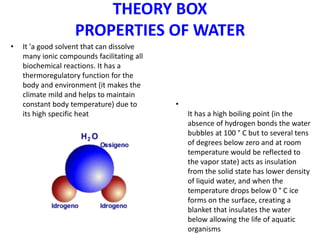
• It 'a good solvent that can dissolve
many ionic compounds facilitating all
biochemical reactions. It has a
thermoregulatory function for the
body and environment (it makes the
climate mild and helps to maintain
constant body temperature) due to
its high specific heat
•
It has a high boiling point (in the
absence of hydrogen bonds the water
bubbles at 100 ° C but to several tens
of degrees below zero and at room
temperature would be reflected to
the vapor state) acts as insulation
from the solid state has lower density
of liquid water, and when the
temperature drops below 0 ° C ice
forms on the surface, creating a
blanket that insulates the water
below allowing the life of aquatic
organisms
WATER LABORATORY 1
• To see if our students are able to
perceive a different taste
between tap water and bottled
water we gave them the
opportunity to show their skills
by organizing a tasting "in the
dark" of two brands of mineral
water and tap water.
• The pupils were invited to taste
water from anonymous bottles,
since the only tool for analyzing
was their taste. Students gave a
score (from 6 to 10) and the
results were tabulated in the
table
ALUNNI
15%
18%
67%
AMATA
ACQUA RUBINETTO
S.MARIA DEGLI ANGELI
Water:
How much water do you use in your home during a
year?
• A survey was made into
some classes to
calculate the average
consumption of water
for domestic use. For
the recording of data
the students have
completed a
questionairre to define
not only the type of
family and place of
residence but patterns
related to the use of
common household and
personal hygiene.
• The students have
monitored the
weekly consumption
of water through the
meter reading it
from the month of
November to
January.
In the first six
weeks the quantity
of water
consumption
related to the
normal needs of
family life was
recorded.
• In the next six weeks we
recorded the quantity of
water consumption related
to a more rational use, by
applying some rules set by
the handbook for saving
water.
Campione
Consumo idrico in
litri
25 % 65
15 % 123
35 % 172
15 % 287
10 % 571
Campione Risparmio idrico
14 % 12 %
21 % 37 %
29 % 44%
7% 56 %
7% 68 %
22 % 0 %
DATA
• We observed that the
average daily consumption
of 195 litres is very close to
the average daily
consumption of Italian
people which is of 180-190
litres.
• It was noticed that 15% had
a consumption equal to 1 /
3 of the national average,
50% is approaching 10%
while for some families
water consumption is
actually three times higher.
It is noted that 80% of
housewives saved an
average of 94 litres of water
each per day.
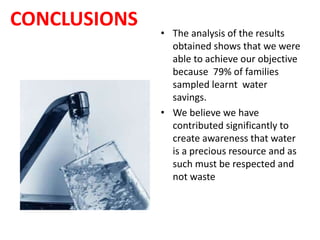
CONCLUSIONS
• The analysis of the results
obtained shows that we were
able to achieve our objective
because 79% of families
sampled learnt water
savings.
• We believe we have
contributed significantly to
create awareness that water
is a precious resource and as
such must be respected and
not waste
Is the water quality good all year around? Taste, smell, colour, micro-
organisms (bacteria, amoebas)?
Who guarantees us the quality of the water that comes into our homes?
• Drinkable water is regulated by
Presidential Decree n.236/1988
and legislative decrees n.31/2001
and n.27/2002, according to
European Directives, which have
imposed very strict requirements.
• The regulations governing
drinkable water impose limits on
the presence of toxic substances
;this is the case of two pollutants:
arsenic and manganese.
• Water from aqueducts has
already taken with the DL 31/01.
• “ No water, even if taken
directly from the source, may,
by law, be defined and be used
for drinking water supply, if it
contains bacteria, ammonia or
nitrogen compounds”.
• This is because in the seas,
lakes and rivers, considerable
quantities of waste are
downloaded every day : when
pollution reaches the
underground aquifer, it could
pollute the water we all drink.
If it is contaminated by
harmful substances must be
purified to become potable.
• . The purification is achieved
by holding the water in large
tanks so that the majority of
substances are deposited on
the bottom and then
appropriately filtered. After
these treatments, it should be
sterilized to kill germs that
may still be present.
• Especially chlorine is used for
this purpose
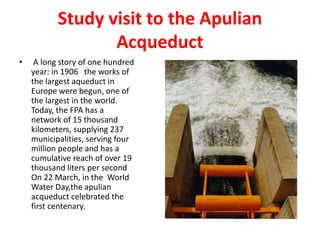
Study visit to the Apulian
Acqueduct
• A long story of one hundred
year: in 1906 the works of
the largest aqueduct in
Europe were begun, one of
the largest in the world.
Today, the FPA has a
network of 15 thousand
kilometers, supplying 237
municipalities, serving four
million people and has a
cumulative reach of over 19
thousand liters per second
On 22 March, in the World
Water Day,the apulian
acqueduct celebrated the
first centenary.
• Our water is supplied to us
dall'AQP. Every day,
chemical and bacteriological
laboratory staff by the
region Apulia, check the
purity of the water we
drink. They take samples
from the sources, wells,
from public fountains,
analyze them in the eight
central and peripheral
laboratories (Bari, Taranto,
Brindisi, Lecce, Foggia,
• Vieste, Matera and
Potenza), and those ones
present at the five plants
potable (Fortore, Sinn,
Pertusillo, Montalbano Ionic
and Camastra
• From the data supplied to
us by the laboratory in
Taranto of AQP we see that
our water is as good as
mineral water.
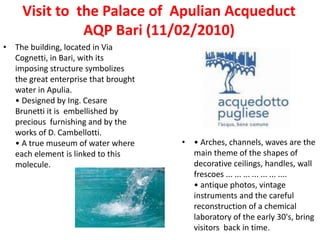
Visit to the Palace of Apulian Acqueduct
AQP Bari (11/02/2010)
• The building, located in Via
Cognetti, in Bari, with its
imposing structure symbolizes
the great enterprise that brought
water in Apulia.
• Designed by Ing. Cesare
Brunetti it is embellished by
precious furnishing and by the
works of D. Cambellotti.
• A true museum of water where
each element is linked to this
molecule.
• • Arches, channels, waves are the
main theme of the shapes of
decorative ceilings, handles, wall
frescoes ... ... ... ... ... ... ....
• antique photos, vintage
instruments and the careful
reconstruction of a chemical
laboratory of the early 30's, bring
visitors back in time.
Historical instruments
• A chemical laboratory of the early 30s has been rebuilt on
the ground floor with antique photos and old instruments
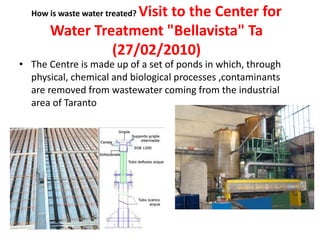
How is waste water treated? Visit to the Center for
Water Treatment "Bellavista" Ta
(27/02/2010)
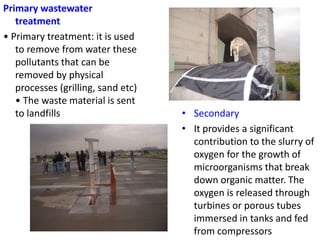
• The Centre is made up of a set of ponds in which, through
physical, chemical and biological processes ,contaminants
are removed from wastewater coming from the industrial
area of Taranto
Primary wastewater
treatment
• Primary treatment: it is used
to remove from water these
pollutants that can be
removed by physical
processes (grilling, sand etc)
• The waste material is sent
to landfills • Secondary
• It provides a significant
contribution to the slurry of
oxygen for the growth of
microorganisms that break
down organic matter. The
oxygen is released through
turbines or porous tubes
immersed in tanks and fed
from compressors
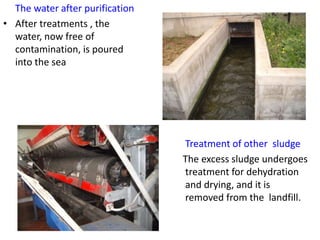
The water after purification
• After treatments , the
water, now free of
contamination, is poured
into the sea
Treatment of other sludge
The excess sludge undergoes
treatment for dehydration
and drying, and it is
removed from the landfill.
Affection on environment?
Chemical analysis of Mar piccolo waters
The training was born from the need to understand
the impact of waste waters coming from industries .So
we collected information from the "natural
environment" of our territory: the sea of Taranto
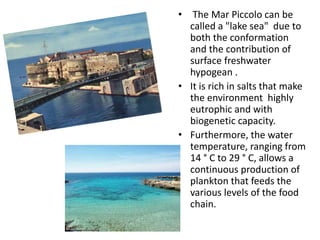
• The Mar Piccolo can be
called a "lake sea" due to
both the conformation
and the contribution of
surface freshwater
hypogean .
• It is rich in salts that make
the environment highly
eutrophic and with
biogenetic capacity.
• Furthermore, the water
temperature, ranging from
14 ° C to 29 ° C, allows a
continuous production of
plankton that feeds the
various levels of the food
chain.
The dominant feature of the Mar
Piccolo is the presence of several
systems for rearing mussels that
is favoured by environmental
conditions thanks to the
numerous underwater springs,
the” citri”,
The purpose of this teaching/
learning experience was to make
students understand how knowledge
of chemical - physical parameters
on the abiotic component of our
marine environment is crucial for
the understanding of the
distribution of the biotic
component.
The main physical-chemical
parameters of seawater
OBJECTIVES:
• Arouse the interest of
students.
• develop scientific skills
• develop skills of observation of
a phenomenon starting from
physical contact with their
environment
METHODOLOGY :
simple laboratory experiments
that can also be made in the
ordinary classrooms
CONTENTS:
Monitoring of environmental
parameters of water in Mar
Piccolo
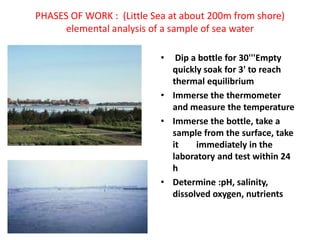
PHASES OF WORK : (Little Sea at about 200m from shore)
elemental analysis of a sample of sea water
• Dip a bottle for 30'''Empty
quickly soak for 3' to reach
thermal equilibrium
• Immerse the thermometer
and measure the temperature
• Immerse the bottle, take a
sample from the surface, take
it immediately in the
laboratory and test within 24
h
• Determine :pH, salinity,
dissolved oxygen, nutrients
METHODS USED
• Measuring pH with pH meter
whose principle is based on
determination of the fem
between a glass electrode and
a reference electrode
immersed in the solution to be
measured. You must read
three times and average
values.
• Measurement of salinity with
a conductivity: Conductivity
measures are specific to the
determination of ion in
solution, revealing the total
salinity. That parameter was
determined by immersing a
conductivity cell Conductivity
in the sample and reading the
values as mS / cm
Temperature measurements at sea, with the mercury
thermometer
RESULTS
 The measured
temperature is equal
to 18.8 ° C.
 The pH value was
equal to 8.13
 The value of
conductivity is 49.5
mS / cm dissolved
oxygen value is equal
to 4.7 mg / l value of
'N ammonia is <1 mg
/ l N.
 The value nitrous is
<0.5 mg / l of nitrate
value is <1 mg / l
Referente del progetto :
Ada . A. Iannotta
• M. Lo Savio,
• M. Schirano, ,
• A.Greco,
• F. La Neve,
• L.Laterza.
• L. Cusumano,,
• Classi:
• I A O.CB
• IB O.G.B
• II A O.CB
• II B O.C.B
• II B O.G.B
• II C EAT,
• III A O.C.B
• IV A T.C.B
• IV B T.C. B
• VD T.S.T
• III A O.C.A.

Teaching experimental sciences.water pptx

  • 1.
    I.P.S. “ F.SCABRINI “ TA Anno scol. 2009/10
  • 3.
    The purpose ofthis educational activity ,based on visual and operational approaches, was to arouse interest and curiosity in the students to make them understand how nature should be lived, studied and experienced working on the field with the tools and scientific data (in the classroom and laboratory and on the textbook)
  • 4.
    THEORY BOX PROPERTIES OFWATER • It 'a good solvent that can dissolve many ionic compounds facilitating all biochemical reactions. It has a thermoregulatory function for the body and environment (it makes the climate mild and helps to maintain constant body temperature) due to its high specific heat • It has a high boiling point (in the absence of hydrogen bonds the water bubbles at 100 ° C but to several tens of degrees below zero and at room temperature would be reflected to the vapor state) acts as insulation from the solid state has lower density of liquid water, and when the temperature drops below 0 ° C ice forms on the surface, creating a blanket that insulates the water below allowing the life of aquatic organisms
  • 5.
    WATER LABORATORY 1 •To see if our students are able to perceive a different taste between tap water and bottled water we gave them the opportunity to show their skills by organizing a tasting "in the dark" of two brands of mineral water and tap water. • The pupils were invited to taste water from anonymous bottles, since the only tool for analyzing was their taste. Students gave a score (from 6 to 10) and the results were tabulated in the table ALUNNI 15% 18% 67% AMATA ACQUA RUBINETTO S.MARIA DEGLI ANGELI
  • 6.
    Water: How much waterdo you use in your home during a year? • A survey was made into some classes to calculate the average consumption of water for domestic use. For the recording of data the students have completed a questionairre to define not only the type of family and place of residence but patterns related to the use of common household and personal hygiene.
  • 7.
    • The studentshave monitored the weekly consumption of water through the meter reading it from the month of November to January. In the first six weeks the quantity of water consumption related to the normal needs of family life was recorded.
  • 8.
    • In thenext six weeks we recorded the quantity of water consumption related to a more rational use, by applying some rules set by the handbook for saving water.
  • 10.
    Campione Consumo idrico in litri 25% 65 15 % 123 35 % 172 15 % 287 10 % 571 Campione Risparmio idrico 14 % 12 % 21 % 37 % 29 % 44% 7% 56 % 7% 68 % 22 % 0 %
  • 11.
    DATA • We observedthat the average daily consumption of 195 litres is very close to the average daily consumption of Italian people which is of 180-190 litres. • It was noticed that 15% had a consumption equal to 1 / 3 of the national average, 50% is approaching 10% while for some families water consumption is actually three times higher. It is noted that 80% of housewives saved an average of 94 litres of water each per day.
  • 12.
    CONCLUSIONS • The analysisof the results obtained shows that we were able to achieve our objective because 79% of families sampled learnt water savings. • We believe we have contributed significantly to create awareness that water is a precious resource and as such must be respected and not waste
  • 13.
    Is the waterquality good all year around? Taste, smell, colour, micro- organisms (bacteria, amoebas)? Who guarantees us the quality of the water that comes into our homes? • Drinkable water is regulated by Presidential Decree n.236/1988 and legislative decrees n.31/2001 and n.27/2002, according to European Directives, which have imposed very strict requirements. • The regulations governing drinkable water impose limits on the presence of toxic substances ;this is the case of two pollutants: arsenic and manganese. • Water from aqueducts has already taken with the DL 31/01.
  • 14.
    • “ Nowater, even if taken directly from the source, may, by law, be defined and be used for drinking water supply, if it contains bacteria, ammonia or nitrogen compounds”. • This is because in the seas, lakes and rivers, considerable quantities of waste are downloaded every day : when pollution reaches the underground aquifer, it could pollute the water we all drink. If it is contaminated by harmful substances must be purified to become potable. • . The purification is achieved by holding the water in large tanks so that the majority of substances are deposited on the bottom and then appropriately filtered. After these treatments, it should be sterilized to kill germs that may still be present. • Especially chlorine is used for this purpose
  • 15.
    Study visit tothe Apulian Acqueduct • A long story of one hundred year: in 1906 the works of the largest aqueduct in Europe were begun, one of the largest in the world. Today, the FPA has a network of 15 thousand kilometers, supplying 237 municipalities, serving four million people and has a cumulative reach of over 19 thousand liters per second On 22 March, in the World Water Day,the apulian acqueduct celebrated the first centenary.
  • 16.
    • Our wateris supplied to us dall'AQP. Every day, chemical and bacteriological laboratory staff by the region Apulia, check the purity of the water we drink. They take samples from the sources, wells, from public fountains, analyze them in the eight central and peripheral laboratories (Bari, Taranto, Brindisi, Lecce, Foggia, • Vieste, Matera and Potenza), and those ones present at the five plants potable (Fortore, Sinn, Pertusillo, Montalbano Ionic and Camastra • From the data supplied to us by the laboratory in Taranto of AQP we see that our water is as good as mineral water.
  • 17.
    Visit to thePalace of Apulian Acqueduct AQP Bari (11/02/2010) • The building, located in Via Cognetti, in Bari, with its imposing structure symbolizes the great enterprise that brought water in Apulia. • Designed by Ing. Cesare Brunetti it is embellished by precious furnishing and by the works of D. Cambellotti. • A true museum of water where each element is linked to this molecule. • • Arches, channels, waves are the main theme of the shapes of decorative ceilings, handles, wall frescoes ... ... ... ... ... ... .... • antique photos, vintage instruments and the careful reconstruction of a chemical laboratory of the early 30's, bring visitors back in time.
  • 18.
    Historical instruments • Achemical laboratory of the early 30s has been rebuilt on the ground floor with antique photos and old instruments
  • 19.
    How is wastewater treated? Visit to the Center for Water Treatment "Bellavista" Ta (27/02/2010) • The Centre is made up of a set of ponds in which, through physical, chemical and biological processes ,contaminants are removed from wastewater coming from the industrial area of Taranto
  • 20.
    Primary wastewater treatment • Primarytreatment: it is used to remove from water these pollutants that can be removed by physical processes (grilling, sand etc) • The waste material is sent to landfills • Secondary • It provides a significant contribution to the slurry of oxygen for the growth of microorganisms that break down organic matter. The oxygen is released through turbines or porous tubes immersed in tanks and fed from compressors
  • 21.
    The water afterpurification • After treatments , the water, now free of contamination, is poured into the sea Treatment of other sludge The excess sludge undergoes treatment for dehydration and drying, and it is removed from the landfill.
  • 22.
    Affection on environment? Chemicalanalysis of Mar piccolo waters The training was born from the need to understand the impact of waste waters coming from industries .So we collected information from the "natural environment" of our territory: the sea of Taranto
  • 23.
    • The MarPiccolo can be called a "lake sea" due to both the conformation and the contribution of surface freshwater hypogean . • It is rich in salts that make the environment highly eutrophic and with biogenetic capacity. • Furthermore, the water temperature, ranging from 14 ° C to 29 ° C, allows a continuous production of plankton that feeds the various levels of the food chain.
  • 24.
    The dominant featureof the Mar Piccolo is the presence of several systems for rearing mussels that is favoured by environmental conditions thanks to the numerous underwater springs, the” citri”, The purpose of this teaching/ learning experience was to make students understand how knowledge of chemical - physical parameters on the abiotic component of our marine environment is crucial for the understanding of the distribution of the biotic component.
  • 25.
    The main physical-chemical parametersof seawater OBJECTIVES: • Arouse the interest of students. • develop scientific skills • develop skills of observation of a phenomenon starting from physical contact with their environment METHODOLOGY : simple laboratory experiments that can also be made in the ordinary classrooms CONTENTS: Monitoring of environmental parameters of water in Mar Piccolo
  • 26.
    PHASES OF WORK: (Little Sea at about 200m from shore) elemental analysis of a sample of sea water • Dip a bottle for 30'''Empty quickly soak for 3' to reach thermal equilibrium • Immerse the thermometer and measure the temperature • Immerse the bottle, take a sample from the surface, take it immediately in the laboratory and test within 24 h • Determine :pH, salinity, dissolved oxygen, nutrients
  • 27.
    METHODS USED • MeasuringpH with pH meter whose principle is based on determination of the fem between a glass electrode and a reference electrode immersed in the solution to be measured. You must read three times and average values. • Measurement of salinity with a conductivity: Conductivity measures are specific to the determination of ion in solution, revealing the total salinity. That parameter was determined by immersing a conductivity cell Conductivity in the sample and reading the values as mS / cm Temperature measurements at sea, with the mercury thermometer
  • 30.
    RESULTS  The measured temperatureis equal to 18.8 ° C.  The pH value was equal to 8.13  The value of conductivity is 49.5 mS / cm dissolved oxygen value is equal to 4.7 mg / l value of 'N ammonia is <1 mg / l N.  The value nitrous is <0.5 mg / l of nitrate value is <1 mg / l
  • 31.
    Referente del progetto: Ada . A. Iannotta • M. Lo Savio, • M. Schirano, , • A.Greco, • F. La Neve, • L.Laterza. • L. Cusumano,, • Classi: • I A O.CB • IB O.G.B • II A O.CB • II B O.C.B • II B O.G.B • II C EAT, • III A O.C.B • IV A T.C.B • IV B T.C. B • VD T.S.T • III A O.C.A.