THE WATER
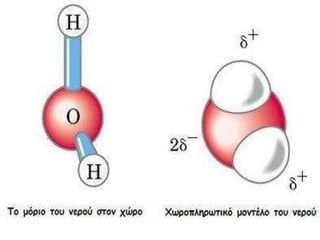
THE DEFINITION Water is the most widespread  chemical compound which is necessary for all known forms in our planet. The molecule of water is consists of two  atoms  of hydrogen and one  atom  of oxygen , the chemical substance  of water's molecule is proved by the  french chemist  Antoine  L a voisier .
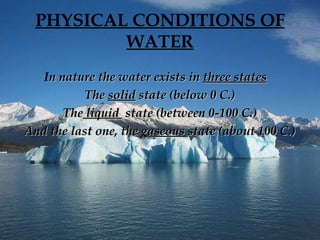
PHYSICAL CONDITIONS OF WATER I n nature the water exists in  three states   The  solid  state (below 0 C.) The  liquid  state (between 0-100 C.) And the last one, the  gaseous  state (about 100 C.)
THE NAME The water in Greek “nero” got its name  from the  byzantine phrase “νεαρό ύδωρ” “nearo ydor”(= young water) which means flowing water. This phrase  comes from the ancient greek phrase “ νήρον ύδωρ” “nyron ydor”
 
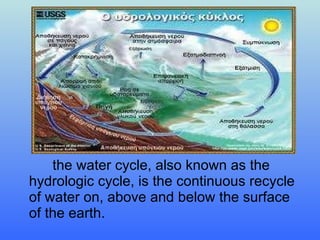
the water cycle, also known as the hydrologic cycle, is the continuous   recycle of water on, above and below the surface of the earth.
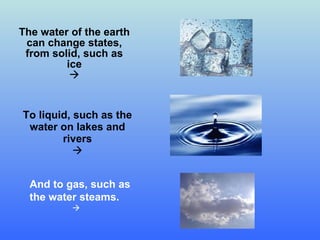
The water of the earth can change states ,  from solid, such as ice  To liquid, such as the water on lakes and rivers  And to gas, such as the water steams.   
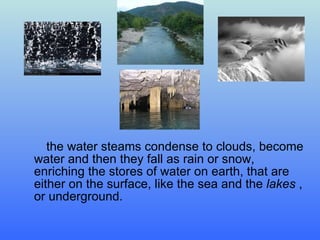
the water steams condense to clouds ,  become water and then they fall as rain or snow ,  enriching the stores of water on earth ,  that are either   on the surface ,  like   the sea   and   the   lakes   ,  or underground.
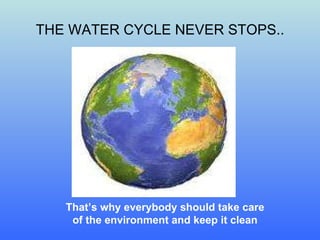
THE WATER CYCLE NEVER STOPS.. That’s why everybody should   take care of the environment and keep it clean
Water purification
The water, which is received with pipes from the dams( particularly from the one in Marathon) is dirty as it contains pieces of solid debrids ( like mud, brunches, dust e.t.c.) which are carried away while passing.  Also, micro-organisms such as bacteria, which can’t be traced with a bare eye are transferred through water. That’s why, the water must go through some treatment in order to become drinkable.
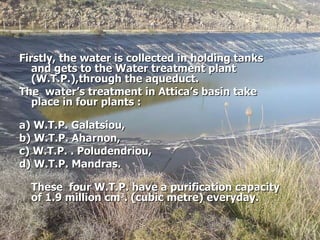
Firstly, the water is collected in holding tanks  and gets to the Water treatment plant (W.T.P.),through the aqueduct.  The  water’s treatment in Attica’s basin take place in four plants : a)  W.T.P.  Galatsiou, b)  W.T.P.  Aharnon, c)  W.T.P.  . Poludendriou, d)  W.T.P.  Mandras. These  four  W.T.P. have a purification capacity of 1.9 million cm 3 . (cubic metre) everyday.
The steps for water purification are: 1.  Pre-chlorination   in order to kill bacteria and  algae and arresting any biological growth  2.  Flocculation   a process which clarifies the water by adding  aluminium  sulfate  in order to  remove any turbidity or colour so that the water is clear and colourless .
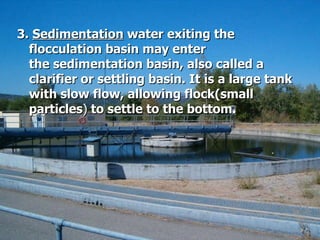
3.  Sedimentation  water exiting the flocculation basin may enter the sedimentation basin, also called a clarifier or settling basin. It is a large tank with slow flow, allowing flock(small particles )  to settle to the bottom.
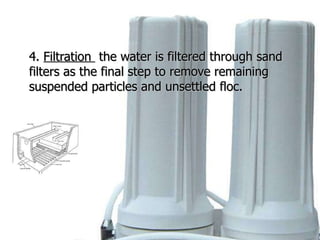
4.  Filtration    the water is filtered through sand filters as the final step to remove remaining suspended particles and unsettled floc.
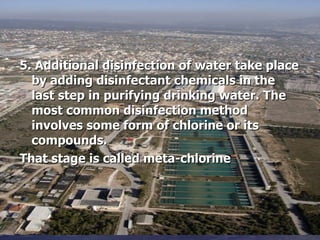
5. Additional disinfection of water take place  by adding disinfectant chemicals in the last step in purifying drinking water. The most common disinfection method involves some form of chlorine or its compounds.  That stage is called meta-chlorine 
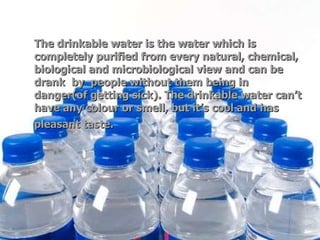
The drinkable water is the water which is completely purified from every natural, chemical, biological and microbiological view and can be drank  by  people without them being in danger(of getting sick). The drinkable water can’t have any colour or smell, but it’s cool and has pleasant taste.
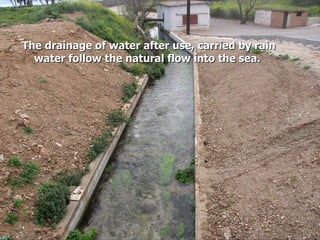
The drainage of water after use, carried by rain water follow the natural flow into the sea.
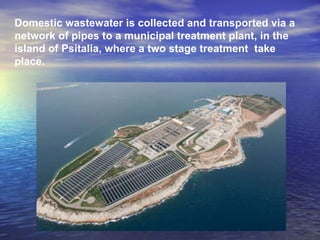
Domestic wastewater is collected and transported via a network of pipes to a municipal treatment plant, in the island of Psitalia, where a two stage treatment  take place.

About water

  • 1.
  • 2.
    THE DEFINITION Wateris the most widespread chemical compound which is necessary for all known forms in our planet. The molecule of water is consists of two atoms of hydrogen and one atom of oxygen , the chemical substance of water's molecule is proved by the french chemist Antoine L a voisier .
  • 3.
    PHYSICAL CONDITIONS OFWATER I n nature the water exists in three states The solid state (below 0 C.) The liquid state (between 0-100 C.) And the last one, the gaseous state (about 100 C.)
  • 4.
    THE NAME Thewater in Greek “nero” got its name from the byzantine phrase “νεαρό ύδωρ” “nearo ydor”(= young water) which means flowing water. This phrase comes from the ancient greek phrase “ νήρον ύδωρ” “nyron ydor”
  • 5.
  • 6.
    the water cycle,also known as the hydrologic cycle, is the continuous recycle of water on, above and below the surface of the earth.
  • 7.
    The water ofthe earth can change states , from solid, such as ice  To liquid, such as the water on lakes and rivers  And to gas, such as the water steams. 
  • 8.
    the water steamscondense to clouds , become water and then they fall as rain or snow , enriching the stores of water on earth , that are either on the surface , like the sea and the lakes , or underground.
  • 9.
    THE WATER CYCLENEVER STOPS.. That’s why everybody should take care of the environment and keep it clean
  • 10.
  • 11.
    The water, whichis received with pipes from the dams( particularly from the one in Marathon) is dirty as it contains pieces of solid debrids ( like mud, brunches, dust e.t.c.) which are carried away while passing. Also, micro-organisms such as bacteria, which can’t be traced with a bare eye are transferred through water. That’s why, the water must go through some treatment in order to become drinkable.
  • 12.
    Firstly, the wateris collected in holding tanks and gets to the Water treatment plant (W.T.P.),through the aqueduct. The water’s treatment in Attica’s basin take place in four plants : a) W.T.P. Galatsiou, b) W.T.P. Aharnon, c) W.T.P. . Poludendriou, d) W.T.P. Mandras. These four W.T.P. have a purification capacity of 1.9 million cm 3 . (cubic metre) everyday.
  • 13.
    The steps forwater purification are: 1. Pre-chlorination   in order to kill bacteria and algae and arresting any biological growth 2. Flocculation   a process which clarifies the water by adding aluminium sulfate in order to remove any turbidity or colour so that the water is clear and colourless .
  • 14.
    3. Sedimentation water exiting the flocculation basin may enter the sedimentation basin, also called a clarifier or settling basin. It is a large tank with slow flow, allowing flock(small particles ) to settle to the bottom.
  • 15.
    4. Filtration   the water is filtered through sand filters as the final step to remove remaining suspended particles and unsettled floc.
  • 16.
    5. Additional disinfectionof water take place by adding disinfectant chemicals in the last step in purifying drinking water. The most common disinfection method involves some form of chlorine or its compounds. That stage is called meta-chlorine 
  • 17.
    The drinkable wateris the water which is completely purified from every natural, chemical, biological and microbiological view and can be drank by people without them being in danger(of getting sick). The drinkable water can’t have any colour or smell, but it’s cool and has pleasant taste.
  • 18.
  • 19.
    Domestic wastewater is collectedand transported via a network of pipes to a municipal treatment plant, in the island of Psitalia, where a two stage treatment take place.