*http://www.marsol.eu
Technical Solutions
and Environmental
issues in MAR
Dr. Jon San Sebastián Sauto
(jsss@tragsa.es)
Index
1.INTRODUCTION
2.ENVIRONMENTAL IMPACTS
3.MAR DEVICES IN SANTIUSTE
4.MULTIFACTOR MAR SERVICES
5. CONCLUSIONS
Grupo Tragsa
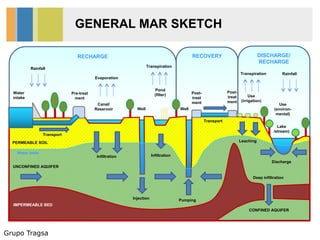
GENERAL MAR SKETCH
DISCHARGE/
RECHARGE
RECHARGE RECOVERY
Pre-treat
ment
Transport
Canal/
Reservoir Well
Pond
(filter) Post-
treat
ment
Transport
Use
(irrigation)
Infiltration
Injection
Discharge
Pumping
UNCONFINED AQUIFER
CONFINED AQUIFER
PERMEABLE SOIL
IMPERMEABLE BED
Leaching
Use
(environ-
mental)
Water
intake
Transpiration
Transpiration
Evaporation
Rainfall
Rainfall
Infiltration
Water table
Well
Deep infiltration
Lake
/stream)
Post-
treat
ment
Grupo Tragsa
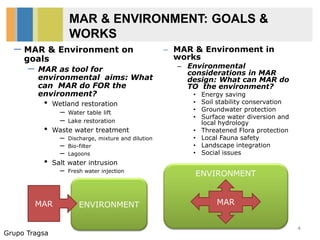
MAR & ENVIRONMENT: GOALS &
WORKS
– MAR & Environment in
works
– Environmental
considerations in MAR
design: What can MAR do
TO the environment?
• Energy saving
• Soil stability conservation
• Groundwater protection
• Surface water diversion and
local hydrology
• Threatened Flora protection
• Local Fauna safety
• Landscape integration
• Social issues
4
ENVIRONMENTMAR
ENVIRONMENT
MAR
– MAR & Environment on
goals
– MAR as tool for
environmental aims: What
can MAR do FOR the
environment?
• Wetland restoration
– Water table lift
– Lake restoration
• Waste water treatment
– Discharge, mixture and dilution
– Bio-filter
– Lagoons
• Salt water intrusion
– Fresh water injection
Grupo Tragsa
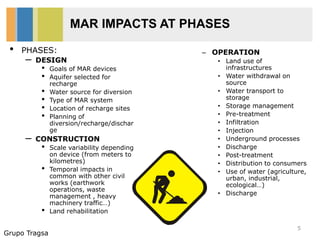
MAR IMPACTS AT PHASES
• PHASES:
– DESIGN
• Goals of MAR devices
• Aquifer selected for
recharge
• Water source for diversion
• Type of MAR system
• Location of recharge sites
• Planning of
diversion/recharge/dischar
ge
– CONSTRUCTION
• Scale variability depending
on device (from meters to
kilometres)
• Temporal impacts in
common with other civil
works (earthwork
operations, waste
management , heavy
machinery traffic…)
• Land rehabilitation
– OPERATION
• Land use of
infrastructures
• Water withdrawal on
source
• Water transport to
storage
• Storage management
• Pre-treatment
• Infiltration
• Injection
• Underground processes
• Discharge
• Post-treatment
• Distribution to consumers
• Use of water (agriculture,
urban, industrial,
ecological…)
• Discharge
5
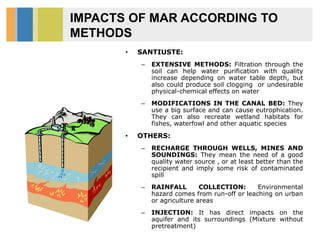
IMPACTS OF MAR ACCORDING TO
METHODS
• SANTIUSTE:
– EXTENSIVE METHODS: Filtration through the
soil can help water purification with quality
increase depending on water table depth, but
also could produce soil clogging or undesirable
physical-chemical effects on water
– MODIFICATIONS IN THE CANAL BED: They
use a big surface and can cause eutrophication.
They can also recreate wetland habitats for
fishes, waterfowl and other aquatic species
• OTHERS:
– RECHARGE THROUGH WELLS, MINES AND
SOUNDINGS: They mean the need of a good
quality water source , or at least better than the
recipient and imply some risk of contaminated
spill
– RAINFALL COLLECTION: Environmental
hazard comes from run-off or leaching on urban
or agriculture areas
– INJECTION: It has direct impacts on the
aquifer and its surroundings (Mixture without
pretreatment)
IMPACTS OF MAR ACCORDING TO
FACTORS
• ENVIRONMENTAL FACTORS:
– AIR
– GROUNDWATER
– SURFACE WATER
– SOIL
– FLORA
– FAUNA
– ECOLOGY
– LANDSCAPE
– HERITAGE
– SOCIO-ECONOMY
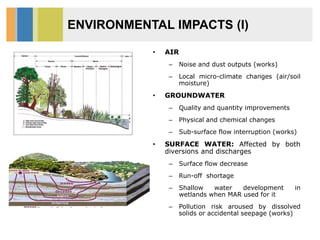
ENVIRONMENTAL IMPACTS (I)
• AIR
– Noise and dust outputs (works)
– Local micro-climate changes (air/soil
moisture)
• GROUNDWATER
– Quality and quantity improvements
– Physical and chemical changes
– Sub-surface flow interruption (works)
• SURFACE WATER: Affected by both
diversions and discharges
– Surface flow decrease
– Run-off shortage
– Shallow water development in
wetlands when MAR used for it
– Pollution risk aroused by dissolved
solids or accidental seepage (works)
ENVIRONMENTAL IMPACTS (II)
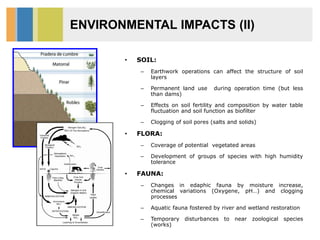
• SOIL:
– Earthwork operations can affect the structure of soil
layers
– Permanent land use during operation time (but less
than dams)
– Effects on soil fertility and composition by water table
fluctuation and soil function as biofilter
– Clogging of soil pores (salts and solids)
• FLORA:
– Coverage of potential vegetated areas
– Development of groups of species with high humidity
tolerance
• FAUNA:
– Changes in edaphic fauna by moisture increase,
chemical variations (Oxygene, pH…) and clogging
processes
– Aquatic fauna fostered by river and wetland restoration
– Temporary disturbances to near zoological species
(works)
ENVIRONMENTAL IMPACTS (III)
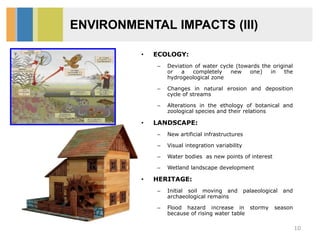
• ECOLOGY:
– Deviation of water cycle (towards the original
or a completely new one) in the
hydrogeological zone
– Changes in natural erosion and deposition
cycle of streams
– Alterations in the ethology of botanical and
zoological species and their relations
• LANDSCAPE:
– New artificial infrastructures
– Visual integration variability
– Water bodies as new points of interest
– Wetland landscape development
• HERITAGE:
– Initial soil moving and palaeological and
archaeological remains
– Flood hazard increase in stormy season
because of rising water table
10
ENVIRONMENTAL IMPACTS (and IV)
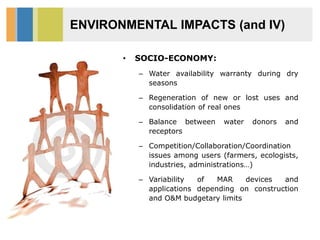
• SOCIO-ECONOMY:
– Water availability warranty during dry
seasons
– Regeneration of new or lost uses and
consolidation of real ones
– Balance between water donors and
receptors
– Competition/Collaboration/Coordination
issues among users (farmers, ecologists,
industries, administrations…)
– Variability of MAR devices and
applications depending on construction
and O&M budgetary limits
Grupo Tragsa
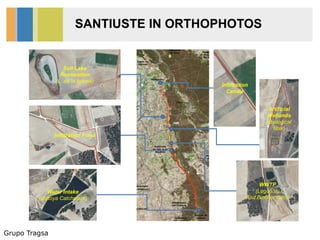
SANTIUSTE IN ORTHOPHOTOS
Salt Lake
Restoration
(L. de la Iglesia)
Water Intake
(Voltoya Catchment)
Infiltration Pond
Artificial
Wetlands
(Biological
filter)
WWTP
(Lagoons)
And Biofilter canal
Infiltration
Canals
Grupo Tragsa
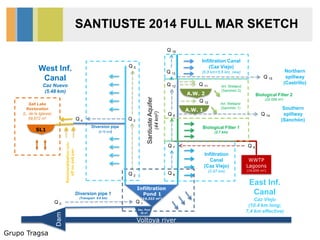
SANTIUSTE 2014 FULL MAR SKETCH
Q 11
WWTP
Lagoons
(14,659 m2)
A.W. 1
A.W. 2
Q 1
Q 6
Q 7
Q 0
Q 2
Q 8
Q 12
Q 5
Infiltration
Pond 1
(14,322 m2)
Infiltration
Canal
(Caz Viejo)
(0.87 km)
West Inf.
Canal
Caz Nuevo
(5.48 km)
. 2
SantiusteAquifer
(44km2)
Diversion pipe 1
(Transport 9.6 km)
Art. Wetland
(Sanchón 2)
Art. Wetland
(Sanchón 1)
Q 9
SL1
Salt Lake
Restoration
(L. de la Iglesia)
59,872 m2
Q 3
Voltoya river
Dam
Dec. Pool
36 m2
Q 4
Q 10
Remineralisationrun-
offonsaltpan
Q 14
Southern
spillway
(Sanchón)
East Inf.
Canal
Caz Viejo
(10.4 km long;
7,4 km effective)
Q 13
Infiltration Canal
(Caz Viejo)
(6.8 km+5.6 km, new)
Q 15
Northern
spillway
(Castrillo)
Q 16
Biological Filter 2
(25.556 m2)
Biological Filter 1
(2.7 km)
Diversion pipe
(0.75 km)
Grupo Tragsa
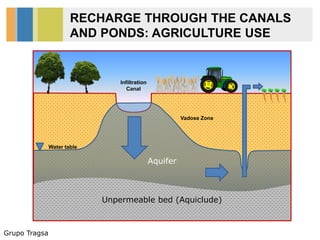
RECHARGE THROUGH THE CANALS
AND PONDS: AGRICULTURE USE
Aquifer
Unpermeable bed (Aquiclude)
Water table
Vadose Zone
Infiltration
Canal
Grupo Tragsa
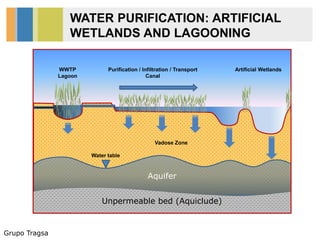
WATER PURIFICATION: ARTIFICIAL
WETLANDS AND LAGOONING
Aquifer
Unpermeable bed (Aquiclude)
Water table
Vadose Zone
Purification / Infiltration / Transport
Canal
Artificial WetlandsWWTP
Lagoon
Grupo Tragsa
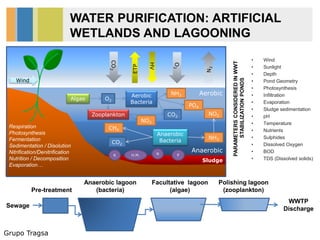
WATER PURIFICATION: ARTIFICIAL
WETLANDS AND LAGOONING
PARAMETERSCONSIDEREDINWWT
STABILIZATIONPONDS
• Wind
• Sunlight
• Depth
• Pond Geometry
• Photosynthesis
• Infiltration
• Evaporation
• Sludge sedimentation
• pH
• Temperature
• Nutrients
• Sulphides
• Dissolved Oxygen
• BOD
• TDS (Dissolved solids)
Pre-treatment
Anaerobic lagoon
(bacteria)
Facultative lagoon
(algae)
Polishing lagoon
(zooplankton)
WWTP
DischargeSewage
O2
HO2
Aerobic
Anaerobic
Sludge
CO2
PO4
NH3
Algae
Aerobic
Bacteria
Anaerobic
Bacteria
Wind
HV
O2
ETP
N PK H.M.
NO3
Zooplankton
CO2
CH4
NH3
CO2
O2
N2
Respiration
Photosynthesis
Fermentation
Sedimentation / Disolution
Nitrification/Denitrification
Nutrition / Decomposition
Evaporation…
NO2
Grupo Tragsa
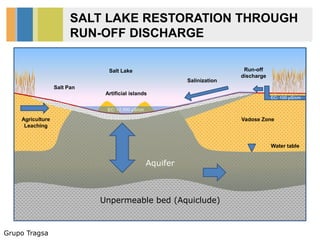
SALT LAKE RESTORATION THROUGH
RUN-OFF DISCHARGE
Aquifer
Unpermeable bed (Aquiclude)
Water table
Vadose Zone
Salt Lake
Salt Pan
Run-off
discharge
Artificial islands
Agriculture
Leaching
Salinization
EC: 100 μS/cm
EC: >2,000 μS/cm
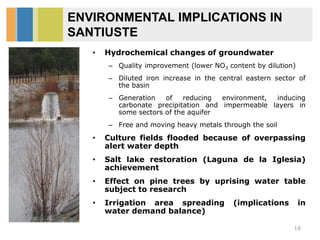
ENVIRONMENTAL IMPLICATIONS IN
SANTIUSTE
• Hydrochemical changes of groundwater
– Quality improvement (lower NO3 content by dilution)
– Diluted iron increase in the central eastern sector of
the basin
– Generation of reducing environment, inducing
carbonate precipitation and impermeable layers in
some sectors of the aquifer
– Free and moving heavy metals through the soil
• Culture fields flooded because of overpassing
alert water depth
• Salt lake restoration (Laguna de la Iglesia)
achievement
• Effect on pine trees by uprising water table
subject to research
• Irrigation area spreading (implications in
water demand balance)
18
CONCLUSIONS
• MAR can be focussed 2
ways:
– As an environmental goal
through recharge itself
– As an environmental concern
in MAR design
• MAR in Santiuste is
playing different
environmental roles
• Monitoring must be a
mandatory tool to check
right performance
Grupo Tragsa
Thank you
Gomezserracín, 2015 March 11th

Low impact MAR activities and benchmarking - JSSS

  • 1.
    *http://www.marsol.eu Technical Solutions and Environmental issuesin MAR Dr. Jon San Sebastián Sauto (jsss@tragsa.es)
  • 2.
    Index 1.INTRODUCTION 2.ENVIRONMENTAL IMPACTS 3.MAR DEVICESIN SANTIUSTE 4.MULTIFACTOR MAR SERVICES 5. CONCLUSIONS
  • 3.
    Grupo Tragsa GENERAL MARSKETCH DISCHARGE/ RECHARGE RECHARGE RECOVERY Pre-treat ment Transport Canal/ Reservoir Well Pond (filter) Post- treat ment Transport Use (irrigation) Infiltration Injection Discharge Pumping UNCONFINED AQUIFER CONFINED AQUIFER PERMEABLE SOIL IMPERMEABLE BED Leaching Use (environ- mental) Water intake Transpiration Transpiration Evaporation Rainfall Rainfall Infiltration Water table Well Deep infiltration Lake /stream) Post- treat ment
  • 4.
    Grupo Tragsa MAR &ENVIRONMENT: GOALS & WORKS – MAR & Environment in works – Environmental considerations in MAR design: What can MAR do TO the environment? • Energy saving • Soil stability conservation • Groundwater protection • Surface water diversion and local hydrology • Threatened Flora protection • Local Fauna safety • Landscape integration • Social issues 4 ENVIRONMENTMAR ENVIRONMENT MAR – MAR & Environment on goals – MAR as tool for environmental aims: What can MAR do FOR the environment? • Wetland restoration – Water table lift – Lake restoration • Waste water treatment – Discharge, mixture and dilution – Bio-filter – Lagoons • Salt water intrusion – Fresh water injection
  • 5.
    Grupo Tragsa MAR IMPACTSAT PHASES • PHASES: – DESIGN • Goals of MAR devices • Aquifer selected for recharge • Water source for diversion • Type of MAR system • Location of recharge sites • Planning of diversion/recharge/dischar ge – CONSTRUCTION • Scale variability depending on device (from meters to kilometres) • Temporal impacts in common with other civil works (earthwork operations, waste management , heavy machinery traffic…) • Land rehabilitation – OPERATION • Land use of infrastructures • Water withdrawal on source • Water transport to storage • Storage management • Pre-treatment • Infiltration • Injection • Underground processes • Discharge • Post-treatment • Distribution to consumers • Use of water (agriculture, urban, industrial, ecological…) • Discharge 5
  • 6.
    IMPACTS OF MARACCORDING TO METHODS • SANTIUSTE: – EXTENSIVE METHODS: Filtration through the soil can help water purification with quality increase depending on water table depth, but also could produce soil clogging or undesirable physical-chemical effects on water – MODIFICATIONS IN THE CANAL BED: They use a big surface and can cause eutrophication. They can also recreate wetland habitats for fishes, waterfowl and other aquatic species • OTHERS: – RECHARGE THROUGH WELLS, MINES AND SOUNDINGS: They mean the need of a good quality water source , or at least better than the recipient and imply some risk of contaminated spill – RAINFALL COLLECTION: Environmental hazard comes from run-off or leaching on urban or agriculture areas – INJECTION: It has direct impacts on the aquifer and its surroundings (Mixture without pretreatment)
  • 7.
    IMPACTS OF MARACCORDING TO FACTORS • ENVIRONMENTAL FACTORS: – AIR – GROUNDWATER – SURFACE WATER – SOIL – FLORA – FAUNA – ECOLOGY – LANDSCAPE – HERITAGE – SOCIO-ECONOMY
  • 8.
    ENVIRONMENTAL IMPACTS (I) •AIR – Noise and dust outputs (works) – Local micro-climate changes (air/soil moisture) • GROUNDWATER – Quality and quantity improvements – Physical and chemical changes – Sub-surface flow interruption (works) • SURFACE WATER: Affected by both diversions and discharges – Surface flow decrease – Run-off shortage – Shallow water development in wetlands when MAR used for it – Pollution risk aroused by dissolved solids or accidental seepage (works)
  • 9.
    ENVIRONMENTAL IMPACTS (II) •SOIL: – Earthwork operations can affect the structure of soil layers – Permanent land use during operation time (but less than dams) – Effects on soil fertility and composition by water table fluctuation and soil function as biofilter – Clogging of soil pores (salts and solids) • FLORA: – Coverage of potential vegetated areas – Development of groups of species with high humidity tolerance • FAUNA: – Changes in edaphic fauna by moisture increase, chemical variations (Oxygene, pH…) and clogging processes – Aquatic fauna fostered by river and wetland restoration – Temporary disturbances to near zoological species (works)
  • 10.
    ENVIRONMENTAL IMPACTS (III) •ECOLOGY: – Deviation of water cycle (towards the original or a completely new one) in the hydrogeological zone – Changes in natural erosion and deposition cycle of streams – Alterations in the ethology of botanical and zoological species and their relations • LANDSCAPE: – New artificial infrastructures – Visual integration variability – Water bodies as new points of interest – Wetland landscape development • HERITAGE: – Initial soil moving and palaeological and archaeological remains – Flood hazard increase in stormy season because of rising water table 10
  • 11.
    ENVIRONMENTAL IMPACTS (andIV) • SOCIO-ECONOMY: – Water availability warranty during dry seasons – Regeneration of new or lost uses and consolidation of real ones – Balance between water donors and receptors – Competition/Collaboration/Coordination issues among users (farmers, ecologists, industries, administrations…) – Variability of MAR devices and applications depending on construction and O&M budgetary limits
  • 12.
    Grupo Tragsa SANTIUSTE INORTHOPHOTOS Salt Lake Restoration (L. de la Iglesia) Water Intake (Voltoya Catchment) Infiltration Pond Artificial Wetlands (Biological filter) WWTP (Lagoons) And Biofilter canal Infiltration Canals
  • 13.
    Grupo Tragsa SANTIUSTE 2014FULL MAR SKETCH Q 11 WWTP Lagoons (14,659 m2) A.W. 1 A.W. 2 Q 1 Q 6 Q 7 Q 0 Q 2 Q 8 Q 12 Q 5 Infiltration Pond 1 (14,322 m2) Infiltration Canal (Caz Viejo) (0.87 km) West Inf. Canal Caz Nuevo (5.48 km) . 2 SantiusteAquifer (44km2) Diversion pipe 1 (Transport 9.6 km) Art. Wetland (Sanchón 2) Art. Wetland (Sanchón 1) Q 9 SL1 Salt Lake Restoration (L. de la Iglesia) 59,872 m2 Q 3 Voltoya river Dam Dec. Pool 36 m2 Q 4 Q 10 Remineralisationrun- offonsaltpan Q 14 Southern spillway (Sanchón) East Inf. Canal Caz Viejo (10.4 km long; 7,4 km effective) Q 13 Infiltration Canal (Caz Viejo) (6.8 km+5.6 km, new) Q 15 Northern spillway (Castrillo) Q 16 Biological Filter 2 (25.556 m2) Biological Filter 1 (2.7 km) Diversion pipe (0.75 km)
  • 14.
    Grupo Tragsa RECHARGE THROUGHTHE CANALS AND PONDS: AGRICULTURE USE Aquifer Unpermeable bed (Aquiclude) Water table Vadose Zone Infiltration Canal
  • 15.
    Grupo Tragsa WATER PURIFICATION:ARTIFICIAL WETLANDS AND LAGOONING Aquifer Unpermeable bed (Aquiclude) Water table Vadose Zone Purification / Infiltration / Transport Canal Artificial WetlandsWWTP Lagoon
  • 16.
    Grupo Tragsa WATER PURIFICATION:ARTIFICIAL WETLANDS AND LAGOONING PARAMETERSCONSIDEREDINWWT STABILIZATIONPONDS • Wind • Sunlight • Depth • Pond Geometry • Photosynthesis • Infiltration • Evaporation • Sludge sedimentation • pH • Temperature • Nutrients • Sulphides • Dissolved Oxygen • BOD • TDS (Dissolved solids) Pre-treatment Anaerobic lagoon (bacteria) Facultative lagoon (algae) Polishing lagoon (zooplankton) WWTP DischargeSewage O2 HO2 Aerobic Anaerobic Sludge CO2 PO4 NH3 Algae Aerobic Bacteria Anaerobic Bacteria Wind HV O2 ETP N PK H.M. NO3 Zooplankton CO2 CH4 NH3 CO2 O2 N2 Respiration Photosynthesis Fermentation Sedimentation / Disolution Nitrification/Denitrification Nutrition / Decomposition Evaporation… NO2
  • 17.
    Grupo Tragsa SALT LAKERESTORATION THROUGH RUN-OFF DISCHARGE Aquifer Unpermeable bed (Aquiclude) Water table Vadose Zone Salt Lake Salt Pan Run-off discharge Artificial islands Agriculture Leaching Salinization EC: 100 μS/cm EC: >2,000 μS/cm
  • 18.
    ENVIRONMENTAL IMPLICATIONS IN SANTIUSTE •Hydrochemical changes of groundwater – Quality improvement (lower NO3 content by dilution) – Diluted iron increase in the central eastern sector of the basin – Generation of reducing environment, inducing carbonate precipitation and impermeable layers in some sectors of the aquifer – Free and moving heavy metals through the soil • Culture fields flooded because of overpassing alert water depth • Salt lake restoration (Laguna de la Iglesia) achievement • Effect on pine trees by uprising water table subject to research • Irrigation area spreading (implications in water demand balance) 18
  • 19.
    CONCLUSIONS • MAR canbe focussed 2 ways: – As an environmental goal through recharge itself – As an environmental concern in MAR design • MAR in Santiuste is playing different environmental roles • Monitoring must be a mandatory tool to check right performance
  • 20.