Part II of Getting Started by Judy Thompson
Saturday January 16, 2016
2:00 EST (Toronto time)
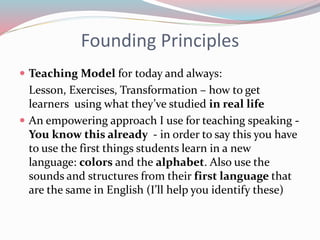
Founding Principles
 Teaching Model for today and always:
Lesson, Exercises, Transformation – how to get
learners using what they’ve studied in real life
 An empowering approach I use for teaching speaking -
You know this already - in order to say this you have
to use the first things students learn in a new
language: colors and the alphabet. Also use the
sounds and structures from their first language that
are the same in English (I’ll help you identify these)
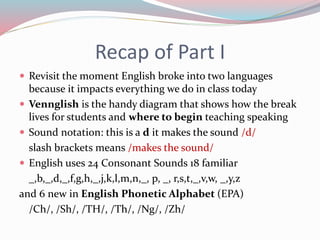
Recap of Part I
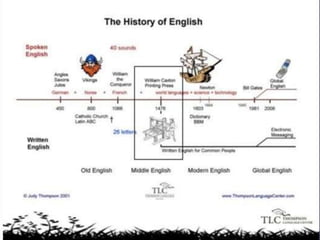
 Revisit the moment English broke into two languages
because it impacts everything we do in class today
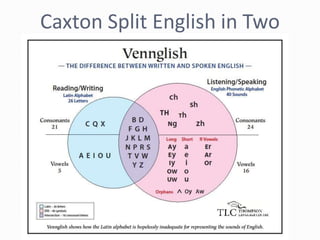
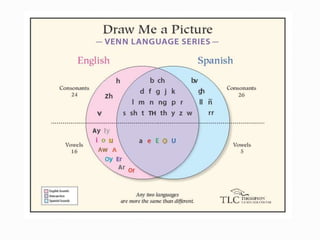
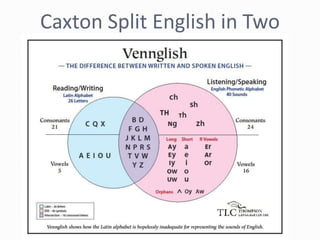
 Vennglish is the handy diagram that shows how the break
lives for students and where to begin teaching speaking
 Sound notation: this is a d it makes the sound /d/
slash brackets means /makes the sound/
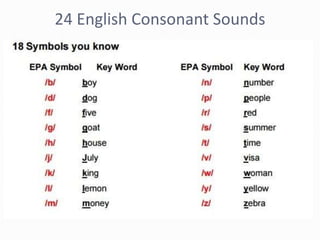
 English uses 24 Consonant Sounds 18 familiar
_,b,_,d,_,f,g,h,_,j,k,l,m,n,_, p, _, r,s,t,_,v,w, _,y,z
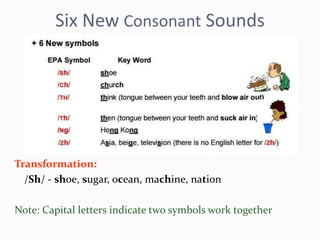
and 6 new in English Phonetic Alphabet (EPA)
/Ch/, /Sh/, /TH/, /Th/, /Ng/, /Zh/
Caxton Split English in Two
24 English Consonant Sounds
Six New Consonant Sounds
Transformation:
/Sh/ - shoe, sugar, ocean, machine, nation
Note: Capital letters indicate two symbols work together
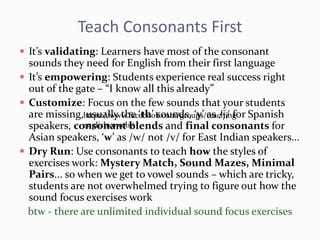
Teach Consonants First
 It’s validating: Learners have most of the consonant
sounds they need for English from their first language
 It’s empowering: Students experience real success right
out of the gate – “I know all this already”
 Customize: Focus on the few sounds that your students
are missing, usually the ‘th’ sounds, ‘y’ as /j/ for Spanish
speakers, consonant blends and final consonants for
Asian speakers, ‘w’ as /w/ not /v/ for East Indian speakers...
 Dry Run: Use consonants to teach how the styles of
exercises work: Mystery Match, Sound Mazes, Minimal
Pairs... so when we get to vowel sounds – which are tricky,
students are not overwhelmed trying to figure out how the
sound focus exercises work
btw - there are unlimited individual sound focus exercises
https://www.facebook.com/groups/teaching
englishvowels/
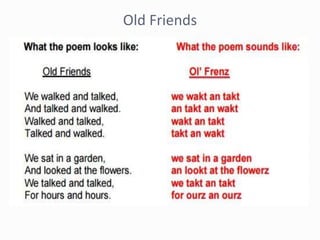
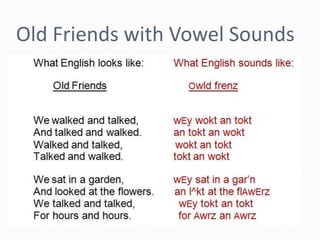
Old Friends
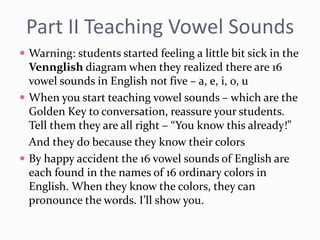
Part II Teaching Vowel Sounds
 Warning: students started feeling a little bit sick in the
Vennglish diagram when they realized there are 16
vowel sounds in English not five – a, e, i, o, u
 When you start teaching vowel sounds – which are the
Golden Key to conversation, reassure your students.
Tell them they are all right – “You know this already!”
And they do because they know their colors
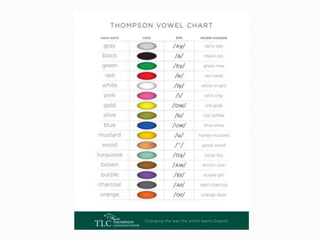
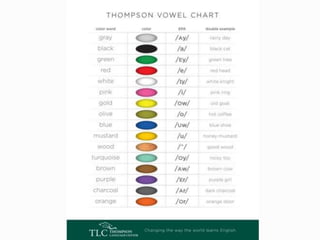
 By happy accident the 16 vowel sounds of English are
each found in the names of 16 ordinary colors in
English. When they know the colors, they can
pronounce the words. I’ll show you.
Caxton Split English in Two
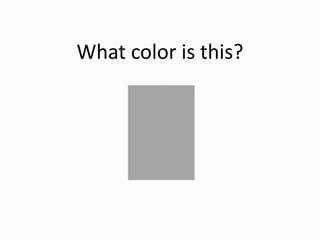
What color is this?
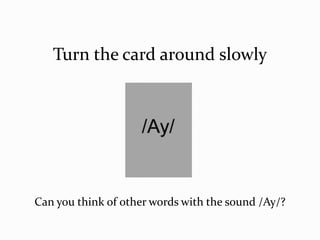
Turn the card around slowly
Can you think of other words with the sound /Ay/?
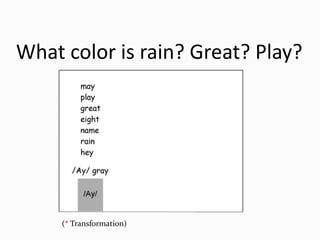
What color is rain? Great? Play?
(* Transformation)
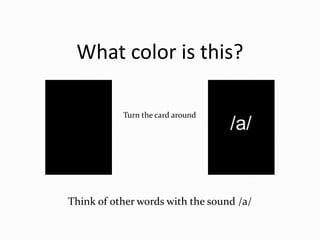
What color is this?
Think of other words with the sound /a/
Turn the card around
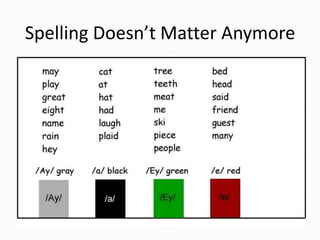
Spelling Doesn’t Matter Anymore
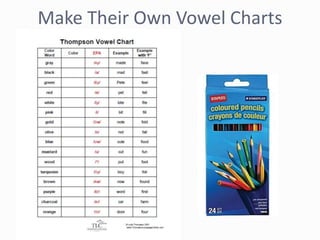
Make Their Own Vowel Charts
Old Friends with Vowel Sounds
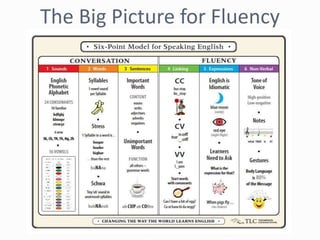
The Big Picture for Fluency
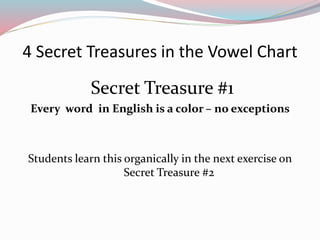
4 Secret Treasures in the Vowel Chart
Secret Treasure #1
Every word in English is a color – no exceptions
Students learn this organically in the next exercise on
Secret Treasure #2
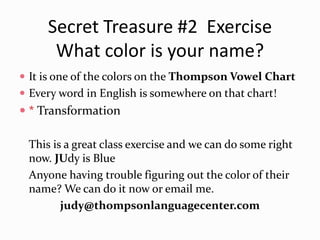
Secret Treasure #2 Exercise
What color is your name?
 It is one of the colors on the Thompson Vowel Chart
 Every word in English is somewhere on that chart!
 * Transformation
This is a great class exercise and we can do some right
now. JUdy is Blue
Anyone having trouble figuring out the color of their
name? We can do it now or email me.
judy@thompsonlanguagecenter.com
Treasure #2 Bonus Lesson
Word Stress is the single most important feature
of intelligibility.
If Word Stress is wrong or missing no one can
understand the speaker
English is a stress-based language
BAnana is not a word
Neither is banaNA
The word is baNAna
There are no variations. Banana is a Black word
The stressed syllable determines the color of the word
3rd Secret Treasure
3. Sentence Stress is the same principle as Word Stress:
Some words are important and some are not.
(shout out to Peggy Tharpe who identified the
undulating patterns of important/unimportant in all
levels of English clearly)
* Transformation Do you want a cup of coffee?
sounds like:
/Jawanna cuppa COffee/
Unimportant words (grammar words) are shrunk to
/uh/ the same as unimportant syllables in Word Stress
4th Secret Treasure
4. Connected Speech or Linking
The ‘You Know This Already’ is A or An
When a noun begins with a vowel sound you must use
An because humans can’t start interior words with
vowel sounds – it is how speaking physically works
and the foundation of Connected Speech
The consonants neededin the middle of sentences are
w or y and they are a built-in part of the EPA notation
I am sounds like /i yam/
you are sounds like /yu ware/
he is sounds like /he yiz/
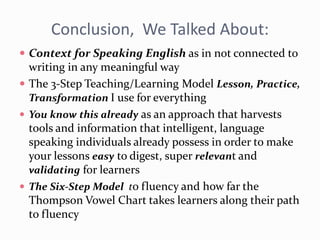
Conclusion, We Talked About:
 Context for Speaking English as in not connected to
writing in any meaningful way
 The 3-Step Teaching/Learning Model Lesson, Practice,
Transformation I use for everything
 You know this already as an approach that harvests
tools and information that intelligent, language
speaking individuals already possess in order to make
your lessons easy to digest, super relevant and
validating for learners
 The Six-Step Model to fluency and how far the
Thompson Vowel Chart takes learners along their path
to fluency
Resources
 Free 18 YouTube video Playlist of me teaching teachers
Speaking Made Simple: http://bit.ly/1H9Sp6R
 Email me for free 8.5 x 11 copies of Vennglish, The
Thompson Vowel Chart , Old Friends and the Six-
Point Model for Speaking English
judy@thompsonlanguagecenter.com
 The whole system including exercises and answer keys
is in English is Stupid, Students are Not pdf $15
Thanks for watching!
The next video is on Pronunciation and Literacy

Teaching English Vowels Made Simple

  • 1.
    Part II ofGetting Started by Judy Thompson Saturday January 16, 2016 2:00 EST (Toronto time)
  • 2.
    Founding Principles  TeachingModel for today and always: Lesson, Exercises, Transformation – how to get learners using what they’ve studied in real life  An empowering approach I use for teaching speaking - You know this already - in order to say this you have to use the first things students learn in a new language: colors and the alphabet. Also use the sounds and structures from their first language that are the same in English (I’ll help you identify these)
  • 3.
    Recap of PartI  Revisit the moment English broke into two languages because it impacts everything we do in class today  Vennglish is the handy diagram that shows how the break lives for students and where to begin teaching speaking  Sound notation: this is a d it makes the sound /d/ slash brackets means /makes the sound/  English uses 24 Consonant Sounds 18 familiar _,b,_,d,_,f,g,h,_,j,k,l,m,n,_, p, _, r,s,t,_,v,w, _,y,z and 6 new in English Phonetic Alphabet (EPA) /Ch/, /Sh/, /TH/, /Th/, /Ng/, /Zh/
  • 5.
  • 6.
  • 7.
    Six New ConsonantSounds Transformation: /Sh/ - shoe, sugar, ocean, machine, nation Note: Capital letters indicate two symbols work together
  • 8.
    Teach Consonants First It’s validating: Learners have most of the consonant sounds they need for English from their first language  It’s empowering: Students experience real success right out of the gate – “I know all this already”  Customize: Focus on the few sounds that your students are missing, usually the ‘th’ sounds, ‘y’ as /j/ for Spanish speakers, consonant blends and final consonants for Asian speakers, ‘w’ as /w/ not /v/ for East Indian speakers...  Dry Run: Use consonants to teach how the styles of exercises work: Mystery Match, Sound Mazes, Minimal Pairs... so when we get to vowel sounds – which are tricky, students are not overwhelmed trying to figure out how the sound focus exercises work btw - there are unlimited individual sound focus exercises https://www.facebook.com/groups/teaching englishvowels/
  • 10.
  • 11.
    Part II TeachingVowel Sounds  Warning: students started feeling a little bit sick in the Vennglish diagram when they realized there are 16 vowel sounds in English not five – a, e, i, o, u  When you start teaching vowel sounds – which are the Golden Key to conversation, reassure your students. Tell them they are all right – “You know this already!” And they do because they know their colors  By happy accident the 16 vowel sounds of English are each found in the names of 16 ordinary colors in English. When they know the colors, they can pronounce the words. I’ll show you.
  • 12.
  • 14.
  • 15.
    Turn the cardaround slowly Can you think of other words with the sound /Ay/?
  • 16.
    What color israin? Great? Play? (* Transformation)
  • 17.
    What color isthis? Think of other words with the sound /a/ Turn the card around
  • 18.
  • 19.
    Make Their OwnVowel Charts
  • 20.
    Old Friends withVowel Sounds
  • 21.
    The Big Picturefor Fluency
  • 22.
    4 Secret Treasuresin the Vowel Chart Secret Treasure #1 Every word in English is a color – no exceptions Students learn this organically in the next exercise on Secret Treasure #2
  • 23.
    Secret Treasure #2Exercise What color is your name?  It is one of the colors on the Thompson Vowel Chart  Every word in English is somewhere on that chart!  * Transformation This is a great class exercise and we can do some right now. JUdy is Blue Anyone having trouble figuring out the color of their name? We can do it now or email me. judy@thompsonlanguagecenter.com
  • 24.
    Treasure #2 BonusLesson Word Stress is the single most important feature of intelligibility. If Word Stress is wrong or missing no one can understand the speaker English is a stress-based language BAnana is not a word Neither is banaNA The word is baNAna There are no variations. Banana is a Black word The stressed syllable determines the color of the word
  • 25.
    3rd Secret Treasure 3.Sentence Stress is the same principle as Word Stress: Some words are important and some are not. (shout out to Peggy Tharpe who identified the undulating patterns of important/unimportant in all levels of English clearly) * Transformation Do you want a cup of coffee? sounds like: /Jawanna cuppa COffee/ Unimportant words (grammar words) are shrunk to /uh/ the same as unimportant syllables in Word Stress
  • 26.
    4th Secret Treasure 4.Connected Speech or Linking The ‘You Know This Already’ is A or An When a noun begins with a vowel sound you must use An because humans can’t start interior words with vowel sounds – it is how speaking physically works and the foundation of Connected Speech The consonants neededin the middle of sentences are w or y and they are a built-in part of the EPA notation I am sounds like /i yam/ you are sounds like /yu ware/ he is sounds like /he yiz/
  • 28.
    Conclusion, We TalkedAbout:  Context for Speaking English as in not connected to writing in any meaningful way  The 3-Step Teaching/Learning Model Lesson, Practice, Transformation I use for everything  You know this already as an approach that harvests tools and information that intelligent, language speaking individuals already possess in order to make your lessons easy to digest, super relevant and validating for learners  The Six-Step Model to fluency and how far the Thompson Vowel Chart takes learners along their path to fluency
  • 29.
    Resources  Free 18YouTube video Playlist of me teaching teachers Speaking Made Simple: http://bit.ly/1H9Sp6R  Email me for free 8.5 x 11 copies of Vennglish, The Thompson Vowel Chart , Old Friends and the Six- Point Model for Speaking English judy@thompsonlanguagecenter.com  The whole system including exercises and answer keys is in English is Stupid, Students are Not pdf $15 Thanks for watching! The next video is on Pronunciation and Literacy