Where Arabic
and English
Intersect
QATAR UNIVERSITY – FOUNDATION PROGRAM
MAY 12, 2020
JUDY THOMPSON
Agenda
LANGUAGE LEARNING
AND PATTERNS
ARABIC AND
ENGLISH SOUNDS
THE SIX PATTERNS TO
SPOKEN ENGLISH
How the Brain Learns
Attach new
to information it
knows – first language
is an ideal starting
for learning a second
language
Pattern-seeking,
meaning-making
machines
What I Mean by Patterns:
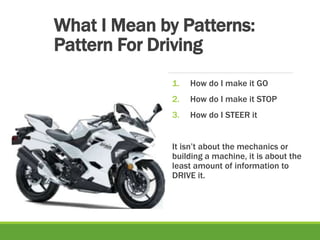
Pattern For Driving
1. How do I make it GO
2. How do I make it STOP
3. How do I STEER it
It isn’t about the mechanics or
building a machine, it is about the
least amount of information to
DRIVE it.
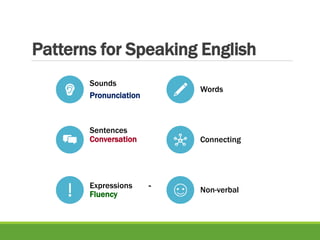
Patterns for Speaking English
Sounds
Pronunciation
Words
Sentences
Conversation Connecting
Expressions -
Fluency
Non-verbal
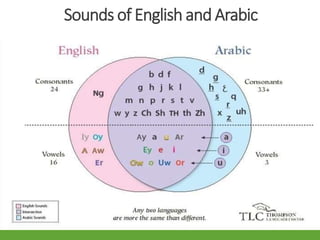
Sounds of English and Arabic
Arabic is Consonant-Rich
I should mention:
Consonant sounds stop - /b/, /k/, /Sh/…
Vowel sounds stretch /Ayyyyy/, /Eyyyyy/...
It takes less than 5 minutes to teach Consonant sounds to an
Arabic speaker because /Ng/ as in singing, finger and English
Is the only consonant sound they don’t already use.
Vowels (as with most languages) are the sticking point.
This is easily solved.
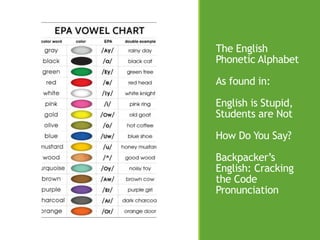
The English
Phonetic Alphabet
As found in:
English is Stupid,
Students are Not
How Do You Say?
Backpacker’s
English: Cracking
the Code
Pronunciation
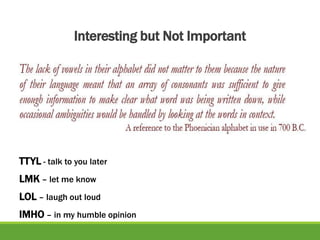
Interesting but Not Important
TTYL - talk to you later
LMK – let me know
LOL – laugh out loud
IMHO – in my humble opinion
Conversation
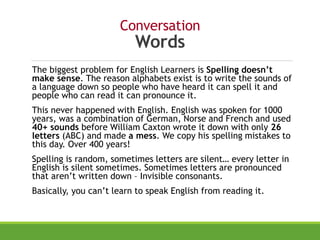
Words
The biggest problem for English Learners is Spelling doesn’t
make sense. The reason alphabets exist is to write the sounds of
a language down so people who have heard it can spell it and
people who can read it can pronounce it.
This never happened with English. English was spoken for 1000
years, was a combination of German, Norse and French and used
40+ sounds before William Caxton wrote it down with only 26
letters (ABC) and made a mess. We copy his spelling mistakes to
this day. Over 400 years!
Spelling is random, sometimes letters are silent… every letter in
English is silent sometimes. Sometimes letters are pronounced
that aren’t written down – Invisible consonants.
Basically, you can’t learn to speak English from reading it.
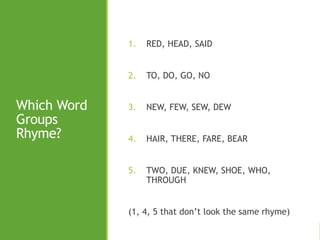
Which Word
Groups
Rhyme?
1. RED, HEAD, SAID
2. TO, DO, GO, NO
3. NEW, FEW, SEW, DEW
4. HAIR, THERE, FARE, BEAR
5. TWO, DUE, KNEW, SHOE, WHO,
THROUGH
(1, 4, 5 that don’t look the same rhyme)
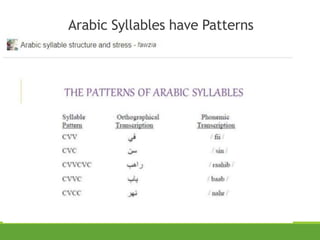
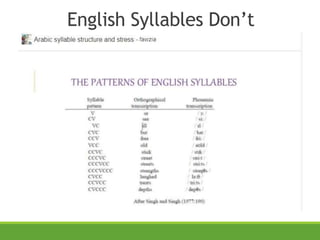
Arabic Syllables have Patterns
English Syllables Don’t
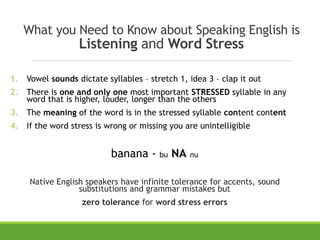
What you Need to Know about Speaking English is
Listening and Word Stress
1. Vowel sounds dictate syllables – stretch 1, idea 3 – clap it out
2. There is one and only one most important STRESSED syllable in any
word that is higher, louder, longer than the others
3. The meaning of the word is in the stressed syllable content content
4. If the word stress is wrong or missing you are unintelligible
banana - bu NA nu
Native English speakers have infinite tolerance for accents, sound
substitutions and grammar mistakes but
zero tolerance for word stress errors
Conversation
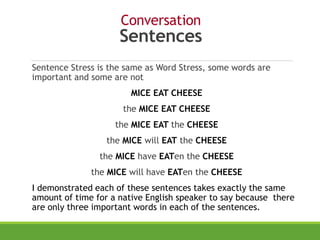
Sentences
Sentence Stress is the same as Word Stress, some words are
important and some are not
MICE EAT CHEESE
the MICE EAT CHEESE
the MICE EAT the CHEESE
the MICE will EAT the CHEESE
the MICE have EATen the CHEESE
the MICE will have EATen the CHEESE
I demonstrated each of these sentences takes exactly the same
amount of time for a native English speaker to say because there
are only three important words in each of the sentences.
Conversation
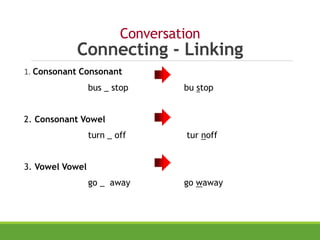
Connecting - Linking
1. Consonant Consonant
bus _ stop bu stop
2. Consonant Vowel
turn _ off tur noff
3. Vowel Vowel
go _ away go waway
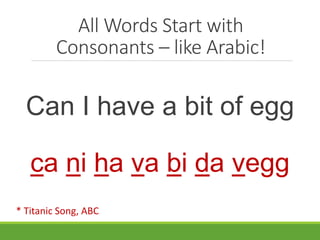
All Words Start with
Consonants – like Arabic!
Can I have a bit of egg
ca ni ha va bi da vegg
* Titanic Song, ABC
Conversation
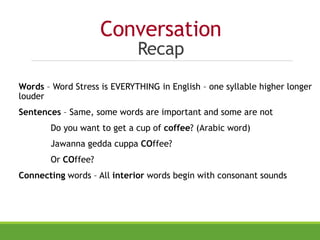
Recap
Words – Word Stress is EVERYTHING in English – one syllable higher longer
louder
Sentences – Same, some words are important and some are not
Do you want to get a cup of coffee? (Arabic word)
Jawanna gedda cuppa COffee?
Or COffee?
Connecting words – All interior words begin with consonant sounds
Fluency
Expressions
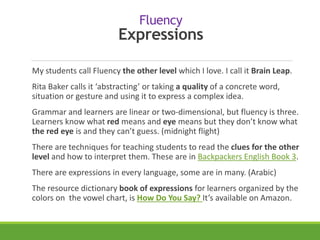
My students call Fluency the other level which I love. I call it Brain Leap.
Rita Baker calls it ‘abstracting’ or taking a quality of a concrete word,
situation or gesture and using it to express a complex idea.
Grammar and learners are linear or two-dimensional, but fluency is three.
Learners know what red means and eye means but they don’t know what
the red eye is and they can’t guess. (midnight flight)
There are techniques for teaching students to read the clues for the other
level and how to interpret them. These are in Backpackers English Book 3.
There are expressions in every language, some are in many. (Arabic)
The resource dictionary book of expressions for learners organized by the
colors on the vowel chart, is How Do You Say? It’s available on Amazon.
Fluency
Non-Verbal
Communication
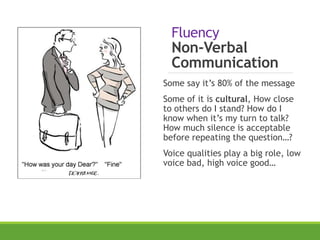
Some say it’s 80% of the message
Some of it is cultural, How close
to others do I stand? How do I
know when it’s my turn to talk?
How much silence is acceptable
before repeating the question…?
Voice qualities play a big role, low
voice bad, high voice good…
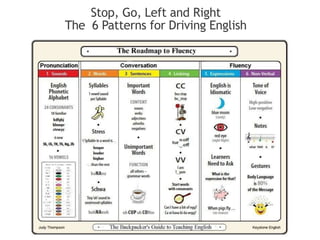
Stop, Go, Left and Right
The 6 Patterns for Driving English
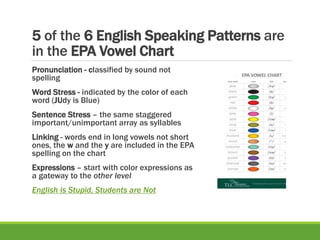
5 of the 6 English Speaking Patterns are
in the EPA Vowel Chart
Pronunciation - classified by sound not
spelling
Word Stress - indicated by the color of each
word (JUdy is Blue)
Sentence Stress – the same staggered
important/unimportant array as syllables
Linking - words end in long vowels not short
ones, the w and the y are included in the EPA
spelling on the chart
Expressions – start with color expressions as
a gateway to the other level
English is Stupid, Students are Not
Where
Arabic and
English
Intersect
Consonant sounds are the same, Arabic
has more
Arabic spelling is better
English has borrowed (stolen) many words
from Arabic
Word stress is different in English and in
English it’s the single most critical element
of intelligibility
English syllables and words are crazy but
every internal syllable and word begins
with a consonant, like Arabic
I don’t know where Arabic and English
expressions intersect but they do
Body language is a function of culture I
don’t know about the culture to say.
I’m Judy
Thompson
Thank you for
listening
It was an honor to speak at the
Foundation Program Virtual Conference.
Thank you.
Many, many thanks to Anwar Alfetlawi
who put my name forward, to Ahmad
Hazratzad for all his help and to all the
organizers. It’s a great event.
Email me if you have any questions:
judy@thompsonlanguagecenter.com
or through the website
www.backpackersenglish.com
I wish you and your families well.
Good day.

Where Arabic and English Intersect

  • 1.
    Where Arabic and English Intersect QATARUNIVERSITY – FOUNDATION PROGRAM MAY 12, 2020 JUDY THOMPSON
  • 2.
    Agenda LANGUAGE LEARNING AND PATTERNS ARABICAND ENGLISH SOUNDS THE SIX PATTERNS TO SPOKEN ENGLISH
  • 3.
    How the BrainLearns Attach new to information it knows – first language is an ideal starting for learning a second language Pattern-seeking, meaning-making machines
  • 4.
    What I Meanby Patterns: Pattern For Driving 1. How do I make it GO 2. How do I make it STOP 3. How do I STEER it It isn’t about the mechanics or building a machine, it is about the least amount of information to DRIVE it.
  • 5.
    Patterns for SpeakingEnglish Sounds Pronunciation Words Sentences Conversation Connecting Expressions - Fluency Non-verbal
  • 6.
  • 7.
    Arabic is Consonant-Rich Ishould mention: Consonant sounds stop - /b/, /k/, /Sh/… Vowel sounds stretch /Ayyyyy/, /Eyyyyy/... It takes less than 5 minutes to teach Consonant sounds to an Arabic speaker because /Ng/ as in singing, finger and English Is the only consonant sound they don’t already use. Vowels (as with most languages) are the sticking point. This is easily solved.
  • 8.
    The English Phonetic Alphabet Asfound in: English is Stupid, Students are Not How Do You Say? Backpacker’s English: Cracking the Code Pronunciation
  • 9.
    Interesting but NotImportant TTYL - talk to you later LMK – let me know LOL – laugh out loud IMHO – in my humble opinion
  • 10.
    Conversation Words The biggest problemfor English Learners is Spelling doesn’t make sense. The reason alphabets exist is to write the sounds of a language down so people who have heard it can spell it and people who can read it can pronounce it. This never happened with English. English was spoken for 1000 years, was a combination of German, Norse and French and used 40+ sounds before William Caxton wrote it down with only 26 letters (ABC) and made a mess. We copy his spelling mistakes to this day. Over 400 years! Spelling is random, sometimes letters are silent… every letter in English is silent sometimes. Sometimes letters are pronounced that aren’t written down – Invisible consonants. Basically, you can’t learn to speak English from reading it.
  • 11.
    Which Word Groups Rhyme? 1. RED,HEAD, SAID 2. TO, DO, GO, NO 3. NEW, FEW, SEW, DEW 4. HAIR, THERE, FARE, BEAR 5. TWO, DUE, KNEW, SHOE, WHO, THROUGH (1, 4, 5 that don’t look the same rhyme)
  • 12.
  • 13.
  • 14.
    What you Needto Know about Speaking English is Listening and Word Stress 1. Vowel sounds dictate syllables – stretch 1, idea 3 – clap it out 2. There is one and only one most important STRESSED syllable in any word that is higher, louder, longer than the others 3. The meaning of the word is in the stressed syllable content content 4. If the word stress is wrong or missing you are unintelligible banana - bu NA nu Native English speakers have infinite tolerance for accents, sound substitutions and grammar mistakes but zero tolerance for word stress errors
  • 15.
    Conversation Sentences Sentence Stress isthe same as Word Stress, some words are important and some are not MICE EAT CHEESE the MICE EAT CHEESE the MICE EAT the CHEESE the MICE will EAT the CHEESE the MICE have EATen the CHEESE the MICE will have EATen the CHEESE I demonstrated each of these sentences takes exactly the same amount of time for a native English speaker to say because there are only three important words in each of the sentences.
  • 16.
    Conversation Connecting - Linking 1.Consonant Consonant bus _ stop bu stop 2. Consonant Vowel turn _ off tur noff 3. Vowel Vowel go _ away go waway
  • 17.
    All Words Startwith Consonants – like Arabic! Can I have a bit of egg ca ni ha va bi da vegg * Titanic Song, ABC
  • 18.
    Conversation Recap Words – WordStress is EVERYTHING in English – one syllable higher longer louder Sentences – Same, some words are important and some are not Do you want to get a cup of coffee? (Arabic word) Jawanna gedda cuppa COffee? Or COffee? Connecting words – All interior words begin with consonant sounds
  • 20.
    Fluency Expressions My students callFluency the other level which I love. I call it Brain Leap. Rita Baker calls it ‘abstracting’ or taking a quality of a concrete word, situation or gesture and using it to express a complex idea. Grammar and learners are linear or two-dimensional, but fluency is three. Learners know what red means and eye means but they don’t know what the red eye is and they can’t guess. (midnight flight) There are techniques for teaching students to read the clues for the other level and how to interpret them. These are in Backpackers English Book 3. There are expressions in every language, some are in many. (Arabic) The resource dictionary book of expressions for learners organized by the colors on the vowel chart, is How Do You Say? It’s available on Amazon.
  • 21.
    Fluency Non-Verbal Communication Some say it’s80% of the message Some of it is cultural, How close to others do I stand? How do I know when it’s my turn to talk? How much silence is acceptable before repeating the question…? Voice qualities play a big role, low voice bad, high voice good…
  • 22.
    Stop, Go, Leftand Right The 6 Patterns for Driving English
  • 23.
    5 of the6 English Speaking Patterns are in the EPA Vowel Chart Pronunciation - classified by sound not spelling Word Stress - indicated by the color of each word (JUdy is Blue) Sentence Stress – the same staggered important/unimportant array as syllables Linking - words end in long vowels not short ones, the w and the y are included in the EPA spelling on the chart Expressions – start with color expressions as a gateway to the other level English is Stupid, Students are Not
  • 24.
    Where Arabic and English Intersect Consonant soundsare the same, Arabic has more Arabic spelling is better English has borrowed (stolen) many words from Arabic Word stress is different in English and in English it’s the single most critical element of intelligibility English syllables and words are crazy but every internal syllable and word begins with a consonant, like Arabic I don’t know where Arabic and English expressions intersect but they do Body language is a function of culture I don’t know about the culture to say.
  • 25.
    I’m Judy Thompson Thank youfor listening It was an honor to speak at the Foundation Program Virtual Conference. Thank you. Many, many thanks to Anwar Alfetlawi who put my name forward, to Ahmad Hazratzad for all his help and to all the organizers. It’s a great event. Email me if you have any questions: judy@thompsonlanguagecenter.com or through the website www.backpackersenglish.com I wish you and your families well. Good day.