JudyThompson
Learning2gether
May 22, 2014
An international organization of pattern
thinkers with simple solutions for the
challenges of learning and teaching English
Come from the place
of what is always true vs.
endless details and exceptions.
www.radicalenglish.weebly.com
 Teresa Almeida d’Eca –Webhead L1 – L2
 Rita Baker –The Global Approach
 Jennifer England – Business English
 JuditTarczy –Vocabulary building – games
 PeggyTharpe – AmericanAccent Coach
 JudyThompson – Speaking Made Simple
Here is the big problem with English.
Letters don’t represent sounds.
No one knows what words sound like from
reading them:
blue through
you who
two do
few shoe
due boo
1. A short History of English showing speaking
as a different language than writing
2. The English Phonetic Alphabet using colors
1. Consonants – sounds that stop
2. Vowels – sounds that stretch
3. Take away pronunciation tools teachers and
students can use anywhere
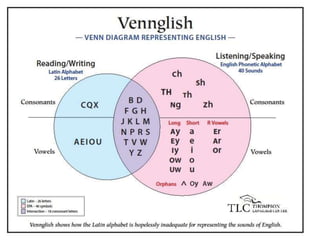
40 sounds
26 letters
 English speaking is completely separate
from English writing
 The history provides context for students
and their education so far
 It is not their fault that their speaking has not
gone as well as they’d hoped
We have a clean slate
– a fresh start for a new approach
 We are at zero
 What we put in place now is a model for how
speaking works in all situations
 Students can use this framework outside of
class, independent of teacher support for
ever and ever
There are 40 sounds in English
24 consonant sounds
16 vowel sounds
40
▪ Consonant sounds STOP
▪ Vowel sounds s t r e t c h
ALWAYS attach new information
to things students already know
Explain the notation slash brackets
/makes the sound/
This is a dog.
– it makes the sound /woof/
This is a d - it makes the sound /d/
ThompsonLanguageCenter.com 11
18 familiar
b, d, f, g, h, j, k, l, m, n, p, r, s, t, v, w, y, z
/b/ /d/ /f/ /g/ /h/ /j/ /k/ /l/ /m/ /n/ /p/ /r/ /s/ /t/ /v/ /w/ /y/ /z/
6 new
Sh, Ch, TH, Th, Ng, Zh
/Sh/ /Ch/ /TH/ /Th/ /Ng/ /Zh/
 Capital letters mean two symbols – one sound
_ b _ d _ f g h _ j k l m n _ p _ r s t _ v w _y z
/Sh/ - shoe, sugar, nation, machine*
/Ch/ - church, cello, picture
/TH/ - thing, thank, both, teeth
/Th/ - the, them, these, mother, brother
/Ng/ - singing, pink
/Zh/ - Asia, garage, usual,Taj Mahal
(*Transformation)
Old Friends Ol’ Frenz
We walked and talked, we wakt an takt
And talked and walked. an takt an wakt
Walked and talked, wakt an takt
Talked and walked. takt an wakt
We sat in a garden, we sat in a gardn
And looked at the flowers. an lookt at the flowerz
We talked and talked, we takt an takt
For hours and hours. for ourz an ourz
(*Transformation)
 The first thing people learn in a new language
is the names of the colors
 Inside the names of 16 common colors in
English are the 16 vowel sounds of English
 Students learn the colors of words and crazy
English spelling is no longer a barrier to
confident speaking
Can you think of other words with the sound /Ay/?
(*Transformation)
Think of other words with the sound /a/
Turn the card around
 Students understand the most important
feature of English organically – you just wake it
up in them
 English is a stress-based language
 The stressed syllable determines the color of the
word
 Every word in English is a color
BAnana is not a word
Neither is banaNA
The word is baNAna
There are no variations. banana is a Black word
 It is one of the colors on theThompsonVowel
Chart
 Every word in English is somewhere on that
chart!
 *Transformation
FYI
If the word-stress isn’t right, a native English
speaker can’t guess what is being said
Old Friends Ol’ Frenz
We walked and talked we wokt an tokt
And talked and walked an tokt an wokt
Walked and talked wokt an tokt
Talked and walked tokt an wokt
 Every word in English is a color
 English is a stress-based language – if
someone can’t understand word stress is the
problem not ‘accent’
 Accents don’t matter – everyone has an
accent – only word stress matters
Teacher Judy’s Sound Dictionary app
The other four tools we did not talk about today are:
 Content words carry message – grammar doesn’t
 Linking – all spoken words start with consonants
 Expressions – English is idiomatic
 Body Language – non-verbal is 80% of the message
It was my goal to show you a new way of looking at
Spoken English and how to teach it using colors.
You should also know there is a full range of materials on
this process that are available if you are interested
JudyThompson
2554The Grange Sideroad
Caledon, Ontario
Canada
www.ThompsonLanguageCenter.com
Email: judy@thompsonlanguagecenter.com
Skype: judycaledon
Follow us onTwitter @ judyisblue

Pronunciation with Colors - Learning 2gether

  • 1.
  • 2.
    An international organizationof pattern thinkers with simple solutions for the challenges of learning and teaching English Come from the place of what is always true vs. endless details and exceptions.
  • 3.
    www.radicalenglish.weebly.com  Teresa Almeidad’Eca –Webhead L1 – L2  Rita Baker –The Global Approach  Jennifer England – Business English  JuditTarczy –Vocabulary building – games  PeggyTharpe – AmericanAccent Coach  JudyThompson – Speaking Made Simple
  • 4.
    Here is thebig problem with English. Letters don’t represent sounds. No one knows what words sound like from reading them: blue through you who two do few shoe due boo
  • 5.
    1. A shortHistory of English showing speaking as a different language than writing 2. The English Phonetic Alphabet using colors 1. Consonants – sounds that stop 2. Vowels – sounds that stretch 3. Take away pronunciation tools teachers and students can use anywhere
  • 6.
  • 7.
     English speakingis completely separate from English writing  The history provides context for students and their education so far  It is not their fault that their speaking has not gone as well as they’d hoped We have a clean slate – a fresh start for a new approach
  • 9.
     We areat zero  What we put in place now is a model for how speaking works in all situations  Students can use this framework outside of class, independent of teacher support for ever and ever
  • 10.
    There are 40sounds in English 24 consonant sounds 16 vowel sounds 40 ▪ Consonant sounds STOP ▪ Vowel sounds s t r e t c h ALWAYS attach new information to things students already know
  • 11.
    Explain the notationslash brackets /makes the sound/ This is a dog. – it makes the sound /woof/ This is a d - it makes the sound /d/ ThompsonLanguageCenter.com 11
  • 12.
    18 familiar b, d,f, g, h, j, k, l, m, n, p, r, s, t, v, w, y, z /b/ /d/ /f/ /g/ /h/ /j/ /k/ /l/ /m/ /n/ /p/ /r/ /s/ /t/ /v/ /w/ /y/ /z/ 6 new Sh, Ch, TH, Th, Ng, Zh /Sh/ /Ch/ /TH/ /Th/ /Ng/ /Zh/  Capital letters mean two symbols – one sound
  • 13.
    _ b _d _ f g h _ j k l m n _ p _ r s t _ v w _y z /Sh/ - shoe, sugar, nation, machine* /Ch/ - church, cello, picture /TH/ - thing, thank, both, teeth /Th/ - the, them, these, mother, brother /Ng/ - singing, pink /Zh/ - Asia, garage, usual,Taj Mahal (*Transformation)
  • 14.
    Old Friends Ol’Frenz We walked and talked, we wakt an takt And talked and walked. an takt an wakt Walked and talked, wakt an takt Talked and walked. takt an wakt We sat in a garden, we sat in a gardn And looked at the flowers. an lookt at the flowerz We talked and talked, we takt an takt For hours and hours. for ourz an ourz (*Transformation)
  • 15.
     The firstthing people learn in a new language is the names of the colors  Inside the names of 16 common colors in English are the 16 vowel sounds of English  Students learn the colors of words and crazy English spelling is no longer a barrier to confident speaking
  • 18.
    Can you thinkof other words with the sound /Ay/?
  • 19.
  • 20.
    Think of otherwords with the sound /a/ Turn the card around
  • 22.
     Students understandthe most important feature of English organically – you just wake it up in them  English is a stress-based language  The stressed syllable determines the color of the word  Every word in English is a color BAnana is not a word Neither is banaNA The word is baNAna There are no variations. banana is a Black word
  • 23.
     It isone of the colors on theThompsonVowel Chart  Every word in English is somewhere on that chart!  *Transformation FYI If the word-stress isn’t right, a native English speaker can’t guess what is being said
  • 24.
    Old Friends Ol’Frenz We walked and talked we wokt an tokt And talked and walked an tokt an wokt Walked and talked wokt an tokt Talked and walked tokt an wokt
  • 25.
     Every wordin English is a color  English is a stress-based language – if someone can’t understand word stress is the problem not ‘accent’  Accents don’t matter – everyone has an accent – only word stress matters Teacher Judy’s Sound Dictionary app
  • 27.
    The other fourtools we did not talk about today are:  Content words carry message – grammar doesn’t  Linking – all spoken words start with consonants  Expressions – English is idiomatic  Body Language – non-verbal is 80% of the message It was my goal to show you a new way of looking at Spoken English and how to teach it using colors. You should also know there is a full range of materials on this process that are available if you are interested
  • 28.
    JudyThompson 2554The Grange Sideroad Caledon,Ontario Canada www.ThompsonLanguageCenter.com Email: judy@thompsonlanguagecenter.com Skype: judycaledon Follow us onTwitter @ judyisblue