S
Professionalism?
What’s that?
Presenting the best YOU at all times
Job Search Summit
Joe Jerles, Ed.D.
Austin Peay State University, Clarksville, TN
S
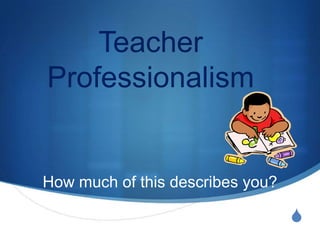
Teacher
Professionalism
How much of this describes you?
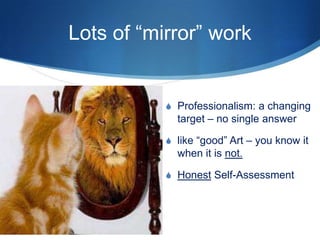
Lots of “mirror” work
S Professionalism: a changing
target – no single answer
S like “good” Art – you know it
when it is not.
S Honest Self-Assessment
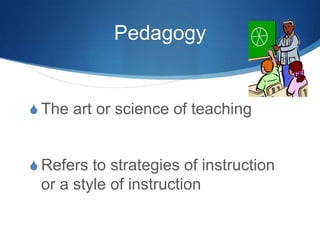
Pedagogy
S The art or science of teaching
S Refers to strategies of instruction
or a style of instruction
Instructional Theory
S Focuses on how to structure
material for promoting the
education of human beings
S Two Parts: Cognitive, Behavioral
Teacher Professionalism in
3 parts:
S Competence
S Performance
S Conduct
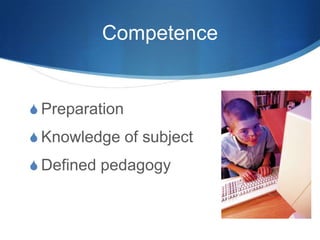
Competence
S Preparation
S Knowledge of subject
S Defined pedagogy
Competence: 1-Preparation
S Innovative techniques to create an
effective learning environment
based on the needs of the
students
S Teacher can (still) make classroom
management decisions
Competence: 2-Subject
Knowledge
S Knowing the curriculum well is an
advantage – allowing the teacher to
focus on HOW to relate the material
S Must develop and incorporate various
innovative instructional strategies
based on knowledge of learning
theories (what works for you!)
Competence: 3-Defined
Pedagogy
S Informed trials to discover the most
effective methods and techniques
S Constant self-evaluation and
revision if necessary
S Allows teacher FREEDOM within
bounds of the scope and sequence
Competence - Self Assessment
S Do you feel prepared enough?
S Do you know the curriculum in your chosen
area(s) well enough?
S Was your field practice sufficient to test your
methodologies? Classroom Management!
S What can I do to become MORE prepared?
Performance: Efficaciousness
S Efficacious: Having the ability to
achieve the desired effect. Efficient,
effective, practical, valid, dynamic
S Do your methods have the necessary
efficaciousness? How do you know?
Performance: Efficaciousness
S Ability to effectively teach the concepts
AND MORE:
S Students learn application of knowledge in
authentic experiences
S Must be reliable and dedicated to
achieving the target – an “active” teacher
Performance: Self-Assessment
S How effective and efficient are your
strategies as a novice?
S How dedicated are you to successfully
educating your students?
S How do you intend to keep your skills
honed? Journals, associations, conferences
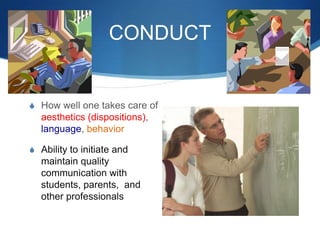
CONDUCT
S How well one takes care of
aesthetics (dispositions),
language, behavior
S Ability to initiate and
maintain quality
communication with
students, parents, and
other professionals
CONDUCT
How well one takes care of
S aesthetics (dispositions),
S language,
S behavior
CONDUCT
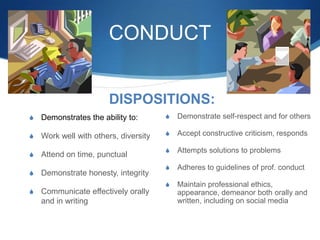
DISPOSITIONS:
S Demonstrates the ability to:
S Work well with others, diversity
S Attend on time, punctual
S Demonstrate honesty, integrity
S Communicate effectively orally
and in writing
S Demonstrate self-respect and for others
S Accept constructive criticism, responds
S Attempts solutions to problems
S Adheres to guidelines of prof. conduct
S Maintain professional ethics,
appearance, demeanor both orally and
written, including on social media
CONDUCT
S Language – speaking properly
“Do not give potential employers reason to
suspect the quality of your education”
S Model correct language use, proper grammar!
S Limit/eliminate use of slang, minor exceptions
S Use academic language appropriately
S Caution: “Waving your degree” at parents, others
CONDUCT
S Behavior – Teachers are never “off”
S Interviews: A critical turning point for some
S Dress: That uncomfortable subject – your
personal dress code in the classroom
S Serve as the example in all areas
S Hold yourself to a higher standard
Conduct: Self-Assessment
S Do you believe others see you as a
budding professional? Why?
S In what ways do you conduct
yourself that say “I am a professional
educator?”
The Wholeness of a
Professional
S Difficult to completely define
S More than just knowledge, skill, caring
S Professional “energy” or “passion”
S Genuine interest in others learning
What is a “good” teacher?
Defining a professional educator
S Characteristics: Think of your favorite
teacher who inspired you
Try to sum that quality in a single word
S 1.
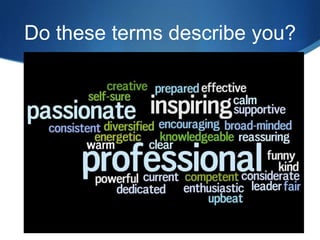
Do these terms describe you?
Your journey begins…soon!
Questions / Comments
S Offline questions/comments – KDP Open Forum
S Email to: jerlesj@apsu.edu
Dr. Joe Jerles
Dept. of Teaching and Learning
Martha Dickerson Ericsson College of Education
Austin Peay State University
Clarksville, TN 37044

Teacherprofessionalism 140114150748-phpapp02 (1)

  • 1.
    S Professionalism? What’s that? Presenting thebest YOU at all times Job Search Summit Joe Jerles, Ed.D. Austin Peay State University, Clarksville, TN
  • 2.
  • 3.
    Lots of “mirror”work S Professionalism: a changing target – no single answer S like “good” Art – you know it when it is not. S Honest Self-Assessment
  • 4.
    Pedagogy S The artor science of teaching S Refers to strategies of instruction or a style of instruction
  • 5.
    Instructional Theory S Focuseson how to structure material for promoting the education of human beings S Two Parts: Cognitive, Behavioral
  • 6.
    Teacher Professionalism in 3parts: S Competence S Performance S Conduct
  • 7.
    Competence S Preparation S Knowledgeof subject S Defined pedagogy
  • 8.
    Competence: 1-Preparation S Innovativetechniques to create an effective learning environment based on the needs of the students S Teacher can (still) make classroom management decisions
  • 9.
    Competence: 2-Subject Knowledge S Knowingthe curriculum well is an advantage – allowing the teacher to focus on HOW to relate the material S Must develop and incorporate various innovative instructional strategies based on knowledge of learning theories (what works for you!)
  • 10.
    Competence: 3-Defined Pedagogy S Informedtrials to discover the most effective methods and techniques S Constant self-evaluation and revision if necessary S Allows teacher FREEDOM within bounds of the scope and sequence
  • 11.
    Competence - SelfAssessment S Do you feel prepared enough? S Do you know the curriculum in your chosen area(s) well enough? S Was your field practice sufficient to test your methodologies? Classroom Management! S What can I do to become MORE prepared?
  • 12.
    Performance: Efficaciousness S Efficacious:Having the ability to achieve the desired effect. Efficient, effective, practical, valid, dynamic S Do your methods have the necessary efficaciousness? How do you know?
  • 13.
    Performance: Efficaciousness S Abilityto effectively teach the concepts AND MORE: S Students learn application of knowledge in authentic experiences S Must be reliable and dedicated to achieving the target – an “active” teacher
  • 14.
    Performance: Self-Assessment S Howeffective and efficient are your strategies as a novice? S How dedicated are you to successfully educating your students? S How do you intend to keep your skills honed? Journals, associations, conferences
  • 15.
    CONDUCT S How wellone takes care of aesthetics (dispositions), language, behavior S Ability to initiate and maintain quality communication with students, parents, and other professionals
  • 16.
    CONDUCT How well onetakes care of S aesthetics (dispositions), S language, S behavior
  • 17.
    CONDUCT DISPOSITIONS: S Demonstrates theability to: S Work well with others, diversity S Attend on time, punctual S Demonstrate honesty, integrity S Communicate effectively orally and in writing S Demonstrate self-respect and for others S Accept constructive criticism, responds S Attempts solutions to problems S Adheres to guidelines of prof. conduct S Maintain professional ethics, appearance, demeanor both orally and written, including on social media
  • 18.
    CONDUCT S Language –speaking properly “Do not give potential employers reason to suspect the quality of your education” S Model correct language use, proper grammar! S Limit/eliminate use of slang, minor exceptions S Use academic language appropriately S Caution: “Waving your degree” at parents, others
  • 19.
    CONDUCT S Behavior –Teachers are never “off” S Interviews: A critical turning point for some S Dress: That uncomfortable subject – your personal dress code in the classroom S Serve as the example in all areas S Hold yourself to a higher standard
  • 20.
    Conduct: Self-Assessment S Doyou believe others see you as a budding professional? Why? S In what ways do you conduct yourself that say “I am a professional educator?”
  • 21.
    The Wholeness ofa Professional S Difficult to completely define S More than just knowledge, skill, caring S Professional “energy” or “passion” S Genuine interest in others learning
  • 22.
    What is a“good” teacher? Defining a professional educator S Characteristics: Think of your favorite teacher who inspired you Try to sum that quality in a single word S 1.
  • 23.
    Do these termsdescribe you?
  • 24.
  • 25.
    Questions / Comments SOffline questions/comments – KDP Open Forum S Email to: jerlesj@apsu.edu Dr. Joe Jerles Dept. of Teaching and Learning Martha Dickerson Ericsson College of Education Austin Peay State University Clarksville, TN 37044