Collaborating for Student Success
Teacher Collaboration:Teacher Collaboration:
Strategies & OutcomesStrategies & Outcomes
ARCHES SeminarARCHES Seminar
UC Irvine ~ 3/15/10UC Irvine ~ 3/15/10
Ivan ChengIvan Cheng icheng@csun.eduicheng@csun.edu
Collaborating for Student Success
““The majority of students did not pass [algebra]The majority of students did not pass [algebra]
in eighth or ninth grades, and roughly two-in eighth or ninth grades, and roughly two-
thirds of them failed to graduate on time.”thirds of them failed to graduate on time.”
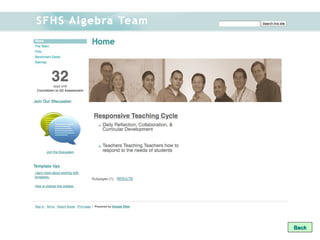
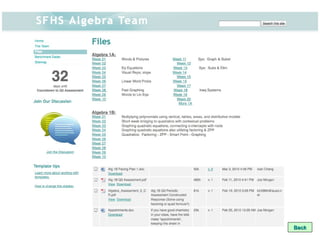
The Context
Los Angeles Times, June 21, 2008Los Angeles Times, June 21, 2008
Collaborating for Student Success
““To improve their mathematics instruction,To improve their mathematics instruction,
teachers must be able to analyze what theyteachers must be able to analyze what they
and their students are doing and consider howand their students are doing and consider how
those actions are affecting students’those actions are affecting students’
learning.”learning.”
The Context
NCTM Principles and Standards, p. 18NCTM Principles and Standards, p. 18
Collaborating for Student Success
The Context
””Teachers learn well just as students do –Teachers learn well just as students do –
by studying, doing, and reflecting;by studying, doing, and reflecting;
by collaborating with other teachers;by collaborating with other teachers;
by looking closely at students and their work;by looking closely at students and their work;
and by sharing what they see.”and by sharing what they see.”
Darling-Hammond (1999), p. 12Darling-Hammond (1999), p. 12
by collaborating with other teachersby collaborating with other teachers
Collaborating for Student Success
Two thirds of teachers (67%) and threeTwo thirds of teachers (67%) and three
quarters of principals (78%) think thatquarters of principals (78%) think that
teacher collaboration would have a majorteacher collaboration would have a major
impact on student achievement.impact on student achievement.
MetLife Survey of the American Teacher 2009MetLife Survey of the American Teacher 2009
The Context
Collaborating for Student Success
The Benefits
• Greater collective responsibility for studentGreater collective responsibility for student
learninglearning
• Higher levels of trust between teachers andHigher levels of trust between teachers and
administratorsadministrators
• Greater job satisfactionGreater job satisfaction
MetLife Survey of the American Teacher 2009MetLife Survey of the American Teacher 2009
Collaborating for Student Success
Types of Collaboration
• Department meetingsDepartment meetings
• Interdisciplinary meetingsInterdisciplinary meetings
• Professional learning communitiesProfessional learning communities
• Coaching and mentoringCoaching and mentoring
• Lesson studyLesson study
• ““Learning Teams” (Pearson)Learning Teams” (Pearson)
Collaborating for Student Success
The Problem
””The environments in which most teachers workThe environments in which most teachers work
have been structured in ways that actuallyhave been structured in ways that actually
work against the kind of sustainedwork against the kind of sustained
collaboration that we have suggested iscollaboration that we have suggested is
needed for significant and steadyneeded for significant and steady
improvement.”improvement.”
Stigler & Hiebert (1999), p. 172Stigler & Hiebert (1999), p. 172
Collaborating for Student Success
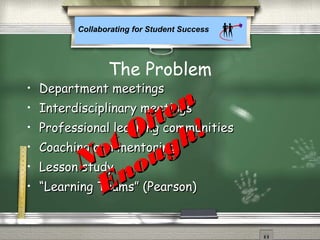
• Department meetingsDepartment meetings
• Interdisciplinary meetingsInterdisciplinary meetings
• Professional learning communitiesProfessional learning communities
• Coaching and mentoringCoaching and mentoring
• Lesson studyLesson study
• ““Learning Teams” (Pearson)Learning Teams” (Pearson)
The Problem
Not Often
Not Often
Enough!
Enough!
Collaborating for Student Success
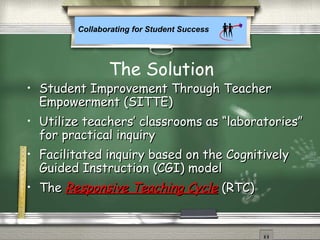
• Student Improvement Through TeacherStudent Improvement Through Teacher
Empowerment (SITTE)Empowerment (SITTE)
• Utilize teachers’ classrooms as “laboratories”Utilize teachers’ classrooms as “laboratories”
for practical inquiryfor practical inquiry
• Facilitated inquiry based on the CognitivelyFacilitated inquiry based on the Cognitively
Guided Instruction (CGI) modelGuided Instruction (CGI) model
• TheThe Responsive Teaching CycleResponsive Teaching Cycle (RTC)(RTC)
The Solution
Collaborating for Student Success
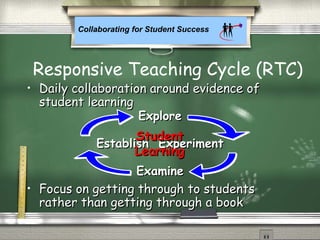
Responsive Teaching Cycle (RTC)
• Daily collaboration around evidence ofDaily collaboration around evidence of
student learningstudent learning
• Focus on getting through to studentsFocus on getting through to students
rather than getting through a bookrather than getting through a book
ExploreExplore
EstablishEstablish ExperimentExperiment
ExamineExamine
StudentStudent
LearningLearning
Collaborating for Student Success
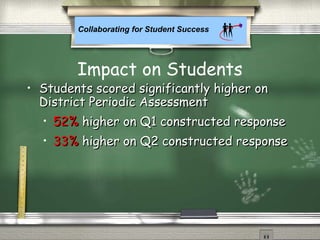
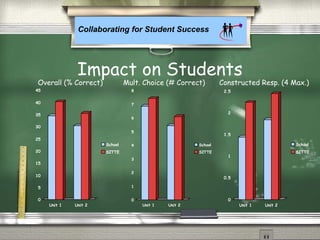
• Students scored significantly higher onStudents scored significantly higher on
District Periodic AssessmentDistrict Periodic Assessment
• 52%52% higher on Q1 constructed responsehigher on Q1 constructed response
• 33%33% higher on Q2 constructed responsehigher on Q2 constructed response
Impact on Students
Collaborating for Student Success
0
5
10
15
20
25
30
35
40
45
Unit 1 Unit 2
School
SITTE
0
1
2
3
4
5
6
7
8
Unit 1 Unit 2
School
SITTE
0
0.5
1
1.5
2
2.5
Unit 1 Unit 2
School
SITTE
Overall (% Correct) Mult. Choice (# Correct) Constructed Resp. (4 Max.)
Impact on Students
Collaborating for Student Success
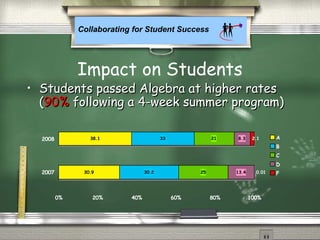
• Students passed Algebra at higher ratesStudents passed Algebra at higher rates
((90%90% following a 4-week summer program)following a 4-week summer program)
30.9
38.1
30.2
33
25
21
13.4
8.3
0.01
2.1
0% 20% 40% 60% 80% 100%
2007
2008 A
B
C
D
F
Impact on Students
Collaborating for Student Success
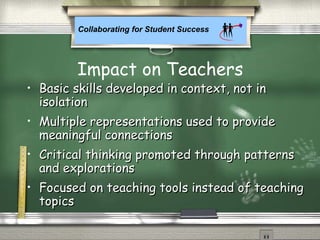
• Basic skills developed in context, not inBasic skills developed in context, not in
isolationisolation
• Multiple representations used to provideMultiple representations used to provide
meaningful connectionsmeaningful connections
• Critical thinking promoted through patternsCritical thinking promoted through patterns
and explorationsand explorations
• Focused on teaching tools instead of teachingFocused on teaching tools instead of teaching
topicstopics
Impact on Teachers
Collaborating for Student Success
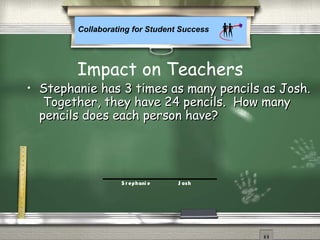
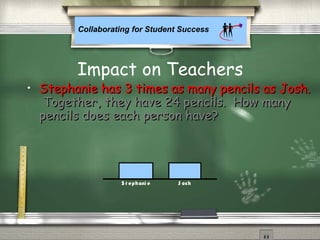
• Stephanie has 3 times as many pencils as Josh.Stephanie has 3 times as many pencils as Josh.
Together, they have 24 pencils. How manyTogether, they have 24 pencils. How many
pencils does each person have?pencils does each person have?
S t ephani e J osh
Impact on Teachers
Collaborating for Student Success
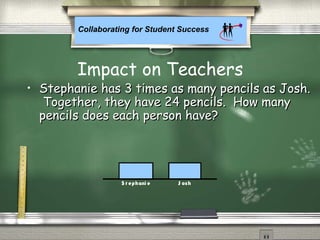
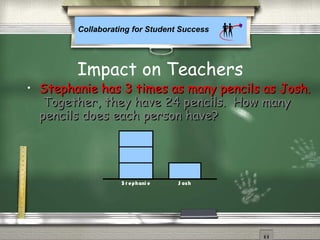
• Stephanie has 3 times as many pencils as Josh.Stephanie has 3 times as many pencils as Josh.
Together, they have 24 pencils. How manyTogether, they have 24 pencils. How many
pencils does each person have?pencils does each person have?
S t ephani e J osh
Impact on Teachers
Collaborating for Student Success
• Stephanie has 3 times as many pencils as Josh.Stephanie has 3 times as many pencils as Josh.
Together, they have 24 pencils. How manyTogether, they have 24 pencils. How many
pencils does each person have?pencils does each person have?
S t ephani e J osh
Impact on Teachers
Collaborating for Student Success
• Stephanie has 3 times as many pencils as Josh.Stephanie has 3 times as many pencils as Josh.
Together, they have 24 pencils. How manyTogether, they have 24 pencils. How many
pencils does each person have?pencils does each person have?
S t ephani e J osh
Impact on Teachers
Collaborating for Student Success
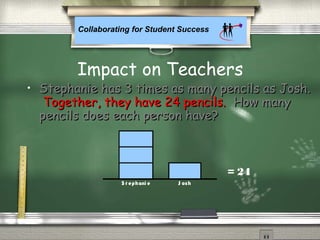
• Stephanie has 3 times as many pencils as Josh.Stephanie has 3 times as many pencils as Josh.
Together, they have 24 pencils.Together, they have 24 pencils. How manyHow many
pencils does each person have?pencils does each person have?
S t ephani e J osh
= 24
Impact on Teachers
Collaborating for Student Success
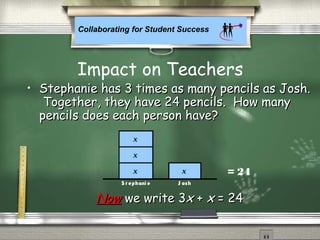
• Stephanie has 3 times as many pencils as Josh.Stephanie has 3 times as many pencils as Josh.
Together, they have 24 pencils. How manyTogether, they have 24 pencils. How many
pencils does each person have?pencils does each person have?
NowNow we write 3we write 3xx ++ xx = 24= 24
x
x
x x
S t ephani e J osh
= 24
Impact on Teachers
Collaborating for Student Success
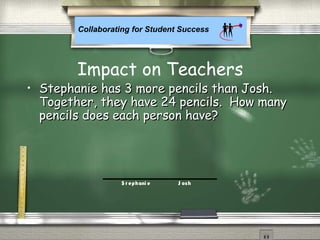
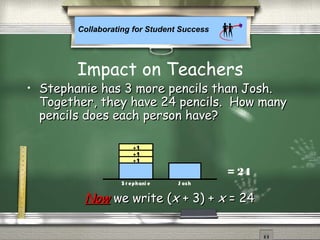
• Stephanie has 3 more pencils than Josh.Stephanie has 3 more pencils than Josh.
Together, they have 24 pencils. How manyTogether, they have 24 pencils. How many
pencils does each person have?pencils does each person have?
S t ephani e J osh
Impact on Teachers
Collaborating for Student Success
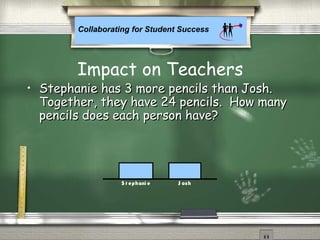
S t ephani e J osh
• Stephanie has 3 more pencils than Josh.Stephanie has 3 more pencils than Josh.
Together, they have 24 pencils. How manyTogether, they have 24 pencils. How many
pencils does each person have?pencils does each person have?
Impact on Teachers
Collaborating for Student Success
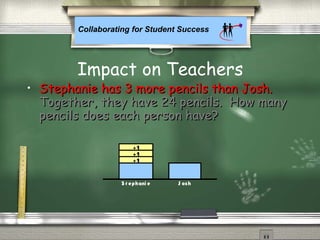
• Stephanie has 3 more pencils than Josh.Stephanie has 3 more pencils than Josh.
Together, they have 24 pencils. How manyTogether, they have 24 pencils. How many
pencils does each person have?pencils does each person have?
+1
+1
+1
S t ephani e J osh
Impact on Teachers
Collaborating for Student Success
+1
+1
+1
S t ephani e J osh
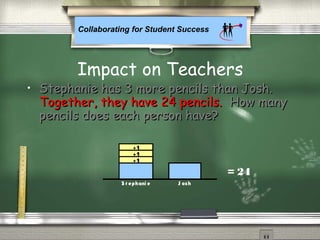
= 24
• Stephanie has 3 more pencils than Josh.Stephanie has 3 more pencils than Josh.
Together, they have 24 pencils.Together, they have 24 pencils. How manyHow many
pencils does each person have?pencils does each person have?
Impact on Teachers
Collaborating for Student Success
• Stephanie has 3 more pencils than Josh.Stephanie has 3 more pencils than Josh.
Together, they have 24 pencils. How manyTogether, they have 24 pencils. How many
pencils does each person have?pencils does each person have?
NowNow we write (we write (xx + 3) ++ 3) + xx = 24= 24
= 24
+1
+1
+1
S t ephani e J osh
Impact on Teachers
Collaborating for Student Success
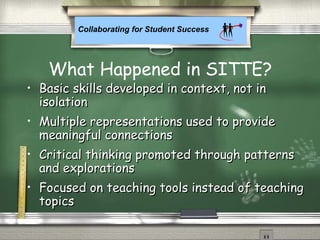
• Basic skills developed in context, not inBasic skills developed in context, not in
isolationisolation
• Multiple representations used to provideMultiple representations used to provide
meaningful connectionsmeaningful connections
• Critical thinking promoted through patternsCritical thinking promoted through patterns
and explorationsand explorations
• Focused on teaching tools instead of teachingFocused on teaching tools instead of teaching
topicstopics
What Happened in SITTE?
Collaborating for Student Success
How did SITTE Happen?
Changing teacher practiceChanging teacher practice
• Scrambled NumbersScrambled Numbers
• Following DirectionsFollowing Directions
Collaborating for Student Success
Changing teacher attitudesChanging teacher attitudes
• Consideration of local school contexts andConsideration of local school contexts and
teachers’ actual situationsteachers’ actual situations
• Focusing on student learning rather than onFocusing on student learning rather than on
teacher improvementteacher improvement
• Providing resources rather than mandatingProviding resources rather than mandating
particular strategies or curriculaparticular strategies or curricula
• Using teacher knowledge to generate solutionsUsing teacher knowledge to generate solutions
Respect &
Trust
Respect &
Trust
How did SITTE Happen?
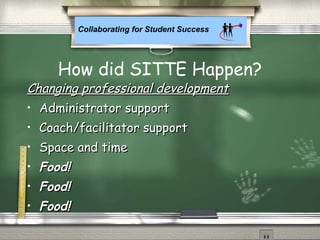
Collaborating for Student Success
Changing professional developmentChanging professional development
• Administrator supportAdministrator support
• Coach/facilitator supportCoach/facilitator support
• Space and timeSpace and time
• Food!Food!
• Food!Food!
• Food!Food!
How did SITTE Happen?
Collaborating for Student Success
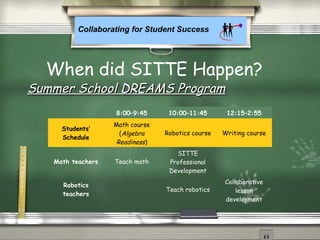
Summer School DREAMS ProgramSummer School DREAMS Program
8:00–9:45 10:00–11:45 12:15–2:55
Students’
Schedule
Math course
(Algebra
Readiness)
Robotics course Writing course
Math teachers Teach math
SITTE
Professional
Development
Robotics
teachers
Teach robotics
Collaborative
lesson
development
When did SITTE Happen?
Collaborating for Student Success
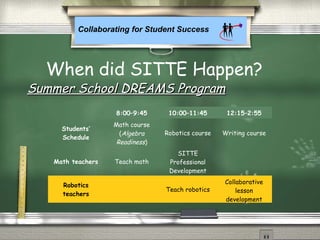
Summer School DREAMS ProgramSummer School DREAMS Program
8:00–9:45 10:00–11:45 12:15–2:55
Students’
Schedule
Math course
(Algebra
Readiness)
Robotics course Writing course
Math teachers Teach math
SITTE
Professional
Development
Robotics
teachers
Teach robotics
Collaborative
lesson
development
When did SITTE Happen?
Collaborating for Student Success
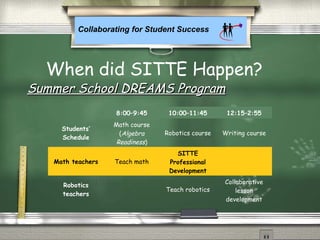
Summer School DREAMS ProgramSummer School DREAMS Program
8:00–9:45 10:00–11:45 12:15–2:55
Students’
Schedule
Math course
(Algebra
Readiness)
Robotics course Writing course
Math teachers Teach math
SITTE
Professional
Development
Robotics
teachers
Teach robotics
Collaborative
lesson
development
When did SITTE Happen?
Collaborating for Student Success
Common Conference PeriodCommon Conference Period
• 4 Teachers4 Teachers
• 55 Student TeachersStudent Teachers
• Google SitesGoogle Sites
• 4 x 4 schedule next year in two schools4 x 4 schedule next year in two schools
When did SITTE Happen?
Collaborating for Student Success
After SchoolAfter School
• Twice per weekTwice per week
• Coffee HouseCoffee House
• QEIA fundedQEIA funded
When did SITTE Happen?
Collaborating for Student Success
• Teachers & administrators unsure of benefitsTeachers & administrators unsure of benefits
• Teachers afraid of additional burden on timeTeachers afraid of additional burden on time
• Teachers distracted by other PD commitmentsTeachers distracted by other PD commitments
• Teachers unfamiliar with alternate teachingTeachers unfamiliar with alternate teaching
strategiesstrategies
• Teachers lack opportunities to engage inTeachers lack opportunities to engage in
alternate teaching strategiesalternate teaching strategies
Possible Roadblocks to SITTE
Collaborating for Student Success
When we reconvene:When we reconvene:
• Inventory of current collaborative effortsInventory of current collaborative efforts
• Identification of tasks that need to be done inIdentification of tasks that need to be done in
order to set up collaboration timeorder to set up collaboration time
• Discussion of creative strategies to provideDiscussion of creative strategies to provide
opportunities for teacher collaborationopportunities for teacher collaboration
LUNCH :)
Collaborating for Student Success
What’s Happening?
• What is the current state of collaboration atWhat is the current state of collaboration at
your school or district?your school or district?
• What are your goals? How do you envisionWhat are your goals? How do you envision
collaboration at your school?collaboration at your school?
• What are the barriers/supports that exist?What are the barriers/supports that exist?
• Time?Time?
• Money?Money?
• Motivation/resistance?Motivation/resistance?
Collaborating for Student Success
• Where can teacher collaboration occur?Where can teacher collaboration occur?
• When can teacher collaboration occur?When can teacher collaboration occur?
• How can teacher collaboration occur?How can teacher collaboration occur?
• Who can help teacher collaboration to occur?Who can help teacher collaboration to occur?
How Will it Happen?
Collaborating for Student Success
• Who are the key people that need to beWho are the key people that need to be
involved?involved?
• TeachersTeachers
• AdministratorsAdministrators
• Outside partnersOutside partners
• What are the key tasks that need to be done?What are the key tasks that need to be done?
• What is the timeline for implementation?What is the timeline for implementation?
Making It Happen
Collaborating for Student Success
Thank YouThank You
For Your ParticipationFor Your Participation
ARCHES SeminarARCHES Seminar
UC Irvine ~ 3/15/10UC Irvine ~ 3/15/10
Ivan ChengIvan Cheng icheng@csun.eduicheng@csun.edu
Collaborating for Student Success
BackBack
Collaborating for Student Success
BackBack
Collaborating for Student Success
BackBack
Collaborating for Student Success

Teacher collaboration

  • 1.
    Collaborating for StudentSuccess Teacher Collaboration:Teacher Collaboration: Strategies & OutcomesStrategies & Outcomes ARCHES SeminarARCHES Seminar UC Irvine ~ 3/15/10UC Irvine ~ 3/15/10 Ivan ChengIvan Cheng icheng@csun.eduicheng@csun.edu
  • 2.
    Collaborating for StudentSuccess ““The majority of students did not pass [algebra]The majority of students did not pass [algebra] in eighth or ninth grades, and roughly two-in eighth or ninth grades, and roughly two- thirds of them failed to graduate on time.”thirds of them failed to graduate on time.” The Context Los Angeles Times, June 21, 2008Los Angeles Times, June 21, 2008
  • 3.
    Collaborating for StudentSuccess ““To improve their mathematics instruction,To improve their mathematics instruction, teachers must be able to analyze what theyteachers must be able to analyze what they and their students are doing and consider howand their students are doing and consider how those actions are affecting students’those actions are affecting students’ learning.”learning.” The Context NCTM Principles and Standards, p. 18NCTM Principles and Standards, p. 18
  • 4.
    Collaborating for StudentSuccess The Context ””Teachers learn well just as students do –Teachers learn well just as students do – by studying, doing, and reflecting;by studying, doing, and reflecting; by collaborating with other teachers;by collaborating with other teachers; by looking closely at students and their work;by looking closely at students and their work; and by sharing what they see.”and by sharing what they see.” Darling-Hammond (1999), p. 12Darling-Hammond (1999), p. 12 by collaborating with other teachersby collaborating with other teachers
  • 5.
    Collaborating for StudentSuccess Two thirds of teachers (67%) and threeTwo thirds of teachers (67%) and three quarters of principals (78%) think thatquarters of principals (78%) think that teacher collaboration would have a majorteacher collaboration would have a major impact on student achievement.impact on student achievement. MetLife Survey of the American Teacher 2009MetLife Survey of the American Teacher 2009 The Context
  • 6.
    Collaborating for StudentSuccess The Benefits • Greater collective responsibility for studentGreater collective responsibility for student learninglearning • Higher levels of trust between teachers andHigher levels of trust between teachers and administratorsadministrators • Greater job satisfactionGreater job satisfaction MetLife Survey of the American Teacher 2009MetLife Survey of the American Teacher 2009
  • 7.
    Collaborating for StudentSuccess Types of Collaboration • Department meetingsDepartment meetings • Interdisciplinary meetingsInterdisciplinary meetings • Professional learning communitiesProfessional learning communities • Coaching and mentoringCoaching and mentoring • Lesson studyLesson study • ““Learning Teams” (Pearson)Learning Teams” (Pearson)
  • 8.
    Collaborating for StudentSuccess The Problem ””The environments in which most teachers workThe environments in which most teachers work have been structured in ways that actuallyhave been structured in ways that actually work against the kind of sustainedwork against the kind of sustained collaboration that we have suggested iscollaboration that we have suggested is needed for significant and steadyneeded for significant and steady improvement.”improvement.” Stigler & Hiebert (1999), p. 172Stigler & Hiebert (1999), p. 172
  • 9.
    Collaborating for StudentSuccess • Department meetingsDepartment meetings • Interdisciplinary meetingsInterdisciplinary meetings • Professional learning communitiesProfessional learning communities • Coaching and mentoringCoaching and mentoring • Lesson studyLesson study • ““Learning Teams” (Pearson)Learning Teams” (Pearson) The Problem Not Often Not Often Enough! Enough!
  • 10.
    Collaborating for StudentSuccess • Student Improvement Through TeacherStudent Improvement Through Teacher Empowerment (SITTE)Empowerment (SITTE) • Utilize teachers’ classrooms as “laboratories”Utilize teachers’ classrooms as “laboratories” for practical inquiryfor practical inquiry • Facilitated inquiry based on the CognitivelyFacilitated inquiry based on the Cognitively Guided Instruction (CGI) modelGuided Instruction (CGI) model • TheThe Responsive Teaching CycleResponsive Teaching Cycle (RTC)(RTC) The Solution
  • 11.
    Collaborating for StudentSuccess Responsive Teaching Cycle (RTC) • Daily collaboration around evidence ofDaily collaboration around evidence of student learningstudent learning • Focus on getting through to studentsFocus on getting through to students rather than getting through a bookrather than getting through a book ExploreExplore EstablishEstablish ExperimentExperiment ExamineExamine StudentStudent LearningLearning
  • 12.
    Collaborating for StudentSuccess • Students scored significantly higher onStudents scored significantly higher on District Periodic AssessmentDistrict Periodic Assessment • 52%52% higher on Q1 constructed responsehigher on Q1 constructed response • 33%33% higher on Q2 constructed responsehigher on Q2 constructed response Impact on Students
  • 13.
    Collaborating for StudentSuccess 0 5 10 15 20 25 30 35 40 45 Unit 1 Unit 2 School SITTE 0 1 2 3 4 5 6 7 8 Unit 1 Unit 2 School SITTE 0 0.5 1 1.5 2 2.5 Unit 1 Unit 2 School SITTE Overall (% Correct) Mult. Choice (# Correct) Constructed Resp. (4 Max.) Impact on Students
  • 14.
    Collaborating for StudentSuccess • Students passed Algebra at higher ratesStudents passed Algebra at higher rates ((90%90% following a 4-week summer program)following a 4-week summer program) 30.9 38.1 30.2 33 25 21 13.4 8.3 0.01 2.1 0% 20% 40% 60% 80% 100% 2007 2008 A B C D F Impact on Students
  • 15.
    Collaborating for StudentSuccess • Basic skills developed in context, not inBasic skills developed in context, not in isolationisolation • Multiple representations used to provideMultiple representations used to provide meaningful connectionsmeaningful connections • Critical thinking promoted through patternsCritical thinking promoted through patterns and explorationsand explorations • Focused on teaching tools instead of teachingFocused on teaching tools instead of teaching topicstopics Impact on Teachers
  • 16.
    Collaborating for StudentSuccess • Stephanie has 3 times as many pencils as Josh.Stephanie has 3 times as many pencils as Josh. Together, they have 24 pencils. How manyTogether, they have 24 pencils. How many pencils does each person have?pencils does each person have? S t ephani e J osh Impact on Teachers
  • 17.
    Collaborating for StudentSuccess • Stephanie has 3 times as many pencils as Josh.Stephanie has 3 times as many pencils as Josh. Together, they have 24 pencils. How manyTogether, they have 24 pencils. How many pencils does each person have?pencils does each person have? S t ephani e J osh Impact on Teachers
  • 18.
    Collaborating for StudentSuccess • Stephanie has 3 times as many pencils as Josh.Stephanie has 3 times as many pencils as Josh. Together, they have 24 pencils. How manyTogether, they have 24 pencils. How many pencils does each person have?pencils does each person have? S t ephani e J osh Impact on Teachers
  • 19.
    Collaborating for StudentSuccess • Stephanie has 3 times as many pencils as Josh.Stephanie has 3 times as many pencils as Josh. Together, they have 24 pencils. How manyTogether, they have 24 pencils. How many pencils does each person have?pencils does each person have? S t ephani e J osh Impact on Teachers
  • 20.
    Collaborating for StudentSuccess • Stephanie has 3 times as many pencils as Josh.Stephanie has 3 times as many pencils as Josh. Together, they have 24 pencils.Together, they have 24 pencils. How manyHow many pencils does each person have?pencils does each person have? S t ephani e J osh = 24 Impact on Teachers
  • 21.
    Collaborating for StudentSuccess • Stephanie has 3 times as many pencils as Josh.Stephanie has 3 times as many pencils as Josh. Together, they have 24 pencils. How manyTogether, they have 24 pencils. How many pencils does each person have?pencils does each person have? NowNow we write 3we write 3xx ++ xx = 24= 24 x x x x S t ephani e J osh = 24 Impact on Teachers
  • 22.
    Collaborating for StudentSuccess • Stephanie has 3 more pencils than Josh.Stephanie has 3 more pencils than Josh. Together, they have 24 pencils. How manyTogether, they have 24 pencils. How many pencils does each person have?pencils does each person have? S t ephani e J osh Impact on Teachers
  • 23.
    Collaborating for StudentSuccess S t ephani e J osh • Stephanie has 3 more pencils than Josh.Stephanie has 3 more pencils than Josh. Together, they have 24 pencils. How manyTogether, they have 24 pencils. How many pencils does each person have?pencils does each person have? Impact on Teachers
  • 24.
    Collaborating for StudentSuccess • Stephanie has 3 more pencils than Josh.Stephanie has 3 more pencils than Josh. Together, they have 24 pencils. How manyTogether, they have 24 pencils. How many pencils does each person have?pencils does each person have? +1 +1 +1 S t ephani e J osh Impact on Teachers
  • 25.
    Collaborating for StudentSuccess +1 +1 +1 S t ephani e J osh = 24 • Stephanie has 3 more pencils than Josh.Stephanie has 3 more pencils than Josh. Together, they have 24 pencils.Together, they have 24 pencils. How manyHow many pencils does each person have?pencils does each person have? Impact on Teachers
  • 26.
    Collaborating for StudentSuccess • Stephanie has 3 more pencils than Josh.Stephanie has 3 more pencils than Josh. Together, they have 24 pencils. How manyTogether, they have 24 pencils. How many pencils does each person have?pencils does each person have? NowNow we write (we write (xx + 3) ++ 3) + xx = 24= 24 = 24 +1 +1 +1 S t ephani e J osh Impact on Teachers
  • 27.
    Collaborating for StudentSuccess • Basic skills developed in context, not inBasic skills developed in context, not in isolationisolation • Multiple representations used to provideMultiple representations used to provide meaningful connectionsmeaningful connections • Critical thinking promoted through patternsCritical thinking promoted through patterns and explorationsand explorations • Focused on teaching tools instead of teachingFocused on teaching tools instead of teaching topicstopics What Happened in SITTE?
  • 28.
    Collaborating for StudentSuccess How did SITTE Happen? Changing teacher practiceChanging teacher practice • Scrambled NumbersScrambled Numbers • Following DirectionsFollowing Directions
  • 29.
    Collaborating for StudentSuccess Changing teacher attitudesChanging teacher attitudes • Consideration of local school contexts andConsideration of local school contexts and teachers’ actual situationsteachers’ actual situations • Focusing on student learning rather than onFocusing on student learning rather than on teacher improvementteacher improvement • Providing resources rather than mandatingProviding resources rather than mandating particular strategies or curriculaparticular strategies or curricula • Using teacher knowledge to generate solutionsUsing teacher knowledge to generate solutions Respect & Trust Respect & Trust How did SITTE Happen?
  • 30.
    Collaborating for StudentSuccess Changing professional developmentChanging professional development • Administrator supportAdministrator support • Coach/facilitator supportCoach/facilitator support • Space and timeSpace and time • Food!Food! • Food!Food! • Food!Food! How did SITTE Happen?
  • 31.
    Collaborating for StudentSuccess Summer School DREAMS ProgramSummer School DREAMS Program 8:00–9:45 10:00–11:45 12:15–2:55 Students’ Schedule Math course (Algebra Readiness) Robotics course Writing course Math teachers Teach math SITTE Professional Development Robotics teachers Teach robotics Collaborative lesson development When did SITTE Happen?
  • 32.
    Collaborating for StudentSuccess Summer School DREAMS ProgramSummer School DREAMS Program 8:00–9:45 10:00–11:45 12:15–2:55 Students’ Schedule Math course (Algebra Readiness) Robotics course Writing course Math teachers Teach math SITTE Professional Development Robotics teachers Teach robotics Collaborative lesson development When did SITTE Happen?
  • 33.
    Collaborating for StudentSuccess Summer School DREAMS ProgramSummer School DREAMS Program 8:00–9:45 10:00–11:45 12:15–2:55 Students’ Schedule Math course (Algebra Readiness) Robotics course Writing course Math teachers Teach math SITTE Professional Development Robotics teachers Teach robotics Collaborative lesson development When did SITTE Happen?
  • 34.
    Collaborating for StudentSuccess Common Conference PeriodCommon Conference Period • 4 Teachers4 Teachers • 55 Student TeachersStudent Teachers • Google SitesGoogle Sites • 4 x 4 schedule next year in two schools4 x 4 schedule next year in two schools When did SITTE Happen?
  • 35.
    Collaborating for StudentSuccess After SchoolAfter School • Twice per weekTwice per week • Coffee HouseCoffee House • QEIA fundedQEIA funded When did SITTE Happen?
  • 36.
    Collaborating for StudentSuccess • Teachers & administrators unsure of benefitsTeachers & administrators unsure of benefits • Teachers afraid of additional burden on timeTeachers afraid of additional burden on time • Teachers distracted by other PD commitmentsTeachers distracted by other PD commitments • Teachers unfamiliar with alternate teachingTeachers unfamiliar with alternate teaching strategiesstrategies • Teachers lack opportunities to engage inTeachers lack opportunities to engage in alternate teaching strategiesalternate teaching strategies Possible Roadblocks to SITTE
  • 37.
    Collaborating for StudentSuccess When we reconvene:When we reconvene: • Inventory of current collaborative effortsInventory of current collaborative efforts • Identification of tasks that need to be done inIdentification of tasks that need to be done in order to set up collaboration timeorder to set up collaboration time • Discussion of creative strategies to provideDiscussion of creative strategies to provide opportunities for teacher collaborationopportunities for teacher collaboration LUNCH :)
  • 38.
    Collaborating for StudentSuccess What’s Happening? • What is the current state of collaboration atWhat is the current state of collaboration at your school or district?your school or district? • What are your goals? How do you envisionWhat are your goals? How do you envision collaboration at your school?collaboration at your school? • What are the barriers/supports that exist?What are the barriers/supports that exist? • Time?Time? • Money?Money? • Motivation/resistance?Motivation/resistance?
  • 39.
    Collaborating for StudentSuccess • Where can teacher collaboration occur?Where can teacher collaboration occur? • When can teacher collaboration occur?When can teacher collaboration occur? • How can teacher collaboration occur?How can teacher collaboration occur? • Who can help teacher collaboration to occur?Who can help teacher collaboration to occur? How Will it Happen?
  • 40.
    Collaborating for StudentSuccess • Who are the key people that need to beWho are the key people that need to be involved?involved? • TeachersTeachers • AdministratorsAdministrators • Outside partnersOutside partners • What are the key tasks that need to be done?What are the key tasks that need to be done? • What is the timeline for implementation?What is the timeline for implementation? Making It Happen
  • 41.
    Collaborating for StudentSuccess Thank YouThank You For Your ParticipationFor Your Participation ARCHES SeminarARCHES Seminar UC Irvine ~ 3/15/10UC Irvine ~ 3/15/10 Ivan ChengIvan Cheng icheng@csun.eduicheng@csun.edu
  • 42.
  • 43.
    Collaborating for StudentSuccess BackBack
  • 44.
    Collaborating for StudentSuccess BackBack
  • 45.
    Collaborating for StudentSuccess BackBack
  • 46.

Editor's Notes

  • #10 Not enough time. Not often enough.
  • #12 Many reform efforts using “data” fail to improve student achievement because the analysis only identifies what students know or don’t know. Teachers need opportunities to examine why their students are not understanding or struggling. Furthermore, they need opportunities to explore how to provide the necessary supports to help their students succeed. The Responsive Teaching Cycle allows teachers to focus on student thinking as the starting point of collaboration with student achievement in specific areas as the destination of each cycle. Samples of teacher produced lessons will illustrate this cycle.
  • #13 Q2 Overall Scores (% Correct) School 30.31130064 (n = 469) SITTE 35.56617647 (n = 272) (17%  over School) Partial 31.05882353 (n = 425) Q2 MC Scores (No. Correct) School 5.436759062 SITTE 6.096544118 (12%  over School) Partial 5.512 Q2 CR Scores (Out of 4 Max.) School 1.837953092 SITTE 2.439338235 (33%  over School) Partial 1.942117647
  • #14 Q2 Overall Scores (% Correct) School 30.31130064 (n = 469) SITTE 35.56617647 (n = 272) (17%  over School) Partial 31.05882353 (n = 425) Q2 MC Scores (No. Correct) School 5.436759062 SITTE 6.096544118 (12%  over School) Partial 5.512 Q2 CR Scores (Out of 4 Max.) School 1.837953092 SITTE 2.439338235 (33%  over School) Partial 1.942117647
  • #15 In 2007, 86% passed algebra (61% with A or B) In 2008, 90% passed algebra (71% with A or B)
  • #16 Traditional teachers became open minded and willing to take risks. Their focus moved from content coverage to student understanding. Hand out packet of sample worksheets created by teachers. Note the rigor of the activities.
  • #28 Teachers became open minded and willing to take risks. Their focus moved from content coverage to student understanding.
  • #29 Explain HOW new teaching practices were presented to teachers! Scrambled Numbers to illustrate the need to help organize content to promote sense-making Serenade to illustrate the need to use multiple representations Following Directions to illustrate the difference between instrumental understanding and relational understanding
  • #30 Key features of SITTE: Respect teachers’ professional experience and knowledge Trust teachers’ professional judgment
  • #31 Key features of SITTE: Respect teachers’ professional experience and knowledge Trust teachers’ professional judgment
  • #32 Key features of SITTE: Respect teachers’ professional experience and knowledge Trust teachers’ professional judgment
  • #33 Key features of SITTE: Respect teachers’ professional experience and knowledge Trust teachers’ professional judgment
  • #34 Key features of SITTE: Respect teachers’ professional experience and knowledge Trust teachers’ professional judgment
  • #35 Key features of SITTE: Respect teachers’ professional experience and knowledge Trust teachers’ professional judgment
  • #36 Key features of SITTE: Respect teachers’ professional experience and knowledge Trust teachers’ professional judgment
  • #37 Key features of SITTE: Respect teachers’ professional experience and knowledge Trust teachers’ professional judgment
  • #38 Key features of SITTE: Respect teachers’ professional experience and knowledge Trust teachers’ professional judgment