By:
Elizabeth Bove , Joy Holbrook, Darby Koteff, Jessica
            Moreman, & Valerie Powell
“In research, in medicine, in
     manufacturing, and even in
technology, collaboration is becoming
             the norm.”
 Click the link below to see how collaboration can make
 a large task seem very small.


          http://www.youtube.com/watch?v=PF8oc5n
          P6jI
We will discuss four different ways
educators can utilize collaboration:
       Grade Level Collaboration
       Co-Teaching
       Cross-Curricular Collaboration
       Student Collaboration
Grade Level Collaboration
Grade level Collaboration involves working with the
  other teachers in your grade level to develop and
               implement instruction.
Teachers should work with other teachers to make
 connections between and among disciplines (Kentucky
                   Department of Education, 2011).
Teachers utilize one another when
   effectively using grade level
           collaboration.
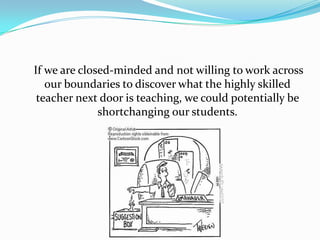
If we are closed-minded and not willing to work across
   our boundaries to discover what the highly skilled
 teacher next door is teaching, we could potentially be
              shortchanging our students.
Co-Teaching
 Collaborative teaching is defined as “the preferred
 umbrella term for the joint efforts of two certified
 teachers with different areas of expertise….partnering
 to share responsibility for
 designing, delivering, monitoring and evaluating
 instruction for a diverse group of learners in general
 education classes” Kentucky Department of Education (KDE): Collaborative Teaching Practices
 for Exceptional Children, June 2011.
Co-Teaching Models
 There are five defined co-teaching models, University of Kansas
  Center for Research on Learning: Content Enhancement, Fall 2004.


    One teach, One assist
    Station Teaching
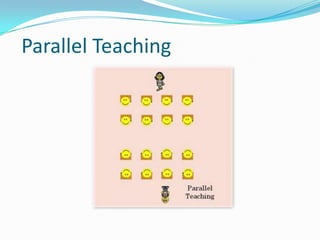
    Parallel Teaching
    Alternative Teaching
    Team Teaching
One Teach, One Assist
Station Teaching
Parallel Teaching
Alternative Teaching
Team Teaching
Benefits of Co-Teaching
1. Brings together teachers’ expertise to meet the needs of all
    the students in the classroom (Austin, 2001).

2. Allows for more instructional options in the classroom and
   reduces the student-teacher ratio, therefore potentially
   improves classroom management (Magiera & Zigmond, 2005).

3. Disabled students felt a greater sense of pride and
   capability. Walther-Thomas (1997)

4. Creates high expectations and a positive climate for all of
  the students in the classroom. Dieker (2001)
 “Planning instructional strategies and activities that
  facilitate multiple levels of learning”

 “Identifying students whose learning could be
  enhanced by collaboration”

 “Designing a plan to enhance student learning that
  includes all parties in the collaborative effort.”
Cross-Curricular Collaboration
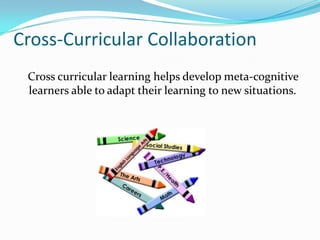
 Cross curricular learning helps develop meta-cognitive
 learners able to adapt their learning to new situations.
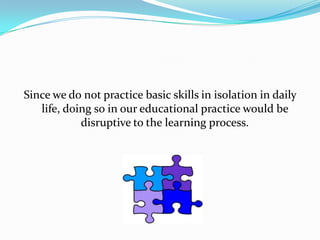
Since we do not practice basic skills in isolation in daily
   life, doing so in our educational practice would be
            disruptive to the learning process.
According to the National Assessment of Educational
     Progress, while students are learning the basic
information in core subject areas, they are not learning
  to apply their knowledge effectively in thinking and
               reasoning (Applebee, Langer, & Mullis, 1989).
Making Connections
 Interdisciplinary/cross-curricular teaching provides a
  meaningful way in which students can use knowledge
   they have learned in one context as a knowledge base
  in other contexts in and out of school (Collins, Brown, & Newman, 1989).
Increase Student Motivation
 Interdisciplinary/cross-curricular teaching can also
  increase students' motivation for learning and their
              level of engagement. (Resnick, 1989).
Time Management

 Curriculum integration maximizes the utilization of
 learning time by “borrowing” from one area to support
                    another. (Timmons,2012)
Student Collaboration
It is our responsibility to give our students opportunities
     to collaborate in teams, small groups or in pairs on
                          assignments
How
 There are many ways this can be done ranging from
 basic things such as the arrangement of desks in a
 classroom to more intentional things such as
 providing academic opportunities throughout the year
 to provide practice for students to work together
 collaboratively.
According to Wagner, “[o]ne of the lessons we learned
 quickly was that the hardest thing to change was the
            behavior of employees” (2008, p. 23).
In order to equip our students for the future that awaits
   them. We need to take advantage of collaboration in
  all areas of teaching; within the classroom and among
    the professionals in our schools. The future for our
      students is unknown, but we can be certain that
  collaboration is a skill that they will need to possess in
   order to have a fighting chance to adapt to the world
                   that is waiting for them.
References
   Applebee, A.N., Langer, J.A., & Mullis, I.V. (1989). Crossroads in American education: A summary of findings: Educational Testing Service. Princeton, NJ.

   Austin, V. L. (2001). Teachers’ beliefs about co-teaching. Remedial and Special Education, 22, 245-255.

   Barton, K.C. & Smith, L.A. (September 2000). Themes or motifs? Aiming for coherence through interdisciplinary outlines. The Reading Teacher, 54(1), 54 – 63.

   Brophy, J. & Alleman, J. (October 1991). A caveat: Curriculum integration isn’t always a good idea. Educational Leadership, 49(2), 66

   Ciccorico, E. W. 1970. Integration in the curriculum. Main Currents in Modern Thought 27 (November/December):60–62.

   Collins, A., Brown, J.S., & Newman, S.E. (1989). Cognitive apprenticeship: Teaching the crafts of reading, writing, and mathematics. In L. Resnick (Ed.), Knowledge, learning and

                  instruction: Essays in honor of Robert Glaser (453-494). Hillsdale, NJ: Erlbaum.

   Dieker, L. A. (2001). What are the characteristics of “effective” middle and high school co-taught teams for students with disabilities? Preventing School Failure, 46, 14-23.

   Gatewood, T. (March 1998). How valid is integrated curriculum in today’s middle school? Middle School Journal, 29(4), 38 - 41.

   Georgetown College Conceptual Framework Outcomes, Standards, and Indicators (2011).

   Kentucky Department of Education, Division of Learning Services, Collaborative Teaching Practices for Exceptional Children, Question and Answer Document (June 2011).

   Kentucky Department of Education. (2011). HETL common characteristics. Retrieved from http://www.education.ky.gov/KDE/Instructional Resources/Highly Effective

                  Teaching and Learning/HETL Common Characteristics.tm.

   Magiera, K., & Zigmond, N. (2005). Co-teaching in middle school classrooms under routine conditions: Does the instructional experiences differ for students with disabilities in

                  co-taught and solo-taught classes? Learning Disabilities Research and Practice, 20, 79-85.

   Resnick, L.B. (Ed.) (1989). Introduction. In Knowing, learning and instruction: Essays in honor of Robert Glaser (1-24). Hillsdale, NJ: Erlbaum.

   Timmons, Jess “What’s the Big Deal?- Why Cross-Curricular Collaboration is so Darn Good For Kids. Retrieved June 3, 2012 from

                  http://pricetimmons.blogspot.com/2007/07/so-whats-big-deal-anyways.html

   University of Kansas, Center for Research on Learning: Content Enhancement-Concept Comparison Routine (Fall, 2004).

   Wagner, T. (2008). The Global Achievement Gap. New York, NY: Basic Books.

   Walther-Thomas, C. S. (1997). Co-teaching experiences: The benefits and problems that teachers and principals report over time. Journal of Learning Disabilities, 30, 395-408.

Collaboration in education2

  • 1.
    By: Elizabeth Bove ,Joy Holbrook, Darby Koteff, Jessica Moreman, & Valerie Powell
  • 2.
    “In research, inmedicine, in manufacturing, and even in technology, collaboration is becoming the norm.”
  • 3.
     Click thelink below to see how collaboration can make a large task seem very small. http://www.youtube.com/watch?v=PF8oc5n P6jI
  • 4.
    We will discussfour different ways educators can utilize collaboration:  Grade Level Collaboration  Co-Teaching  Cross-Curricular Collaboration  Student Collaboration
  • 5.
    Grade Level Collaboration Gradelevel Collaboration involves working with the other teachers in your grade level to develop and implement instruction.
  • 6.
    Teachers should workwith other teachers to make connections between and among disciplines (Kentucky Department of Education, 2011).
  • 7.
    Teachers utilize oneanother when effectively using grade level collaboration.
  • 8.
    If we areclosed-minded and not willing to work across our boundaries to discover what the highly skilled teacher next door is teaching, we could potentially be shortchanging our students.
  • 9.
    Co-Teaching  Collaborative teachingis defined as “the preferred umbrella term for the joint efforts of two certified teachers with different areas of expertise….partnering to share responsibility for designing, delivering, monitoring and evaluating instruction for a diverse group of learners in general education classes” Kentucky Department of Education (KDE): Collaborative Teaching Practices for Exceptional Children, June 2011.
  • 10.
    Co-Teaching Models  Thereare five defined co-teaching models, University of Kansas Center for Research on Learning: Content Enhancement, Fall 2004.  One teach, One assist  Station Teaching  Parallel Teaching  Alternative Teaching  Team Teaching
  • 11.
  • 12.
  • 13.
  • 14.
  • 15.
  • 16.
    Benefits of Co-Teaching 1.Brings together teachers’ expertise to meet the needs of all the students in the classroom (Austin, 2001). 2. Allows for more instructional options in the classroom and reduces the student-teacher ratio, therefore potentially improves classroom management (Magiera & Zigmond, 2005). 3. Disabled students felt a greater sense of pride and capability. Walther-Thomas (1997) 4. Creates high expectations and a positive climate for all of the students in the classroom. Dieker (2001)
  • 17.
     “Planning instructionalstrategies and activities that facilitate multiple levels of learning”  “Identifying students whose learning could be enhanced by collaboration”  “Designing a plan to enhance student learning that includes all parties in the collaborative effort.”
  • 18.
    Cross-Curricular Collaboration Crosscurricular learning helps develop meta-cognitive learners able to adapt their learning to new situations.
  • 19.
    Since we donot practice basic skills in isolation in daily life, doing so in our educational practice would be disruptive to the learning process.
  • 20.
    According to theNational Assessment of Educational Progress, while students are learning the basic information in core subject areas, they are not learning to apply their knowledge effectively in thinking and reasoning (Applebee, Langer, & Mullis, 1989).
  • 21.
    Making Connections Interdisciplinary/cross-curricularteaching provides a meaningful way in which students can use knowledge they have learned in one context as a knowledge base in other contexts in and out of school (Collins, Brown, & Newman, 1989).
  • 22.
    Increase Student Motivation Interdisciplinary/cross-curricular teaching can also increase students' motivation for learning and their level of engagement. (Resnick, 1989).
  • 23.
    Time Management Curriculumintegration maximizes the utilization of learning time by “borrowing” from one area to support another. (Timmons,2012)
  • 24.
    Student Collaboration It isour responsibility to give our students opportunities to collaborate in teams, small groups or in pairs on assignments
  • 25.
    How  There aremany ways this can be done ranging from basic things such as the arrangement of desks in a classroom to more intentional things such as providing academic opportunities throughout the year to provide practice for students to work together collaboratively.
  • 26.
    According to Wagner,“[o]ne of the lessons we learned quickly was that the hardest thing to change was the behavior of employees” (2008, p. 23).
  • 27.
    In order toequip our students for the future that awaits them. We need to take advantage of collaboration in all areas of teaching; within the classroom and among the professionals in our schools. The future for our students is unknown, but we can be certain that collaboration is a skill that they will need to possess in order to have a fighting chance to adapt to the world that is waiting for them.
  • 28.
    References  Applebee, A.N., Langer, J.A., & Mullis, I.V. (1989). Crossroads in American education: A summary of findings: Educational Testing Service. Princeton, NJ.  Austin, V. L. (2001). Teachers’ beliefs about co-teaching. Remedial and Special Education, 22, 245-255.  Barton, K.C. & Smith, L.A. (September 2000). Themes or motifs? Aiming for coherence through interdisciplinary outlines. The Reading Teacher, 54(1), 54 – 63.  Brophy, J. & Alleman, J. (October 1991). A caveat: Curriculum integration isn’t always a good idea. Educational Leadership, 49(2), 66  Ciccorico, E. W. 1970. Integration in the curriculum. Main Currents in Modern Thought 27 (November/December):60–62.  Collins, A., Brown, J.S., & Newman, S.E. (1989). Cognitive apprenticeship: Teaching the crafts of reading, writing, and mathematics. In L. Resnick (Ed.), Knowledge, learning and instruction: Essays in honor of Robert Glaser (453-494). Hillsdale, NJ: Erlbaum.  Dieker, L. A. (2001). What are the characteristics of “effective” middle and high school co-taught teams for students with disabilities? Preventing School Failure, 46, 14-23.  Gatewood, T. (March 1998). How valid is integrated curriculum in today’s middle school? Middle School Journal, 29(4), 38 - 41.  Georgetown College Conceptual Framework Outcomes, Standards, and Indicators (2011).  Kentucky Department of Education, Division of Learning Services, Collaborative Teaching Practices for Exceptional Children, Question and Answer Document (June 2011).  Kentucky Department of Education. (2011). HETL common characteristics. Retrieved from http://www.education.ky.gov/KDE/Instructional Resources/Highly Effective Teaching and Learning/HETL Common Characteristics.tm.  Magiera, K., & Zigmond, N. (2005). Co-teaching in middle school classrooms under routine conditions: Does the instructional experiences differ for students with disabilities in co-taught and solo-taught classes? Learning Disabilities Research and Practice, 20, 79-85.  Resnick, L.B. (Ed.) (1989). Introduction. In Knowing, learning and instruction: Essays in honor of Robert Glaser (1-24). Hillsdale, NJ: Erlbaum.  Timmons, Jess “What’s the Big Deal?- Why Cross-Curricular Collaboration is so Darn Good For Kids. Retrieved June 3, 2012 from http://pricetimmons.blogspot.com/2007/07/so-whats-big-deal-anyways.html  University of Kansas, Center for Research on Learning: Content Enhancement-Concept Comparison Routine (Fall, 2004).  Wagner, T. (2008). The Global Achievement Gap. New York, NY: Basic Books.  Walther-Thomas, C. S. (1997). Co-teaching experiences: The benefits and problems that teachers and principals report over time. Journal of Learning Disabilities, 30, 395-408.