Collaboration
March 25, 2021
Beginning Teacher
Professional Development
What is Collaboration?
... the process of two or more people, entities or
organizations working together to complete a
task or achieve a goal.
The Power of Collaboration
Why is Collaboration Important?
It helps us problem-solve
It brings people (and organizations) closer together
It helps people learn from each other
It opens up new channels for communication
It boosts morale across your organization
It leads to higher retention rates
It makes us more efficient workers
Student
Collaboration
Collaborative learning – the practice of breaking students into
small groups to answer questions, work on projects and learn from
one another – has become one of the strongest core philosophies
operating in classrooms today.
The concept is not new; much of the early research on collaborative
learning (also called cooperative learning) was done in the 1980s
and 1990s when most classrooms favored the traditional teacher
lectures and individual student work. But with the growth of
technology and the increasing value society places on the ability to
work in teams, collaborative learning has become more common.
https://gsehd.gwu.edu/articles/10-strategies-build-student-collaboration-classroom
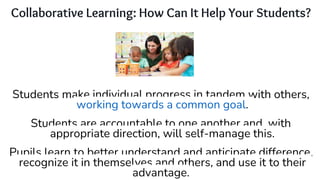
Collaborative Learning: How Can It Help Your Students?
Students make individual progress in tandem with others,
working towards a common goal.
Students are accountable to one another and, with
appropriate direction, will self-manage this.
Pupils learn to better understand and anticipate difference,
recognize it in themselves and others, and use it to their
advantage.
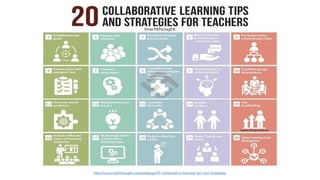
10 Strategies to Build Student Collaboration in the Classroom
1. Deliberately select which students will work together
2. Size the groups for maximum effectiveness
3. Teach your students how to listen to one another
4. Set the rules of language and collaboration
5. Make goals and expectations clear
6. Assign roles to the members of each group
7. Use real-world problems, not imaginary ones
8. Consider giving each group a different task
9. Play a game to get students warmed up
10. Evaluate each group on its own merit
Ways to Help Your Students Collaborate in the Classroom
1. Play games- games help students become critical thinkers, learn to work with one another and
establish a positive classroom environment
2. Give everyone their moment in the spotlight- Flipgrid is a powerful tech tool that allows students
to express themselves creatively and amplify their voices
3. Create a safe space for discussion- Edmodo is a multi-platform, kid-safe platform that is perfect for
active learning. Kids can share content, have a dialogue (in or out of the classroom), and even get
parents involved
4. Dive into a Fishbowl- a teaching strategy that lets students practice being both speaker and
https://www.teachthought.com/pedagogy/20-collaborative-learning-tips-and-strategies/
Some Ways to Collaborate
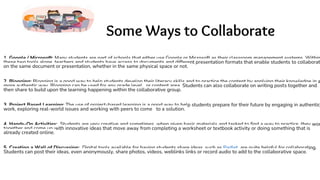
1. Google / Microsoft: Many students are part of schools that either use Google or Microsoft as their classroom management systems. Within
these two tools alone, teachers and students have access to documents and different presentation formats that enable students to collaborat
on the same document or presentation, whether in the same physical space or not.
2. Blogging: Blogging is a good way to help students develop their literacy skills and to practice the content by applying their knowledge in a
more authentic way. Blogging can be used for any grade level or content area. Students can also collaborate on writing posts together and
then share to build upon the learning happening within the collaborative group.
3. Project Based Learning: The use of project-based learning is a good way to help students prepare for their future by engaging in authentic
work, exploring real-world issues and working with peers to come to a solution.
4. Hands-On Activities: Students are very creative and sometimes, when given basic materials and tasked to find a way to practice, they wor
together and come up with innovative ideas that move away from completing a worksheet or textbook activity or doing something that is
already created online.
5. Creating a Wall of Discussion: Digital tools available for having students share ideas, such as Padlet, are quite helpful for collaborating.
Students can post their ideas, even anonymously, share photos, videos, weblinks links or record audio to add to the collaborative space.
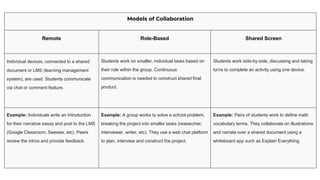
Models of Collaboration
Remote Role-Based Shared Screen
Individual devices, connected to a shared
document or LMS (learning management
system), are used. Students communicate
via chat or comment feature.
Students work on smaller, individual tasks based on
their role within the group. Continuous
communication is needed to construct shared final
product.
Students work side-by-side, discussing and taking
turns to complete an activity using one device.
Example: Individuals write an introduction
for their narrative essay and post to the LMS
(Google Classroom, Seesaw, etc). Peers
review the intros and provide feedback.
Example: A group works to solve a school problem,
breaking the project into smaller tasks (researcher,
interviewer, writer, etc). They use a web chat platform
to plan, interview and construct the project.
Example: Pairs of students work to define math
vocabulary terms. They collaborate on illustrations
and narrate over a shared document using a
whiteboard app such as Explain Everything.
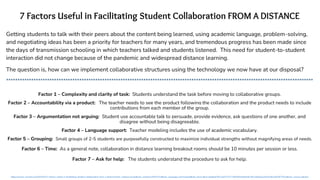
7 Factors Useful in Facilitating Student Collaboration FROM A DISTANCE
Getting students to talk with their peers about the content being learned, using academic language, problem-solving,
and negotiating ideas has been a priority for teachers for many years, and tremendous progress has been made since
the days of transmission schooling in which teachers talked and students listened. This need for student-to-student
interaction did not change because of the pandemic and widespread distance learning.
The question is, how can we implement collaborative structures using the technology we now have at our disposal?
**************************************************************************************************************************************
Factor 1 – Complexity and clarity of task: Students understand the task before moving to collaborative groups.
Factor 2 – Accountability via a product: The teacher needs to see the product following the collaboration and the product needs to include
contributions from each member of the group.
Factor 3 – Argumentation not arguing: Student use accountable talk to persuade, provide evidence, ask questions of one another, and
disagree without being disagreeable.
Factor 4 – Language support: Teacher modeling includes the use of academic vocabulary.
Factor 5 – Grouping: Small groups of 2-5 students are purposefully constructed to maximize individual strengths without magnifying areas of needs.
Factor 6 – Time: As a general note, collaboration in distance learning breakout rooms should be 10 minutes per session or less.
Factor 7 – Ask for help: The students understand the procedure to ask for help.
https://corwin-connect.com/2021/01/7-factors-useful-in-facilitating-student-collaboration-from-a-distance/?utm_medium=email&utm_content=GPE21214&utm_campaign=not+tracked&utm_term=&em=d4d4e479c7ea47a7a7733fe4f3a43b434c7811a93a5aa1510c2be1057877f22a&utm_source=adestra
Teacher
Collaboration
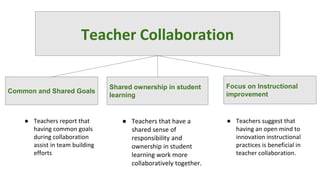
Teacher Collaboration
Teacher collaboration occurs when members of a learning
community work together to increase student learning. As
educators, our ultimate goal is student achievement in
which teacher collaboration becomes the journey.
Teacher Collaboration
Common and Shared Goals
Shared ownership in student
learning
Focus on Instructional
improvement
● Teachers report that
having common goals
during collaboration
assist in team building
efforts
● Teachers that have a
shared sense of
responsibility and
ownership in student
learning work more
collaboratively together.
● Teachers suggest that
having an open mind to
innovation instructional
practices is beneficial in
teacher collaboration.
Benefits of Teacher Collaboration
• Better instruction
Teachers obtain more support to try new ideas and fine-tune activities.
• Expanded teaching toolkit
Provides teachers with more resources and promotes use of recommended instructional
practices.
• Lesson consistency
Teachers feel they are more on the same page in terms of planning and delivering instruction.
• More inclusive methods
Teacher conversations started focusing more on student learning and how to teach to different
learning styles.
• Increased student effort
Academic rigor increases as teachers develop core competencies they expected their students
to meet.
• Higher teacher responsibility
Teachers developed a greater sense of accountability for promoting student success and
meeting school goals.
Effective Teacher Collaboration Strategies
• Develop and Agree Upon a Shared Vision and Mutual Goals
Having a shared vision and mutual goals can lead to the buy-in required for teachers to have a
genuine sense of ownership.
• Foster a Sense of Community
Collaboration is all about building relationships. Taking the time to get to know your colleagues
and relate on a personal level develops a greater sense of respect and trust. Like any
relationship, collaborative teams take time to develop.
• Establish Group Norms and Expectations
Unfortunately collaboration can be stressful and uncomfortable at times as educators are
passionate about their work and beliefs. It’s important to develop a culture of trust, respect, and
humility. Your team should delegate roles and responsibilities, as well as protocols for
communication and time management.
• Leverage Discussion to Work Through Conflicts
Although dialogue opens doors to new possibilities, it can also open the door to conflict. It’s a
good idea to develop a conflict management plan, monitor your own emotions, and always use
your professional judgment.
https://www.schoology.com/blog/teacher-collaboration
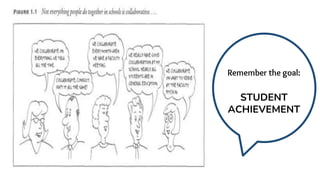
Remember the goal:
STUDENT
ACHIEVEMENT
3.25 - collaboration pd.pptx

3.25 - collaboration pd.pptx

  • 1.
    Collaboration March 25, 2021 BeginningTeacher Professional Development
  • 2.
    What is Collaboration? ...the process of two or more people, entities or organizations working together to complete a task or achieve a goal.
  • 3.
    The Power ofCollaboration
  • 4.
    Why is CollaborationImportant? It helps us problem-solve It brings people (and organizations) closer together It helps people learn from each other It opens up new channels for communication It boosts morale across your organization It leads to higher retention rates It makes us more efficient workers
  • 5.
  • 6.
    Collaborative learning –the practice of breaking students into small groups to answer questions, work on projects and learn from one another – has become one of the strongest core philosophies operating in classrooms today. The concept is not new; much of the early research on collaborative learning (also called cooperative learning) was done in the 1980s and 1990s when most classrooms favored the traditional teacher lectures and individual student work. But with the growth of technology and the increasing value society places on the ability to work in teams, collaborative learning has become more common. https://gsehd.gwu.edu/articles/10-strategies-build-student-collaboration-classroom
  • 7.
    Collaborative Learning: HowCan It Help Your Students? Students make individual progress in tandem with others, working towards a common goal. Students are accountable to one another and, with appropriate direction, will self-manage this. Pupils learn to better understand and anticipate difference, recognize it in themselves and others, and use it to their advantage.
  • 8.
    10 Strategies toBuild Student Collaboration in the Classroom 1. Deliberately select which students will work together 2. Size the groups for maximum effectiveness 3. Teach your students how to listen to one another 4. Set the rules of language and collaboration 5. Make goals and expectations clear 6. Assign roles to the members of each group 7. Use real-world problems, not imaginary ones 8. Consider giving each group a different task 9. Play a game to get students warmed up 10. Evaluate each group on its own merit
  • 9.
    Ways to HelpYour Students Collaborate in the Classroom 1. Play games- games help students become critical thinkers, learn to work with one another and establish a positive classroom environment 2. Give everyone their moment in the spotlight- Flipgrid is a powerful tech tool that allows students to express themselves creatively and amplify their voices 3. Create a safe space for discussion- Edmodo is a multi-platform, kid-safe platform that is perfect for active learning. Kids can share content, have a dialogue (in or out of the classroom), and even get parents involved 4. Dive into a Fishbowl- a teaching strategy that lets students practice being both speaker and
  • 10.
  • 11.
    Some Ways toCollaborate 1. Google / Microsoft: Many students are part of schools that either use Google or Microsoft as their classroom management systems. Within these two tools alone, teachers and students have access to documents and different presentation formats that enable students to collaborat on the same document or presentation, whether in the same physical space or not. 2. Blogging: Blogging is a good way to help students develop their literacy skills and to practice the content by applying their knowledge in a more authentic way. Blogging can be used for any grade level or content area. Students can also collaborate on writing posts together and then share to build upon the learning happening within the collaborative group. 3. Project Based Learning: The use of project-based learning is a good way to help students prepare for their future by engaging in authentic work, exploring real-world issues and working with peers to come to a solution. 4. Hands-On Activities: Students are very creative and sometimes, when given basic materials and tasked to find a way to practice, they wor together and come up with innovative ideas that move away from completing a worksheet or textbook activity or doing something that is already created online. 5. Creating a Wall of Discussion: Digital tools available for having students share ideas, such as Padlet, are quite helpful for collaborating. Students can post their ideas, even anonymously, share photos, videos, weblinks links or record audio to add to the collaborative space.
  • 12.
    Models of Collaboration RemoteRole-Based Shared Screen Individual devices, connected to a shared document or LMS (learning management system), are used. Students communicate via chat or comment feature. Students work on smaller, individual tasks based on their role within the group. Continuous communication is needed to construct shared final product. Students work side-by-side, discussing and taking turns to complete an activity using one device. Example: Individuals write an introduction for their narrative essay and post to the LMS (Google Classroom, Seesaw, etc). Peers review the intros and provide feedback. Example: A group works to solve a school problem, breaking the project into smaller tasks (researcher, interviewer, writer, etc). They use a web chat platform to plan, interview and construct the project. Example: Pairs of students work to define math vocabulary terms. They collaborate on illustrations and narrate over a shared document using a whiteboard app such as Explain Everything.
  • 13.
    7 Factors Usefulin Facilitating Student Collaboration FROM A DISTANCE Getting students to talk with their peers about the content being learned, using academic language, problem-solving, and negotiating ideas has been a priority for teachers for many years, and tremendous progress has been made since the days of transmission schooling in which teachers talked and students listened. This need for student-to-student interaction did not change because of the pandemic and widespread distance learning. The question is, how can we implement collaborative structures using the technology we now have at our disposal? ************************************************************************************************************************************** Factor 1 – Complexity and clarity of task: Students understand the task before moving to collaborative groups. Factor 2 – Accountability via a product: The teacher needs to see the product following the collaboration and the product needs to include contributions from each member of the group. Factor 3 – Argumentation not arguing: Student use accountable talk to persuade, provide evidence, ask questions of one another, and disagree without being disagreeable. Factor 4 – Language support: Teacher modeling includes the use of academic vocabulary. Factor 5 – Grouping: Small groups of 2-5 students are purposefully constructed to maximize individual strengths without magnifying areas of needs. Factor 6 – Time: As a general note, collaboration in distance learning breakout rooms should be 10 minutes per session or less. Factor 7 – Ask for help: The students understand the procedure to ask for help. https://corwin-connect.com/2021/01/7-factors-useful-in-facilitating-student-collaboration-from-a-distance/?utm_medium=email&utm_content=GPE21214&utm_campaign=not+tracked&utm_term=&em=d4d4e479c7ea47a7a7733fe4f3a43b434c7811a93a5aa1510c2be1057877f22a&utm_source=adestra
  • 14.
  • 15.
    Teacher Collaboration Teacher collaborationoccurs when members of a learning community work together to increase student learning. As educators, our ultimate goal is student achievement in which teacher collaboration becomes the journey.
  • 16.
    Teacher Collaboration Common andShared Goals Shared ownership in student learning Focus on Instructional improvement ● Teachers report that having common goals during collaboration assist in team building efforts ● Teachers that have a shared sense of responsibility and ownership in student learning work more collaboratively together. ● Teachers suggest that having an open mind to innovation instructional practices is beneficial in teacher collaboration.
  • 17.
    Benefits of TeacherCollaboration • Better instruction Teachers obtain more support to try new ideas and fine-tune activities. • Expanded teaching toolkit Provides teachers with more resources and promotes use of recommended instructional practices. • Lesson consistency Teachers feel they are more on the same page in terms of planning and delivering instruction. • More inclusive methods Teacher conversations started focusing more on student learning and how to teach to different learning styles. • Increased student effort Academic rigor increases as teachers develop core competencies they expected their students to meet. • Higher teacher responsibility Teachers developed a greater sense of accountability for promoting student success and meeting school goals.
  • 18.
    Effective Teacher CollaborationStrategies • Develop and Agree Upon a Shared Vision and Mutual Goals Having a shared vision and mutual goals can lead to the buy-in required for teachers to have a genuine sense of ownership. • Foster a Sense of Community Collaboration is all about building relationships. Taking the time to get to know your colleagues and relate on a personal level develops a greater sense of respect and trust. Like any relationship, collaborative teams take time to develop. • Establish Group Norms and Expectations Unfortunately collaboration can be stressful and uncomfortable at times as educators are passionate about their work and beliefs. It’s important to develop a culture of trust, respect, and humility. Your team should delegate roles and responsibilities, as well as protocols for communication and time management. • Leverage Discussion to Work Through Conflicts Although dialogue opens doors to new possibilities, it can also open the door to conflict. It’s a good idea to develop a conflict management plan, monitor your own emotions, and always use your professional judgment. https://www.schoology.com/blog/teacher-collaboration
  • 19.