
TEACCH
APPROACH
FOR ASDBautista, Ian Russ O.
DLSHSI OT INTERN
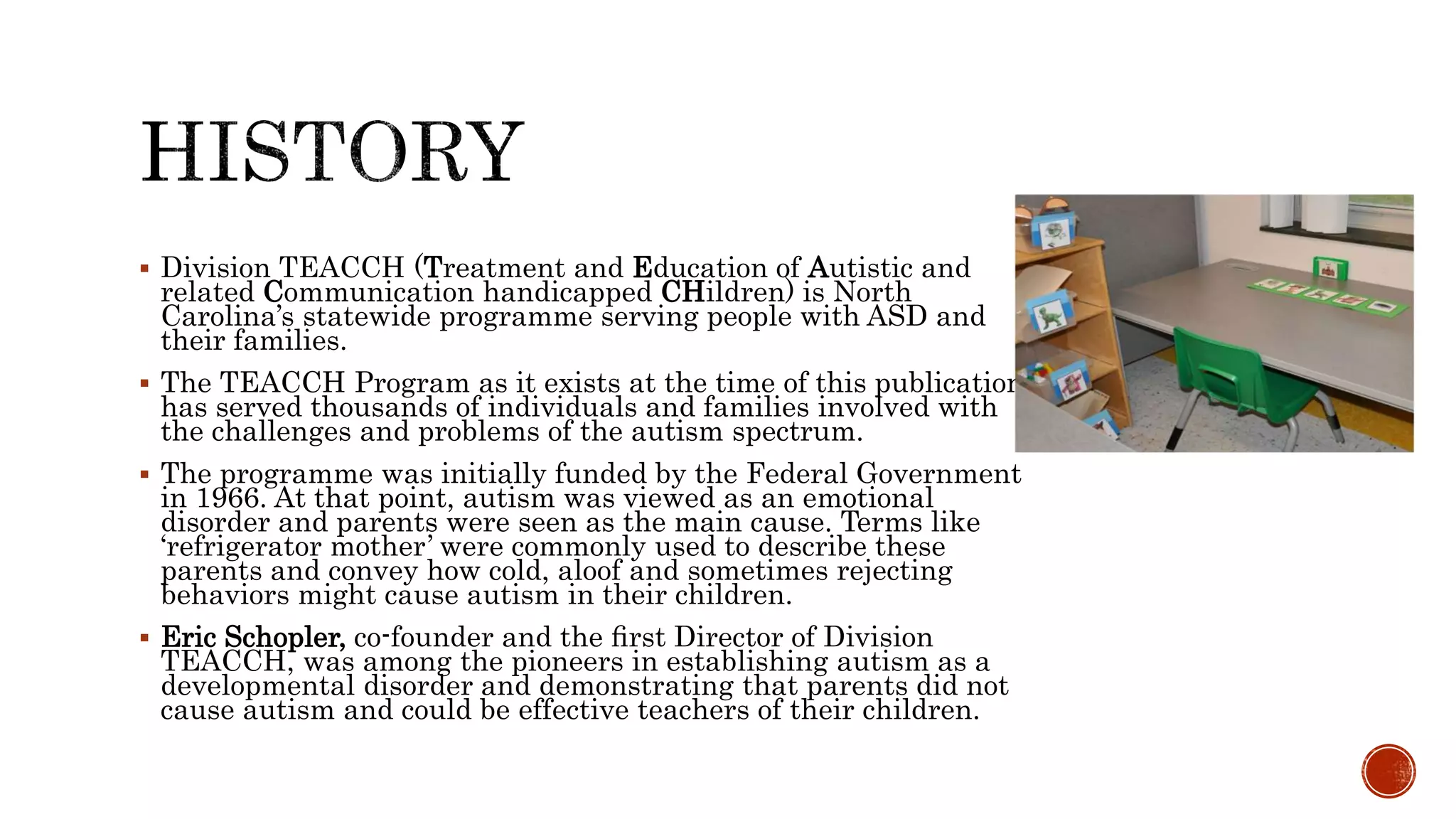
 Division TEACCH (Treatment and Education of Autistic and
related Communication handicapped CHildren) is North
Carolina’s statewide programme serving people with ASD and
their families.
 The TEACCH Program as it exists at the time of this publication
has served thousands of individuals and families involved with
the challenges and problems of the autism spectrum.
 The programme was initially funded by the Federal Government
in 1966. At that point, autism was viewed as an emotional
disorder and parents were seen as the main cause. Terms like
‘refrigerator mother’ were commonly used to describe these
parents and convey how cold, aloof and sometimes rejecting
behaviors might cause autism in their children.
 Eric Schopler, co-founder and the first Director of Division
TEACCH, was among the pioneers in establishing autism as a
developmental disorder and demonstrating that parents did not
cause autism and could be effective teachers of their children.
 The focus of the initial Federal grant to Schopler that was the precursor to Division
TEACCH in 1966. The Federal grant was enormously successful and had an
immediate positive impact on the parents who participated and their children. For this
reason, the state of North Carolina adopted Division TEACCH statewide and initiated
state funding in its founding legislation in 1972.
 Over the past three decades, Division TEACCH has helped to reconceptualize theories
about autism and has created a successful and widely used intervention approach.
TEACCH has also implemented a comprehensive service delivery system that has
impacted on the lives of over 5,000 people with autism and their families in North
Carolina and many others throughout the world. The programme’s major priorities
include:
1. Enabling individuals with ASD to function meaningfully, productively and as independently
as possible in their communities;
2. To offer exemplary services to individuals with ASD and their families and those who work
with them and support them; and
3. As a member of the University of North Carolina community, to generate knowledge, to
integrate theory with clinical practice and to disseminate information about theory and
practice internationally.
 Structured Teaching as a foundation for educational programmes
 Division TEACCH has a zero-reject policy and therefore serves people with ASD of
all ages and levels of functioning. Starting with diagnostic evaluations that
typically occur between the ages of two and four, families first learn about the
disability of autism from TEACCH staff, who work out of nine clinical centres
geographically distributed throughout the state of North Carolina. Each clinic
serves families of people with ASD from ages 1 to 70 years in their local regions.
About 80 per cent of the initial visits are for children under the age of five.
 Division TEACCH integrates a community-based service system
 TEACCH offers the best of what universities are capable of for the benefit of the
citizens of the state of North Carolina
 The active involvement of the TEACCH programme in community-based activities
also adds to the University’s lustre and credibility.
 Division TEACCH has evolved its own treatment strategy and approach to
working with clients with ASD and their families. This approach, called
Structured Teaching, assures continuity and consistency throughout all of the
statewide services for people with ASD and their families.
 The strategies and administrative structures from Division TEACCH have been
implemented throughout the USA and all over the world. Practitioners and
administrators have been using these ideas in each of the 50 states in America.
Many states have set up TEACCH Structured Teaching educational programmes
and there are also numerous clinics and other services following these models.
Internationally, these techniques are practised throughout Europe, Asia and
South America. These approaches have also had a major impact in the UK.
 TEACCH developed the intervention approach called “Structured TEACCHing”
 TEACCH priorities are
 Focusing on the person, their skills, interests and needs
 Understanding the ‘culture of autism’ and identifying differences based on individualized
assessments
 Using visual structures to organize the environment and tasks when teaching skills
 Being broad-based, ie support people at work, teach skills but also ensure that people
are supported during leisure and/or social activities
 Being flexible and teaching flexibility.
 TEACCH Values
 Teaching – sharing autism knowledge and increasing the skill level of professionals and
practitioners.
 Expanding – increasing own knowledge to provide high-quality services to people on the
autism spectrum and their families.
 Appreciating – appreciating the strengths and uniqueness of autistic culture.
 Collaborating and Cooperating with colleagues, other professionals, people on the autism
spectrum and their families.
 Holistic – adopting a holistic approach, looking at the person, their family and
community.
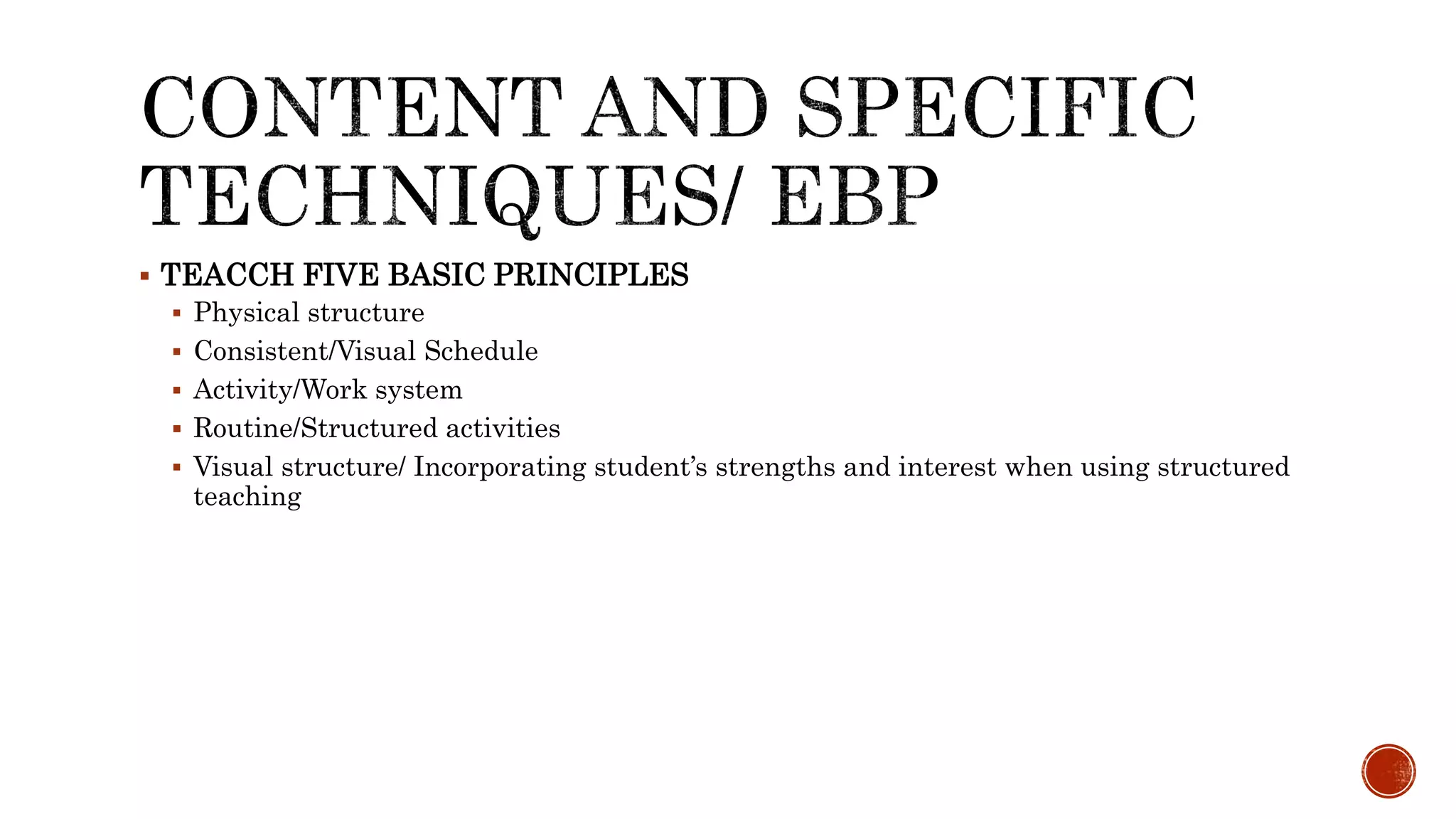
 TEACCH FIVE BASIC PRINCIPLES
 Physical structure
 Consistent/Visual Schedule
 Activity/Work system
 Routine/Structured activities
 Visual structure/ Incorporating student’s strengths and interest when using structured
teaching
 What work?
 How much work?
 When am I finished?
 What happens next?
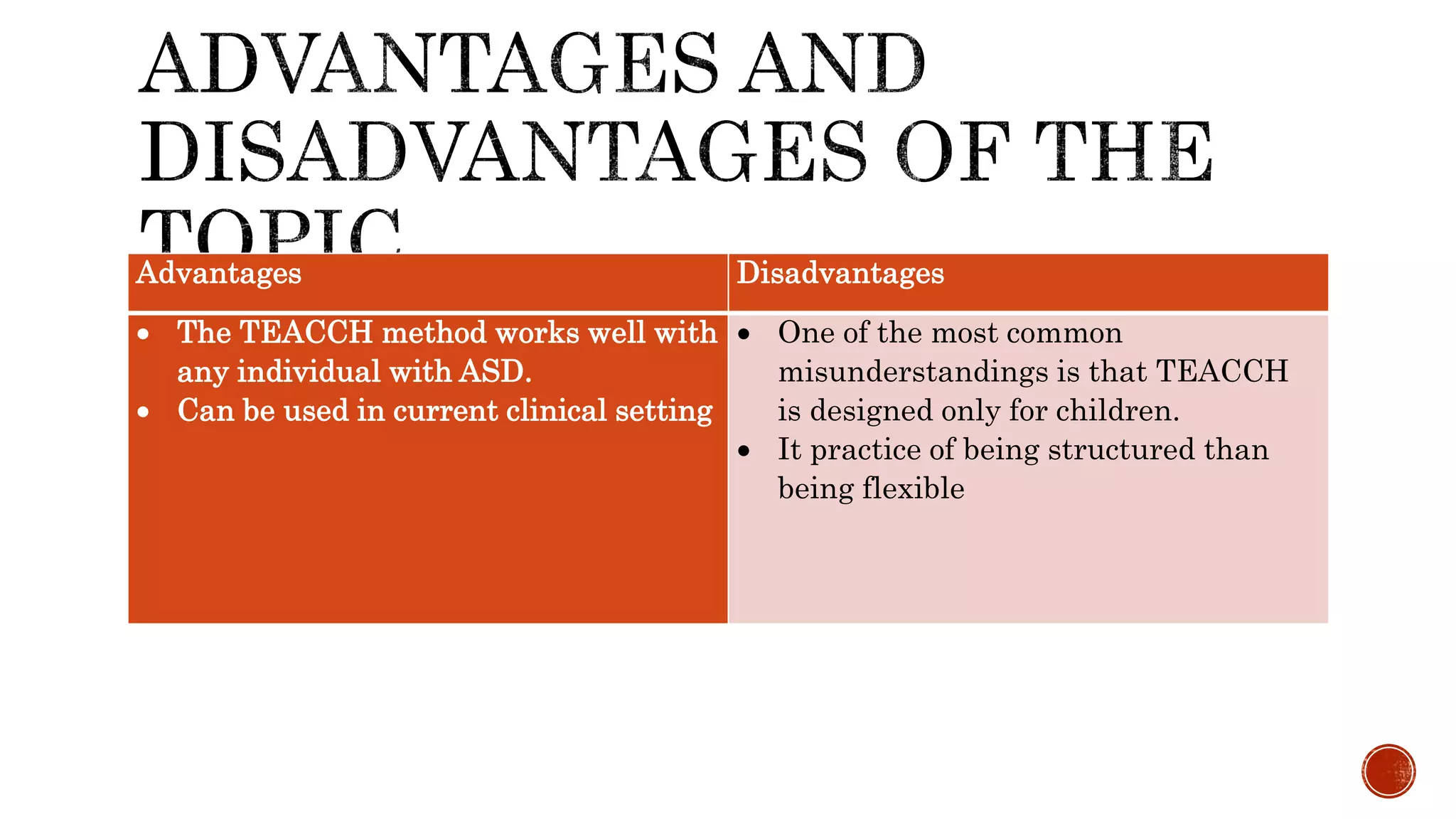
Advantages Disadvantages
 The TEACCH method works well with
any individual with ASD.
 Can be used in current clinical setting
 One of the most common
misunderstandings is that TEACCH
is designed only for children.
 It practice of being structured than
being flexible
 This topic can serve as a guide in treatment session of the patient especially in
ASD patients in MOC and patients that requires structured teaching
 Reference:
 Autism Speaks. (2018). TEACCH Autism Program. [online] Available at:
https://www.autismspeaks.org/what-autism/treatment/teacch [Accessed 6 Mar.
2018].
 Autism.org.uk. (2018). TEACCH - NAS. [online] Available at:
http://www.autism.org.uk/about/strategies/teacch.aspx [Accessed 6 Mar. 2018].
 Mesibov, G., Shea, V. and Schopler, E. (2006). The TEACCH approach to autism
spectrum disorders. New York: Springer.
 Mesibov, G. and Howley, M. (2003). Accessing the curriculum for pupils with
autistic spectrum disorders. London: David Fulton Publishers.
TEACCH APPROACH FOR ASD

TEACCH APPROACH FOR ASD

  • 1.
    TEACCH APPROACH FOR ASDBautista, IanRuss O. DLSHSI OT INTERN
  • 2.
     Division TEACCH(Treatment and Education of Autistic and related Communication handicapped CHildren) is North Carolina’s statewide programme serving people with ASD and their families.  The TEACCH Program as it exists at the time of this publication has served thousands of individuals and families involved with the challenges and problems of the autism spectrum.  The programme was initially funded by the Federal Government in 1966. At that point, autism was viewed as an emotional disorder and parents were seen as the main cause. Terms like ‘refrigerator mother’ were commonly used to describe these parents and convey how cold, aloof and sometimes rejecting behaviors might cause autism in their children.  Eric Schopler, co-founder and the first Director of Division TEACCH, was among the pioneers in establishing autism as a developmental disorder and demonstrating that parents did not cause autism and could be effective teachers of their children.
  • 3.
     The focusof the initial Federal grant to Schopler that was the precursor to Division TEACCH in 1966. The Federal grant was enormously successful and had an immediate positive impact on the parents who participated and their children. For this reason, the state of North Carolina adopted Division TEACCH statewide and initiated state funding in its founding legislation in 1972.  Over the past three decades, Division TEACCH has helped to reconceptualize theories about autism and has created a successful and widely used intervention approach. TEACCH has also implemented a comprehensive service delivery system that has impacted on the lives of over 5,000 people with autism and their families in North Carolina and many others throughout the world. The programme’s major priorities include: 1. Enabling individuals with ASD to function meaningfully, productively and as independently as possible in their communities; 2. To offer exemplary services to individuals with ASD and their families and those who work with them and support them; and 3. As a member of the University of North Carolina community, to generate knowledge, to integrate theory with clinical practice and to disseminate information about theory and practice internationally.
  • 4.
     Structured Teachingas a foundation for educational programmes  Division TEACCH has a zero-reject policy and therefore serves people with ASD of all ages and levels of functioning. Starting with diagnostic evaluations that typically occur between the ages of two and four, families first learn about the disability of autism from TEACCH staff, who work out of nine clinical centres geographically distributed throughout the state of North Carolina. Each clinic serves families of people with ASD from ages 1 to 70 years in their local regions. About 80 per cent of the initial visits are for children under the age of five.  Division TEACCH integrates a community-based service system  TEACCH offers the best of what universities are capable of for the benefit of the citizens of the state of North Carolina  The active involvement of the TEACCH programme in community-based activities also adds to the University’s lustre and credibility.
  • 5.
     Division TEACCHhas evolved its own treatment strategy and approach to working with clients with ASD and their families. This approach, called Structured Teaching, assures continuity and consistency throughout all of the statewide services for people with ASD and their families.  The strategies and administrative structures from Division TEACCH have been implemented throughout the USA and all over the world. Practitioners and administrators have been using these ideas in each of the 50 states in America. Many states have set up TEACCH Structured Teaching educational programmes and there are also numerous clinics and other services following these models. Internationally, these techniques are practised throughout Europe, Asia and South America. These approaches have also had a major impact in the UK.
  • 6.
     TEACCH developedthe intervention approach called “Structured TEACCHing”  TEACCH priorities are  Focusing on the person, their skills, interests and needs  Understanding the ‘culture of autism’ and identifying differences based on individualized assessments  Using visual structures to organize the environment and tasks when teaching skills  Being broad-based, ie support people at work, teach skills but also ensure that people are supported during leisure and/or social activities  Being flexible and teaching flexibility.
  • 7.
     TEACCH Values Teaching – sharing autism knowledge and increasing the skill level of professionals and practitioners.  Expanding – increasing own knowledge to provide high-quality services to people on the autism spectrum and their families.  Appreciating – appreciating the strengths and uniqueness of autistic culture.  Collaborating and Cooperating with colleagues, other professionals, people on the autism spectrum and their families.  Holistic – adopting a holistic approach, looking at the person, their family and community.
  • 8.
     TEACCH FIVEBASIC PRINCIPLES  Physical structure  Consistent/Visual Schedule  Activity/Work system  Routine/Structured activities  Visual structure/ Incorporating student’s strengths and interest when using structured teaching
  • 11.
     What work? How much work?  When am I finished?  What happens next?
  • 15.
    Advantages Disadvantages  TheTEACCH method works well with any individual with ASD.  Can be used in current clinical setting  One of the most common misunderstandings is that TEACCH is designed only for children.  It practice of being structured than being flexible
  • 16.
     This topiccan serve as a guide in treatment session of the patient especially in ASD patients in MOC and patients that requires structured teaching
  • 17.
     Reference:  AutismSpeaks. (2018). TEACCH Autism Program. [online] Available at: https://www.autismspeaks.org/what-autism/treatment/teacch [Accessed 6 Mar. 2018].  Autism.org.uk. (2018). TEACCH - NAS. [online] Available at: http://www.autism.org.uk/about/strategies/teacch.aspx [Accessed 6 Mar. 2018].  Mesibov, G., Shea, V. and Schopler, E. (2006). The TEACCH approach to autism spectrum disorders. New York: Springer.  Mesibov, G. and Howley, M. (2003). Accessing the curriculum for pupils with autistic spectrum disorders. London: David Fulton Publishers.