1
SABA NAWAB (06)


ATEEBA MALIK (49)


AYINA ALI (54)


TEHREEM NAQVI (31)


USMAN KHALIL (16)


AHMAD AMMAR (34)


BILAL ZAFAR(48)


                    I.A.S (TEAM BUILDING)   2
It's Easy To Get Good Players. Getting Them To Play
          Together, That’s The Hard Part.


                     I.A.S (TEAM BUILDING)            3
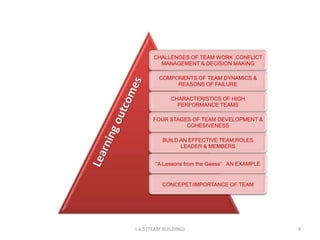
CHALLENGES OF TEAM WORK ,CONFLICT
         MANAGEMENT & DECISION MAKING

          COMPONENTS OF TEAM DYNAMICS &
               REASONS OF FAILURE

               CHARACTERISTICS OF HIGH
                 PERFORMANCE TEAMS

       FOUR STAGES OF TEAM DEVELOPMENT &
                 COHESIVENESS

           BUILD AN EFFECTIVE TEAM,ROLES
                 LEADER & MEMBERS


        “A Lessons from the Geese” AN EXAMPLE


           CONCEPET/IMPORTANCE OF TEAM


I.A.S (TEAM BUILDING)                           4
I.A.S (TEAM BUILDING)   5
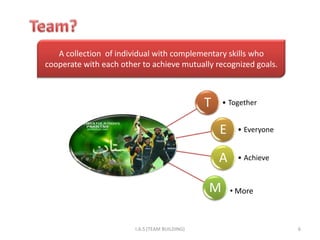
A collection of individual with complementary skills who
cooperate with each other to achieve mutually recognized goals.


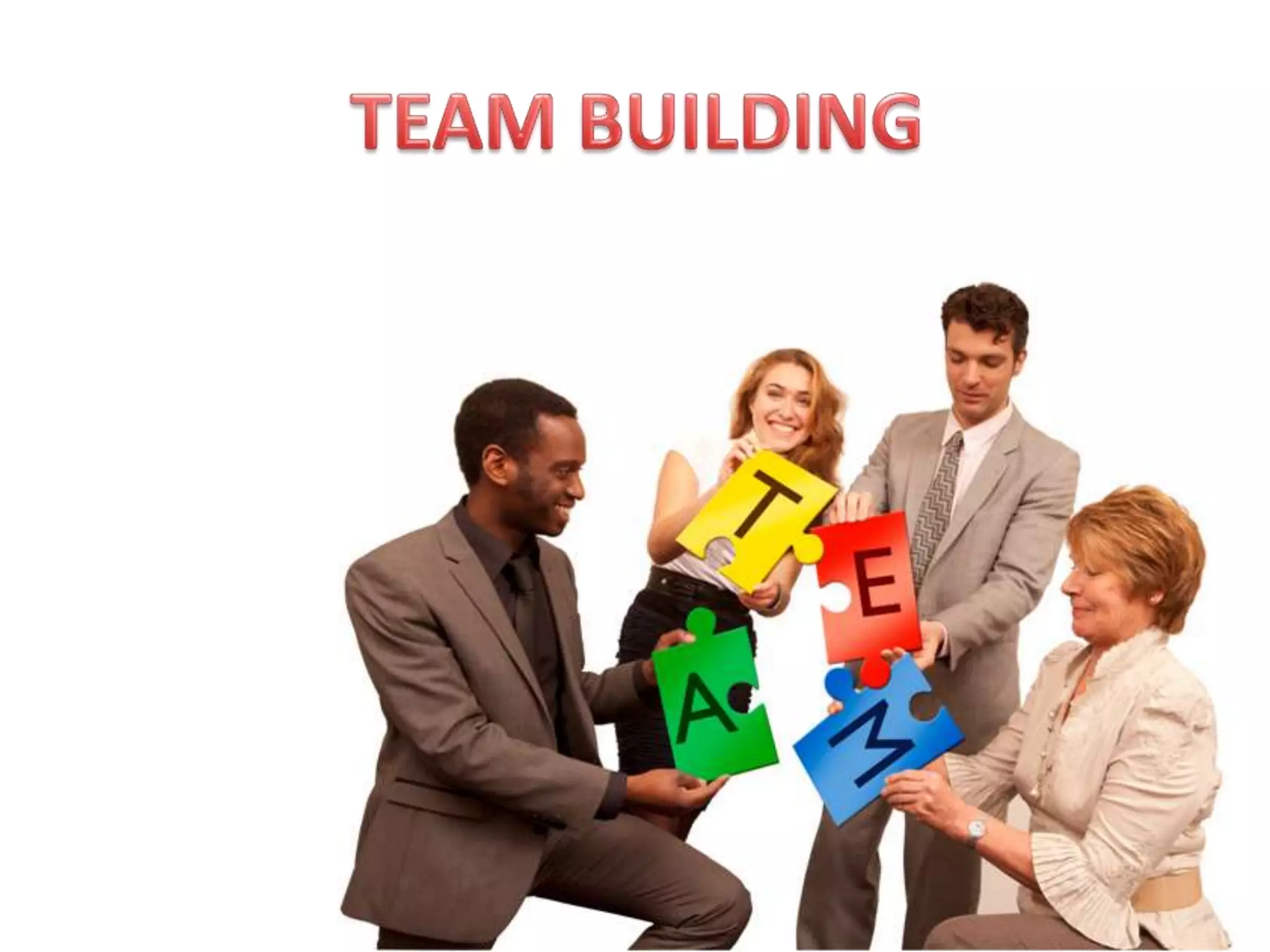
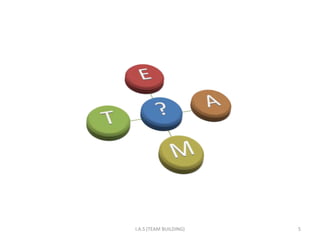
                                                T   • Together


                                                    E     • Everyone


                                                    A     • Achieve


                                                M       • More


                        I.A.S (TEAM BUILDING)                          6
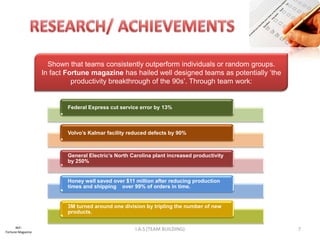
Shown that teams consistently outperform individuals or random groups.
                   In fact Fortune magazine has hailed well designed teams as potentially ‟the
                             productivity breakthrough of the 90s‟. Through team work:


                           Federal Express cut service error by 13%


                           Volvo’s Kalmar facility reduced defects by 90%


                           General Electric’s North Carolina plant increased productivity
                           by 250%


                           Honey well saved over $11 million after reducing production
                           times and shipping over 99% of orders in time.


                           3M turned around one division by tripling the number of new
                           products.

      REF:                                           I.A.S (TEAM BUILDING)                       7
Fortune Magazine
I.A.S (TEAM BUILDING)   8
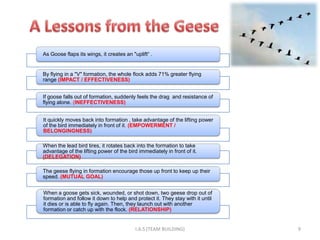
As Goose flaps its wings, it creates an "uplift“ .


By flying in a "V" formation, the whole flock adds 71% greater flying
range (IMPACT / EFFECTIVENESS)


If goose falls out of formation, suddenly feels the drag and resistance of
flying alone. (INEFFECTIVENESS)


It quickly moves back into formation , take advantage of the lifting power
of the bird immediately in front of it. (EMPOWERMENT /
BELONGINGNESS)

When the lead bird tires, it rotates back into the formation to take
advantage of the lifting power of the bird immediately in front of it.
(DELEGATION)

The geese flying in formation encourage those up front to keep up their
speed. (MUTUAL GOAL)


When a goose gets sick, wounded, or shot down, two geese drop out of
formation and follow it down to help and protect it. They stay with it until
it dies or is able to fly again. Then, they launch out with another
formation or catch up with the flock. (RELATIONSHIP)


                                          I.A.S (TEAM BUILDING)                9
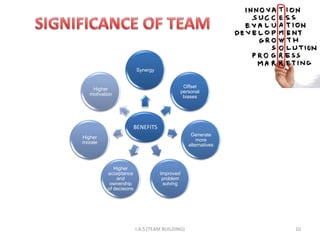
Synergy


                                               Offset
   Higher
                                              personal
  motivation
                                               biases


                     BENEFITS
                                                  Generate
Higher
                                                     more
morale
                                                 alternatives


             Higher
          acceptance               Improved
              and                   problem
           ownership                solving
          of decisions


                         I.A.S (TEAM BUILDING)                  10
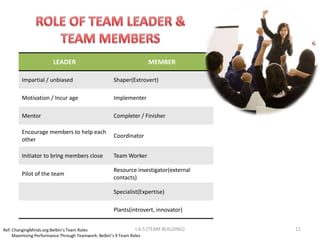
LEADER                                      MEMBER

        Impartial / unbiased                       Shaper(Extrovert)

        Motivation / Incur age                     Implementer

        Mentor                                     Completer / Finisher

        Encourage members to help each
                                                   Coordinator
        other

        Initiator to bring members close           Team Worker

                                                   Resource investigator(external
        Pilot of the team
                                                   contacts)

                                                   Specialist(Expertise)

                                                   Plants(introvert, innovator)


Ref: ChangingMinds.org:Belbin’s Team Roles                      I.A.S (TEAM BUILDING)   11
     Maximizing Performance Through Teamwork: Belbin’s 9 Team Roles
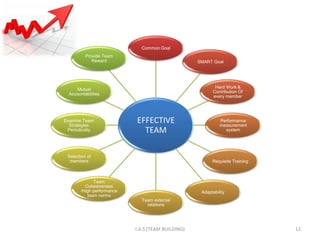
Common Goal
          Provide Team
             Reward                                 SMART Goal


      Mutual                                               Hard Work &
  Accountabilities                                        Contribution Of
                                                          every member


Examine Team
  Strategies
                            EFFECTIVE                         Performance
                                                              measurement
 Periodically                 TEAM                              system


 Selection of
  members                                                 Requisite Training


              Team
          Cohesiveness
        /High performance                            Adaptability
           team norms
                              Team external
                                relations


                            I.A.S (TEAM BUILDING)                              12
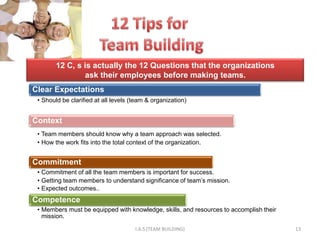
12 C, s is actually the 12 Questions that the organizations
                ask their employees before making teams.
Clear Expectations
 • Should be clarified at all levels (team & organization)


Context
 • Team members should know why a team approach was selected.
 • How the work fits into the total context of the organization.


Commitment
 • Commitment of all the team members is important for success.
 • Getting team members to understand significance of team‟s mission.
 • Expected outcomes..
Competence
 • Members must be equipped with knowledge, skills, and resources to accomplish their
   mission.

                                      I.A.S (TEAM BUILDING)                             13
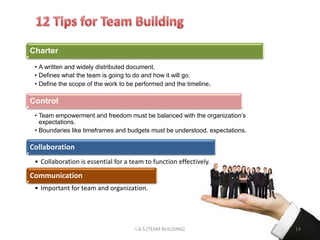
Charter
 • A written and widely distributed document.
 • Defines what the team is going to do and how it will go.
 • Define the scope of the work to be performed and the timeline.

Control
 • Team empowerment and freedom must be balanced with the organization‟s
   expectations.
 • Boundaries like timeframes and budgets must be understood. expectations.

Collaboration
 • Collaboration is essential for a team to function effectively.

Communication
 • Important for team and organization.


                                     I.A.S (TEAM BUILDING)                    14
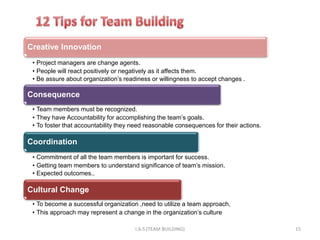
Creative Innovation
 • Project managers are change agents.
 • People will react positively or negatively as it affects them.
 • Be assure about organization‟s readiness or willingness to accept changes .

Consequence
 • Team members must be recognized.
 • They have Accountability for accomplishing the team‟s goals.
 • To foster that accountability they need reasonable consequences for their actions.

Coordination
 • Commitment of all the team members is important for success.
 • Getting team members to understand significance of team‟s mission.
 • Expected outcomes..

Cultural Change
 • To become a successful organization ,need to utilize a team approach,
 • This approach may represent a change in the organization‟s culture

                                      I.A.S (TEAM BUILDING)                             15
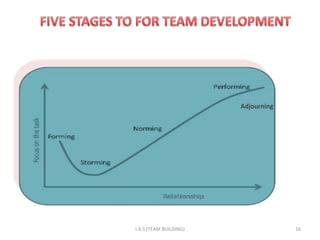
Adjourning


I.A.S (TEAM BUILDING)                16
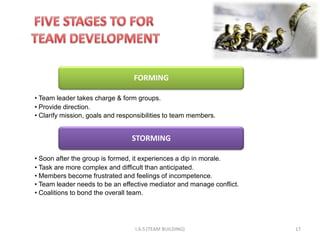
FORMING

• Team leader takes charge & form groups.
• Provide direction.
• Clarify mission, goals and responsibilities to team members.


                                 STORMING

• Soon after the group is formed, it experiences a dip in morale.
• Task are more complex and difficult than anticipated.
• Members become frustrated and feelings of incompetence.
• Team leader needs to be an effective mediator and manage conflict.
• Coalitions to bond the overall team.


                                  I.A.S (TEAM BUILDING)                17
NORMING
             • Resolve the differences of members and develop a group & trust.
             • Structure that with acceptable norms and cohesiveness.
                                        STORMING

             • Team operates smoothly like a well oiled machine.
             • All parts are functioning in perfect harmony to produce the
               desired result.
             • Leader can stand aside, supportive, and let the team work with
               minimal interference.
                                       ADJOURNING
             • Complete task & breaking up team.
             • Should be planned
             • Some become comfortable some not ,other get ready for next
               challenge.
             • Leader should celebrate team achievement ,people should leave
               team on positive note.
Ref: Mind tools ltd.                         I.A.S (TEAM BUILDING)               18
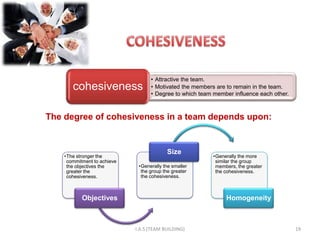
Essential skill for excellent career
• Attractive the team.
       cohesiveness                • Motivated the members are to remain in the team.
                                   • Degree to which team member influence each other.


The degree of cohesiveness in a team depends upon:


                                          Size
    •The stronger the                                     •Generally the more
     commitment to achieve                                 similar the group
     the objectives the       •Generally the smaller       members, the greater
     greater the               the group the greater       the cohesiveness.
     cohesiveness.             the cohesiveness.


           Objectives                                          Homogeneity


                             I.A.S (TEAM BUILDING)                                       19
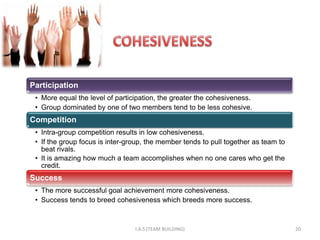
Participation
 • More equal the level of participation, the greater the cohesiveness.
 • Group dominated by one of two members tend to be less cohesive.
Competition
 • Intra-group competition results in low cohesiveness.
 • If the group focus is inter-group, the member tends to pull together as team to
   beat rivals.
 • It is amazing how much a team accomplishes when no one cares who get the
   credit.
Success
 • The more successful goal achievement more cohesiveness.
 • Success tends to breed cohesiveness which breeds more success.


                                 I.A.S (TEAM BUILDING)                               20
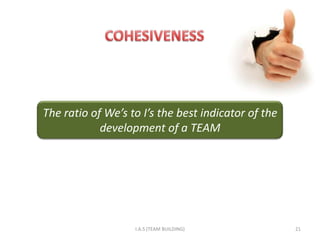
The ratio of We’s to I’s the best indicator of the
            development of a TEAM


                   I.A.S (TEAM BUILDING)             21
I.A.S (TEAM BUILDING)   22
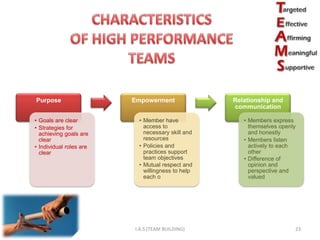
Purpose                  Empowerment              Relationship and
                                                  communication

• Goals are clear         • Member have              • Members express
• Strategies for            access to                  themselves openly
  achieving goals are       necessary skill and        and honestly
  clear                     resources                • Members listen
• Individual roles are    • Policies and               actively to each
  clear                     practices support          other
                            team objectives          • Difference of
                          • Mutual respect and         opinion and
                            willingness to help        perspective and
                            each o                     valued


                         I.A.S (TEAM BUILDING)                         23
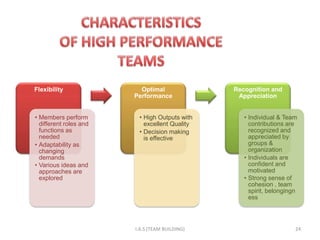
Flexibility               Optimal               Recognition and
                        Performance              Appreciation


• Members perform        • High Outputs with       • Individual & Team
  different roles and      excellent Quality         contributions are
  functions as           • Decision making           recognized and
  needed                   is effective              appreciated by
• Adaptability as                                    groups &
  changing                                           organization
  demands                                          • Individuals are
• Various ideas and                                  confident and
  approaches are                                     motivated
  explored                                         • Strong sense of
                                                     cohesion , team
                                                     spirit, belongingn
                                                     ess


                        I.A.S (TEAM BUILDING)                         24
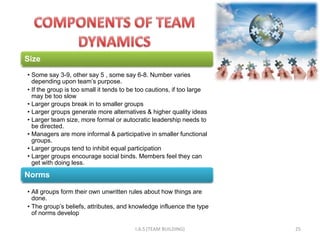
Size
• Some say 3-9, other say 5 , some say 6-8. Number varies
  depending upon team‟s purpose.
• If the group is too small it tends to be too cautions, if too large
  may be too slow
• Larger groups break in to smaller groups
• Larger groups generate more alternatives & higher quality ideas
• Larger team size, more formal or autocratic leadership needs to
  be directed.
• Managers are more informal & participative in smaller functional
  groups.
• Larger groups tend to inhibit equal participation
• Larger groups encourage social binds. Members feel they can
  get with doing less.

Norms

• All groups form their own unwritten rules about how things are
  done.
• The group‟s beliefs, attributes, and knowledge influence the type
  of norms develop

                                         I.A.S (TEAM BUILDING)          25
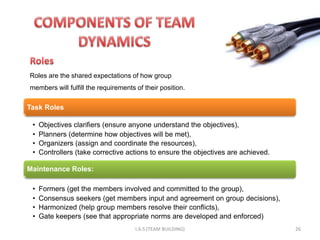
Roles are the shared expectations of how group
members will fulfill the requirements of their position.

Task Roles

 •   Objectives clarifiers (ensure anyone understand the objectives),
 •   Planners (determine how objectives will be met),
 •   Organizers (assign and coordinate the resources),
 •   Controllers (take corrective actions to ensure the objectives are achieved.

Maintenance Roles:

 •   Formers (get the members involved and committed to the group),
 •   Consensus seekers (get members input and agreement on group decisions),
 •   Harmonized (help group members resolve their conflicts),
 •   Gate keepers (see that appropriate norms are developed and enforced)
                                      I.A.S (TEAM BUILDING)                        26
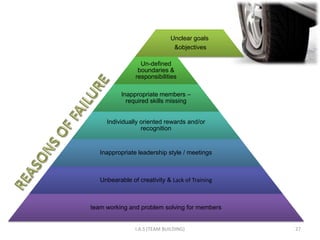
Unclear goals
                               &objectives

                  Un-defined
                 boundaries &
                responsibilities

           Inappropriate members –
             required skills missing


     Individually oriented rewards and/or
                  recognition


   Inappropriate leadership style / meetings


   Unbearable of creativity & Lack of Training


team working and problem solving for members


                I.A.S (TEAM BUILDING)            27
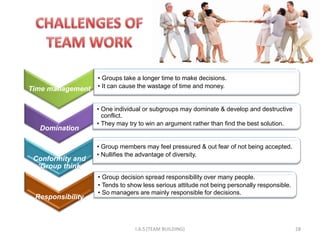
• Groups take a longer time to make decisions.
Time management   • It can cause the wastage of time and money.


                  • One individual or subgroups may dominate & develop and destructive
                    conflict.
                  • They may try to win an argument rather than find the best solution.
  Domination

                  • Group members may feel pressured & out fear of not being accepted.
                  • Nullifies the advantage of diversity.
 Conformity and
  ‘Group think
                  • Group decision spread responsibility over many people.
                  • Tends to show less serious attitude not being personally responsible.
                  • So managers are mainly responsible for decisions.
 Responsibility


                               I.A.S (TEAM BUILDING)                                        28
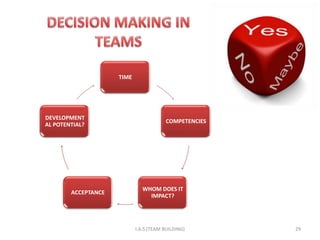
TIME


DEVELOPMENT
                                        COMPETENCIES
AL POTENTIAL?


                               WHOM DOES IT
        ACCEPTANCE
                                 IMPACT?


                            I.A.S (TEAM BUILDING)      29
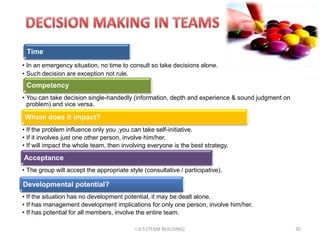
Time
• In an emergency situation, no time to consult so take decisions alone.
• Such decision are exception not rule.
 Competency
• You can take decision single-handedly (information, depth and experience & sound judgment on
  problem) and vice versa.

Whom does it impact?
• If the problem influence only you ,you can take self-initiative.
• If it involves just one other person, involve him/her.
• If will impact the whole team, then involving everyone is the best strategy.

Acceptance
• The group will accept the appropriate style (consultative / participative).

Developmental potential?
• If the situation has no development potential, it may be dealt alone.
• If has management development implications for only one person, involve him/her.
• If has potential for all members, involve the entire team.

                                           I.A.S (TEAM BUILDING)                                 30
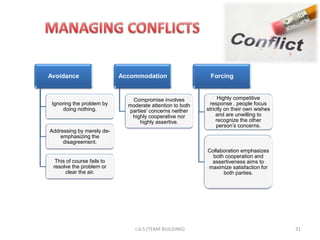
Avoidance                   Accommodation                   Forcing


                               Compromise involves               Highly competitive
 Ignoring the problem by      moderate attention to both    response , people focus
     doing nothing.           parties' concerns neither    strictly on their own wishes
                               highly cooperative nor           and are unwilling to
                                   highly assertive.            recognize the other
                                                                person‟s concerns.
Addressing by merely de-
    emphasizing the
     disagreement.
                                                           Collaboration emphasizes
                                                             both cooperation and
  This of course fails to                                   assertiveness aims to
 resolve the problem or                                    maximize satisfaction for
      clear the air.                                             both parties.


                                 I.A.S (TEAM BUILDING)                                    31
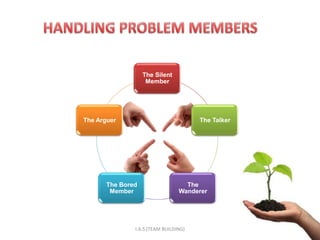
The Silent
                    Member


The Arguer                             The Talker


       The Bored                   The
        Member                   Wanderer


               I.A.S (TEAM BUILDING)                32
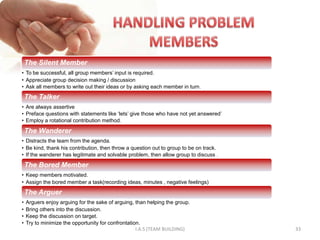
The Silent Member
• To be successful, all group members‟ input is required.
• Appreciate group decision making / discussion
• Ask all members to write out their ideas or by asking each member in turn.
    The Talker
• Are always assertive
• Preface questions with statements like „lets‟ give those who have not yet answered‟
• Employ a rotational contribution method.

    The Wanderer
• Distracts the team from the agenda.
• Be kind, thank his contribution, then throw a question out to group to be on track.
• If the wanderer has legitimate and solvable problem, then allow group to discuss .

    The Bored Member
• Keep members motivated.
• Assign the bored member a task(recording ideas, minutes , negative feelings)
    The Arguer
•   Arguers enjoy arguing for the sake of arguing, than helping the group.
•   Bring others into the discussion.
•   Keep the discussion on target.
•   Try to minimize the opportunity for confrontation.
                                                    I.A.S (TEAM BUILDING)               33
“Coming together is a beginning. Keeping together is
      progress. Working together is success-


                    SUCCESS


                          I.A.S (TEAM BUILDING)        34
I.A.S (TEAM BUILDING)   35

T&dfinal proj

  • 1.
  • 2.
    SABA NAWAB (06) ATEEBAMALIK (49) AYINA ALI (54) TEHREEM NAQVI (31) USMAN KHALIL (16) AHMAD AMMAR (34) BILAL ZAFAR(48) I.A.S (TEAM BUILDING) 2
  • 3.
    It's Easy ToGet Good Players. Getting Them To Play Together, That’s The Hard Part. I.A.S (TEAM BUILDING) 3
  • 4.
    CHALLENGES OF TEAMWORK ,CONFLICT MANAGEMENT & DECISION MAKING COMPONENTS OF TEAM DYNAMICS & REASONS OF FAILURE CHARACTERISTICS OF HIGH PERFORMANCE TEAMS FOUR STAGES OF TEAM DEVELOPMENT & COHESIVENESS BUILD AN EFFECTIVE TEAM,ROLES LEADER & MEMBERS “A Lessons from the Geese” AN EXAMPLE CONCEPET/IMPORTANCE OF TEAM I.A.S (TEAM BUILDING) 4
  • 5.
  • 6.
    A collection ofindividual with complementary skills who cooperate with each other to achieve mutually recognized goals. T • Together E • Everyone A • Achieve M • More I.A.S (TEAM BUILDING) 6
  • 7.
    Shown that teamsconsistently outperform individuals or random groups. In fact Fortune magazine has hailed well designed teams as potentially ‟the productivity breakthrough of the 90s‟. Through team work: Federal Express cut service error by 13% Volvo’s Kalmar facility reduced defects by 90% General Electric’s North Carolina plant increased productivity by 250% Honey well saved over $11 million after reducing production times and shipping over 99% of orders in time. 3M turned around one division by tripling the number of new products. REF: I.A.S (TEAM BUILDING) 7 Fortune Magazine
  • 8.
  • 9.
    As Goose flapsits wings, it creates an "uplift“ . By flying in a "V" formation, the whole flock adds 71% greater flying range (IMPACT / EFFECTIVENESS) If goose falls out of formation, suddenly feels the drag and resistance of flying alone. (INEFFECTIVENESS) It quickly moves back into formation , take advantage of the lifting power of the bird immediately in front of it. (EMPOWERMENT / BELONGINGNESS) When the lead bird tires, it rotates back into the formation to take advantage of the lifting power of the bird immediately in front of it. (DELEGATION) The geese flying in formation encourage those up front to keep up their speed. (MUTUAL GOAL) When a goose gets sick, wounded, or shot down, two geese drop out of formation and follow it down to help and protect it. They stay with it until it dies or is able to fly again. Then, they launch out with another formation or catch up with the flock. (RELATIONSHIP) I.A.S (TEAM BUILDING) 9
  • 10.
    Synergy Offset Higher personal motivation biases BENEFITS Generate Higher more morale alternatives Higher acceptance Improved and problem ownership solving of decisions I.A.S (TEAM BUILDING) 10
  • 11.
    LEADER MEMBER Impartial / unbiased Shaper(Extrovert) Motivation / Incur age Implementer Mentor Completer / Finisher Encourage members to help each Coordinator other Initiator to bring members close Team Worker Resource investigator(external Pilot of the team contacts) Specialist(Expertise) Plants(introvert, innovator) Ref: ChangingMinds.org:Belbin’s Team Roles I.A.S (TEAM BUILDING) 11 Maximizing Performance Through Teamwork: Belbin’s 9 Team Roles
  • 12.
    Common Goal Provide Team Reward SMART Goal Mutual Hard Work & Accountabilities Contribution Of every member Examine Team Strategies EFFECTIVE Performance measurement Periodically TEAM system Selection of members Requisite Training Team Cohesiveness /High performance Adaptability team norms Team external relations I.A.S (TEAM BUILDING) 12
  • 13.
    12 C, sis actually the 12 Questions that the organizations ask their employees before making teams. Clear Expectations • Should be clarified at all levels (team & organization) Context • Team members should know why a team approach was selected. • How the work fits into the total context of the organization. Commitment • Commitment of all the team members is important for success. • Getting team members to understand significance of team‟s mission. • Expected outcomes.. Competence • Members must be equipped with knowledge, skills, and resources to accomplish their mission. I.A.S (TEAM BUILDING) 13
  • 14.
    Charter • Awritten and widely distributed document. • Defines what the team is going to do and how it will go. • Define the scope of the work to be performed and the timeline. Control • Team empowerment and freedom must be balanced with the organization‟s expectations. • Boundaries like timeframes and budgets must be understood. expectations. Collaboration • Collaboration is essential for a team to function effectively. Communication • Important for team and organization. I.A.S (TEAM BUILDING) 14
  • 15.
    Creative Innovation •Project managers are change agents. • People will react positively or negatively as it affects them. • Be assure about organization‟s readiness or willingness to accept changes . Consequence • Team members must be recognized. • They have Accountability for accomplishing the team‟s goals. • To foster that accountability they need reasonable consequences for their actions. Coordination • Commitment of all the team members is important for success. • Getting team members to understand significance of team‟s mission. • Expected outcomes.. Cultural Change • To become a successful organization ,need to utilize a team approach, • This approach may represent a change in the organization‟s culture I.A.S (TEAM BUILDING) 15
  • 16.
  • 17.
    FORMING • Team leadertakes charge & form groups. • Provide direction. • Clarify mission, goals and responsibilities to team members. STORMING • Soon after the group is formed, it experiences a dip in morale. • Task are more complex and difficult than anticipated. • Members become frustrated and feelings of incompetence. • Team leader needs to be an effective mediator and manage conflict. • Coalitions to bond the overall team. I.A.S (TEAM BUILDING) 17
  • 18.
    NORMING • Resolve the differences of members and develop a group & trust. • Structure that with acceptable norms and cohesiveness. STORMING • Team operates smoothly like a well oiled machine. • All parts are functioning in perfect harmony to produce the desired result. • Leader can stand aside, supportive, and let the team work with minimal interference. ADJOURNING • Complete task & breaking up team. • Should be planned • Some become comfortable some not ,other get ready for next challenge. • Leader should celebrate team achievement ,people should leave team on positive note. Ref: Mind tools ltd. I.A.S (TEAM BUILDING) 18 Essential skill for excellent career
  • 19.
    • Attractive theteam. cohesiveness • Motivated the members are to remain in the team. • Degree to which team member influence each other. The degree of cohesiveness in a team depends upon: Size •The stronger the •Generally the more commitment to achieve similar the group the objectives the •Generally the smaller members, the greater greater the the group the greater the cohesiveness. cohesiveness. the cohesiveness. Objectives Homogeneity I.A.S (TEAM BUILDING) 19
  • 20.
    Participation • Moreequal the level of participation, the greater the cohesiveness. • Group dominated by one of two members tend to be less cohesive. Competition • Intra-group competition results in low cohesiveness. • If the group focus is inter-group, the member tends to pull together as team to beat rivals. • It is amazing how much a team accomplishes when no one cares who get the credit. Success • The more successful goal achievement more cohesiveness. • Success tends to breed cohesiveness which breeds more success. I.A.S (TEAM BUILDING) 20
  • 21.
    The ratio ofWe’s to I’s the best indicator of the development of a TEAM I.A.S (TEAM BUILDING) 21
  • 22.
  • 23.
    Purpose Empowerment Relationship and communication • Goals are clear • Member have • Members express • Strategies for access to themselves openly achieving goals are necessary skill and and honestly clear resources • Members listen • Individual roles are • Policies and actively to each clear practices support other team objectives • Difference of • Mutual respect and opinion and willingness to help perspective and each o valued I.A.S (TEAM BUILDING) 23
  • 24.
    Flexibility Optimal Recognition and Performance Appreciation • Members perform • High Outputs with • Individual & Team different roles and excellent Quality contributions are functions as • Decision making recognized and needed is effective appreciated by • Adaptability as groups & changing organization demands • Individuals are • Various ideas and confident and approaches are motivated explored • Strong sense of cohesion , team spirit, belongingn ess I.A.S (TEAM BUILDING) 24
  • 25.
    Size • Some say3-9, other say 5 , some say 6-8. Number varies depending upon team‟s purpose. • If the group is too small it tends to be too cautions, if too large may be too slow • Larger groups break in to smaller groups • Larger groups generate more alternatives & higher quality ideas • Larger team size, more formal or autocratic leadership needs to be directed. • Managers are more informal & participative in smaller functional groups. • Larger groups tend to inhibit equal participation • Larger groups encourage social binds. Members feel they can get with doing less. Norms • All groups form their own unwritten rules about how things are done. • The group‟s beliefs, attributes, and knowledge influence the type of norms develop I.A.S (TEAM BUILDING) 25
  • 26.
    Roles are theshared expectations of how group members will fulfill the requirements of their position. Task Roles • Objectives clarifiers (ensure anyone understand the objectives), • Planners (determine how objectives will be met), • Organizers (assign and coordinate the resources), • Controllers (take corrective actions to ensure the objectives are achieved. Maintenance Roles: • Formers (get the members involved and committed to the group), • Consensus seekers (get members input and agreement on group decisions), • Harmonized (help group members resolve their conflicts), • Gate keepers (see that appropriate norms are developed and enforced) I.A.S (TEAM BUILDING) 26
  • 27.
    Unclear goals &objectives Un-defined boundaries & responsibilities Inappropriate members – required skills missing Individually oriented rewards and/or recognition Inappropriate leadership style / meetings Unbearable of creativity & Lack of Training team working and problem solving for members I.A.S (TEAM BUILDING) 27
  • 28.
    • Groups takea longer time to make decisions. Time management • It can cause the wastage of time and money. • One individual or subgroups may dominate & develop and destructive conflict. • They may try to win an argument rather than find the best solution. Domination • Group members may feel pressured & out fear of not being accepted. • Nullifies the advantage of diversity. Conformity and ‘Group think • Group decision spread responsibility over many people. • Tends to show less serious attitude not being personally responsible. • So managers are mainly responsible for decisions. Responsibility I.A.S (TEAM BUILDING) 28
  • 29.
    TIME DEVELOPMENT COMPETENCIES AL POTENTIAL? WHOM DOES IT ACCEPTANCE IMPACT? I.A.S (TEAM BUILDING) 29
  • 30.
    Time • In anemergency situation, no time to consult so take decisions alone. • Such decision are exception not rule. Competency • You can take decision single-handedly (information, depth and experience & sound judgment on problem) and vice versa. Whom does it impact? • If the problem influence only you ,you can take self-initiative. • If it involves just one other person, involve him/her. • If will impact the whole team, then involving everyone is the best strategy. Acceptance • The group will accept the appropriate style (consultative / participative). Developmental potential? • If the situation has no development potential, it may be dealt alone. • If has management development implications for only one person, involve him/her. • If has potential for all members, involve the entire team. I.A.S (TEAM BUILDING) 30
  • 31.
    Avoidance Accommodation Forcing Compromise involves Highly competitive Ignoring the problem by moderate attention to both response , people focus doing nothing. parties' concerns neither strictly on their own wishes highly cooperative nor and are unwilling to highly assertive. recognize the other person‟s concerns. Addressing by merely de- emphasizing the disagreement. Collaboration emphasizes both cooperation and This of course fails to assertiveness aims to resolve the problem or maximize satisfaction for clear the air. both parties. I.A.S (TEAM BUILDING) 31
  • 32.
    The Silent Member The Arguer The Talker The Bored The Member Wanderer I.A.S (TEAM BUILDING) 32
  • 33.
    The Silent Member •To be successful, all group members‟ input is required. • Appreciate group decision making / discussion • Ask all members to write out their ideas or by asking each member in turn. The Talker • Are always assertive • Preface questions with statements like „lets‟ give those who have not yet answered‟ • Employ a rotational contribution method. The Wanderer • Distracts the team from the agenda. • Be kind, thank his contribution, then throw a question out to group to be on track. • If the wanderer has legitimate and solvable problem, then allow group to discuss . The Bored Member • Keep members motivated. • Assign the bored member a task(recording ideas, minutes , negative feelings) The Arguer • Arguers enjoy arguing for the sake of arguing, than helping the group. • Bring others into the discussion. • Keep the discussion on target. • Try to minimize the opportunity for confrontation. I.A.S (TEAM BUILDING) 33
  • 34.
    “Coming together isa beginning. Keeping together is progress. Working together is success- SUCCESS I.A.S (TEAM BUILDING) 34
  • 35.