Preserving Key Employees and
Avoiding Talent Drain to Win the
Human Capital Fight

Peter Watson
HR Director - AstraZeneca

5 March 2011
HR Summit – Gold Coast Australia
Topics

• Framework for the Talent Retention Challenge

               • What drives retention

               • The role of the Manager

• Case Studies:

               • AZ Managers‟ Program

               • Flexibility with Accountability

               • Targeted Retention


2 | Title of presentation | 00 Month Year (Go Header & Footer to edit this text)
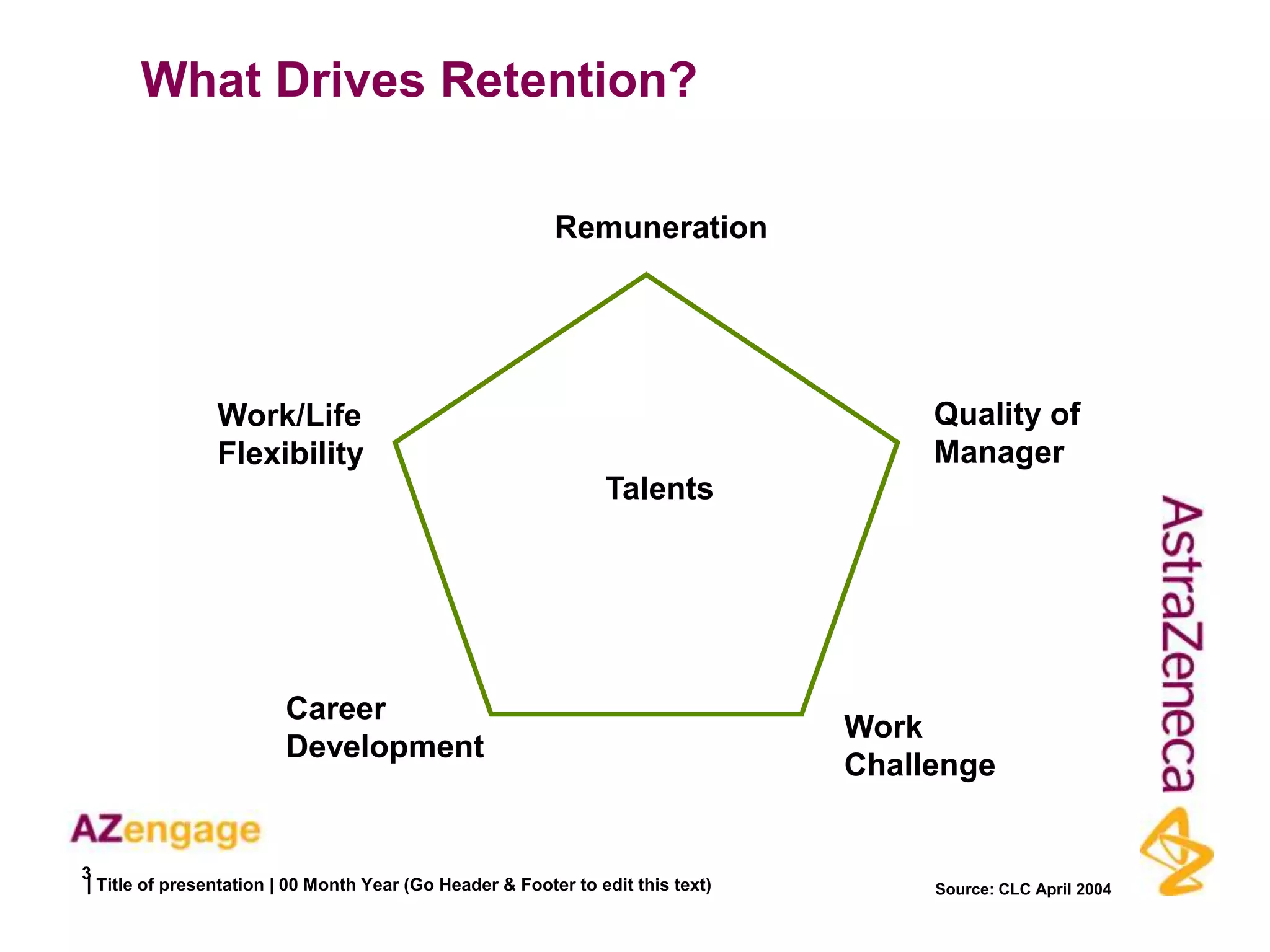
What Drives Retention?

                                                           Remuneration


                 Work/Life                                                             Quality of
                 Flexibility                                                           Manager
                                                                 Talents


                         Career
                                                                                  Work
                         Development
                                                                                  Challenge


3
 | Title of presentation | 00 Month Year (Go Header & Footer to edit this text)        Source: CLC April 2004
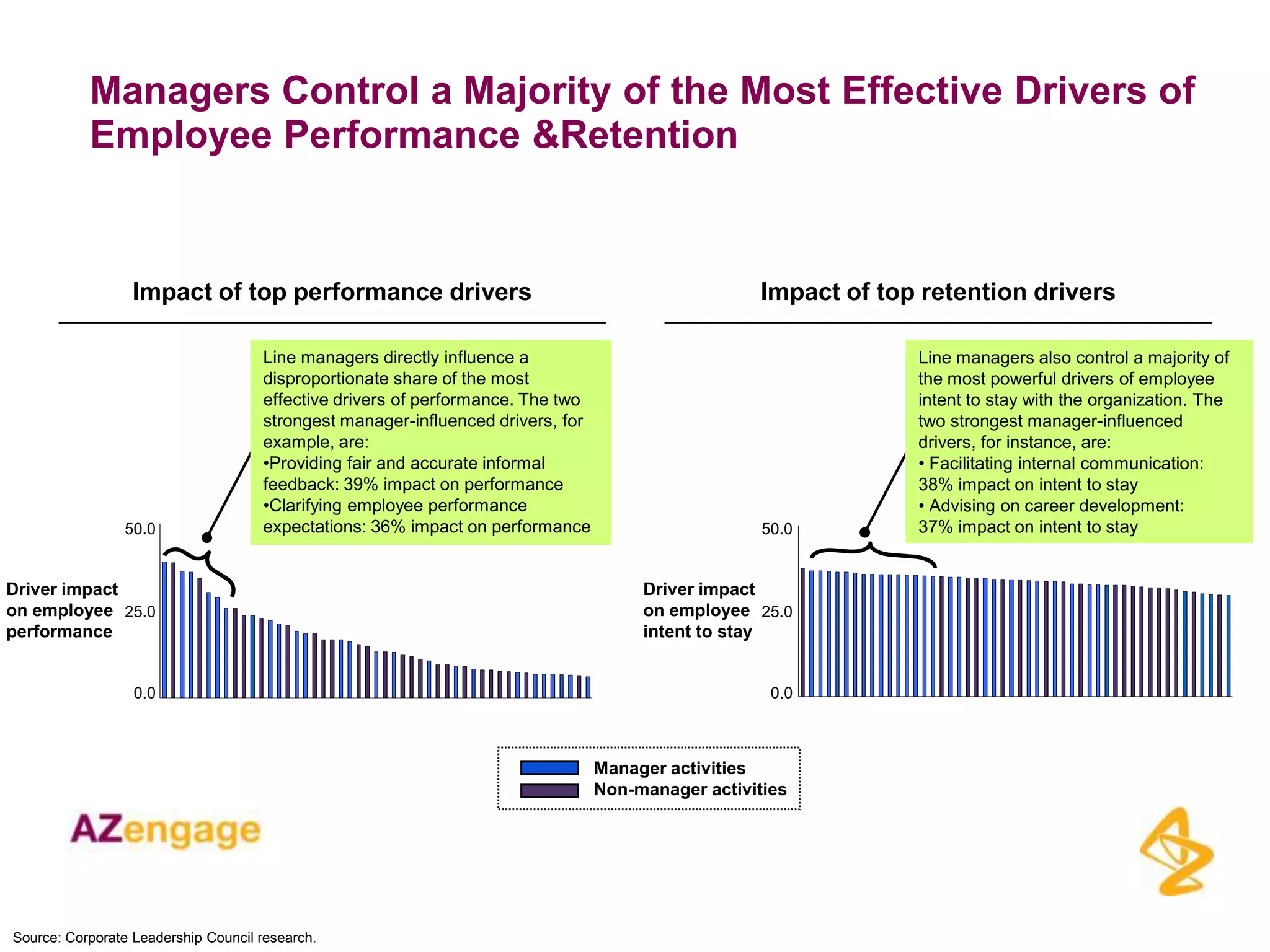
Managers Control a Majority of the Most Effective Drivers of
           Employee Performance &Retention


                  Impact of top performance drivers                                                Impact of top retention drivers

                                     Line managers directly influence a                                         Line managers also control a majority of
                                     disproportionate share of the most                                         the most powerful drivers of employee
                                     effective drivers of performance. The two                                  intent to stay with the organization. The
                                     strongest manager-influenced drivers, for                                  two strongest manager-influenced
                                     example, are:                                                              drivers, for instance, are:
                                     •Providing fair and accurate informal                                      • Facilitating internal communication:
                                     feedback: 39% impact on performance                                        38% impact on intent to stay
                                     •Clarifying employee performance                                           • Advising on career development:
                50.0                 expectations: 36% impact on performance                        50.0        37% impact on intent to stay


Driver impact                                                                         Driver impact
on employee 25.0                                                                      on employee 25.0
performance                                                                           intent to stay


                  0.0                                                                                0.0


                                                                                 Manager activities
                                                                                 Non-manager activities


Source: Corporate Leadership Council research.
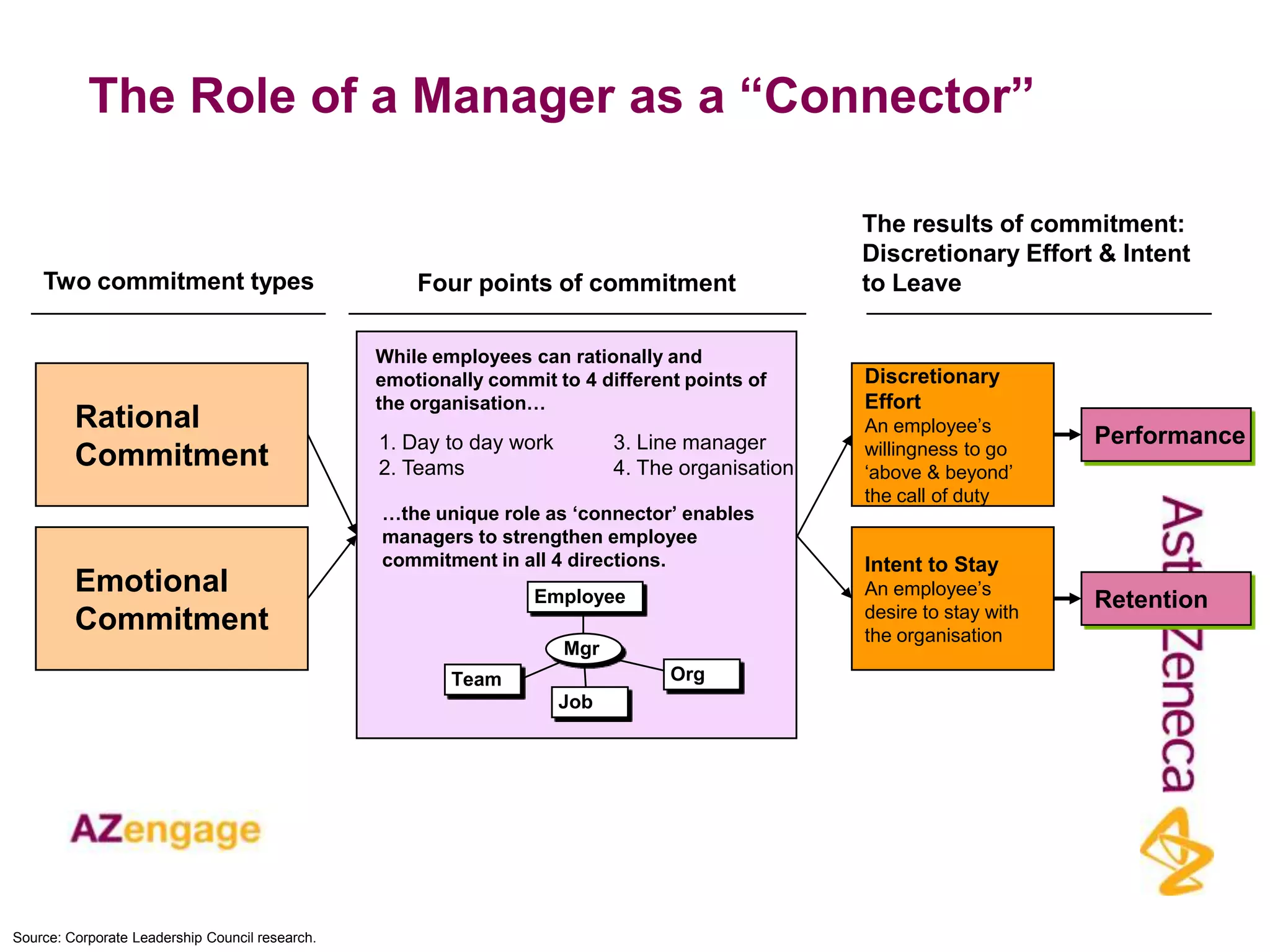
The Role of a Manager as a “Connector”

                                                                                                  The results of commitment:
                                                                                                  Discretionary Effort & Intent
    Two commitment types                             Four points of commitment                    to Leave

                                                 While employees can rationally and
                                                 emotionally commit to 4 different points of      Discretionary
                                                 the organisation…                                Effort
         Rational                                                                                 An employee‟s
                                                 1. Day to day work         3. Line manager       willingness to go
                                                                                                                        Performance
         Commitment                              2. Teams                   4. The organisation   „above & beyond‟
                                                                                                  the call of duty
                                                 …the unique role as „connector‟ enables
                                                 managers to strengthen employee
                                                 commitment in all 4 directions.                  Intent to Stay
         Emotional                                                Employee                        An employee‟s
                                                                                                  desire to stay with
                                                                                                                        Retention
         Commitment                                                                               the organisation
                                                                      Mgr
                                                         Team                    Org
                                                                      Job


Source: Corporate Leadership Council research.
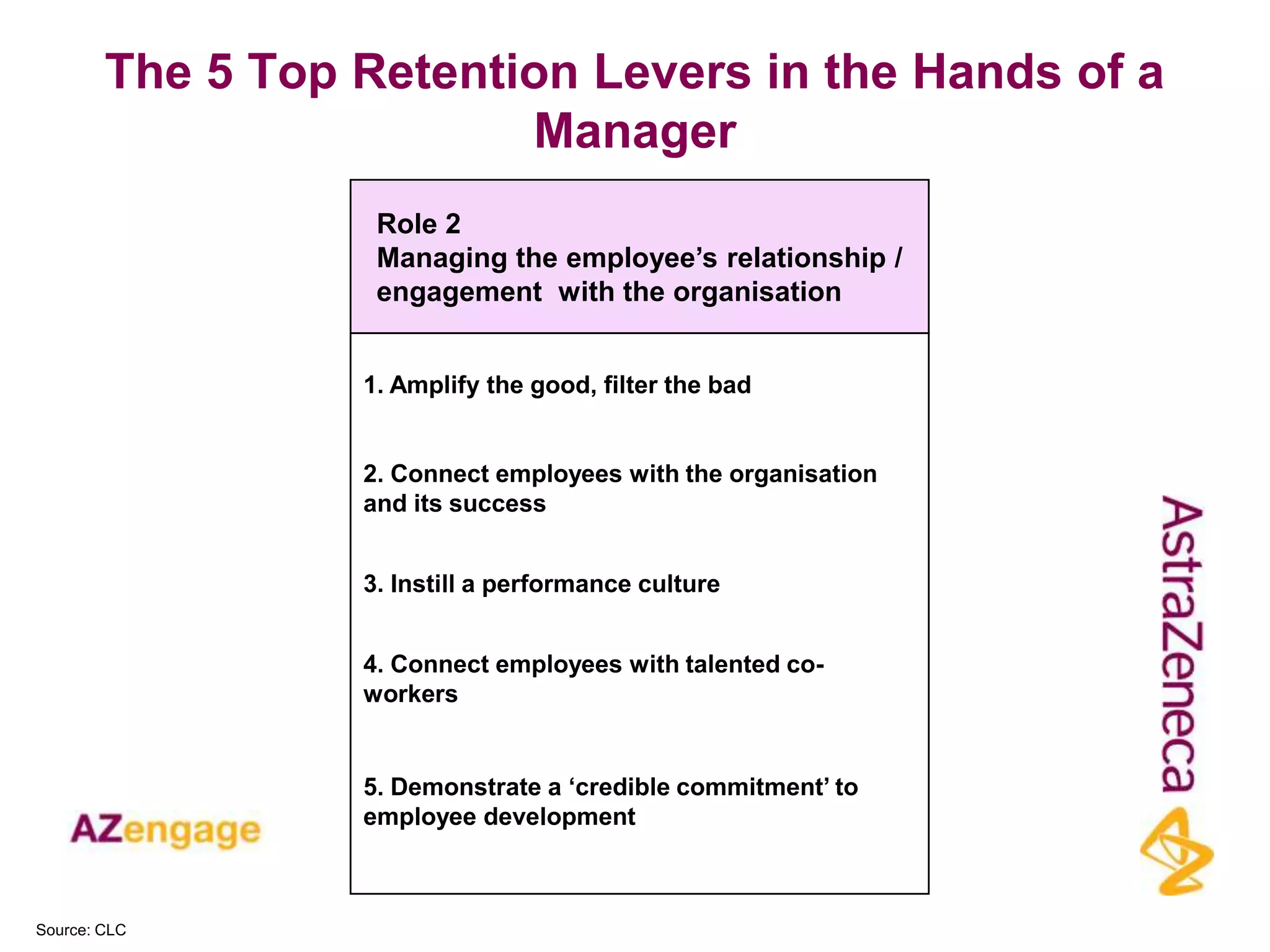
The 5 Top Retention Levers in the Hands of a
                         Manager
                   Role 2
                   Managing the employee‟s relationship /
                   engagement with the organisation


                  1. Amplify the good, filter the bad


                  2. Connect employees with the organisation
                  and its success


                  3. Instill a performance culture


                  4. Connect employees with talented co-
                  workers


                  5. Demonstrate a „credible commitment‟ to
                  employee development


Source: CLC
Case Study 1

AZ Managers‟ Programme


7   | Title of presentation | 00 Month Year (Go Header & Footer to edit this text)
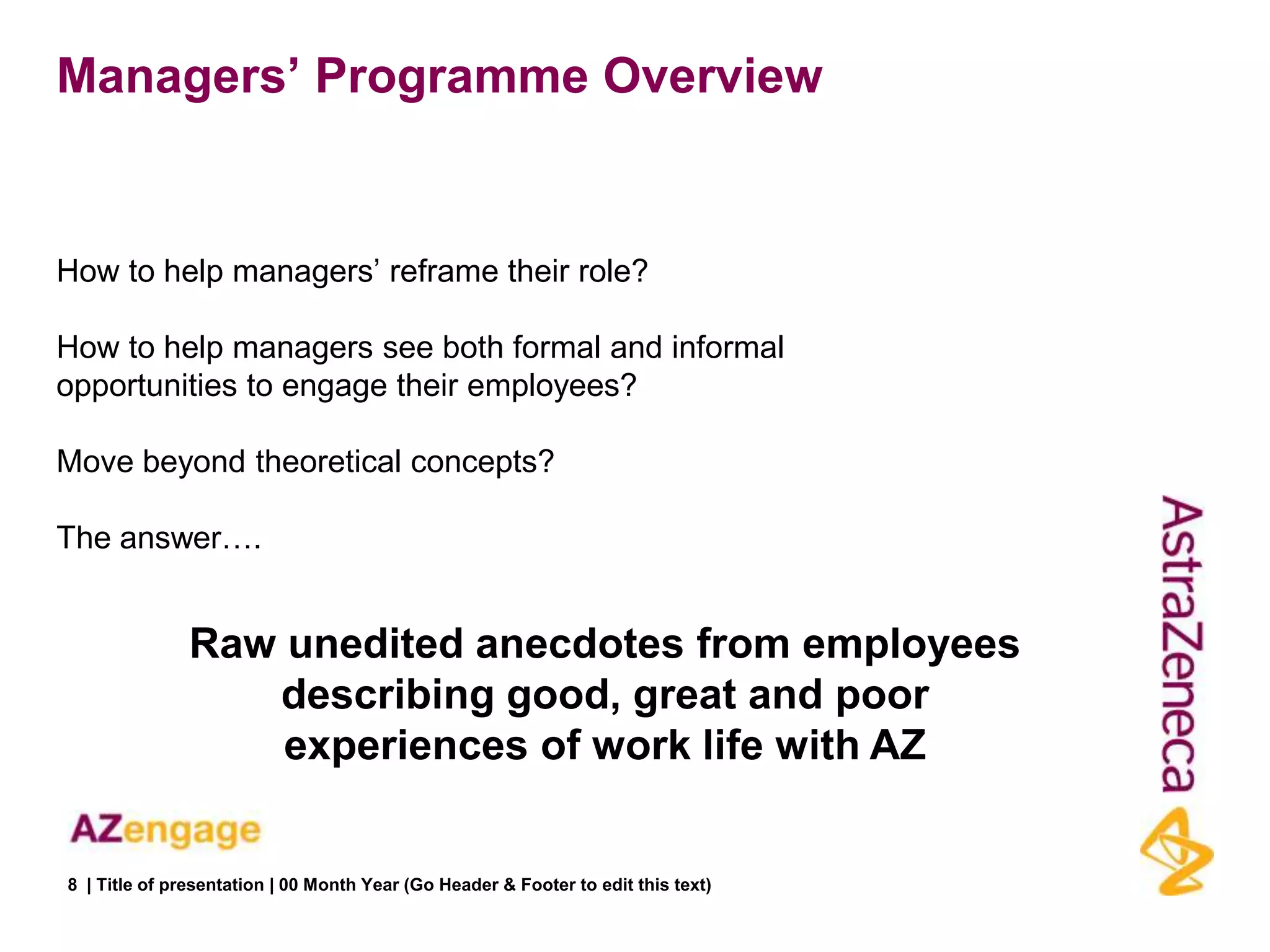
Managers‟ Programme Overview


How to help managers‟ reframe their role?

How to help managers see both formal and informal
opportunities to engage their employees?

Move beyond theoretical concepts?

The answer….


               Raw unedited anecdotes from employees
                  describing good, great and poor
                   experiences of work life with AZ


8 | Title of presentation | 00 Month Year (Go Header & Footer to edit this text)
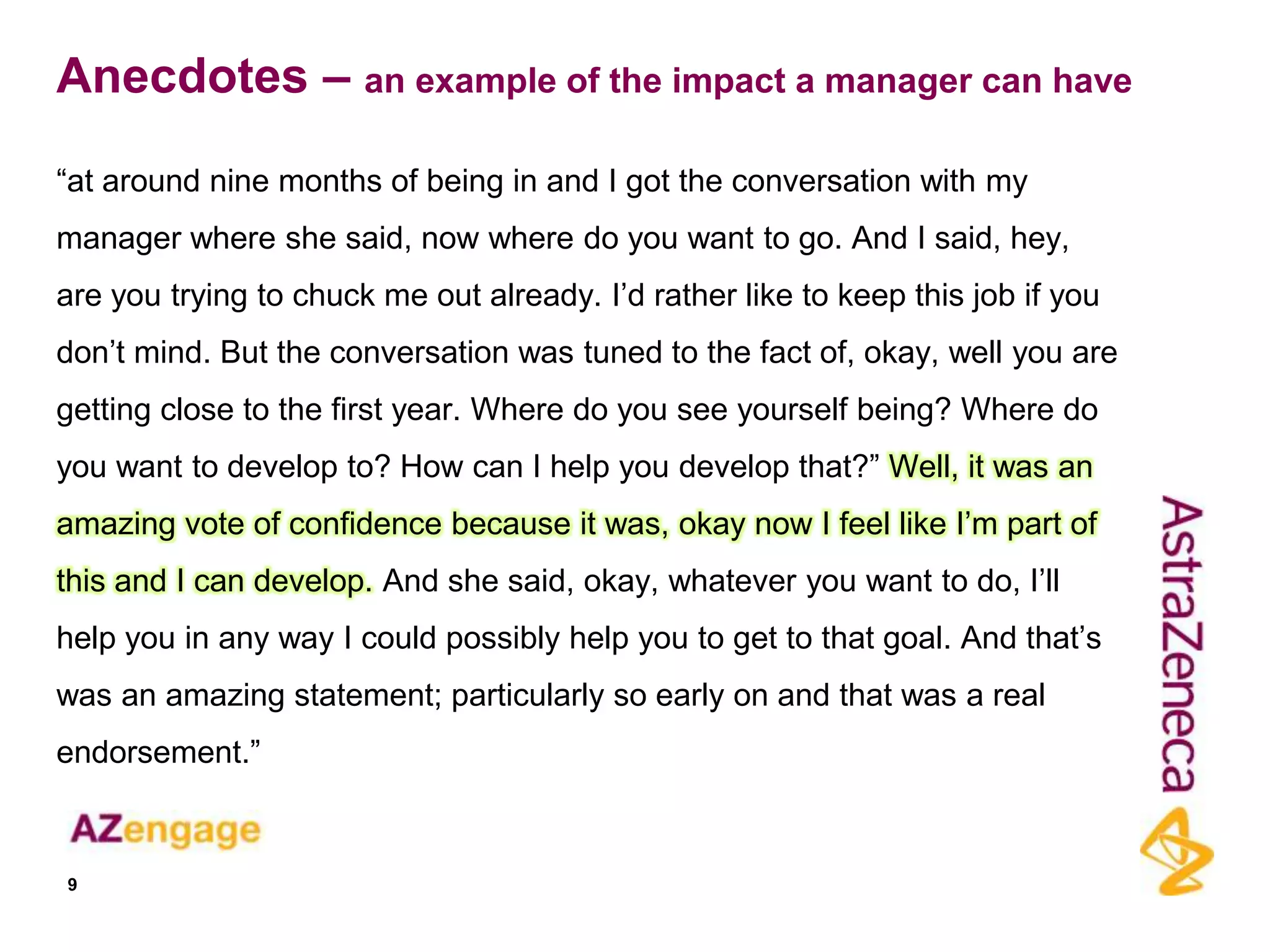
Anecdotes – an example of the impact a manager can have

“at around nine months of being in and I got the conversation with my
manager where she said, now where do you want to go. And I said, hey,
are you trying to chuck me out already. I‟d rather like to keep this job if you
don‟t mind. But the conversation was tuned to the fact of, okay, well you are
getting close to the first year. Where do you see yourself being? Where do
you want to develop to? How can I help you develop that?” Well, it was an
amazing vote of confidence because it was, okay now I feel like I‟m part of
this and I can develop. And she said, okay, whatever you want to do, I‟ll
help you in any way I could possibly help you to get to that goal. And that‟s
was an amazing statement; particularly so early on and that was a real
endorsement.”


9
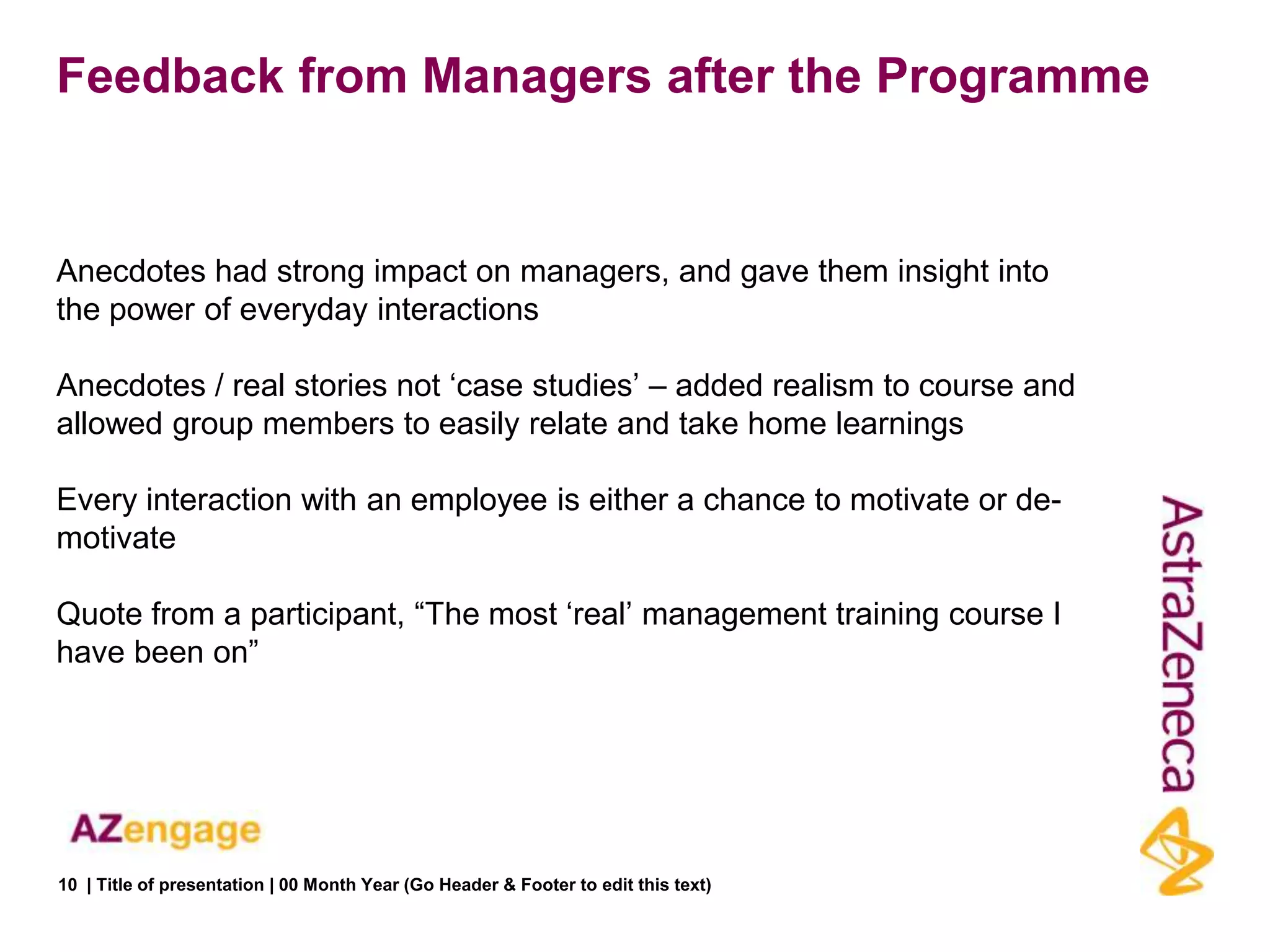
Feedback from Managers after the Programme


Anecdotes had strong impact on managers, and gave them insight into
the power of everyday interactions

Anecdotes / real stories not „case studies‟ – added realism to course and
allowed group members to easily relate and take home learnings

Every interaction with an employee is either a chance to motivate or de-
motivate

Quote from a participant, “The most „real‟ management training course I
have been on”


10 | Title of presentation | 00 Month Year (Go Header & Footer to edit this text)
Case Study 2

Flexibility with Accountability


11   | Title of presentation | 00 Month Year (Go Header & Footer to edit this text)
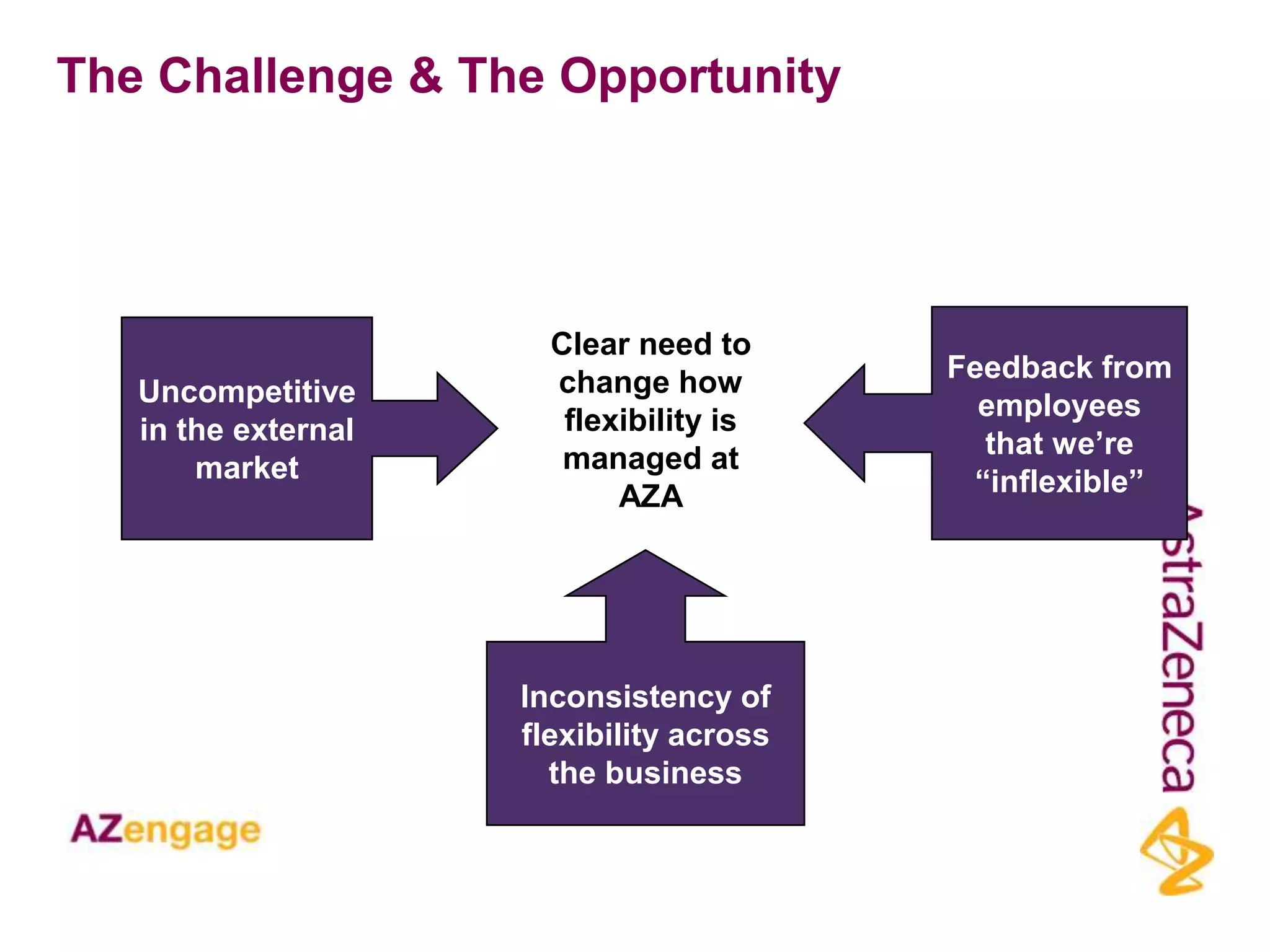
The Challenge & The Opportunity


                       Clear need to
                       change how         Feedback from
   Uncompetitive                            employees
   in the external      flexibility is
                        managed at          that we‟re
       market                              “inflexible”
                            AZA


                     Inconsistency of
                     flexibility across
                       the business
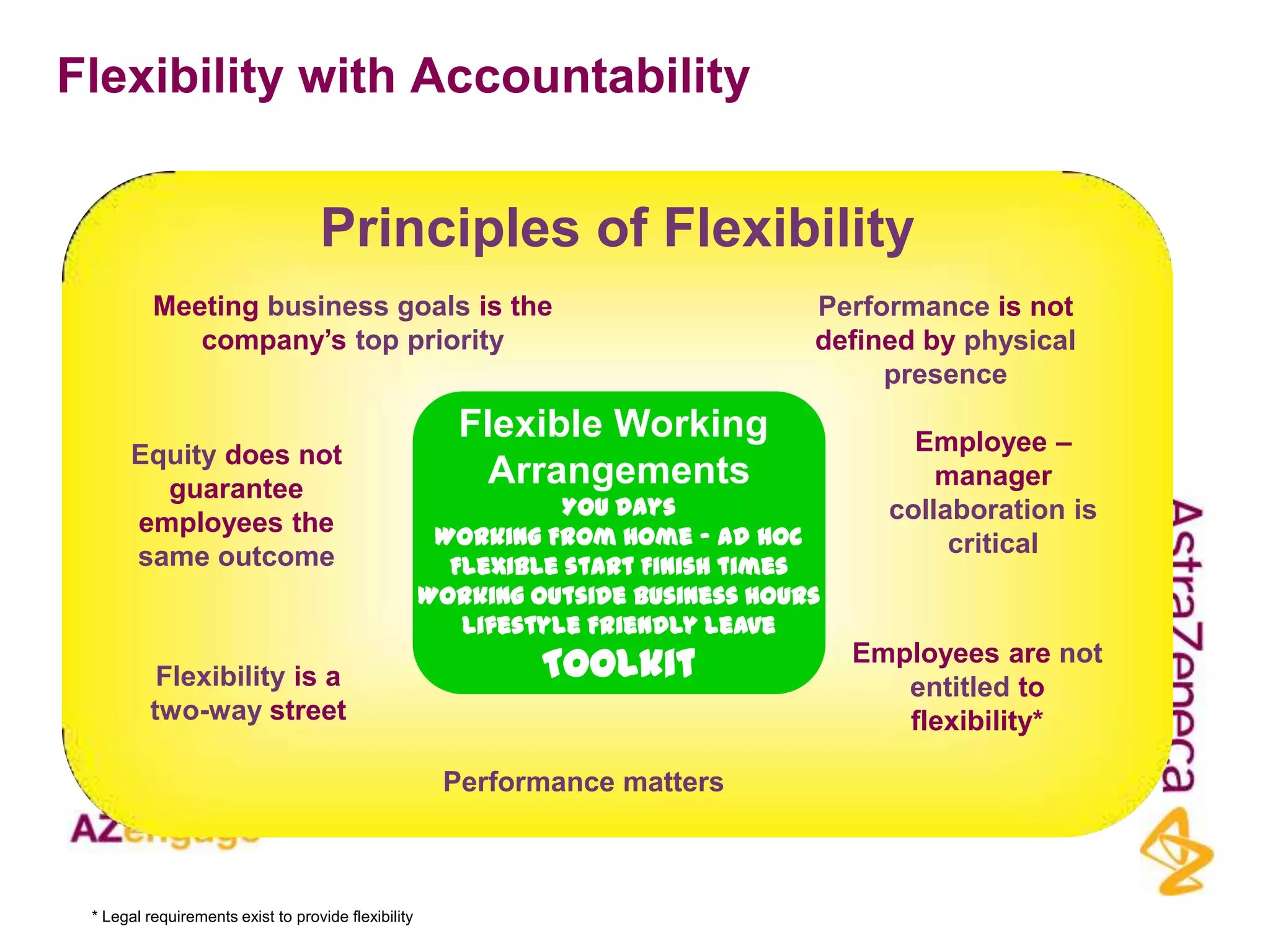
Flexibility with Accountability


                                   Principles of Flexibility
          Meeting business goals is the                                           Performance is not
             company‟s top priority                                               defined by physical
                                                                                       presence
                                                        Flexible Working                  Employee –
      Equity does not
        guarantee
                                                          Arrangements                      manager
                                                                You days                collaboration is
      employees the                                   Working From Home – Ad hoc
      same outcome                                                                           critical
                                                       Flexible start Finish times
                                                     Working outside business hours
                                                        Lifestyle Friendly Leave

          Flexibility is a                                    Toolkit                 Employees are not
                                                                                         entitled to
         two-way street                                                                  flexibility*

                                                      Performance matters


 * Legal requirements exist to provide flexibility
Key challenge: balance flexibility with accountability

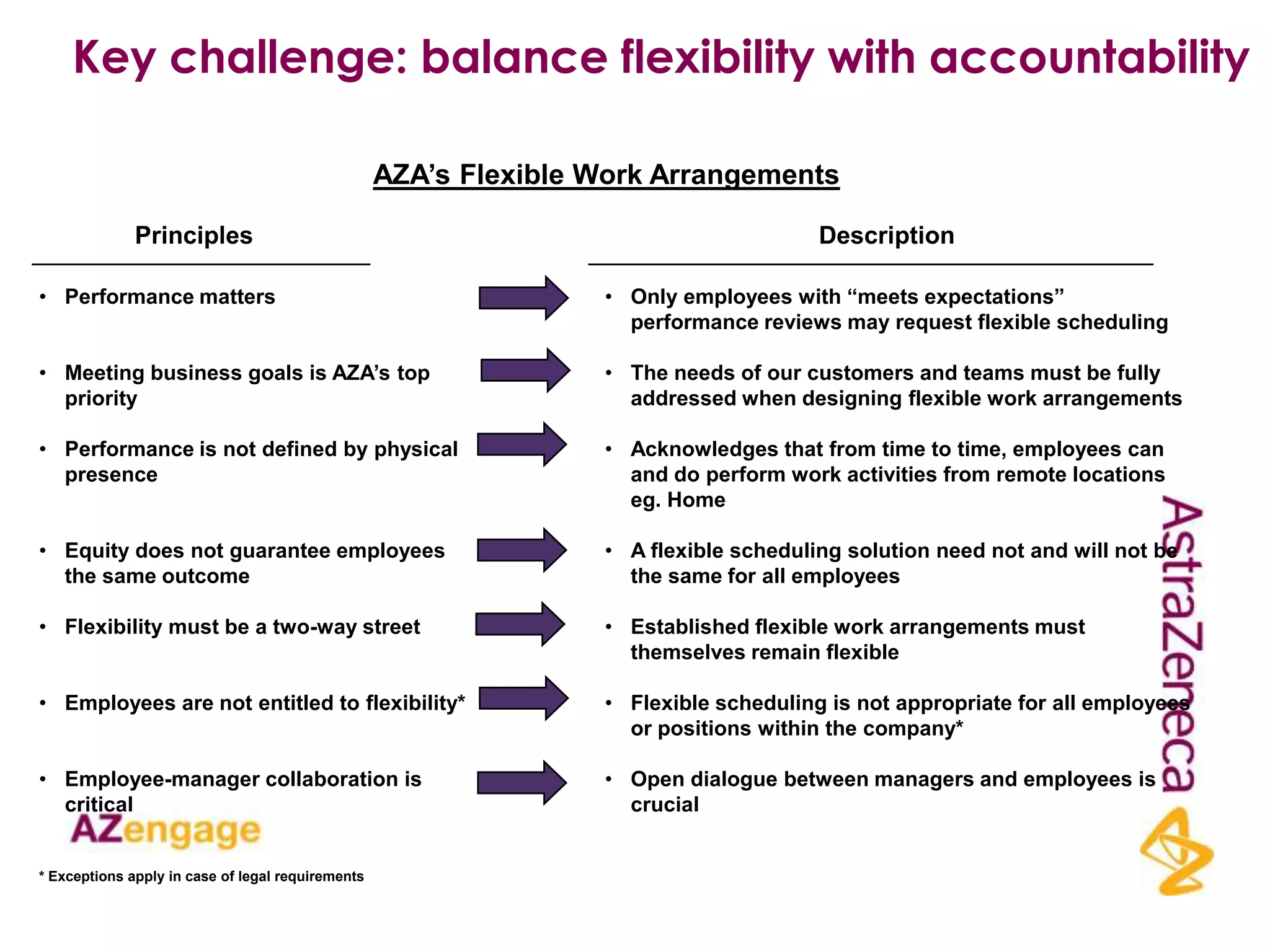
                                                   AZA‟s Flexible Work Arrangements

              Principles                                                               Description

• Performance matters                                             • Only employees with “meets expectations”
                                                                    performance reviews may request flexible scheduling

• Meeting business goals is AZA‟s top                             • The needs of our customers and teams must be fully
  priority                                                          addressed when designing flexible work arrangements

• Performance is not defined by physical                          • Acknowledges that from time to time, employees can
  presence                                                          and do perform work activities from remote locations
                                                                    eg. Home

• Equity does not guarantee employees                             • A flexible scheduling solution need not and will not be
  the same outcome                                                  the same for all employees

• Flexibility must be a two-way street                            • Established flexible work arrangements must
                                                                    themselves remain flexible

• Employees are not entitled to flexibility*                      • Flexible scheduling is not appropriate for all employees
                                                                    or positions within the company*

• Employee-manager collaboration is                               • Open dialogue between managers and employees is
  critical                                                          crucial


* Exceptions apply in case of legal requirements
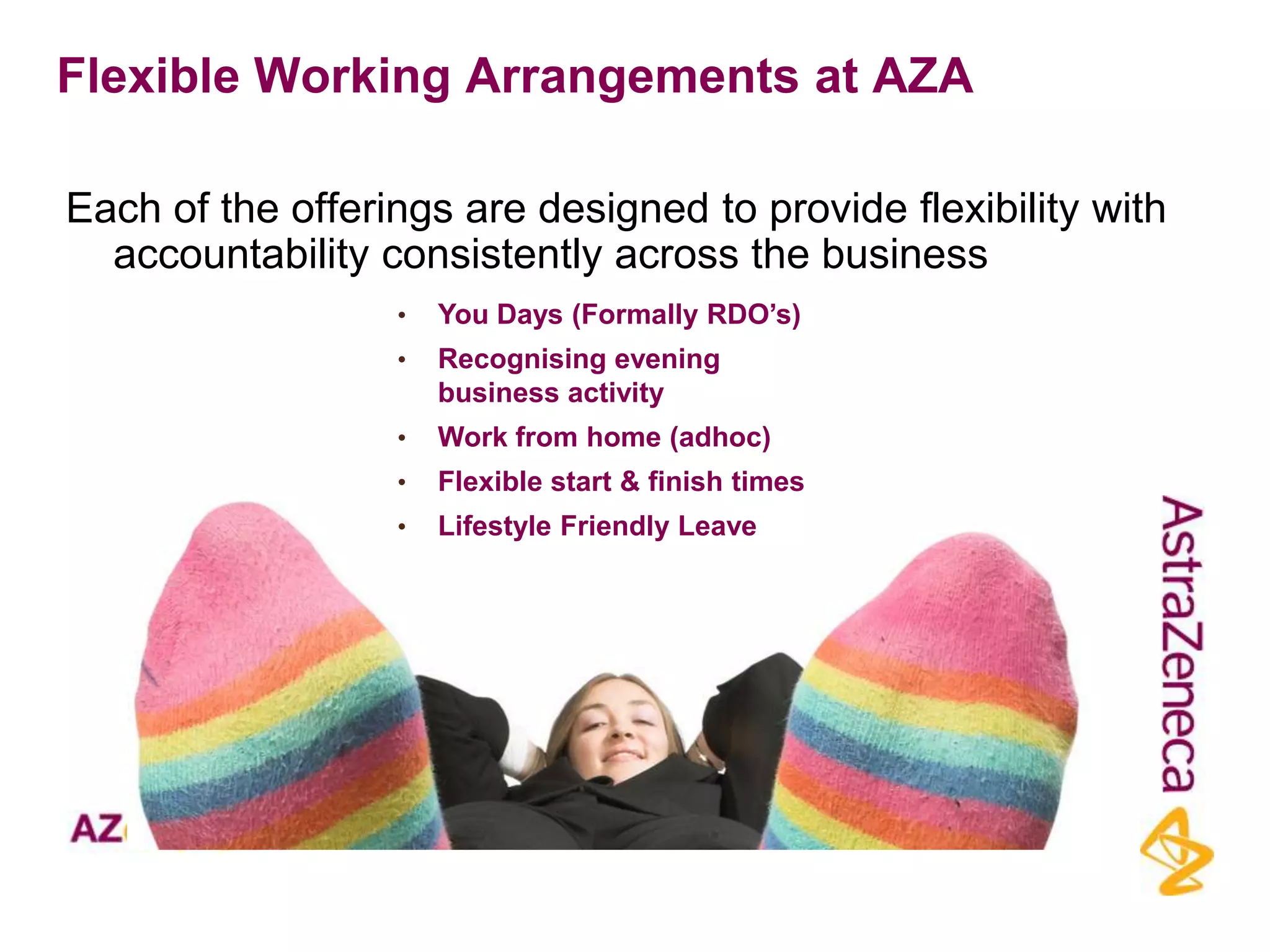
Flexible Working Arrangements at AZA

Each of the offerings are designed to provide flexibility with
  accountability consistently across the business
                  •   You Days (Formally RDO‟s)
                  •   Recognising evening
                      business activity
                  •   Work from home (adhoc)
                  •   Flexible start & finish times
                  •   Lifestyle Friendly Leave
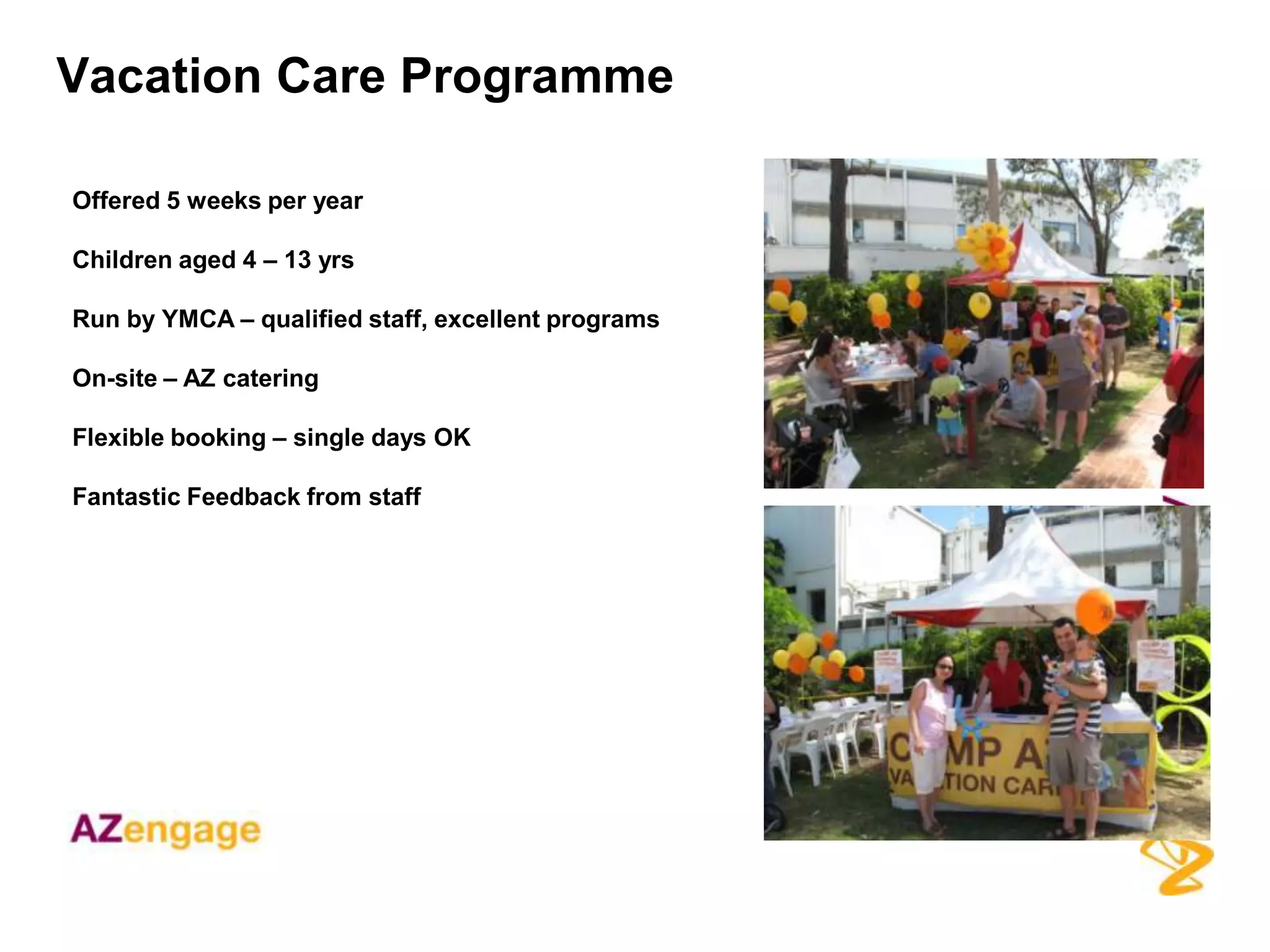
Vacation Care Programme

Offered 5 weeks per year

Children aged 4 – 13 yrs

Run by YMCA – qualified staff, excellent programs

On-site – AZ catering

Flexible booking – single days OK

Fantastic Feedback from staff
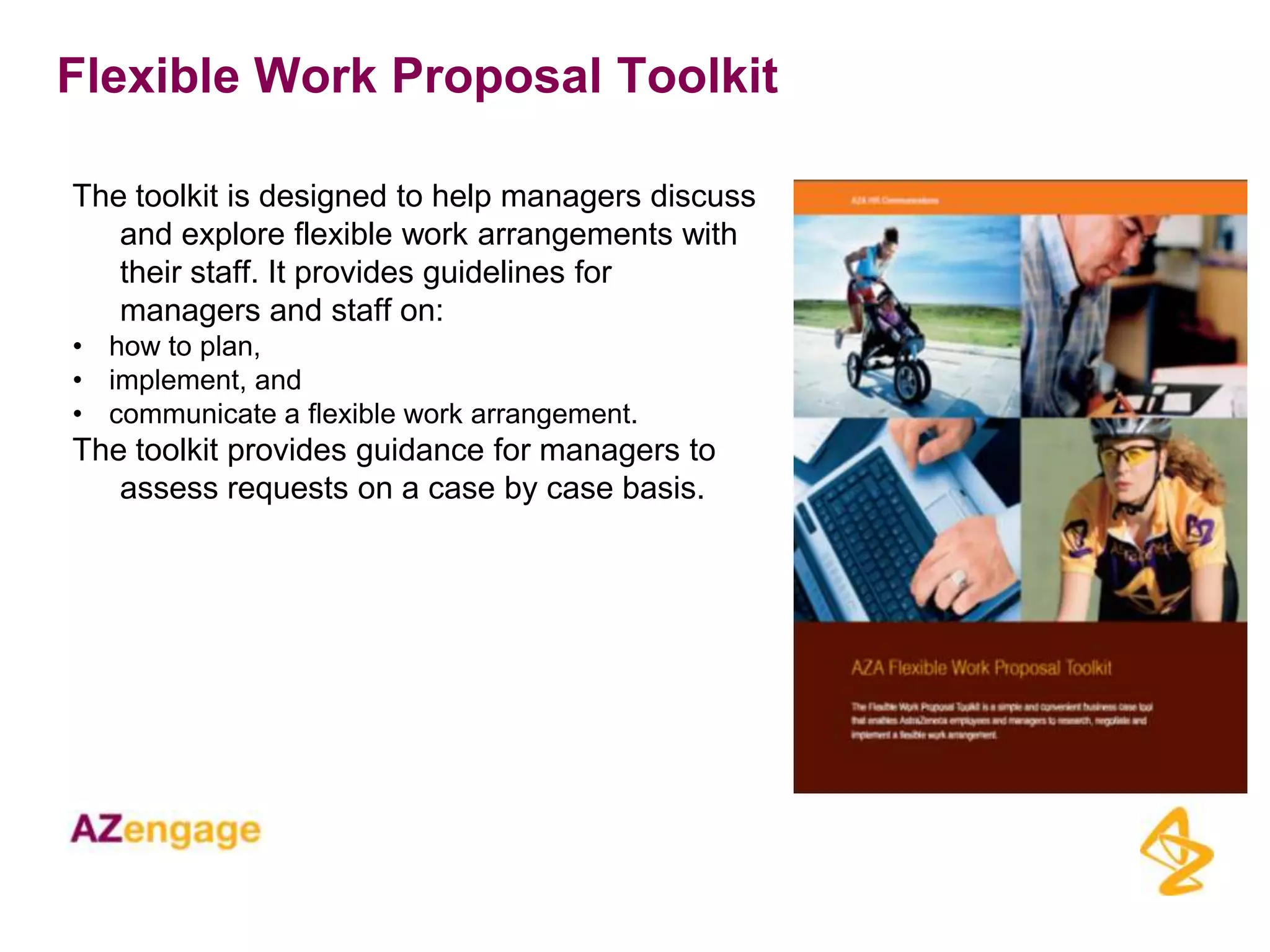
Flexible Work Proposal Toolkit

The toolkit is designed to help managers discuss
   and explore flexible work arrangements with
   their staff. It provides guidelines for
   managers and staff on:
• how to plan,
• implement, and
• communicate a flexible work arrangement.
The toolkit provides guidance for managers to
   assess requests on a case by case basis.
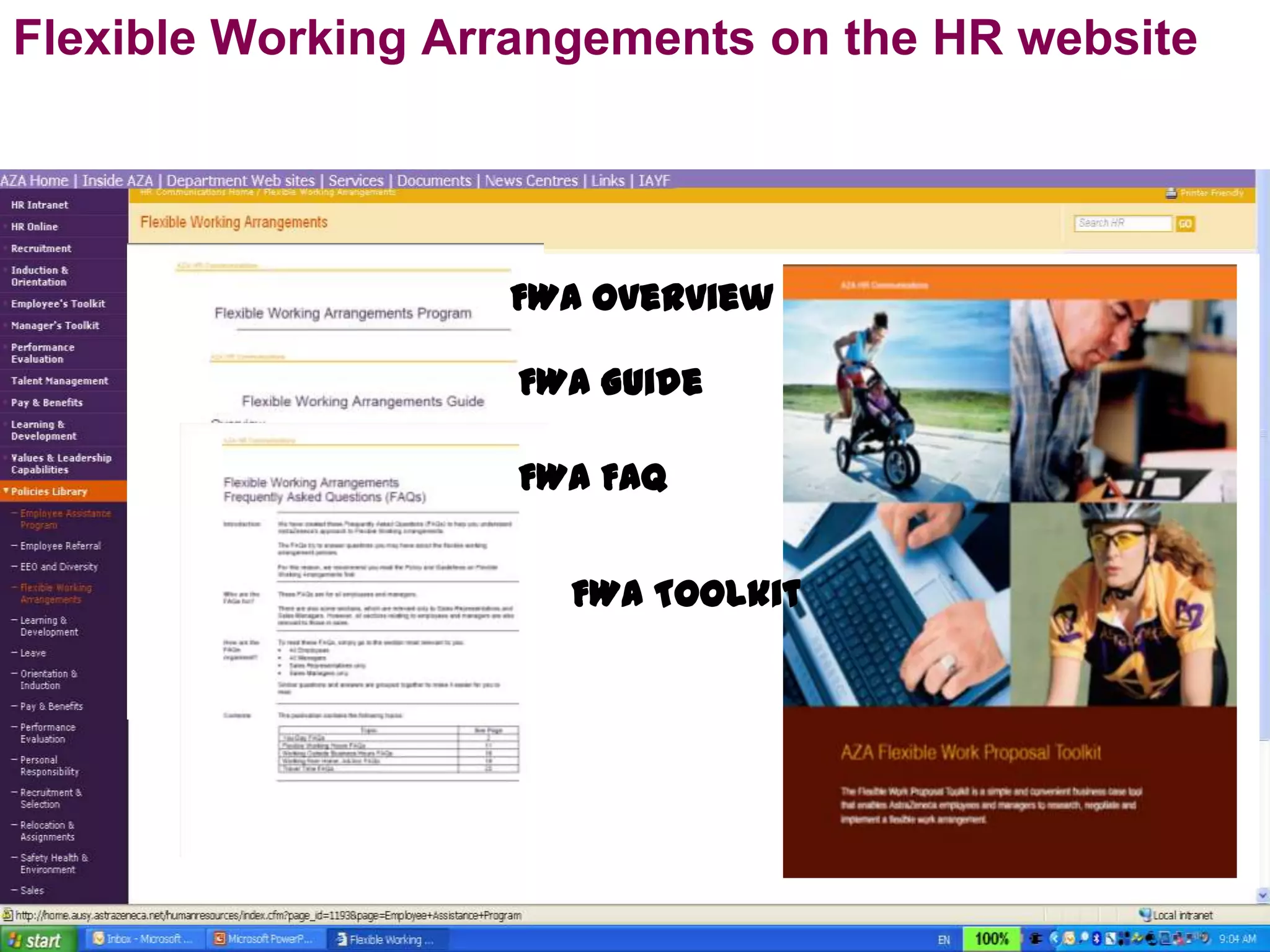
Flexible Working Arrangements on the HR website


                   FWA Overview

                    FWA Guide

                    FWA FAQ


                      FWA Toolkit
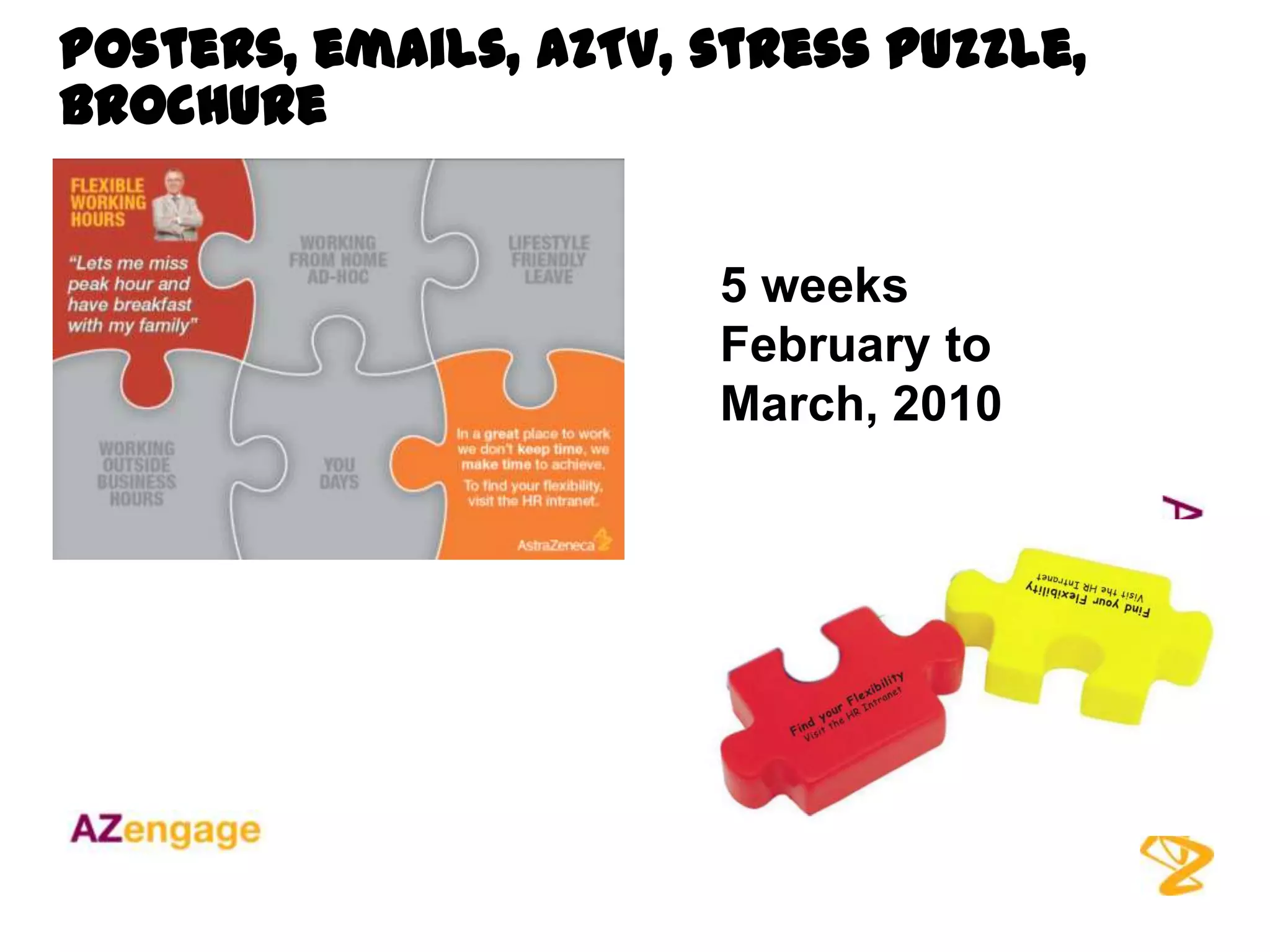
Posters, emails, AZTV, stress puzzle,
brochure


                       5 weeks
                       February to
                       March, 2010
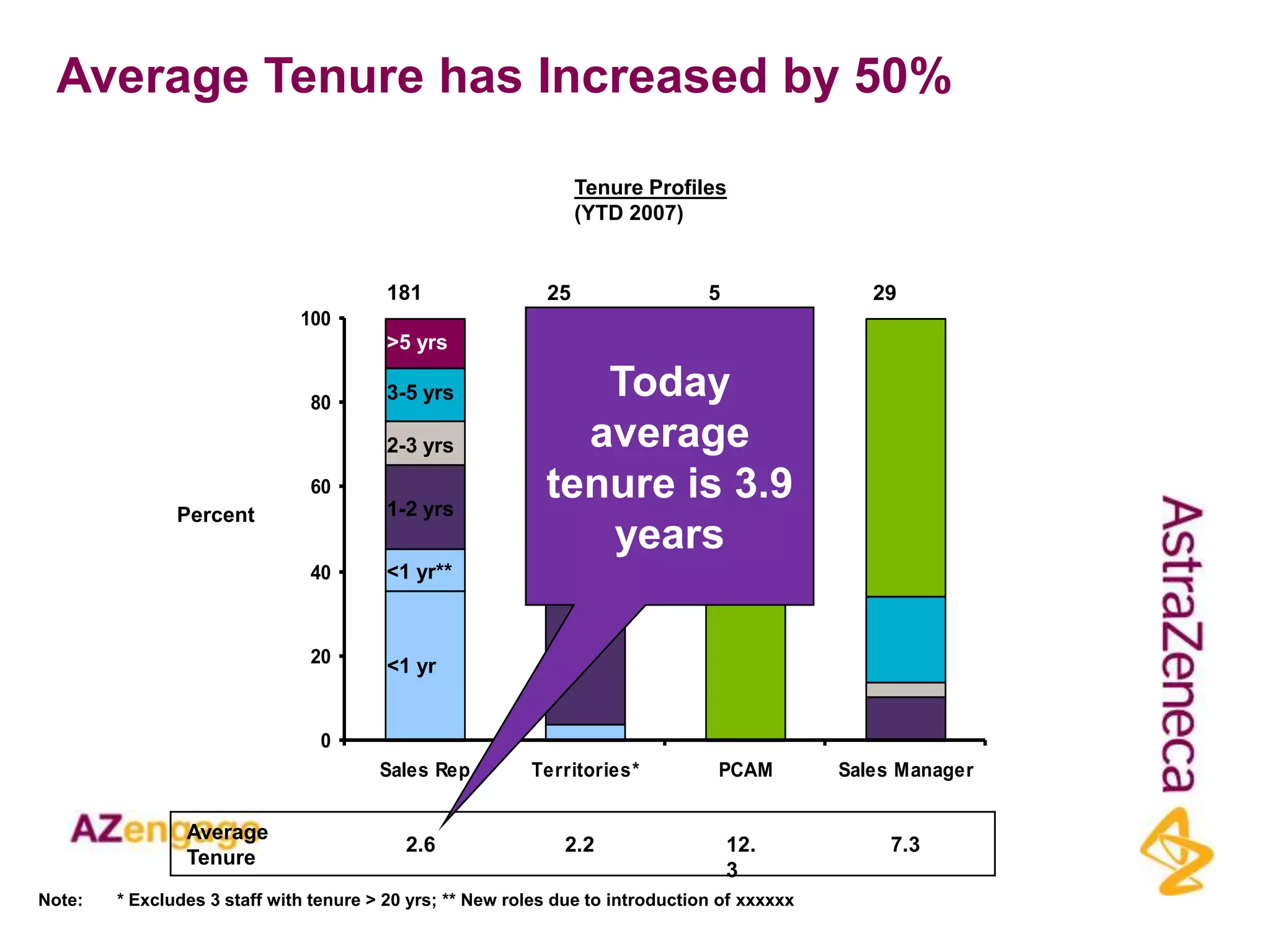
Average Tenure has Increased by 50%

                                                                 Tenure Profiles
                                                                 (YTD 2007)


                                         181                25                  5                29
                              100
                                         >5 yrs

                               80        3-5 yrs               Today
                                         2-3 yrs              average
                               60
                                         1-2 yrs
                                                            tenure is 3.9
               Percent
                                                               years
                               40        <1 yr**


                               20        <1 yr


                                0
                                        Sales Rep         Territories*           PCAM         Sales Manager


                Average
                                           2.6                2.2                   12.            7.3
                Tenure
                                                                                    3
Note:   * Excludes 3 staff with tenure > 20 yrs; ** New roles due to introduction of xxxxxx
Summing Up


Build a Brand
• Alignment with EVP

Create a Supportive Culture
• Manager engagement
• Principles, Mindset & Behaviours

Get the Mechanics in Place
• Policies
• Guides
• FAQs
• Toolkits
Case Study 3

Targeted Retention of Talents


22   | Title of presentation | 00 Month Year (Go Header & Footer to edit this text)
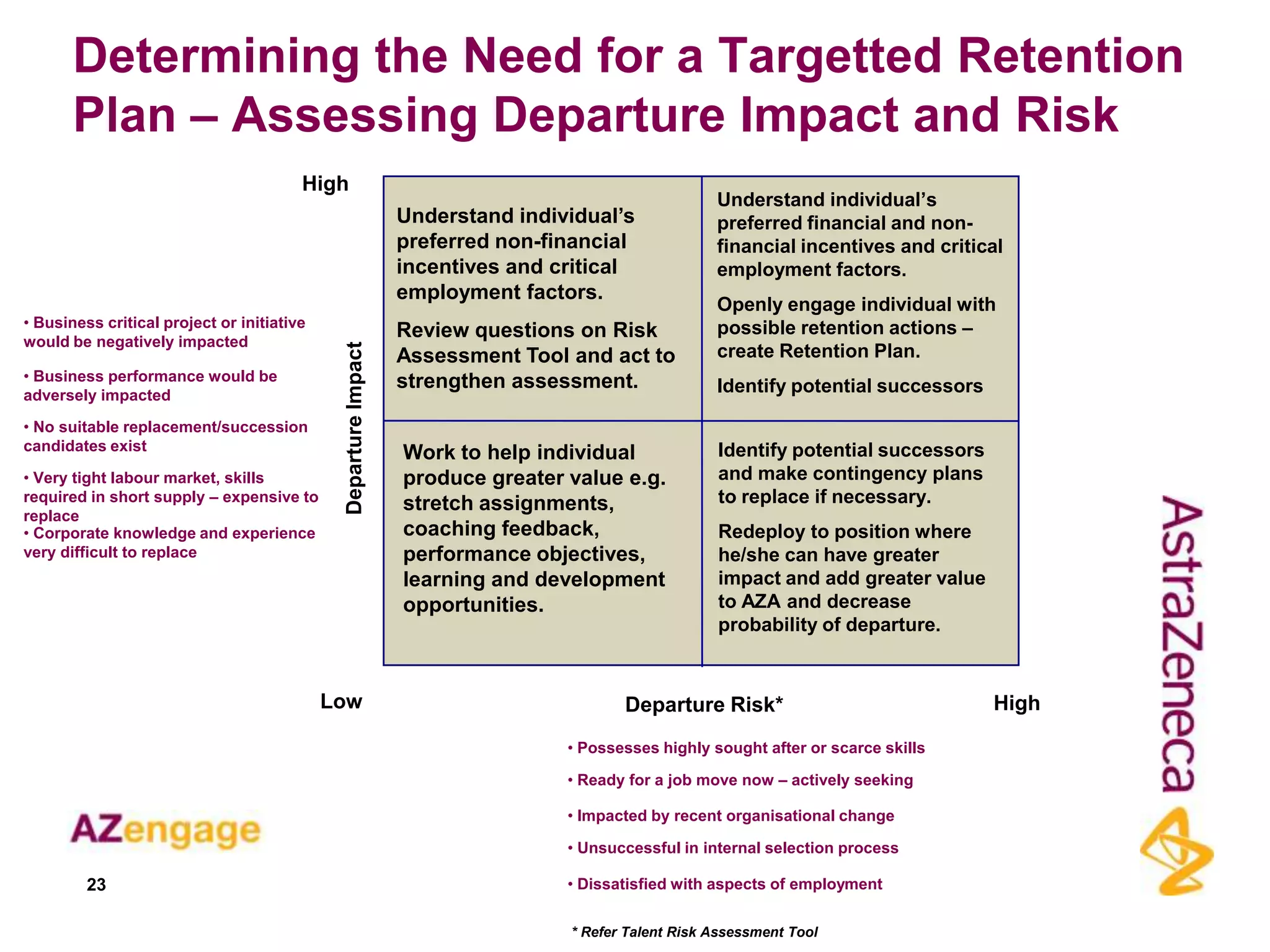
Determining the Need for a Targetted Retention
       Plan – Assessing Departure Impact and Risk
                                        High
                                                                                                    Understand individual‟s
                                                                Understand individual‟s             preferred financial and non-
                                                                preferred non-financial             financial incentives and critical
                                                                incentives and critical             employment factors.
                                                                employment factors.
                                                                                                    Openly engage individual with
• Business critical project or initiative                                                           possible retention actions –
would be negatively impacted
                                                                Review questions on Risk
                                             Departure Impact   Assessment Tool and act to          create Retention Plan.
• Business performance would be                                 strengthen assessment.
adversely impacted
                                                                                                    Identify potential successors

• No suitable replacement/succession
candidates exist                                                                                    Identify potential successors
                                                                Work to help individual
• Very tight labour market, skills                              produce greater value e.g.          and make contingency plans
required in short supply – expensive to                                                             to replace if necessary.
                                                                stretch assignments,
replace
• Corporate knowledge and experience                            coaching feedback,                  Redeploy to position where
very difficult to replace                                       performance objectives,             he/she can have greater
                                                                learning and development            impact and add greater value
                                                                opportunities.                      to AZA and decrease
                                                                                                    probability of departure.


                                            Low                                        Departure Risk*                              High

                                                                                • Possesses highly sought after or scarce skills

                                                                                • Ready for a job move now – actively seeking

                                                                                • Impacted by recent organisational change

                                                                                • Unsuccessful in internal selection process

         23                                                                     • Dissatisfied with aspects of employment

                                                                                * Refer Talent Risk Assessment Tool
Targeting Retention of Talents


1. Make an assessment of „departure risk‟

2. Consider individual retention drivers

3. Formalise in a Retention Plan

4. Communicate with the Employee

5. Follow up and ensure action


24 | Title of presentation | 00 Month Year (Go Header & Footer to edit this text)
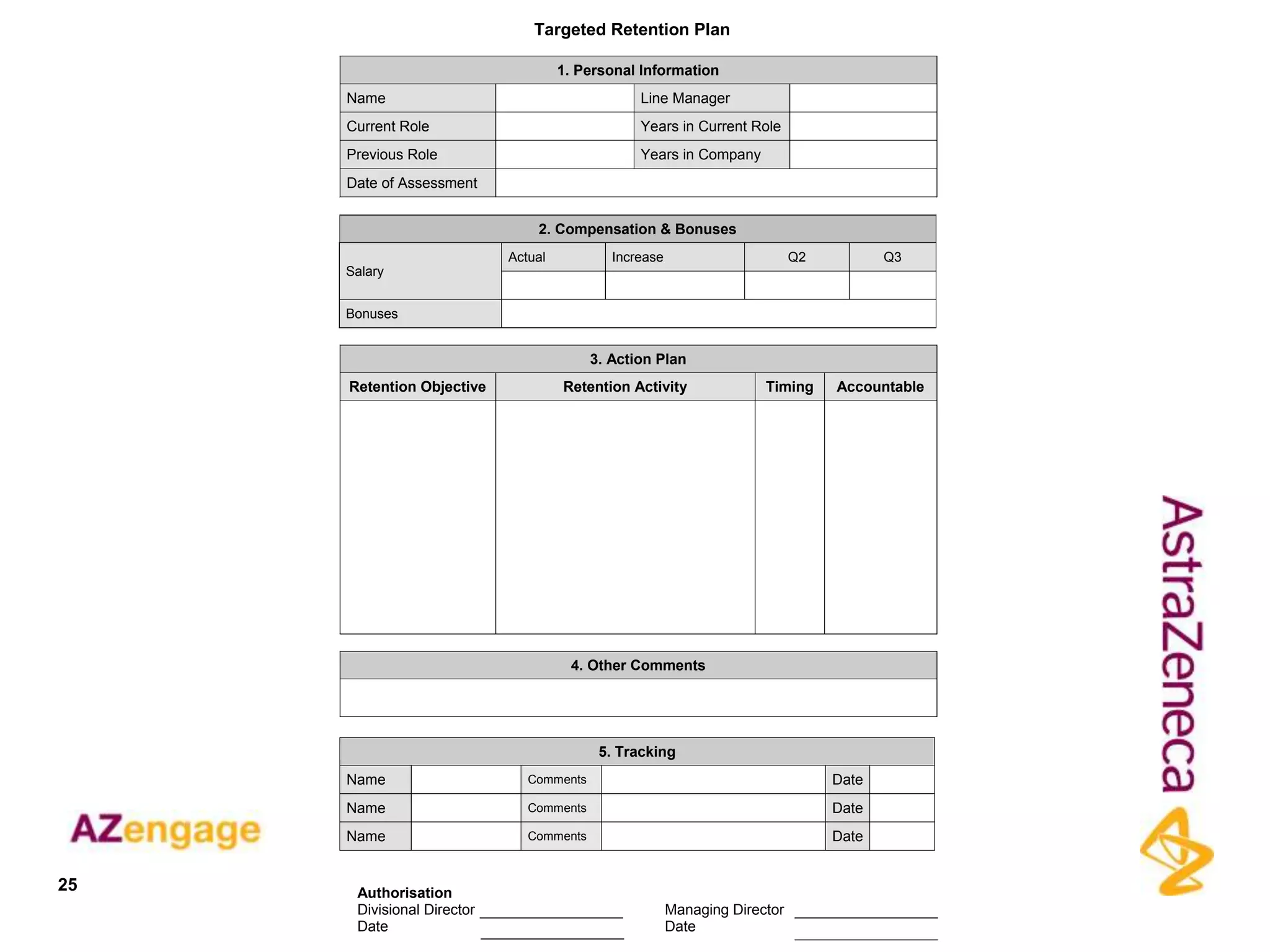
Targeted Retention Plan

                                     1. Personal Information
     Name                                        Line Manager
     Current Role                                Years in Current Role
     Previous Role                               Years in Company
     Date of Assessment


                                2. Compensation & Bonuses
                            Actual           Increase                       Q2          Q3
     Salary


     Bonuses


                                          3. Action Plan
     Retention Objective             Retention Activity               Timing     Accountable


                                      4. Other Comments


                                           5. Tracking
     Name                      Comments                                          Date
     Name                      Comments                                          Date
     Name                      Comments                                          Date


25    Authorisation
      Divisional Director                               Managing Director
      Date                                              Date
26 | Introducing AZengage| Octoberl 2010

Peter Watson's Presentation on Talent Retention at the 2011 HR Summit

  • 1.
    Preserving Key Employeesand Avoiding Talent Drain to Win the Human Capital Fight Peter Watson HR Director - AstraZeneca 5 March 2011 HR Summit – Gold Coast Australia
  • 2.
    Topics • Framework forthe Talent Retention Challenge • What drives retention • The role of the Manager • Case Studies: • AZ Managers‟ Program • Flexibility with Accountability • Targeted Retention 2 | Title of presentation | 00 Month Year (Go Header & Footer to edit this text)
  • 3.
    What Drives Retention? Remuneration Work/Life Quality of Flexibility Manager Talents Career Work Development Challenge 3 | Title of presentation | 00 Month Year (Go Header & Footer to edit this text) Source: CLC April 2004
  • 4.
    Managers Control aMajority of the Most Effective Drivers of Employee Performance &Retention Impact of top performance drivers Impact of top retention drivers Line managers directly influence a Line managers also control a majority of disproportionate share of the most the most powerful drivers of employee effective drivers of performance. The two intent to stay with the organization. The strongest manager-influenced drivers, for two strongest manager-influenced example, are: drivers, for instance, are: •Providing fair and accurate informal • Facilitating internal communication: feedback: 39% impact on performance 38% impact on intent to stay •Clarifying employee performance • Advising on career development: 50.0 expectations: 36% impact on performance 50.0 37% impact on intent to stay Driver impact Driver impact on employee 25.0 on employee 25.0 performance intent to stay 0.0 0.0 Manager activities Non-manager activities Source: Corporate Leadership Council research.
  • 5.
    The Role ofa Manager as a “Connector” The results of commitment: Discretionary Effort & Intent Two commitment types Four points of commitment to Leave While employees can rationally and emotionally commit to 4 different points of Discretionary the organisation… Effort Rational An employee‟s 1. Day to day work 3. Line manager willingness to go Performance Commitment 2. Teams 4. The organisation „above & beyond‟ the call of duty …the unique role as „connector‟ enables managers to strengthen employee commitment in all 4 directions. Intent to Stay Emotional Employee An employee‟s desire to stay with Retention Commitment the organisation Mgr Team Org Job Source: Corporate Leadership Council research.
  • 6.
    The 5 TopRetention Levers in the Hands of a Manager Role 2 Managing the employee‟s relationship / engagement with the organisation 1. Amplify the good, filter the bad 2. Connect employees with the organisation and its success 3. Instill a performance culture 4. Connect employees with talented co- workers 5. Demonstrate a „credible commitment‟ to employee development Source: CLC
  • 7.
    Case Study 1 AZManagers‟ Programme 7 | Title of presentation | 00 Month Year (Go Header & Footer to edit this text)
  • 8.
    Managers‟ Programme Overview Howto help managers‟ reframe their role? How to help managers see both formal and informal opportunities to engage their employees? Move beyond theoretical concepts? The answer…. Raw unedited anecdotes from employees describing good, great and poor experiences of work life with AZ 8 | Title of presentation | 00 Month Year (Go Header & Footer to edit this text)
  • 9.
    Anecdotes – anexample of the impact a manager can have “at around nine months of being in and I got the conversation with my manager where she said, now where do you want to go. And I said, hey, are you trying to chuck me out already. I‟d rather like to keep this job if you don‟t mind. But the conversation was tuned to the fact of, okay, well you are getting close to the first year. Where do you see yourself being? Where do you want to develop to? How can I help you develop that?” Well, it was an amazing vote of confidence because it was, okay now I feel like I‟m part of this and I can develop. And she said, okay, whatever you want to do, I‟ll help you in any way I could possibly help you to get to that goal. And that‟s was an amazing statement; particularly so early on and that was a real endorsement.” 9
  • 10.
    Feedback from Managersafter the Programme Anecdotes had strong impact on managers, and gave them insight into the power of everyday interactions Anecdotes / real stories not „case studies‟ – added realism to course and allowed group members to easily relate and take home learnings Every interaction with an employee is either a chance to motivate or de- motivate Quote from a participant, “The most „real‟ management training course I have been on” 10 | Title of presentation | 00 Month Year (Go Header & Footer to edit this text)
  • 11.
    Case Study 2 Flexibilitywith Accountability 11 | Title of presentation | 00 Month Year (Go Header & Footer to edit this text)
  • 12.
    The Challenge &The Opportunity Clear need to change how Feedback from Uncompetitive employees in the external flexibility is managed at that we‟re market “inflexible” AZA Inconsistency of flexibility across the business
  • 13.
    Flexibility with Accountability Principles of Flexibility Meeting business goals is the Performance is not company‟s top priority defined by physical presence Flexible Working Employee – Equity does not guarantee Arrangements manager You days collaboration is employees the Working From Home – Ad hoc same outcome critical Flexible start Finish times Working outside business hours Lifestyle Friendly Leave Flexibility is a Toolkit Employees are not entitled to two-way street flexibility* Performance matters * Legal requirements exist to provide flexibility
  • 14.
    Key challenge: balanceflexibility with accountability AZA‟s Flexible Work Arrangements Principles Description • Performance matters • Only employees with “meets expectations” performance reviews may request flexible scheduling • Meeting business goals is AZA‟s top • The needs of our customers and teams must be fully priority addressed when designing flexible work arrangements • Performance is not defined by physical • Acknowledges that from time to time, employees can presence and do perform work activities from remote locations eg. Home • Equity does not guarantee employees • A flexible scheduling solution need not and will not be the same outcome the same for all employees • Flexibility must be a two-way street • Established flexible work arrangements must themselves remain flexible • Employees are not entitled to flexibility* • Flexible scheduling is not appropriate for all employees or positions within the company* • Employee-manager collaboration is • Open dialogue between managers and employees is critical crucial * Exceptions apply in case of legal requirements
  • 15.
    Flexible Working Arrangementsat AZA Each of the offerings are designed to provide flexibility with accountability consistently across the business • You Days (Formally RDO‟s) • Recognising evening business activity • Work from home (adhoc) • Flexible start & finish times • Lifestyle Friendly Leave
  • 16.
    Vacation Care Programme Offered5 weeks per year Children aged 4 – 13 yrs Run by YMCA – qualified staff, excellent programs On-site – AZ catering Flexible booking – single days OK Fantastic Feedback from staff
  • 17.
    Flexible Work ProposalToolkit The toolkit is designed to help managers discuss and explore flexible work arrangements with their staff. It provides guidelines for managers and staff on: • how to plan, • implement, and • communicate a flexible work arrangement. The toolkit provides guidance for managers to assess requests on a case by case basis.
  • 18.
    Flexible Working Arrangementson the HR website FWA Overview FWA Guide FWA FAQ FWA Toolkit
  • 19.
    Posters, emails, AZTV,stress puzzle, brochure 5 weeks February to March, 2010
  • 20.
    Average Tenure hasIncreased by 50% Tenure Profiles (YTD 2007) 181 25 5 29 100 >5 yrs 80 3-5 yrs Today 2-3 yrs average 60 1-2 yrs tenure is 3.9 Percent years 40 <1 yr** 20 <1 yr 0 Sales Rep Territories* PCAM Sales Manager Average 2.6 2.2 12. 7.3 Tenure 3 Note: * Excludes 3 staff with tenure > 20 yrs; ** New roles due to introduction of xxxxxx
  • 21.
    Summing Up Build aBrand • Alignment with EVP Create a Supportive Culture • Manager engagement • Principles, Mindset & Behaviours Get the Mechanics in Place • Policies • Guides • FAQs • Toolkits
  • 22.
    Case Study 3 TargetedRetention of Talents 22 | Title of presentation | 00 Month Year (Go Header & Footer to edit this text)
  • 23.
    Determining the Needfor a Targetted Retention Plan – Assessing Departure Impact and Risk High Understand individual‟s Understand individual‟s preferred financial and non- preferred non-financial financial incentives and critical incentives and critical employment factors. employment factors. Openly engage individual with • Business critical project or initiative possible retention actions – would be negatively impacted Review questions on Risk Departure Impact Assessment Tool and act to create Retention Plan. • Business performance would be strengthen assessment. adversely impacted Identify potential successors • No suitable replacement/succession candidates exist Identify potential successors Work to help individual • Very tight labour market, skills produce greater value e.g. and make contingency plans required in short supply – expensive to to replace if necessary. stretch assignments, replace • Corporate knowledge and experience coaching feedback, Redeploy to position where very difficult to replace performance objectives, he/she can have greater learning and development impact and add greater value opportunities. to AZA and decrease probability of departure. Low Departure Risk* High • Possesses highly sought after or scarce skills • Ready for a job move now – actively seeking • Impacted by recent organisational change • Unsuccessful in internal selection process 23 • Dissatisfied with aspects of employment * Refer Talent Risk Assessment Tool
  • 24.
    Targeting Retention ofTalents 1. Make an assessment of „departure risk‟ 2. Consider individual retention drivers 3. Formalise in a Retention Plan 4. Communicate with the Employee 5. Follow up and ensure action 24 | Title of presentation | 00 Month Year (Go Header & Footer to edit this text)
  • 25.
    Targeted Retention Plan 1. Personal Information Name Line Manager Current Role Years in Current Role Previous Role Years in Company Date of Assessment 2. Compensation & Bonuses Actual Increase Q2 Q3 Salary Bonuses 3. Action Plan Retention Objective Retention Activity Timing Accountable 4. Other Comments 5. Tracking Name Comments Date Name Comments Date Name Comments Date 25 Authorisation Divisional Director Managing Director Date Date
  • 26.
    26 | IntroducingAZengage| Octoberl 2010

Editor's Notes

  • #5 Effective People Management Leads to ImprovedPerformance—Why focus on people management? Since linemanagers control many of the most effective drivers of employeeperformance they can act to improve the performance of theiremployees substantially, making effective people managementcritical for organizational success. Effective People Management Leads to Increased Retention—Effective people management has a sizeable impact not onlyon performance but also on retention. Excellence in peoplemanagement directly influences intent to stay with theorganization and thereby reduces probability of departure.
  • #6 Managing Employee Attitudes Drives Performance andRetention—Rational and emotional commitment increaseemployee performance and retention through their impacton employee discretionary effort and intent to stay with theorganization. As employees develop commitment to their work,managers, teams, and organizations, they in turn exhibit greaterlevels of effort in ways that boost performance, and their desireto stay with the organization increases as they recognize how itcan meet their financial, developmental, and professional needs.The Manager Acts as a “Conduit” for Employee Commitment—Managers, through their role as the primary connection betweenthe employee and the organization, directly shape an employee’sperception of teams, the organization, and their job. Throughthis influence, managers magnify (or diminish) employeecommitment, thereby serving as a critical leverage point formaximizing the impact that teams, the organization, and day-to-day work have on employee performance and retention